
Kusse B.R., Westwig E.A. Mathematical Physics: Applied Mathematics for Scientists and Engineers
Подождите немного. Документ загружается.

46
CURVILINEAR COORDINATE SYSTEMS
x
=
pcos4
y
=
psin+
(3.5)
z=z
and the corresponding inverse equations
p
=
dw
4
=
tan-'
(Yh)
(3.6)
z=z
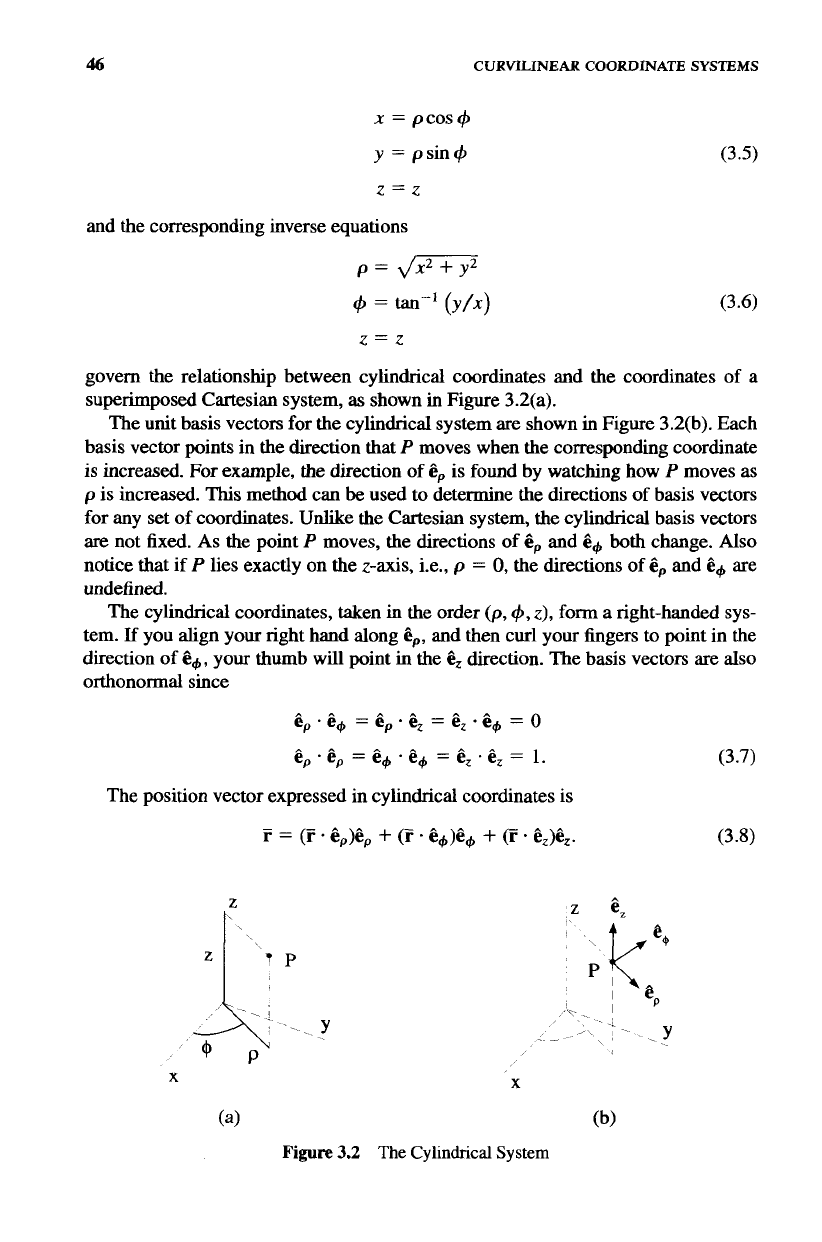
govern the relationship between cylindrrcal coordinates and the coordinates
of
a
superimposed Cartesian system,
as
shown in Figure 3.2(a).
The unit basis vectors for the cylindrical system are shown in Figure 3.2(b). Each
basis vector points in the direction that
P
moves when the corresponding coordinate
is
increased. For example, the direction
of
SP
is
found
by watching how
P
moves as
p
is increased.
This
method can
be
used to determine the directions of basis vectors
for any set
of
coordinates. Unlike the Cartesian system, the cylindrical basis vectors
are not fixed.
As
the point
P
moves, the directions
of
i$
and
i?+
both change.
Also
notice that if
P
lies exactly on the
z-axis,
i.e.,
p
=
0,
the directions
of
Sp
and
6,
are
undefined.
The cylindrical coordinates, taken in the order
(p,
4,
z),
form
a right-handed
sys-
tem.
If
you align your right hand along
GP,
and then curl your fingers to point in the
direction
of
i?+,
your thumb will point in the
GZ
direction. The basis vectors are also
orthononnal since
6,
.
6,
=
6,
.
Q
=
Q
.
e+
=
0
e,
.
*p
=
e,
.
c,
=
c,
.
Q
=
1.
The position vector expressed in cylindrical coordinates is
r"
Ap
Y
X
z
6,
X
(4
(b)
Figure
3.2
The
Cylindrical System
(3.7)
(3.8)
THE
CYLINDRICAL
SYSTEM
47
Y
r
$e@
6P
Y
eP
X
Figure
3.3
The Position Vector in
a
Cylindrical System
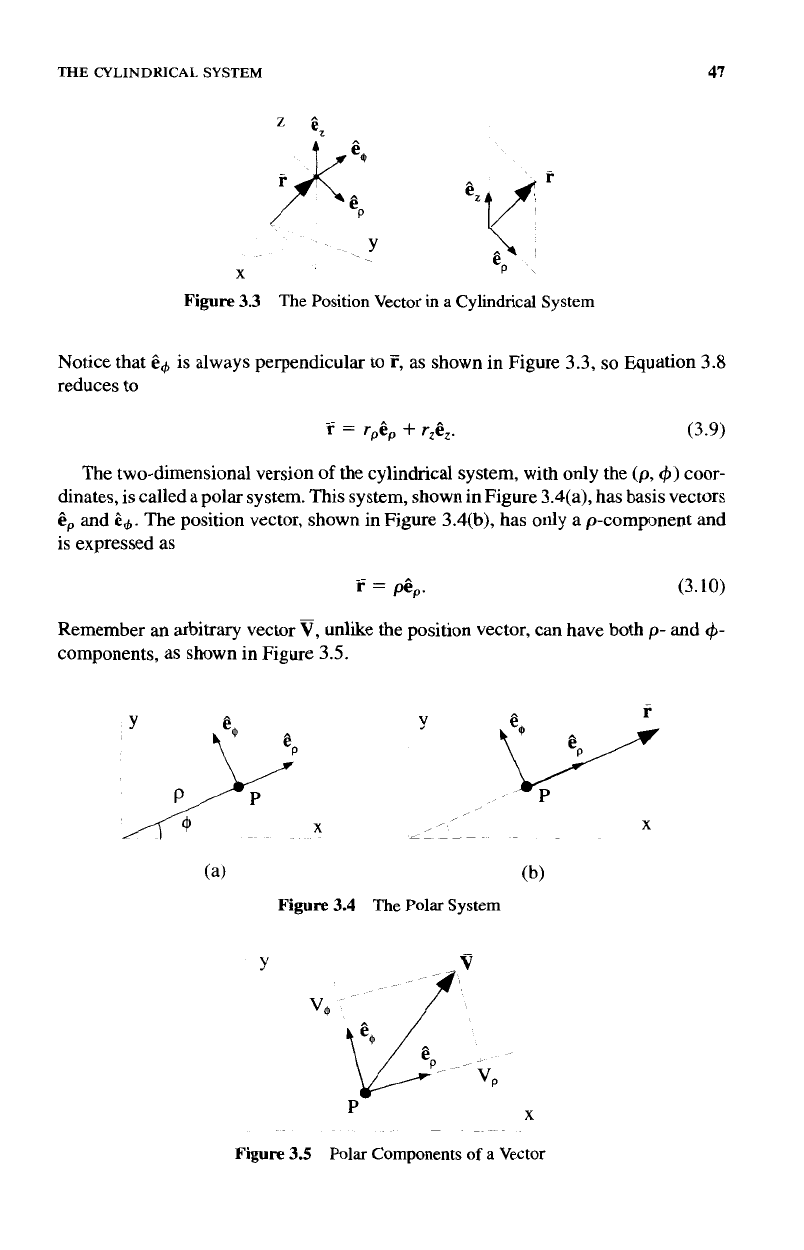
Notice that
C+
is always perpendicular to
F,
as shown in Figure 3.3,
so
Equation 3.8
reduces to
-
r
=
rpCp
+
rtQ.
(3.9)
The two-dimensional version
of
the cylindrical system, with only the
(p,
4)
coor-
dinates, is called a polar system. This system, shown in Figure 3.4(a), has basis vectors
C,
and
C+.
The position vector, shown in Figure
3.4(b),
has only a p-component and
is expressed
as
r;
=
$,.
(3.10)
Remember
an
arbitrary vector
v,
unlike the position vector, can have both
p-
and
4-
components,
as
shown in Figure
3.5.
(b)
Figure
3.4 The Polar System
Y
Figure
v@
dV
eP
VP
X
P
~~
3.5
Polar Components
of
a
Vector
48
CURVILINEAR
COORDINATE
SYSTEMS
3.3
THE
SPHERICAL
SYSTEM
The
three
coordinates (r,
8,Cp)
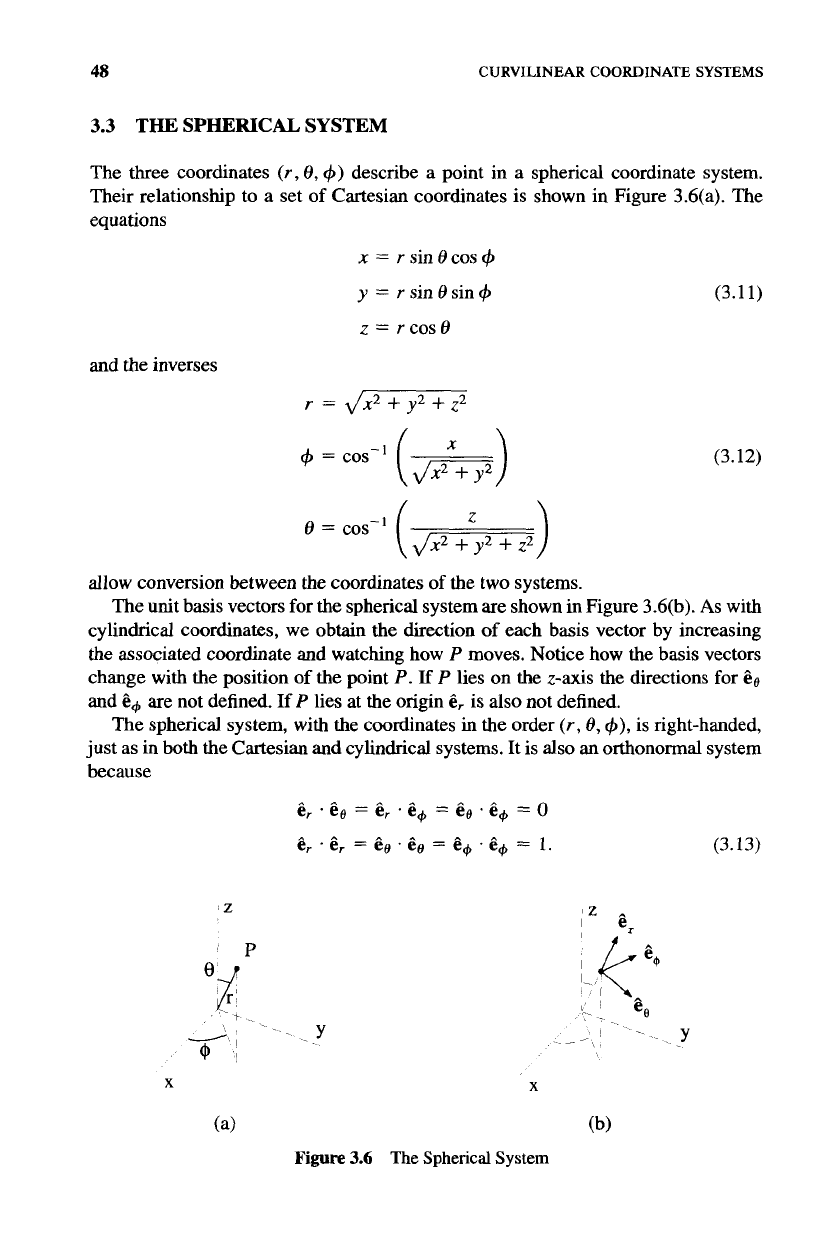
describe a point in a spherical coordinate system.
Their relationship to a set of Cartesian coordinates is shown in Figure 3.6(a). The
equations
x
=
rsin8cos4
y
=
rsin0sinCp
(3.1
1)
z
=
r
cos
8
and
the inverses
r
=
Jx2
+
y2
+
22
X
Cp
=
cos-'
(
)
VG-Tp
(3.12)
allow
conversion between the coordinates of the two systems.
The unit basis vectors for the spherical system are shown
in
Figure 3.6(b).
As
with
cylindrical coordinates, we obtain the direction of each
basis
vector by increasing
the associated coordinate and watching how
P
moves. Notice how the basis vectors
change with the position of the point
P.
If
P
lies
on
the
z-axis
the directions for
20
and
64
are not defined. If
P
lies at the origin
er
is also not defined.
The spherical system, with the coordinates
in
the order (r,
0,
Cp),
is right-handed,
just as in both the Cartesian and cylindrical systems. It is
also
an orthonormal system
because
X X
(a)
(b)
Figure
3.6
The
Spherical
System
GENERAL
CURVILINEAR
SYSTEMS
49
X
Figure
3
1
Y
The Position Vector in -2herical Coordinates
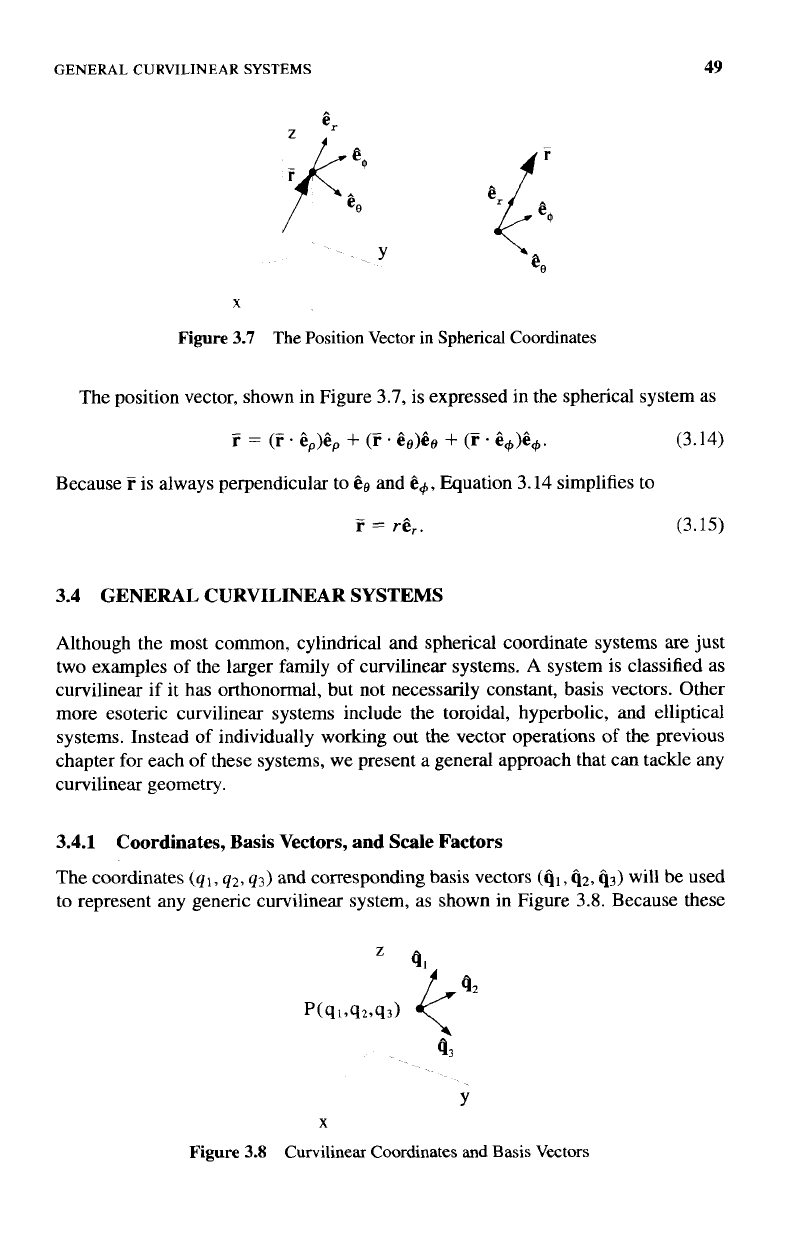
The position vector, shown in Figure
3.7,
is expressed in the spherical system as
(3.14)
-
r
=
(F
.
C,)$
+
(F
-
&)CO
+
(F
.
@+)@+.
Because
F
is
always perpendicular to
20
and
$4,
Equation 3.14 simplifies to
(3.15)
-
r
=
rC,.
3.4
GENERAL CURVILINEAR
SYSTEMS
Although the most common, cylindrical and spherical coordinate systems are just
two examples of the larger family
of
curvilinear systems.
A
system is classified
as
curvilinear if
it
has orthonormal, but not necessarily constant, basis vectors. Other
more esoteric curvilinear systems include the toroidal, hyperbolic, and elliptical
systems. Instead of individually working out the vector operations of
the
previous
chapter for each
of
these systems, we present a general approach that can tackle any
curvilinear geometry.
3.4.1
The coordinates
(41,
q2,
q3)
and corresponding basis vectors
($1,
q2,
q3)
will be used
to
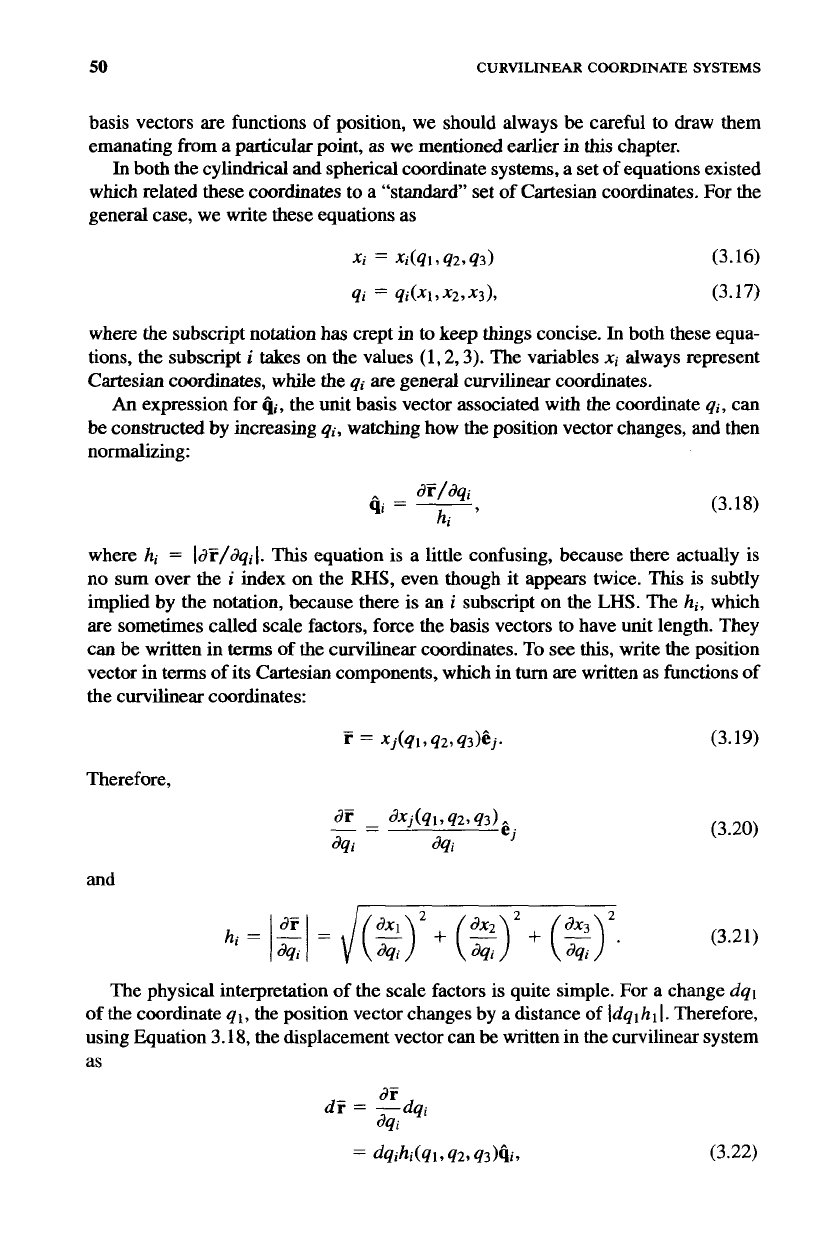
represent any generic curvilinear system, as shown in Figure
3.8.
Because these
Coordinates, Basis Vectors, and
Scale
Factors
6
Y
X
Figure
3.8
Curvilinear
Coordinates
and
Basis
Vectors
50
CURVILINEAR COORDINATE SYSTEMS
basis vectors are functions
of
position, we should always
be
careful to draw them
emanating from a particular point,
as
we mentioned earlier in this chapter.
In
both the cylindrical and spherical coordinate systems, a set
of
equations existed
which related these coordinates to a “standard” set of Cartesian coordinates. For the
general case, we write these equations as
xi
=
xi(q19q27q3)
(3.16)
qi
=
qi(xl,x2,x3),
(3.17)
where the subscript notation has crept in to keep things concise.
In
both these equa-
tions, the subscript
i
takes on the values (1,2,3). The variables
xi
always represent
Cartesian coordinates, while the
qi
are general curvilinear coordinates.
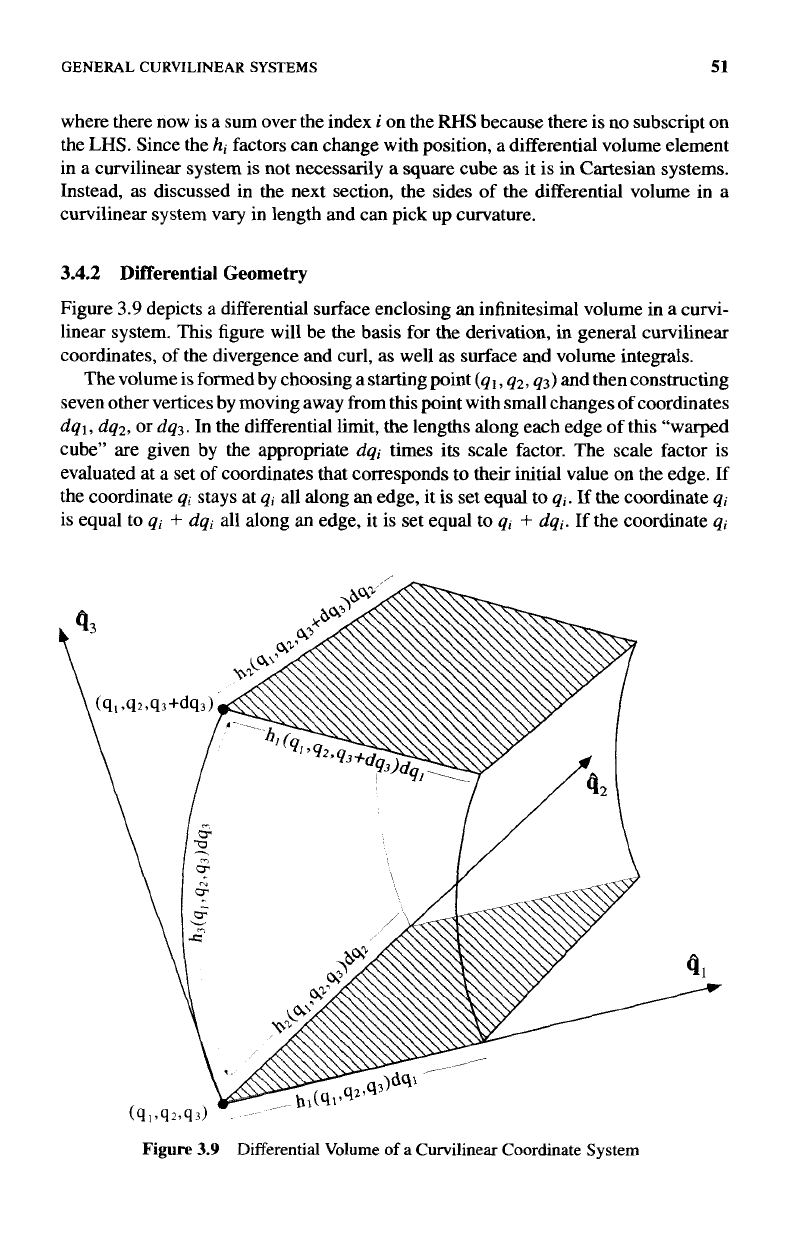
An
expression for
qi,
the
unit basis vector associated with the coordinate
qi.
can
be
constructed by increasing
qi.
watching how the position vector changes, and then
normalizing:
(3.18)
where
hi
=
ldF/dqiI.
This
equation is a little confusing, because there actually is
no
sum over the
i
index on the
RHS,
even though it appears twice.
This
is
subtly
implied by the notation, because there is
an
i
subscript on the
LHS.
The
hi,
which
are sometimes called scale factors, force the basis vectors to have
unit
length. They
can be written in
terms
of
the curvilinear coordinates.
To
see
this,
write the position
vector in terms
of
its Cartesian components, which
in
turn
are written as functions of
the
curvilinear coordinates:
(3.19)
Therefore,
and
hi
=
121
=
dm.
(3.21)
The physical interpretation of the scale factors is quite simple. For a change
dql
of the coordinate
41,
the position vector changes by a distance of
ldql
hl
I.
Therefore,
using Equation 3.18, the displacement vector can be written in the curvilinear system
as
(3.22)
GENERAL CURVILINEAR
SYSTEMS
51
where there now is a sum over the index
i
on
the
RHS
because there is no subscript on
the
LHS.
Since the
hi
factors can change with position, a differential volume element
in a curvilinear system
is
not necessarily a square cube
as
it is
in
Cartesian systems.
Instead, as discussed in the next section, the sides of the differential volume in a
curvilinear system vary in length and can pick up curvature.
3.4.2
Differential Geometry
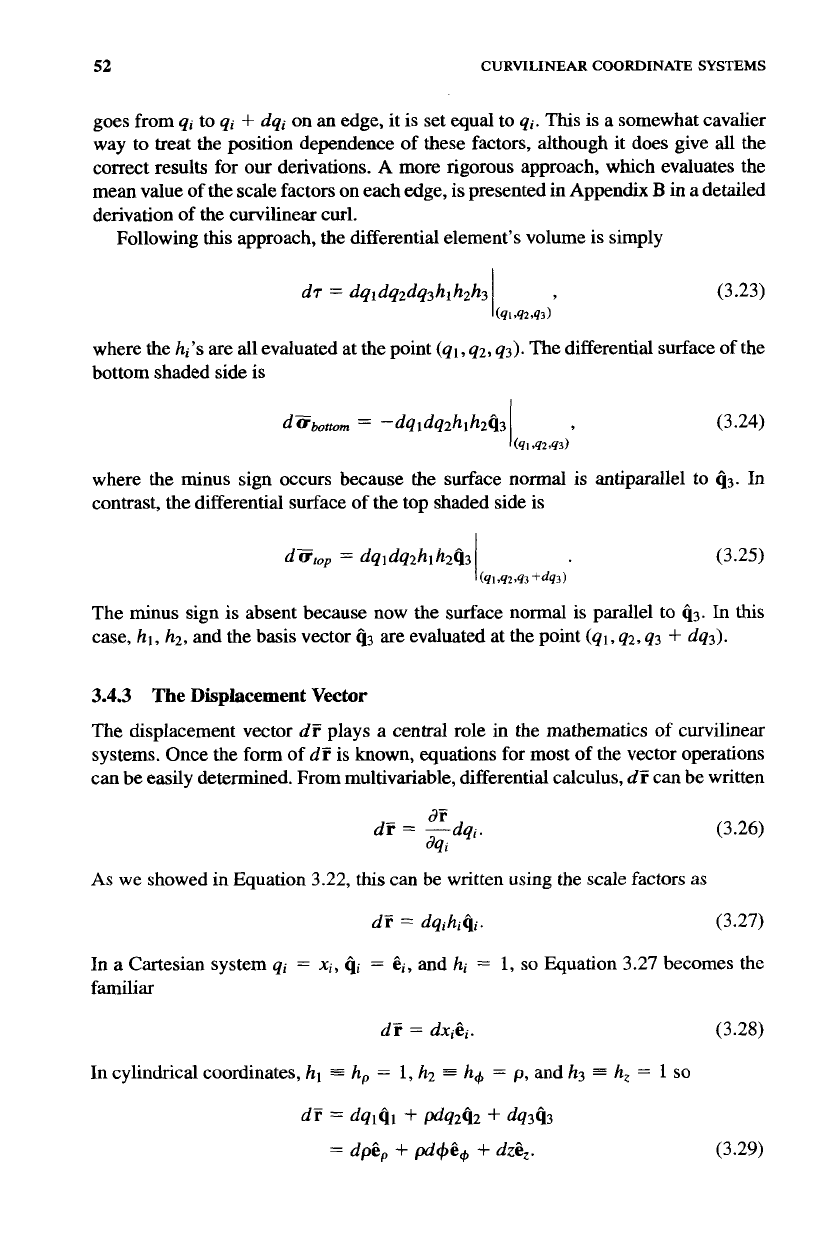
Figure
3.9
depicts a differential surface enclosing an infinitesimal volume in a curvi-
linear system.
This
figure will be the basis for
the
derivation, in general curvilinear
coordinates, of the divergence and curl, as well as surface and volume integrals.
The volume is formed by choosing a starting point
(q,,
q2,
q3)
and then constructing
seven other vertices by moving away
from
this
point with small changes of coordinates
dql,
dq2,
or
dq3.
In the differential limit, the lengths along each edge of this “warped
cube” are given
by
the appropriate
dqi
times
its
scale factor. The scale factor is
evaluated at a set
of
coordinates that corresponds to their initial value on the edge.
If
the coordinate
qi
stays at
qi
all along an edge, it is set equal to
qi.
If
the coordinate
qi
is equal to
qi
+
dqi
all along
an
edge, it is set equal to
qr
+
dqi.
If the coordinate
qi
Figure
3.9
Differential Volume
of
a
Curvilinear Coordinate System
52
CURVILINEAR
COORDINATE
SYSTEMS
goes from
qi
to
qi
+
dqi
on an edge, it is set equal to
qi.
This
is a somewhat cavalier
way
to
treat
the position dependence of these factors, although it does give all the
correct results for
our
derivations.
A
more rigorous approach, which evaluates the
mean value of the scale factors on each edge,
is
presented
in
Appendix
B
in a detailed
derivation of the curvilinear curl.
Following
this
approach, the differential element’s volume is simply
(3.23)
where the
hi’s
are all evaluated at the point
(ql,
qz,
q3).
The differential surface
of
the
bottom shaded side
is
d*baom
=
-dqldqM~q31
,
(3.24)
where
the
minus sign occurs because
the
surface normal
is
antiparallel to
q3.
In
contrast, the differential surface of the top shaded side is
(41.42.43)
datop
=
dqldq2hlh243
(3.25)
(41.42143
+43)
The minus sign is absent because now the surface normal is parallel to
q3.
In
th~s
case,
hl,
hz,
and the basis vector
q3
are evaluated at the point
(ql,
q2,
q3
+
dq3).
3.4.3
The
Displacement
Vector
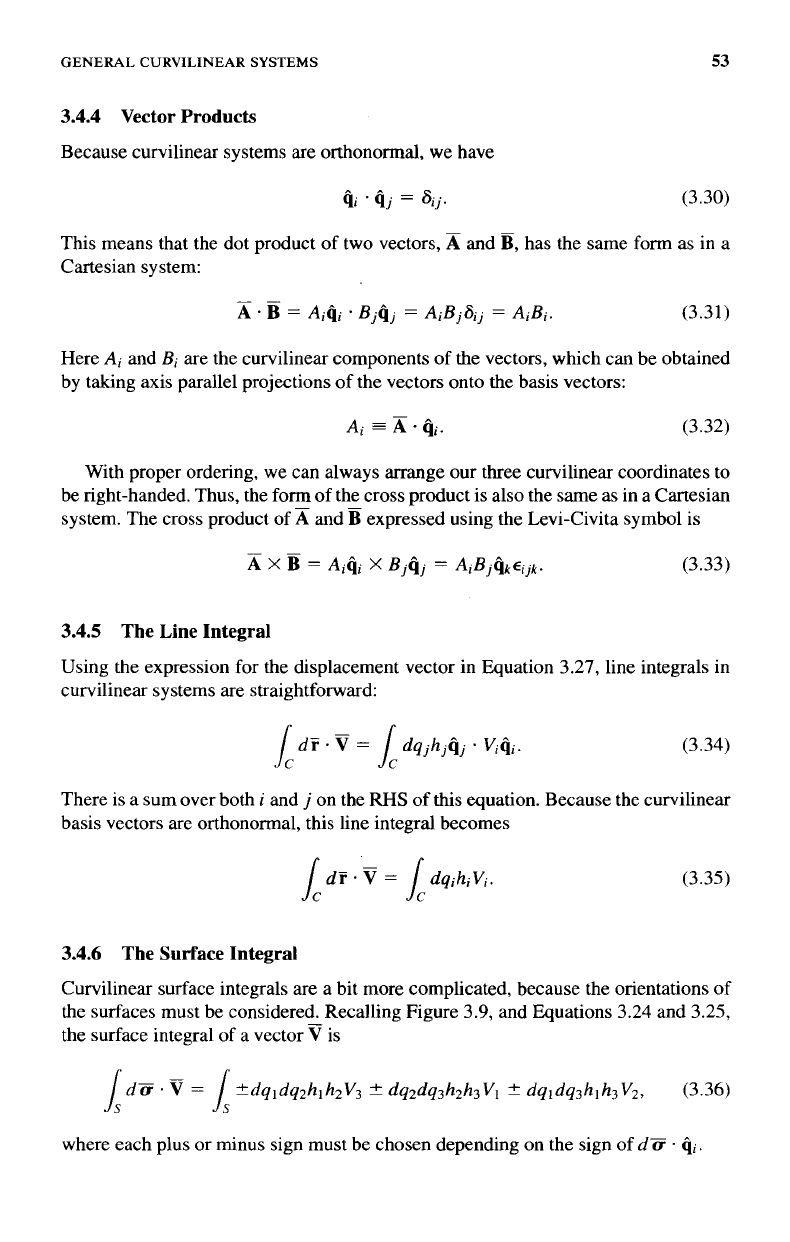
The displacement vector
di
plays a central role in the mathematics
of
curvilinear
systems. Once the
form
of
dF
is known, equations for most of the vector operations
can be easily determined. From multivariable, differential calculus,
di
can be written
(3.26)
AS
we showed in Equation
3.22,
this
can be written using the scale factors
as
dI;
=
dq.h.
1 1%.
A.
(3.27)
In a Cartesian system
qi
=
xi,
qi
=
Ci,
and
hi
=
1,
so
Equation
3.27
becomes the
familiar
dF
=
d&.
(3.28)
In cylindrical coordinates,
hl
=
h,
=
1,
hz
=
h+
=
p,
and
h3
=
h,
=
1
so
(3.29)
GENERAL
CURVILINEAR
SYSTEMS
53
3.4.4 Vector Products
Because curvilinear systems are orthonormal, we have
q.
1
.
q.
J
=
6..
'I'
(3.30)
This means that the dot product of two vectors,
Cartesian system:
and
B,
has the same form as in a
Here
Ai
and
B;
are the curvilinear components of the vectors, which can be obtained
by taking axis parallel projections of the vectors onto the basis vectors:
-
A.
1-
=
A.
4.
I'
(3.32)
With proper ordering, we can always arrange our three curvilinear coordinates to
be right-handed. Thus, the form of the cross product is also the same as in
a
Cartesian
system. The cross product of and
B
expressed using the Levi-Civita symbol is
A
X
B
=
Aiqi
X
B,Q,
=
AiBiqkeijk.
(3.33)
3.4.5 The Line Integral
Using the expression for the displacement vector in Equation 3.27, line integrals in
curvilinear systems are straightforward:
(3.34)
There is a sum over both
i
and
j
on the
RHS
of this equation. Because the curvilinear
basis vectors are orthonormal, this line integral becomes
(3.35)
3.4.6 The Surface Integral
Curvilinear surface integrals are a bit more complicated, because the orientations
of
the surfaces must be considered. Recalling Figure 3.9, and Equations 3.24 and 3.25,
the surface integral
of
a vector
v
is
ids.
V
=
J,'
5dqldq2hlh2V3
+-
dq~dq3h2h3V1
+-
dqldq3hlh3V2,
(3.36)
where each
plus
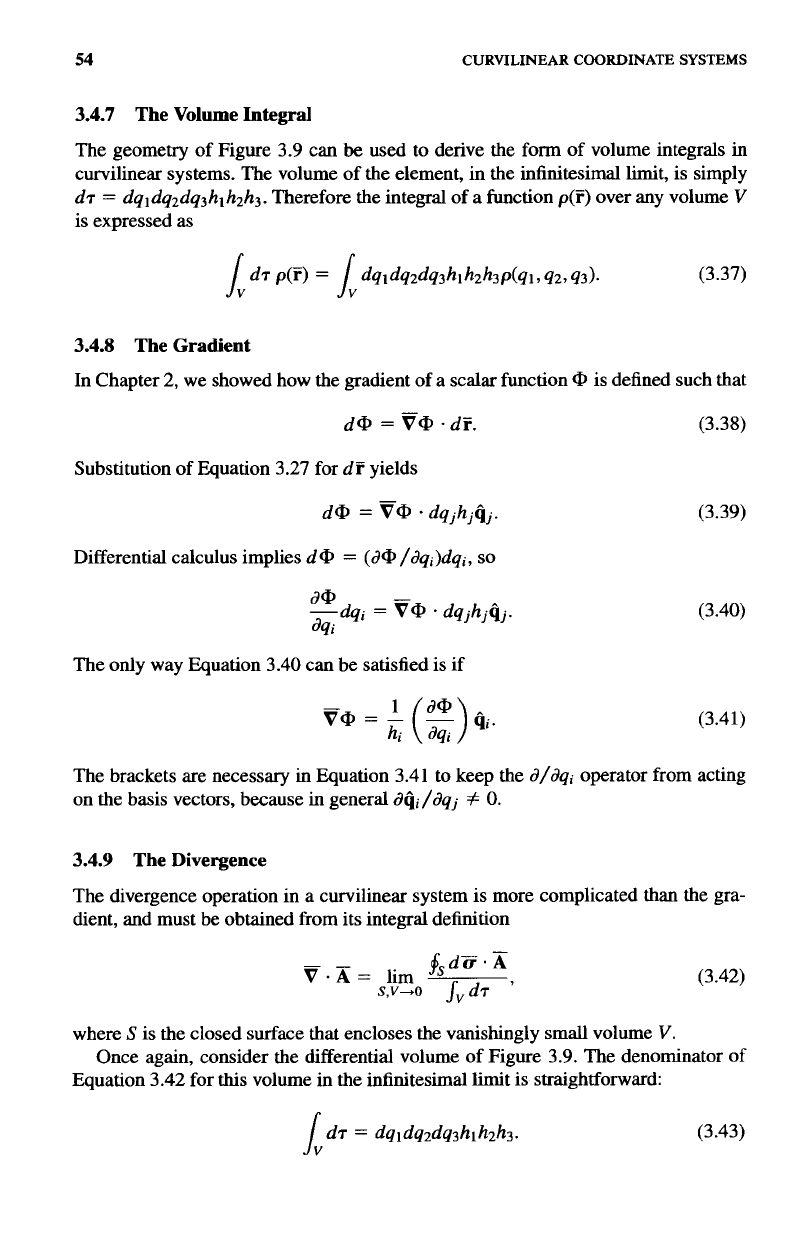
or minus sign must be chosen depending
on
the sign
of
da.
qi.
54
CURVILINEAR COORDINATE SYSTEMS
3.4.7 The Volume
Integral
The geometry of Figure 3.9 can
be
used to derive the form of volume integrals in
curvilinear systems. The volume
of
the element, in
the
infinitesimal limit, is simply
dT
=
dqldqzdq3hlhzh3.
Therefore the integral
of
a function
p(F)
over any volume
V
is expressed
as
(3.37)
3.4.8 The Gradient
In Chapter 2, we showed how the gradient of a scalar function
@
is defined such that
d@
=
v@
*dT.
(3.38)
Substitution of Equation 3.27 ford? yields
d@
=
V@
*
dqjhjaj.
Differential calculus implies
d@
=
(d@/dqi)dqi,
so
The only way Equation 3.40 can be satisfied is if
(3.39)
(3.40)
(3.41)
The brackets are necessary in Equation 3.41 to keep the
d/dqi
operator from acting
on the basis vectors, because in general
dqi/dqj
f
0.
3.4.9 The Divergence
The divergence operation in a curvilinear system is more complicated than the gra-
dient, and must be obtained from its integral definition
-_
JsdXF*K
V
*A=
lim
s,v-+o
JVdr
'
(3.42)
where
S
is the closed surface that encloses the vanishingly small volume
V.
Equation 3.42 for
this
volume in the infinitesimal iimit
is
straightforward:
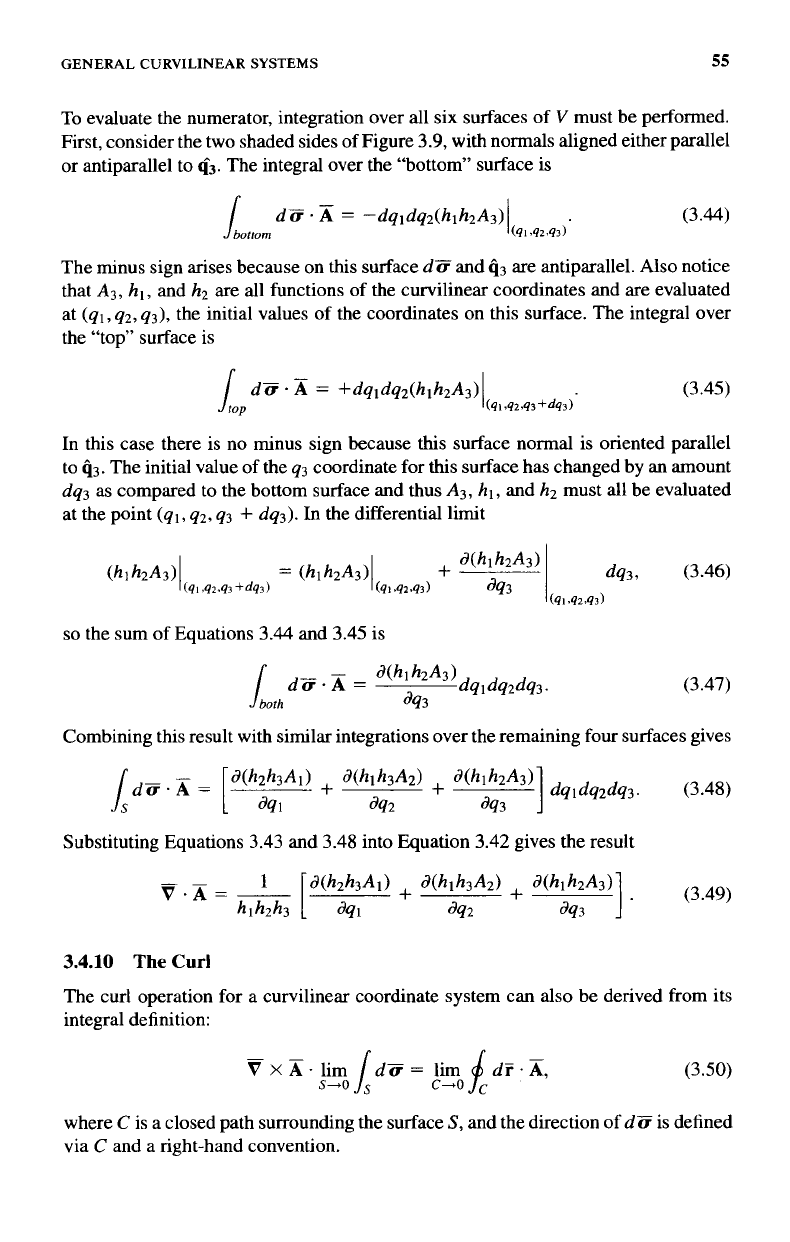
Once again, consider the differential volume of Figure 3.9. The denominator
of
ldr
=
dqldqdq3hlhzh3.
(3.43)
GENERAL CURVILINEAR SYSTEMS
55
To evaluate the numerator, integration over all six surfaces of
V
must be performed.
First, consider the two shaded sides
of
Figure
3.9,
with normals aligned either parallel
or antiparallel to
q3.
The integral over the “bottom” surface is
The minus sign arises because on this surface
diF
and
$3
are antiparallel.
Also
notice
that
A3,
hl
,
and
h2
are
all
functions of the curvilinear coordinates and are evaluated
at
(41, q2, q3),
the initial values
of
the coordinates on this surface. The integral over
the “top” surface is
In this case there is no minus sign because
this
surface normal is oriented parallel
to
$3.
The initial value of the
q3
coordinate for
this
surface has changed by an amount
dq3
as compared to the bottom surface and thus
A3,
hl,
and
h2
must all be evaluated
at the point
(ql, q2, q3
+
dq3). In
the differential limit
so
the sum of Equations
3.44
and
3.45
is
(3.47)
Combining this result with similar integrations over the remaining four surfaces gives
3.4.10
The
Curl
The curl operation for
a
curvilinear coordinate system can also be derived from its
integral definition:
v
X
A.
lim
da
=
lim
dT;.
A,
s-0
c-0
(3.50)
where
C
is
a closed path surrounding the surface
S,
and the direction
of
d5
is defined
via
C
and a right-hand convention.