
Kusse B.R., Westwig E.A. Mathematical Physics: Applied Mathematics for Scientists and Engineers
Подождите немного. Документ загружается.

56
CURVILINEAR COORDINATE SYSTEMS
1
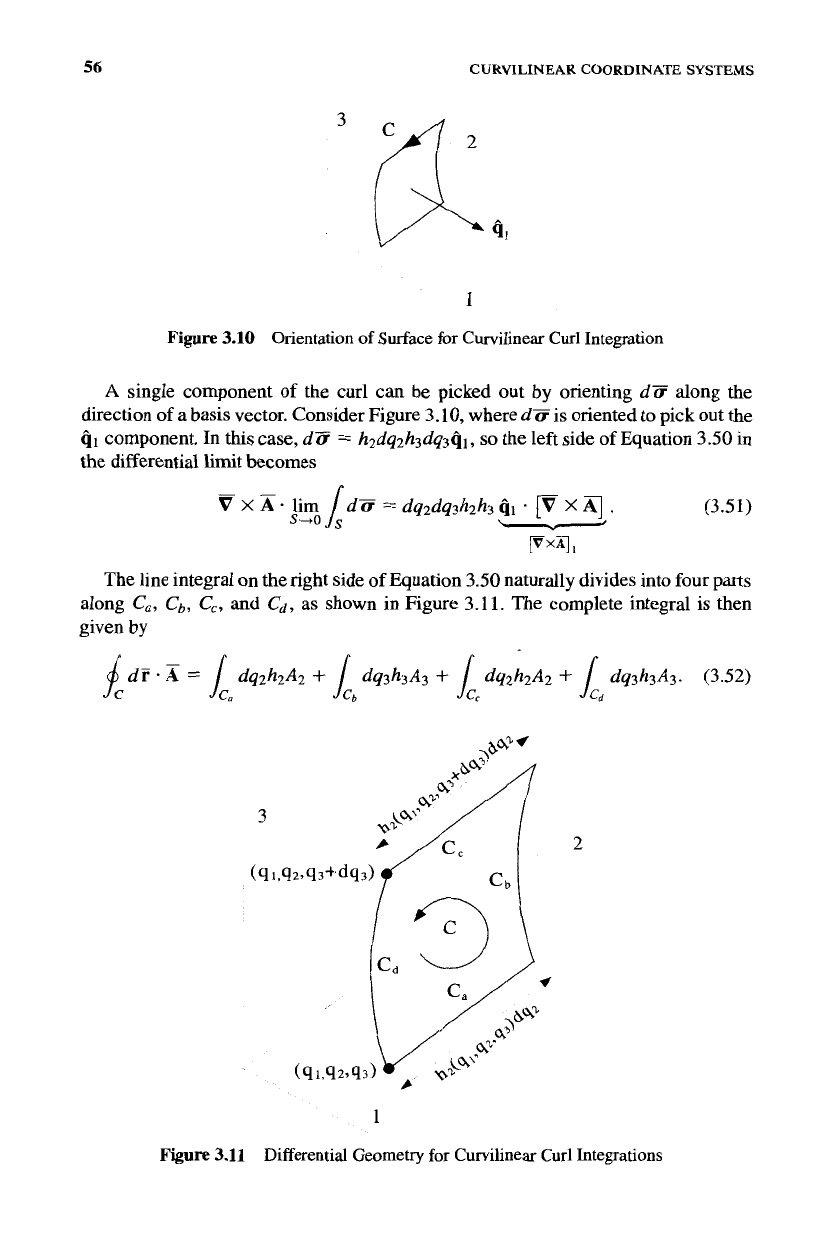
Figure
3.10
Orientation
of
Surface for Curvilinear Curl Integration
A
single component
of
the curl can be picked out
by
orienting
dF
along the
direction of a basis vector. Consider Figure
3.10,
where
do
is oriented to pick out the
q1
component.
In
this case,
d3
=
h2dq2h3dq3q1,
so
the left side of Equation
3.50
in
the differential limit becomes
The
line integral
on
the right side of Equation
3.50
naturally divides into four parts
along
C,, C,,
C,,
and
C,,
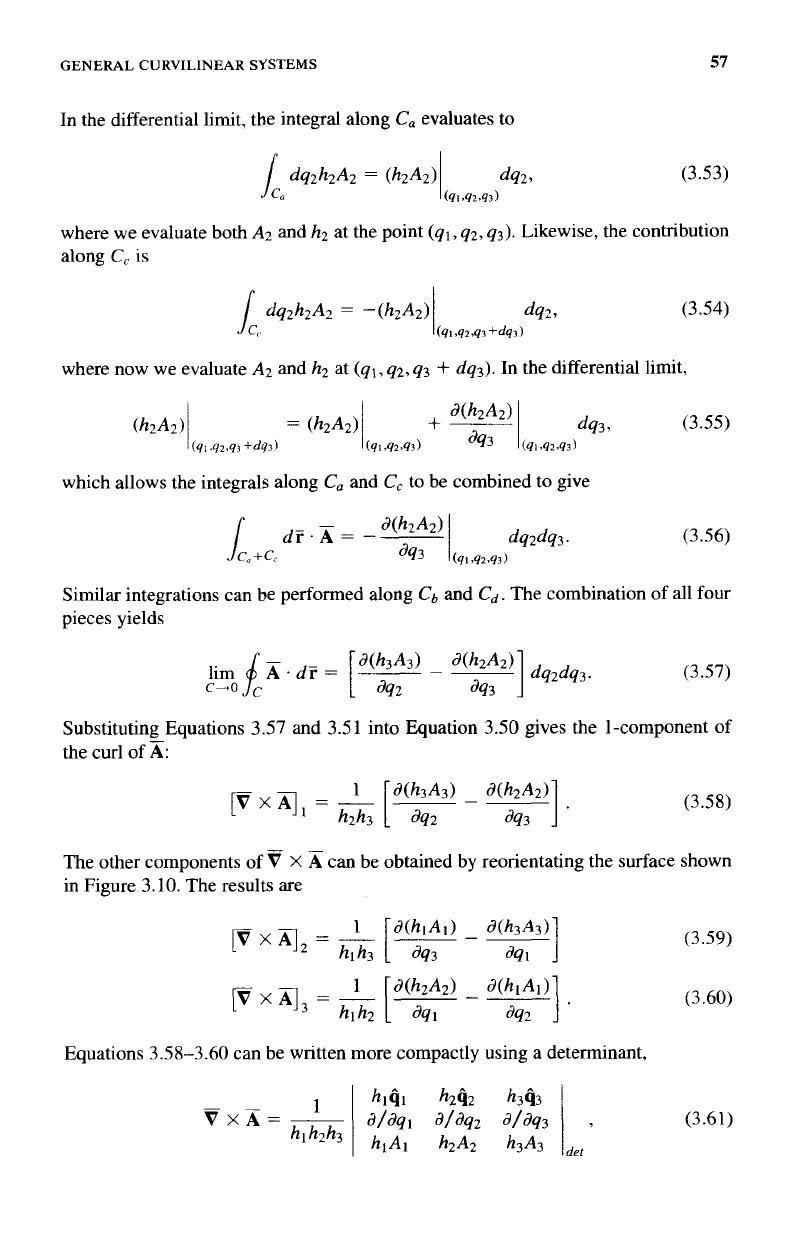
as shown
in
Figure
3.11.
The complete integral is then
given
by
2
1
Figure
3.11
Differential Geometry for Curvilinear Curl Integrations
GENERAL CURVILINEAR SYSTEMS
57
hi& h2$2
h343
QXA=- a/aql
a/dq2
d3s3
hlA1 h2A2
h3A3
-
In the differential limit, the integral along
C,
evaluates to
lo
dq2h2A2
=
(h2A2)
1
dq2>
(3.53)
(41
,42.43)
where we evaluate both
A2
and
h2
at the point
(q1,42,
q3).
Likewise, the contribution
along
C,
is
,
der
dq2,
(3.54)
(41~42.43
+43)
where now we evaluate
A2
and
h2
at
(41,
q2,43
+
dq3).
In
the differential limit,
+
?!!!?!dl
dq3,
(3.55)
(41
42.43
+43)
(9lr92.43)
dq3
(41.42.43)
which allows the integrals along
C,
and
C,
to be combined to give
(3.56)
dT;f
A
=
-
d(h2A2)
-1
&2dq3.
s
C"
+
cc
dq3
(41r42r43)
Similar integrations can be performed along
Cb
and
Cd
.
The combination of all four
pieces yields
(3.57)
Substituting Equations 3.57 and 3.51 into Equation
3.50
gives the 1-component
of
the curl
of
A:
(3.58)
The other components of
v
X
A
can be obtained by reorientating the surface shown
in Figure 3.10. The results are
(3.59)
(3.60)
(3.61)
58
CURVILINEAR COORDINATE
SYSTEMS
or
using the Levi-Civita symbol and subscript notation,
(3.62)
3.5
THE
GRADIENT, DIVERGENCE, AND CURL
IN
CYLINDRICAL
AND SPHERICAL
SYSTEMS
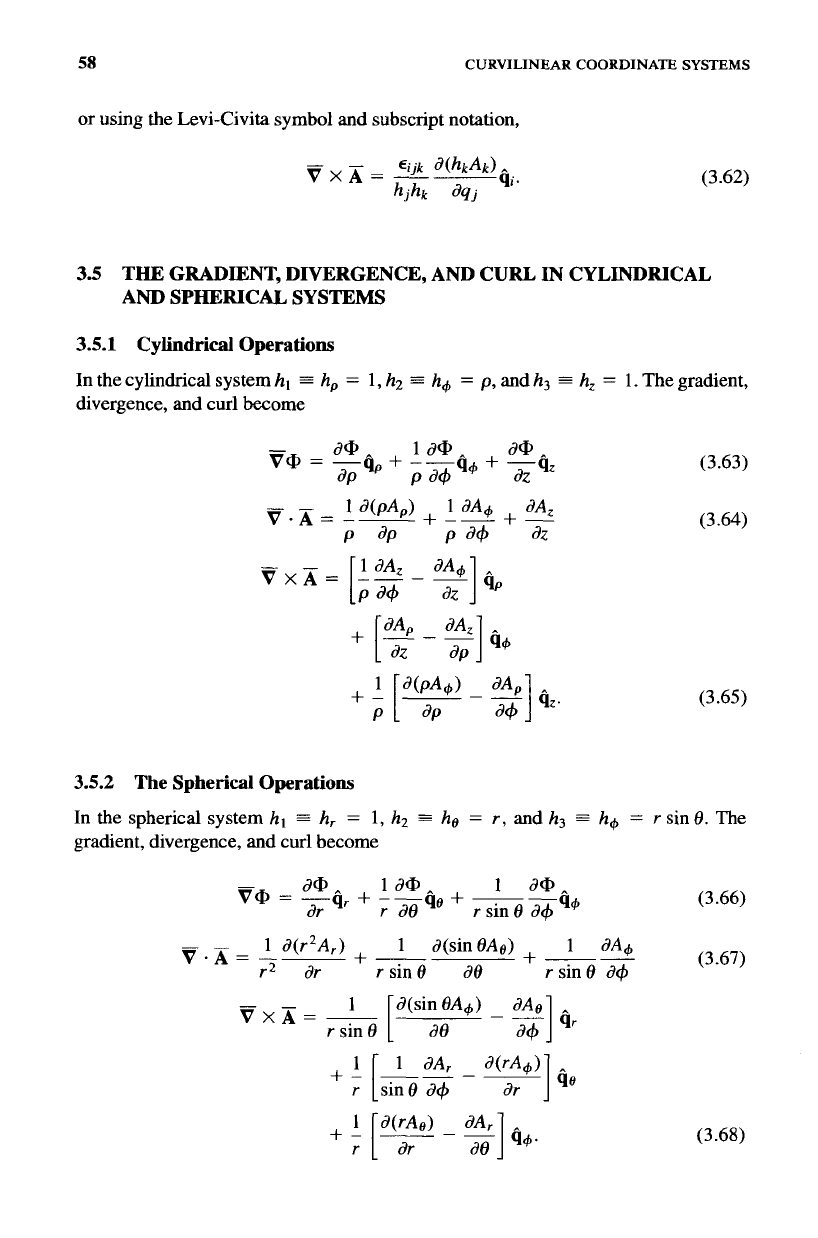
3.5.1
Cylindrical Operations
In
the cylindrical system
h,
=
h,
=
1,
h2
=
hg
=
p,
and
h3
=
h,
=
I.
The gradient,
divergence, and curl become
3.5.2
The Spherical Operations
(3.63)
(3.64)
(3.65)
In the spherical system
hl
=
h,
=
I,
h2
=
he
=
r,
and
h3
=
h+
=
r
sin
0.
The
gradient, divergence, and curl become
(3.66)
-
dQt
1
dQt
1
dQ,
VQ,
=
-4,
+
--qe +
~-
dr
r
30
r
sin
0
a+
‘4
1
dA+
+--
(3.67)
-_
I
d(r2A,)
I
d(sin0Ae)
V.A=--
+-
r
sin
0
J+
r2
dr
r
sin
0
d0
(3.68)
EXERCISES
59
EXERCISES FOR CHAPTER
3
1.
A
vector expressed in a Cartesian system has the following
form:
-
v
=
Cx
+
C,
+
CZ.
(a)
If this vector exists at the Cartesian point
(1,2,
l),
what are its components
(b)
If this vector exists at the Cartesian point
(1,2,
l),
what are its components
(c)
If this vector exists at the Cartesian point
(0,
0,
l),
what are its components
(d)
If
this vector exists at the Cartesian point
(0,
0,
l),
what are its components
2.
In a cylindrical system, with coordinates
(p,
4,
z),
the vector
Vl
exists at the
point
(1
,
0,O)
and is given by
=
C,
+
6,.
A
second vector
'5,
exists in the
same coordinate system at the point
(117r/2,
0)
and is given by
v2
=
CP
+
64.
What is the value of
V,
.
V,?
expressed in a cylindrical system?
expressed in a spherical system?
expressed in a cylindrical system?
expressed in a spherical system?
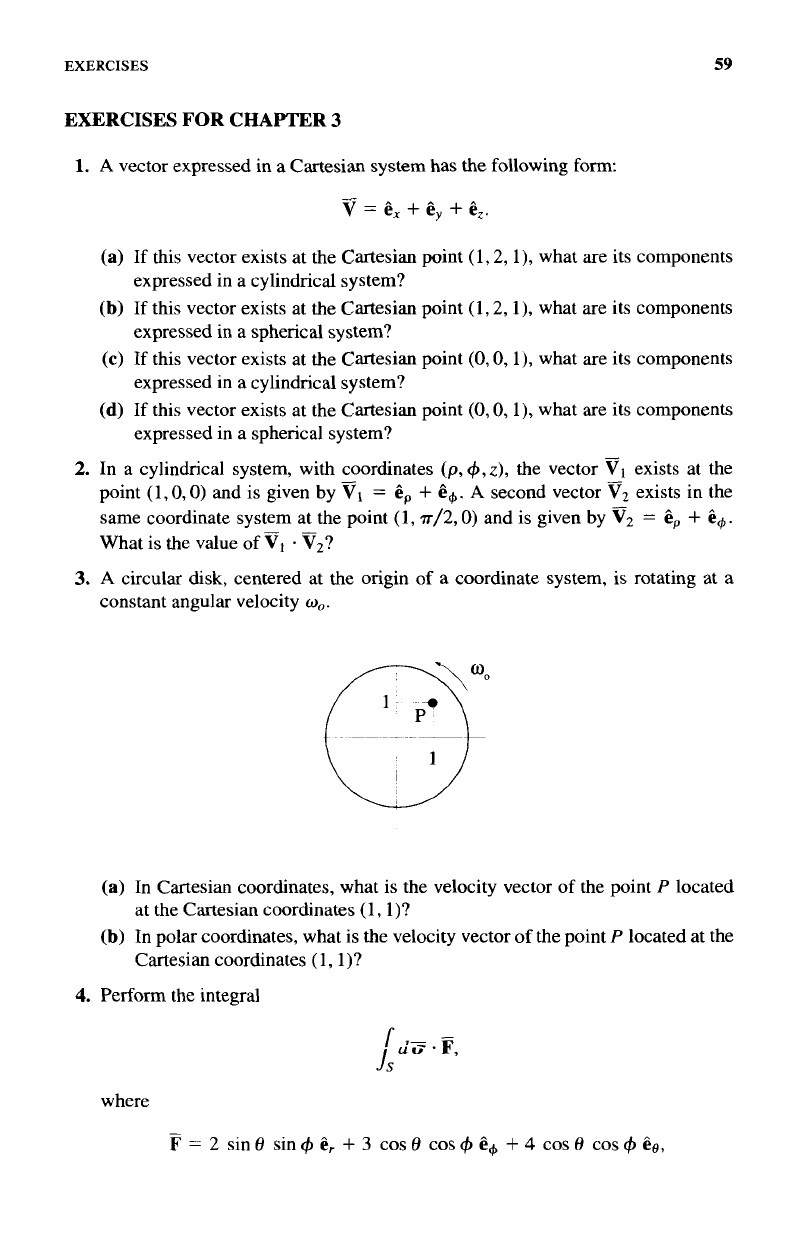
3.
A
circular disk, centered at the origin
of
a coordinate system, is rotating at a
constant angular velocity
0,.
(a)
In Cartesian coordinates, what is the velocity vector
of
the point
P
located
(b)
In polar coordinates, what is the velocity vector
of
the point
P
located at the
at the Cartesian coordinates
(1,
l)?
Cartesian coordinates
(1,
l)?
4.
Perform the integral
where
-
F
=
2
sin
0
sin
4
6,
+
3
cos
0
cos
4
C+
+
4
cos
0
cos
4
60,
60
CURVILINEAR
COORDINATE
SYSTEMS
and
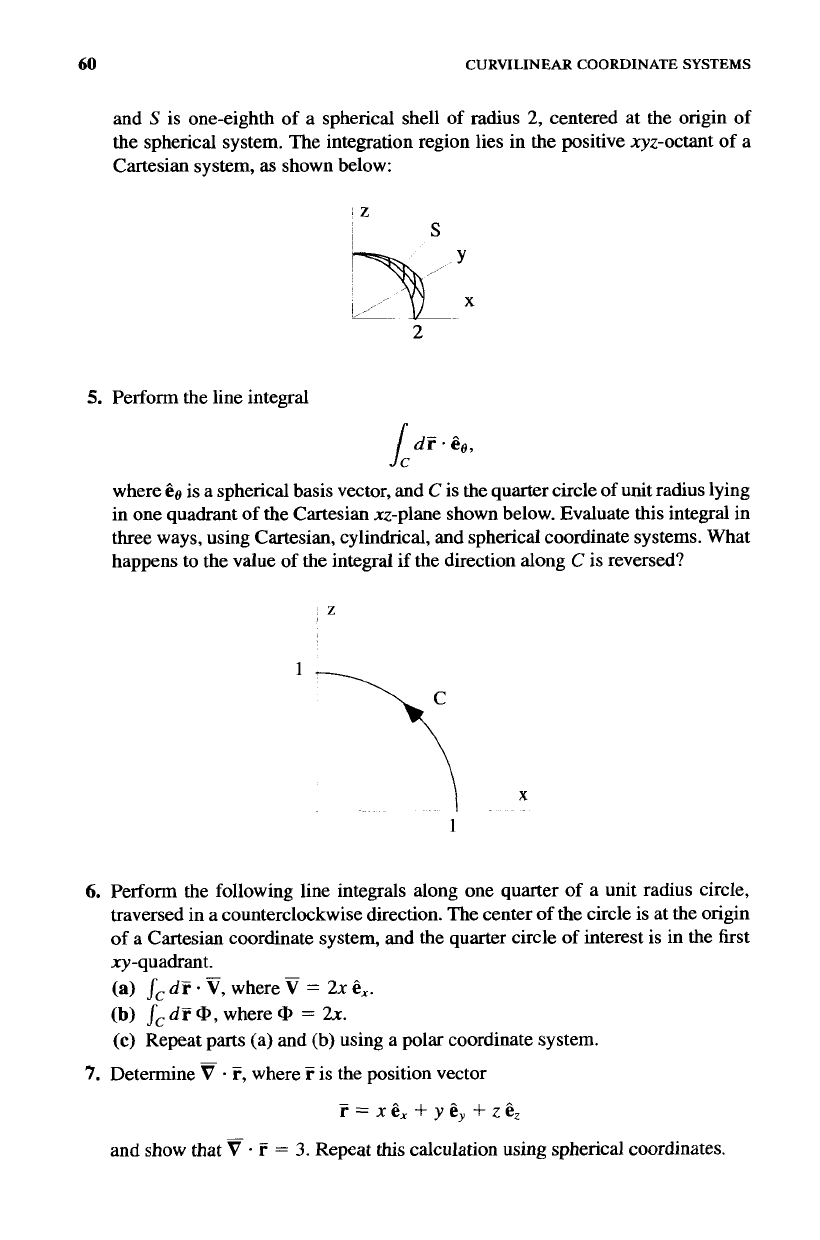
S
is one-eighth of a spherical shell of radius
2,
centered at the origin of
the spherical system. The integration region lies in the positive xyz-octant
of
a
Cartesian system,
as
shown below:
2
5.
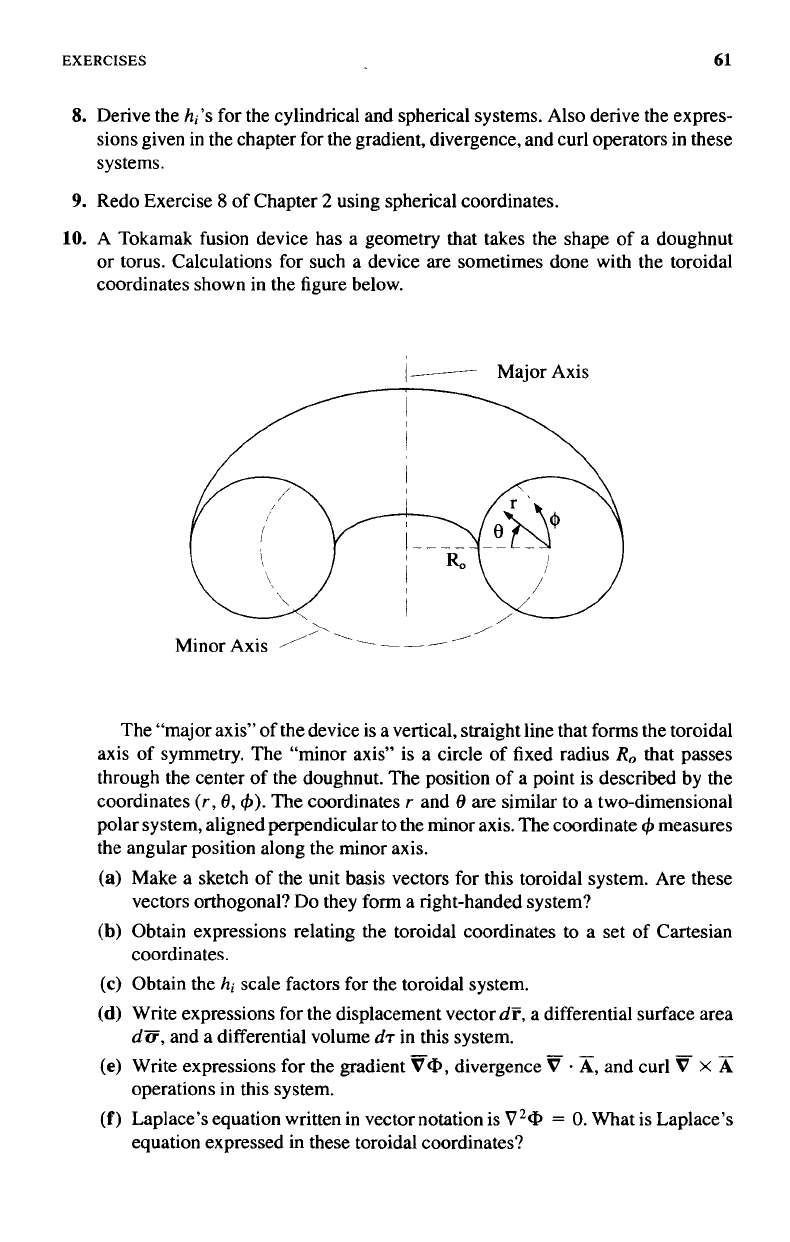
Perform the line integral
dl;
.Go,
where
60
is a spherical basis vector, and
C
is the quarter circle
of
unit radius lying
in one quadrant of
the
Cartesian xz-plane shown below. Evaluate this integral in
three ways, using Cartesian, cylindrical, and spherical coordinate systems. What
happens to the value of the integral
if
the direction along
C
is reversed?
Z
1
6.
Perform the following line integrals along one quarter
of
a unit radius circle,
traversed in a counterclockwise direction. The center of the circle is at the origin
of a Cartesian coordinate system, and the quarter circle of interest
is
in the first
xy -quadrant.
(a)
J,
dF
*
v,
where
v
=
2x
ex.
(b)
Jc
dI;
a,
where
(c)
Repeat parts (a) and
(b)
using a polar coordinate system.
=
2x.
7.
Determine
V
.
E,
where
E
is the position vector
-
r
=
x
GX
+
y
gY
+
z
GZ
and show that
V
.
I;
=
3.
Repeat
this
calculation using spherical coordinates.
EXERCISES
61
8.
Derive the
hi’s
for the cylindrical and spherical systems. Also derive the expres-
sions given in the chapter for the gradient, divergence, and curl operators in these
systems.
9.
Redo Exercise
8
of Chapter
2
using spherical coordinates.
10.
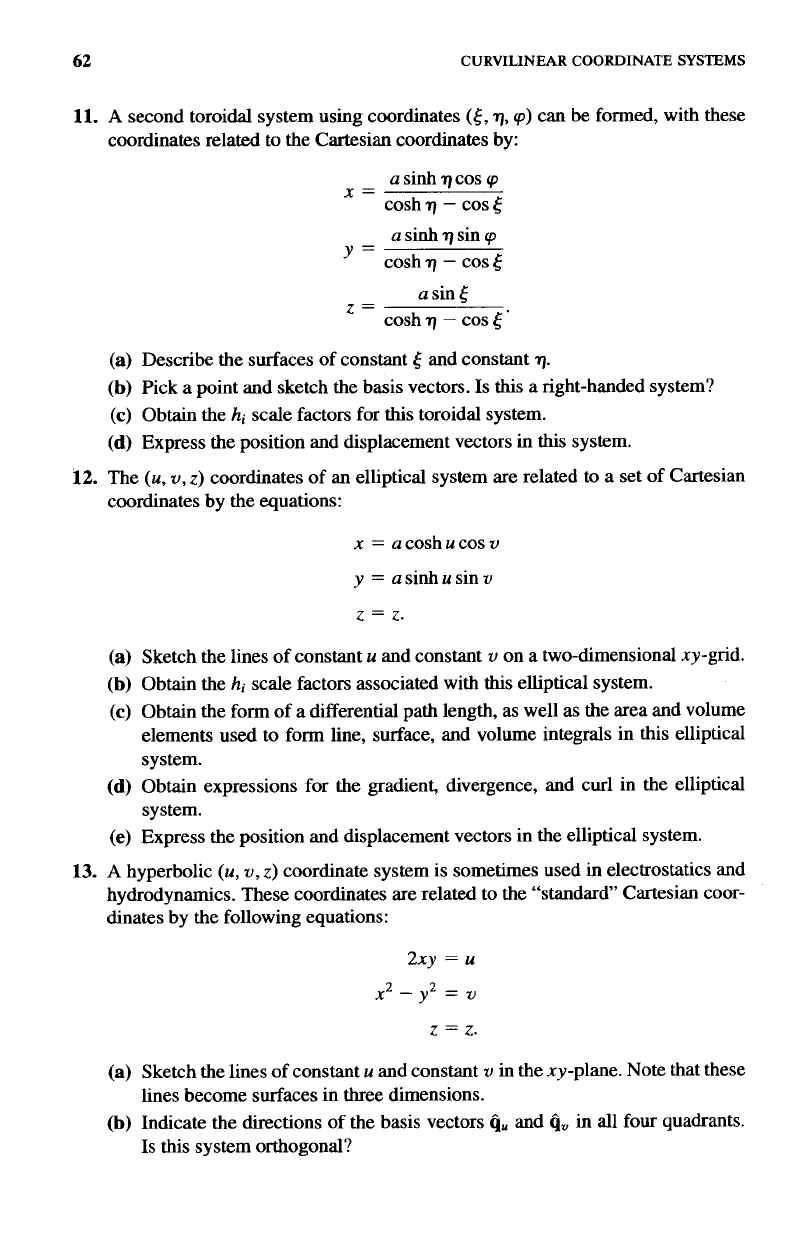
A Tokamak fusion device has a geometry that takes the shape of a doughnut
or torus. Calculations for such a device are sometimes done with the toroidal
coordinates shown in the figure below.
1
-
Ma.jor Axis
/’
/
Minor Axis
,/>‘
.__-
The “major axis” of the device is a vertical, straight line that forms the toroidal
axis of symmetry. The “minor axis” is a circle of fixed radius
R,
that passes
through the center of the doughnut. The position
of
a point is described
by
the
coordinates
(r,
8,+).
The coordinates
r
and
8
are similar to a two-dimensional
polar system, aligned perpendicular to the minor axis. The coordinate
+
measures
the angular position along the minor axis.
(a)
Make a sketch of the unit
basis
vectors for this toroidal system. Are these
(b)
Obtain expressions relating the toroidal coordinates to a set of Cartesian
(c)
Obtain the
hi
scale factors for the toroidal system.
(d)
Write expressions for the displacement vector
dF,
a differential surface area
(e)
Write expressions for the gradient
v@,
divergence
V
*
A,
and curl
v
X
(f)
Laplace’s equation written in vector notation is
V2@
=
0.
What
is
Laplace’s
vectors orthogonal?
Do
they form a right-handed system?
coordinates.
dV,
and a differential volume
d7
in this system.
operations
in
this system.
equation expressed in these toroidal coordinates?
-_
62
CURVILINEAR
COORDINATE
SYSTEMS
11.
A
second toroidal system using coordinates
(5.7,
cp)
can
be
formed, with these
coordinates related to the Cartesian coordinates by:
a
sinh
q
cos
cp
cash
q
-
cos
5
x=
a
sinh
r)
sin
cp
=
coshq
-
cost
(a)
Describe the surfaces of constant and constant
17.
(b)
Pick a point and sketch the basis vectors. Is
this
a
right-handed system?
(c)
Obtain the
hi
scale factors for
this
toroidal system.
(d)
Express the position and displacement vectors in
this
system.
coordinates by the equations:
12.
The
(u,
u,
z)
coordinates of an elliptical system are related to a set
of
Cartesian
x
=
acoshucosu
y
=
asinhusinu
z
=
z.
(a)
Sketch
the
lines of constant
u
and constant
u
on a two-dimensional xy-grid.
(b)
Obtain the
hi
scale factors associated with
this
elliptical system.
(c)
Obtain the form of a differential path length, as well as the area and volume
elements
used
to form
line,
surface, and volume integrals in this elliptical
system.
(d)
Obtain expressions for the gradient, divergence, and curl in the elliptical
system.
(e)
Express the position and displacement vectors in the elliptical system.
13.
A
hyperbolic
(u,
u,
z)
coordinate system is sometimes used in electrostatics and
hydrodynamics. These coordinates are related to the "standard" Cartesian coor-
dinates by the following equations:
2xy
=
u
x2
-
y2
=
u
z
=
z.
(a)
Sketch the lines of constant
u
and constant
u
in the xy-plane. Note that these
(b)
Indicate the directions
of
the basis vectors
qu
and
qv
in all four quadrants.
lines become surfaces in three dimensions.
Is
this system orthogonal?
EXERCISES
63
(c)
This
(u,
ZI,
z)
system is left-handed. What can be done to make it right-
(d)
In
the right-handed version of this system, obtain the
hi
scale factors.
(e)
Express the position and displacement vectors in this system.
handed?
14.
An
orthogonal
(u,
u,
z)
coordinate system is defined by the following set of
equations that relate these coordinates to a "standard" Cartesian set:
X
u=-
x2
+
y2
x=
+
y2
-Y
ZI=-
z
=
z.
(a)
Sketch the lines of constant
u
and constant
u
in the xy-plane.
(b)
Pick a point in the xy-plane and sketch the
qu,
qu,
and
qz
basis vectors. It
is not necessary to solve for
them
in terms of the Cartesian basis vectors
C,,
eY,
and
C,.
(c)
Is
this
(u,
u,
z)
system right-handed?
(d)
Invert the above expressions and solve for x and
y
in terms of
u
and
u.
(e)
Express the position and displacement vectors
in
this system.
(f)
Express the gradient operation
v@(u,
u,
z)
in this system.
15.
A
particle is moving in three-dimensional space. Describe its position
F(t),
ve-
locity
f,
and acceleration in terms of the
the
spherical coordinates and basis
vectors.
To
work this problem it will be necessary to take time derivatives
of
the
basis vectors, because they will change as the particle moves in space.
16.
A
particle is moving in a circular orbit with
its
position vector given by
-
r
=
r,
cos(w,t)
C,
+
r,
sin(w,t)
Cy,
where
r,
and
w,
are constants. If and
?
are the first and second derivatives of
F,
(a)
Sketch the orbit in the xy-plane.
(b)
Evaluate
F
.
k
and discuss your result.
(c)
Show that
f
+
w$
=
0.
dinates
(p,
4,
z)
such that
@
=
p
cos
4.
(a)
Plot the surfaces of constant
@
in the xy-plane.
(b)
Let the vectorv
=
v@,
and find the radial
V,
and azimuthal
V,+
components
17.
Consider a scalar function
@
of position which depends on the cylindrical coor-
of
v.
64
CURVILINEAR
COORDINATE
SYSTEMS
(c)
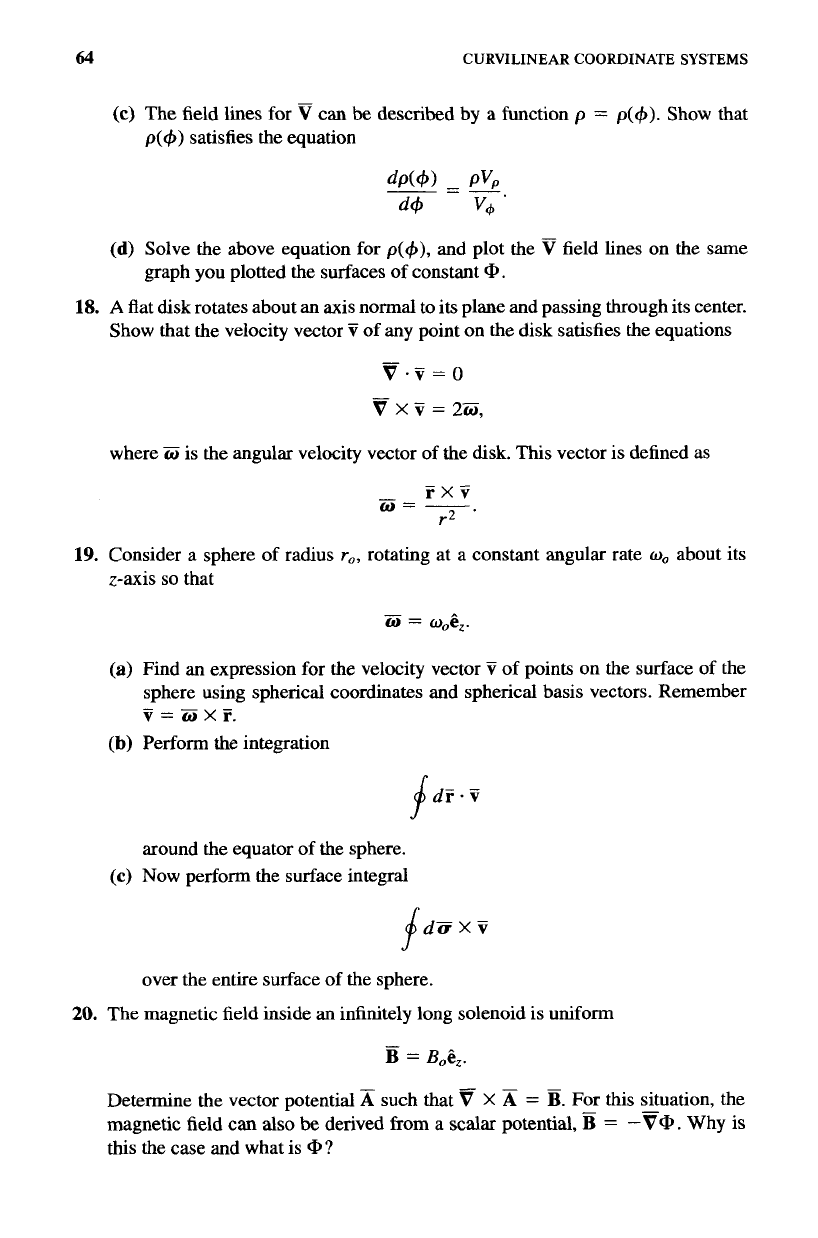
The field lines for
v
can
be
described by a function
p
=
~(4).
Show
that
p(4)
satisfies the equation
dP(4)
-
PV,
d4
v4'
(d)
Solve the above equation for
~(4).
and plot the
v
field lines on the same
18.
A
flat disk rotates about an axis normal to its plane and passing through its center.
graph you plotted the surfaces of constant
@
.
Show that the velocity vector
V
of
any point on the disk satisfies the equations
v*Ti=o
VXTi=2W,
-
-
where
W
is the angular velocity vector of the disk.
This
vector is defined as
19.
Consider a sphere of radius
r,,
rotating at a constant angular rate
w,
about its
z-axis
so
that
(a)
Find an expression for the velocity vector
V
of points on the surface of the
sphere
using
spherical coordinates and spherical basis vectors. Remember
v=wxi.
-
(b)
Perform the integration
around the equator
of
the sphere.
(c)
Now
perform the surface integral
jdWXV
over the entire surface of
the
sphere.
20.
The magnetic field inside
an
infinitely long solenoid
is
uniform
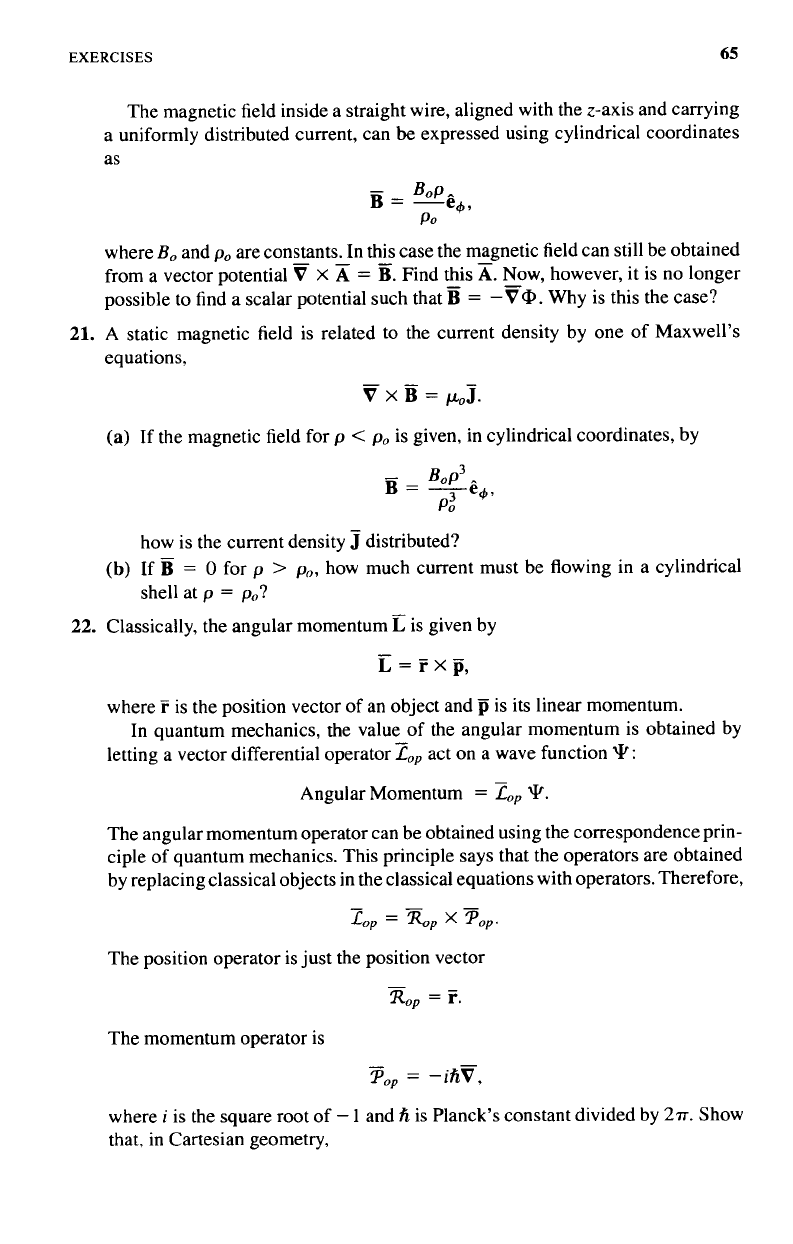
B
=
BOG,.
Determine the vector potential
h
such that
v
X
h
=
B.
For this situation, the
magnetic field can also
be
derived
from
a scalar potential,
B
=
--Fa.
Why
is
this
the case and what is
@?
EXERCISES
65
The magnetic field inside a straight wire, aligned with the z-axis and carrying
a uniformly distributed current, can
be
expressed using cylindrical coordinates
as
where
B,
and
po
are constants. In this case the magnetic field can still be obtained
from a vector potential
v
X
A
=
g.
Find this
A.
Now, however, it is no longer
possible to find a scalar potential such that
21.
A
static magnetic field is related to the current density by one of Maxwell’s
equations,
=
-v@.
Why is this the case?
-
v
x
B
=
poJ.
(a)
If the magnetic field for
p
<
po
is
given, in cylindrical coordinates, by
how is the current density
1
distributed?
shell at
p
=
po?
(b)
If
B
=
0
for
p
>
p,,
how much current must be flowing in a cylindrical
22.
Classically, the angular momentum is given by
-
L=FXP,
where
F
is
the position vector
of
an object and
letting a vector differential operator
Top
act on a wave function
q:
is its linear momentum.
In quantum mechanics, the value
of
the angular momentum is obtained by
Angular Momentum
=
Top
9.
The angular momentum operator can be obtained using the correspondence prin-
ciple of quantum mechanics. This principle says that the operators are obtained
by replacing classical objects in the classical equations with operators. Therefore,
-
.cop
=
RP
x
Fop.
Rep
=
F.
The position operator is just the position vector
-
The momentum operator is
-
pop
=
-iiiV,
where
i
is
the square root of
-
1
and
fi
is
Planck’s constant divided by
27-r.
Show
that,
in
Cartesian geometry,