
Kusse B.R., Westwig E.A. Mathematical Physics: Applied Mathematics for Scientists and Engineers
Подождите немного. Документ загружается.

36
DIFFERENTIAL AND INTEGRAL OPERATIONS
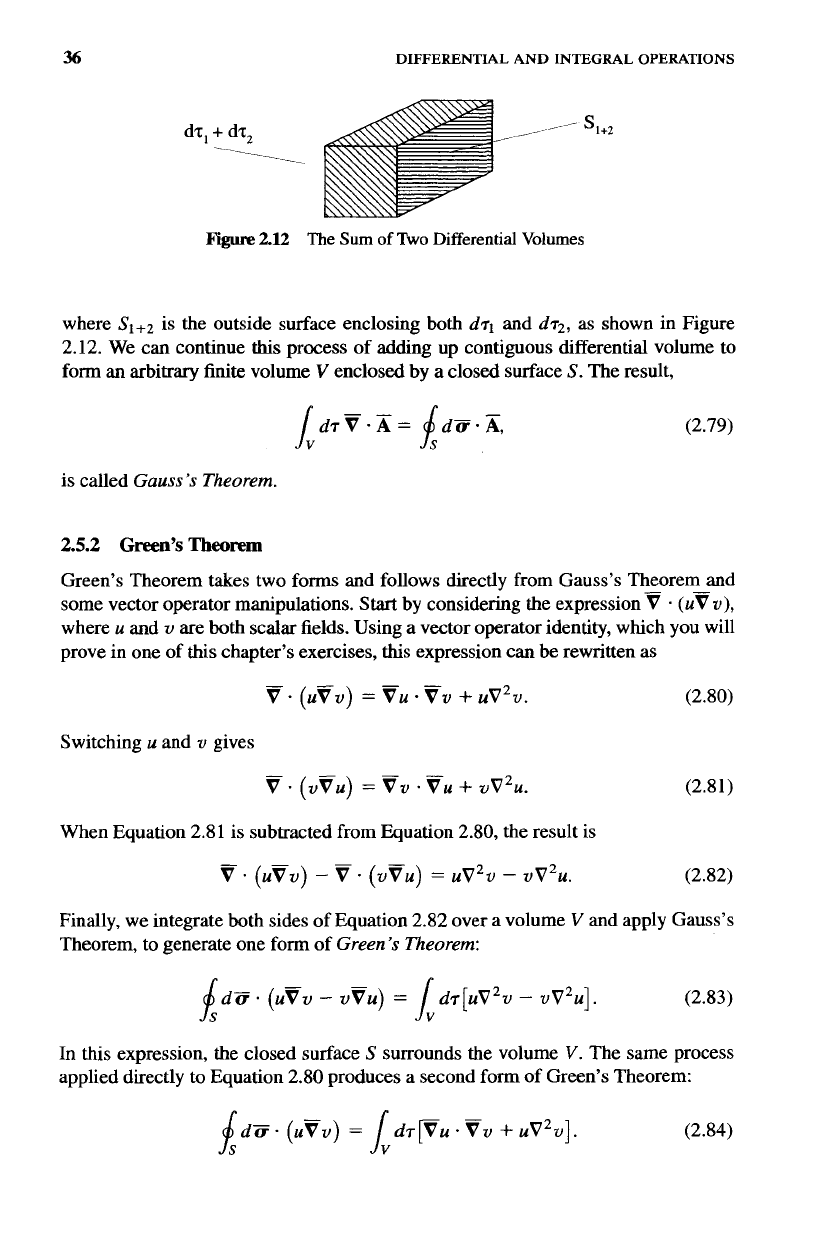
Figure
2.12
The
Sum
of
Two
Differential
Volumes
where
S1+2
is the outside surface enclosing both
dq
and
d72,
as shown in Figure
2.12. We
can
continue
this
process
of
adding up contiguous differential volume
to
form
an arbitrary
finite
volume
V
enclosed by a closed surface
S.
The result,
is called
Gauss’s
Theorem.
(2.79)
2.5.2
Green’s
Theorem
Green’s Theorem takes two
forms
and follows directly from Gauss’s Theorem and
some vector operator manipulations.
Start
by considering the expression
.
(uvv),
where
u
and
u
are
both scalar fields. Using
a
vector operator identity, which you will
prove in one
of
this chapter’s exercises,
this
expression can be rewritten as
-
v
.
(UVU)
=
vu
-
vv
+
uv2v.
(2.80)
Switching
u
and
u
gives
v
.
(UVU)
=
vu
*
vu
+
vv2u.
(2.81)
When Equation 2.81 is subtracted from Equation 2.80, the result is
v
.
(UVV)
-
v
.
(VVU)
=
uv2v
-
vv2u.
(2.82)
Finally, we integrate both sides
of
Equation 2.82 over a volume
V
and apply Gauss’s
Theorem, to generate one form of
Green’s Theorem:
jdB.
(uvv
-
vvu)
=
dr[uV2v
-
vV2u].
S
(2.83)
In this expression, the closed surface
S
surrounds the volume
V.
The same process
applied directly
to
Equation 2.80 produces a second
form
of Green’s Theorem:
/dZF.
(uvv)
=
drFu*vv
+uV2v].
(2.84)
S
THE THEOREMS
37
2.5.3
Stokes’s
Theorem
Stokes’s Theorem derives from Equation
2.74,
(2.85)
where the path
C
encloses the differential surface
dZ
in the right-hand sense.
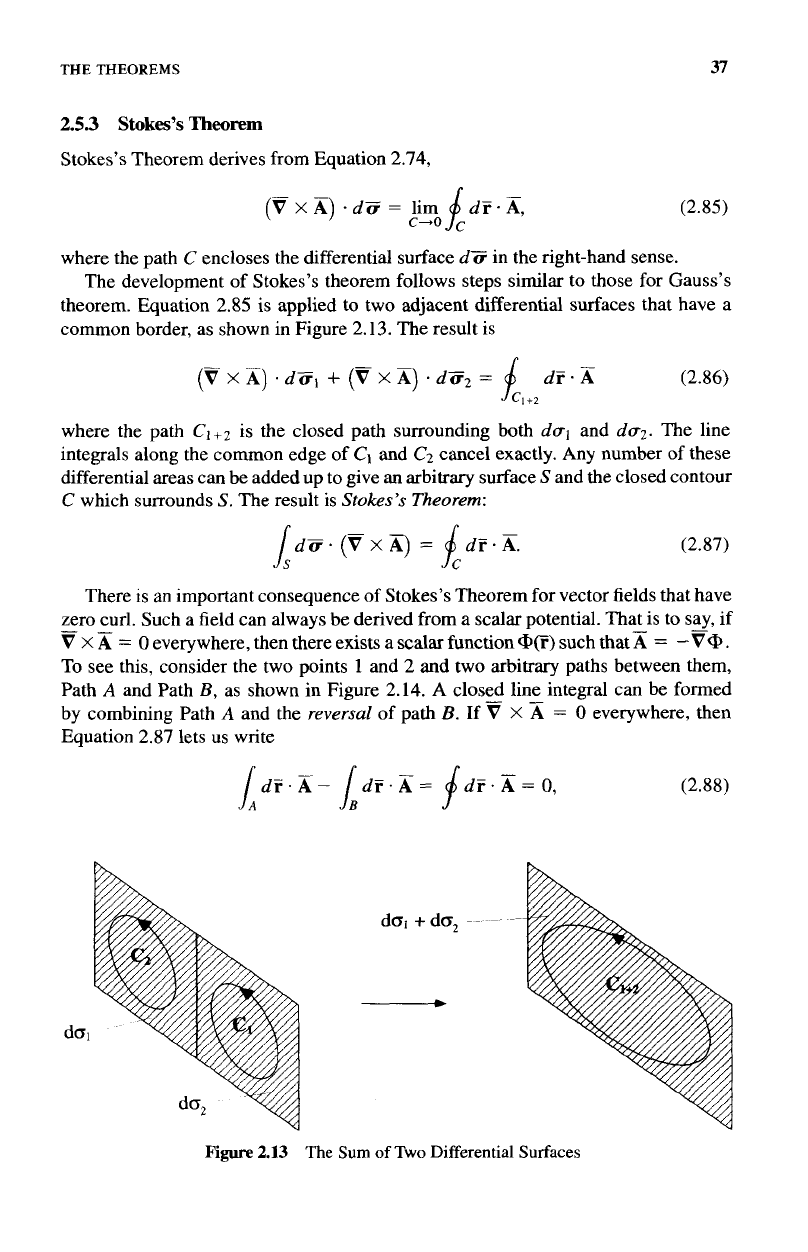
The development of Stokes’s theorem follows steps similar to those for Gauss’s
theorem. Equation
2.85
is
applied to two adjacent differential surfaces that have a
common border, as shown in Figure 2.13. The result is
(2.86)
where the path
CI+~
is the closed path surrounding both
dal
and
daz.
The line
integrals along the common edge
of
C1
and C2 cancel exactly. Any number of these
differential areas can be added up to give
an
arbitrary surface
S
and the closed contour
C
which surrounds
S.
The result
is
Stokes’s
Theorem:
(2.87)
There
is
an important consequence of Stokes’s Theorem for vector fields that have
-
zero curl. Such a field can always be derived from a scalar potential. That is to say, if
V
X
x
=
0
everywhere, then there exists a scalar function
a@)
such that
A
=
-v@.
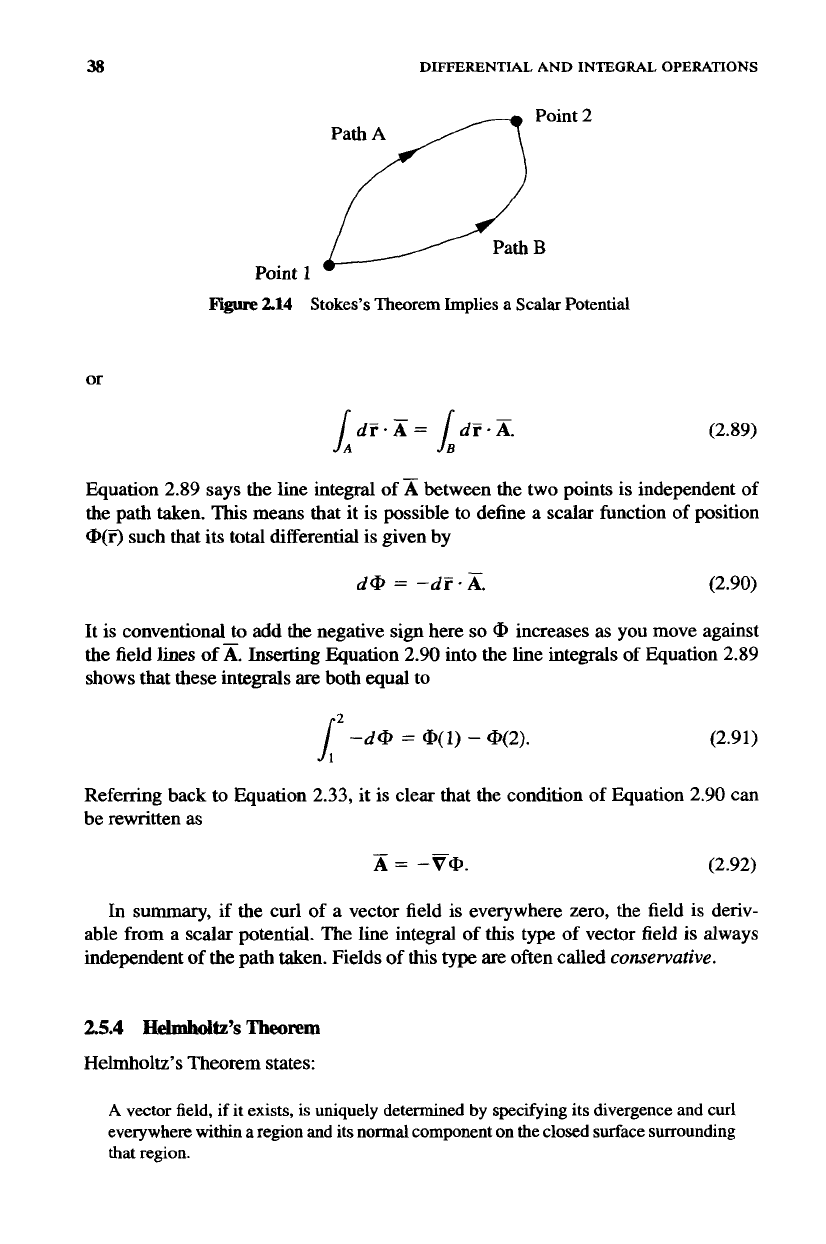
To see this, consider the two points
1
and 2 and two arbitrary paths between them,
Path
A
and Path
B,
as shown in Figure 2.14.
A
closed line integral can be formed
by combining Path
A
and the
reversal
of
path
B.
If
X
A
=
0
everywhere, then
Equation 2.87 lets
us
write
(2.88)
Figure
2.13
The
Sum
of
Two
Differential
Surfaces
38
DIFFERENTIAL AND INTEGRAL
OPERATIONS
Point 2
B
Point
1
Figure
214
Stokes’s Theorem Implies
a
Scalar Potential
(2.89)
or
Equation 2.89 says the line integral of
A
between the two points is independent of
the path taken.
This
means that it
is
possible to define a scalar function
of
position
@(f)
such that its total differential is given by
d@
=
-df*A.
(2.90)
It is conventional to add the negative sign here
so
Q,
increases
as
you move against
the field lines
of
A.
Inserting
Equation 2.90 into the line integrals of Equation 2.89
shows that these integrals are both
equal
to
1
-d@
=
@(1)
-
@(2).
(2.91)
Referring back
to
Equation 2.33, it is clear that the condition
of
Equation 2.90 can
be rewritten as
-
A=
-V@.
(2.92)
In
summary, if the curl
of
a vector field
is
everywhere zero, the field
is
deriv-
able from a scalar potential. The line integral of
this
type
of
vector field
is
always
independent of the path taken. Fields of
this
type
are often called
conservative.
25.4
Helmhdtz’s
Theorem
Helmholtz’s Theorem states:
A
vector field, if it exists, is uniquely determined by specifying its divergence and curl
everywhere
within
a
region and its normal component on
the
closed surface surrounding
that region.
THE THEOREMS
39
There are two important parts of
this
statement. On one hand, it says if we have a
field
v
that we are trying to determine, and we know the values of
V
.
V
and
v
X
v
at every point in some volume, plus the normal component
of
fi
on the surface of
that volume, there is only one
fi
that will make
all
this work. On the other hand, we
have the disclaimer, “if it exists.” This qualification is necessary because it
is
entirely
possible to specify values for the divergence, curl, and normal component of a vector
field that cannot be satisfied by any field.
To
prove Helmholtz’s Theorem we will assume the two vector fields
vl
and
v2
have the same values for the divergence, curl, and normal component. Then we show
that if this is the case, the two solutions must
be
equal.
Let
w
=
v1
-
v,.
Since
the divergence, curl, and the dot product are all linear operators,
%’
must have the
following properties:
-_
-_
V
*
W
=
0
V
x
w
=
0
ii.
W
=
o
in the region
in the region
on the surface.
-
(2.93)
Because
v
X
=
0,
can be derived from a scalar potential
w=
-V@.
(2.94)
Green’s Theorem, in the
form
of
Equation
2.84,
is
now applied with
u
=
u
=
give
to
jd*.@(V@)
=
S,d+V.
(U@)
+V@..@
S
Inserting Equation 2.94 into Equation 2.95 gives
j
da
.
CDW
=
kdr(@8.
w
-
w.
W).
S
(2.96)
Using Equations
2.93,
the surface integral on the
LHS
and the volume integral
of
@v
.
Won the
RHS
are zero, with the result that
-_
(2.97)
Because
lWI2
is
always
a positive quantity, the only way to satisfy Equation 2.97 is
to have
W
=
0
everywhere. Consequently,
v1
=
v2
and
Helmholtz’s
Theorem
is
proven.
Helmholtz’s Theorem
is
useful for separating vectors fields into two parts, one
with zero curl, and one with zero divergence.
This
discussion relies on two identities
V.(tTXK)
=o
(2.98)
VXT@
=o,
(2.99)
-
40
DIFFERENTIAL AND INTEGRAL
OPERATIONS
which you will prove at the end of the chapter. Write
v
as
(2.100)
-
V=VXA-V@.
Then we can write:
-
v
.v
=
-V2@
-
v
x
v
=
v
x
v
x
K.
ii.v=
ii-
(VXA-ED),
(2.101)
Since the divergence, curl, and normal component are all specified if and
@
are
specified, Helmholtz’s Theorem says
v
is also uniquely specified. Notice the
contribution to
v
that comes from
has no divergence since
v
*
(v
X
;Ir>
=
0.
This
is called the rotational or solenoidal part
of
the field and
is called the vector
potential. The portion of
X
v@
=
0.
This is called the irrotational part of the field and
@
is
called the scalar potential.
which arises from
@
has
no
curl, because
EXERCISES
FOR
CHAPTEX
2
1.
Consider the two-dimensional scalar potential function
CP(x,y)
=
x3
-
3y2x.
Make a plot
of
the equipotential contours for three positive and three negative
values for
CP.
Find
v@
.
Show that the
v@
field lines are given by setting
3x2y
-
y3
equal to a series
of constants.
Plot six representative
V@
field lines. Be sure to indicate the direction
of
the
field and comment on its magnitude.
Find
V
*
VCP,
the divergence
of
the
v@
vector field, and show that
your
field lines
of
part (d) agree with
this
divergence.
electric dipole
p
is located at the origin
of
a Cartesian system. This dipole
__
creates an electric potential field
@@)
given
by
where
F
is
the position vector,
F
=
ni4.
Let
(a)
Sketch the equipotential lines,
@
=
constant.
(b)
Find the electric field,
a
=
-v@.
(c)
Sketch the electric field lines.
=
p&.
EXERCISES
41
3.
Perform the line integral
/dFXv,
C
where
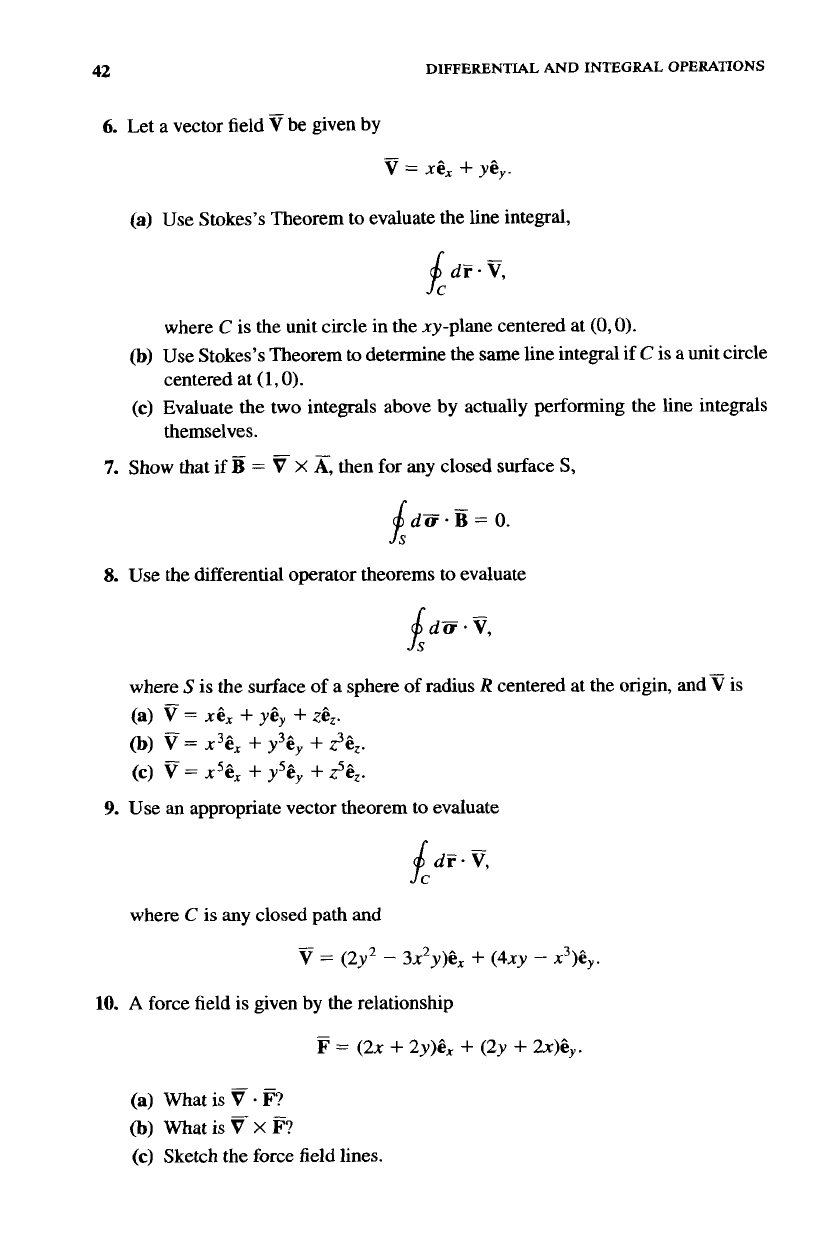
C
is
the contour shown below
Y
C
1
-1
and
(a)
V=
v,&,.
(b)
v=
V&.
(c)
v
=
v,r
VOY
(a)
7,
(fA)
=
f(T-K)
+A.Vj.
-
F2T
X2
+
y2
+
-
,&+
4.
Use subscript/summation notation
to
verify the following identities:
(b)
VXvXA=V(V.-A;)
-V2A.
(c)
vx
(fA)
=f(VXA)
+VfXA.
(f)
=
fVg
+
gvf.
(g)
V(A.B)
=Ax
(VxB)
+Bx
(VXX)
+
(A.V)B+
(B3)A.
(d)
V-((AXB)=B*(VXA)-A*(TXB).
(e)
AX
(VxB)
=
(VB)
.A-
(A.V)B.
(h)
X
V,f
=
0.
(i)
V.
(V
x
A)
=
O.
5.
Calculate the work done by following
a
straight line path from the Cartesian
point
(1,
1)
to
(3,3),
if
the force exerted
is
given by
F
=
(x
-
y)Cx
+
(x
+
y)$.
Can this force be derived from a scalar potential?
Pick
any other path that goes
from (1,l) to
(3,3)
and calculate the work done.
42
DIFFERENTIAL AND INTEGRAL
OPERATIONS
6.
Let a vector field
v
be given by
-
v
=
xb
+
yey.
(a)
Use Stokes’s Theorem to evaluate the line integral,
where
C
is the unit circle in the xy-plane centered at
(0,O).
centered at
(1,O).
themselves.
(b)
Use Stokes’s Theorem to determine the same
line
integral
if
C
is
a unit circle
(c)
Evaluate the two integrals above by actually performing the line integrals
7.
Show that
if
B
=
7
X
x,
then for any closed surface
S,
kd5.B
=
0.
8.
Use the differential operator theorems to evaluate
jkdT.V,
S
where
S
is the surface of a sphere
of
radius
R
centered at the origin, and
v
is
(a)
V
=
xQ
+
yzY
+
z&.
(b)
v
=
x3&
+
y3Cy
+
$6,.
(c)
v
=
x5Q
+
y5zy
+
2$.
9.
Use an appropriate vector theorem to evaluate
where
C
is any closed path and
-
v
=
(2y2
-
3x2y)Cx
+
(4xy
-
x3)@,.
10.
A
force field
is
given by the relationship
-
F
=
(2x
+
2y)&
+
(2y
+
2x)iiy.
(a)
What
is
v
-
F?
(c)
Sketch the force field lines.
What is
V
x
F?
EXERCISES
43
(d)
This is a conservative field. What is its potential?
(e)
Sketch the equipotentials.
11.
The continuity equation for a fluid is
JP
at
L-
V.J+-=O,
where
J
=
pv.
(a)
Show
V
-
V
=
0
if the
fluid
is incompressible (constant density).
(b)
Apply Gauss’s Theorem to the continuity equation and interpret the result.
--
12.
Prove these integral
forms
of
the differential operators:
13.
Maxwell’s equations in vacuum are
Manipulate these using subscript/summation notation to obtain the wave equation
in vacuum:
3
CURVILINEAR COORDINATE
SYSTEMS
Up to
this
point,
our
discussions of vector, differential, and integral operations have
been limited to Cartesian coordinate systems. While conceptually simple, these sys-
tems often fail to utilize the natural symmetry of certain problems. Consider the
electric field vector created by a point charge
q,
located at the origin of a Cartesian
system. Using Cartesian basis vectors,
this
field is
(3.1)
In
contrast, a spherical system, described by the coordinates
(r,
8,
+),
fully exploits
the symmetry
of
this
field and simplifies Equation
3.1
to
The spherical system belongs to the class
of
curvilinear
coordinate systems. Basis
vectors of a curvilinear system
are
orthonormal, just like those of Cartesian systems,
but their directions can
be
functions of position.
This chapter generalizes the concepts of the previous chapters to include curvi-
linear coordinate systems. The two most common systems, spherical
and
cylindrical,
are described first, in order to provide
a
framework for the more abstract discussion
of
generalized
curvilinear coordinates that follows.
3.1
THE
POSITION
VECTOR
The position vector
F(P)
associated with a point
P
describes the offset
of
P
from the
origin of the coordinate system. It has a magnitude equal
to
the distance from the
origin
to
P,
and a direction that points from the origin to
P.
44
THE CYLINDRICAL SYSTEM
45
Figure
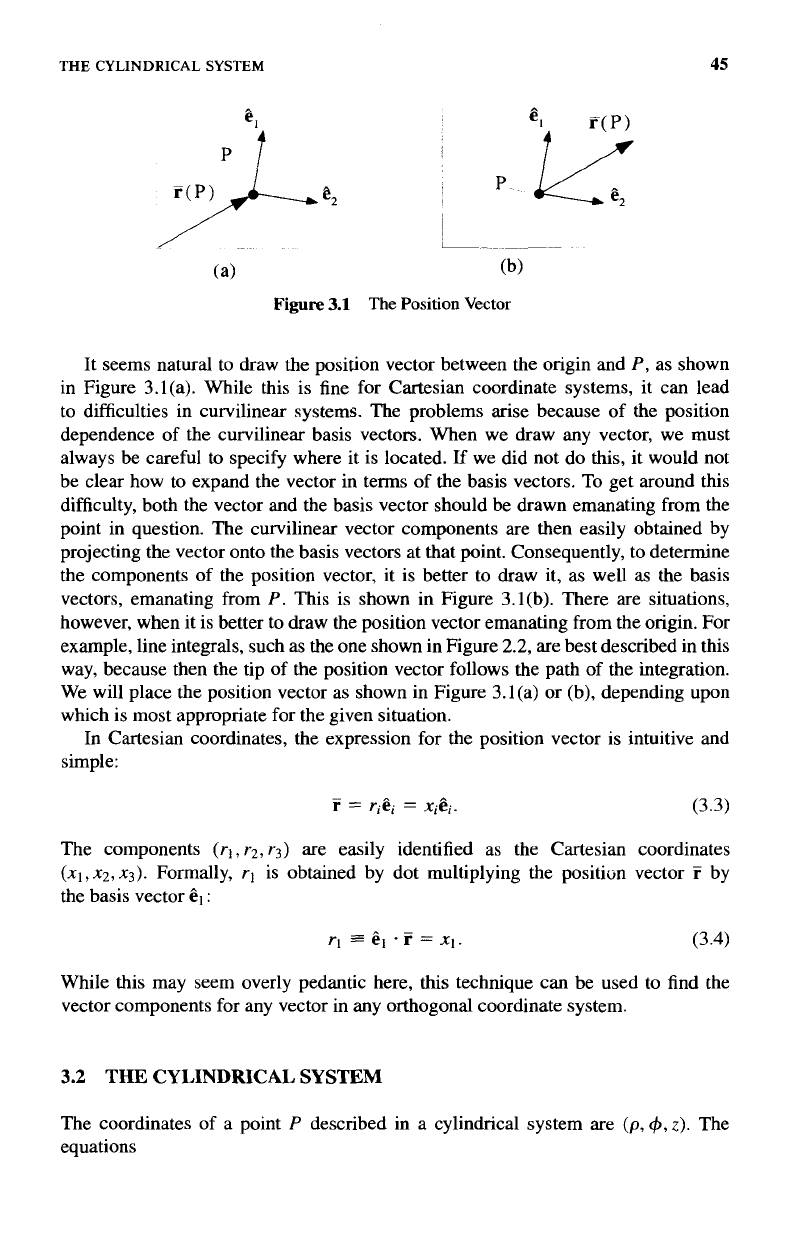
3.1
The
Position
Vector
It seems natural to draw the position vector between the origin and
P,
as shown
in Figure 3.l(a). While this is fine for Cartesian coordinate systems, it can lead
to difficulties in curvilinear systems. The problems arise because of the position
dependence of the curvilinear basis vectors. When we draw any vector, we must
always be careful to specify where it is located.
If
we did not do this, it would not
be clear how to expand the vector in terms of the basis vectors.
To
get around this
difficulty, both the vector and the basis vector should be drawn emanating from the
point in question. The curvilinear vector components are then easily obtained by
projecting the vector onto the basis vectors at that point. Consequently, to determine
the components of the position vector, it is better to draw it,
as
well
as
the basis
vectors, emanating from
P.
This is shown in Figure 3.l(b). There are situations,
however, when it is better to draw the position vector emanating from the origin. For
example, line integrals, such as the one shown in Figure
2.2,
are best described in this
way, because then the tip
of
the position vector follows the path of the integration.
We will place the position vector as shown in Figure 3.l(a) or (b), depending upon
which is most appropriate for the given situation.
In Cartesian coordinates, the expression for the position vector is intuitive and
simple:
The components
(rl
,
rz,
r3)
are easily identified as the Cartesian coordinates
(xl,xz,xj).
Formally,
r1
is obtained by dot multiplying the position vector
f
by
the basis vector
:
While this may seem overly pedantic here, this technique can be used to find the
vector components for any vector in any orthogonal coordinate system.
3.2
THE
CYLINDRICAL
SYSTEM
The coordinates of a point
P
described in a cylindrical system are
(p,
4,~).
The
equations