
Kusse B.R., Westwig E.A. Mathematical Physics: Applied Mathematics for Scientists and Engineers
Подождите немного. Документ загружается.

6
A
REVIEW
OF
VECTOR
AND
MATRIX
ALGEBRA
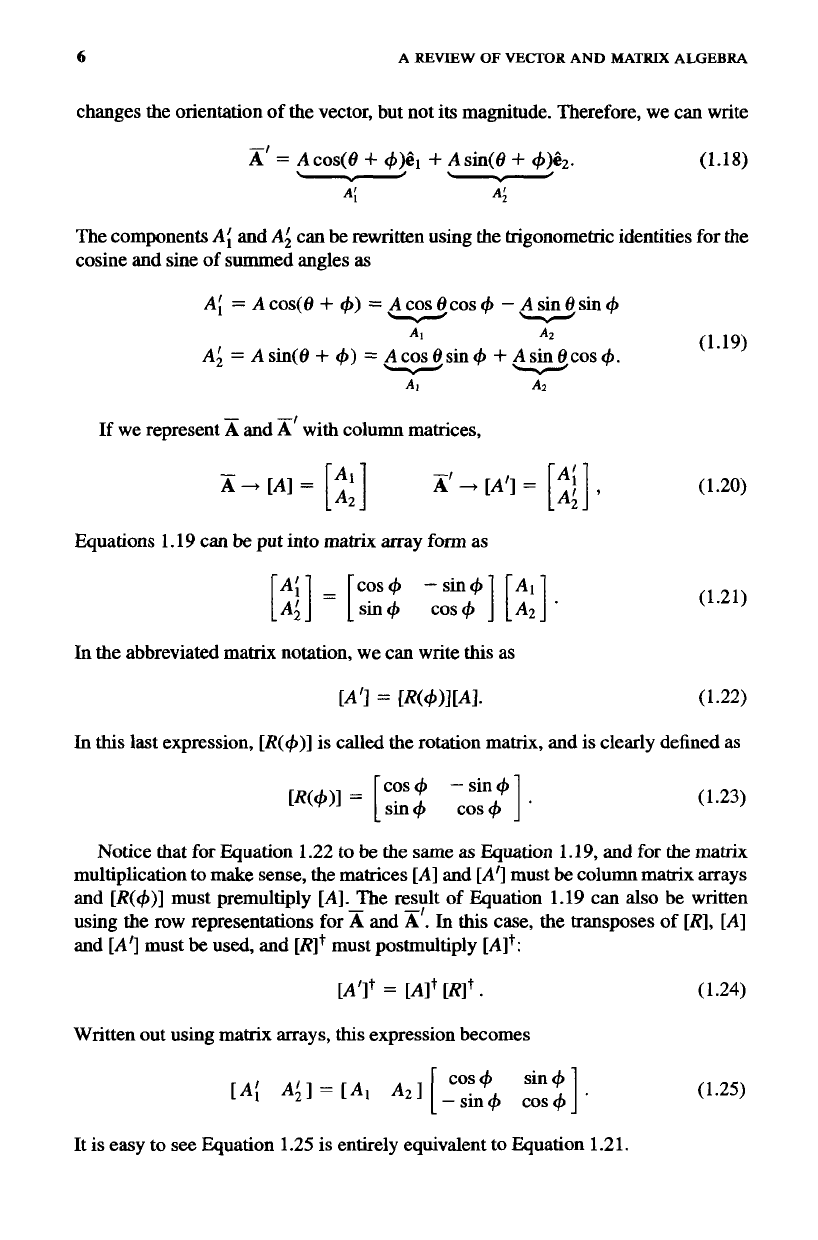
changes the orientation of the vector, but not its magnitude. Therefore, we can write
A’
=
A
cos(8
+
+)el
+
A
sin(8
+
4)&.
(1.18)
--
A: A:
The components
A:
and
A;
can be rewritten using the trigonometric identities for
the
cosine and sine
of
summed angles
as
A;
=
Acos(8
+
4)
=
Acos8cos4
-
AsinOsin4
-
*
(1.19)
AI
A2
A;
=
Asin(8
+
4)
=
Acos8sin4 +Asin8cos4.
+
*
If we represent
A
and
A’
with column matrices,
-
A
-+
[A]
=
[::I
x’
-+
[A‘]
=
,
Equations 1.19 can be
put
into matrix array form as
(1.20)
(1.21)
In
the abbreviated matrix notation. we can write
this
as
In
this
last expression, [R(4)] is called the rotation matrix, and is clearly defined as
cos+ -sin+
(1.23)
Notice that for Equation 1.22
to
be
the same
as
Equation
1.19, and for
the
matrix
multiplication
to
make sense, the matrices [A] and
[A’]
must
be
column matrix arrays
and [R(4)] must premultiply [A]. The result of Equation 1.19 can also be written
using the row representations for
A
and
A‘.
In
this
case, the transposes of [R], [A]
and [A’] must be used, and [RIt must postmultiply [AIt:
[A’It
=
[AIt [RIt. (1.24)
Written out using matrix arrays,
this
expression becomes
(1.25)
It is easy to
see
Equation 1.25 is entirely equivalent to Equation 1.2 1.
VECTOR
OPERATIONS
7
These same manipulations can
be
accomplished using subscriptlsummation nota-
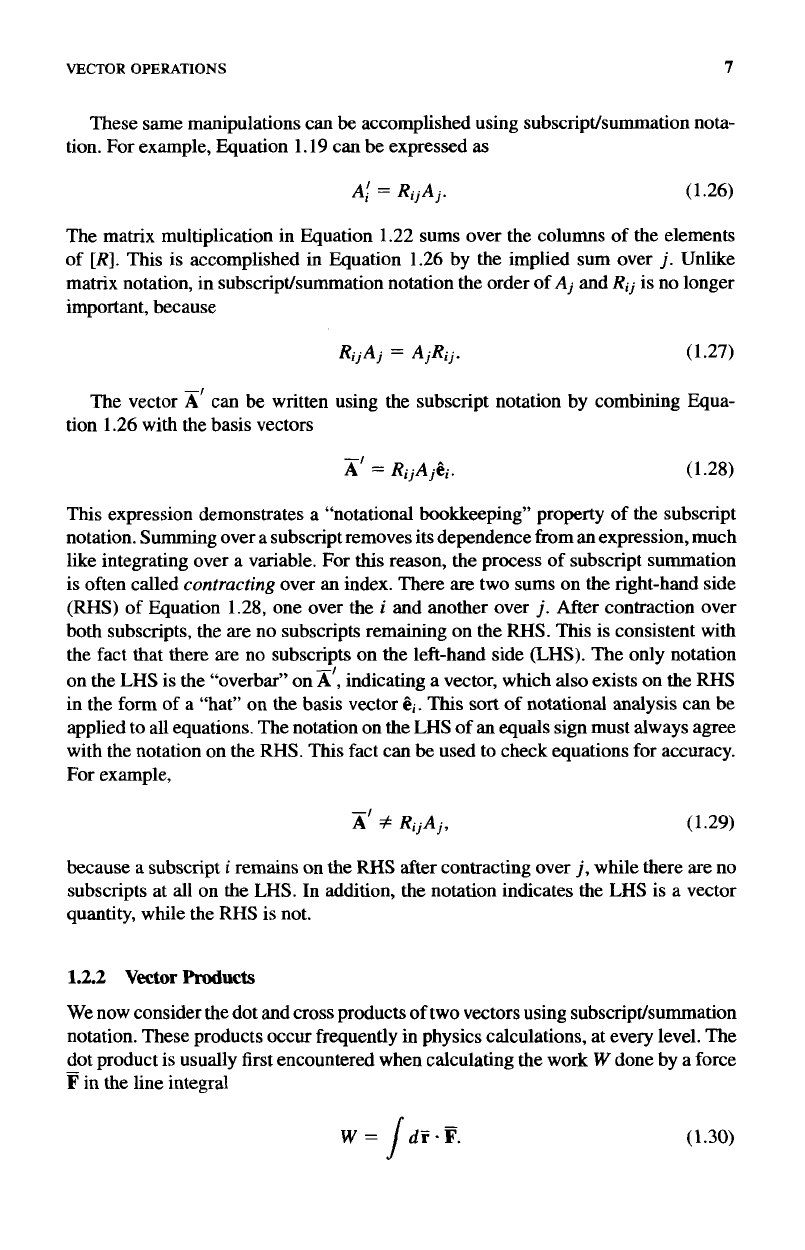
tion. For example, Equation 1.19 can be expressed
as
A;
=
R.
1J
.A
J
..
(1.26)
The matrix multiplication in Equation 1.22 sums over the columns of the elements
of
[R].
This is accomplished in Equation 1.26 by the implied
sum
over
j.
Unlike
matrix notation, in subscriptlsummation notation the order of
A,
and
Rij
is no longer
important, because
R.
‘I
.A
J
.
=
A
J
.R..
‘I’
(1.27)
The vector
;I’
can
be written using the subscript notation by combining Equa-
tion
l
.26 with the basis vectors
This expression demonstrates a “notational bookkeeping” property of the subscript
notation. Summing over a subscript removes its dependence from anexpression, much
like integrating over a variable. For
this
reason, the process of subscript summation
is
often called
contracting
over an index. There
are
two sums on the right-hand side
(RHS)
of Equation 1.28, one over the
i
and another over
j.
After contraction over
both subscripts, the are no subscripts remaining on the
RHS.
This
is consistent with
the
fact that there are no subscripts on the left-hand side
(LHS).
The only notation
on the
LHS
is the “overbar” on
h‘,
indicating a vector, which also exists on the
RHS
in the form of a “hat” on the basis vector
@i.
This
sort of notational analysis can be
applied to all equations. The notation on the
LHS
of
an
equals sign must always agree
with the notation on the
RHS.
This
fact can
be
used to check equations for accuracy.
For example,
&’
f
RijAj,
(1.29)
because a subscript
i
remains on the
RHS
after contracting over
j,
while there are no
subscripts at all on the
LHS.
In addition, the notation indicates the
LHS
is a vector
quantity, while the
RHS
is not.
1.2.2
Vector
Products
We now consider the dot and cross products of two vectors using subscriptlsummation
notation. These products occur frequently in physics calculations, at every level. The
dot product is usually first encountered when calculating the work
W
done by a force
F
in
the
line integral
-
W
=
1dF-F.
(1.30)
8
A
REVIEW
OF
VECTOR
AND
MATRIX
ALGEBRA
In this equation,
d?
is a differential displacement vector. The cross product can be
used to find the force on a particle
of
charge
q
moving with velocity
t
in an externally
applied magnetic field
B:
F
=
q(V
x
B).
The
Dot
Product
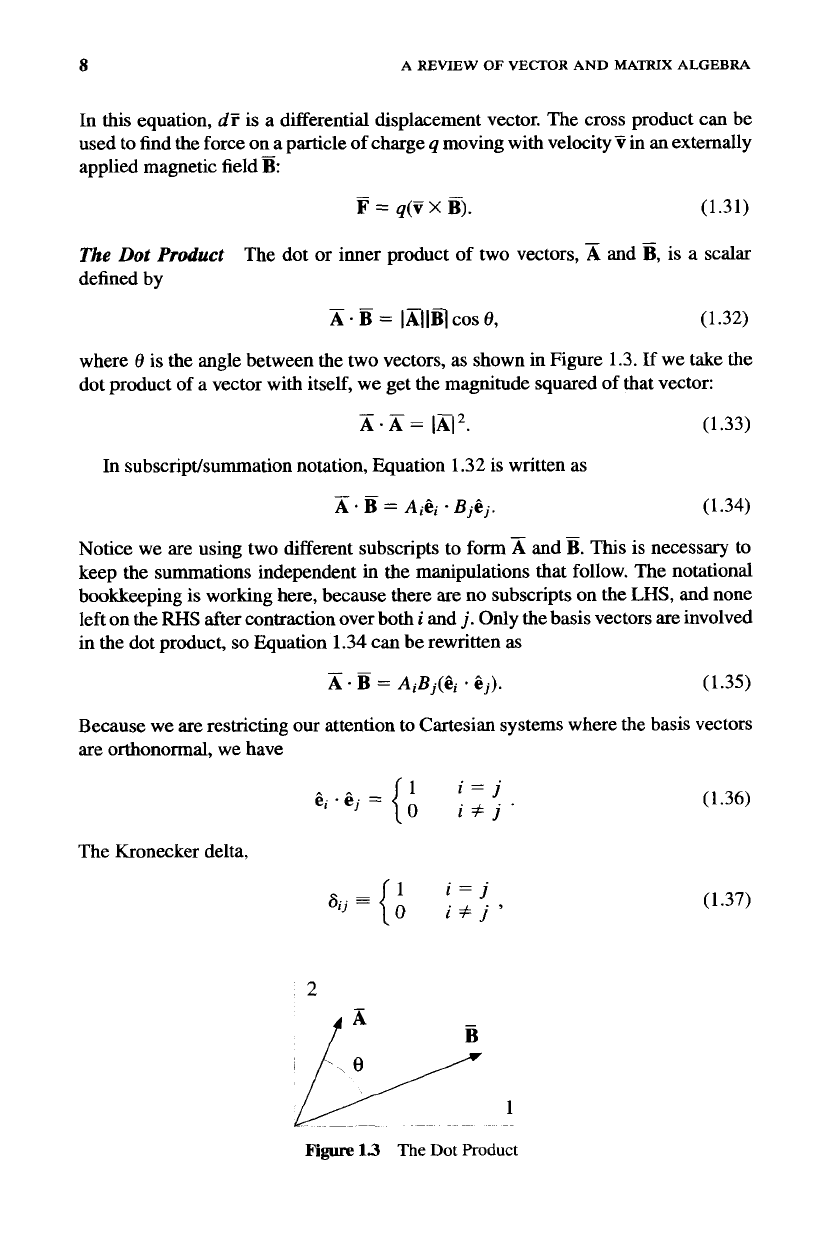
The dot or inner product
of
two vectors,
defined by
(1.31)
and
B,
is a scalar
-
A
.
B
=
IKl
I@
cos
0,
(1.32)
where
0
is the angle between the two vectors, as shown
in
Figure 1.3.
If
we take the
dot product of a vector with itself, we get the magnitude squared of that vector:
-
A.
h
=
&I2.
(1.33)
In
subscripthmmation notation, Equation
1.32
is written as
--
A.B=A.C..B.C.
11
JJ'
(1.34)
Notice we are using two different subscripts to form and
B.
This
is necessary to
keep the summations independent in the manipulations that follow. The notational
bookkeeping
is
working here, because there
are
no subscripts on the
LHS,
and none
left on the
RHS
after contraction over both
i
and
j.
Only the basis vectors are involved
in the dot product,
so
Equation 1.34 can be rewritten as
--
A. B
=
AiBj(Ci
*
@j).
(1.35)
Because we are restricting our attention to Cartesian systems where the basis vectors
are orthonormal, we have
The Kronecker delta,
8..
Ee
'J
{A
2
rl"
(1.36)
(1.37)
Figure
13
The
Dot
Product
VECTOR
OPERATIONS
9
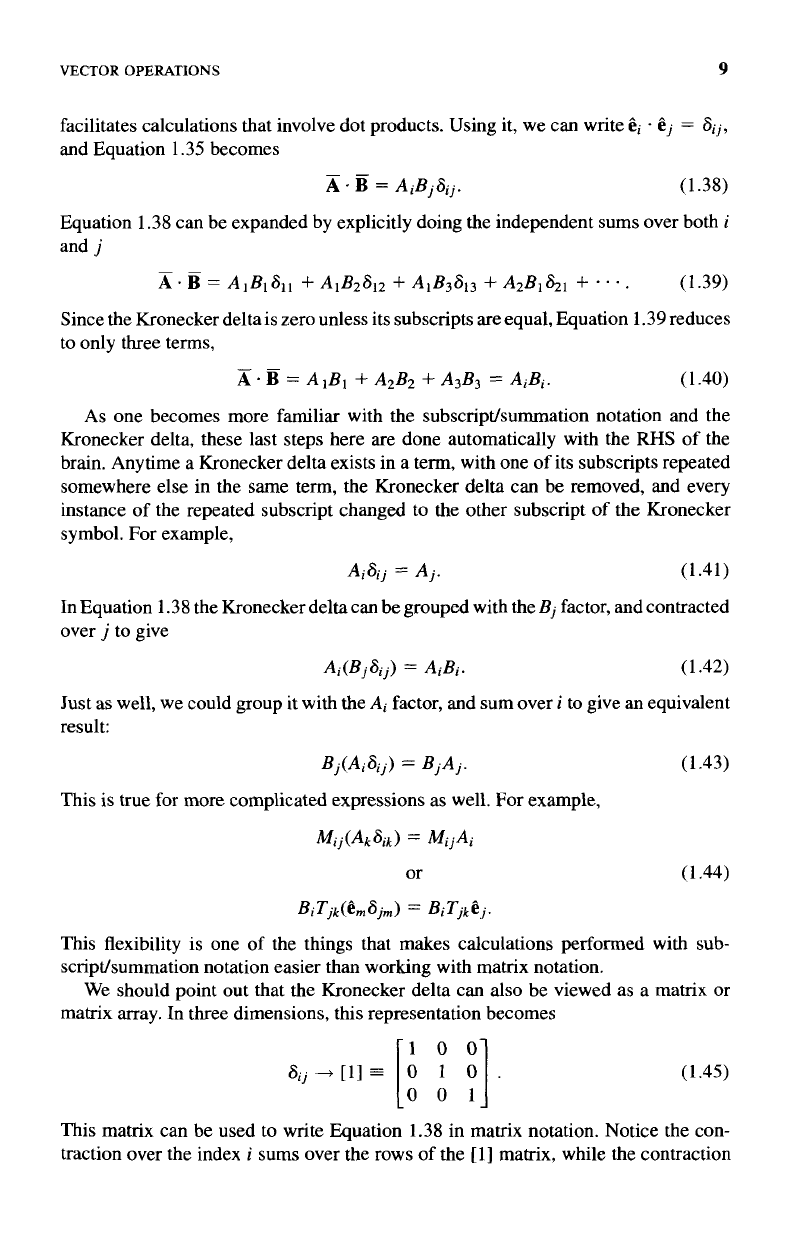
facilitates calculations that involve dot products. Using it, we can write
Ci
.
@;
=
a,;,
and Equation 1.35 becomes
--
A
'
B
=
AiBj6ij.
(1.38)
Equation 1.38 can be expanded by explicitly doing the independent sums over both
i
and
j
A.B=AIB1611 +AlB2612 +A1B3613 +A2B1&1
+
....
(1.39)
Since the Kronecker delta is zero unless its subscripts are equal, Equation 1.39 reduces
to only thee terms,
--
A.
B
=
AlBl
+
AzB2
+
A3B3 AiBi.
(1.40)
As
one becomes more familiar with the subscript/summation notation and the
Kronecker delta, these last steps here are done automatically with the
RHS
of
the
brain. Anytime a Kronecker delta exists in a term, with one
of
its subscripts repeated
somewhere else in the same term, the Kronecker delta can be removed, and every
instance
of
the repeated subscript changed to the other subscript of the Kronecker
symbol. For example,
A.6..
1
'J
=A.
J-
(1.41)
In
Equation 1.38 the Kronecker delta can be grouped with the
B;
factor, and contracted
over
j
to give
Ai(B;&j)
=
AiBi.
(1.42)
Just as well, we could group it with the
Ai
factor, and sum over
i
to give an equivalent
result:
Bj(Ai6i;)
=
Bj
A;.
(1.43)
This is true for more complicated expressions as well.
For
example,
Mij(Ak6ik)
=
MijAi
or (1.44)
Bi
T;k(C,
a;,,,)
=
Bi TjkC
j.
This flexibility is one
of
the things that makes calculations performed with sub-
scripthmmation notation easier than working with matrix notation.
We should point out that the Kronecker delta can also be viewed as a matrix
or
matrix array. In thee dimensions, this representation becomes
6,j
+
[I]
=
0
1
0
.
(1.45)
This matrix can be used to write Equation
1.38
in matrix notation. Notice the con-
traction over the index
i
sums over the rows of the
[
13
matrix, while the contraction
[:
:]
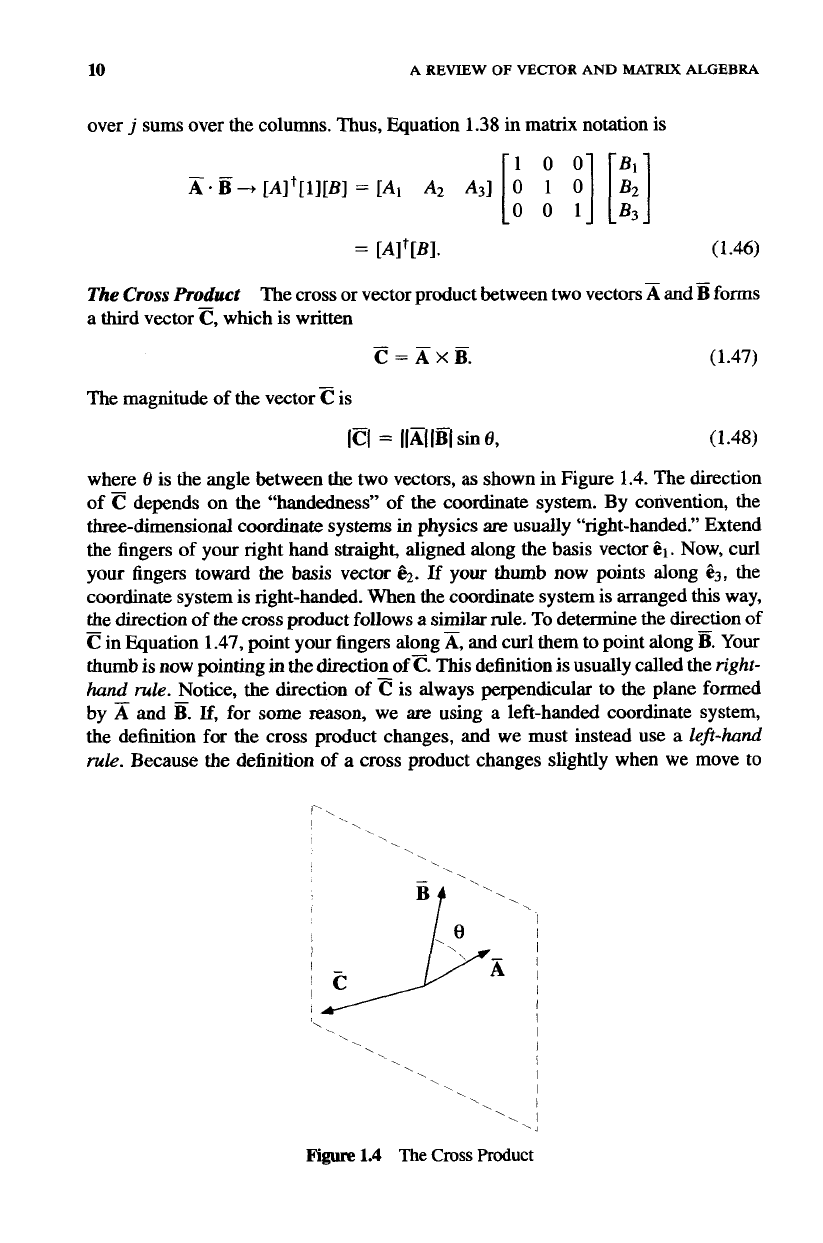
10
A
REVIEW OF
VECTOR
AND
MATRIX
ALGEBRA
over
j
sums
over the columns. Thus, Equation
1.38
in matrix notation is
100
001
x.B-+[A]t[l][B]
=
[A1
A2
A31
[0
1
01
[ii]
=
[AIt[B].
(1.46)
The
Cross
Product
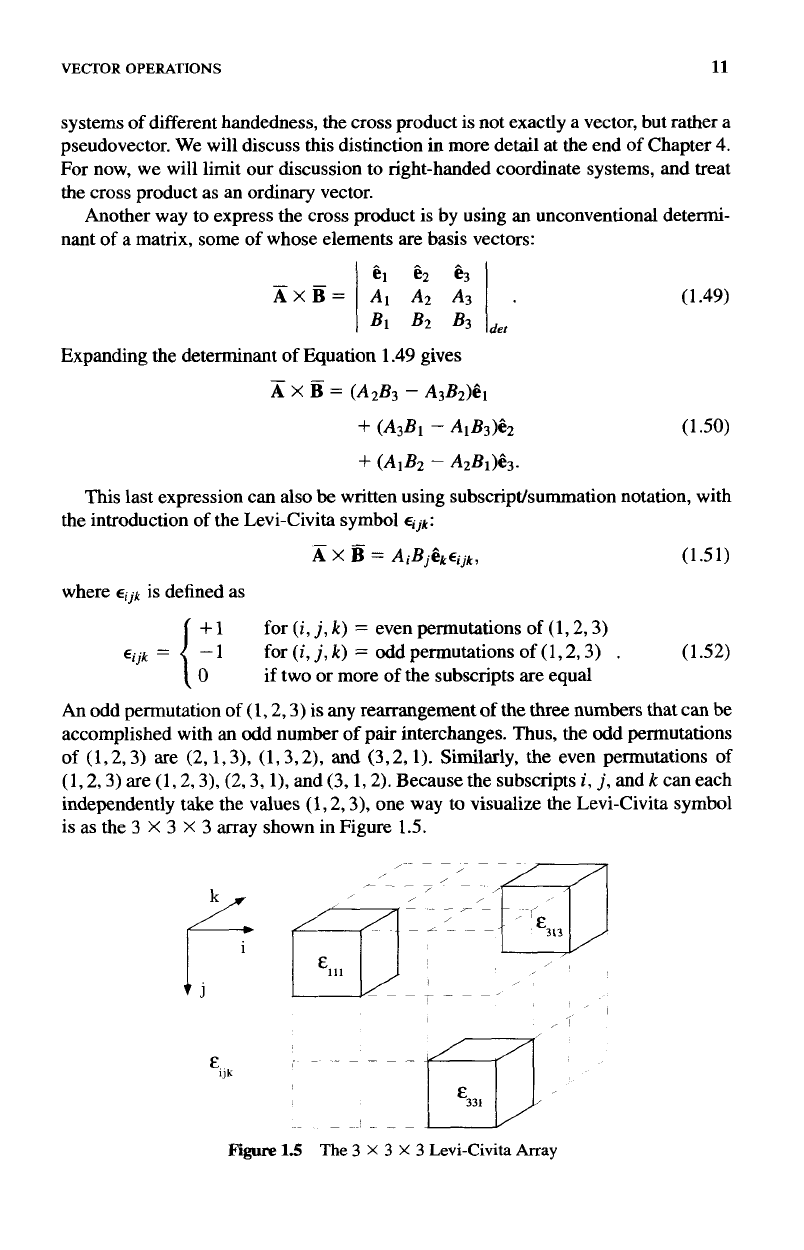
The cross or vector product between two vectors
a third vector
c,
which
is
written
andB forms
-
C=AXB.
(
1.47)
The magnitude of the vector
e
is
where
8
is
the angle between the two vectors,
as
shown in Figure
1.4.
The direction
of
c
depends on the “handedness” of the coordinate system. By convention, the
three-dimensional coordinate system
in
physics
are
usually “right-handed.’’ Extend
the fingers of your right hand
straight,
aligned along the basis vector
61.
Now, curl
your fingers toward
&he
basis
vector
$2.
If
your
thumb
now points along
63,
the
coordinate system
is
right-handed. When the coordinate system
is
arranged
this
way,
the direction
of
the
cross
product follows a
similar
rule.
To
determine the direction
of
C
in Equation
1.47,
point your fingers along
A,
and curl them
to
point along
B.
Your
thumb
is
now pointing
in
the direction
of
e.
This
definition
is
usually called the
right-
hand
mle.
Notice, the direction of is always perpendicular to the plane formed
by
A
and
B.
If,
for some reason, we
are
using a left-handed coordinate system,
the definition for the cross product changes, and we must instead use a
left-hand
rule.
Because the definition of a cross product changes slightly when we move to
-
I
I
,
\
\
\
\
,
\
\
‘.
‘
Figure
1.4
The
Cross
Product
-1
VECTOR
OPERATIONS
11
systems
of
different handedness, the cross product is not exactly a vector, but rather a
pseudovector. We will discuss
this
distinction in more detail at the end of Chapter
4.
For now, we will limit our discussion to right-handed coordinate systems, and treat
the cross product as an ordinary vector.
Another way to express the cross product is by using an unconventional determi-
nant of a matrix, some of whose elements
are
basis vectors:
Expanding the determinant of quation
1.49
gives
(
1.49)
This last expression can also
be
written using subscript/summation notation, with
the introduction of the Levi-Civita symbol
Gjk:
where
Eijk
is defined as
+
1 for
(i,
j,
k)
=
even permutations
of
(1,2,3)
if two or more of the subscripts are equal
1
for
(i,
j,
k)
=
odd
permutations
of
(1,2,3)
.
(1.52)
An
odd permutation
of
(1,2,3) is any rearrangement of the three numbers that can be
accomplished with an odd number
of
pair interchanges. Thus, the odd permutations
of (1,2,3) are (2,1,3), (1,3,2), and (3,2,1). Similarly, the even permutations of
(1,2,3) are (1,2,3), (2,3,
l),
and (3,1,2). Because
the
subscripts
i,
j,
and
k
can each
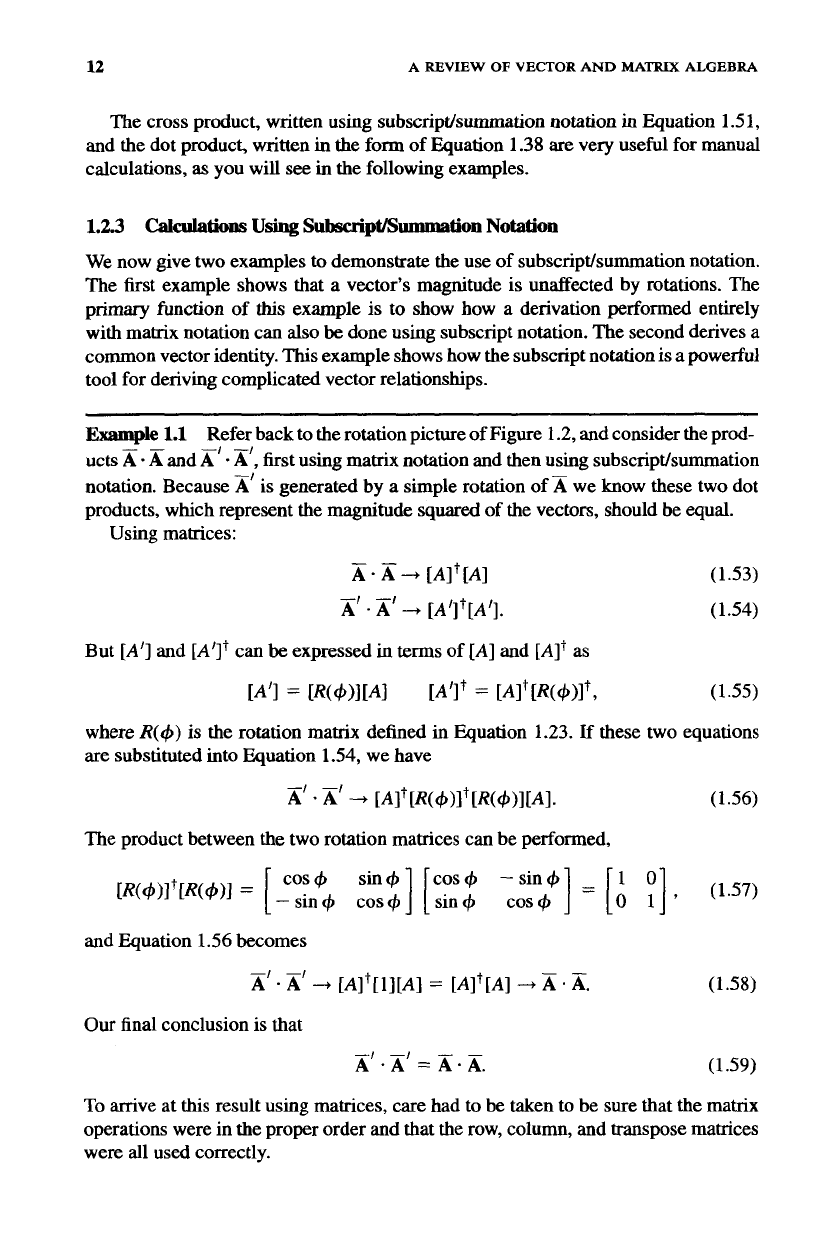
independently take the values (1,2,3), one way to visualize the Levi-Civita symbol
is as
the
3
X
3
X
3 array shown in Figure
1.5.
Figurr
1.5
The
3
X
3
X
3
Levi-Civita
Array
12
A
REVIEW
OF
VECTOR
AND
MATRIX
ALGEBRA
The cross product, written using subscriptlsummation notation
in
Equation 1.51,
and the dot product, written in the form
of
Equation 1.38 are very useful for manual
calculations,
as
you will
see
in the following examples.
1.2.3
calculations
Using
Subscript/summation
Notation
We now give two examples to demonstrate the use of subscript/summation notation.
The first example shows that a vector’s magnitude is unaffected
by
rotations. The
primary function of
this
example
is
to show how a derivation performed entirely
with matrix notation can also
be
done using subscript notation. The second derives a
common vector identity.
This
example shows how the subscript notation
is
a powerful
tool for deriving complicated vector relationships.
Example
1.1
Refer back to the rotation picture of Figure
1.2,
and consider the prod-
ucts
A
-
A
and
A
-
A
,
first using matrix notation and then using subscriptlsummation
notation. Because
A’
is
generated by a simple rotation of
A
we know these two dot
products, which represent the magnitude
squared
of
the vectors, should be equal.
-/
-/
__
Using matrices:
-
A
-
A
-+
[AIt[A]
A’.
A’
-+
[A’It[A’].
(1.53)
(
1.54)
But
[A’]
and
[Allt
can
be
expressed
in
terms of
[A]
and
[AIf
as
M’I
=
[N4)I[Al [A’]+
=
[Alt[R(4)lt,
(1.55)
where
R(+)
is
the rotation matrix defined
in
Equation 1.23.
If
these two equations
are substituted into Equation 1.54, we have
A’
’
A’
+
[Alt[R(4)lt[R(~,)I[Al.
(1.56)
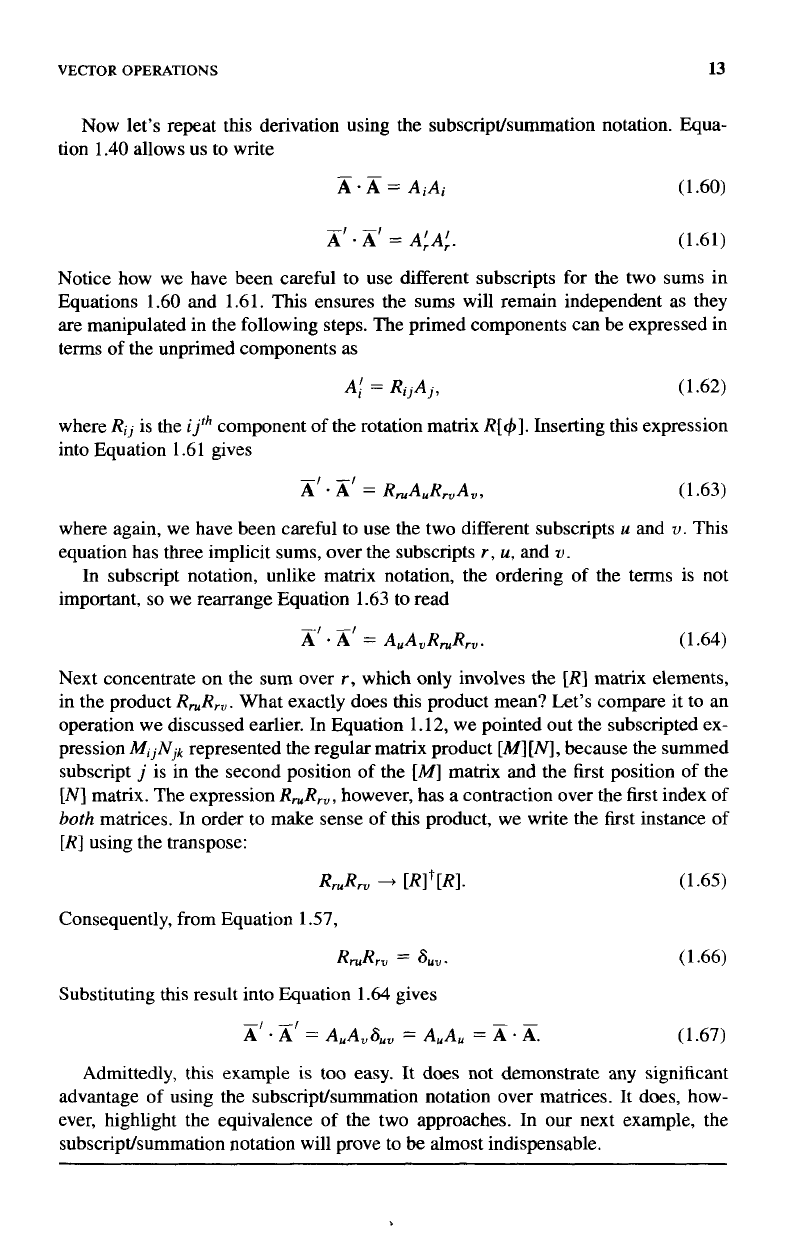
The product between the two rotation matrices can be performed,
and Equation 1.56 becomes
-/ -/
A -A
-i
[A]’[l][A]
=
[AIt[A]
-+A*A.
Our final conclusion is that
(1.58)
(1.59)
To
arrive at
this
result using matrices, care had to be taken to be sure that the matrix
operations were in the proper order and that the row, column, and transpose matrices
were all used correctly.
VECTOR
OPERATIONS
13
Now let’s repeat
this
derivation using the subscriptlsummation notation. Equa-
tion
l
.40
allows us to write
_-
A.
A
=
AiAi
(1.60)
(1.61)
A
.A
=
A:A:.
Notice how we have been careful to use different subscripts for the two sums in
Equations 1.60 and 1.61. This ensures the
sums
will remain independent as they
are manipulated in the following steps. The primed components can be expressed in
terms
of
the unprimed components as
-1 -1
A,!
=
R..A
‘I
I
.,
(1.62)
where
Rij
is the
ijth
component of the rotation matrix
R[4].
Inserting this expression
into Equation 1.61 gives
(1.63)
A
*A
=
R,A,R,,A,,
where again, we have been careful to use
the
two different subscripts
u
and
v.
This
equation has three implicit sums, over the subscripts
r,
u,
and
u.
In
subscript notation, unlike matrix notation, the ordering
of
the terms is not
important,
so
we rearrange Equation 1.63 to read
--I --I
(1.64)
A *A
=
A,A,R,R,,.
Next concentrate on the sum over
r,
which only involves the
[R]
matrix elements,
in the product
R,R,,.
What exactly does
this
product mean? Let’s compare it to an
operation we discussed earlier. In Equation 1.12, we pointed out the subscripted ex-
pression
MijNjk
represented the regular matrix product
[M][N],
because the summed
subscript
j
is in the second position
of
the
[MI
matrix and the first position of the
[N]
matrix. The expression
R,R,,,
however, has a contraction over the first index
of
both
matrices. In order to make sense
of
this product, we write the first instance
of
[R]
using the transpose:
--I
--I
RruRru
+
[Rlt [Rl-
(1.65)
Consequently, from Equation 1.57,
R,R,,
=
&,.
(1.66)
Substituting this
result
into Equation 1.64 gives
(1.67)
Admittedly, this example is too easy. It
does
not demonstrate any significant
advantage of using the subscriptlsummation notation over matrices. It does, how-
ever, highlight the equivalence
of
the two approaches. In our next example, the
subscriptlsummation notation will prove to
be
almost indispensable.
14
A
REVIEW
OF VECTOR
AND
MATRIX
ALGEBRA
~~~ ~~
Example
1.2
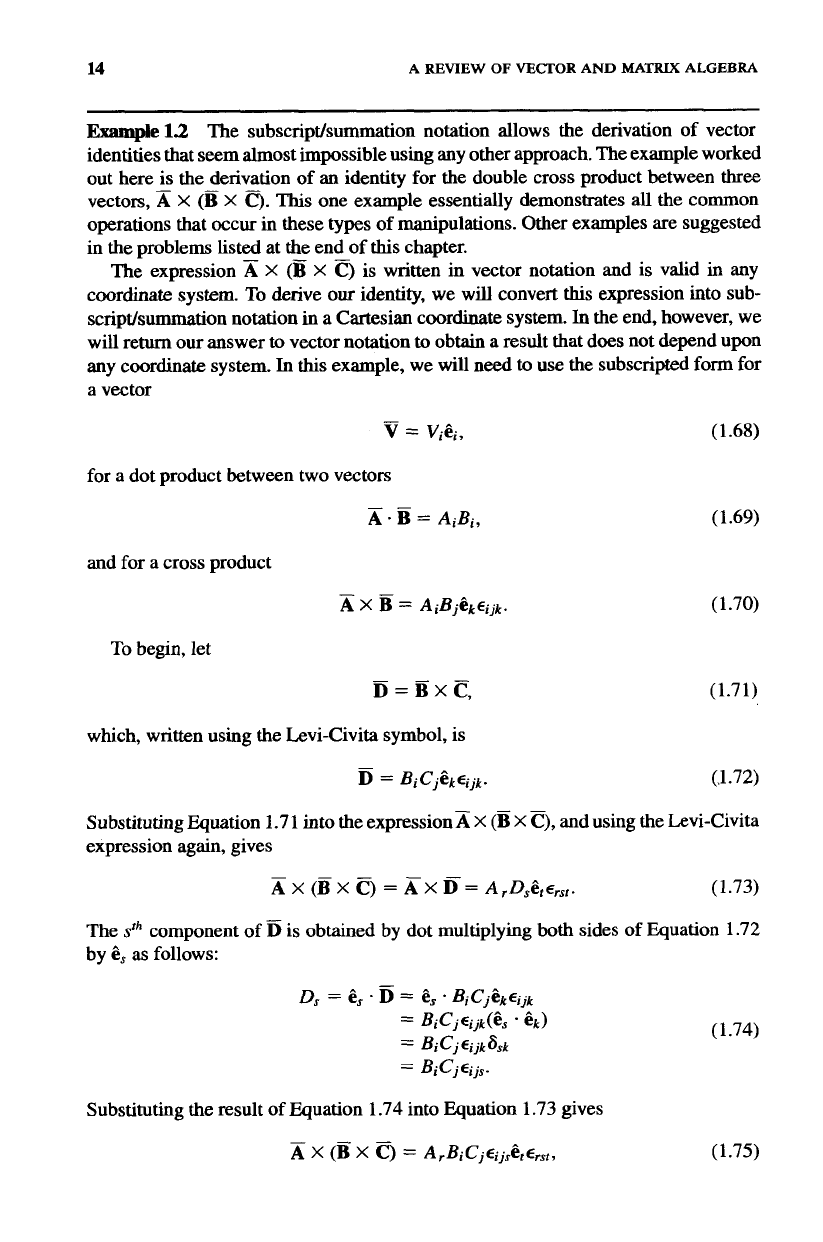
The subscript/summation notation allows the derivation
of
vector
identities that seem almost impossible using any other approach. The example worked
out here is the derivation of an identity for the double cross product between three
vectors,
X
(B
X
0.
This
one example essentially demonstrates all the common
operations that occur in these types of manipulations. Other examples are suggested
in the problems
listed
at the end of
this
chapter.
The expression
A
X
(B
X
c)
is written in vector notation and is valid
in
any
coordinate system.
To
derive
our
identity, we
will
convert
this
expression into sub-
script/summation notation
in
a Cartesian coordinate system.
In
the end, however, we
will return our answer to vector notation
to
obtain a result that does not depend upon
any coordinate system.
In
this
example, we will need to use the subscripted
form
for
a vector
-
v
=
Vi&, (1.68)
for a dot product between
two
vectors
__
A
*
B
=
AiBi,
(1.69)
and for a cross product
To
begin, let
-
D=BXC,
(1.71)
which, written using the Levi-Civita symbol,
is
=
BiCj&€ijk. (1.72)
Substituting Equation 1.71 into the expressionx
X
(BX
c),
and using
the
Levi-Civita
expression again, gives
Ax
(Bx
C)
=
Ax
D=
A~D~~+~E,.,~. (1.73)
The
sth
component of
D
is obtained by dot multiplying both sides of Equation 1.72
by
ii,
as
follows:
Substituting the result of Equation 1.74 into Equation 1.73 gives
(1.74)
(1.75)
EXERCISES
15
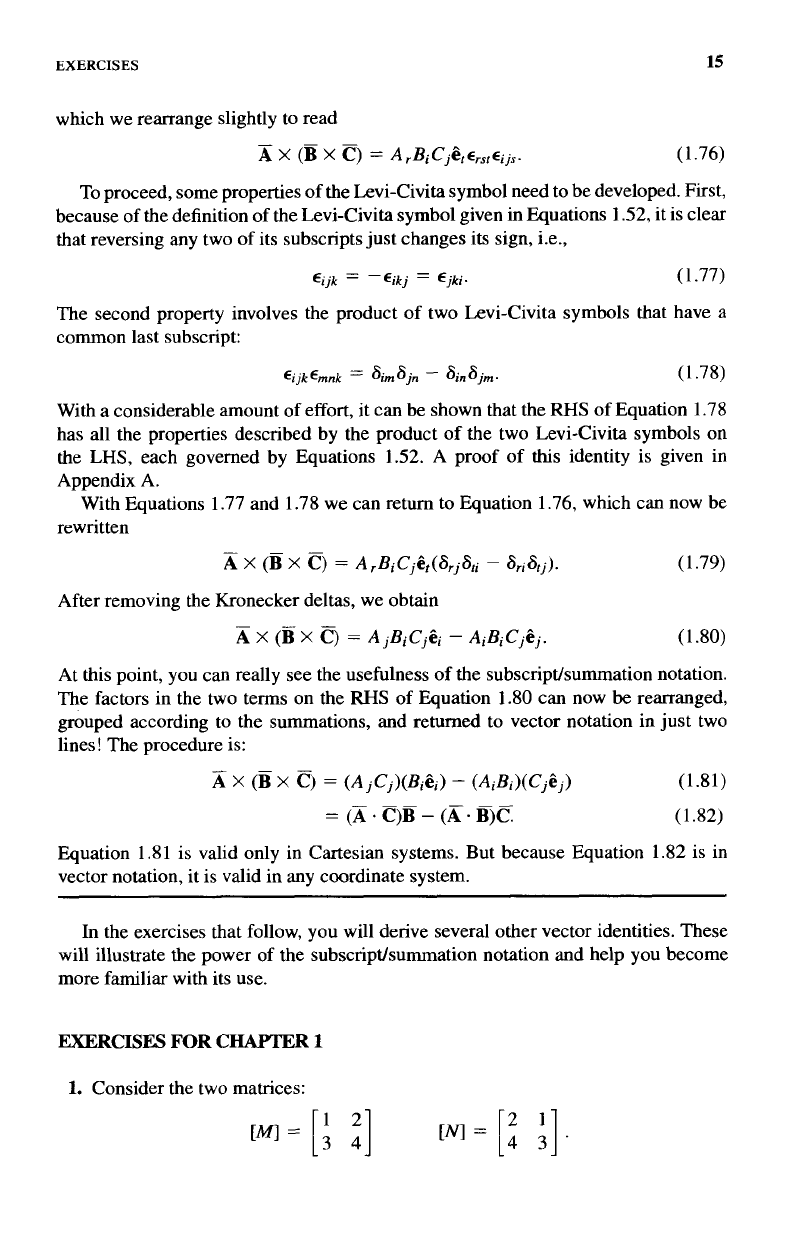
which we rearrange slightly to read
-
A
X
(B
X
C)
=
ArBiCjCtErstEijs.
(1.76)
To proceed, some properties of the Levi-Civita symbol need to be developed. First,
because of the definition of the Levi-Civita symbol given in Equations 1.52, it is clear
that reversing any two of its subscripts just changes its sign, i.e.,
E..
=
-E.
1kJ
.
=
E.
Jk1.
.
(1.77)
The second property involves the product of two Levi-Civita symbols that have a
common last subscript:
ZJk
EijkEmnk
=
8im8jn
-
8in8jm.
(1.78)
With a considerable amount of effort, it can be shown that the
RHS
of Equation 1.78
has all the properties described by the product of the two Levi-Civita symbols
on
the
LHS,
each governed by Equations 1.52. A proof of
this
identity is given in
Appendix
A.
With Equations 1.77 and 1.78 we can return to Equation 1.76, which can now be
rewritten
-
A
X
(B
X
C)
=
ArB,Cj&,(8,j&i
-
&atj).
(1.79)
After removing the Kronecker deltas, we obtain
-
A
X
(B
X
C)
=
AjBiCjCi
-
AiBiCjCj.
(1
30)
At this point, you can really see the usefulness of the subscript/summation notation.
The factors in the two terms on the
F2HS
of Equation 1.80 can now
be
rearranged,
grouped according to the summations, and returned to vector notation in just two
lines! The procedure is:
(1.81)
(1.82)
Equation 1.81 is valid only in Cartesian systems. But because Equation
1.82
is in
vector notation, it is valid in
any
coordinate system.
K
X
(B
X
C)
=
(AjCj)(BiCi)
-
(AiBi)(Cjej>
=
(K
*
C)B
-
(K-
B)C
In the exercises that follow, you will derive several other vector identities. These
will illustrate the power of the subscript/summation notation and help you become
more familiar with its use.
EXERCISES FOR CHAPTER
1
1.
Consider the two matrices: