
Kusse B.R., Westwig E.A. Mathematical Physics: Applied Mathematics for Scientists and Engineers
Подождите немного. Документ загружается.

26
DIFFERENTIAL AND INTEGRAL OPERATIONS
This says
CP
decreases by 2 units for every unit moved
in
that direction. If instead,
we were sitting at the point
(3,4)
and move an infinitesimal amount
dr,
at a 45-degree
angle with respect to the
x-axis,
changes by an amount
(2.37)
-7
=
-dr.
Jz
Notice, these changes are for infinitesimal quantities.
To
calculate the change
of
CP
over a finite path, where the gradient changes
as
we move from point to point, we
need to use a line integral
(2.38)
When using the gradient to generate a vector field, we usually add a negative sign
to the definition. For example, the electric field is generated from the electrostatic
potential by
-
E
=
-V@.
(2.39)
Using
this
convention, moving against the field lines increases
CP.
For the potential
of Equation 2.34, the negative gradient is
-
-
VCP
=
yGx
+
xi?,.
(2.40)
The field lines for
this
function can be determined as follows:
dY
-
x
dx
Y
-_-
dy y
=
dx x
y2
=
x2
+
c
x2
-
y2
=
c.
(2.41)
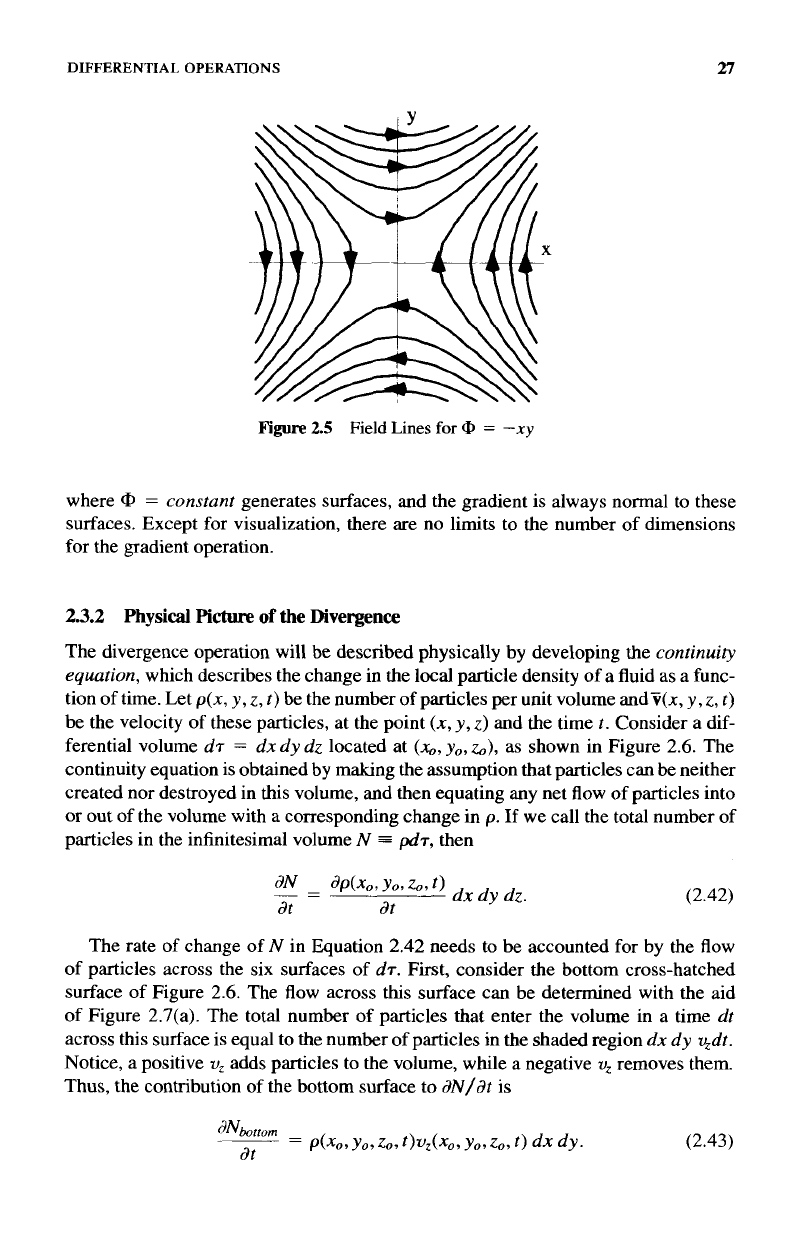
These lines are perpendicular to the lines
of
constant
@,
as shown
in
Figure
2.5.
Notice how the density of the vector field lines shows that the magnitude
of
the field
increases
as
you move away from the origin.
In
summary,
the gradient of a scalar function
CP
generates a vector field which, at
each point, indicates the direction
of
the greatest increase
of
@
and lies perpendicular
to the lines or surfaces of constant
@.
The example discussed above was worked
out in two dimensions, but the process can
also
be visualized in three dimensions,
DIFFERENTIAL
OPERATIONS
27
Figure
2.5
Field
Lines
for
@
=
-xy
where
CD
=
constant
generates surfaces, and the gradient is always normal to these
surfaces. Except for visualization, there are
no
limits to the number of dimensions
for the gradient operation.
2.3.2
Physical
Picture
of
the
Divergence
The divergence operation will be described physically by developing the
continuity
equation,
which describes the change in the local particle density of a fluid as a func-
tion of time. Let
p(x,
y,
z,
t)
be the number of particles per unit volume andT(x,
y.
z,
t)
be the velocity of these particles, at the point
(x,
y,
z)
and the time
t.
Consider a dif-
ferential volume
dr
=
dx dy dz
located at
(G,
yo,
G),
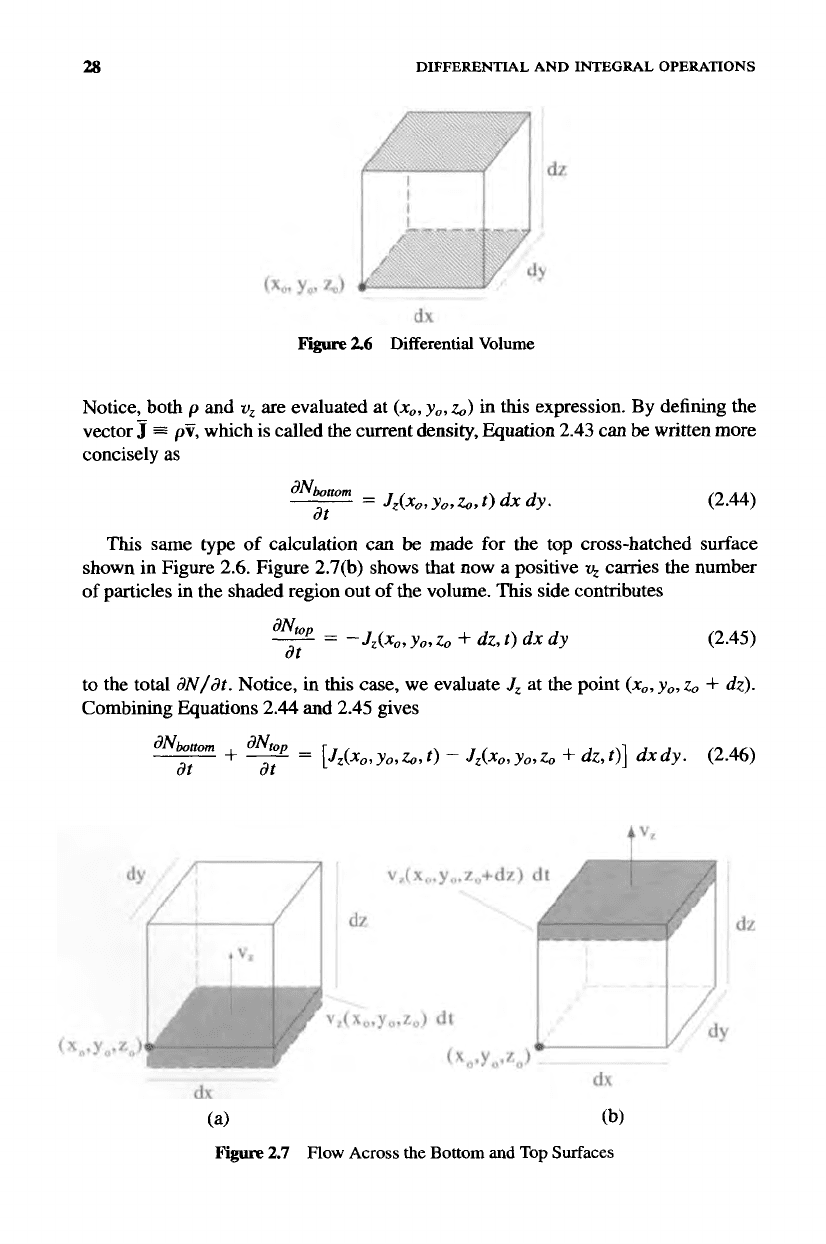
as shown in Figure 2.6. The
continuity equation is obtained by making the assumption that particles can be neither
created nor destroyed in this volume, and then equating any net flow of particles into
or
out of the volume with a corresponding change
in
p.
If
we call the total number
of
particles in the infinitesimal volume
N
=
pd~,
then
(2.42)
The rate
of
change
of
N
in Equation 2.42 needs to be accounted for by the flow
of particles
across
the six surfaces of
dr.
First, consider the bottom cross-hatched
surface of Figure 2.6. The flow across
this
surface can be determined with the aid
of Figure 2.7(a). The total number of particles that enter the volume in a time
dt
across this surface
is
equal to the number of particles in the shaded region
dx dy ydt.
Notice, a positive
v,
adds particles to the volume, while a negative
v,
removes them.
Thus, the contribution of the bottom surface to
dN/&
is
(2.43)
DIFFERENTIAL AND
INTEGRAL
OPERATIONS
dx
Figwt
2.6
Differential
Volume
Notice, both
p
and
v,
are evaluated at
(xo,
yo,
G)
in
this
expression.
By
defining the
vector
5
=
p3,
which is called the current density, Equation 2.43 can
be
written more
concisely as
(2.44)
This
same type
of
calculation
can
be
made for the top cross-hatched surface
shown in Figure 2.6. Figure 2.7(b) shows that now a positive
y
carries the number
of
particles in the shaded region out
of
the volume.
This
side contributes
JNbottom
~-
-
JJxo,
yo,
~0,
t)
dx dY.
at
(2.45)
to the total
dN/at.
Notice, in
this
case, we evaluate
J,
at the point
(a.
yo,
zo
+
dz).
Combining Equations 2.44 and 2.45 gives
dN0p
-
-Jz(x0,
yo,
zo
+
dz,
t)
dx dy
-_
at
aNbottom aNtop
-
+--
[JZ(xo,
yo,
zo,
t)
-
Jz(xo,
yo,
zo
+
dz,
t>]
dx
dy.
(2.46)
dt
at
dx
dx
(a>
(b)
Figure
2.7
Flow
Across
the
Bottom
and
Top
Surfaces
DIFFERENTIAL OPERATIONS
29
This last expression can be written in terms of the derivative of
Jz,
because in the
differential limit we have
Jz(xo,
YO,
zo
+
dz,
t)
=
Jz(xo,
yo,
zo?
t)
+
-
(2.47)
Substitution
of
Equation 2.47 into Equation 2.46 gives
(2.48)
Working on the other four surfaces produces similar results. The total flow into
the differential volume is therefore
--
which can be recognized as
-V
*
J
times
d7.
Combining
this
result with Equation
2.42 gives
us
the continuity equation:
(2.50)
For a positive divergence of
J,
more particles are leaving than entering a region
so
dp/dt
is negative.
This exercise provides us with a physical interpretation of the divergence. If the
divergence of a vector field
is
positive
in
a region,
this
region
is
a source. Field
lines are
“born”
in source regions. On the other hand,
if
the divergence in a region is
negative, the region is a sink. Field lines “terminate” in sink regions.
If
the divergence
of a vector field is zero in a region, then
all
field lines that enter it must
also
leave.
2.3.3
Physical
Picture
of
the
Curl
The curl of a vector field is a vector, which describes
on
a local scale
the field’s
circulation. From the word
curl,
itself, it seems reasonable to conclude that if a vector
field has a nonzero curl the field lines should be “curved,” while fields with zero curl
should be “straight.”
This
is a common misconception. It
is
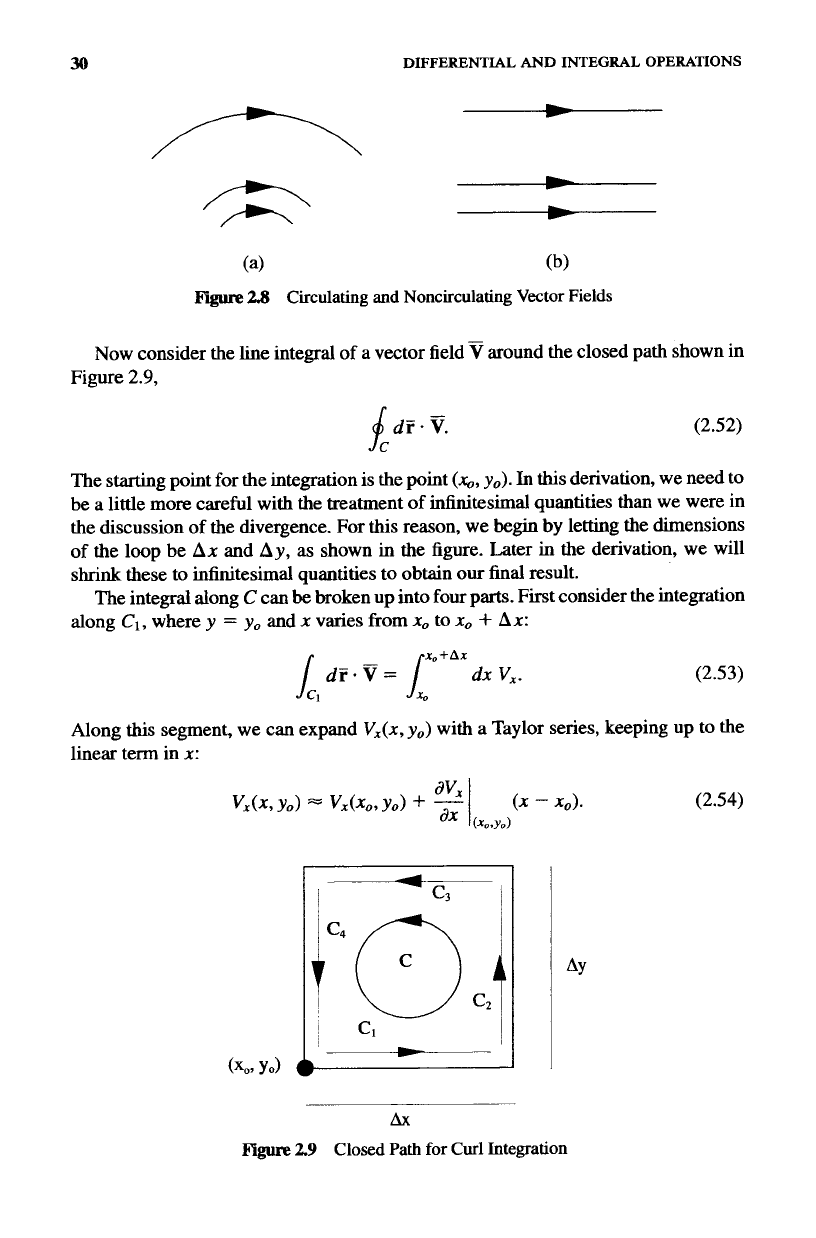
possible for vector field
lines to appear as shown in Figure 2.8(a), clearly describing a “curved” situation,
and have no curl.
Also,
the fields lines shown
in
Figure 2.8(b), which are definitely
“straight,” can have a nonzero curl. To resolve
this
confusion, we must
look
at the
curl on a differential scale.
Consider a vector field
v
that is a function
of
only
x
and
y.
The curl of this field
points in the z-direction, and according to Equation 2.29 is given by
(2.51)
for a Cartesian coordinate system.
30
DIFFERENTIAL
AND
INTEGRAL OPERATIONS
(4
(b)
Figure
2.8
Circulating and Noncirculating
Vector
Fields
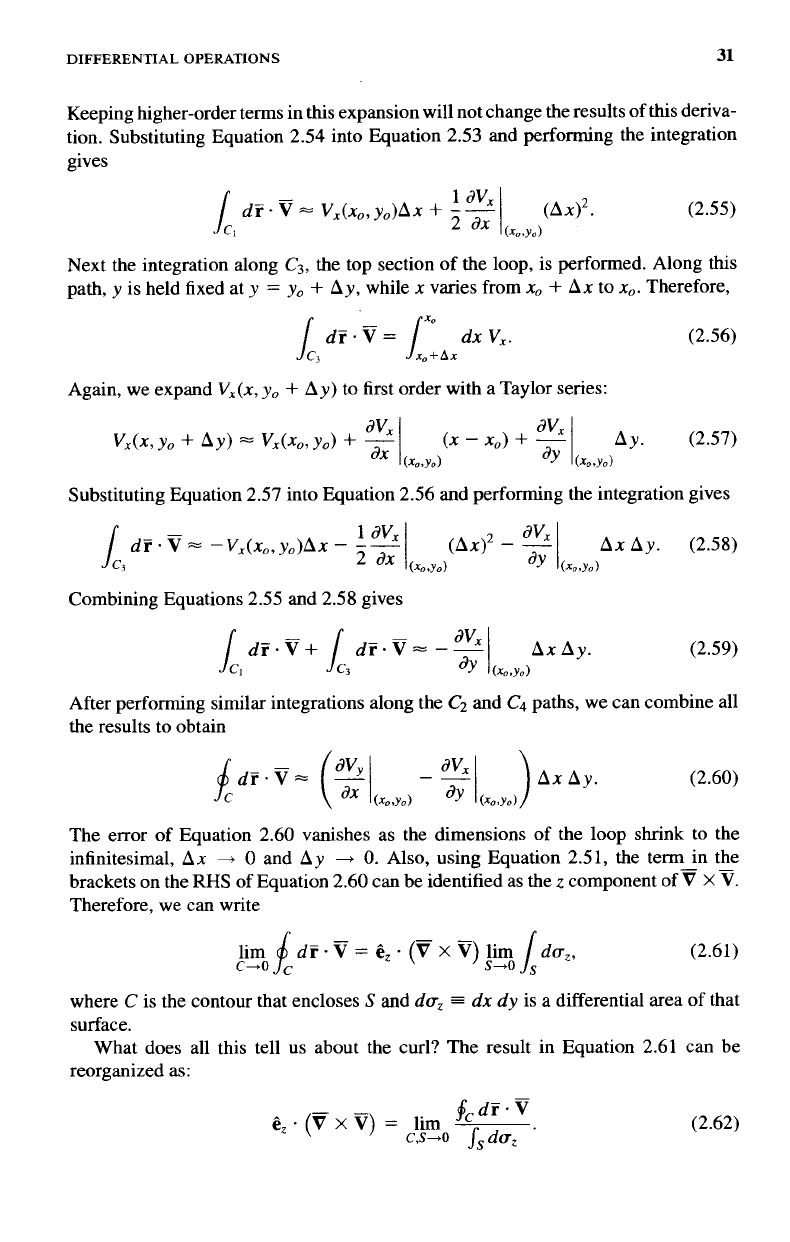
Now consider the line integral
of
a vector field
v
around the closed path shown in
Figure
2.9,
/dP.v.
(2.52)
The starting point for the integration is the point
(h,
yo).
In
this
derivation, we need to
be a little more careful with the treatment
of
infinitesimal quantities than we were in
the discussion
of
the divergence. For
this
reason, we
begin
by letting the dimensions
of
the loop be
Ax
and
Ay,
as shown in the figure. Later in the derivation, we will
shrink
these to infinitesimal quantities to obtain
our
final result.
The integral along
C
can
be
broken up into
four
parts. First consider the integration
along
C1,
where
y
=
yo
and
x
varies from
no
to
xo
+
Ax:
C
x,+Ax
[
d?-v=
[
dxVx.
(2.53)
JCl
JXO
Along
this
segment, we can expand
V,(x,
yo)
with a Taylor series, keeping up to the
linear term in
x:
(2.54)
Ax
Flgun?
2.9
Closed
Path for
Curl
Integration
DIFFERENTIAL OPERATIONS
31
Keeping higher-order terms in
this
expansion will not change the results of this deriva-
tion. Substituting Equation 2.54 into Equation 2.53 and performing the integration
gives
(2.55)
Next the integration along
C3,
the top section
of
the loop, is performed. Along this
path,
y
is held fixed at
y
=
yo
+
Ay,
while
x
varies from
xo
+
Ax
to
x,.
Therefore,
L,
df.
V
=
l:Ax
dx V,.
(2.56)
Again, we expand
Vx(x,
yo
+
Ay)
to first order with a Taylor series:
Substituting Equation 2.57 into Equation 2.56 and performing the integration gives
Combining Equations
2.55
and 2.58 gives
-
L,d?*V+
1,di.V~
-31
AxAy.
(2.59)
After performing similar integrations along the
C,
and
C,
paths, we can combine all
the results to obtain
ay
(X0,YO)
(2.60)
The error
of
Equation
2.60
vanishes as the dimensions of the loop shrink to the
infinitesimal,
Ax
----f
0
and
Ay
+
0.
Also, using Equation 2.51, the term in the
brackets on the
RHS
of Equation 2.60 can be identified as the
z
component of
v
X
v.
Therefore, we can write
(2.61)
where
C
is the contour that encloses
S
and
duz
=
dx dy
is a differential area of that
surface.
What does all this tell us about the curl? The result in Equation 2.61 can be
reorganized as:
(2.62)
32
DIFFERENTIAL AND INTEGRAL OPERATIONS
-~-
C
Figure
2.10
Fields
with Zero
(a)
and
Nonzero
(b)
Curl
This says the
z
component of
V
x
V
at a point is the line integral of
V
on a loop
around that point, divided by the area of that loop,
in
the limit as the
loop
becomes
vanishingly small.
Thus, the
curl
does not directly tell us anything about the circulation
on a macroscopic scale.
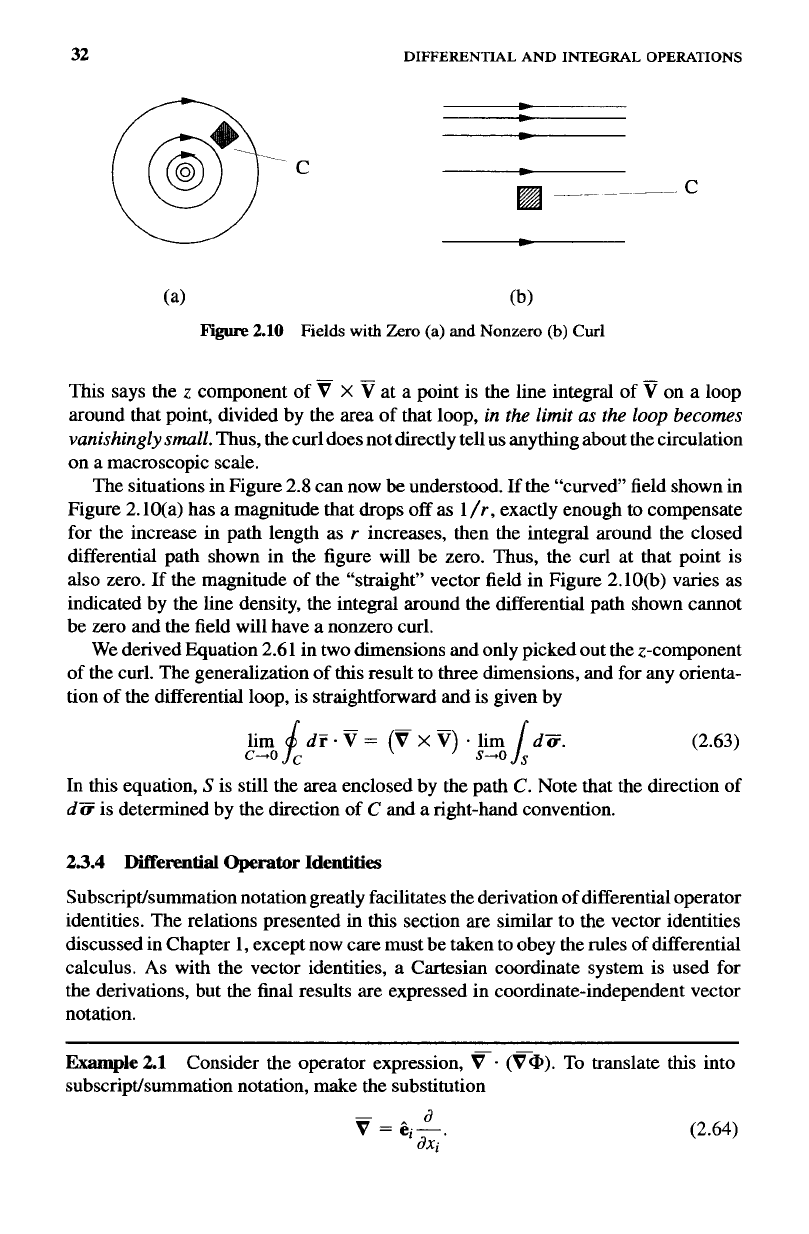
The situations in Figure 2.8 can now be understood.
If
the “curved” field shown in
Figure 2.10(a) has a magnitude that drops off
as
l/r,
exactly enough to compensate
for the increase
in
path length as
r
increases, then the integral around the closed
differential path shown in the figure will be zero. Thus, the curl at that point is
also
zero. If the magnitude of the “straight” vector field in Figure 2.10(b) varies as
indicated by the line density, the integral around the differential path shown cannot
be zero and the field will have a nonzero curl.
We derived Equation 2.61 in two dimensions and only picked out the z-component
of
the curl. The generalization of
this
result to
three
dimensions, and for any orienta-
tion of the differential loop, is straightforward and is given by
In this equation,
S
is still the area enclosed by the path
C.
Note that the direction
of
diF
is determined by the direction of
C
and a right-hand convention.
23.4
Differential
Operator
Identities
Subscriptlsummation notation greatly facilitates the derivation of differential operator
identities. The relations presented in
this
section are similar to the vector identities
discussed in Chapter 1, except now care must be taken to obey the rules of differential
calculus.
As
with the vector identities, a Cartesian coordinate system is used for
the derivations, but the final results
are
expressed in coordinate-independent vector
notation.
Example
2.1
subscriptlsummation notation, make the substitution
Consider the operator expression,
7. (7@).
To
translate this into
(2.64)
DIFFERENTIAL OPERATIONS
33
The two
v
operators in the original expression must be written using independent
subscripts:
(2.65)
Because the basis vectors of a Cartesian system are position independent,
&j/dxi
=
0,
and Equation 2.65 becomes
-
v
.
(Va)
=
(ei
*
ej)-
(5)
axi
axj
=
,,a(+,)
ax, ax
=
-(-a)
da
axi
axi
(2.66)
In the last line, we have written out the implied summation explicitly to show you
how it is working in this case. Equation 2.66 can be returned to vector notation by
defining the
Laplacian
operator
V2
as
so
that
-
v
.
(7,)
=
v2a.
(2.68)
Example
2.2
which is the curl
of
the curl
of
v.
This quantity arises when developing the electromagnetic wave equation from
Maxwell’s equations.
To
write this in subscript notation in a Cartesian coordinate
system, we need to use two Levi-Civita symbols:
Consider the expression
VX VX
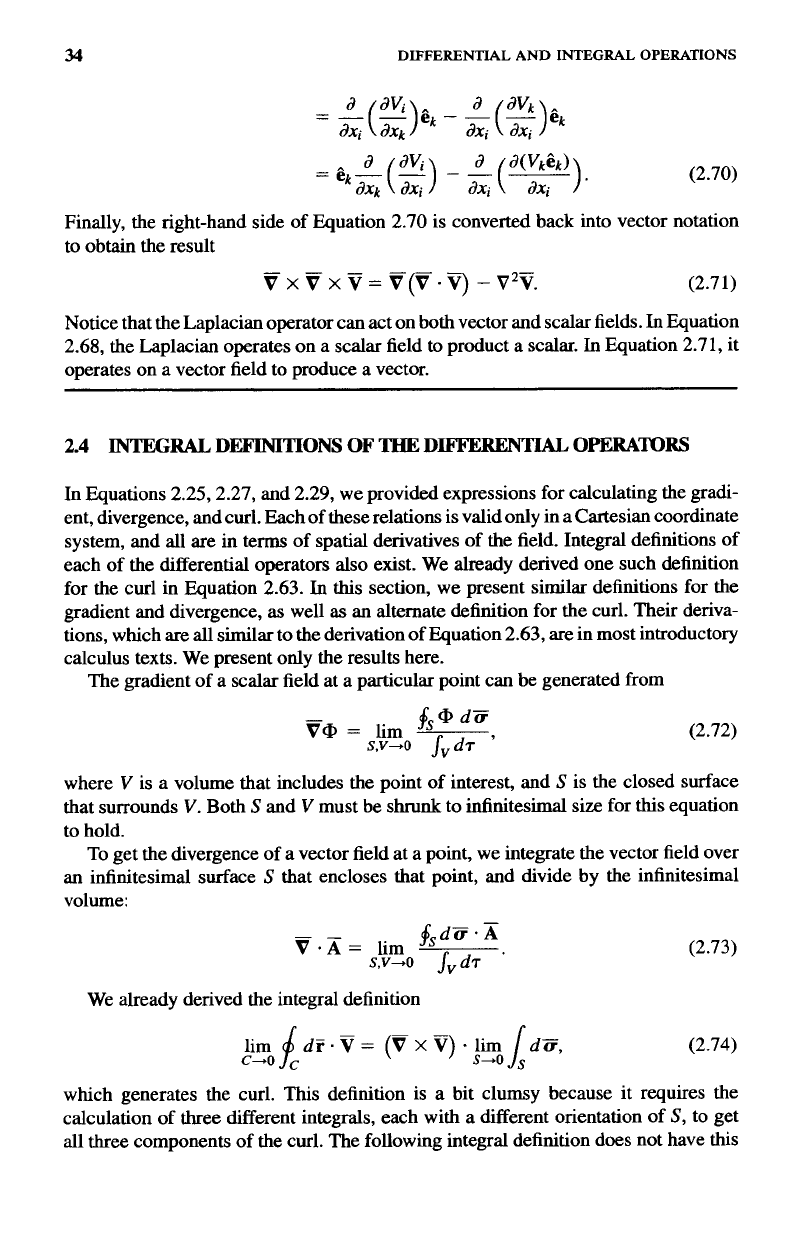
Equation 2.69 can be manipulated as follows:
(2.69)
34
DIFFERENTIAL AND INTEGRAL OPERATIONS
(2.70)
Finally, the right-hand side of Equation 2.70 is converted back into vector notation
to obtain the result
v
XVXV=V(V-5)
-v2V.
(2.7
1)
Notice that the Laplacian operator can act on both vector and scalar fields.
In
Equation
2.68, the Laplacian operates on a scalar field to product a scalar.
In
Equation 2.71,
it
operates on a vector field to produce a vector.
-
2.4
INTEGRAL DEFJNITIONS
OF
THE
DIFFERENTLAL
OPERATORS
In Equations 2.25,2.27, and 2.29, we provided expressions for calculating the gradi-
ent, divergence, and curl. Each of these relations is valid only in a Cartesian coordinate
system, and all are in terms of spatial derivatives
of
the field. Integal definitions of
each of the differential operators
also
exist. We already derived one such definition
for the curl in Equation 2.63.
In
this
section,
we
present similar definitions for the
gradient and divergence,
as
well
as
an alternate definition for the curl. Their deriva-
tions, which are all similar to the derivation
of
Equation 2.63, are in most introductory
calculus texts. We present only the results here.
The gradient of a scalar field at a particular point can be generated
from
(2.72)
where
V
is a volume that includes the point of interest, and
S
is the closed surface
that surrounds
V.
Both
S
and
V
must be
shrunk
to infinitesimal size for
this
equation
to hold.
To get the divergence of a vector field at a point, we integrate the vector field over
an
infinitesimal surface
S
that encloses that point, and divide by the infinitesimal
volume:
We already derived the integral definition
(2.73)
(2.74)
which generates the curl.
This
definition is a bit clumsy because it requires the
calculation of three different integrals, each with a different orientation of
S,
to get
all three components of the curl. The following integral definition does not have this
THE
THEOREMS
35
problem, but it uses an uncommon form of the surface integral:
2.5
THE
THEOREMS
(2.75)
The differential operators give
us
information about the variation
of
vector and
scalar fields on an infinitesimal scale.
To
apply them on a macroscopic scale, we
need to introduce four important theorems. Gauss’s Theorem, Green’s Theorem,
Stokes’s Theorem, and Helmholtz’s Theorem can be derived directly from the integral
definitions of the differential operators. We give special attention to the proof and
discussion
of
Helmholtz’s Theorem because it is not covered adequately in many
texts.
2.5.1
Gauss’s
Theorem
Gauss’s
Theorem is derived from Equation 2.73, written in a slightly different
form:
(2.76)
In this equation, the closed surface
S
completely surrounds the volume
dr,
which we
have written
as
an infinitesimal.
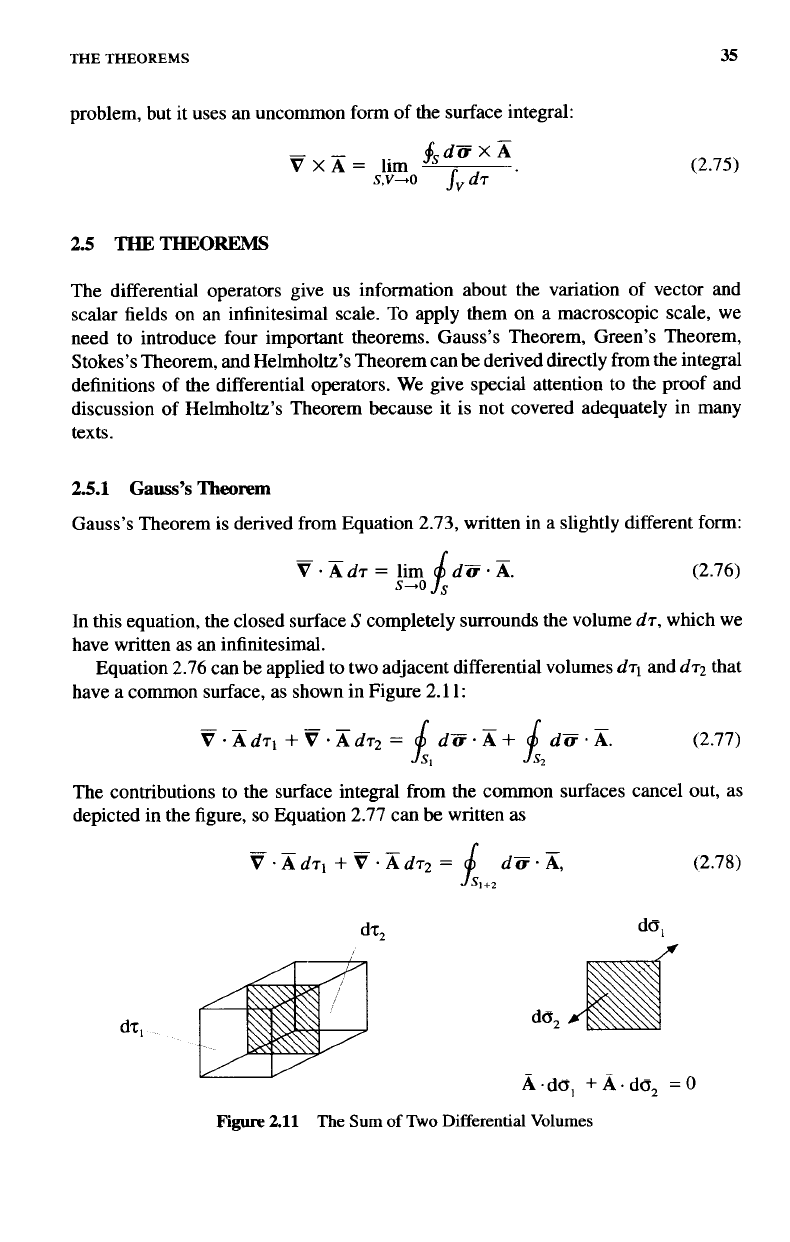
Equation 2.76 can be applied to two adjacent differential volumes
dr1
and
d72
that
have a common surface, as shown in Figure 2.11:
-
V.Adr1 +V-Adr2
=
dZF-%+
(2.77)
The contributions to the surface integral from the common surfaces cancel out,
as
depicted in the figure,
so
Equation 2.77 can
be
written
as
d
izdrr.A.
Figure
2.11
The Sum
of
Two
Differential Volumes