
Kusse B.R., Westwig E.A. Mathematical Physics: Applied Mathematics for Scientists and Engineers
Подождите немного. Документ загружается.

16
A
REVIEW OF
VECTOR
AND
MATRIX ALGEBRA
With matrix notation, a product between these two matrices can be expressed as
[kfI[Nl.
Using subscript/summation notation,
this
same product is expressed as
(a)
With the elements of the
[MJ
and
[N]
matrices given above, evaluate the
matrix products
[MJ[Nl,
[N[MJ
and
[MI[kfl,
leaving the results
in
matrix
array notation.
(b)
Express the matrix products
of
part (a) using the subscriptlsummation nota-
tion.
(c)
Convert the following expressions, which
are
written in subscriptlsummation
notation, to
matrix
notation:
Mi
jNjk.
i.
MjkNij.
ii.
MijNkj.
fi.
M
..N.
Jl
Jk*
iV.
MijNjk
$.
Tki.
V.
MjiNkj
-k
Tik.
2.
Consider the square
3
X
3 matrix
[MI
whose elements
Mij
are
generated by the
expression
M..
11
=
ij2
and
a
vector
v
whose components
in
some basis are given by
vk
=
k
forc,
j
=
1,2,3,
fork
=
1,2,3.
(a)
Using a matrix representation for
-+
[u,
determine the components of
(b)
Determine the components of the vector that result from a premultiplication
the vector that result from a premultiplication of
[u
by
[MI.
of
[MI
by
[Ut.
3.
Thematrix
1
,Rl
=
[
cos8 sin8
-sin8 cos8
represents a rotation. Show that the matrices
[RI2
=
[R][R]
and
[RI3
=
[RlER][Rl
are matrices that correspond to rotations of
28
and
38
respectively.
4.
Let
[D]
be a 2
X
2 square matrix and
[V]
a 2
X
1
row
matrix. Determine the
conditions imposed on
[D]
by the requirement that
[D"
=
[VI+[Dl
for
any
[V].
5.
The trace of
a
matrix
is
the sum of all its diagonal elements. Using the sub-
scriptlsummation notation to represent the elements
of
the matrices
[TI
and
lM1,
EXERCISES
17
(a)
Find an expression for the trace of
[TI.
(b)
Show that the trace of the matrix formed
by
the product
[T][M]
is equal to
the trace of the matrix formed by
[MI[TI.
6.
Let
[MI
be a square matrix. Express the elements of the following matrix products
using subscriptlsummation notation:
(a)
[M][M]+.
(b)
[Mlt[Ml.
(4
[MI
+
[MI
t.
7.
Convert the following Cartesian, subscript/summation expressions into vector
notation:
(a)
VfA,Bf@,.
(b)
cA
f
B,
6,.
(c)
AIBj@k%jk8b.
(d)
Af
B,
CIDm
Efjk
%k.
8.
Expand each of the following expressions by explicitly writing out
all
the terms
in the implied summations. Assume
(i,
j,
k)
can each take on the values
(1,2,3).
(a)
8ijEfjk.
(b)
Tfj.4,.
(4
6f,Tf,Al.
9.
Express the value of the determinant
of
the matrix
using subscriptlsummation notation and the Levi-Civita symbol.
10.
Prove the following vector identities using subscript/summation notation:
(a)
A.
(Bx
C)
=
(AX
B>.
c7
(b)
AXB=-BXA
(c)
(A
X
B) .
(CX
D)
=
(A-
C)(B-
D>
-
(A.
D)(B.
CT.
(d)
(A
X
B)
X
(c
X
D)
=
[(AX
B>
.
D]c-
[(AX
B>.
CTDY
2
DIFF'ERENTIALANDINTEGRAL
OPERATIONS
ON
VECTOR
AND
SCALAR
FIELDS
A
field quantity is a function that depends upon space and possibly time. Electric
potential, charge density, temperature, and pressure each have only a magnitude, and
are described by scalar fields.
In
contrast, electric and magnetic fields, gravity, current
density, and fluid velocity have both magnitude and direction, and are described by
vector fields.
Integral and differential operations on vector and scalar field quantities can be
expressed concisely using subscript notation and the operator formalism which is
introduced in
this
chapter.
2.1
PL€YITING
SCALAR
AND
VECTOR
FIELDS
Because it is frequently useful to picture vector and scalar fields, we begin with a
discussion of plotting techniques.
2.1.1
Plotting
scalar
Fields
Plots
of
scalar fields are much easier to construct than plots of vector fields, because
scalar fields are characterized by only a single value at each location in time and space.
Consider the specific example
of
the electric potential produced by two parallel,
uniform line charges of
?
h,
coulombs per meter that are located at
(x
=
5
1,
y
=
0).
In
meter-kilogram-second
(MKS)
units, the electric potential produced by
this
charge
distribution is
a=-
A0
[
(x
+
+
Y*]
47TE,
(x
-
1)2
+
y2
.
18
PLOTTING
SCALAR
AND
VECTOR
FIELDS
19
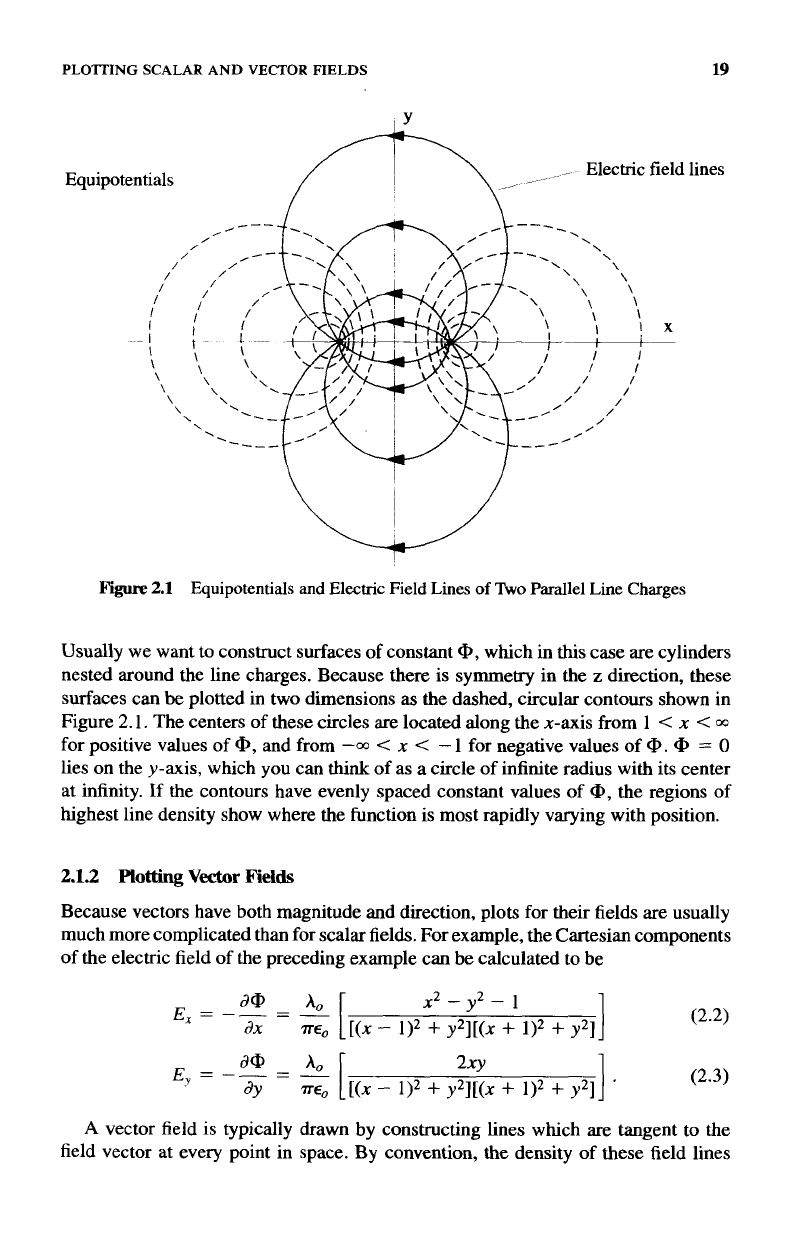
~
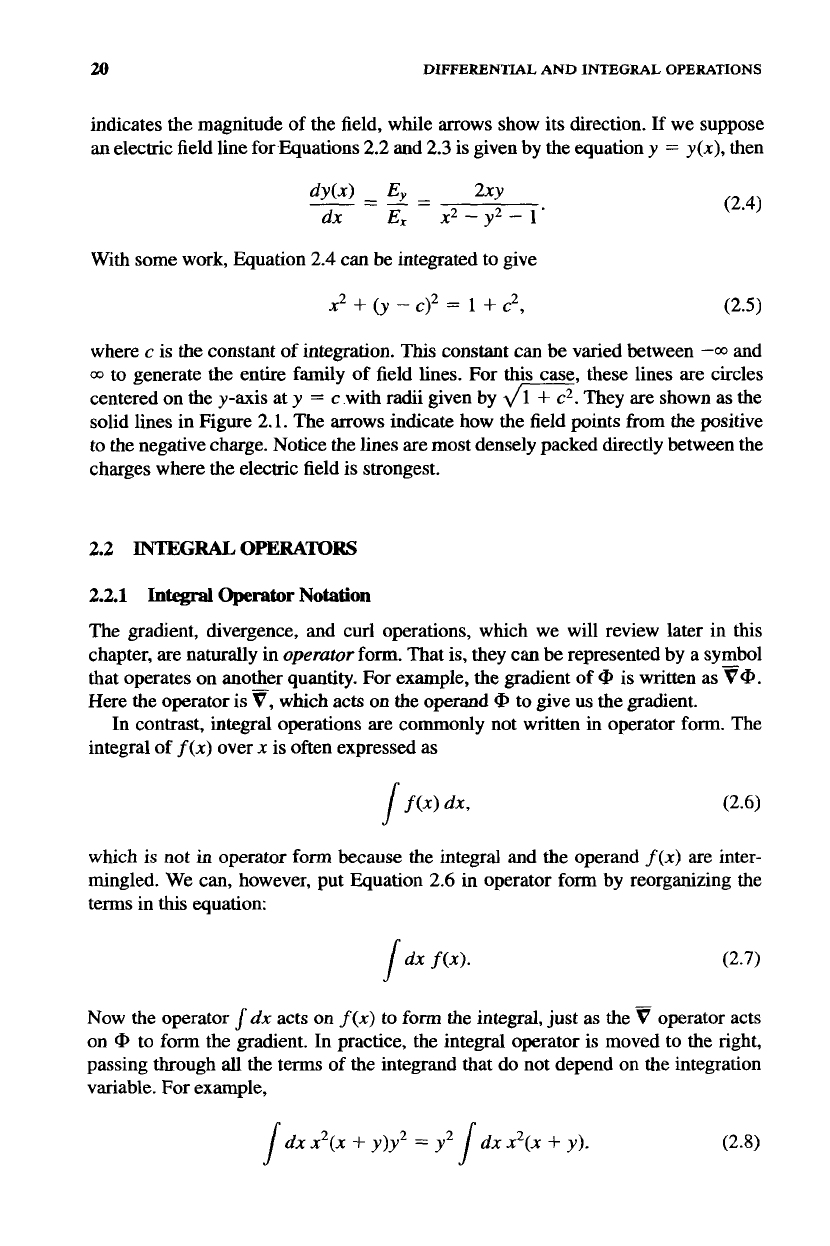
Electric field lines
Equipotentials
Figure
2.1
Equipotentials
and
Electric Field Lines
of
Two
Parallel Line Charges
Usually we want to construct surfaces
of
constant
CP,
which
in
this
case are cylinders
nested around the line charges. Because there is symmetry in the
z
direction, these
surfaces can
be
plotted in two dimensions
as
the dashed, circular contours shown in
Figure
2.1.
The centers of these circles are located along the x-axis from
1
<
x
<
03
for positive values of
<P,
and from
--M
<
x
<
-
1
for negative values
of
CP.
CP
=
0
lies on the y-axis, which you can
think
of as a circle
of
infinite radius with its center
at infinity.
If
the contours have evenly spaced constant values of
<P,
the regions of
highest line density show where the function
is
most rapidly varying with position.
2.1.2
Plotting
Vector
Fields
Because vectors have both magnitude and direction, plots for their fields
are
usually
much more complicated than for scalar fields. For example, the Cartesian components
of the electric field of the preceding example can be calculated to be
A
vector field
is
typically
field vector at every point in
(2.2)
I
"[
x2
-
y2
-
1
[(x
-
1)2
+
y2][(x
+
1)2
+
y2]
7E0
(2.3)
I.
"[
2XY
7rE0
[(x
-
1)2
+
y2][(x
+
1)2
+
y2]
drawn by constructing lines which are tangent to the
space. By convention,
the
density of these field lines
20
DIFFERENTIAL AND
INTEGRAL
OPERATIONS
indicates the magnitude of the field, while arrows show its direction. If we suppose
an electric field line for Equations
2.2
and
2.3
is given by the equation
y
=
y(x),
then
With some work, Equation 2.4 can be integrated to give
x2
+
0,
-
c)2
=
1
+
2,
(2.5)
where
c
is the constant
of
integration.
This
constant can be varied between
--03
and
-03
to generate the entire family of field lines. For
this
case, these lines are circles
centered on the
y-axis
at
y
=
c
with radii given by
I/=.
They are shown as the
solid lines in Figure 2.1. The arrows indicate how the field points from the positive
to the negative charge. Notice the lines are most densely packed directly between the
charges where the electric field is strongest.
2.2
INTEGRALOPERATORS
2.2.1
Integral
Operator
Notation
The gradient, divergence, and curl operations, which we will review later in this
chapter, are naturally
in
operator
form. That is, they can be represented by a symbol
that operates on another quantity. For example, the gradient
of
@
is written as
v@.
Here the operator
is
v,
which acts
on
the operand
@
to give
us
the gradient.
In contrast, integral operations are comonly not written
in
operator form. The
integral of
f(x)
over
x
is often expressed as
which is not
in
operator
form
because the integral and the operand
f(x)
are inter-
mingled. We can, however, put Equation 2.6
in
operator form by reorganizing the
terms in
this
equation:
Now the operator
dx
acts on
f
(x)
to
form
the integral, just as the
v
operator acts
on
@
to form the gradient. In practice, the integral operator is moved to the right,
passing through
all
the terms of the integrand that do not depend on the integration
variable. For example,
/
dx x2(x
+
y)y2
=
y2
/
dx x2(x
+
y).
J J
INTEGRAL
OPERATORS
21
2.2.2
Line
Integrals
The process
of
taking
an
integral along a path is called line integration and is a
common operation in all branches of physics. For example, the work that a force
F
performs as it moves along path
C
is
W
=
LdF-F.
(2.9)
Here the line integral operator diacts on the force
F.
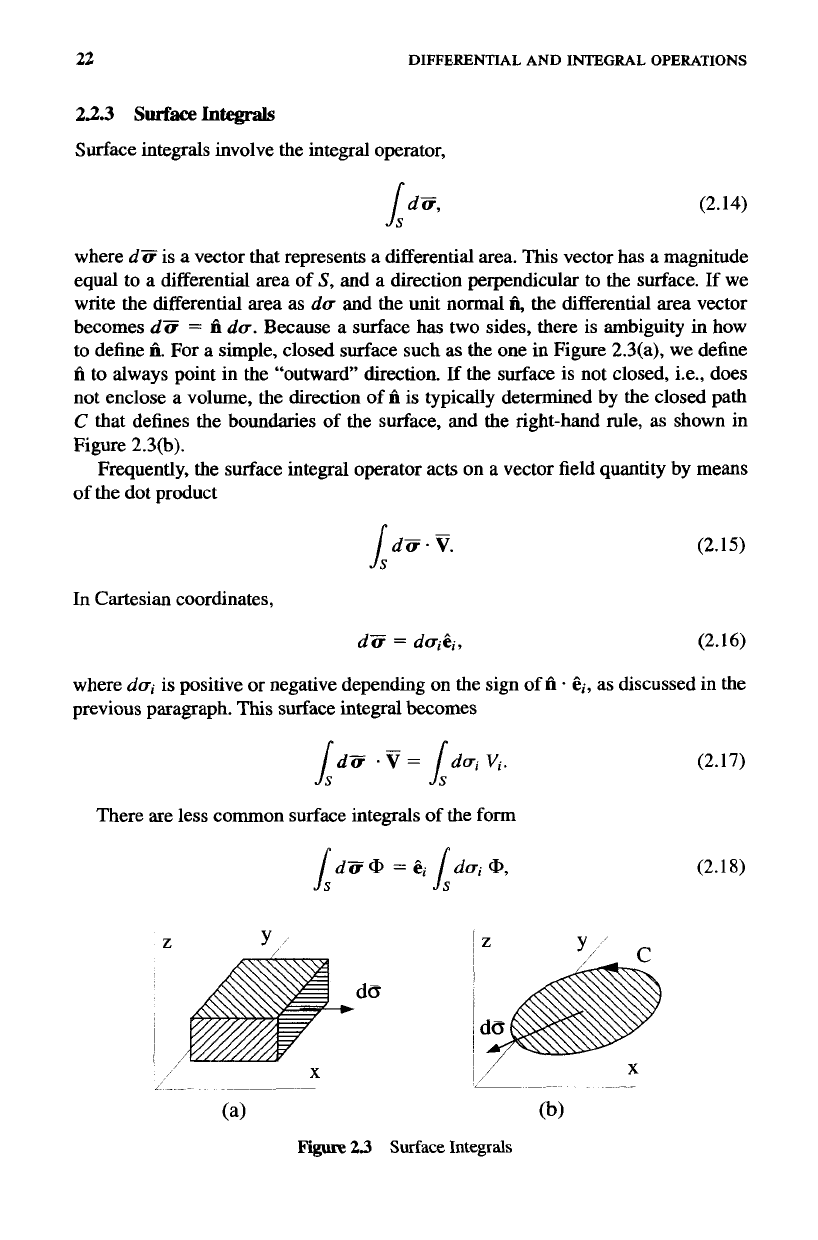
The differential displacement
vector
dF
is
tangent to each point along
C,
as shown in Figure 2.2. If
C
closes
on
itself, we write the operator with a circle on the integral sign:
s,
(2.10)
Because Equation 2.9 is written in vector notation, it is valid in
any
coordinate
system.
In
a Cartesian system,
dF
=
dx$i and Equation 2.9 becomes
(2.1
1)
Notice that the quantity produced by this integration is a scalar, and the subscript
i
is
summed implicitly.
There are other less common line integral operations. For example, the operator
in
acts
on
the scalar
@
to
produce a vector. Another example,
(2.12)
(2.13)
generates a vector using the cross product. Note that all these subscripted expressions
are written
in
a
Cartesian system where the basis vectors are orthonormal and position
independent.
Figure
2.2
The Line Integral
22
DIFFERENTIAL AND INTEGRAL
OPERATIONS
223
Surfacehtegrals
Surface integrals involve the integral operator,
l
d*,
(2.14)
where
do
is a vector that represents a differential area.
This
vector has a magnitude
equal to a differential area of
S,
and a direction perpendicular to the surface. If we
write the differential area as
du
and the unit normal
ii,
the differential area vector
becomes
do
=
i3
du.
Because a surface has two sides, there is ambiguity in how
to define
b.
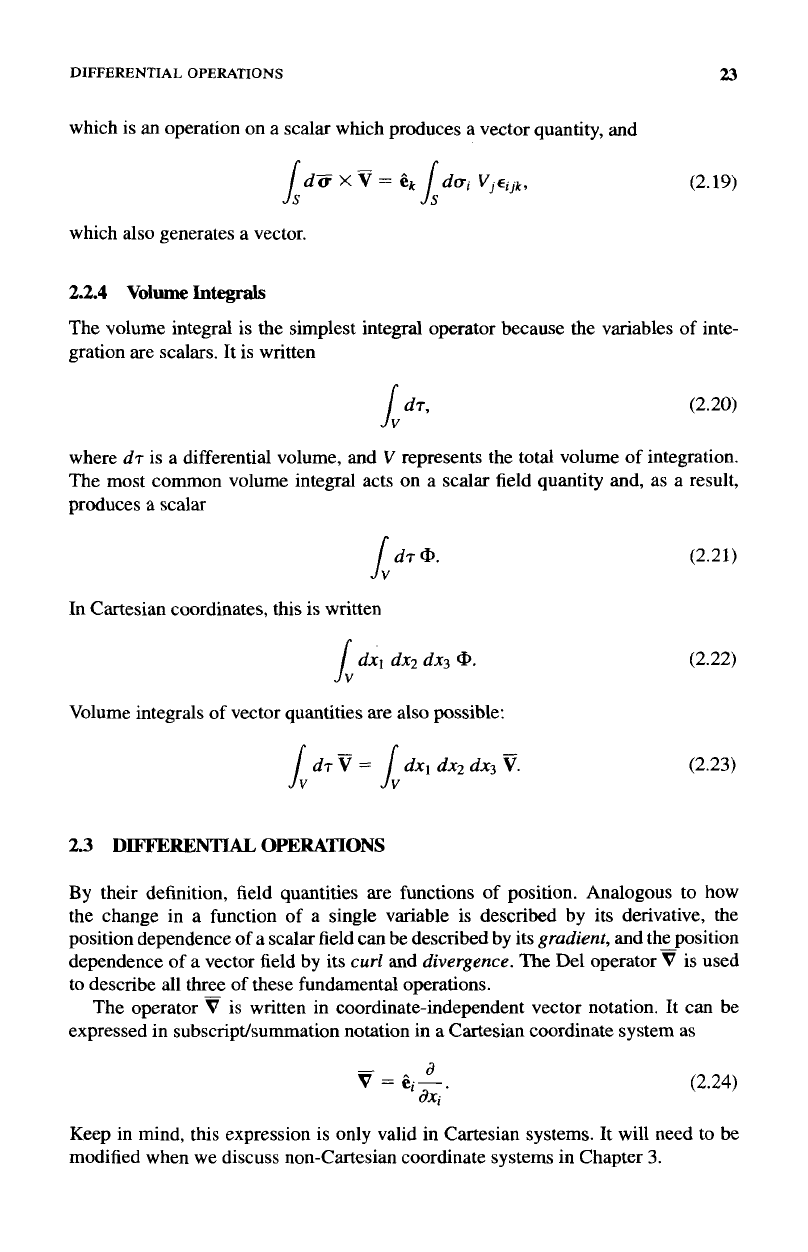
For a simple, closed surface such
as
the one
in
Figure 2.3(a), we define
ci
to always point in the "outward" direction.
If
the surface
is
not closed, i.e., does
not enclose a volume, the direction
of
b
is
typically determined by the closed path
C
that defines the boundaries of the surface, and the right-hand rule,
as
shown in
Figure 2.3(b).
Frequently, the surface integral operator acts on a vector field quantity by means
of
the dot product
/dT.V.
(2.15)
S
h
Cartesian coordinates.
where
dui
is positive or negative depending on the sign of
ii.
&i,
as discussed in the
previous paragraph.
This
surface integral becomes
(2.17)
There are less common surface integrals
of
the form
2
Y'
(2.18)
Figure
2.3
Surface
Integrals
DIFFERENTIAL OPERATIONS
23
which is
an
operation on a scalar which produces a vector quantity, and
P
which also generates a vector.
(2.19)
2.2.4
Volume
Integrals
The volume integral is the simplest integral operator because the variables of inte-
gration are scalars. It
is
written
(2.20)
where
dT
is a differential volume, and
V
represents the total volume of integration.
The most common volume integral acts on a scalar field quantity and, as a result,
produces a scalar
dr
@.
In Cartesian coordinates, this is written
dxl
dx2 dx3
@.
Volume integrals
of
vector quantities are also possible:
(2.21)
(2.22)
(2.23)
2.3
DIFFERENTIAL
OPERATIONS
By
their definition, field quantities are functions of position. Analogous to how
the change in a function of a single variable
is
described by
its
derivative, the
position dependence
of
a scalar field can be described by its
gradient,
and the position
dependence of a vector field by its
curl
and
divergence.
The
Del operator
v
is
used
to describe all three of these fundamental operations.
The operator
v
is
written in coordinate-independent vector notation. It can be
expressed in subscript/summation notation in a Cartesian coordinate system as
(2.24)
Keep in mind, this expression is only valid in Cartesian systems. It will need
to
be
modified when we discuss non-Cartesian coordinate systems in Chapter
3.
24
DIFFERENTIAL AND
INTEGRAL OPERATIONS
When operating on a scalar field, the
v
operator produces a vector quantity called
the gradient:
For example, in electromagnetism the electric field is equal
of
the electric potential:
(2.25)
to
the negative gradient
(2.26)
The Del operator also acts upon vector fields via either the dot product or the cross
product. The divergence
of
a vector field is a scalar quantity created using the dot
product:
(2.27)
The charge density
pc
in a region
of
space can
be
calculated using the divergence
from the relation
--
pc
=
E,(V
*
E).
(2.28)
If
instead we used the cross product, we produce a vector quantity called the curl,
(2.29)
where we have used the Levi-Civita symbol to express the cross product in sub-
script/summation notation. One
of
Maxwell's equations relates the electric field
to
the rate
of
change
of
the magnetic field using the curl operator:
-
dB
VxE=---.
dt
(2.30)
2.3.1
Physical
Picture
of
the
Gradient
The gradient
of
a scalar field is a vector that describes, at each point, how the field
changes with position. Dot multiplying
both
sides
of
Equation
2.25
by
dT
=
dx&
gives
Manipulating the
RHS
of
this
expression gives
(2.31)
(2.32)
DIFFERENTIAL OPERATIONS
25
The
RHS
of
this expression can be recognized
as
the total differential change of
Q,
due to a differential change of position
dF.
The result can be written entirely in vector
notation as
dQ,
=
VQ,
*
dF.
(2.33)
From Equation 2.33, it
is
clear that the largest
value
of
dQ,
occurs when
dT
points in
the same direction as
VQ,.
On the other hand, a displacement perpendicular to
VQ,
produces no change in
Q,
because
d@
=
0.
This means that the gradient will always
point perpendicular to the surfaces
of
constant
Q,.
At the beginning of this chapter, we discussed the electric potential function
generated by two line charges.
The
electric field was generated by taking the gradient
of
this scalar potential, and was plotted in Figure
2.1.
While we could use this example
as a model for developing a physical picture for the gradient operation, it is relatively
complicated. Instead, we will look at the simpler two-dimensional function
Q,
=
-xy.
(2.34)
A
plot
of
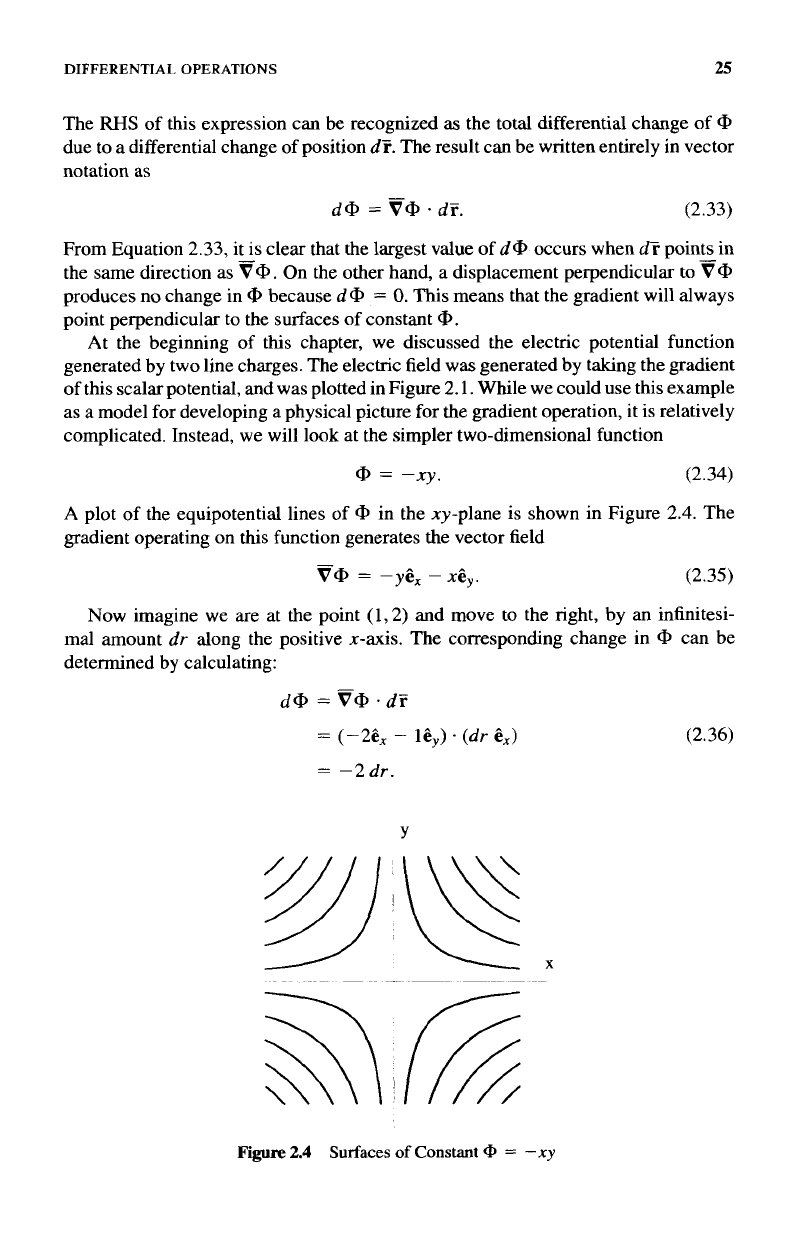
the equipotential lines of
@
in the xy-plane is shown in Figure 2.4. The
gradient operating on
this
function generates the vector field
-
VQ,
=
-ye,
-xi?,. (2.35)
Now
imagine we are at the point (1,2) and move to the right, by an infinitesi-
mal amount
dr
along the positive x-axis. The corresponding change in
Q,
can be
determined by calculating:
dQ,
=vQ,
.dF
=
(-26,
-
16,)
.
(dr
C,)
=
-2dr.
(2.36)
Y
Figure
2.4
Surfaces
of
Constant
@
=
-xy