
Kusse B.R., Westwig E.A. Mathematical Physics: Applied Mathematics for Scientists and Engineers
Подождите немного. Документ загружается.

1%
INTRODUCTION
TO
COMPLEX VARIABLES
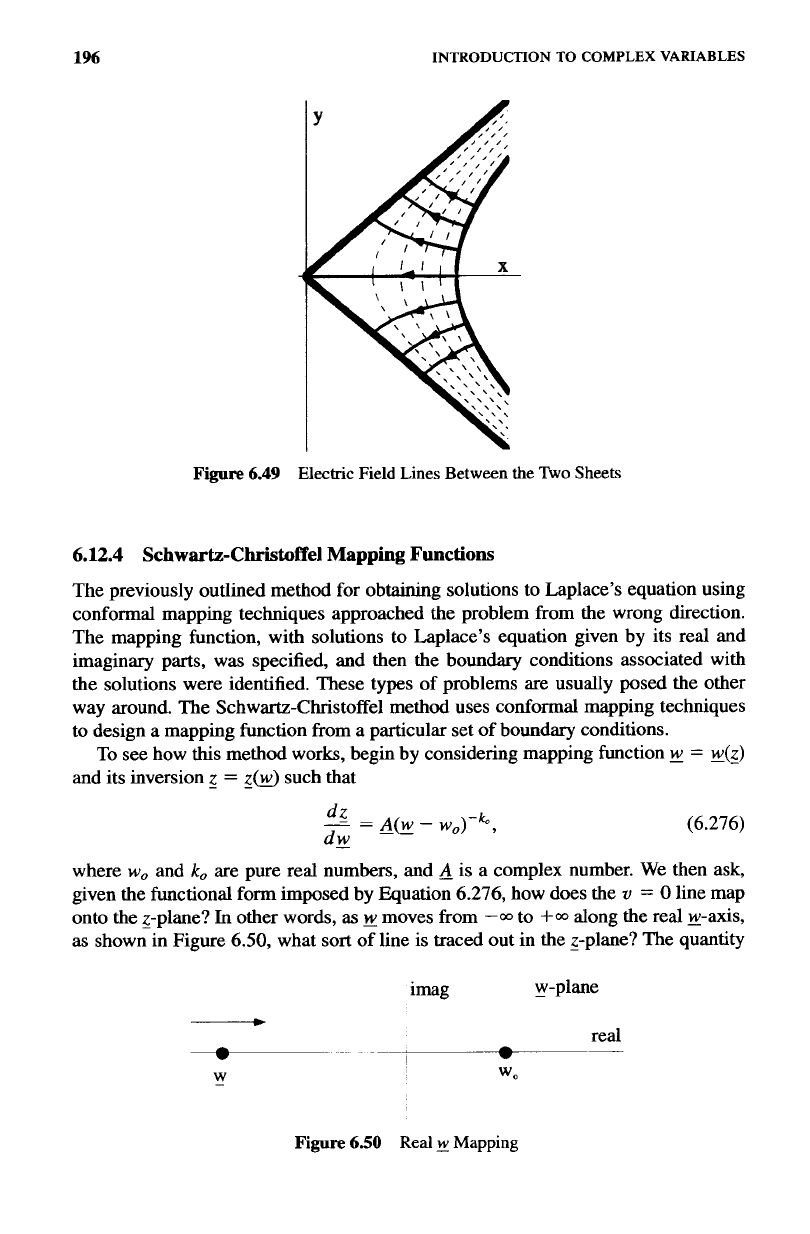
Figure
6.49
Electric
Field Lines Between
the
Two
Sheets
6.12.4
Schwartz-Christoffel
Mapping
Functions
The previously outlined method for obtaining solutions to Laplace's equation using
conformal mapping techniques approached the problem from the wrong direction.
The mapping function, with solutions to Laplace's equation given by its real and
imaginary parts, was specified, and then the boundary conditions associated with
the solutions were identified. These types of problems
are
usually posed the other
way around. The Schwartz-Christoffel method uses conformal mapping techniques
to
design a mapping function from a particular set of boundary conditions.
To
see how
this
method works, begin by considering mapping function
w
=
w(iJ
and its inversion
z
=
g,@
such that
(6.276)
where
w,
and
k,
are pure real numbers, and
A
is
a complex number. We then ask,
given the functional form imposed by Equation
6.276,
how does the
v
=
0
line map
onto the Z-plane?
In
other words,
as
y
moves from
--a,
to
+-a,
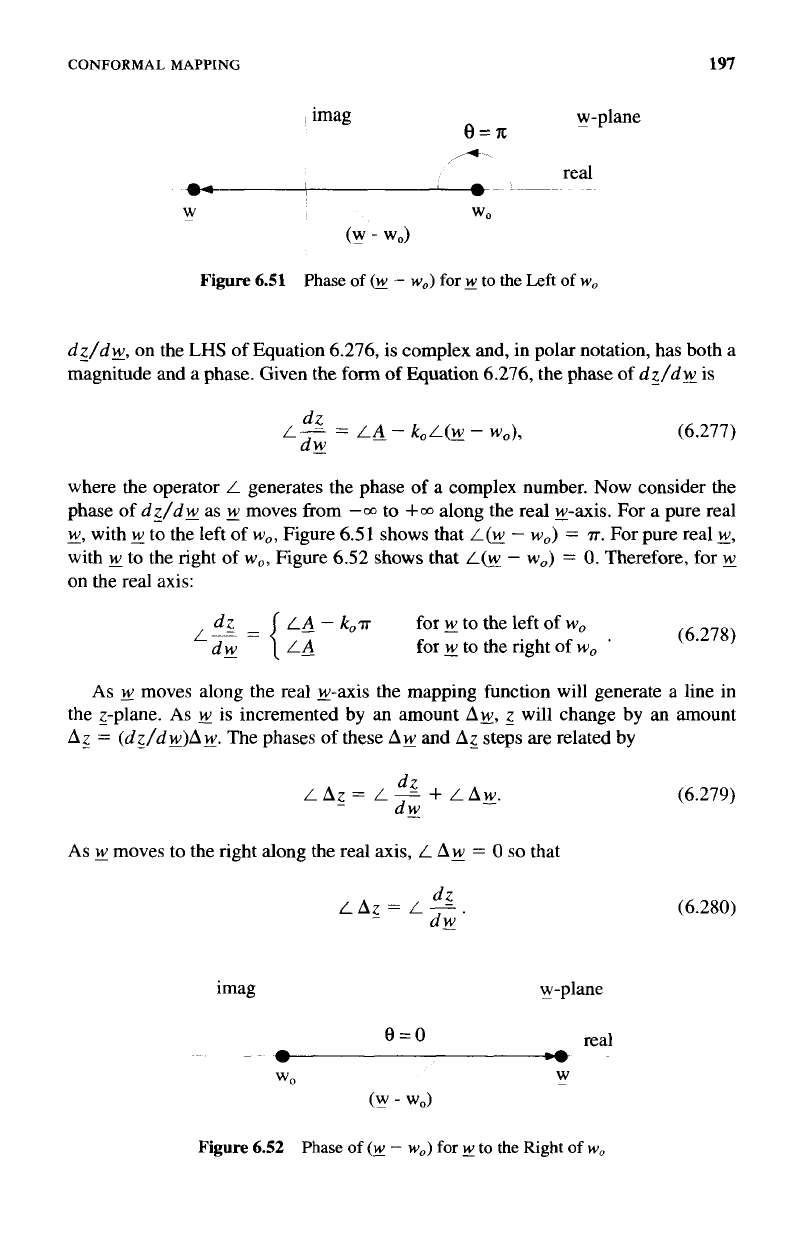
along the real w-axis,
as shown in Figure
6.50,
what
sort
of line is traced out in the z-plane? The quantity
imag y-plane
-
real
I
--t-----------
~~
.
w
wo
Figure
650
Real
w
Mapping
CONFORMAL
MAPPING
197
imag w-plane
e=X
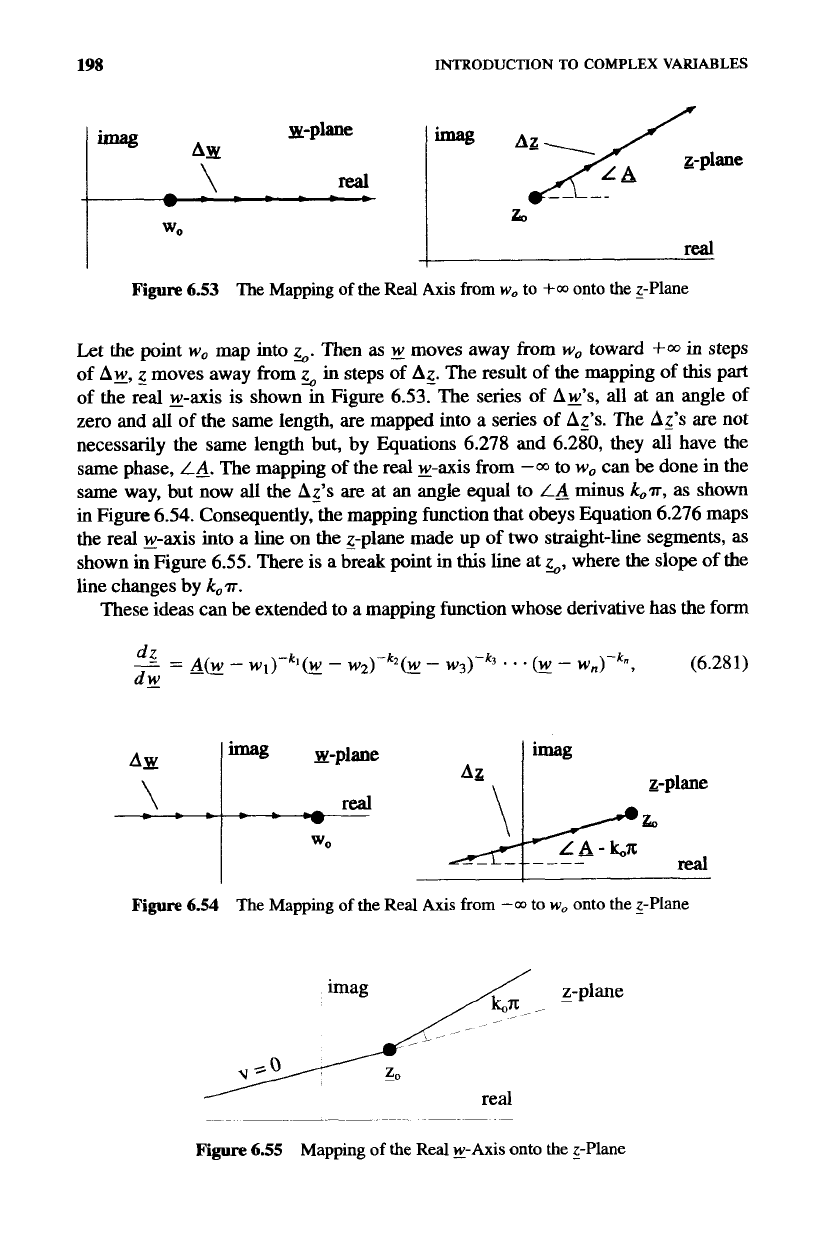
Figure 6.51
Phase
of
@
-
w,)
for
w
to
the
Left
of
w,
dz/dw,
on the
LHS
of Equation 6.276, is complex and, in polar notation, has both a
magnitude and a phase. Given the
form
of
Equation 6.276, the phase of
dg/dw
is
dz
dw
L-=
=
LA_
-
k,L@
-
w,),
(6.277)
where the operator
L
generates the phase
of
a complex number. Now consider the
phase of
dz/dw
as
y
moves
from
--M
to
+a0
along the real w-axis. For a pure real
-
w,
with
w
to
the left of
w,,
Figure 6.51 shows that
L@
-
w,)
=
7~.
For pure real
441,
with
y
to the right of
w,,
Figure 6.52 shows that
L@
-
w,)
=
0.
Therefore, for
w
on the real axis:
(6.278)
LA
-
k,r
for
111
to the left
of
w,
for
w
to the right of
w,
'
As
y
moves along the real w-axis the mapping function will generate
a
line in
the ?-plane.
As
w
is
incremented by an amount
Aw,
z
will change by an amount
Ag
=
(dz/dy)Ay.
The phases of these
Aw
and
Ag
steps
are
related by
As
w
moves to the right along the real axis,
L
Aw
=
0
so
that
imag w-plane
e=o
real
*
wo
w
(w
-
wo)
(6.279)
(6.280)
Figure 6.52
Phase
of
(w
-
w,)
for
to
the
Right
of
w,
198
INTRODUCTION
TO
COMPLEX
VARIABLES
Figure
6.53
The
Mapping
of
the Real
Axis
from
w,
to
+a
onto
the g-Plane
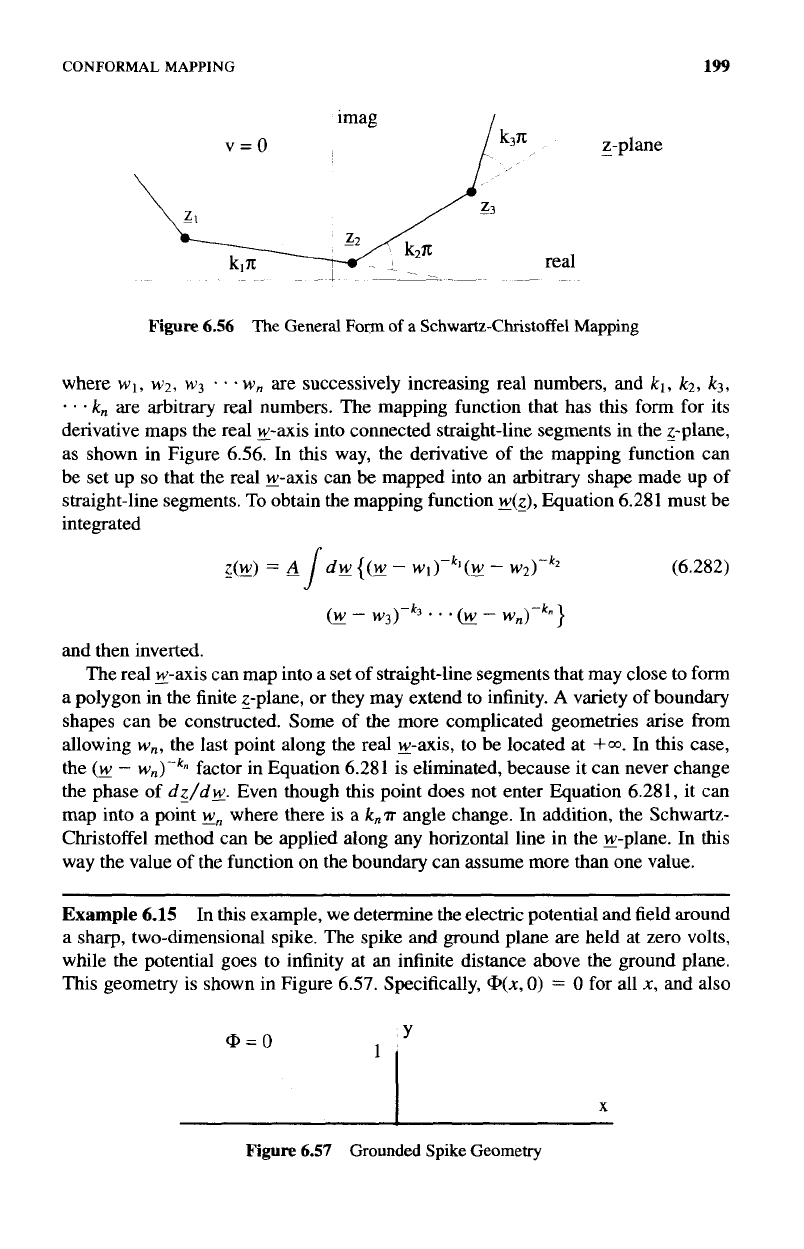
Let
the point
w,
map into
5.
Then
as
moves away
from
w,
toward
fa,
in
steps
of
Ay,
moves away from
z,
in steps of
Ag.
The result of the mapping of
this
part
of
the real y-axis is shown in Figure
6.53.
The series
of
Aw’s,
all at an angle
of
zero and
all
of the same length, are mapped into a series
of
Ag’s. The Ag’s are not
necessarily the same length but, by Equations
6.278
and
6.280,
they all have the
same phase,
LA.
The mapping
of
the real y-axis from
--c4
to
w,
can be done in the
same way, but now
all
the
Az’s
are at an angle equal
to
LA
minus
kow,
as shown
in Figure
6.54.
Consequently, the mapping function that obeys Equation
6.276
maps
the real
y-axis
into
a line on the g-plane made up of
two
straight-line segments, as
shown in Figure
6.55.
There is a break point in
this
line
at
5,
where the
slope
of
the
line changes by
k,w.
These ideas can be extended
to
a mapping function whose derivative has the
form
Figure
6.54 The Mapping
of
the
Real
Axis
from
---a,
to
w,
onto
the g-Plane
imag z-plane
,
ZO
real
Figure
6.55 Mapping
of
the Real
W-Axis
onto
the 5-Plane
CONFORMAL
MAPPING
199
imag
v=o
I
-
z-plane
Figure
6.56
The
General
Form
of
a Schwartz-Chnstoffel Mapping
where
wl,
w2,
w3
.
. .
w,
are successively increasing real numbers, and
kl,
k2,
k3,
*
. .
k,,
are arbitrary real numbers. The mapping function that has this form for its
derivative maps the real F-axis into connected straight-line segments in the z-plane,
as shown in Figure
6.56.
In
this
way, the derivative of the mapping function can
be set up
so
that the real y-axis can
be
mapped into an arbitrary shape made up of
straight-line segments.
To
obtain the mapping function y(g), Equation
6.281
must be
integrated
(6.282)
and then inverted.
The real F-axis can map into a set of straight-line segments that may close to form
a polygon in the finite Z-plane, or they may extend to infinity.
A
variety of boundary
shapes can be constructed. Some of the more complicated geometries arise from
allowing
w,,
the last point along the real y-axis, to be located at
-too.
In this case,
the
(W
-
w,)-"
factor in Equation
6.281
is eliminated, because it can never change
the phase of
dz/dw.
Even though this point does not enter Equation
6.281,
it can
map into a point
y,
where there is a
k,w
angle change. In addition, the Schwartz-
Christoffel method can be applied along any horizontal line in the y-plane. In this
way the value of the function on the boundary can assume more than one value.
Example
6.15
In
this example, we determine the electric potential and field around
a sharp, two-dimensional spike. The spike and ground plane are held at zero volts,
while the potential goes to infinity at an infinite distance above the ground plane.
This geometry is shown in Figure
6.57.
Specifically,
@(x,
0)
=
0
for all
x,
and also
X
Figure
6.57
Grounded
Spike
Geometry
200
INTRODUCTION TO COMPLEX VARIABLES
Figure
6.58
Mapping
of
the Real
g-Axis
for
the Spike Problem
@(O,y)
=
0
for
0
<
y
<
1.
We will
try
to find a solution for in the
y
>
0
half
plane.
To
use the Schwartz-Christoffel mapping for
this
problem, the real w-axis must be
mapped onto
this
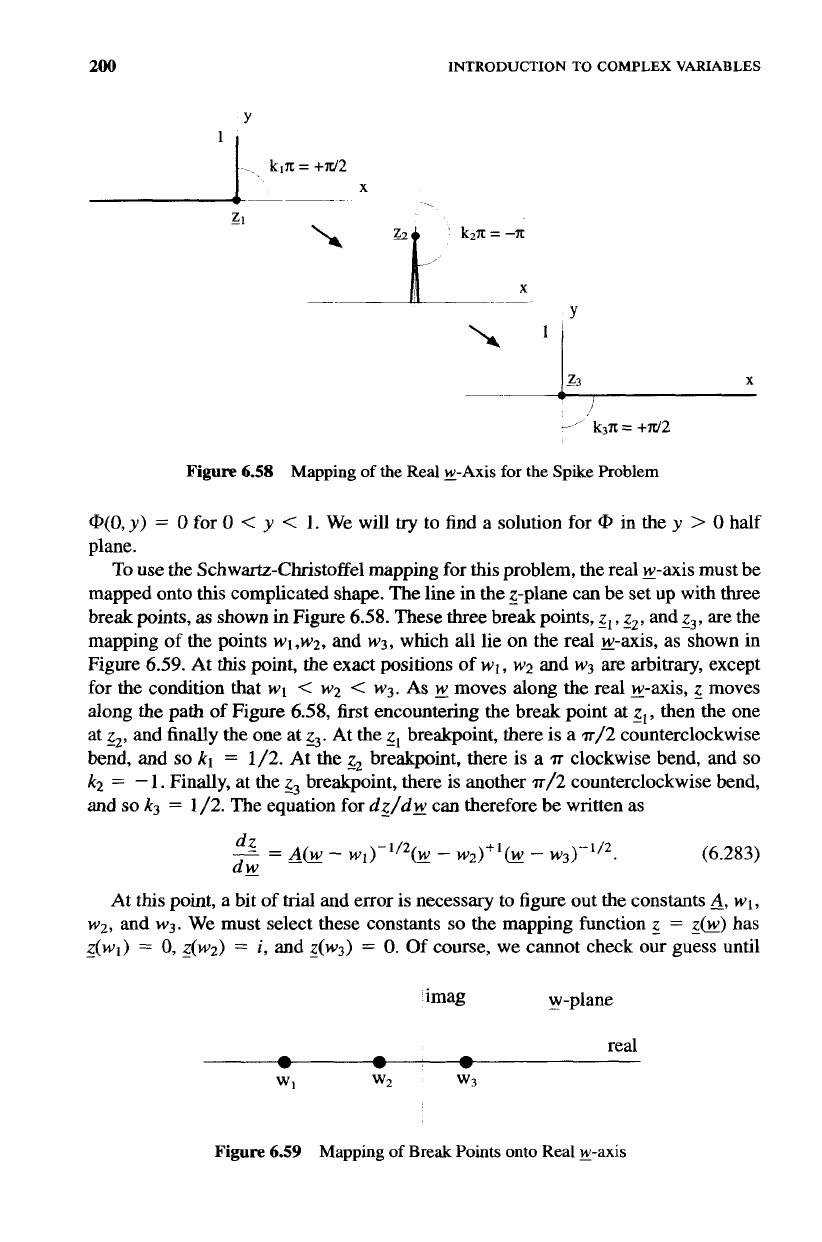
complicated shape. The line in the Z-plane can be set up with three
break points,
as
shown in
Figure
6.58.
These
three
break points,
zl,
g2,
and
g3,
are the
mapping of the points
wl,w2,
and
w3,
which all lie on the real w-axis, as shown in
Figure
6.59.
At
this
point,
the
exact positions of
w1,
w:!
and
w3
are arbitrary, except
for the condition that
w1
<
w:!
<
w3.
As
w
moves along the real w-axis,
z
moves
along the path of Figure
6.58,
first encountering
the
break point at
zl,
then the one
at
gz,
and finally the one at
g3.
At the
z,
breakpoint, there is a
?r/2
counterclockwise
bend,
and
so
kl
=
1/2.
At the
g2
breakpoint, there is a
?r
clockwise bend, and
so
k2
=
-
1.
Finally, at the
z3
breakpoint, there is another
?r/2
counterclockwise bend,
and
so
k3
=
1
/2.
The equation for
dz/dw
can therefore
be
written as
(6.283)
At this point, a bit of trial and error is necessary to figure out the constants
4,
wl,
w2,
and
w3.
We must select these constants
so
the mapping function
z
=
z&)
has
~(wI)
=
0,
g(w2)
=
i,
and
g(w3)
=
0.
Of
course, we cannot check
our
guess until
imag w-plane
Figure
6.59
Mapping
of
Break
Points
onto Real
y-axis
CONFORMAL MAPPING
201
after Equation 6.283
is
integrated. From the symmetry in the z-plane,
-
it makes sense
to make
w2
=
0
and require
w3
=
-WI.
As
a
trial set of constants, let
w1
=
-
1,
w2
=
0,
and
w3
=
1
to give
(6.284)
The constant
4
is just a scaling and rotating factor, which can initially be set equal to
1
and changed later if necessary. Equation 6.284 can then be rewritten in the form
which can be reorganized as the indefinite integral
(6.285)
(6.286)
Ignoring the arbitrary constant of integration, the solution of this integral is
g
=
d-.
(6.287)
Equation 6.287 can be inverted to give
w
=
1/22
+
1.
(6.288)
Now this mapping must be checked to see if the constants were chosen properly.
Whenw
=
w,
=
-1,g
=
g1
=
0.
Whenw
=
w2
=
0,g
=
g2
=
6
=
2i.When
-
w
=
w3
=
+
1,
g
=
z3
=
0.
So
it looks like all the constants are correct. Notice when
-
w
=
w2
=
0,
two values of
z2
are possible.
The
one that is correct for the geometry
of this problem
is
g2
=
+
i.
The second value simply corresponds to a solution in the
lower half of the g-plane.
A
check of Equation 6.288 will show that it is analytic everywhere in the Z-plane,
except at the points
-
z
=
+i.
Consequently,
this
mapping function will generate
a solution to Laplace's equation everywhere, except at those two isolated points.
To
obtain the solution, the functions
u(x,y)
and
v(x,y)
must be determined.
To
accomplish this, rewrite Equation 6.288 as
(u
+
ivl2
=
(x
+
iy12
+
1.
(6.289)
Expand this equation, and separate its real and imaginary parts to get
and
2uv
=
2xy. (6.291)
202
INTRODUCTION
TO
COMPLEX VARIABLES
Y
v=@=
1.0
Figure
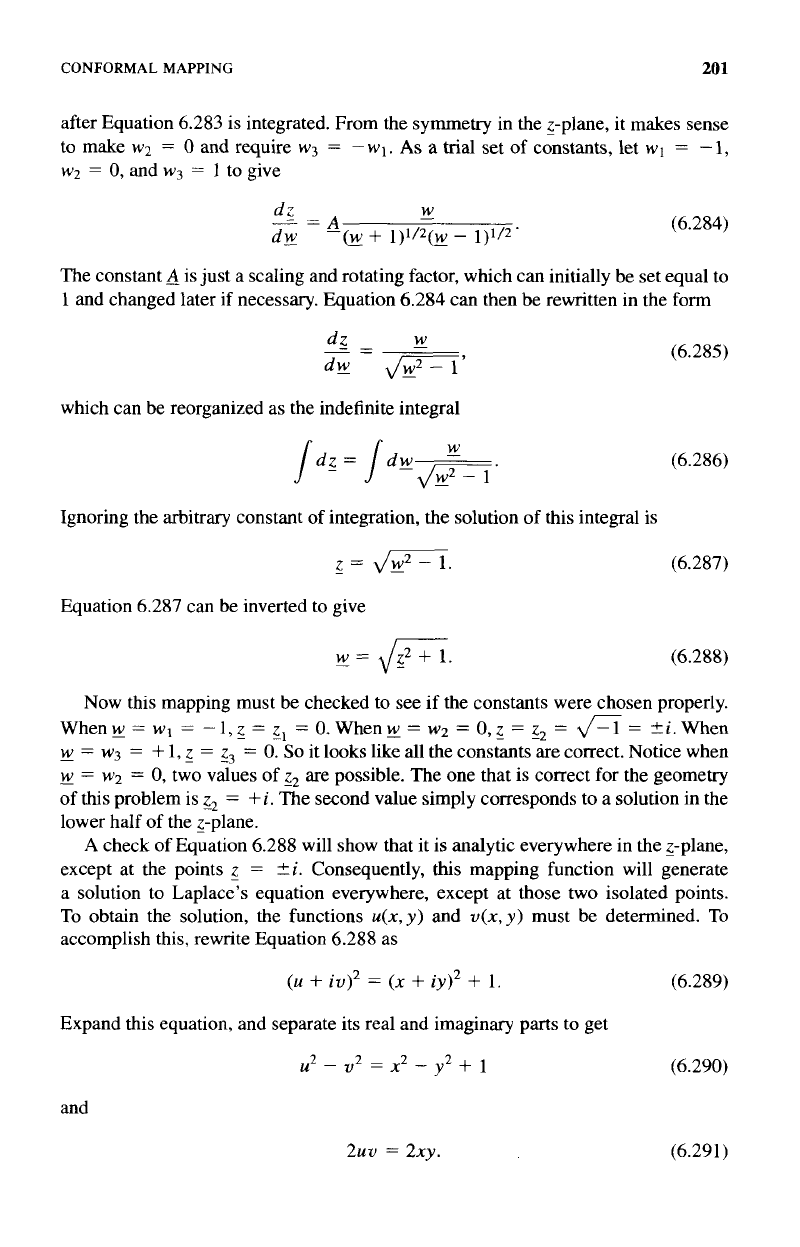
6.60
Equipotentials above the
Grounded
Spike
Solving Equation 6.291 for
u
and substituting the result into Equation 6.290 gives
x2y2
-
v4
-
x2v2
+
y2v2
-
v2
=
0.
(6.292)
This
equation can be
used
to generate lines
of
constant
u
in the z-plane, wluch we
interpret as lines
of
constant potential. The
CP
=
u
=
0
line is just the ground plane
and spike of Figure 6.57. Several other, equally spaced, equipotential lines obtained
from Equation 6.292 are shown in Figure 6.60.
A
computer
is
useful in making these
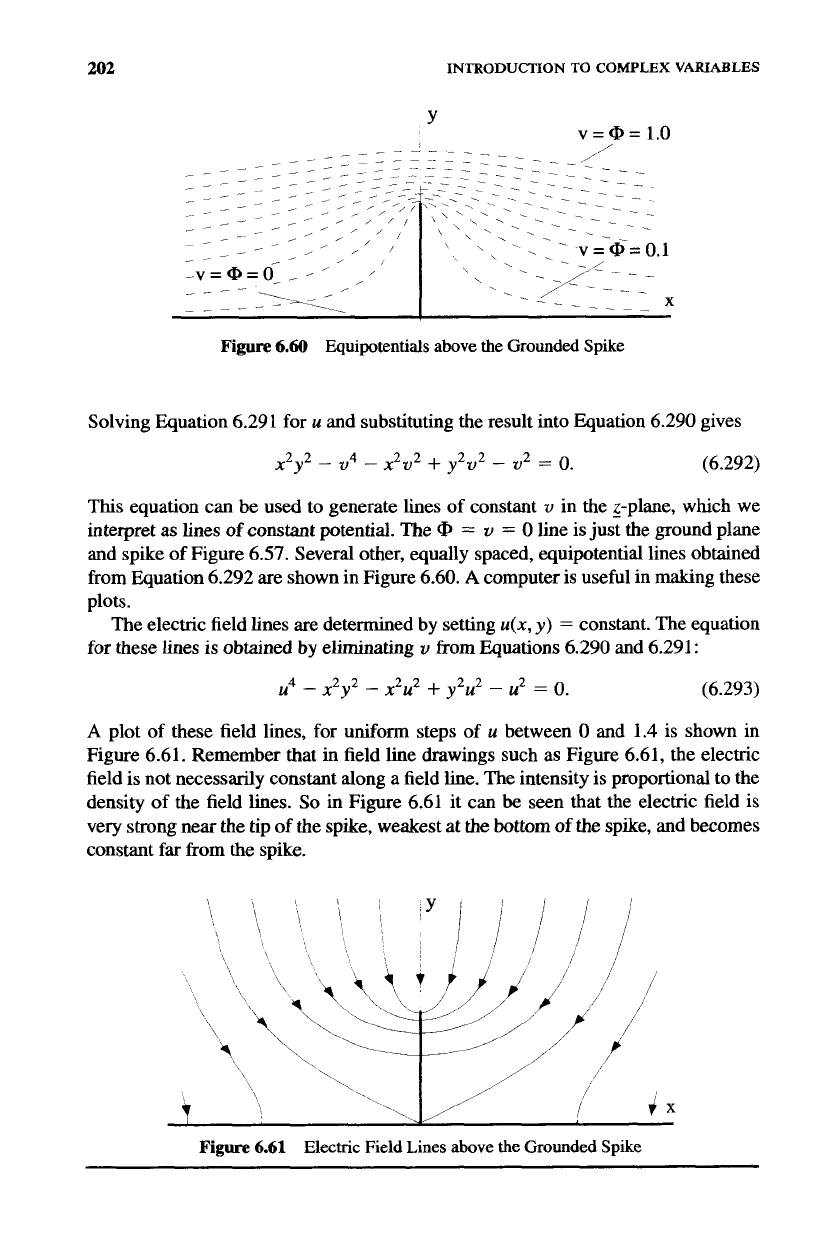
The electric field lines are determined by setting
u(n,
y)
=
constant. The equation
plots.
for these lines is obtained by eliminating
u
from Equations 6.290 and 6.291:
u4
-
.zy2
-
x*u2
+
y2u2
-
u2
=
0.
(6.293)
A
plot of these field lines, for uniform steps
of
u
between
0
and
1.4
is shown in
Figure 6.61. Remember that in field line drawings such as Figure 6.61, the electric
field is not necessarily constant along a field line. The intensity is proportional to the
density
of
the field lines.
So
in Figure 6.61 it can
be
seen that the electric field is
very strong near the tip
of
the spike, weakest at the bottom of the spike, and becomes
constant far from the spike.
Figure
6.61
Electric
Field Lines above
the
Grounded Spike
EXERCISES
203
EXERCISES FOR CHAPTER
6
1.
Use Euler's formula to show that
cos(n0)
+
i
sin(n0)
=
(cos
0
+
i
sin
0)".
This result is called DeMoivre's formula.
2.
Find all the zeros
of
these complex functions:
i.
sing.
iii.
sinhz.
iv.
coshz.
ii.
cosz.
3.
Make a sketch in the complex g-plane of the following relationships:
i.
(g
-
5)(z*
--
5)
=
4.
ii.
(z
-
Si)(g*
+
5i)
=
4.
iii.
-
z2
+
(g21*
=
0.
4.
Show that natural logarithms exist for real, negative numbers in the complex
5.
Determine all the values of
i'
and
plot them in the complex plane.
As
a first step,
6.
Find the real and imaginary
parts
of
the following complex functions:
plane.
In
particular, find the value
of
In
(-
10).
write
i
in polar form.
i.
~(z)
=
ec.
ii.
~(g)
=
lnz.
iii.
y(g)
=
sing
iv.
w(z)
=
l/z.
vi.
~(z)
=
In
(g2
+
I).
vii.
~(2)
=
el';.
viii.
~(z)
=
1/cosg.
ix.
w(g)
=
z/z*.
x.
w(z)
=
z*
Inz.
v.
w(z>
=
I/<?
In what region of the complex plane are each
of
these functions analytic?
7.
Find
an
analytic complex function that has a real part of
u(x,
y)
=
x3
-
3xy2.
8.
Using the polar forms for
z
and
IV,
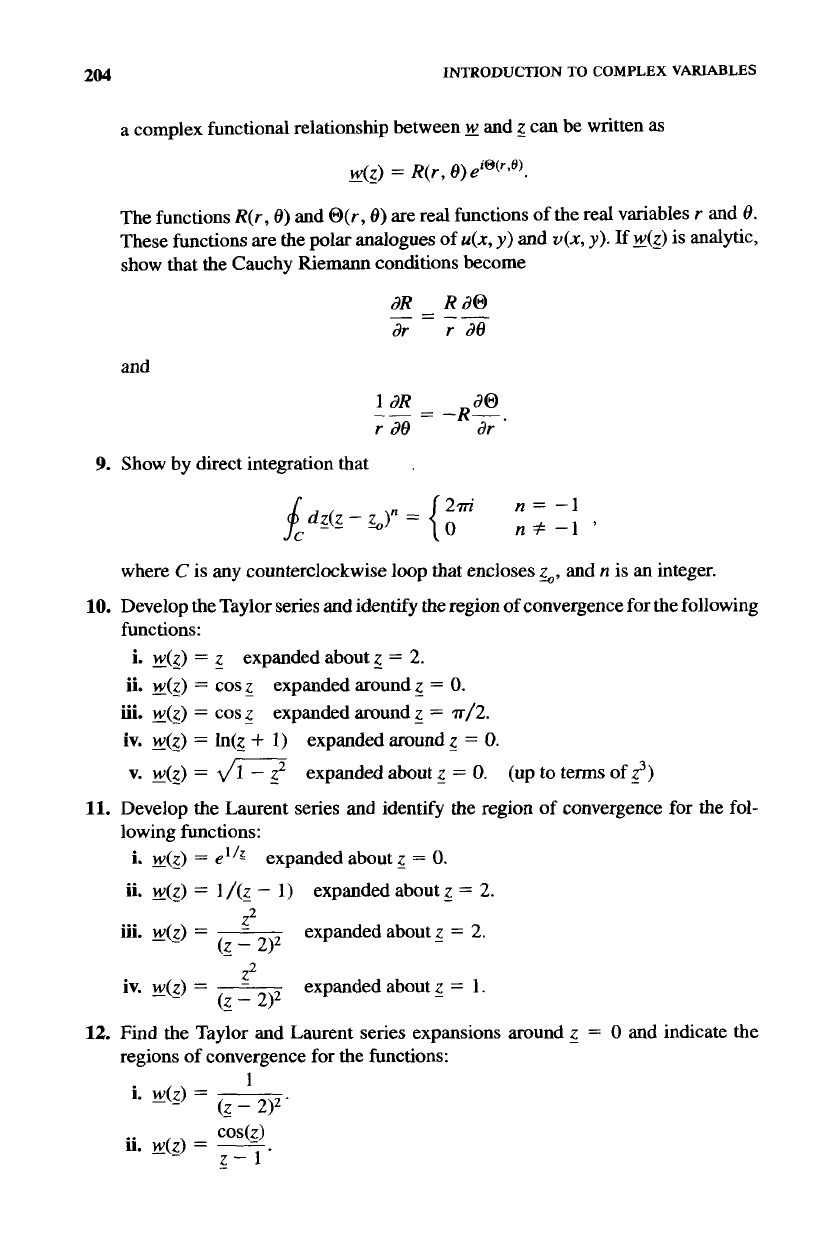
204
INTRODUCTION
TO
COMPLEX
VARIABLES
a complex functional relationship between
411
and
z
can be written
as
-_
W(Z)
=
R(r,
0)
eiecr,@.
The functions
R(r,
6)
and
O(r,
0)
are real functions of the real variables
r
and
8.
These functions are the polar analogues
of
u(n,
y)
and
v(x,
y).
If
&)
is analytic,
show that the Cauchy Riemann conditions become
and
9.
Show by direct integration that
where
C
is any counterclockwise loop that encloses
G,
and
n
is
an integer.
10.
Develop the Taylor series and idenw the region of convergence for the following
functions:
i.
g(z)
=
z
expanded about
z
=
2.
ii.
g(g)
=
cos
g
expanded around
z
=
0.
iii.
g(z)
=
cos
g
expanded around
z
=
7r/2.
iv.
~(z)
=
ln(z
+
1)
expanded around
g
=
0.
v.
g(z)
=
d-
expanded about
g
=
0.
(up to terms of
2)
11.
Develop the Laurent series and identify the region of convergence for the fol-
lowing functions:
i.
~(z)
=
e''Z
ii.
~(z)
=
l/(z
-
1)
expanded about
g
=
2.
iii.
g(z)
=
~
iv.
g(2)
=
-
expanded about
z
=
0.
expanded about
z
=
2.
expanded about
g
=
1.
z'
(z
-
a2
Z2
(z
-
2>2
12.
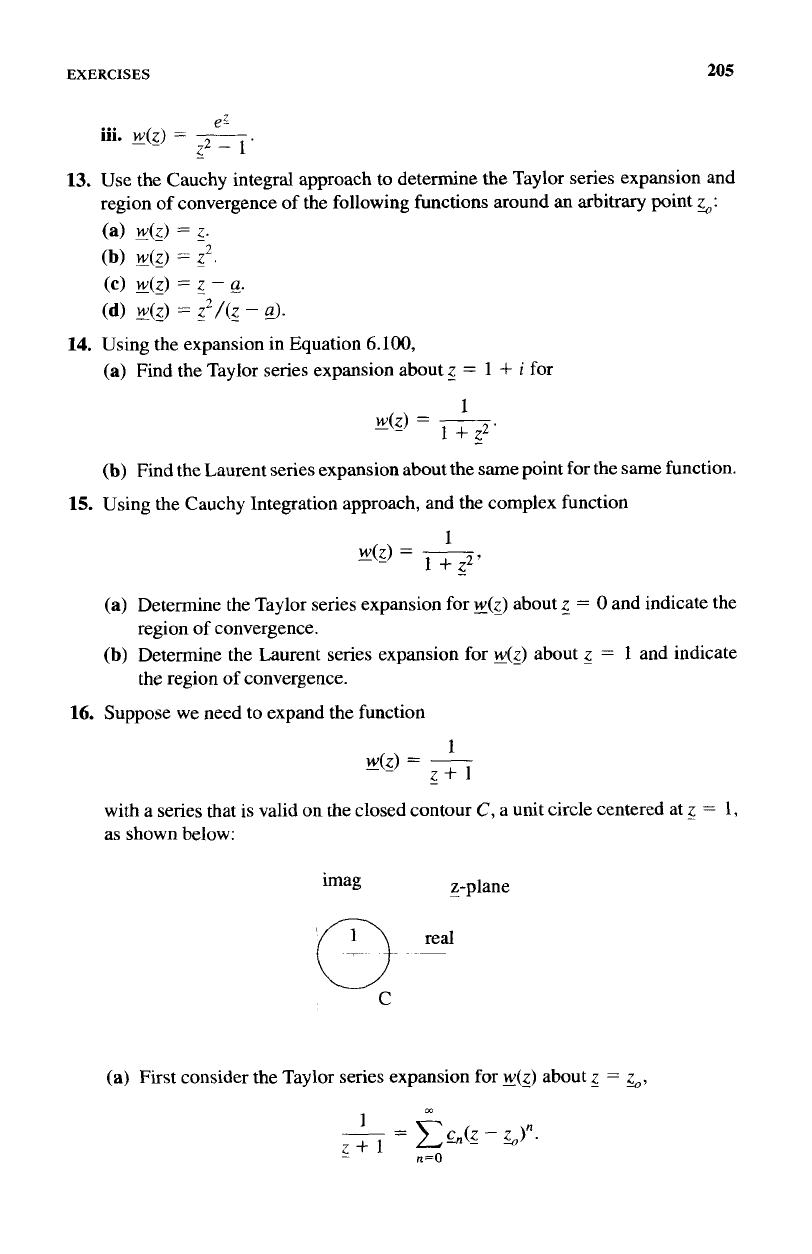
Find the Taylor and Laurent series expansions around
z
=
0
and indicate the
regions of convergence for the functions:
EXERCISES
205
et
iii.
~(z)
=
__
g2
-
1’
13.
Use the Cauchy integral approach to determine the Taylor series expansion and
region of convergence of the following functions around
an
arbitrary point
5:
(a)
~(z)
=
z.
(b)
w(z)
=
g2.
(4
w(z)
=
z
-
a.
(4
w(z>
=
z2/Q
-
@.
(a)
Find the Taylor series expansion about
z
=
1
+
i
for
14.
Using the expansion in Equation
6.100,
(b)
Find the Laurent series expansion about the same point
for
the same function.
15.
Using the Cauchy Integration approach, and the complex function
(a)
Determine the Taylor series expansion for
~(z)
about
z_
=
0
and indicate the
(b)
Determine the Laurent series expansion for
~(z)
about
z
=
1
and indicate
region of convergence.
the region
of
convergence.
16.
Suppose we need to expand the function
with a series that is valid on the closed contour
C,
a unit circle centered at
g
=
1,
as shown below:
imag
-
z-plane
(a)
First consider the Taylor series expansion for
~(z)
about
g
=
G,
m