
Kusse B.R., Westwig E.A. Mathematical Physics: Applied Mathematics for Scientists and Engineers
Подождите немного. Документ загружается.

226
FOURIER SERIES
with the result
I
Figure
7.8
The
Square
Wave
2a
b,
=
A
/
dt
f~(t)sin(nt)
To
a
n
=
1,3,5,7,.
b,,={i;"
n
=
2,4,6,8,.
(7.24)
(7.25)
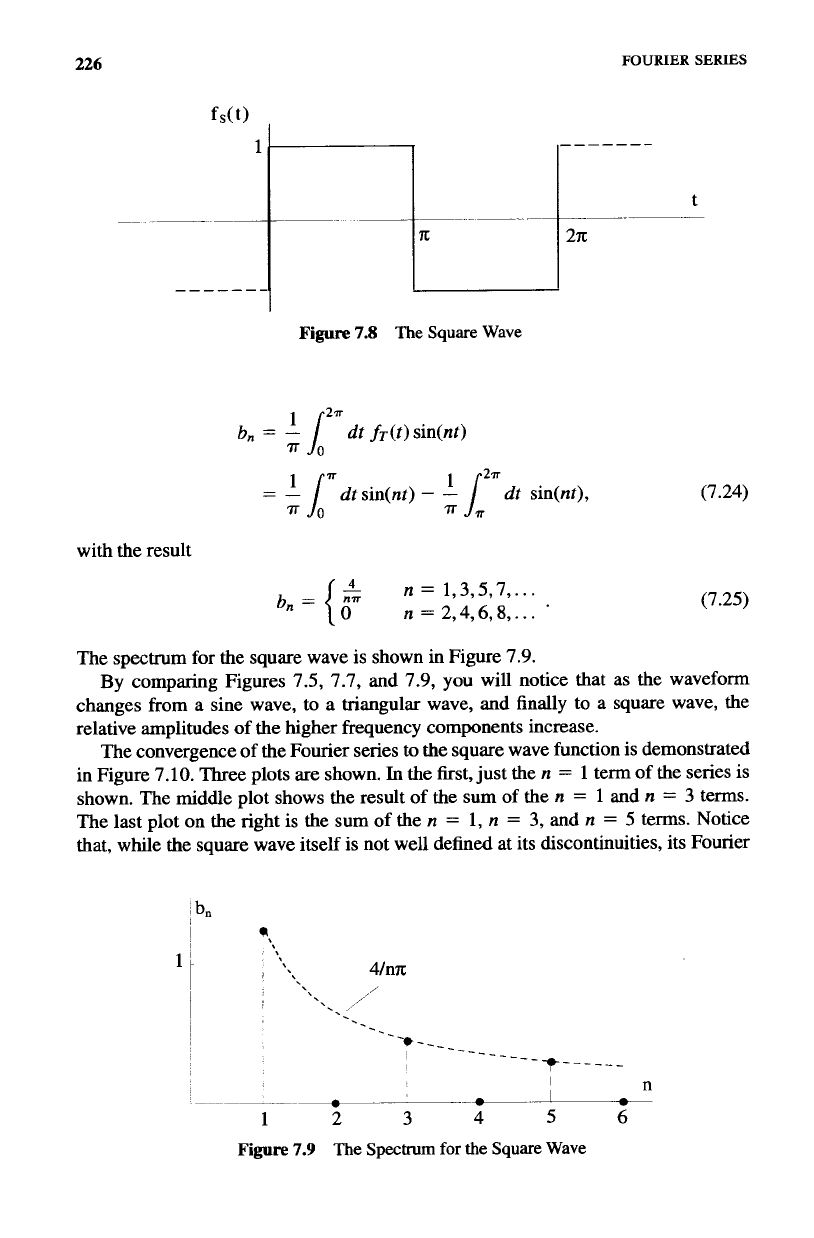
The spectrum for the square wave is shown in Figure 7.9.
By
comparing Figures 7.5, 7.7, and 7.9,
you
will notice that
as
the waveform
changes from a sine wave, to a triangular wave, and finally to a square wave, the
relative amplitudes of the higher frequency components increase.
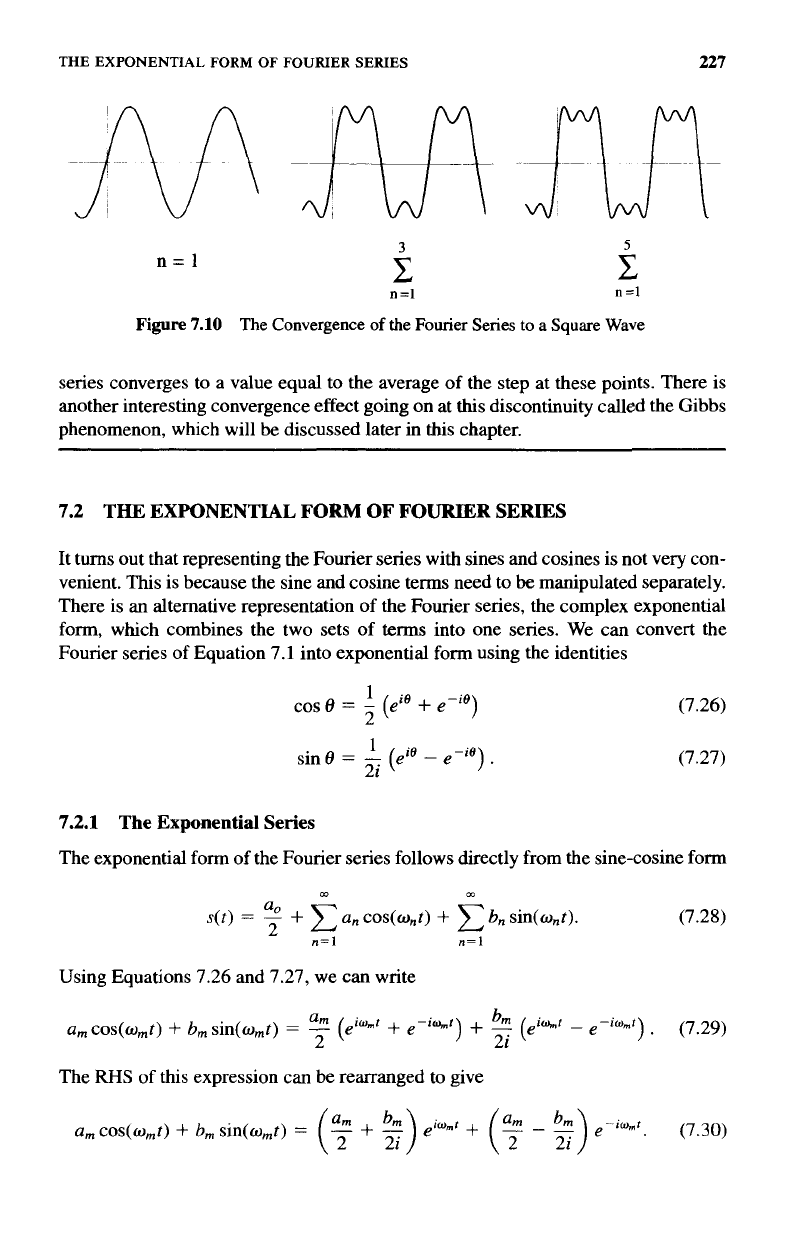
The convergence of the Fourier series to the square wave function is demonstrated
in Figure 7.10. Three plots are shown.
In
the
fist,
just the
n
=
1
term of the series is
shown. The middle plot shows
the
result of the sum of the
n
=
1 and
n
=
3 terms.
The last plot on the right is the sum of the
n
=
1,
n
=
3,
and
n
=
5 terms. Notice
that, while the square wave itself
is
not well defined at its discontinuities, its Fourier
n
I
-
--
'
-
1
2 3 4
5
6
Figure
7.9
The
Spectrum for
the Square Wave
THE EXPONENTIAL
FORM OF FOURIER
SERIES
227
n=l
i
n
=1
i
n
=1
Figure
7.10
The Convergence
of
the
Fourier Series
to
a
Square
Wave
series converges to a value equal to the average
of
the step at these points. There is
another interesting convergence effect going on at this discontinuity called the Gibbs
phenomenon, which will be discussed later in
this
chapter.
7.2 THE EXPONENTIAL
FORM OF FOURIER
SERIES
It turns out that representing the Fourier series with sines and cosines is not very con-
venient.
This
is because the sine and cosine terms need to
be
manipulated separately.
There is an alternative representation of the Fourier series, the complex exponential
form, which combines the two sets of
terms
into one series. We can convert the
Fourier series of Equation
7.1
into exponential form using the identities
(7.26)
1
cos
e
=
-
(eie
+
eP)
2
8').
(7.27)
1
sine
=
-
(,ie
-
2i
7.2.1 The Exponential Series
The exponential form of the Fourier series follows directly from the sine-cosine form
m
m
s(r>
=
7
+
C
a,
cos(w,,t>
+
C
b,
sin(w,t).
(7.28)
I
n=l
,=
1
Using Equations
7.26
and
7.27,
we can write
a,
cos(o,t)
+
b,
sin(w,t)
=
5
(eiwmf
+
+
!!!!
(ei*'
-
e-iwm')
.
(7.29)
2
2i
The
RHS
of
this expression can be rearranged to give
a,COS(w,t)
+
b,
sin(w,t)
=
(7
+
a)
eiwm'
+
(T
-
$)
e-iwm'.
(7.30)
228
Equation
7.28
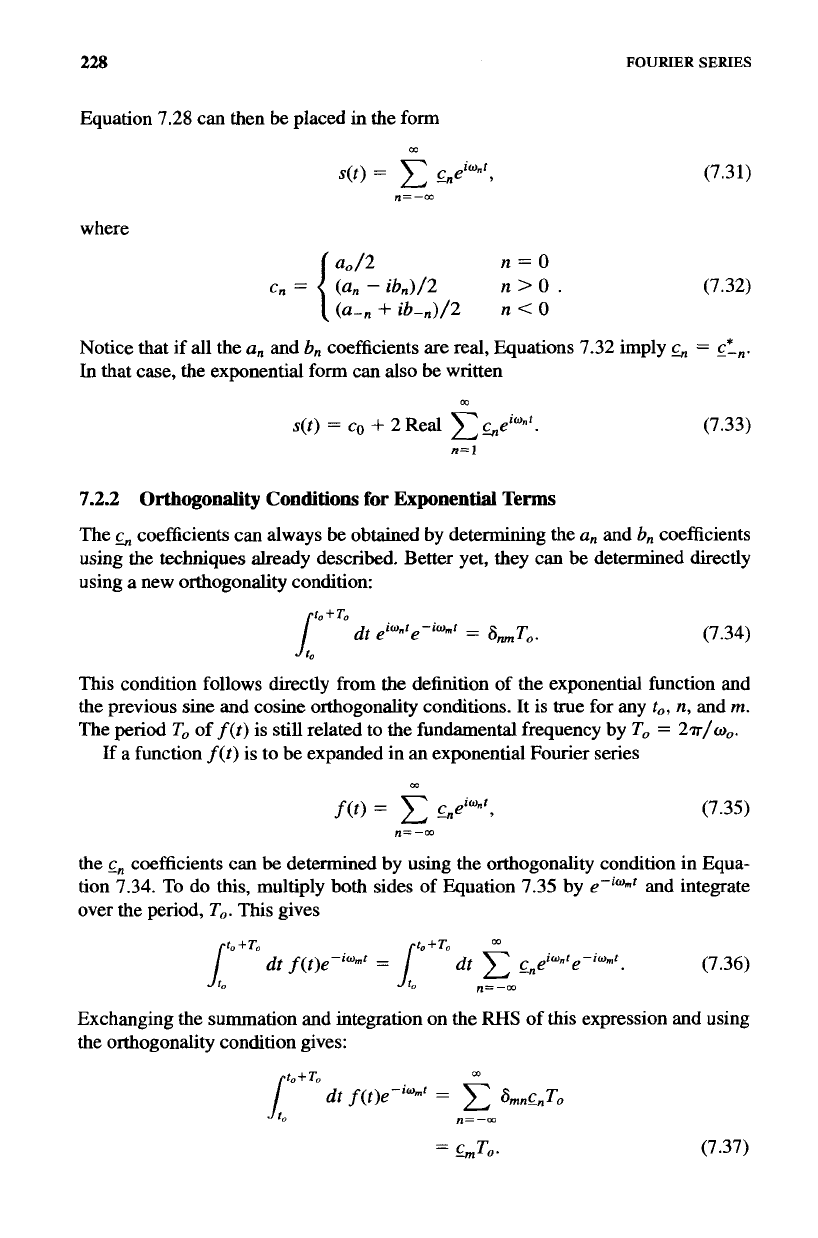
can then be placed in the form
m
n=-m
where
FOURIER
SERIES
(7.31)
(7.32)
Notice that if
all
the
a,,
and
b,
coefficients are real, Equations
7.32
imply
h
=
c?,.
In
that case, the exponential form can also be written
m
s(t)
=
co
+
2
Real
&eion'.
(7.33)
n=
1
7.2.2
Orthogonality
Conditions
for
Exponential
Terms
The
&
coefficients can always be obtained by determining the
a,
and
bn
coefficients
using the techniques already described. Better yet, they
can
be determined directly
using a new orthogonality condition:
lo
+To
&lm
TO.
(7.34)
dt
eionfe-i"t
=
1
This
condition follows directly from the definition of the exponential function and
the previous sine and cosine orthogonality conditions. It
is
true for any
to,
n,
and
m.
The period
To
of
f(t)
is still related to the fundamental frequency by
To
=
27r/w0.
If
a function
f(t)
is to be expanded in an exponential Fourier series
m
the
gn
coefficients can
be
determined by using the orthogonality condition in Equa-
tion
7.34.
To
do
this,
multiply both sides of Equation
7.35
by
e-'%'
and integrate
over the period,
To.
This
gives
Exchanging the summation and integration on the
RHS
of this expression and using
the orthogonality condition gives:
=
&To.
(7.37)
THE EXPONENTIAL
FORM
OF FOURIER SERIES
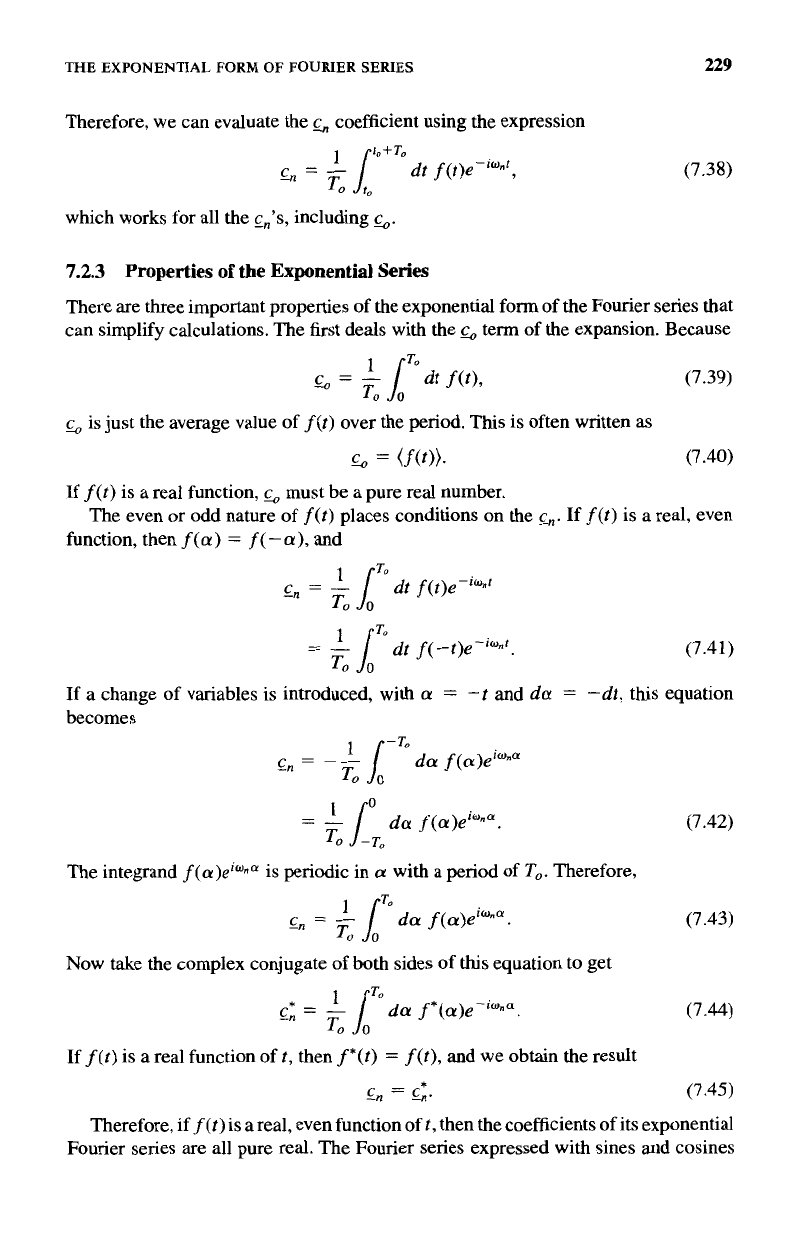
Therefore, we can evaluate the
G
coefficient using the expression
=
s,"'"
dt
f(f)e-'".',
229
(7.38)
which works for all the
en's,
including
c+,.
7.2.3
Properties
of
the Exponential Series
There are three important properties of the exponential form of the Fourier series that
can simplify calculations. The first deals with the
G
term of the expansion. Because
(7.39)
c+,
is just the average value of
f(t)
over the period.
This
is often written
as
If
f(t)
is a real function,
5
must be a pure real number.
function, then
f(
a)
=
f(
-
a).
and
The even or odd nature
of
f(t)
places conditions on the
cn.
If
f(t)
is a real, even
(7.41)
If a change
of
variables is introduced, with
a
=
-f
and
da
=
-dt,
this equation
becomes
0
=
-L
J
da
f(a)e'"n".
'0
-To
The integrand
f(a)eiwna
is periodic in
a
with a period of
To.
Therefore,
Now take the complex conjugate of both sides of
this
equation to get
1
To
c;
=
T,
da
f*(a)e-iona.
(7.42)
(7.43)
(7.44)
If
f(t)
is a real function oft, then
f*(t)
=
f(t),
and we obtain the result
*
(7.45)
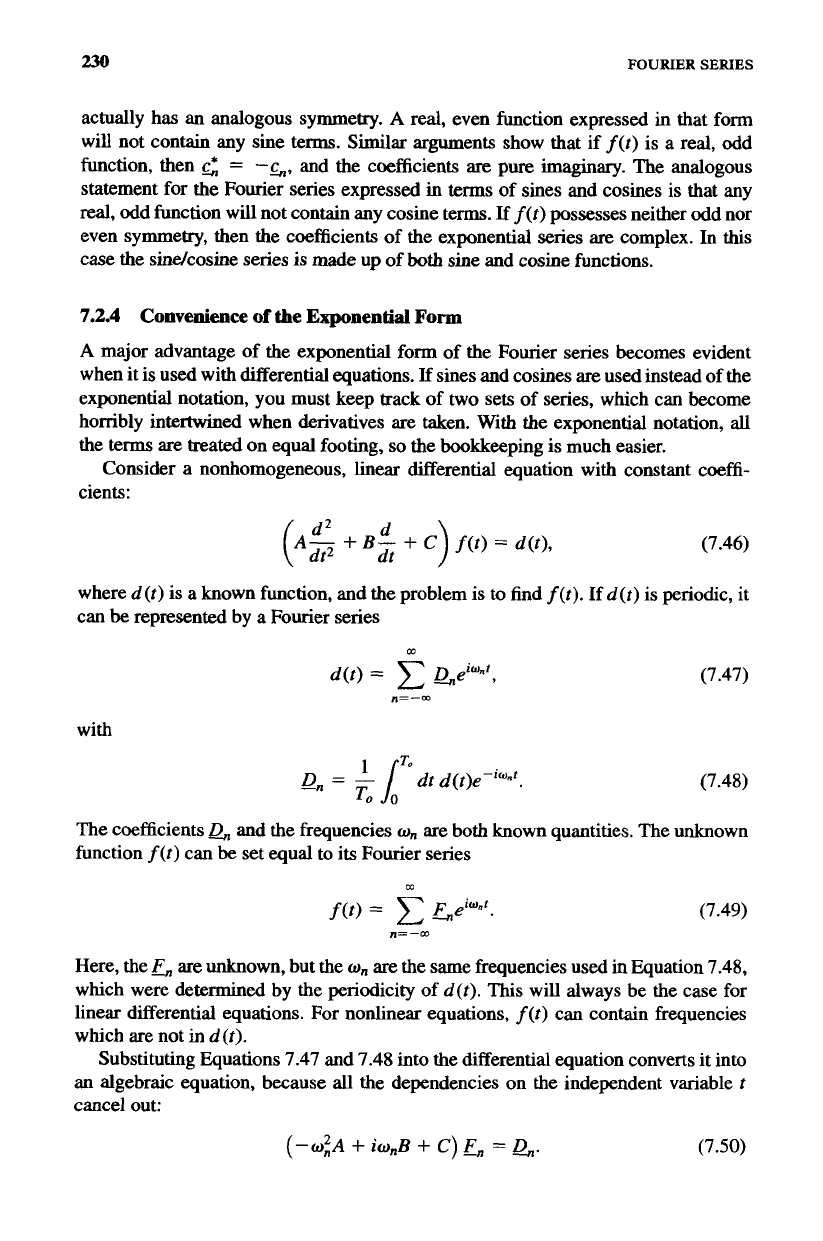
Therefore, if
f(t)
is a real, even function off, then the coefficients of its exponential
Fourier series are all pure real. The Fourier series expressed with sines and cosines
-
Cn
-
Cn.
230
FOURIER
SERIES
actually has an analogous symmetry.
A
real, even function expressed in that form
will not contain any sine terms. Similar arguments show that
if
f(t)
is a real, odd
function, then
=
-&,
and the coefficients
are
pure
imaginary. The analogous
statement for the Fourier series expressed in terms of sines and cosines is that any
real, odd function will not contain any cosine terms.
If
f(t)
possesses neither odd nor
even symmetry, then the coefficients of the exponential series
are
complex.
In
this
case the sindcosine series is made
up
of both sine and cosine functions.
7.2.4
Convenience
of
the
Exponential
Form
A
major advantage of the exponential form of the Fourier series becomes evident
when it
is
used with differential equations.
If
sines and cosines are used instead of the
exponential notation, you must keep track of two sets of series, which can become
horribly intertwined when derivatives are taken. With the exponential notation,
all
the terms are treated on equal footing,
so
the bookkeeping is much easier.
Consider a nonhomogeneous, linear differential equation with constant coeffi-
cients:
(A$
+
Bz
"1
+
C
f(t)
=
d(t),
(7.46)
where
d(t)
is a known function, and the problem is to
find
f(t).
If
d(t)
is periodic, it
can
be
represented by a Fourier series
m
d(t)
=
&eiont,
(7.47)
n=-m
with
(7.48)
The coefficients
Ll-,
and the frequencies
w,,
are both known quantities. The unknown
function
f(t)
can
be
set equal to its Fourier series
OD
f(t>
=
C
F-,eiwnt.
(7.49)
n=-m
Here, the
F-
are unknown, but the
wn
are the same frequencies used in Equation 7.48,
which were determined by the periodicity of
d(t).
This
will always be the case for
linear differential equations. For nonlinear equations,
f
(t)
can contain frequencies
which are not in
d
(t).
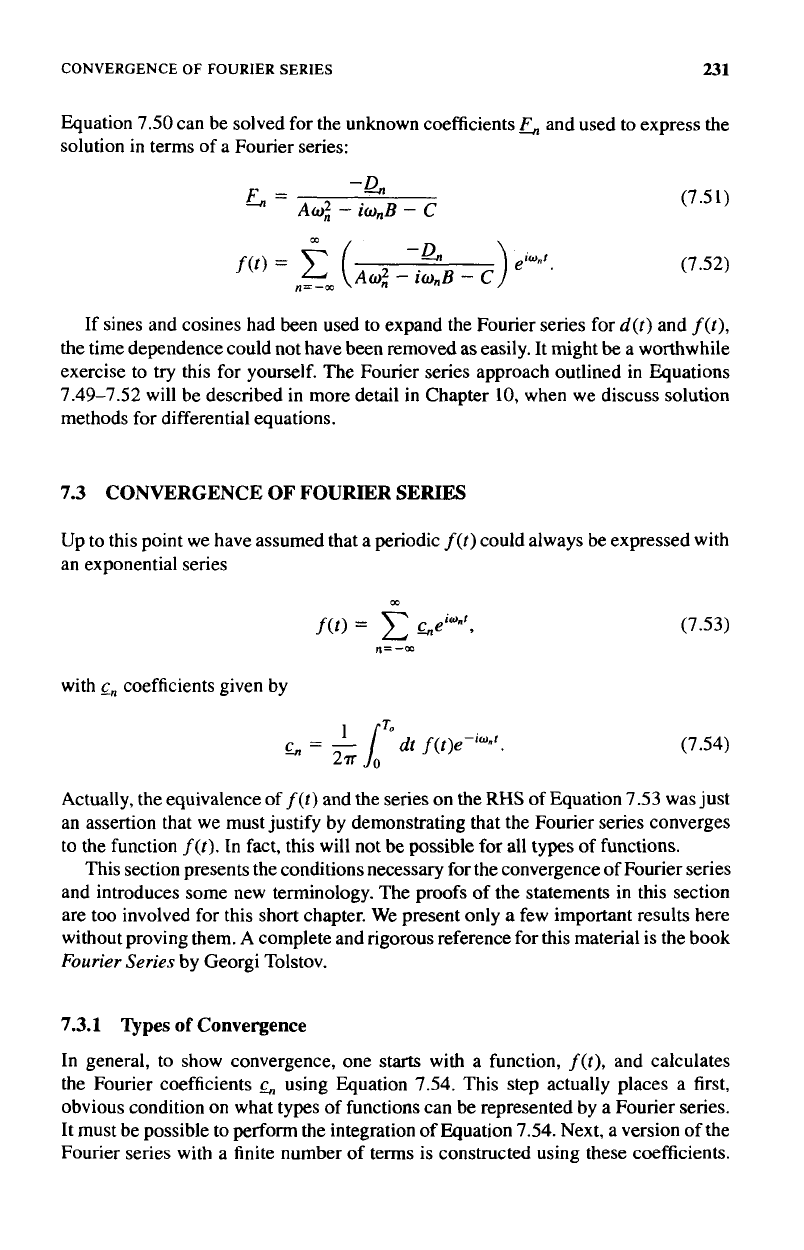
Substituting Equations 7.47 and 7.48 into the differential equation converts it into
an
algebraic equation, because all the dependencies on the independent variable
t
cancel out:
(-wiA+iwnB+C)&
=a.
(7.50)
CONVERGENCE
OF
FOURIER SERIES
231
Equation
7.50
can be solved for the unknown coefficients
F-
and used to express the
solution
in
terms of a Fourier series:
(7.5
1)
L=
-4
Ao:
-
iw,B
-
C
(7.52)
If sines and cosines had been used to expand the Fourier series for
d(t)
and
f(t),
the time dependence could not have been removed
as
easily. It might
be
a worthwhile
exercise to
try
this for yourself.
The
Fourier series approach outlined in Equations
7.49-7.52
will be described
in
more detail in Chapter
10,
when we discuss solution
methods for differential equations.
7.3
CONVERGENCE
OF
FOURIER
SERIES
Up to this point we have assumed that a periodic
f(t)
could always be expressed with
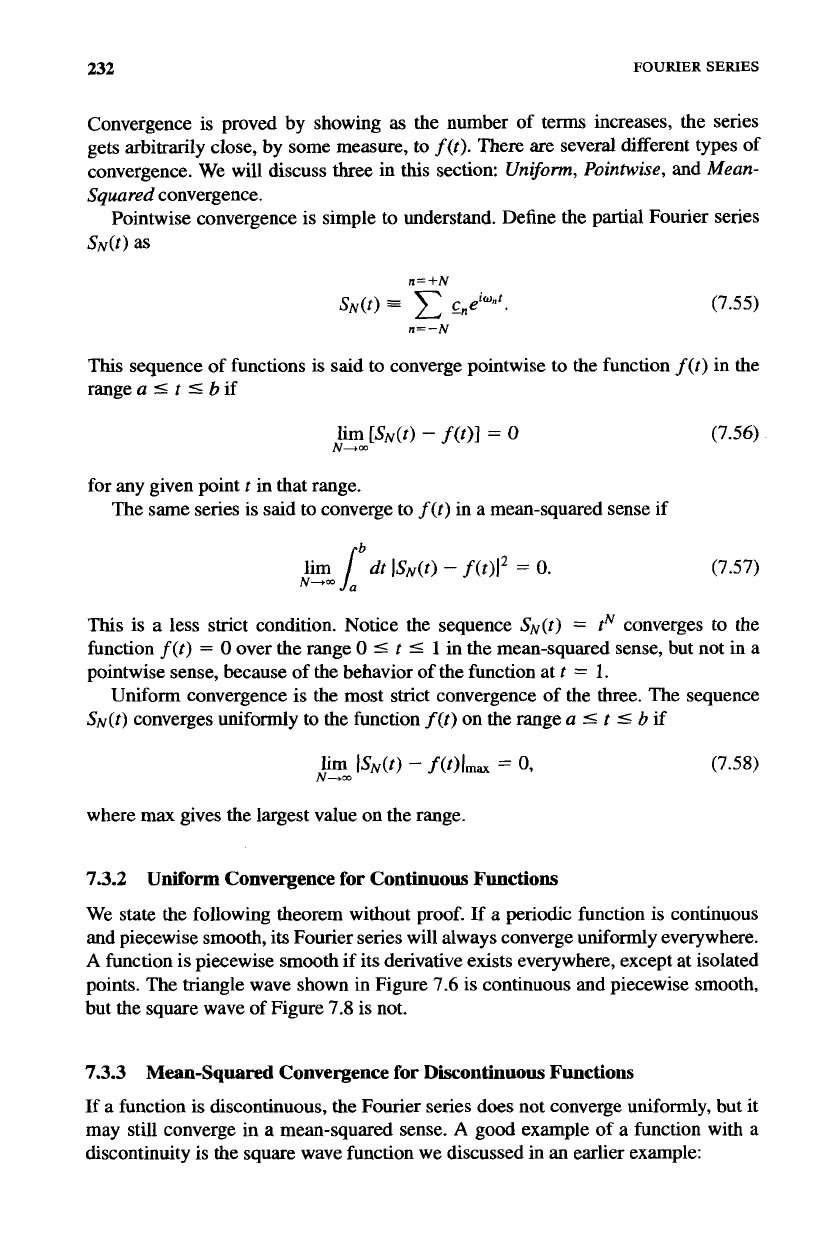
an exponential series
with
c,
coefficients given by
(7.54)
Actually, the equivalence of
f(t)
and the series on the
RHS
of Equation
7.53
was
just
an assertion that we must justify by demonstrating that the Fourier series converges
to the function
f(t).
In fact, this will not be possible
for
all types of functions.
This section presents the conditions necessary
for
the convergence of Fourier series
and introduces some new terminology. The proofs of the statements in this section
are too involved for this short chapter. We present only a few important results here
without proving them.
A
complete and rigorous reference for this material is the book
Fourier Series
by Georgi Tolstov.
7.3.1
Qpes
of
Convergence
In general, to show convergence, one
starts
with a function,
f(t),
and calculates
the Fourier coefficients using Equation
7.54.
This step actually places a first,
obvious condition on what types of functions can be represented by a Fourier series.
It must be possible to perform the integration of Equation
7.54.
Next, a version of the
Fourier series with a finite number of terms
is
constructed using these coefficients.
232
FOURIER
SERIES
Convergence is proved by showing
as
the number of terms increases, the series
gets arbitrarily close, by some measure, to
f(t).
There
are
several different types
of
convergence. We will discuss
three
in
this
section:
Uniform, Pointwise,
and
Mean-
Squared
convergence.
Pointwise convergence is simple to understand. Define the partial Fourier series
sN(t)
as
n=+N
(7.55)
n=-N
This
sequence of functions is
said
to
converge pointwise to the function
f(t)
in the
rangea
5
t
5
bif
lim
[&(t)
-
f(t)]
=
0
(7.56)
N-m
for any given point
t
in that range.
The
same series is
said
to
converge to
f(t)
in a mean-squared sense if
(7.57)
This
is
a
less strict condition. Notice the sequence
&(t)
=
tN
converges
to
the
function
f(t)
=
0
over the range
0
5
t
5
1
in the mean-squared sense, but not
in
a
pointwise sense, because
of
the behavior of the function at
t
=
1.
Uniform convergence is the most strict convergence
of
the three. The sequence
&(t)
converges uniformiy to the function
f(t)
on the range
a
5
t
5
b
if
where max gives the largest value on the range.
7.3.2
Uniform
Convergence
for
Continuous Functions
We
state
the
following theorem without proof. If a periodic function
is
continuous
and piecewise smooth, its Fourier series will always converge uniformly everywhere.
A
function is piecewise smooth if its derivative exists everywhere, except at isolated
points. The triangle wave shown in Figure
7.6
is continuous and piecewise smooth,
but the square wave of Figure
7.8
is not.
7.3.3
Mean-Squared
Convergence
for
Discontinuous Functions
If
a function is discontinuous, the Fourier series does not converge uniformly, but it
may still converge in a mean-squared sense.
A
good example of a function with a
discontinuity is the square wave function we discussed in an earlier example:
CONVERGENCE
OF
FOURIER SERIES
233
(7.59)
The sum
of
the first three terms of the Fourier series was shown progressively in
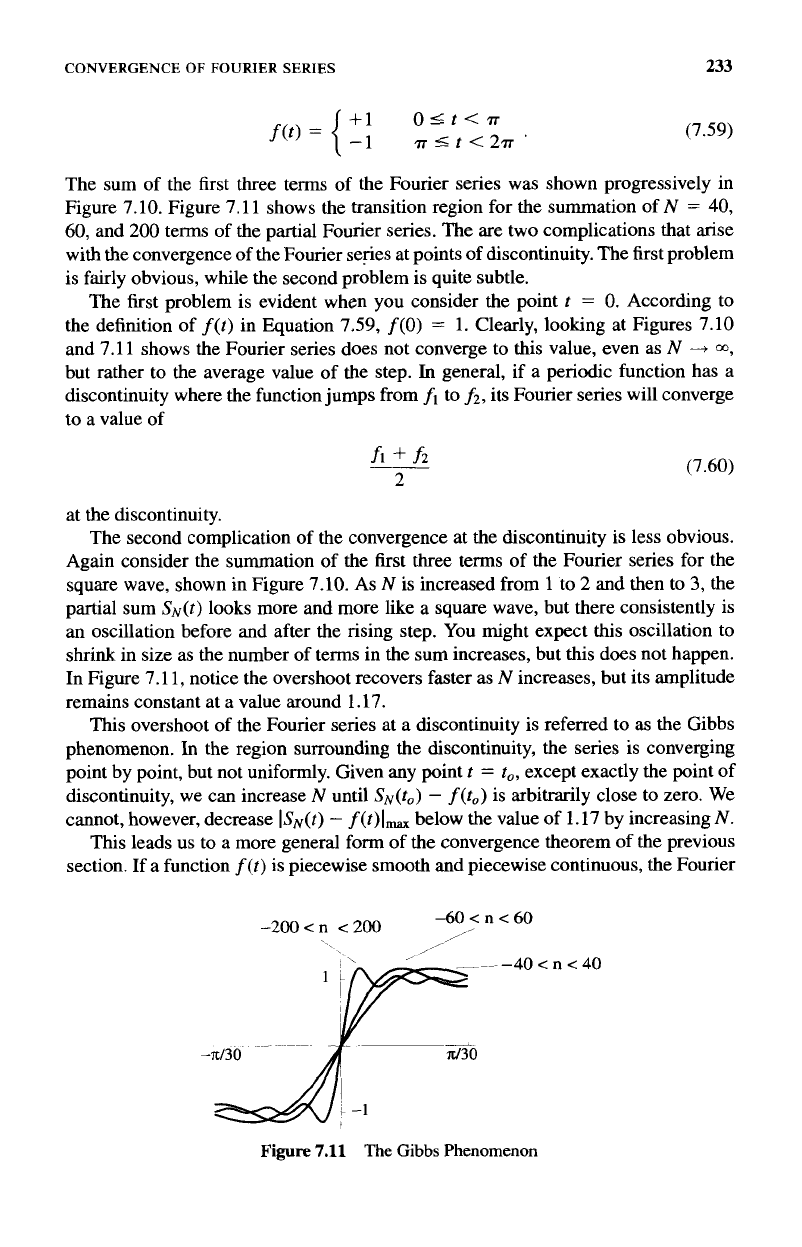
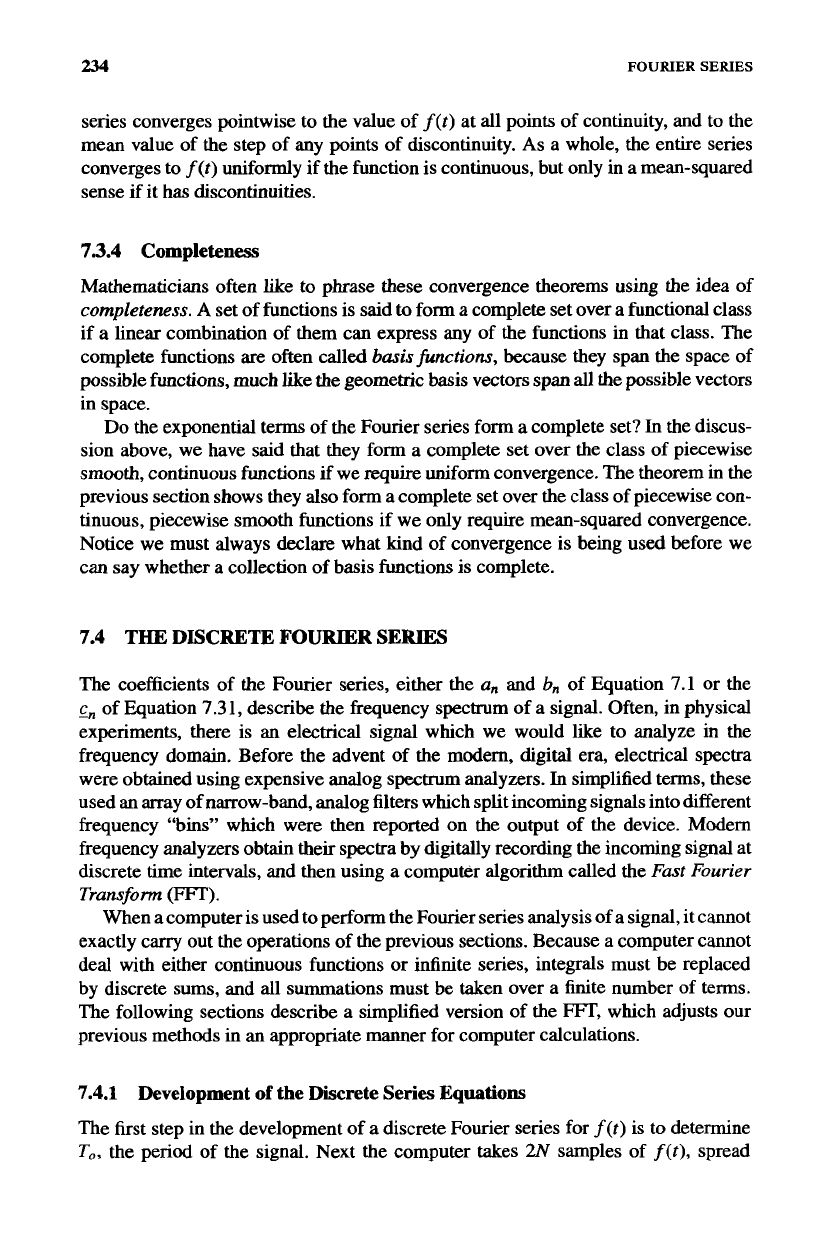
Figure 7.10. Figure 7.1 1 shows the transition region for the summation of
N
=
40,
60, and
200
terms of the partial Fourier series. The
are
two complications that arise
with the convergence of the Fourier seces at points
of
discontinuity. The first problem
is
fairly obvious, while the second problem is quite subtle.
The first problem is evident when you consider the point
t
=
0.
According to
the definition of
f(t)
in Equation 7S9,
f(0)
=
1. Clearly, looking at Figures 7.10
and 7.11 shows the Fourier series does not converge to
this
value, even as
N
---$.
m,
but rather to the average value of the step.
In
general, if a periodic function has a
discontinuity where the function jumps from
f,
to
f2,
its Fourier series will converge
to a value
of
fl
+
f2
2
(7.60)
at the discontinuity.
The second complication
of
the convergence at the discontinuity is less obvious.
Again consider the summation of the lirst three terms of the Fourier series for the
square wave, shown in Figure 7.10. As
N
is increased from
1
to
2
and then to
3,
the
partial sum
SN(~)
looks more and more like a square wave, but there consistently is
an oscillation before and after the rising step.
You
might expect
this
oscillation to
shrink
in size as the number of terms in the sum increases, but
this
does not happen.
In Figure 7.1 1, notice the overshoot recovers faster as
N
increases, but its amplitude
remains constant at a value around 1.17.
This overshoot of the Fourier series at a discontinuity is referred to
as
the Gibbs
phenomenon.
In
the region surrounding the discontinuity,
the
series
is
converging
point by point, but not uniformly. Given any point
f
=
to,
except exactly the point of
discontinuity, we can increase
N
until
&(to)
-
f
(to)
is arbitrarily close to zero. We
cannot, however, decrease
I&(t)
-
f(t)l-
below the value of 1.17 by increasing
N.
This leads us to a more general form of the convergence theorem of the previous
section. If a function
f
(t)
is piecewise smooth and piecewise continuous, the Fourier
Figure
7.11
The
Gibbs
Phenomenon
234
FOURIER
SERIES
series converges pointwise to the value of
f(t)
at all points of continuity, and to the
mean
value
of the step of any points of discontinuity.
As
a whole, the entire series
converges to
f(t)
uniformly
if
the function is continuous, but only in a mean-squared
sense
if
it has discontinuities.
7.3.4 Completeness
Mathematicians often like to phrase these convergence theorems using the idea of
completeness.
A
set of functions is said
to
form a complete set over a functional class
if a
linear combination of them can express any of the functions in that class. The
complete functions are often called
basisfunctions,
because they span the space of
possible functions, much like the geometric basis vectors span all the possible vectors
in space.
Do the exponential terms of the Fourier series form a complete set?
In
the discus-
sion above, we have said that they form a complete set over the class of piecewise
smooth,
continuous functions
if
we require uniform convergence. The theorem in the
previous section shows they also form a complete set over the class of piecewise con-
tinuous, piecewise smooth functions if we
only
require mean-squared convergence.
Notice
we
must always declare what kind of convergence is being used before we
can say whether a collection of basis functions is complete.
7.4 THE
DISCRETE
FOURIER
SERIES
The coefficients of the Fourier series, either the
a,
and
b,
of Equation
7.1
or the
gn
of Equation 7.31, describe the frequency spectrum of a signal. Often, in physical
experiments, there is an electrical signal which we would like
to
analyze in the
frequency domain. Before the advent of the modem, digital era, electrical spectra
were obtained using expensive analog
spectrum
analyzers.
In
simplified terms, these
used an array of narrow-band, analog filters which split incoming signals into different
frequency “bins” which were then reported on the output of the device. Modern
frequency analyzers obtain their spectra by digitally recording the incoming signal at
discrete time intervals, and then using a computer algorithm called the
Fast Fourier
Trunsfomz
(FIT).
When a computer
is
used to perform the Fourier series analysis
of
a
signal, it cannot
exactly carry out the operations of the previous sections. Because
a
computer cannot
deal with either continuous functions or infinite series, integrals must be replaced
by discrete
sums,
and all summations must be taken over a finite number of terms.
The following sections describe a simplified version of the
FIT,
which adjusts our
previous methods in an appropriate manner for computer calculations.
7.4.1
Development
of
the Discrete Series
Equations
The first step in the development of a discrete Fourier series for
f(t)
is to determine
To,
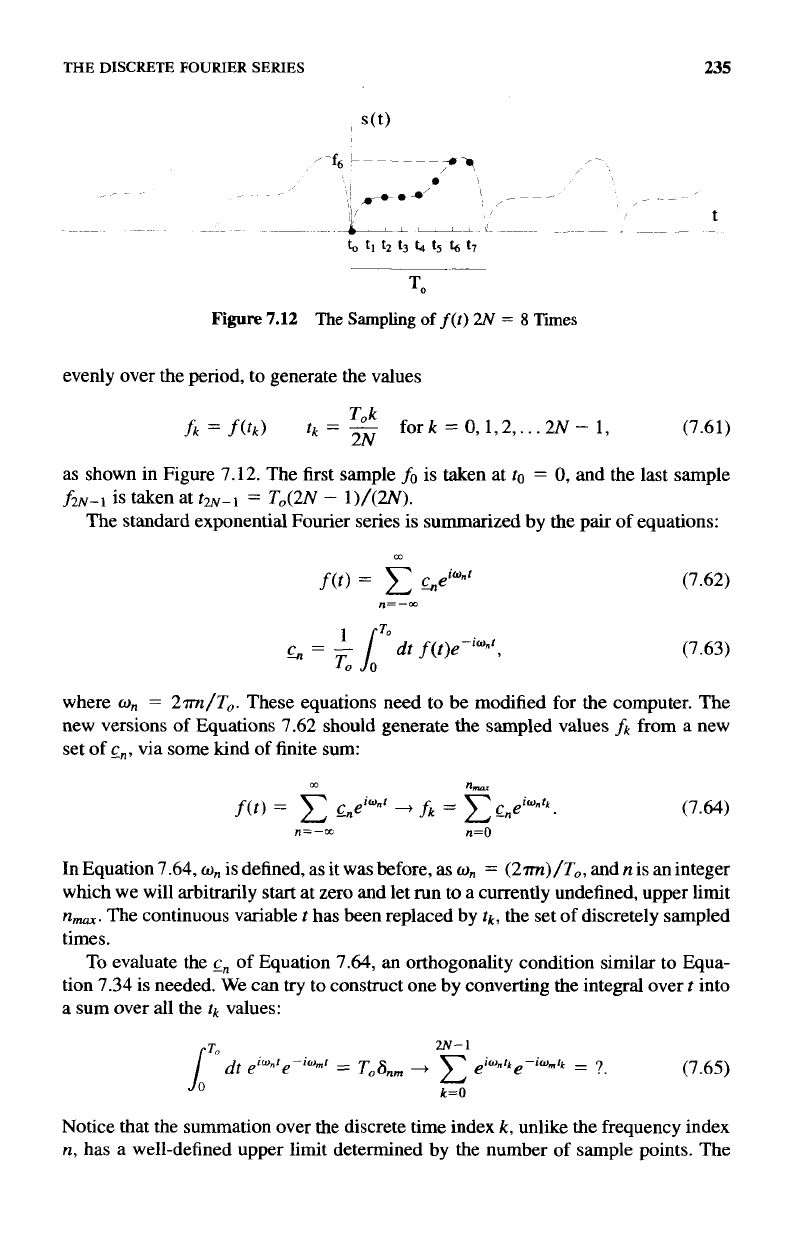
the period of the signal. Next the computer takes
2N
samples
of
f(t),
spread
THE DISCRETE FOURIER
SERIES
235
evenly over the period, to generate the values
(7.61)
as shown in Figure
7.12.
The first sample
fo
is taken at
to
=
0,
and the last sample
fzN-l
is
taken at
tz~-l
=
T0(2N
-
1)/(2N).
The standard exponential Fourier series is summarized by the
pair
of
equations:
TOk
fk
=
f(tk)
tk
=
-
2N
fork
=
0,
1,2,. . .2N
-
1,
m
1
To
=
T,
1
dt
f(t)e-i"n',
(7.62)
(7.63)
where
w,
=
2n/T0.
These equations need to be modified for the computer. The
new versions of Equations
7.62
should generate the sampled values
fk
from a new
set of
cn,
via some kind of finite sum:
(7.64)
n=-m
n=O
In Equation
7.64,
on
is defined, as it was before,
as
on
=
(2nn)/T0,
and
n
is
an
integer
which we will arbitrarily start at zero and let run to a currently undefined, upper limit
n-.
The continuous variable
t
has been replaced by
tk,
the set of discretely sampled
times.
To
evaluate the
c,
of
Equation
7.64,
an
orthogonality condition similar to Equa-
tion
7.34
is needed. We can
try
to construct one by converting the integral over
t
into
a
sum
over all the
tk
values:
Notice that the summation over the discrete time index k, unlike the frequency index
n,
has a well-defined upper limit determined by the number of sample points. The