
Kusse B.R., Westwig E.A. Mathematical Physics: Applied Mathematics for Scientists and Engineers
Подождите немного. Документ загружается.

216
INTRODUCTION
TO
COMPLEX VARIABLES
(c)
Is
this mapping function conformal? Can it be used to generate solutions to
Laplace’s equation?
53.
Consider the mapping function
(a)
Where does the imaginary axis of the y-plane map onto the g-plane?
(b)
Where do the points in
the
right half of the y-plane map onto the z-plane?
(c)
Where do the
points
in the left half of the w-plane map onto the g-plane?
54.
The mapping function
22
+
1
-
w(z>
=
-
z
can be used to analyze two-dimensional flow around a cylindrical obstacle.
Uniform stream lines described in the w-plane by lines of constant
u
become,
upon mapping onto the g-plane, the flow lines around a cylinder. The constant
pressure lines for the flow around the cylinder
are
given by mapping the lines of
constant
u
onto the Z-plane.
(a)
Plotthelinesv
=
-3,-2,-1,0,+1,+2,and f3ontotheg-plane.
(b)
Plot the lines of constant
u
onto the z-plane.
(c)
The velocity field for the flow is proportional to the gradient of the pressure
distribution function, i.e.,
-
v
=
-pVP(x,y),
where
p
is a positive constant called the mobility,
and
P(x,
y)
is the pressure
distribution function. What is the velocity field,
V(x,
y),
for the flow around
the cylinder?
55.
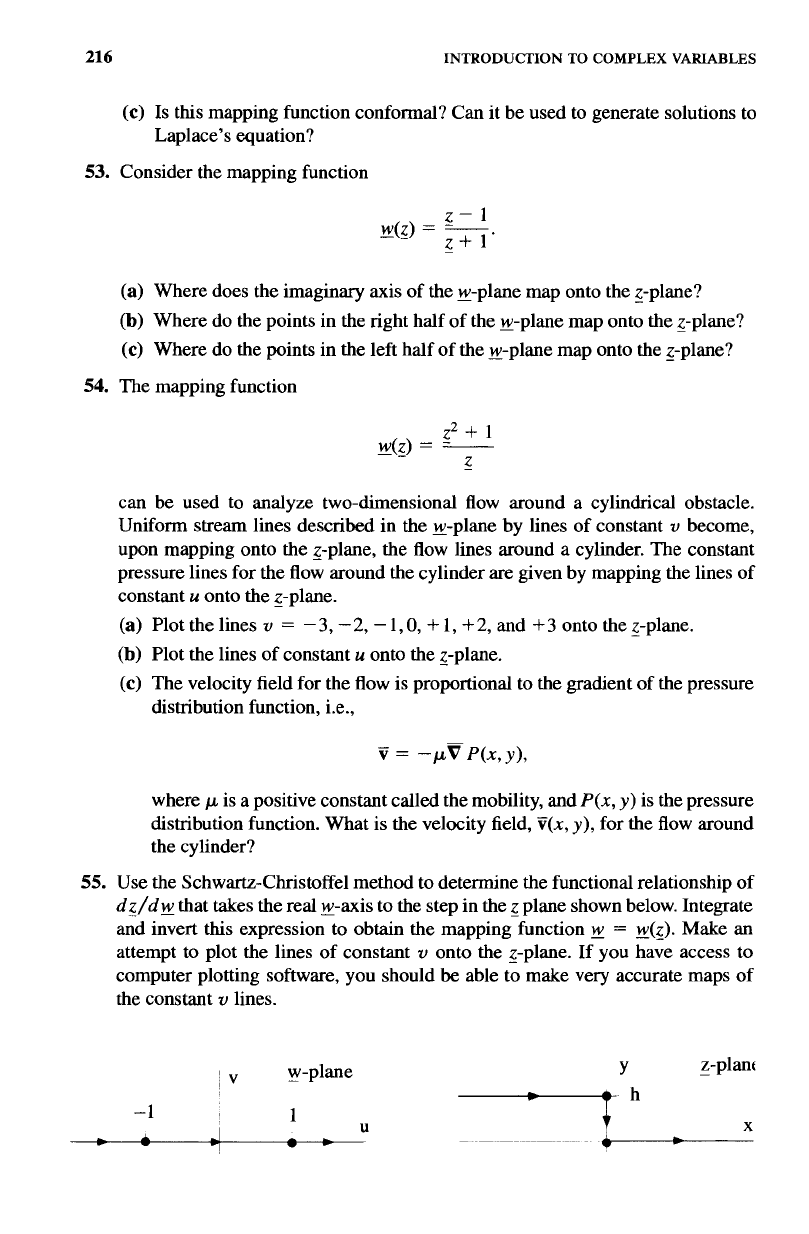
Use the Schwartz-Christoffel method to determine the functional relationship
of
dz/dy
that takes the real y-axis to the step in the
g
plane shown below. Integrate
&d invert this expression to obtain
the
mapping function
w
=
~(g).
Make an
attempt to plot the lines of constant
u
onto the g-plane. If you have access to
computer plotting software, you should
be
able to make
very
accurate maps of
the constant v lines.
1
w-plane
-1 1
lU
Y
-
z-plant
EXERCISES
217
56.
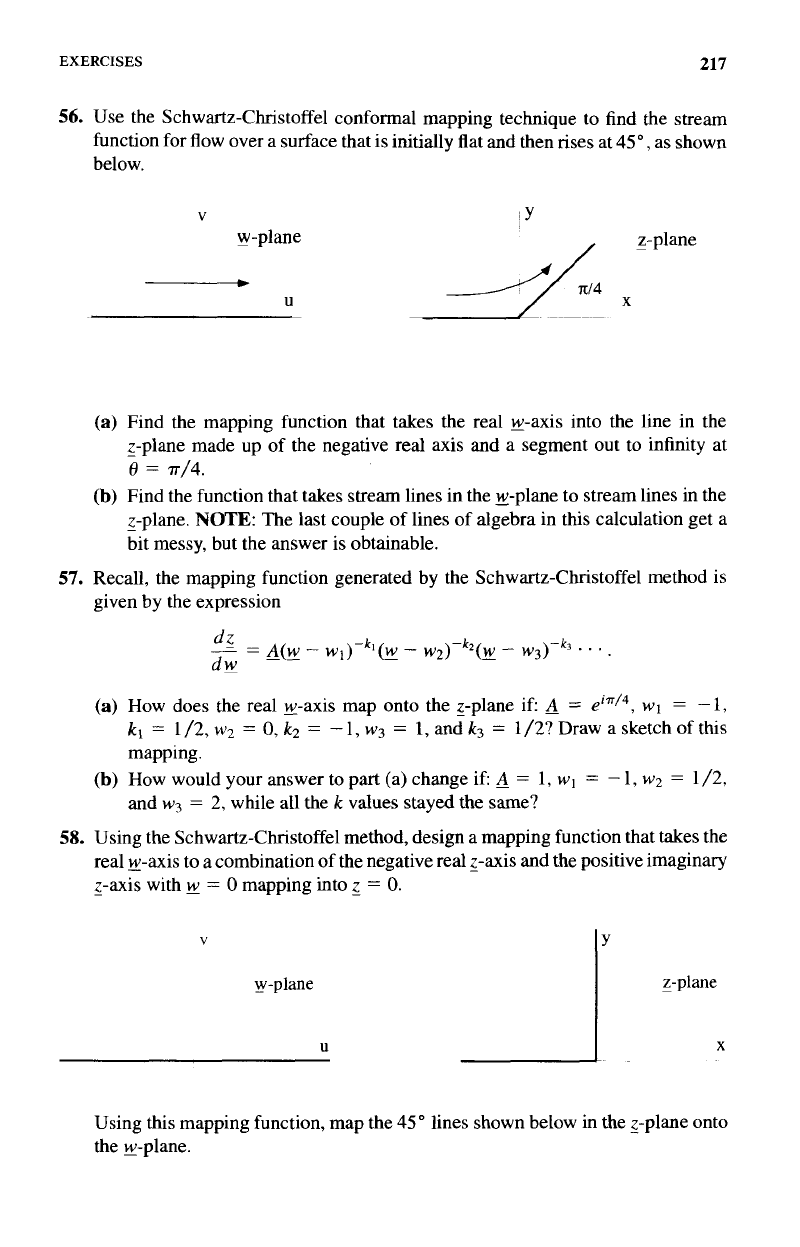
Use the Schwartz-Chnstoffel conformal mapping technique to find the stream
function for flow over a surface that is initially flat and then rises at
45',
as shown
below.
V
Y
w-plane z-plane
-
U
X
(a)
Find the mapping function that takes the real y-axis into the line in the
2-piane made up of the negative real axis and a segment out to infinity at
(b)
Find the function that takes stream lines in the w-plane to stream lines in the
z-plane.
NOTE:
The last couple
of
lines
of
algebra in this calculation get
a
bit messy, but the answer is obtainable.
57.
Recall, the mapping function generated by the Schwartz-Christoffel method is
0
=
T/4.
given
by
the expression
dz
-
=
A(w
-
w,)-kI(W
-
w*)-k'(y
-
Wg)-k'
. . . .
dw
(a)
How does the real g-axis map onto the Z-plane
if:
A
=
w1
=
-1,
kl
=
1
/2,
wz
=
0,
k2
=
-
1,
w3
=
1,
and
k3
=
1/2?
Draw a sketch of this
mapping.
(b)
How would your answer to part (a) change if
A
=
1,
w1
=
-
1,
w2
=
1/2,
and
w3
=
2,
while all the
k
values stayed the same?
58.
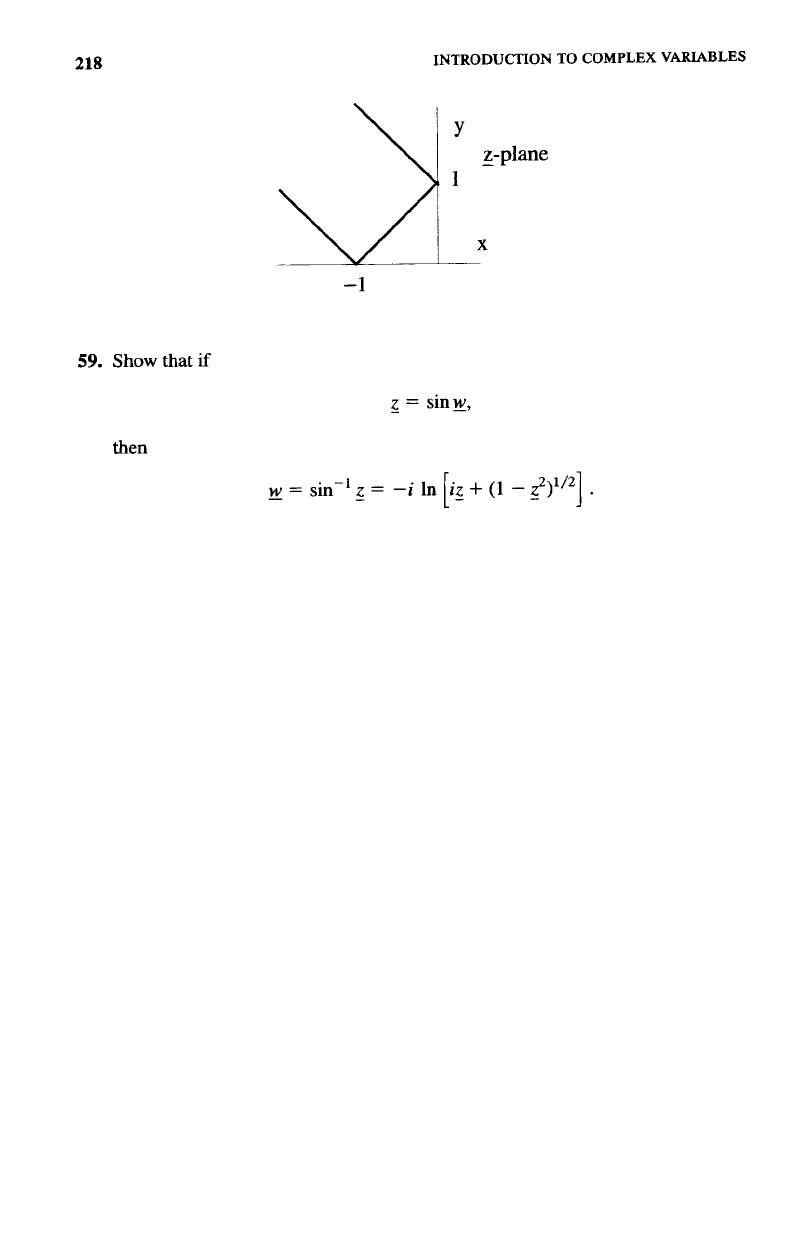
Using the Schwartz-Christoffel method, design a mapping function that takes the
real g-axis to a combination of the negative real z-axis and the positive imaginary
z-axis with
w
=
0
mapping into
z
=
0.
V
y-plane
Y
~
z-plane
X
U
I
Using this mapping function, map the
45"
lines shown below in the z-plane onto
the y-plane.
218
INTRODUCTION
TO
COMPLEX
VARIABLES
-
z-plane
X
-1
59.
Show
that
if
then
7
FOURIER SERIES
This
chapter consists of four sections. In the first section, we present a quick refresher
of Fourier series methods and a few examples. The second section demonstrates the
utility of the complex, exponential form of the Fourier series. These two sections
should provide a framework for the subsequent chapters on Fourier and Laplace
transforms. The third section briefly discusses the convergence properties of Fourier
series and introduces the concept of completeness. In the final section, we discuss the
discrete Fourier series, which is a numerical technique for obtaining Fourier spectra.
7.1
THE
SINE-COSINE
SERIES
A
general Fourier series expansion
is
the sum
of
a potentially infinite number of sine
and cosine terms:
m
a:
s(t)
=
2
+
a,coswnt
+
b,sino,t.
n=1,2,
...
n=1,2,..
2
(7.1)
Each term oscillates at an frequency
on
=
2n/T0,
an integer multiple of the
fundamental frequency
oo
=
27r/TO.
The value of
To
is determined either by the
periodicity
of
the function the series is supposed to represent, or a periodicity we force
the series expansion to take. The form of Equation 7.1 guarantees that the function
generated by the series has a periodicity of
To.
In other words, it obeys the condition
s(t)
=
s(t
+
To)
for all
t.
(7.2)
An
example
of
such
a
function
is
shown in Figure
7.1.
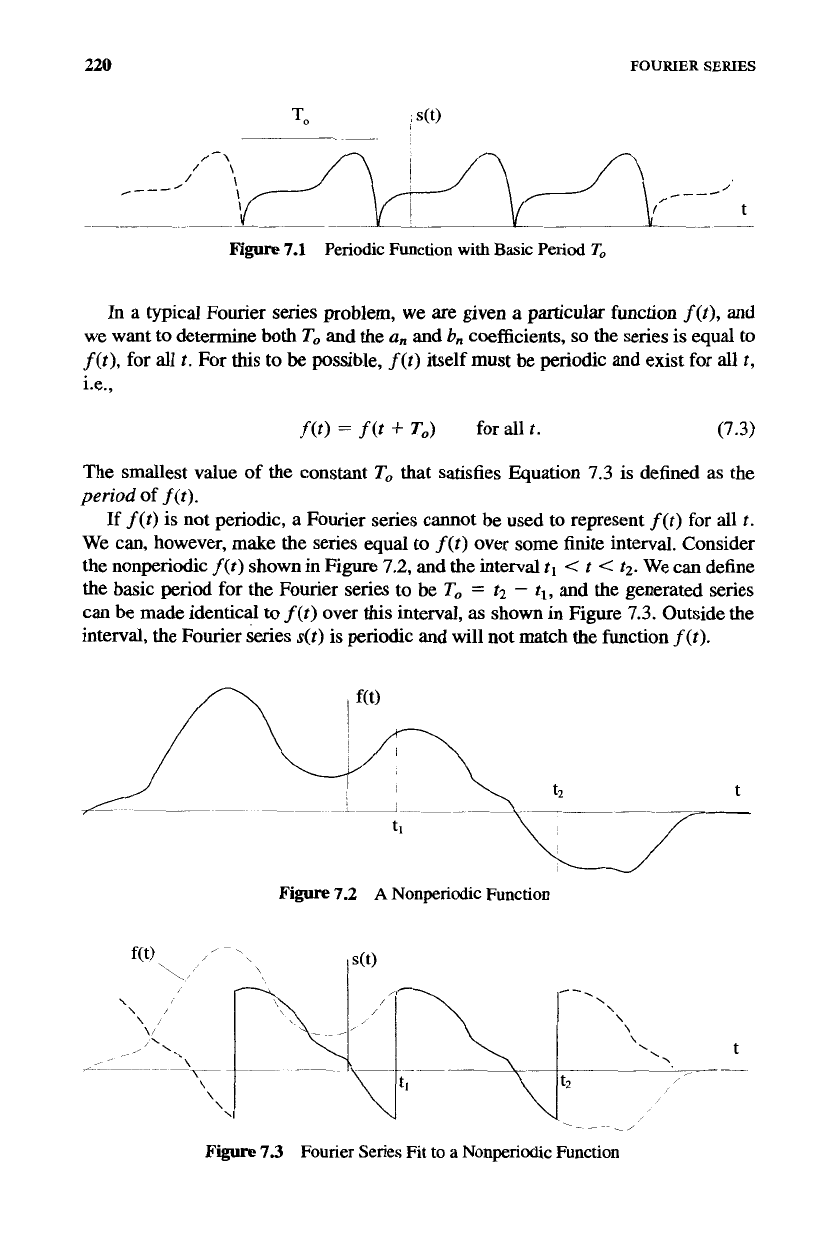
If the independent variable is
time, then
s(t)
has gone on for all past time and must continue forever.
219
220
FOURIER
SERIES
Figure
7.1
Periodic Function
with
Basic Period
To
In a typical Fourier series problem, we are given a particular function
f(t),
and
we want to determine both
To
and the
a,,
and
b,,
coefficients,
so
the series is equal to
f(t),
for all
t.
For
this
to
be
possible,
f(t)
itself must be periodic and exist for all
t,
i.e.,
f(t)
=
f(t
+
To)
for all
t.
(7.3)
The smallest value
of
the constant
To
that satisfies Equation
7.3
is defined as the
period
of
f(t).
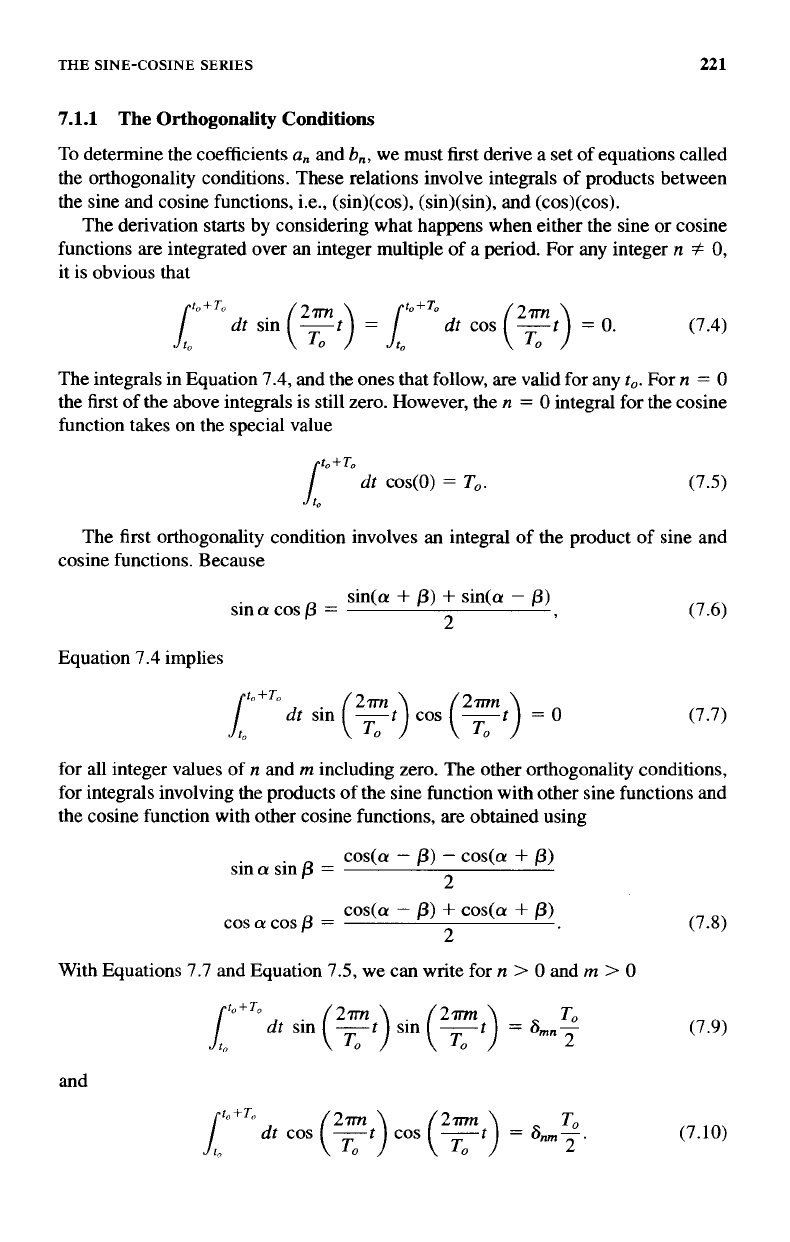
If
f(t)
is not periodic, a Fourier series cannot be used to represent
f(t)
for all
t.
We can, however, make the series equal to
f(t)
over some finite interval. Consider
the nonperiodic
f(t)
shown in
Figure
7.2,
and the interval
tl
<
t
<
t2.
We can define
the basic period for the Fourier series to be
To
=
t2
-
t1,
and the generated series
can
be
made identical
to
f(t)
over
this
interval,
as
shown
in Figure
7.3.
Outside the
interval, the Fourier series
s(t)
is periodic and will not match the function
f(t).
Figure
7.2
A
Nonperiodic Function
._
-_
Figure
7.3
Fourier
Series
Fit to
a
Nonperiodic Function
THE SINE-COSINE SERIES
221
7.1.1
The Orthogonality Conditions
To determine the coefficients
an
and
b,,,
we must first derive a set of equations called
the orthogonality conditions. These relations involve integrals of products between
the sine and cosine functions, i.e., (sin)(cos), (sin)(sin),
and
(cos)(cos).
The derivation starts by considering what happens when either the sine or cosine
functions are integrated over
an
integer multiple of a period. For any integer
n
#
0,
it is obvious that
[+To
dt
sin
(gt)
=
s,"'"dt
cos
(Ft)
=
0.
(7.4)
The integrals in Equation
7.4,
and the ones that follow, are valid for any
to.
For
n
=
0
the first of the above integrals is still zero. However, the
n
=
0
integral for the cosine
function takes
on
the special value
b
+To
dt
cos(0)
=
To
.I
(7.5)
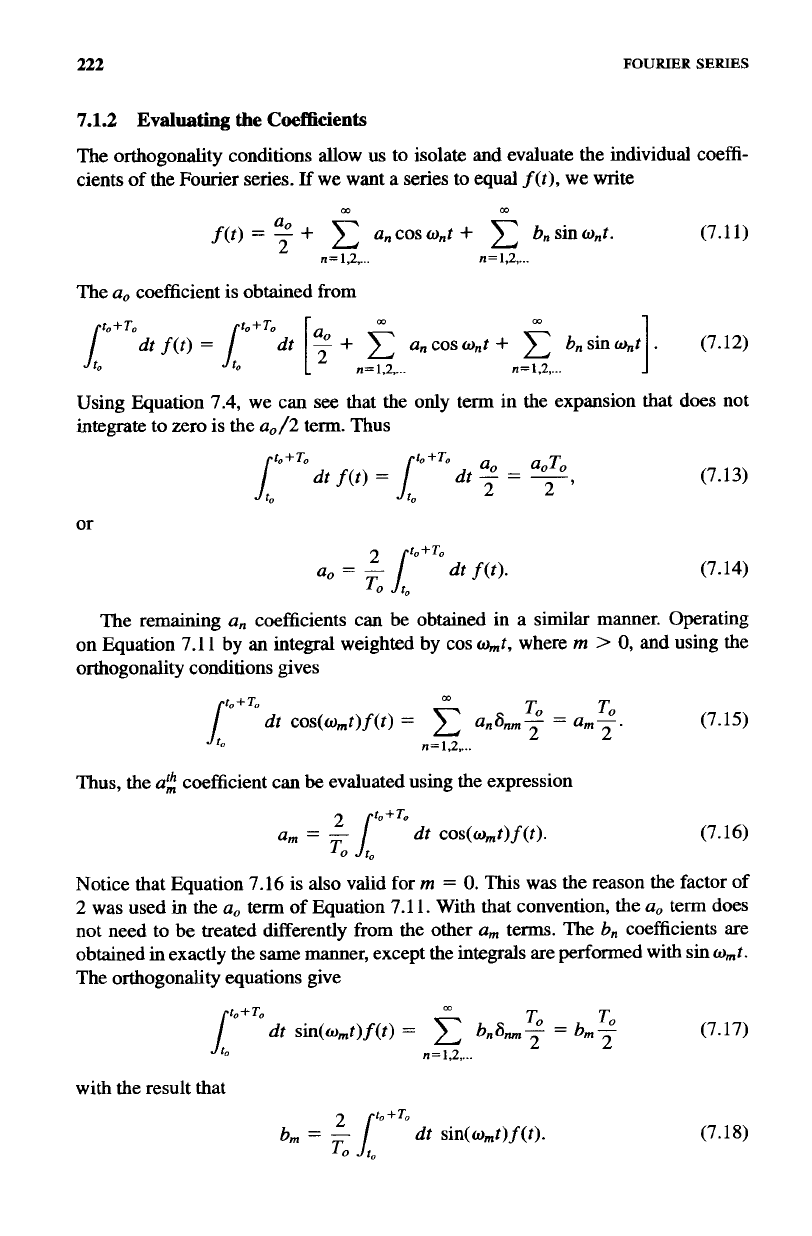
The first orthogonality condition involves
an
integral of the product of sine and
cosine functions. Because
sin(a
+
p)
+
sin(a
-
p)
2
(7.6)
sin
(Y
cos
p
=
Equation 7.4 implies
dt
sin
(gt)
cos
(Ft)
=
0
(7.7)
for all integer values
of
n
and
rn
including zero. The other orthogonality conditions,
for integrals involving the products of the sine function with other sine functions and
the cosine function with other cosine functions, are obtained using
cos(a
-
p)
-
cos(a
+
p)
2
sin
a
sin
p
=
cos(a
-
p)
+
cos(a
+
p)
(7.8)
2
cos
a
cos
p
=
With Equations 7.7 and Equation
7.5,
we can write for
n
>
0
and
rn
>
0
and
2m
2m
TO
dt
cos
(rt)
cos
(rt)
=
S,,,,.
I,
+I"<,
(7.10)
222
FOURIER
SERIES
7.1.2
Evaluating
the
Coefficients
The orthogonality conditions allow
us
to isolate and evaluate the individual coeffi-
cients of the Fourier series.
If
we want a series
to
equal
f
(t),
we write
m
m
f(t)
=
3
+
ancosont
+
b,
sinwnt.
n
=
1,2,..
.
n=
1.2.
...
(7.1 1)
The
a,
coefficient is obtained from
1
m m
b+TO
1
dt
f(t)
=
s,"'".
[a
+
ancosont
+
bnsinqt
.
(7.12)
n=1,2,
...
n=
1.2,
...
Using Equation 7.4, we can see that the only term in the expansion that does not
integrate
to zero is the a,/2 term.
Thus
or
(7.13)
(7.14)
The remaining
a,
coefficients can be obtained in a similar manner. Operating
on Equation 7.11 by an integral weighted by cos
%t,
where
rn
>
0,
and using the
orthogonality conditions gives
m
(7.15)
TO
to
+
To
To
-
dt
cos(w,t)f(t)
=
an&,,-
-
amT.
2
n=
1.2,
...
nus,
the
a,"
coefficient can
be
evaluated using the expression
a,
=
$
s,"'"
dt
cos(%t)
f
(t).
(7.16)
Notice that Equation 7.16 is also valid for
rn
=
0.
This
was the reason the factor
of
2 was used in the
a,
term of Equation 7.11. With that convention, the
a,
term does
not need to be treated differently from the other
a,
terms. The bn coefficients are
obtained in exactly the same manner, except the integrals are performed with
sin
o,t.
The orthogonality equations give
m
TO
TO
bnam--
=
bmy
dt
sin(w,t)f(t)
=
2
n=
1,Z.
...
with the result that
b
m
=
$['"
dt
sin(o,t)
f
(t).
(7.17)
(7.18)
THE
SINE-COSINE SERIES
223
7.1.3
The Fourier Series
Circuit
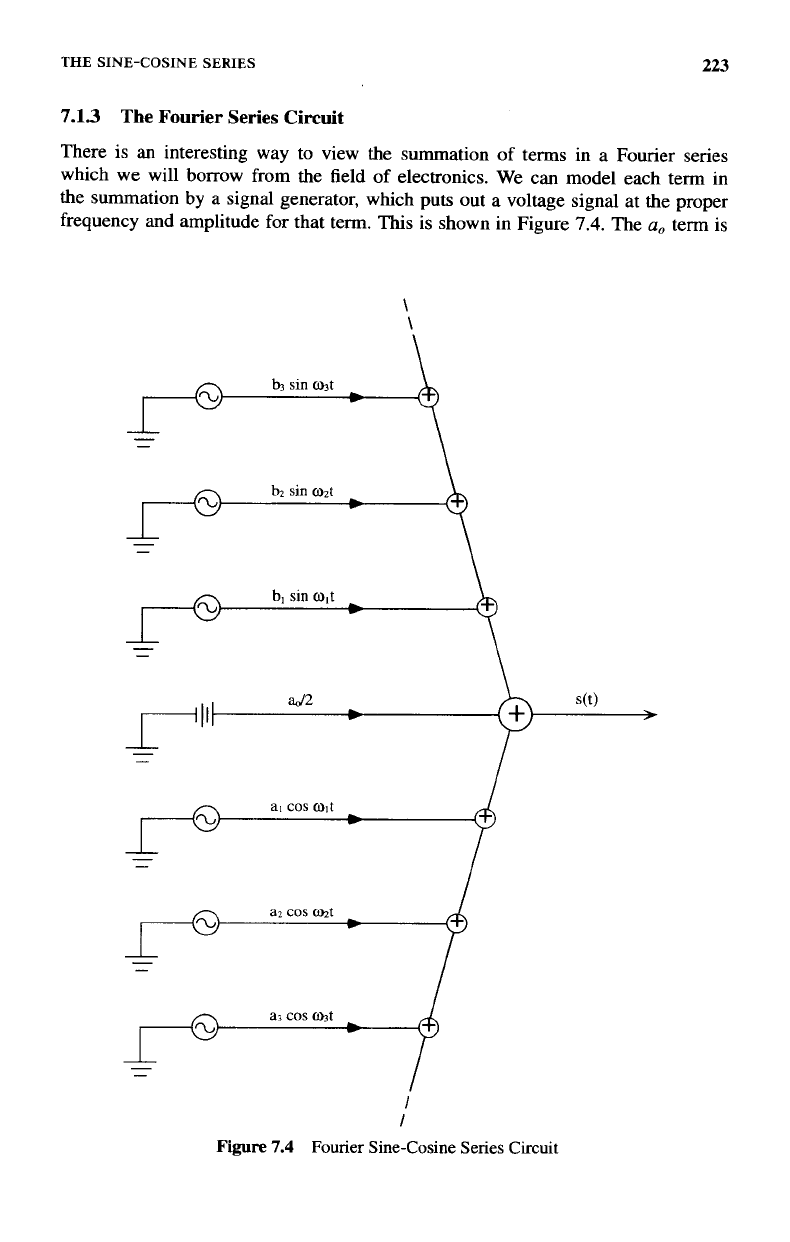
There is an interesting way to view
the
summation of terms in a Fourier series
which we will
borrow
from the field of electronics. We can model each term in
the summation
by
a signal generator, which puts out a voltage signal at the proper
frequency and amplitude for that term.
This
is shown in Figure
7.4.
The
a,
term is
I
I
Figure
7.4
Fourier
Sine-Cosine Series Circuit
224
FOURIER
SERIES
a d.c. source
of
a0/2
volts. The
bl
term is a sine wave oscillating at frequency
01,
with a signal amplitude of
bl
volts. The summation is accomplished by joining
all
the signals into one output from the circuit.
This
is the basis for what the electrical
engineers call the frequency spectrum of a signal. Conceptually, they often break
a signal into its various Fourier series components, analyze how each component
behaves individually, and then join the results back together
to
generate their final
solution.
We will return to
this
analogy in more detail when we discuss Fourier and Laplace
transforms.
Example
7.1
As
a very simple first example, consider the “expansion” of the func-
tion,
f(t)
=
sint.
The function is obviously periodic, with
To
=
27r.
The Fourier
series takes the form
m
m
sin
t
=
5
+
a,
cos(nt)
+
bn
sin(nt).
(7.19)
n=l
n=
1
2
We could struggle through the integral equations
of
the previous section to pick out
the values of the
a,
and b,, coefficients.
In
this
particular case, however, it
is
easy to
see that the only nonzero coefficient is
bl
,
which has a value of
1.
The set of coefficients in the Fourier series is sometimes referred to
as
the
spectrum
off
(t).
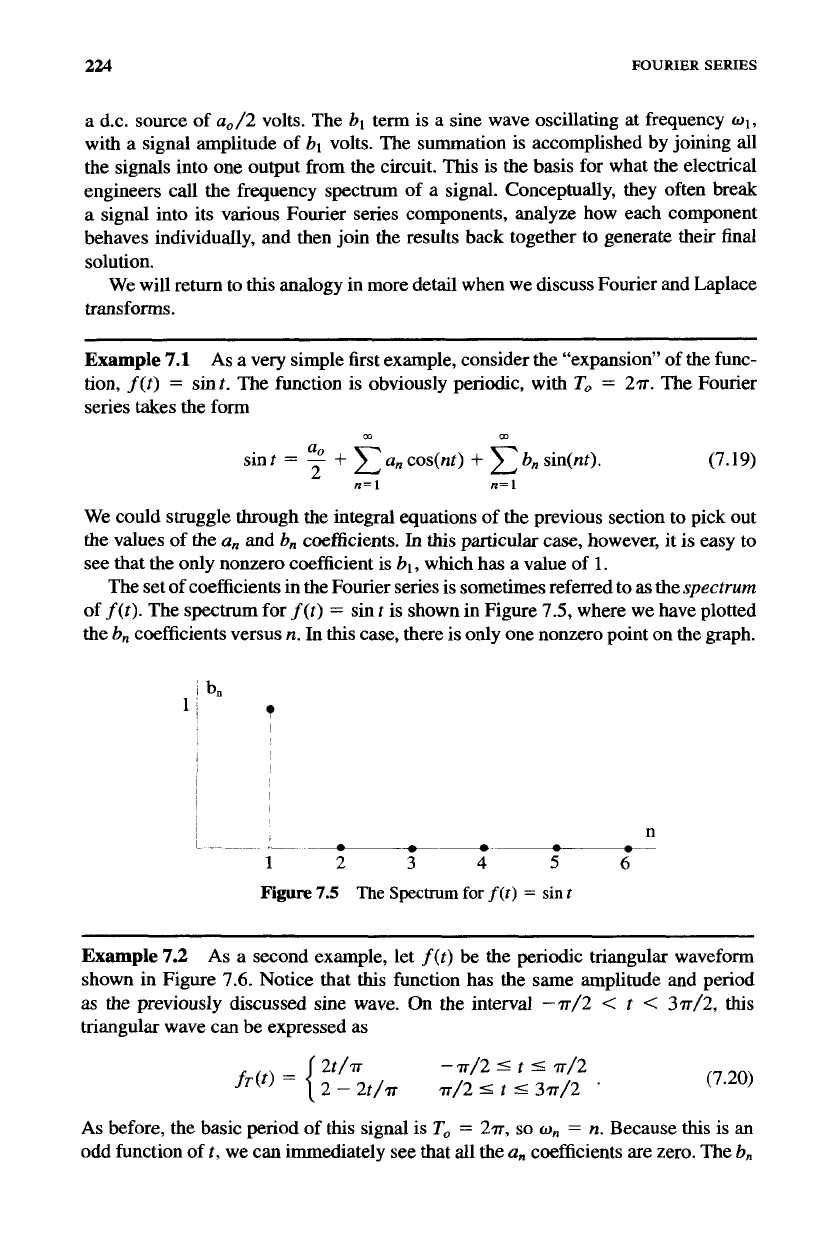
The spectrum for
f(t)
=
sin
t
is shown in Figure
7.5,
where we have plotted
the
b,
coefficients versus
n.
In
this
case, there is only one nonzero point on the graph.
,
n
-*-*--
L.
-~-
--
~
1
2
3
4
5
6
Figure
7.5
The
Spectrum
for
f(t)
=
sin
t
-
~ ~ ~
Example
7.2
As
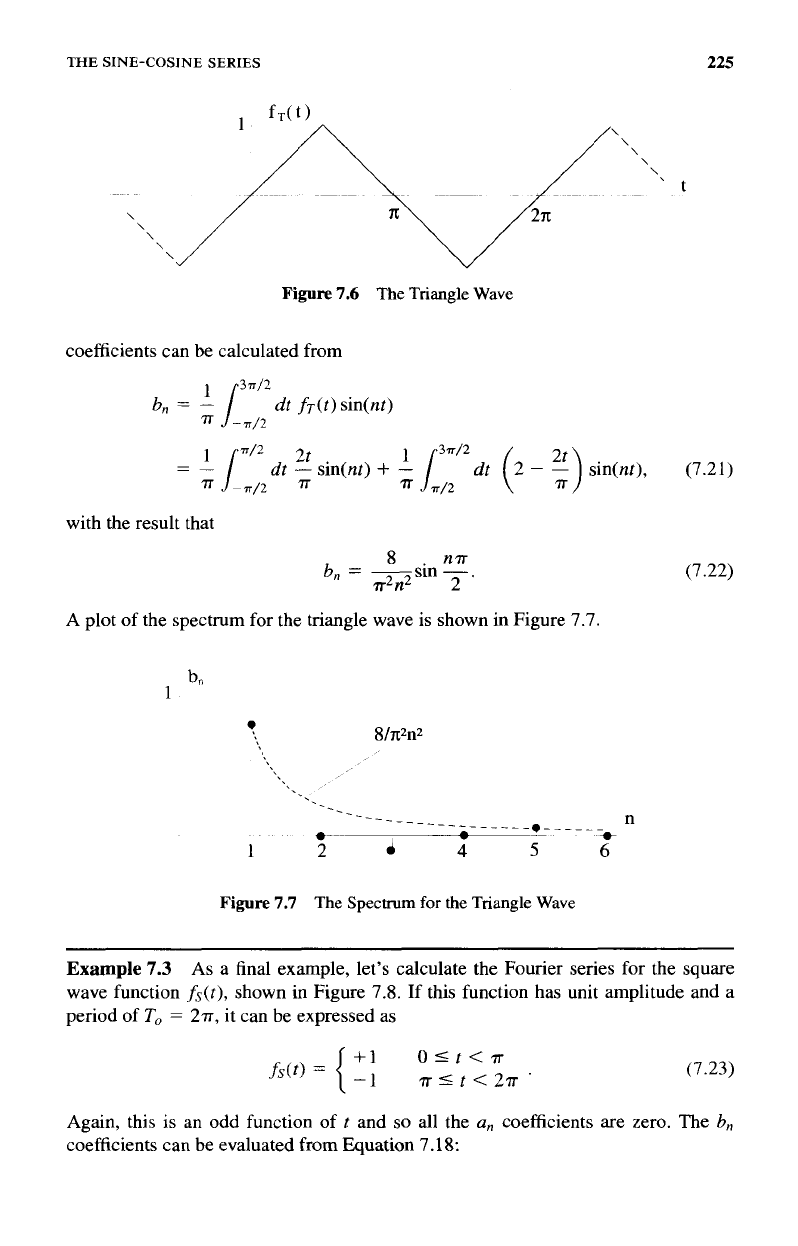
a second example, let
f(t)
be the periodic triangular waveform
shown in Figure
7.6.
Notice that
this
function has the same amplitude and period
as the previously discussed sine wave.
On
the interval
-7r/2
<
t
<
37r/2,
this
triangular wave can
be
expressed as
(7.20)
As
before, the basic period
of
this signal is
To
=
27r,
so
o,
=
n.
Because
this
is
an
odd function oft, we can immediately see that all the
a,
coefficients are zero. The
b,
THE
SINE-COSINE
SERIES
225
Figure
7.6
The Triangle Wave
coefficients can be calculated from
3n/2
b,=
11
dt
fT(t) sin(nt)
IT
-n/2
sin(nt),
(7.21)
with the result that
8
.
nrr
b,
=
2sin-.
rrn
2
(7.22)
A plot of the spectrum for the triangle wave is shown in Figure
7.7.
Figure
7.7
The Spectrum
for
the Triangle Wave
Example
7.3
As
a final example, let’s calculate the Fourier series for the square
wave function
fs(t),
shown in Figure
7.8.
If
this
function has unit amplitude and a
period of
To
=
27r,
it can be expressed as
(7.23)
Again, this is an odd function of
t
and
so
all the
a,
coefficients are zero. The
b,
coefficients can be evaluated from Equation
7.18: