
Kusse B.R., Westwig E.A. Mathematical Physics: Applied Mathematics for Scientists and Engineers
Подождите немного. Документ загружается.

246
FOURIER
SERIES
10.
If
a function can be expressed
as
a Fourier series
m
and
its
derivative can also be expressed
as
a Fourier series
how are
g,,
and
C-,
related? How are
w,
and
Rn
related?
11.
Ifg(t)
is periodic with period
To
and
is
represented by a sinekosine Fourier series
with coefficients
a,
and
b,,,
determine the coefficients
of
the Fourier series that
represents the
function
Repeat
this
problem with
g(t)
represented by
an
exponential Fourier series.
12.
Consider the differential equation
where
f(t)
is a periodic with period
To
and
in
the interval
0
<
t
<
To
is given by
-1
O<t<To/2
f(t)=
{
+1
T0/2
<
t
<
To
'
(7.93)
(a)
Make a plot of
f(t).
(b)
Determine the exponential Fourier series for
f(t).
(c)
Assume
x(t)
can be expressed as an exponential Fourier series and find the
(d)
What electronic circuit demonstrates the action of
this
differential equation?
coefficients.
What type
of
electrical
signals
are represented by
x(t)
and
f(t)?
13.
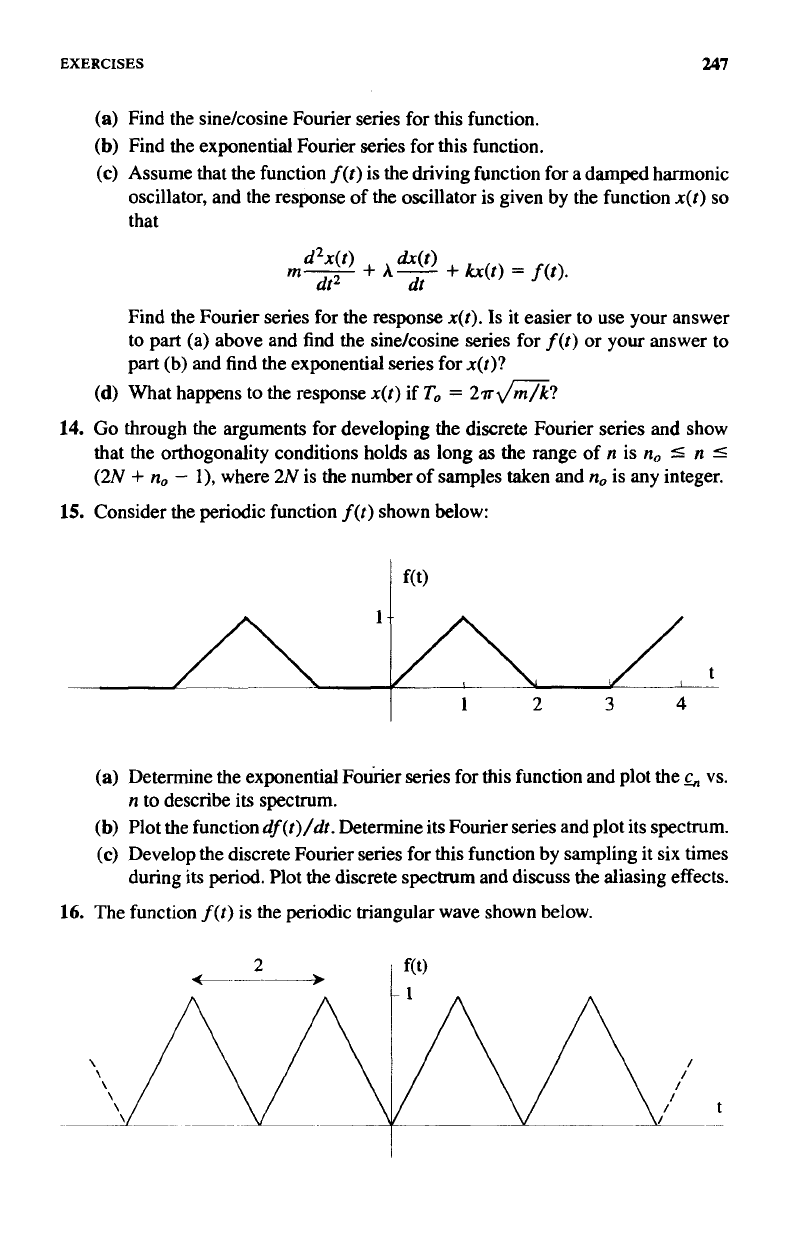
Consider the periodic triangular wave shown below:
EXERCISES
247
(a)
Find the sinekosine Fourier series for this function.
(b)
Find the exponential Fourier series for this function.
(c)
Assume that the function
f(r)
is the driving function for a damped harmonic
oscillator, and the response of the oscillator is given by the function
x(r)
so
that
Find the Fourier series for the response
x(r).
Is
it easier to use your answer
to
part (a) above and find the sinekosine series for
f(r)
or your answer to
part (b) and find the exponential series for
x(t)?
(d)
What happens to the response
x(t)
if
To
=
2.rr@?
14.
Go
through the arguments for developing the discrete Fourier series and show
that the orthogonality conditions holds
as
long
as
the range of
n
is
no
i
n
I
(2N
+
no
-
l),
where
2N
is the number of samples taken and
no
is any integer.
15.
Consider the periodic function
f(r)
shown below:
I
1
2
3
4
(a)
Determine the exponential Fouher series for this function and plot the vs.
(b)
Plot the function
df(t)/dt.
Determine its Fourier series and plot its spectrum.
(c)
Develop the discrete Fourier series for this function by sampling it six times
during
its
period. Plot the discrete spectrum and discuss the aliasing effects.
n
to describe its spectrum.
16.
The function
f(t)
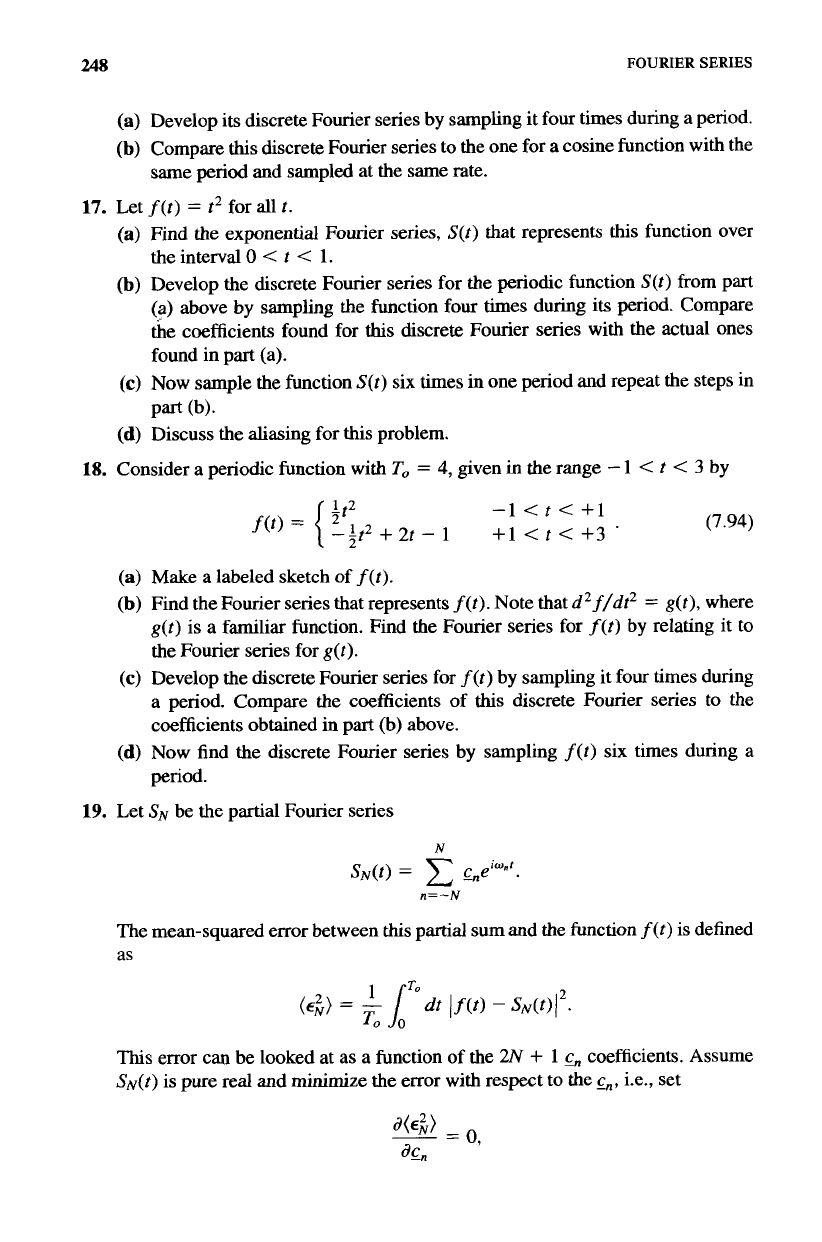
is the periodic triangular wave shown below.
FOURIER SERIES
248
(a)
Develop its discrete Fourier series by sampling it four times during a period.
(b)
Compare
this
discrete Fourier series to the one for a cosine function with the
same period and sampled at the same rate.
17.
Let
f(t)
=
t2
for all
t.
(a)
Find the exponential Fourier series,
S(t)
that represents
this
function over
theinterval0
<
t
<
1.
(b)
Develop the discrete Fourier series for the periodic function
S(t)
from part
(a) above by sampling the function four times during
its
period. Compare
he coefficients found for
this
discrete Fourier series with the actual ones
found in part
(a).
(c)
Now sample the function
S(t)
six
times
in
one period and repeat
the
steps in
(d)
Discuss the aliasing for this problem.
Part (b).
18.
Consider a periodic function with
To
=
4,
given
in
the range
-
1
<
t
<
3
by
(7.94)
Make a labeled sketch of
f(t).
Find the Fourier series that represents
f(t).
Note that
d2
f/dt2
=
g(t),
where
g(t)
is a familiar function. Find the Fourier series for
f(t)
by
relating it
to
the Fourier series for
g(t).
Develop the discrete Fourier series for
f(t)
by sampling it four times during
a period. Compare the coefficients of
this
discrete Fourier series
to
the
coefficients obtained in part
(b)
above.
Now find the discrete Fourier series by sampling
f(t)
six times during a
period.
19.
Let
SN
be the partial Fourier series
N
SN(t)
=
C
cneioJ.
The mean-squared error between
this
partial sum
and
the function
f(t)
is
defined
as
n=-N
This
error can be looked at as a function
of
the
2N
+
1
cn
coefficients. Assume
SN(~)
is pure real and minimize the error with respect to the
gn,
i.e., set
249
EXERCISES
to
generate
2N
+
1
equations
for
the
gn.
Show that these equations lead to
the standard expressions
for
the
Fourier series coefficients.
FOURIER
TRANSFORMS
The Fourier series analysis of the previous chapter can only
be
used to obtain spectra
for periodic functions.
If
the independent variable is time, periodic functions must
repeat themselves for all time.
But
signals in the real world have both a beginning and
an
end, and consequently cannot
be
analyzed using Fourier series. There is, however,
a continuous version of the Fourier series, called the Fourier transform, which can
handle certain
types
of nonperiodic functions.
In
this
chapter, we demonstrate how the
Fourier transform is the limiting case of the Fourier series,
as
the period of repetition
grows infinitely large.
8.1
FOURIER
SERIES
AS
To
4
m
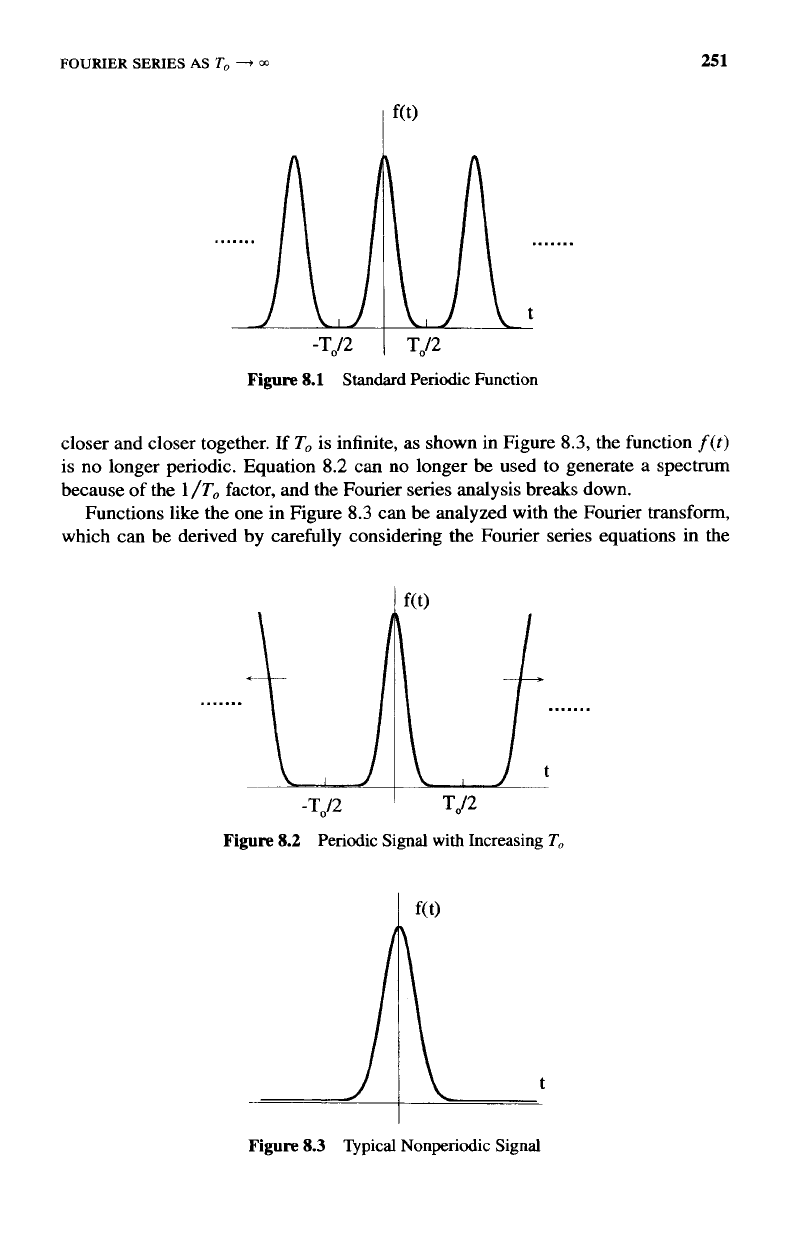
The Fourier series for a periodic function, such
as
the one in Figure
8.1,
can be
summarized by the equation pair
+a
,=-m
To
/2
To
-T,/2
c,
- -
-
1
dt
f(t)e-i"nr,
where
a,
=
2nn/T0.
To simplify the discussion that follows, the limits of integration
have been shifted to
be
symmetric about
t
=
0.
The coefficients are the complex
amplitudes of the discrete frequency components which make up
f(t).
As
the period
To
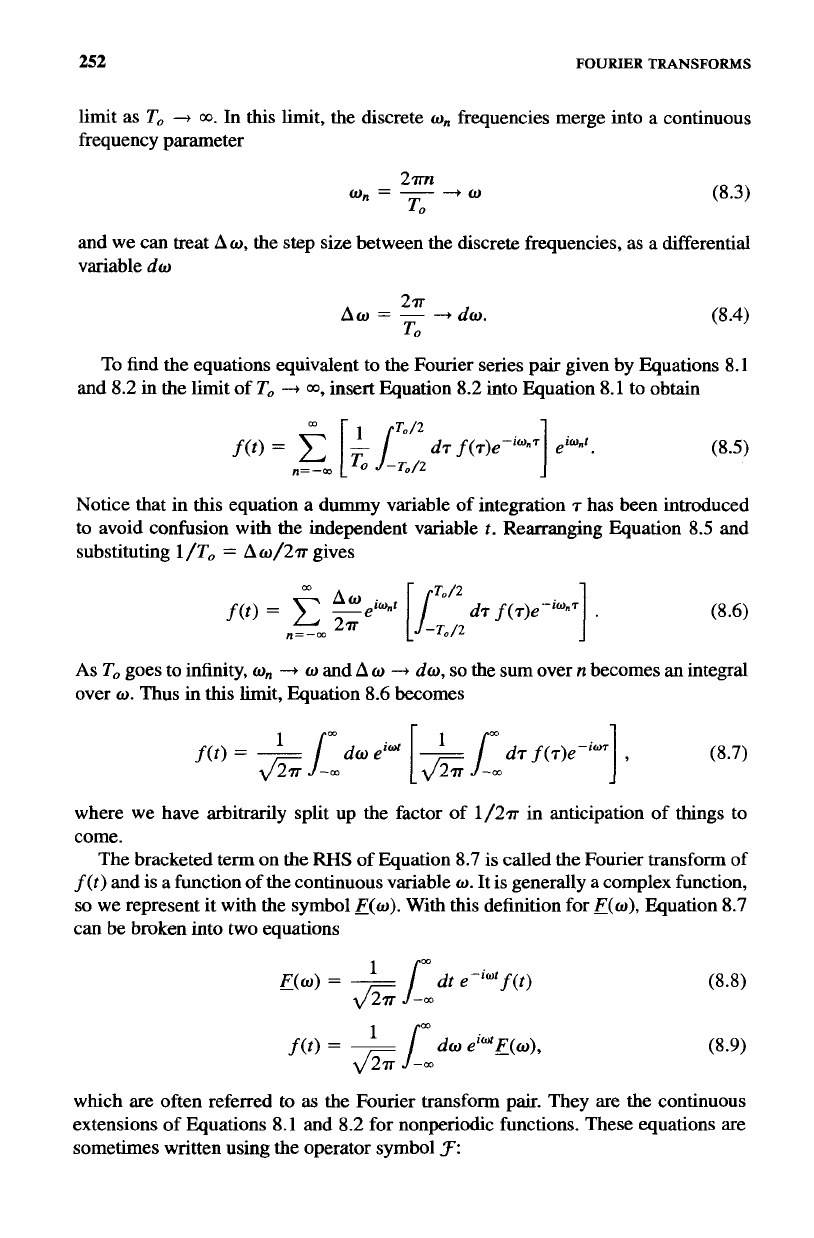
grows larger, as shown in Figure
8.2,
the Fourier series still
generates a spectrum, but the discrete frequencies
a,
=
2mT0
become packed
250
FOURIER SERIES
AS
To
--+
m
251
-T0/2
I
T0/2
Figure 8.1
Standard
Periodic Function
closer and closer together. If
To
is infinite, as shown in Figure
8.3,
the function
f(t)
is no longer periodic. Equation
8.2
can
no longer be used to generate a spectrum
because of the
1
/To
factor, and the Fourier series analysis breaks down.
Functions like the one in Figure
8.3
can be
analyzed
with the Fourier transform,
which can be derived by carefully considering
the
Fourier series equations in the
-T0/2
I
T0/2
Figure 8.2
Periodic Signal with Increasing
To
Figure 8.3
Typical Nonperiodic Signal
252
FOURIER
TRANSFORMS
limit as
To
-+
~0.
In
this
limit, the discrete
on
frequencies merge into a continuous
frequency parameter
2n-n
w,
=
-
-+w
TO
and we can treat
Am,
the step size between the discrete frequencies,
as
a differential
variable
dw
To
find the equations equivalent to the Fourier series pair given by Equations 8.1
and 8.2 in the limit of
To
-00,
insert Equation 8.2 into Equation 8.1 to obtain
Notice that in
this
equation a dummy variable of integration
r
has
been introduced
to avoid confusion with the independent variable
t.
Rearranging Equation 8.5 and
substituting
1
/To
=
A
w/2a gives
As
To
goes to infinity,
w,,
-+
w
and
Aw
--t
do,
so
the sum over
n
becomes
an
integral
over
w.
Thus
in
this
limit, Equation
8.6
becomes
where we have arbitrarily split up the factor of 1/2m in anticipation
of
things to
come.
The bracketed term on the
RHS
of Equation 8.7 is called the Fourier transform
of
f
(t)
and is a function of the continuous variable
w.
It is generally a complex function,
so
we represent it with the symbol
E(w).
With
this
definition for
F(w),
Equation 8.7
can be broken into two equations
f
0)
(8.8)
(8.9)
which are often referred to
as
the Fourier transform pair. They are the continuous
extensions of Equations 8.1 and 8.2 for nonperiodic functions. These equations are
sometimes written using the operator symbol
y:
ORTHOGONALITY
253
where
and
(8.10)
(8.1
I)
(8.12)
(8.13)
are both operators.
8.2
ORTHOGONALITY
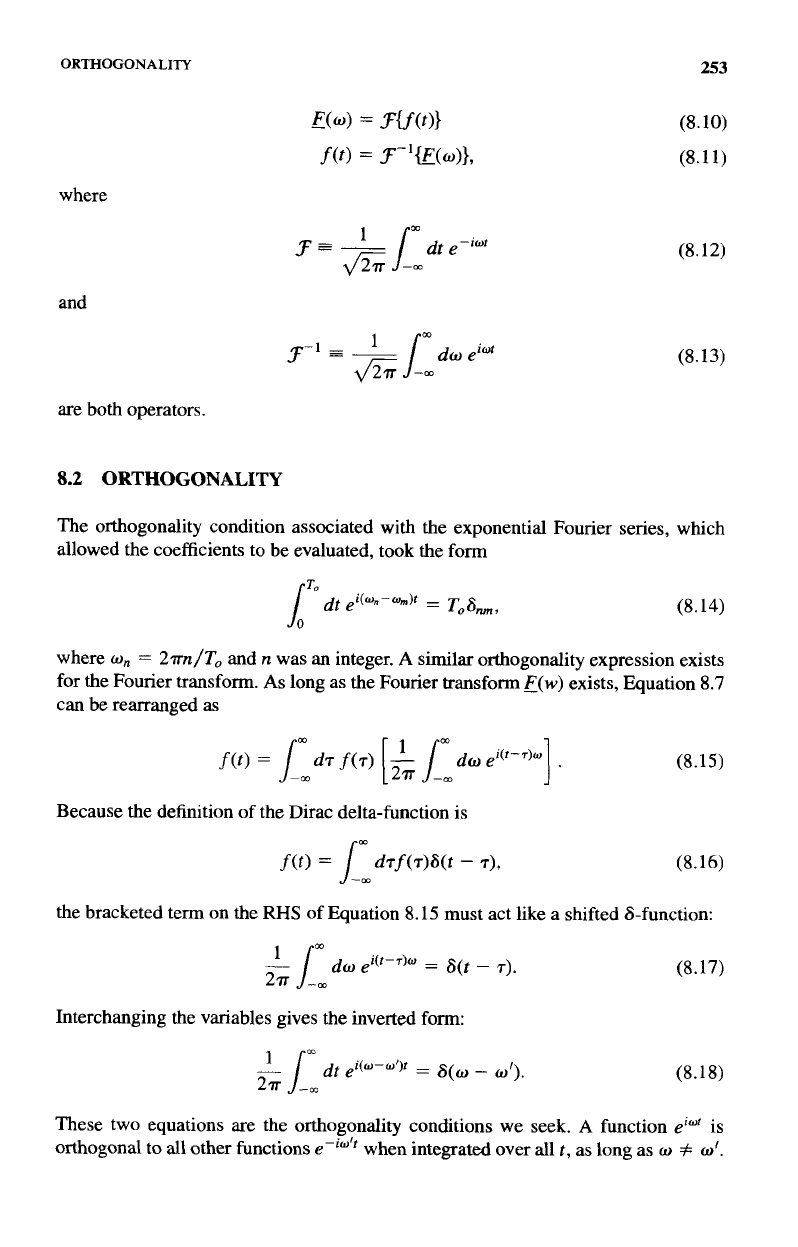
The orthogonality condition associated with the exponential Fourier series, which
allowed the coefficients to be evaluated, took the
form
(8.14)
where
on
=
27rn/T0 and
n
was an integer.
A
similar orthogonality expression exists
for the Fourier transform.
As
long as the Fourier transform
F(w)
exists, Equation 8.7
can be rearranged as
Because the definition
of
the Dirac delta-function is
f(t)
=
s_*,
d7f(T)a(t
-
T),
(8.15)
(8.16)
the bracketed term on the
RHS
of Equation
8.15
must act like
a
shifted &function:
Interchanging the variables gives the inverted form:
m
&
lm
dt
ei(o--o')t
=
6(w
-
0').
(8.17)
(8.18)
These two equations are the orthogonality conditions we seek.
A
function
eiot
is
orthogonal
to
all other functions
e-iO"
when integrated over
all
t,
as long as
o
#
a'.
254
FOURIER
TRANSFORMS
The relations in Equations 8.17 and 8.18 cannot
be
viewed
as
rigorously correct,
because they involve a 8-function which is not enclosed in an integral. The relations
should
be
viewed
as
a shorthand notation and are mathematically valid
only
if they
appear inside integral operations.
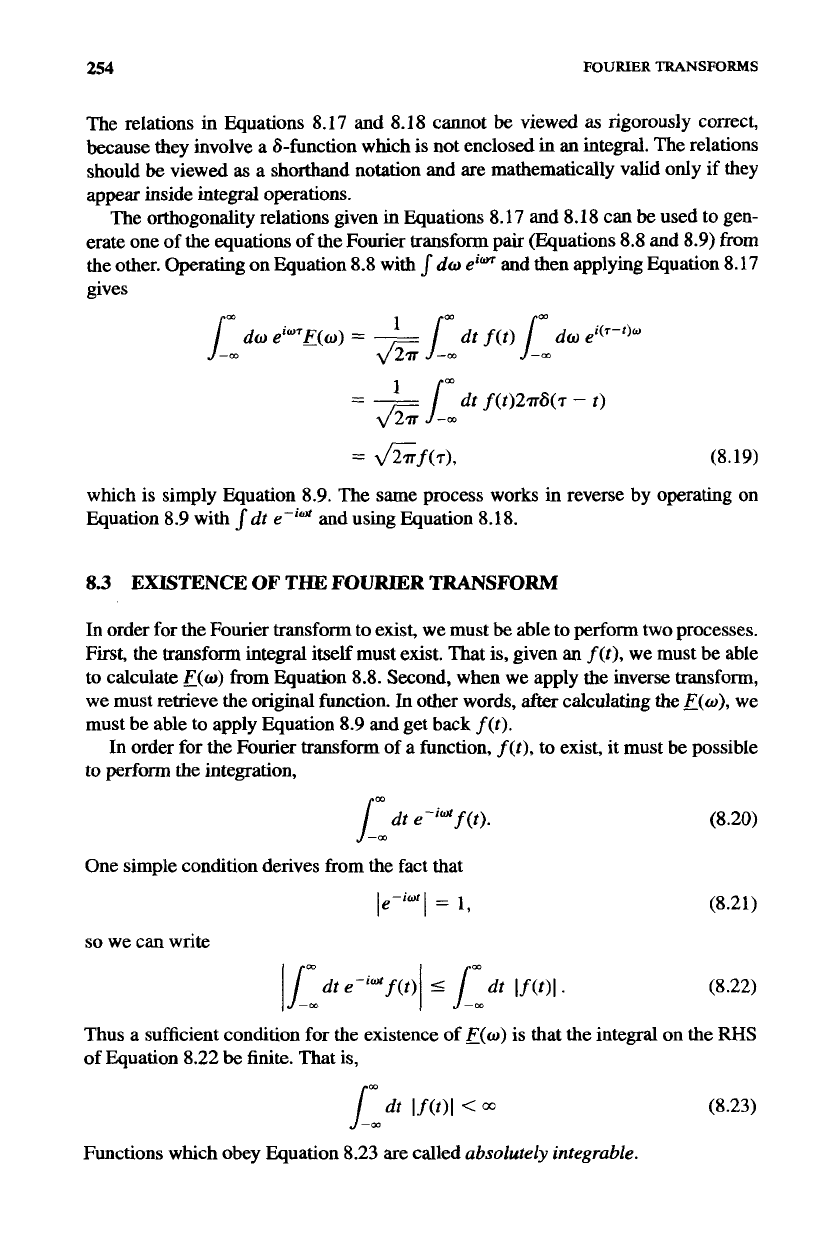
The orthogonality relations given in Equations 8.17 and 8.18 can
be
used to gen-
erate one of the equations of the Fourier transform pair (Equations 8.8
and
8.9) from
the other. Operating on Equation 8.8
with
J
dw eiwr
and then applying Equation 8.17
gives
1:
do e'*'F(w)
=
-
Srn
dt
f
(t)
/:
dw ei(r-r)m
6
--m
=
Gf(r),
(8.19)
which is simply Equation 8.9. The same process works in reverse by operating on
Equation 8.9 with
J
df e-id
and using Equation 8.18.
8.3
EXISTENCE
OF
THE
FOURIER
TRANSFORM
In
order for the Fourier transform to exist, we must be able to
perform
two processes.
First,
the
transform integral itself must exist. That is, given an
f(t),
we must be able
to calculate
F(w)
from
Equation 8.8. Second, when
we
apply the inverse transform,
we must retrieve the original function.
In
other words, after calculating
the
E(w),
we
must be able to apply Equation 8.9 and get back
f(t).
In
order for the Fourier transform of a function,
f(t),
to exist, it must be possible
to
perform the integration,
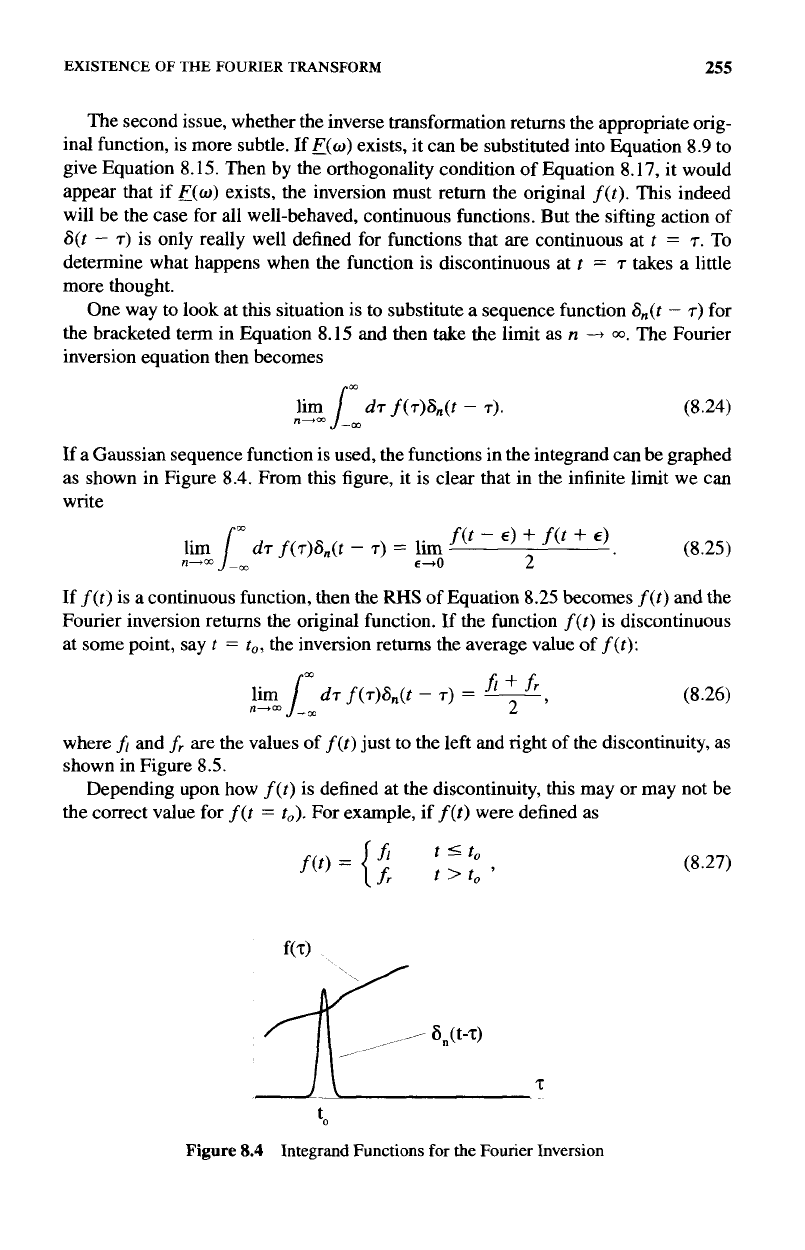
/:
dt e-id
f
(t).
One simple condition derives
from
the fact that
(8.20)
so
we can write
(8.22)
Thus
a sufficient condition for the existence of
F(w)
is
that the integral on the
RHS
of Equation
8.22
be
finite.
That
is,
1:
dt
If(t)l
-=c
Functions which obey Equation 8.23 are called
absolutely integrable.
(8.23)
EXISTENCE OF
THE
FOURIER TRANSFORM
255
The second issue, whether the inverse transformation returns the appropriate orig-
inal function, is more subtle. If
E(m)
exists, it can be substituted into Equation
8.9
to
give Equation 8.15. Then by the orthogonality condition of Equation 8.17, it would
appear that if
F(w)
exists, the inversion must return the original
f(t).
This
indeed
will be the case for all well-behaved, continuous functions. But the sifting action of
8(t
-
T)
is only really well defined for functions that are continuous at
t
=
T.
To
determine what happens when the function is discontinuous at
t
=
T
takes a little
more thought.
One way to look at this situation is to substitute
a
sequence function
8,(t
-
T)
for
the bracketed term in Equation 8.15 and then take the limit as
n
---f
w.
The Fourier
inversion equation then becomes
4.
(8.24)
If a Gaussian sequence function is used, the functions in the integrand can be graphed
as shown in Figure 8.4. From this figure, it is clear that in the infinite limit we can
write
If
f(t)
is a continuous function, then the
RHS
of Equation 8.25 becomes
f(t)
and the
Fourier inversion returns the original function.
If
the function
f(t)
is discontinuous
at some point, say
t
=
to,
the inversion returns the average value of
f(t):
where
fr
and
fr
are the values of
f(t)
just
to
the left and right
of
the discontinuity, as
shown in Figure
8.5.
Depending upon how
f
(t)
is defined at the discontinuity, this
may
or may not be
the correct value for
f(t
=
to),
For example, if
f(t)
were defined as
(8.27)
Figure
8.4
Integrand Functions for the Fourier Inversion