
Kusse B.R., Westwig E.A. Mathematical Physics: Applied Mathematics for Scientists and Engineers
Подождите немного. Документ загружается.

256
FOURIER
TRANSFORMS
!
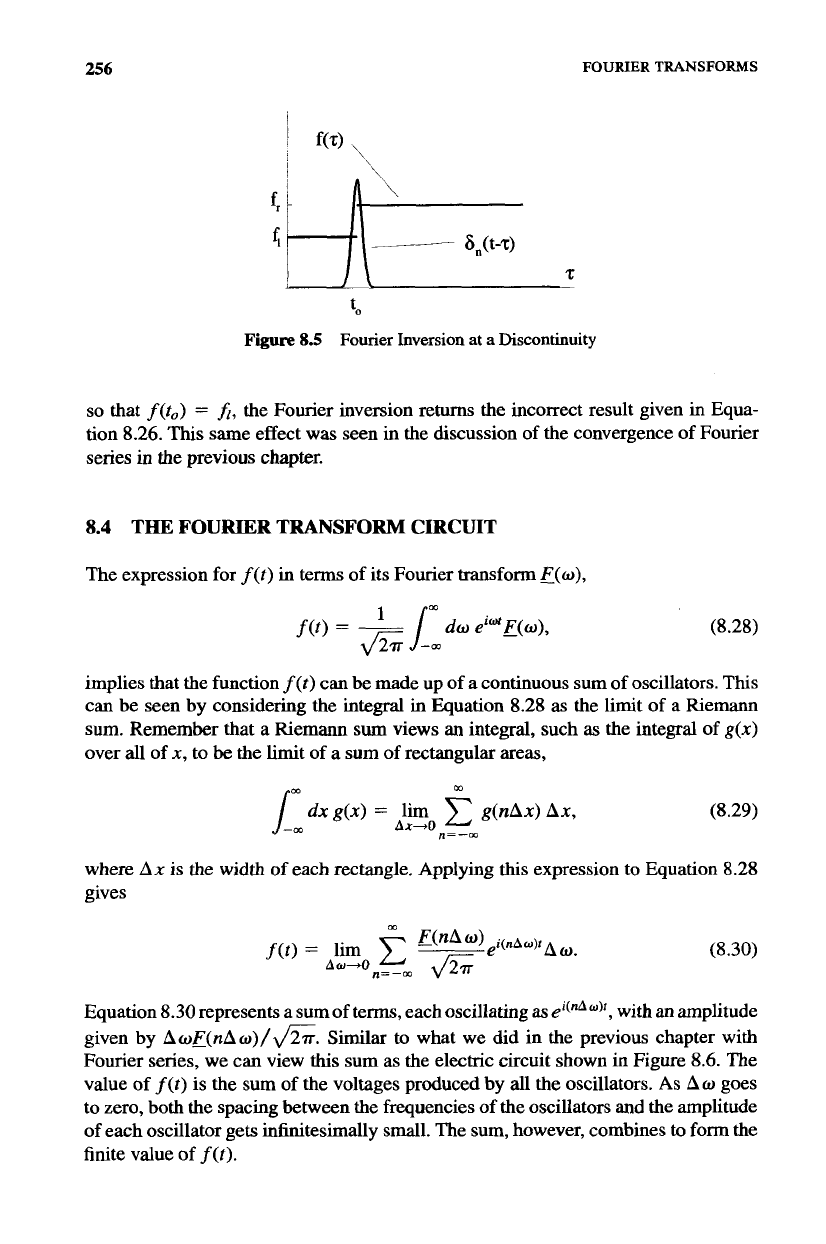
f(T)
j
'\\
fir-
F-
to
Figure
8.5
Fourier
Inversion
at
a
Discontinuity
so that
f(fJ
=
fi,
the Fourier inversion returns the incorrect result given in Equa-
tion 8.26.
This
same effect was seen in the discussion of the convergence
of
Fourier
series in the previous chapter.
8.4
THE
FOURIER TRANSFORM CIRCUIT
The expression for
f(t)
in terms
of
its Fourier
transform
E(w),
f(4
=
J2.lr
Sm
--m
do
eidE(o),
(8.28)
implies that the function
f(t)
can be made up of a continuous
sum
of oscillators. This
can be seen by considering the integral in Equation 8.28 as the limit
of
a
Riemann
sum. Remember that a Riemann
SM
views
an
integral, such
as
the integral of
g(x)
over all
of
x,
to be the limit
of
a sum
of
rectangular areas,
(8.29)
where
Ax
is
the
width
of
each rectangle. Applying
this
expression to Equation 8.28
gives
m
f(t)
=
lh
E(cnAW)ei(nAo)tAW.
(8.30)
Aw-0
n=-m
J2?r
Equation
8.30
represents a sum
of
terms, each oscillating
as
ei(nAw)t,
with
an
amplitude
given by
AoF(nAw)/&.
Similar to what we
did
in the previous chapter with
Fourier series, we can view
this
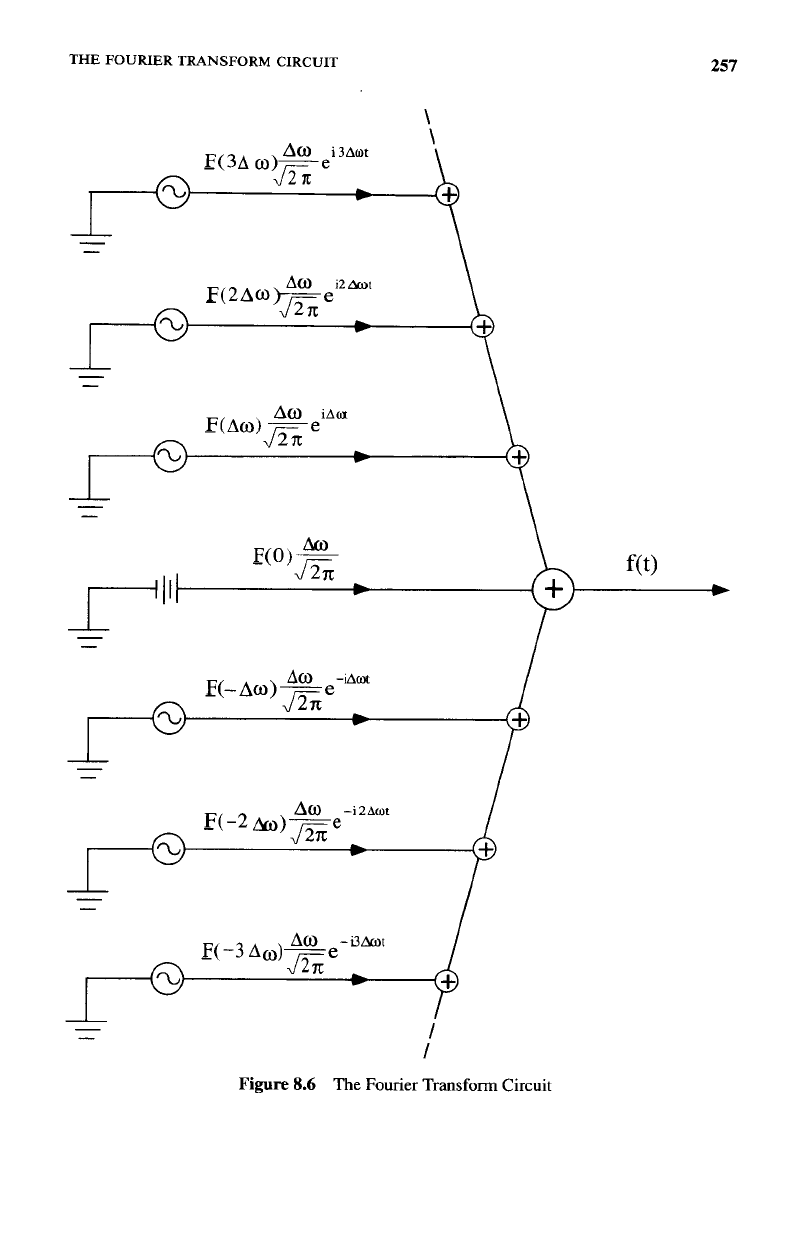
sum as the electric circuit shown in Figure
8.6.
The
value of
f(t)
is the sum of the voltages produced by
all
the oscillators. As
Am
goes
to zero, both the spacing between the frequencies of the oscillators and the amplitude
of each oscillator gets infinitesimally small. The sum, however, combines to form the
finite value of
f(t).
THE
FOURIER
TRANSFORM
CIRCUIT
\
257
J2
x
L
1
\
I
I
I
I
I
I
Figure
8.6
The Fourier Transform Circuit
FOURIER
TRANSFORMS
258
8.5
PROPERTIES
OF
THE FOURIER TRANSFORM
In
this
section, a number of mathematical properties of the Fourier transform are
developed. Each derivation involves either one or both of the functions
f
(t)
and
g(t),
which
we
will assume possess the valid Fourier transforms:
(8.31)
(8.32)
8.5.1
Delay
The Fourier transform of
f
(t
-
to),
which is
f
(t)
delayed by
to,
can be expressed in
terms
of
E((o).
The Fourier transform of the delayed function is
F[f(t
-
to)]
=
-
[l
dt
eCid
f
(t
-
to).
(8.33)
Make
the substitution
a
=
t
-
to
to
obtain
1"
f
(a)
- -
e-ioto-
J2.rr
1"
da
eCioa
=
e-'"~[f(t)].
(8.34)
So
when a function is delayed by an amount
to,
its Fourier transform is multiplied by
a factor of
e-iofo.
8.5.2
Time
Inversion
of
Real
Functions
The Fourier transform of
f(
-t),
if
f
(t)
is
a real function, is the complex conjugate
of
F(w).
To see
this,
start
by writing the
Fourier
transform of the inverted function as
Substitution of
a
=
-t
gives
1
-"
Y[f(-t)]
=
--
/
da
eioa
f(a)
6"
with the result that, iff
(t)
is pure real,
(8.35)
(8.36)
(8.37)
PROPERTIES OF THE FOURIER TRANSFORM
259
8.5.3
Even and Odd Functions
If
f
(t)
is a real, even function then
f
(-t)
=
f(th
(8.38)
and by Equations
8.31
and
8.37
-
F*(W)
=
E(w).
(8.39)
Thus, for even functions,
F(w)
must
be
a pure
real
function of
w.
If
f
(t)
is a real, odd function then
f(-O
=
-fW,
(8.40)
and by Equations
8.31
and
8.37
F*(W)
=
-F(w).
(8.41)
Therefore, for odd functions,
F(w)
must be a pure imaginary function of
w.
8.5.4
Spectra for
Pure
Real
f(t)
Functions which are pure real have transforms
which
obey an important symmetry.
This can be derived easily by substituting
-w
into Equation
8.8
to give
Consequently, if
f(t)
is pure real then
-
F(-a)
=
E'(w).
(8.42)
(8.43)
This means that the negative frequency part of the spectrum can always
be
obtained
from the positive frequency spectrum. The negative frequency part of the spectrum
contains no new information.
8.5.5
The
Transform
of
df(t)/dt
The Fourier transform
of
the derivative of
f(t)
can
be
expressed in terms
of
the
transform of
f
(t).
To
see
this,
start
with the transform of the derivative:
The
RHS
of Equation
8.44
can be integrated by parts. Let
u
=
e-'"'
and
dv
=
(df/dt) dt.
Then
m
Y
[
$1
=
~2.rr
1
{
e-id
f(t)lm
-
Lmdt
(-iw)e-iwtf(t)}.
(8.45)
-m
260
FOURIER
TRANSFORMS
If
f(t)
-+
0
as
t
--+
Im,
which must occur for any function with a valid Fourier
transform, then
=
iwE(w).
(8.46)
8.5.6
The
Transformations of
the
product
and
Convolution
of
'ho
Functions
The Fourier transform of the product
of
two functions can be expressed in terms
of the Fourier
transforms
of the individual functions. The Fourier transform of the
product of
f(t)
and
g(t)
is
1"
F
[f(t)gW]
=
-
,/
dt
e-'"f(t)g(t).
J2.rr
--m
To express
this
transform in terms of
f(w)
and
G(w),
insert the inverse transforms for
f(t)
and
g(t)
into Equation
8.47,
making sure to use different variables
of
integration
to keep all the integrals independent:
(8.47)
1"
X
J2.r
Lrn
dw"
eiw"rF(w").
-
(8.48)
Now
collect all the
1/J2?r
factors, and combine the integrals over
t,
w'
and
w"
into
a three-dimensional integral. The
RHS
of Equation
8.48
becomes
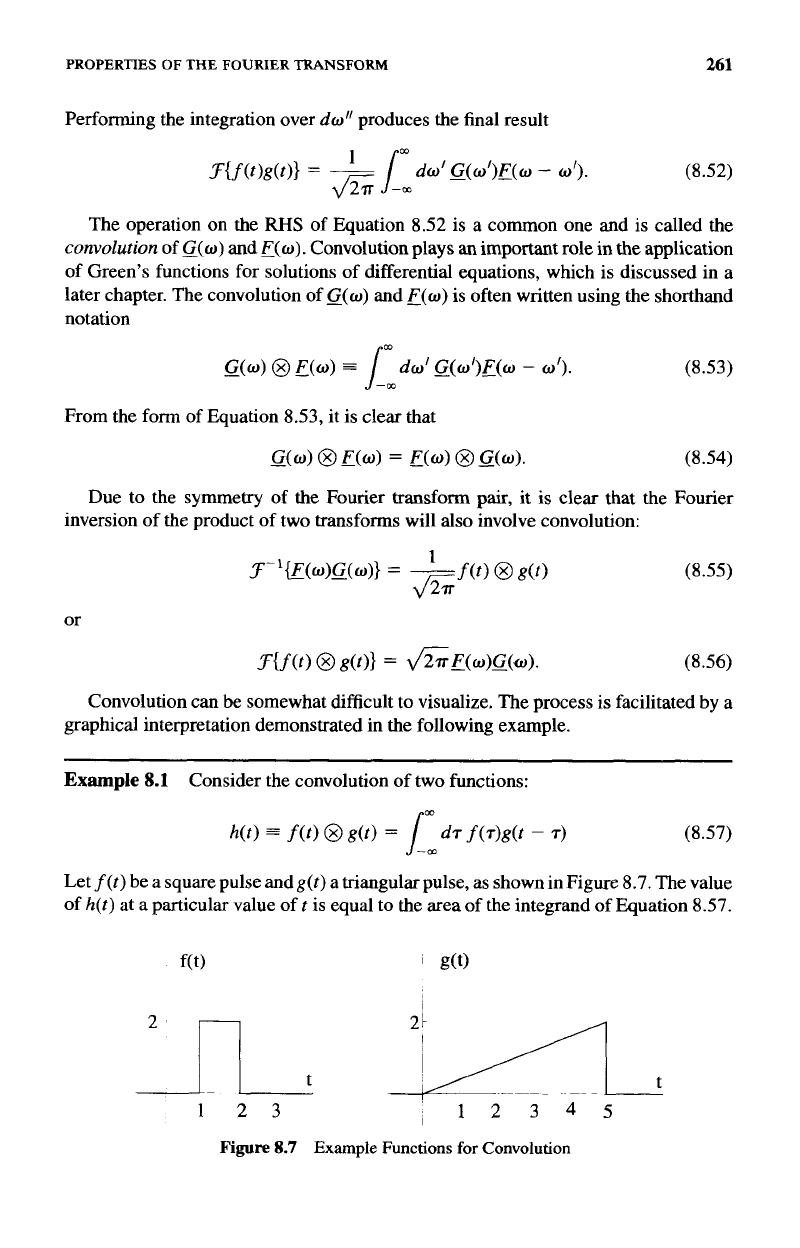
The order
of
integration is arbitrary. If we choose to do the
t
integral first, we are
confronted with the integral
J
--m
which
is
just the orthogonality condition for the Fourier transform. Using this in
Equation
8.49
gives
PROPERTIES
OF
THE FOURIER
TRANSFORM
261
Performing the integration over
dw”
produces the final result
3,{f(r)g(t))
= ___
/:
dw’G(w’)F(w
-
w’).
(8.52)
The operation on the
F2HS
of Equation
8.52
is a common one and is called the
convolution
of
G(w)
and
E(w).
Convolution plays
an
important role in the application
of Green’s functions for solutions of differential equations, which is discussed in a
later chapter. The convolution of
G(w)
and
F(o)
is often written using the shorthand
notation
G(w)
0
F(w)
~w’G(w’)E((o
-
w‘).
(8.53)
-
s_mm
From the form of Equation 8.53, it is clear that
G(w)
0
F(w)
=
F(w)
0
am).
(8.54)
Due to the symmetry of the Fourier transform pair, it is clear that the Fourier
inversion of the product of two transforms will also involve convolution:
(8.55)
1
3,-w4G(4}
=
----f(t)
0
g(t)
fi
or
Convolution can
be
somewhat difficult to visualize. The process is facilitated
by
a
graphical interpretation demonstrated in the following example.
Example
8.1
Consider the convolution of two functions:
W)
_=
fW
0
s(i)
=
d7
f(7Mt
-
7)
(8.57)
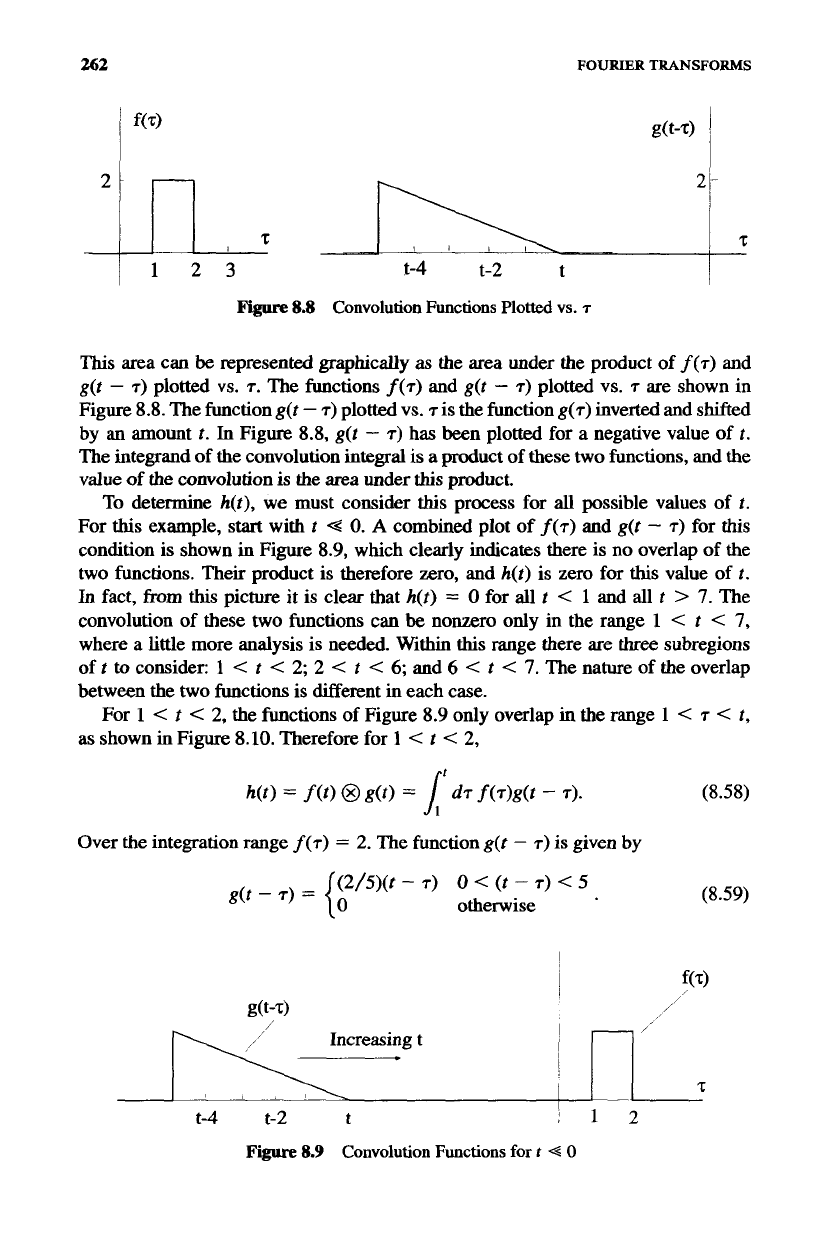
Let
f(t)
be a square pulse and
g(t)
a triangular pulse, as shown in Figure 8.7. The value
of
h(t)
at
a particular value of
r
is equal to the area of the integrand of Equation 8.57.
L
123
,12345
Figure
8.7
Example
Functions
for
Convolution
262
FOURIER
TRANSFORMS
2pT
ht
2[i
23
t-4
t-2
Figure
8.8
Convolution Functions
Plotted
vs.
7
This
area can
be
represented graphically
as
the area under the product of
f(7)
and
g(t
-
7)
plotted vs.
T.
The functions
f(~)
and
g(t
-
7)
plotted vs.
7
are shown in
Figure 8.8. The function
g(t
-
T)
plotted vs.
7
is the function
g(T)
inverted and shifted
by an amount
t.
In
Figure 8.8,
g(t
-
r)
has
been
plotted for a negative value of
t.
The integrand of the convolution integral
is
a product of these two functions, and the
value of
the
convolution is the area under
this
product,
To
determine
h(t),
we
must consider
this
process for
all
possible values of
t.
For
this
example,
start
with
t
Q
0.
A
combined plot
off(7)
and
g(f
-
T)
for
this
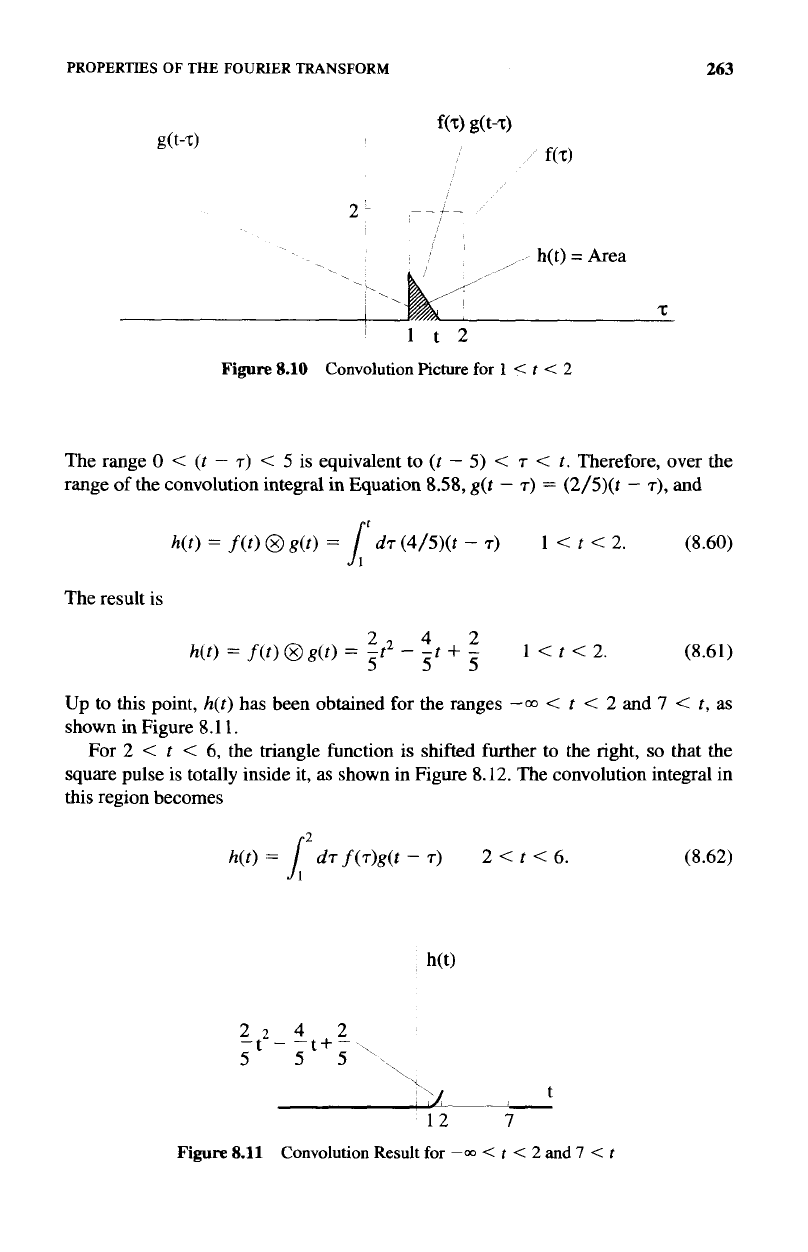
condition is shown in Figure 8.9, which clearly indicates there
is
no overlap of the
two functions. Their product is therefore zero, and
h(t)
is zero for
this
value of
t.
In fact,
from
this
picture it
is
clear that
h(t)
=
0
for
all
t
<
1
and all
t
>
7.
The
convolution of these two functions can
be
nonzero
only
in the range
1
<
t
<
7,
where a little more analysis is needed. Within
this
range
there are
three
subregions
of
t
to
consider: 1
<
t
<
2; 2
<
t
<
6;
and
6
<
t
<
7.
The nature of the overlap
between the
two
functions is different in each case.
For
1
<
f
<
2,
the functions of Figure 8.9
only
overlap
in
the range
1
<
7
<
t,
as shown
in
Figure
8.10.
Therefore for
1
<
t
<
2,
h(t)
=
f(t)
@
g(t)
=
1
d7
f(T)g(t
-
7).
Over the integration range
f(~)
=
2.
The function
g(t
-
T)
is given by
{f?/5)(f
-
7)
0
<
(t
-
7)
<
5
g(t
-
7)
=
otherwise
(8.58)
(8.59)
f(d
,//’
/
z
t-4
t-2
t
2
Figure.
8.9
Convolution
Functions
fort
0
PROPERTIES
OF
THE
FOURIER TRANSFORM
263
'
lt2
Figure
8.10
Convolution
Picture
for
1
<
f
<
2
The range
0
<
(t
-
7)
<
5
is equivalent to
(t
-
5)
<
T
<
t.
Therefore, over the
range of the convolution integral
in
Equation
8.58,
g(t
-
7)
=
(2/5)(t
-
T),
and
The result is
(8.61)
2 42
5
55
h(t)
=
f(t)
@g(t)
=
-t2
-
-t
+
-
1
<
t
<
2.
Up to this point,
h(t)
has been obtained for the ranges
--to
<
t
<
2 and
7
<
I,
as
shown in Figure 8.1
1.
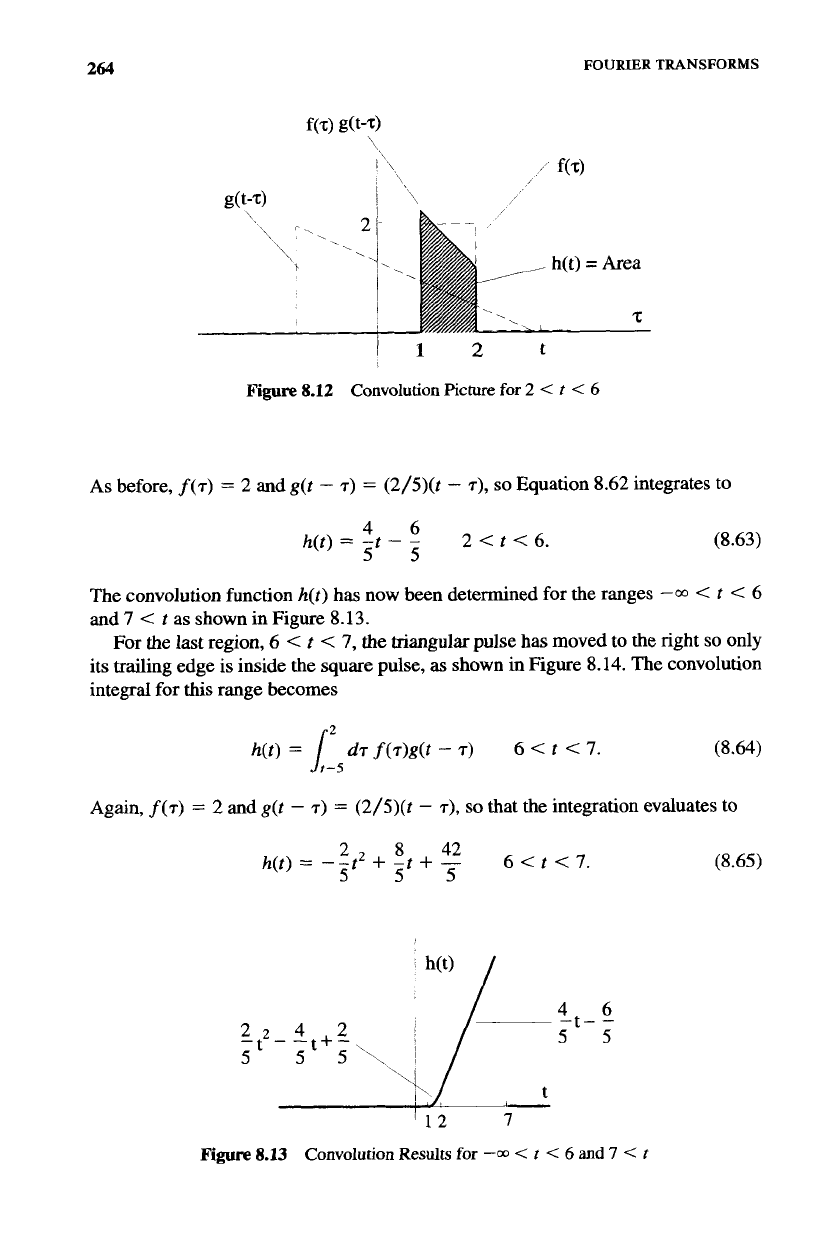
For
2
<
t
<
6,
the triangle function is
shifted
further to the right,
so
that the
square pulse is totally inside it, as shown
in
Figure 8.12. The convolution integral in
this region becomes
dTf(T)g(t
-
7)
2
<
t
<
6. (8.62)
22
4 2
-t
-
-t+-
\,
5
55
t
12
7
Figure
8.11
Convolution Result
for
--m
<
r
<
2
and
7
<
t
264
FOURZER TRANSFORMS
I1
2
t
Figure
8.12
Convolution
picture
for
2
<
t
<
6
As
before,
f(7)
=
2 and
g(t
-
7)
=
(2/5)(t
-
T),
so
Equation 8.62 integrates
to
46
h(t)
=
-t
-
-
55
2<t<6.
(8.63)
The convolution function
h(t)
has now been determined for the ranges
--to
<
t
<
6
and
7
<
t
as shown
in
Figure
8.13.
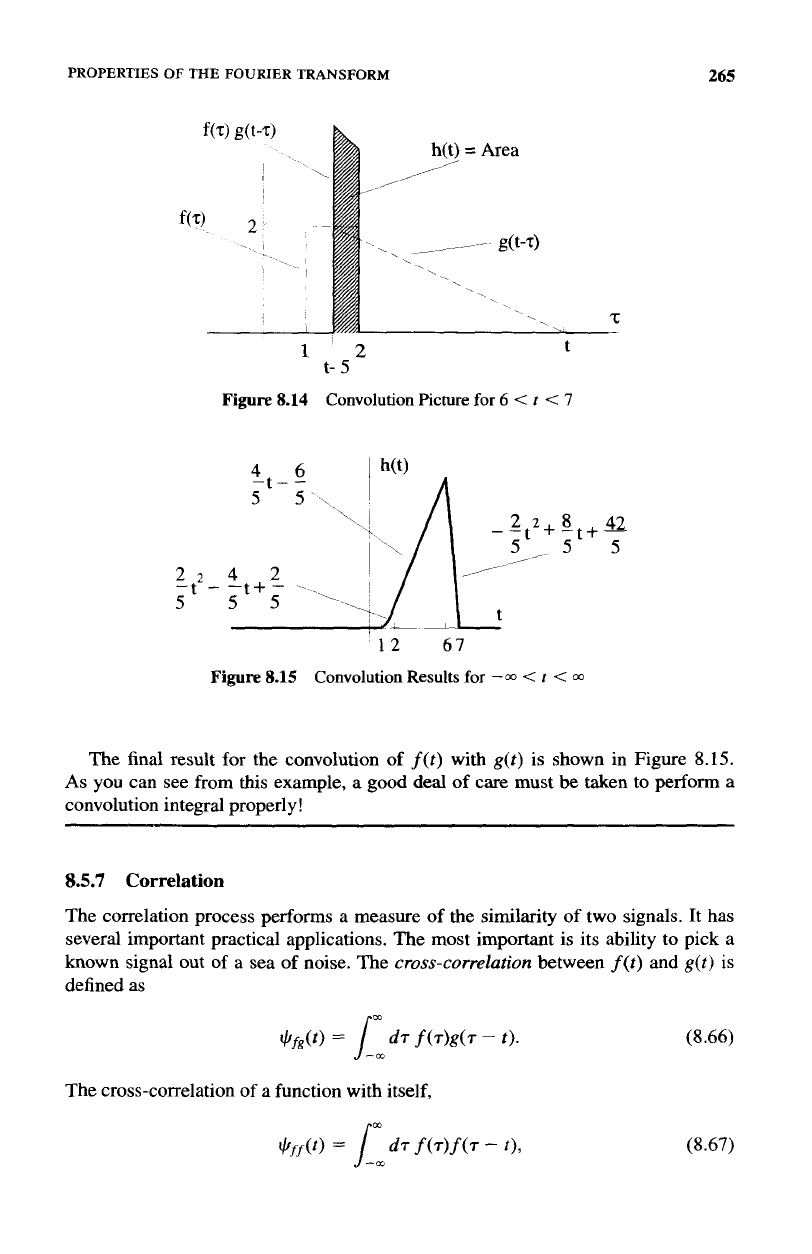
For the last region,
6
<
t
<
7,
the triangular pulse has moved
to
the
right
so
only
its
trailing edge is inside the square pulse,
as
shown
in
Figure 8.14. The convolution
integraI for
this
range becomes
h(t)
=
d~f(~)g(t
-
7)
6
<
t
<
7.
(8.64)
If,
Again,
f(~)
=
2
and
g(t
-
7)
=
(2/5)(t
-
T),
so
that the integration evaluates
to
(8.65)
2
8 42
h(t)
=
--t2
+
-t
+
-
555
6
<I
<
7.
22
-t
5
46
55
-t-
-
‘
12
7
Figure
8.13
Convolution
Results
for
--oo
<
t
<
6
and
7
<
t
PROPERTIES
OF
THE FOURIER TRANSFORM
265
12
t-
5
t
Figure
8.14
Convolution
picture
for
6
<
t
<
7
22
-
22
8
--t
+-t+
46
-t-
-
55
5,5
,
42
55
-t+-
__
t
12
67
-
42
5
Figure
8.15
Convolution
Results
for
--m
<
t
<
-m
The final result for the convolution
of
f(t)
with
g(t)
is shown in Figure 8.15.
As
you can see from
this
example, a
good
deal
of care must
be
taken
to
perform a
convolution integral properly!
8.5.7
Correlation
The correlation process performs a measure of the similarity
of
two signals.
It has
several important practical applications. The most important is its ability to pick a
known signal out of a sea of noise. The
cross-correlation
between
f
(t)
and
g(t)
is
defined
as
The cross-correlation
of
a
function with itself,
(8.66)