
Kusse B.R., Westwig E.A. Mathematical Physics: Applied Mathematics for Scientists and Engineers
Подождите немного. Документ загружается.

266
FOURIER
TRANSFORMS
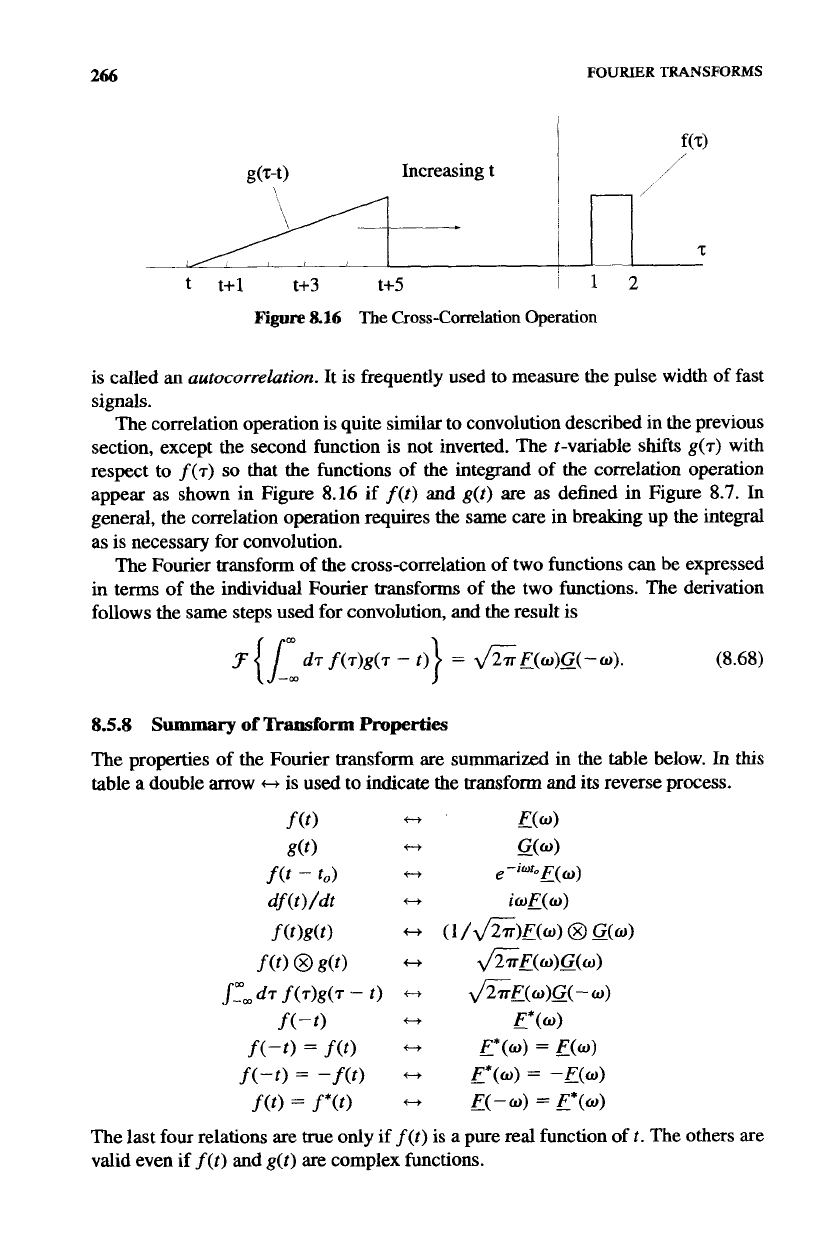
g(7-t) Increasing
t
t
t+l
t+3 t+5
i12
Figure
8.16
The
Cross-Correlation
Operation
is
called
an
autocorrelation.
It is frequently used to measure the pulse width of fast
signals.
The correlation operation is quite similar to convolution described in the previous
section, except the second function is not inverted. The t-variable
shifts
g(7)
with
respect
to
f(7)
so
that the functions of
the
integrand of the correlation operation
appear as shown in Figure
8.16
if
f(r)
and
g(r)
are
as
defined in Figure
8.7.
In
general, the correlation operation requires the same care in breaking up the integral
as is necessary for convolution.
The Fourier transform
of
the cross-correlation of two functions can be expressed
in terms of the individual Fourier transforms of the two functions. The derivation
follows the same steps used for convolution, and the result is
(8.68)
8.5.8
Summary
of
'kansform
Properties
The properties of the Fourier transform are summarized in the table below. In
this
table a double arrow
c)
is used to indicate the transform and
its
reverse process.
The
last four relations are true
only
if
f(t)
is
a pure real function oft. The others are
valid even if
f(t)
and
g(t)
are complex functions.
FOURIER
TRANSFORMS
-
EXAMPLES
267
8.6
FOURIER
TRANSFORMS-EXAMPLES
This
section derives the Fourier transforms
of
several common functions.
In
each
case, we have attempted to explore an important technique or principle associated
with the Fourier transform.
8.6.1
The
Square
Pulse
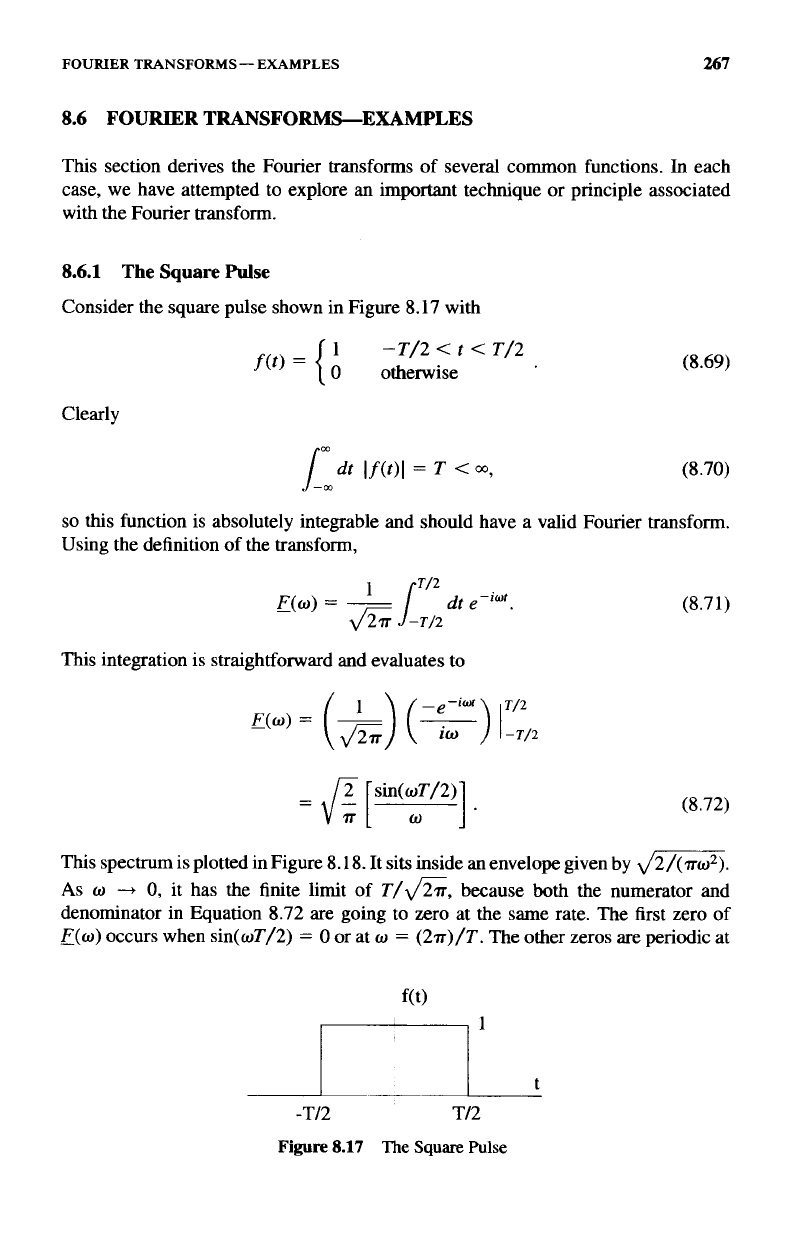
Consider the square pulse shown in Figure
8.17
with
I
0
otherwise
-T/2
<
t
<
T/2
f(f)
=
{
Clearly
(8.69)
(8.70)
so
this function is absolutely integrable and should have a valid Fourier transform.
Using the definition of
the
transform,
dt
e-i6Jt
This integration is straightforward and evaluates to
(8.71)
(8.72)
This
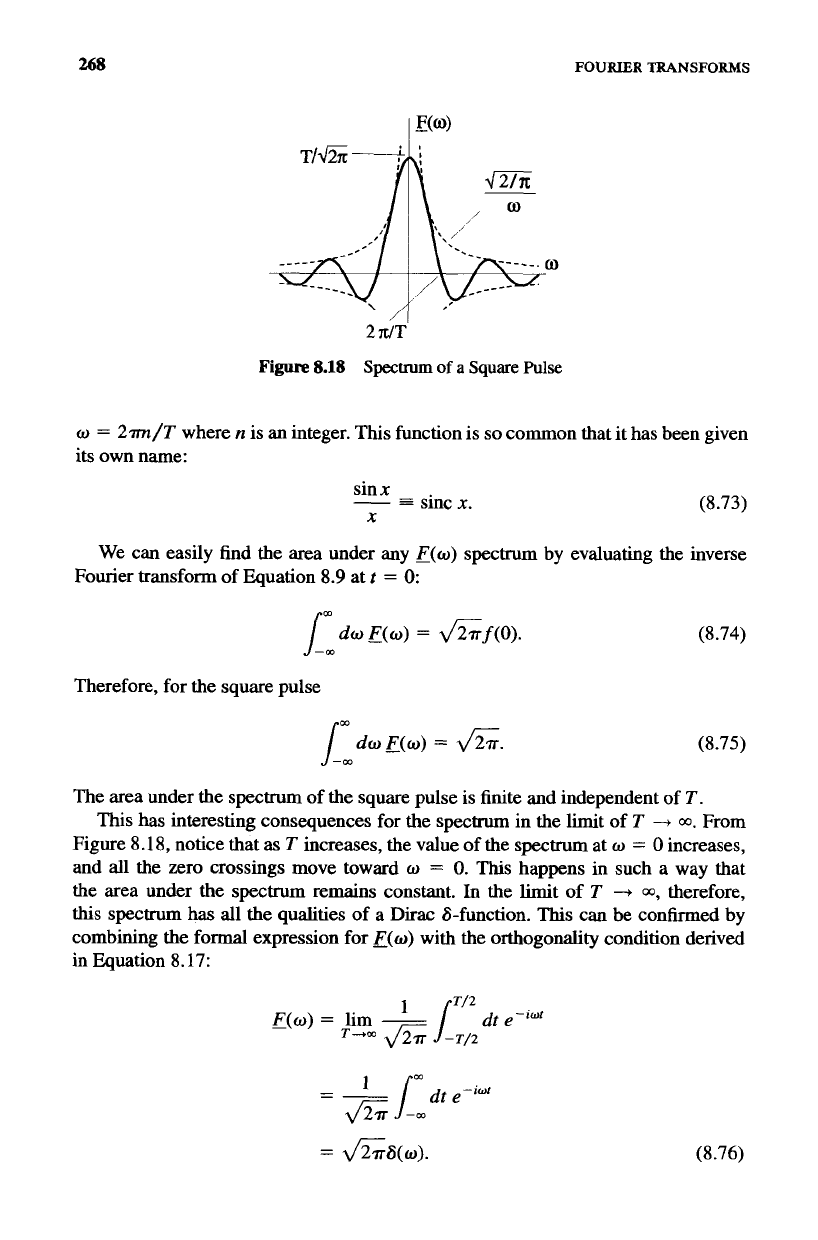
spectrum is plotted in Figure
8.18.
It sits inside an envelope given
by
dm.
As
w
-+
0,
it has the finite limit of
T/&,
because both the numerator and
denominator in Equation
8.72
are going to zero at the same rate. The first zero
of
-
F(
o)
occurs when sin(
wT/2)
=
0
or at
o
=
(27r)/T.
The other zeros are periodic at
-TI2
TI2
Figure
8.17
The
Square
Pulse
268
FOURIER
TRANSFORMS
2
dT'
Figure
8.18
Spectrum
of
a
Square
Pulse
w
=
2m/T
where
n
is an integer.
This
function is
so
common that it has been given
its own name:
sin
x
-
=
sinc
x.
X
(8.73)
We can easily find the area under any
F(w)
spectrum by evaluating the inverse
Fourier transform of Equation
8.9
at
t
=
0:
Therefore, for the square pulse
(8.74)
(8.75)
The area under the spectrum of the square pulse is finite and independent
of
T.
This
has interesting consequences for the spectrum in the limit
of
T
-+
03.
From
Figure
8.18,
notice that as
T
increases, the value of the spectrum at
o
=
0
increases,
and all the zero crossings
move
toward
o
=
0.
This
happens
in
such a way that
the area under the spectrum remains constant.
In
the limit of
T
-+
03,
therefore,
this spectrum
has
all the qualities
of
a
Dirac &function.
This
can be confirmed by
combining the formal expression for
E(o)
with the orthogonality condition derived
in Equation
8.17:
dt
-
iof
F(w)
=
lim
-
-
T4m
6
S"
-T/2
=
&a(").
(8.76)
FOURIER TRANSFORMS
-
EXAMPLES
269
Remember, however, that
this
is not a rigorous equation, because the &function is
not inside an integral. The Fourier transform for the function
f(t)
=
1, is not really
defined, since
(8.77)
does not converge. But in a casual sense, the &function in Equation 8.76 makes
perfect sense, because when it
is
inserted into the inverse Fourier transform, we get
back our original function
f(t)
=
1
:
1"
lm
dw
ei'"'E(w)
=
-
[I
dw
eiWf
&8(w)
We will explore the transform properties of the &function in greater detail in the
following sections.
8.6.2
Transform
of
a
&Function
In
the light of the previous example, it is appropriate to
ask
for the Fourier transform
of
8(t).
Again, we will suspend the rigorous treatment of the &function and allow it to
exist outside
of
integral operations. The 6-function
is
certainly absolutely integrable,
because
and the transform itself is easy:
1
-
___
6'
The inversion
of
this
transform function becomes
ior
(8.78)
(8.79)
(8.80)
which, using Equation 8.17, can be interpreted
as
8(t).
The Fourier transform of
a
6-function
can
be
used to obtain the transform of
a
square pulse. If
f(t)
is the square pulse shown in Figure 8.17, its derivative is the sum
of two &functions
rlfo
=
8(t
+
T/2)
-
8(t
-
T/2).
(8.81)
dt
270
FOURIER
TRANSFORMS
The transform
of
these two
shifted
6-functions, using Equation
8.34,
is
Because
this
is
the transform of the derivative of
the
square pulse, Equation
8.46
says
the spectrum of the square pulse
is
given by
1
iei0T/2
-
e-i0T/2
F(w)
=
~
iw&
-
=
[
sy7,/2)]
which agrees with the result we found earlier
in
Equation
8.72.
8.6.3
Tkansform
of
a
Gaussian
A
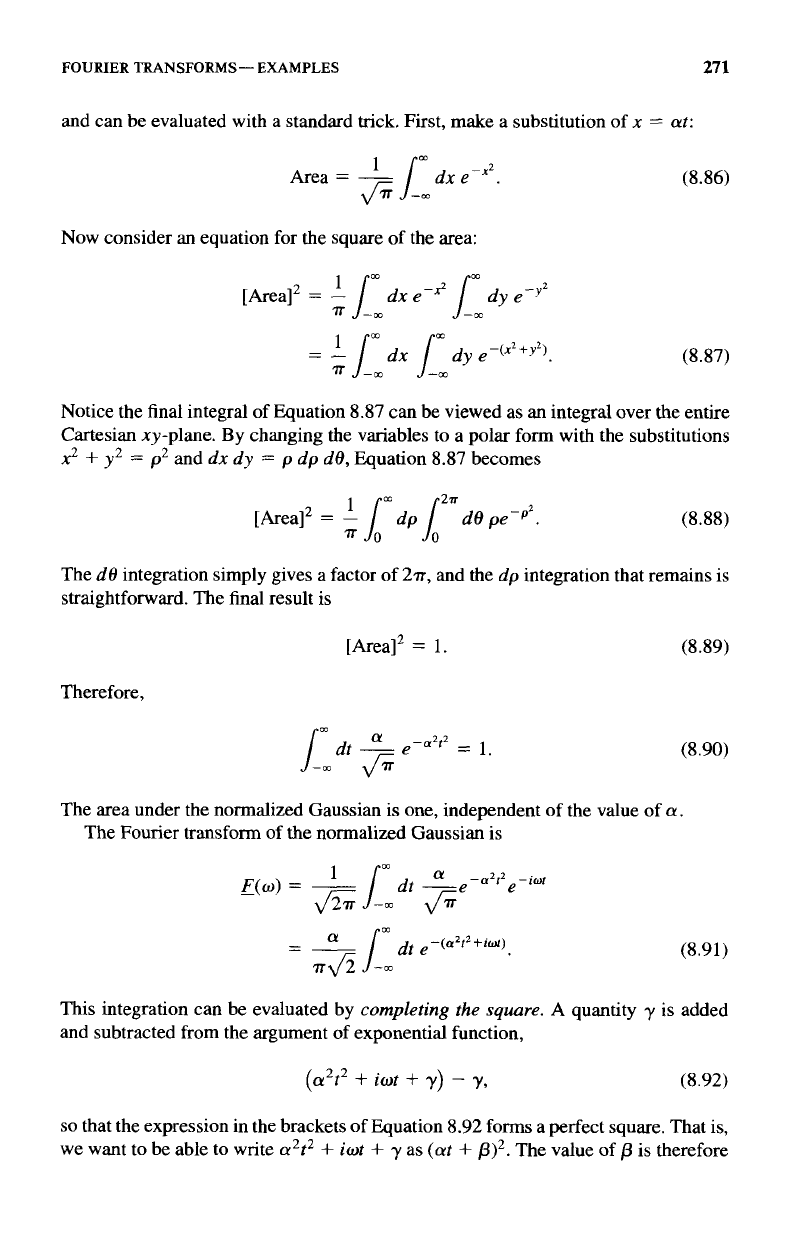
normalized Gaussian pulse has the general form
(8.83)
(8.84)
where the leading constant
normalizes
the
function, as we will prove
shortly.
A
graph
of Equation
8.84
is
shown
in
Figure
8.19.
Notice how the parameter
Q
scales
both
the width and the height
of
the pulse.
The area
of
the pulse
is
given
by
a
22
At)
=
7
e"'
a/-----
I
&i
-
l/a
Figure
8.19
The
Gaussian
Pulse
FOURIER TRANSFORMS
-
EXAMPLES
271
and can be evaluated with a standard trick. First, make a substitution of
x
=
at:
(8.86)
1"
Area
=
-
J
dx
e-".
J.rr
--m
Now consider
an
equation for the square of the area:
Notice the final integral
of
Equation 8.87 can be viewed as
an
integral over the entire
Cartesian xy-plane. By changing the variables
to
a polar form with the substitutions
x2
+
y2
=
p2
and dx
dy
=
p dp do, Equation 8.87 becomes
(8.88)
The
do
integration simply gives a factor of 27r, and the
dp
integration that remains is
straightforward. The final result is
[~rea]~
=
1.
(8.89)
Therefore,
a
22
/:dt
ePat
=
1.
(8.90)
The area under the normalized Gaussian is one, independent of the value of
a.
The Fourier transform of the normalized Gaussian is
-
F(w)
=
-
1
/"
dt
-e-a
a
22
t -.
lot
J2.rr-m
fi
(8.91)
This integration can be evaluated by
completing the
square.
A
quantity
y
is
added
and subtracted from the argument of exponential function,
(a2t2
+
iwt
+
y)
-
y,
(8.92)
so
that the expression in the brackets of Equation 8.92 forms a perfect square. That is,
we want to be able to write
a2t2
+
iwt
+
y
as (at
+
p)2.
The value of
/3
is therefore
272
determined by
FOURIER TRANSFORMS
From Equation 8.93,
so
that
and
a2t2
+
iwt
+
y
=
(at
+
p)2
=
a2t2
+
2apt
i-
p2
2apt
=
iwt
iw
p=-
2a
(8.93)
(8.94)
(8.95)
(8.96)
Equation
8.91
can now be written as
F(w)
=
-
a
e-oz/(4a2)
1:
dt
e-[at+io/(2a)1z
(8.97)
This
integration is accomplished using the substitution
x
=
at
+
io/(2a)
and
dx
=
a
dt:
4
-
(8.98)
Thus we have shown the Fourier transform of
a
Gaussian is another Gaussian:
(8.99)
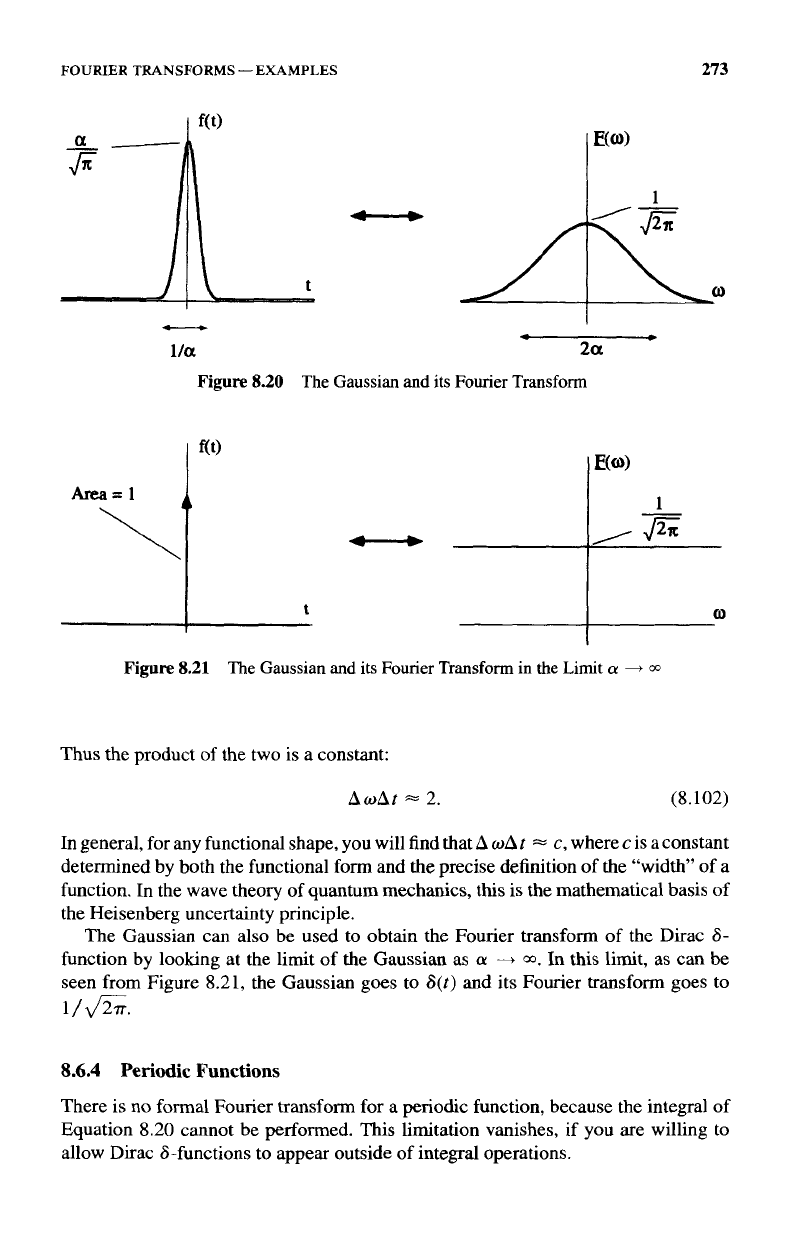
As
a
increases, the width
of
the Gaussian pulse decreases, while the width
of
its Gaussian spectrum increases, as shown in Figure
8.20.
This demonstrates an
important general property of the Fourier transform. The width of the function
f(t)
is always inversely proportional to the width of the transform
F(w).
In
the case of the
Gaussian,
the
width
of
f(t)
is roughly
1
At
zs
-,
a
while the width
of
E(w)
is approximately
(8.100)
Aw
=
2a.
(8.101)
FOURIER
TRANSFORMS
-
EXAMPLES
273
-
0
*
1
/a
2a
Figure
8.20
The
Gaussian
and
its
Fourier Transform
Figure
8.21
The
Gaussian and
its
Fourier Transform
in
the
Limit
a
+
00
Thus the product of the two is a constant:
AhoAt
=
2.
(8.102)
In general, for any functional shape,
you
will find that
A
wAt
=
c,
where
c
is a constant
determined by both the functional form and the precise definition of the “width” of
a
function. In the wave theory of quantum mechanics,
this
is the mathematical basis of
the Heisenberg uncertainty principle.
The Gaussian can also be used to obtain the Fourier transform
of
the Dirac 8-
function by looking at the limit of the Gaussian as
a
---t
00.
In this limit,
as
can
be
seen from Figure 8.21, the Gaussian
goes
to
8(t)
and
its Fourier transform goes to
1/&.
8.6.4
Periodic
Functions
There
is
no
formal Fourier transform for
a
periodic function, because the integral of
Equation 8.20 cannot be performed.
This
limitation vanishes, if
you
are willing
to
allow Dirac 8-functions to appear outside of integral operations.
214
FOURIER
TRANSFORMS
As
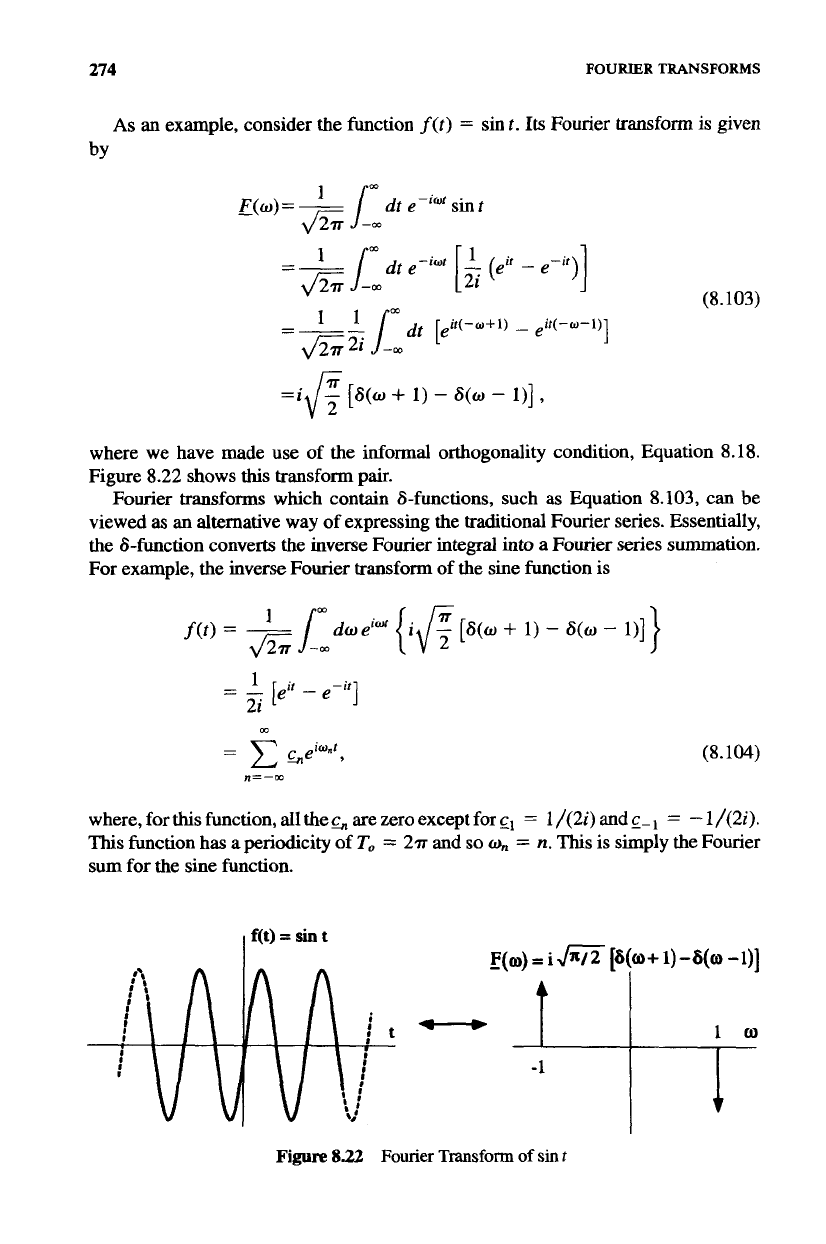
an example, consider the function
f(t)
=
sin
t.
Its
Fourier
transform
is
given
by
(8.103)
where we have made use of the informal orthogonality condition, Equation 8.18.
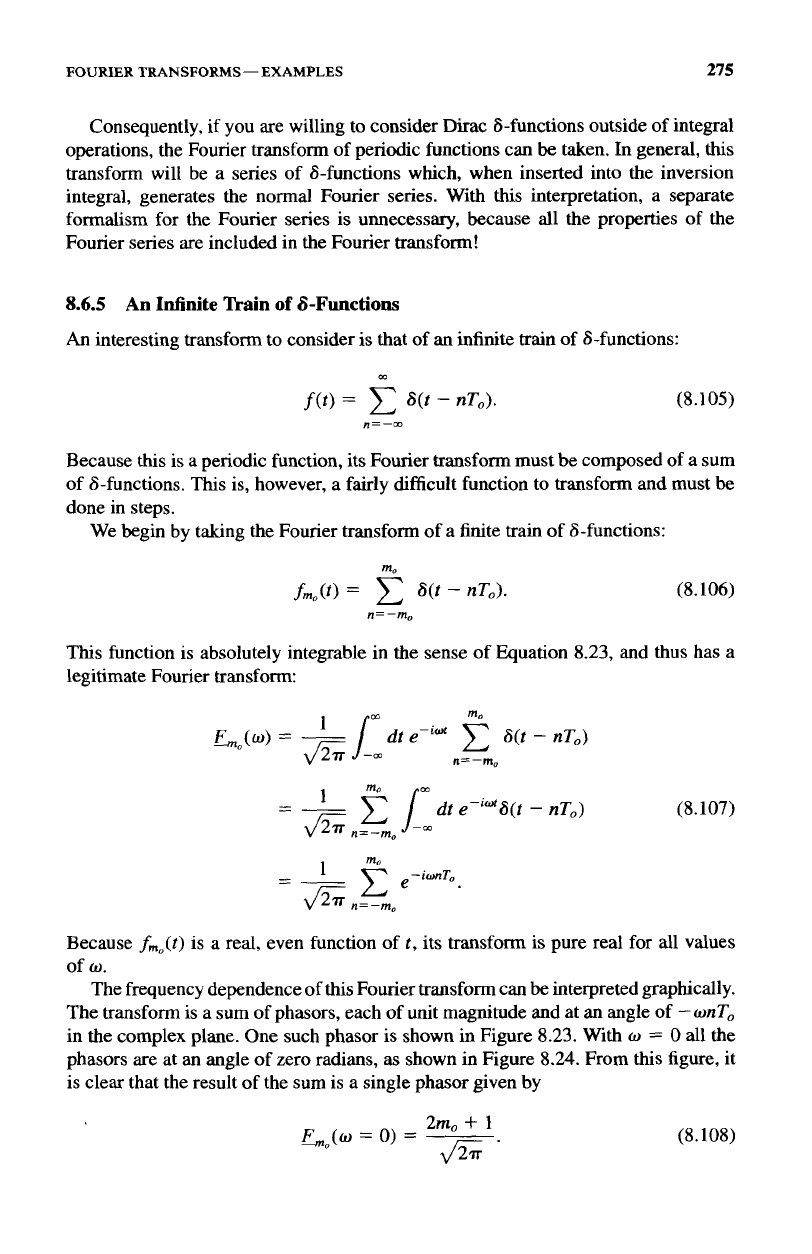
Figure
8.22 shows
this
transform
pair.
Fourier transforms which contain 8-functions, such
as
Equation 8.103, can be
viewed
as
an alternative way
of
expressing the traditional Fourier series. Essentially,
the 6-function converts the inverse Fourier integral into
a
Fourier series summation.
For example, the inverse Fourier
transform
of the sine function
is
1"
f(t>
=
-
J2?r
lmdweid
{
ifi
[6(0
+
1)
-
6(0
-
l)]
m
n=-m
(8.104)
where, for
this
function, all the
are zero except for
c,
=
1
/(2i)
and
c-
=
-
1
/(2i).
This
function
has
a
periodicity of
To
=
2.rr
and
so
o,
=
n.
This
is
simply the Fourier
sum
for the sine function.
Figure
8.22
Fourier
Transform
of
sin
t
FOURIER TRANSFORMS
-
EXAMPLES
275
Consequently, if you are willing to consider Dirac &functions outside of integral
operations, the Fourier transform of periodic functions
can
be
taken. In general,
this
transform will be
a
series of 8-functions which, when inserted into the inversion
integral, generates the normal Fourier series. With
this
interpretation, a separate
formalism for the Fourier series is unnecessary, because
all
the properties of the
Fourier series are included in the Fourier transform!
8.6.5
An
Infinite
'hain
of
6-Functions
An interesting transform
to
consider is that of
an
infinite
train
of 6-functions:
m
(8.105)
Because this is a periodic function, its Fourier transform must be composed
of
a sum
of &functions.
This
is, however, a fairly difficult function to transform and must be
done in steps.
We begin by taking the Fourier transform of a finite train of 6-functions:
mo
fm,(t>
=
C
6(t
-
nTo).
This
function is absolutely integrable in the sense of Equation 8.23, and thus has a
legitimate Fourier transform:
(8.106)
n=-m,
-
-
1
5
[I
dt
ePior6(t
-
nT,)
J27.
n=-m,,
1
m'
-
-
-
c
e-ionToa
J27.
n=-m.
(8.107)
Because
fm,(t)
is a real, even function of
t,
its transform is pure real for all values
of
w.
The frequency dependence of this Fourier transform can be interpreted graphically.
The transform is
a
sum
of
phasors, each of unit magnitude and at
an
angle
of
-
wnT,
in the complex plane. One such phasor
is
shown in Figure 8.23. With
o
=
0
all the
phasors are at an angle of zero radians,
as
shown in Figure 8.24. From this figure, it
is clear that the result of the
sum
is a single phasor given by
2m0
+
1
Lo(@
=
0)
=
___
6'
(8.108)