
Kusse B.R., Westwig E.A. Mathematical Physics: Applied Mathematics for Scientists and Engineers
Подождите немного. Документ загружается.

276
FOURIER TRANSFORMS
I
Figure
8.23
One
of
the Phasors
in
the Fourier Transform of a Finite Train
of
&Functions
m,
I
-2
-1
0
1
2
I.....
__c
n=-m,
__c
.....
(24+
1)
real
I
Figure
8.24
Fourier Transform for a Finite Train of &Functions Evaluated at
w
=
0
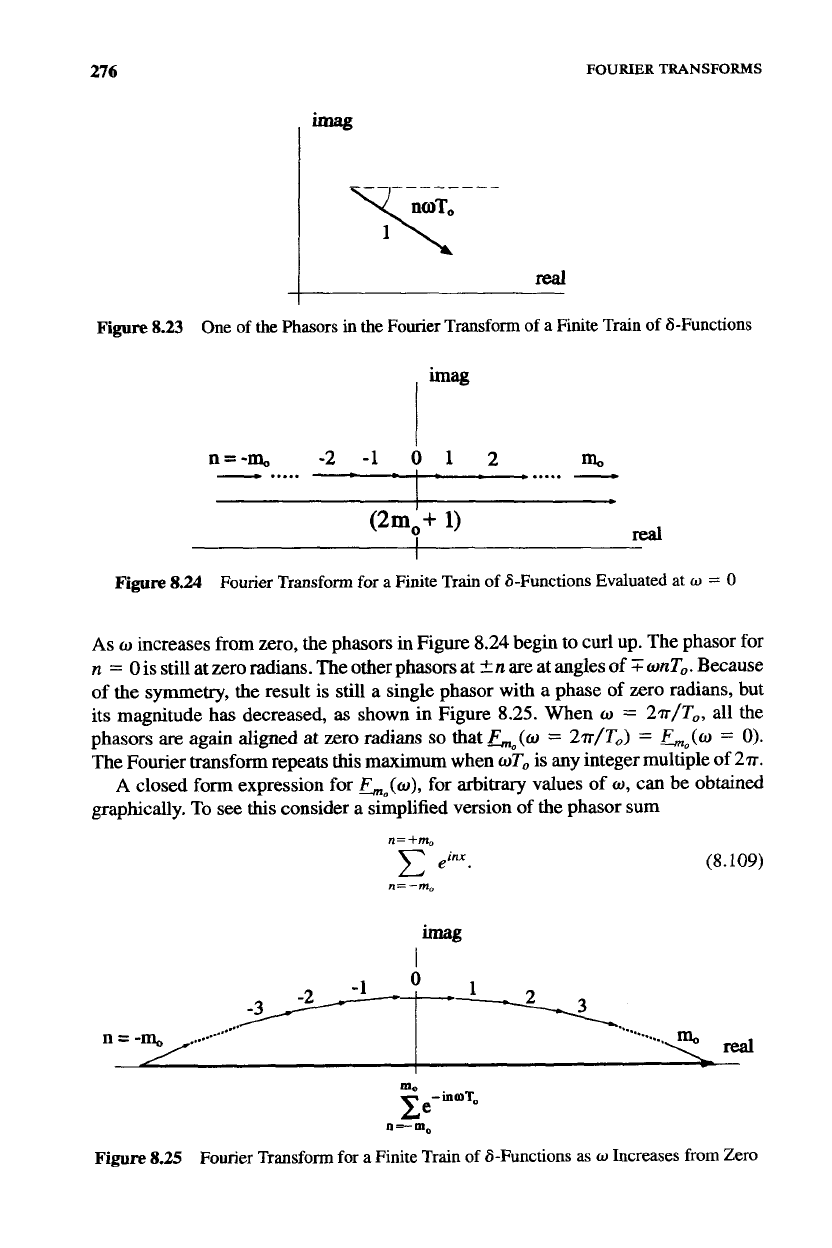
As
o
increases
from
zero, the phasors in Figure
8.24
begin to curl up. The phasor for
n
=
0
is still at zero
radians.
The other phasors at
+_n
are at angles
of
T
onT,.
Because
of the symmetry, the result
is
still
a single phasor with a phase of zero radians, but
its magnitude
has
decreased,
as
shown
in Figure
8.25.
When
o
=
27r/T0,
all the
phasors
are.
again aligned at zero radians
so
that
&,(w
=
27r/T0)
=
&,(o
=
0).
The Fourier transform repeats
this
maximum
when
wT,
is any integer multiple
of
2rr.
A
closed form expression for
F-Jw),
for arbitrary values
of
w,
can be obtained
graphically.
To
see
this
consider a simplified version of the phasor sum
(8.109)
Figure
8.25
Fourier
Transform
for
a Finite Train
of
&Functions
as
w
Increases
from
Zero
FOURIER TRANSFORMS
-
EXAMPLES
277
E
F
Sint(2mo+
1)x/21
A
J
P
Figure
8.26
Phasor
Summation
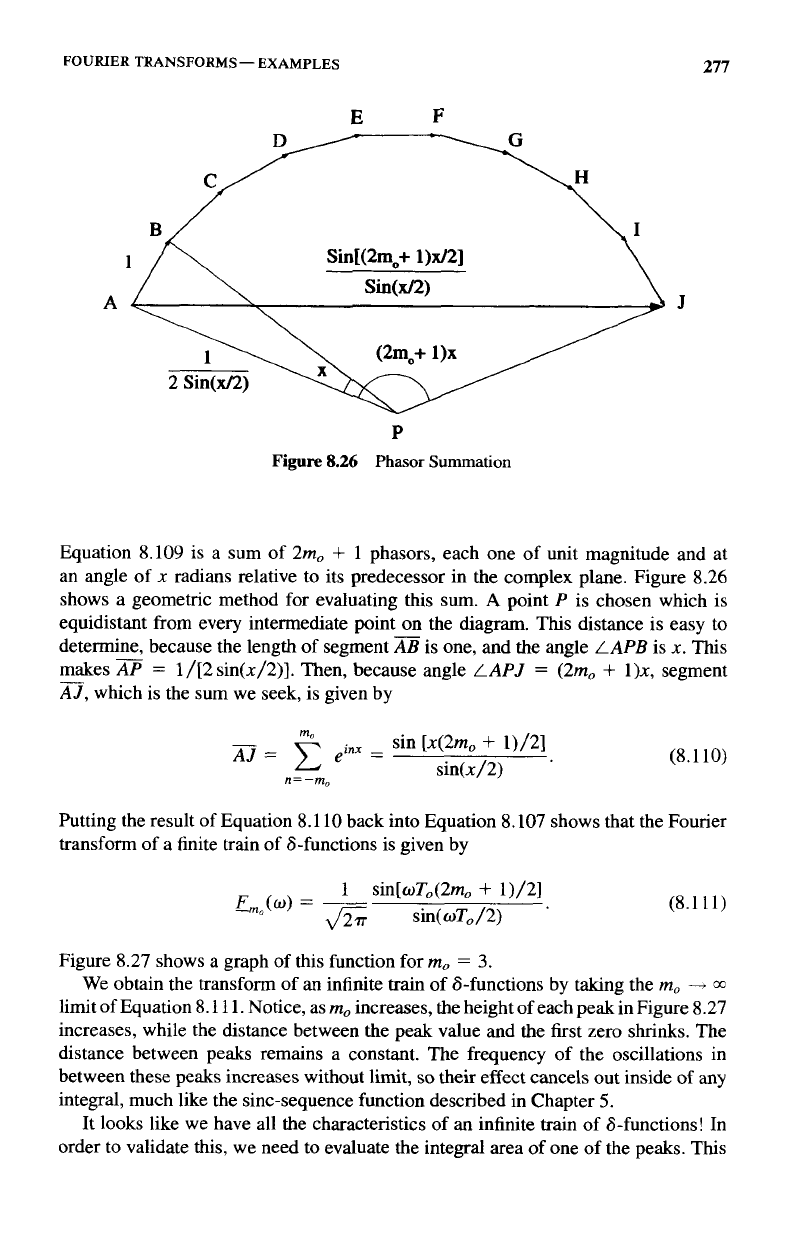
Equation 8.109 is a sum of 2m,
+
1 phasors, each one of unit magnitude and at
an angle of
x
radians relative to its predecessor in the complex plane. Figure 8.26
shows a geometric method for evaluating
this
sum.
A
point
P
is chosen which is
equidistant
from
every intermediate point on the diagram.
This
distance is easy to
determine, because the length
of
segment is one, and the angle
LAPB
is
x.
This
makes
AP
=
1/12 sin(x/2)]. Then, because angle
LAPJ
=
(2m,
+
l)x,
segment
m,
which is the sum we seek, is given by
.
sin [x(2m0
+
1)/2]
m,
-
AJ
=
elnx
=
n=-m,
sin(x/2)
(8.1 10)
Putting the result of Equation 8.1
10
back into Equation 8.107 shows that the Fourier
transform of
a
finite train of 6-functions is given by
(8.1
11)
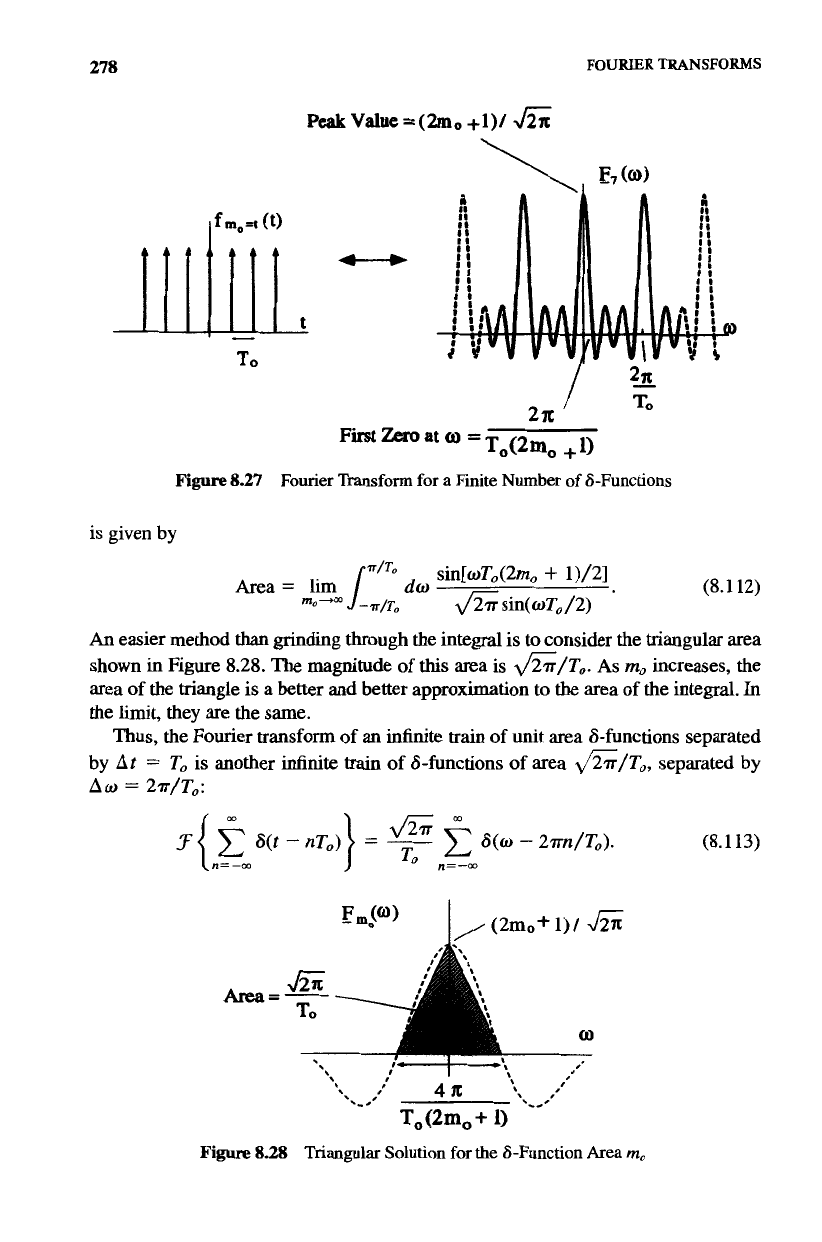
Figure 8.27 shows
a
graph of this function form,
=
3.
We obtain the transform of
an
infinite
train
of &functions by taking the
m,
-
~0
limit of Equation 8.1 11. Notice, as
m,
increases, the height
of
each
peak
in Figure
8.27
increases, while the distance between the peak value and the first zero
shrinks.
The
distance between peaks remains a constant. The frequency of the oscillations in
between these peaks increases without limit,
so
their effect cancels out inside
of
any
integral, much like the sinc-sequence function described in Chapter
5.
It looks like we have all the characteristics of
an
infinite train of &functions! In
order to validate this, we need to evaluate the integral area of one of the peaks.
This
278
FOURIER
TRANSFORMS
TO
First
at
=
T0(2m0
+1)
Figure
8.27
Fourier Transform for
a
Finite Number of &Functions
is given by
(8.1 12)
sin[oTo(2mo
+
1)/2]
J
do
6
sin(
oTo /2)
'
-
dT0
Area
=
lim
m,+m
An
easier method than grinding through the integral is to consider the triangular area
shown
in
Figure
8.28.
The magnitude of
this
area is
G/T0.
As
ma
increases, the
area of the triangle
is
a better and better approximation
to
the area
of
the integral.
In
the limit, they are the same.
Thus, the Fourier transform of an infinite train
of
unit
area &functions separated
by
At
=
To
is another infinite
train
of 6-functions
of
area
&/To,
separated by
A
o
=
27r/TO:
(8.1
13)
Figure
8.28 Triangular Solution for the &Function
Area
no
FOURIER
TRANSFORMS
-
EXAMPLES
279
Area
.....
.....
_Illt
I
TO
.....
llL
II
.....
w
-
Figure
8.29
Fourier Transform of an Infinite Train
of
&Functions
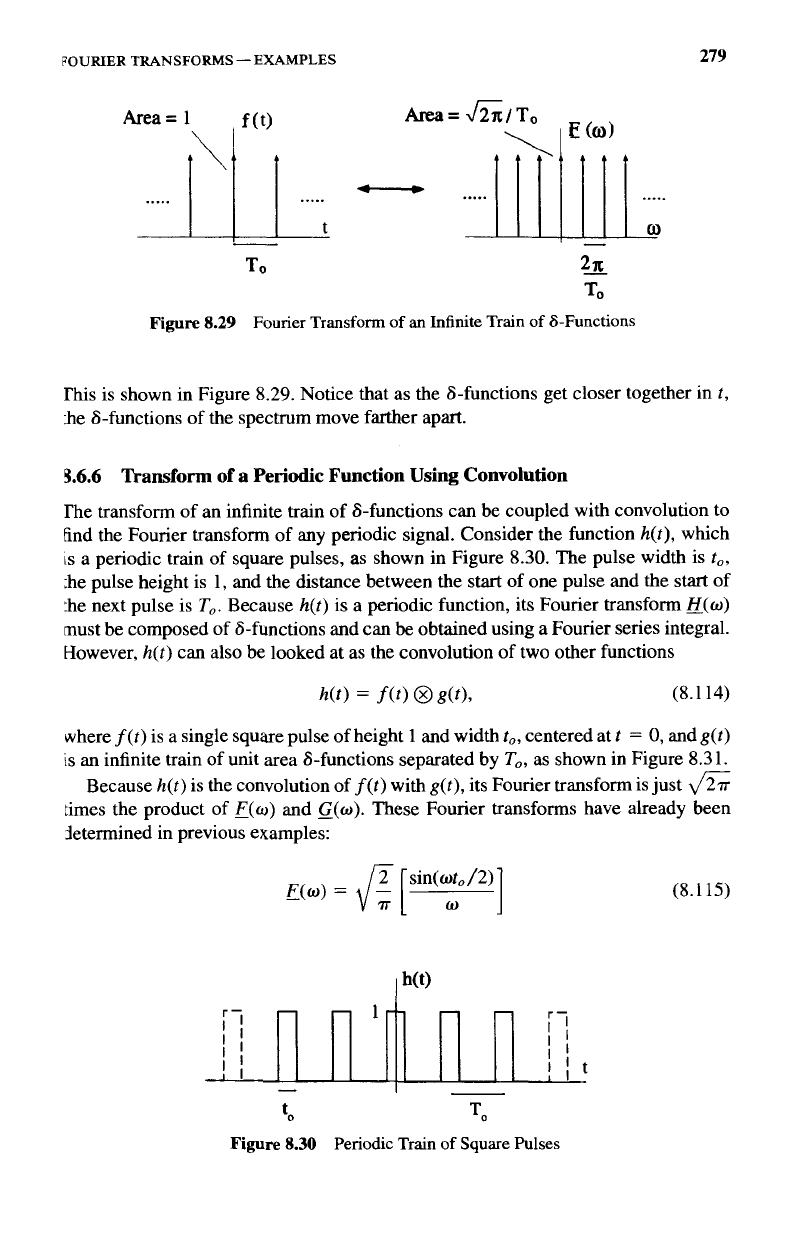
rhis is shown in Figure 8.29. Notice that as the &functions get closer together in
t,
he &functions
of
the spectrum move farther apart.
3.6.6
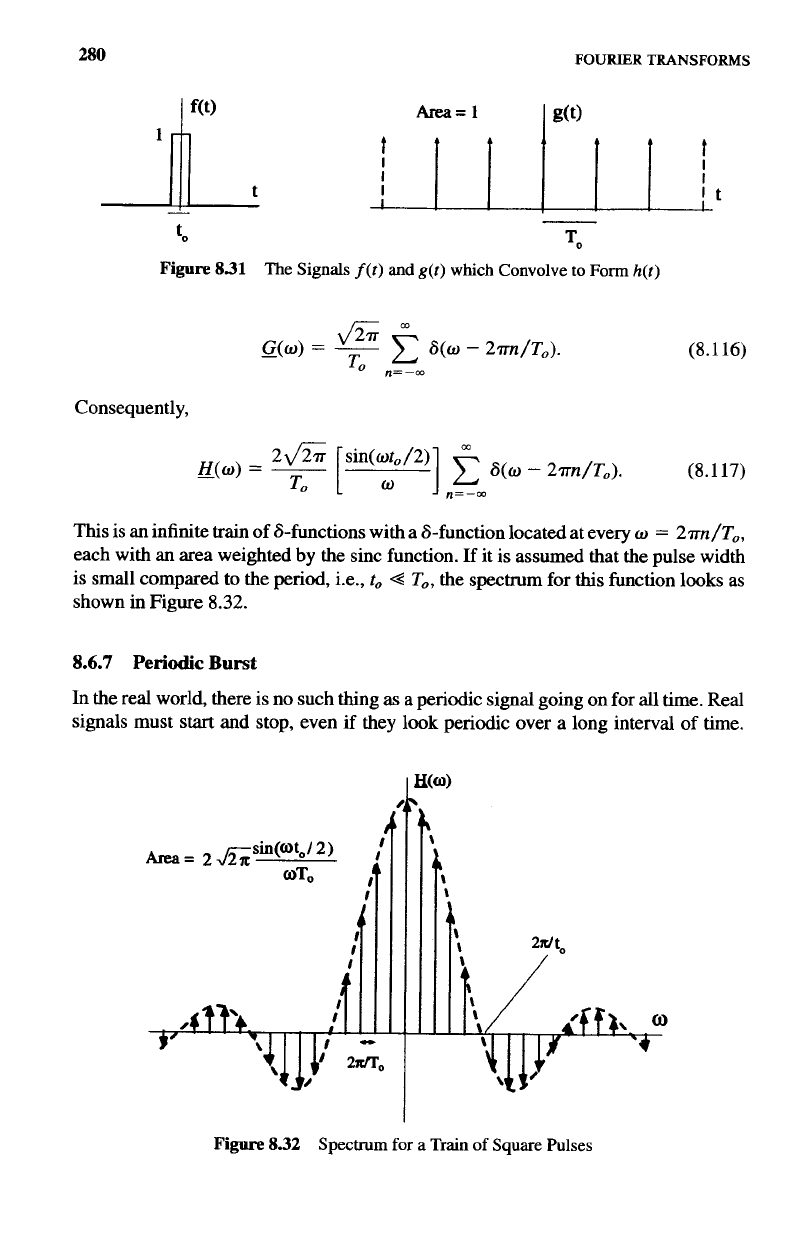
The transform of an infinite train of &functions can be coupled with convolution to
find the Fourier transform of any periodic signal. Consider the function
h(t),
which
is
a periodic train
of
square pulses, as shown in Figure
8.30.
The pulse width is
to,
;he pulse height is
1,
and
the
distance between the
start
of one pulse and the start of
:he next pulse is
To.
Because
h(t)
is a periodic function, its Fourier transform
H(w)
must be composed of &functions and can be obtained using a Fourier series integral.
However,
h(t)
can also be looked at as the convolution of two other functions
Transform
of
a
Periodic Function Using Convolution
where
f(t)
is a single square pulse of height
1
and width
to,
centered at
t
=
0,
and
g(t)
is
an infinite train
of
unit area &functions separated by
To,
as shown in Figure 8.31.
Because
h(t)
is the convolution of
f(t)
with
g(t),
its Fourier transform is just
J2.r
Limes the product of
F(w)
and
G(w).
These Fourier transforms have already been
jetermined in previous examples:
-
I
to
To
Figure
8.30
Periodic Train
of
Square Pulses
(8.1 15)
280
FOURIER TRANSFORMS
to
TO
Figure
831
The Signals
f(t)
and
g(t)
which
Convolve
to
Form
h(t)
(8.1
16)
Consequently,
26
sin(wt0/2)
OC
-
H(w)
=
-
[
]
6(w
-
2m/TO).
(8.1 17)
TO
n=--m
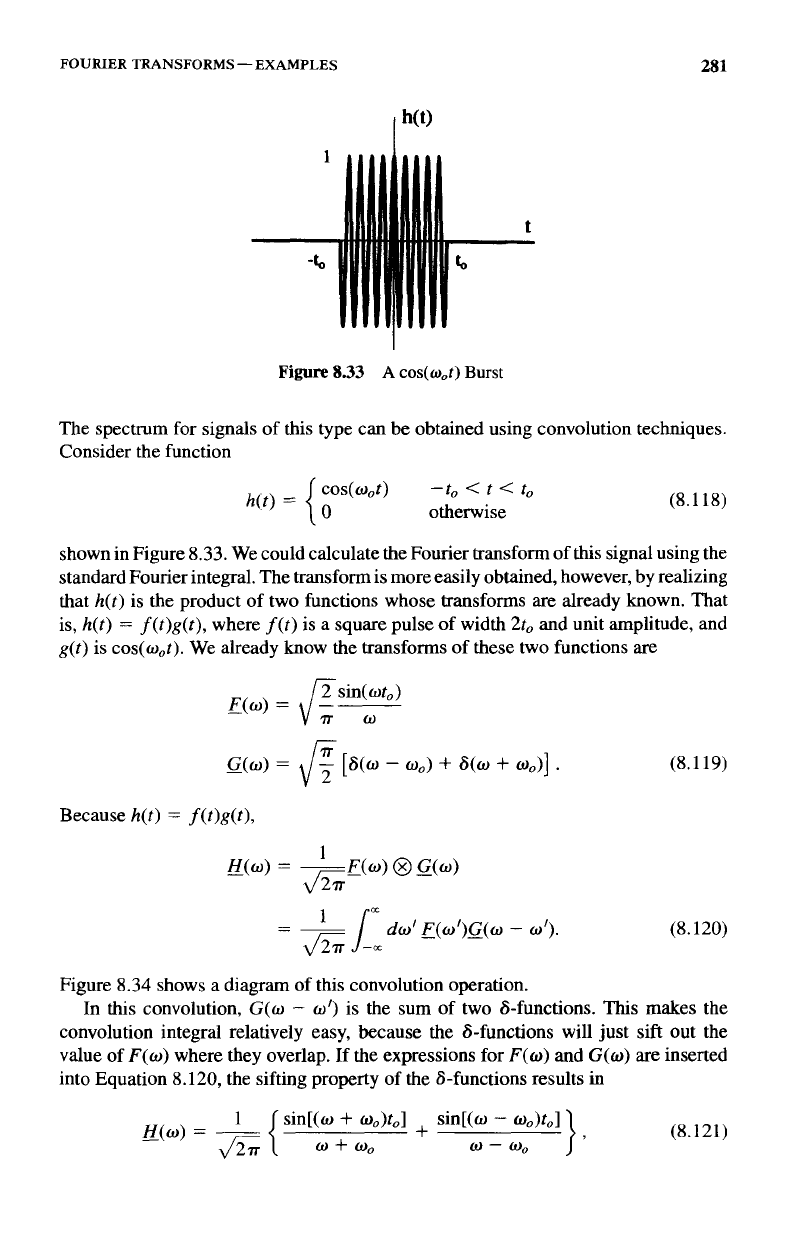
This
is an infinite
train
of 6-functions with a 6-function located at every
w
=
2nn/T0,
each with
an
area weighted by the sinc function. If it is assumed that the pulse width
is small compared to the
period,
i.e.,
to
<
To,
the
spectrum
for this function
looks
as
shown
in
Figure 8.32.
8.6.7
Periodic
Burst
In
the
real world, there is
no
such thing
as
a periodic signal going
on
for all time. Real
signals must
start
and stop, even if they look periodic over a long interval
of
time.
I
Figure
8.32
Spectrum
for
a
Train
of
Square Pulses
FOURIER TRANSFORMS -EXAMPLES
281
Figure
8.33
A
cos(o,t)
Burst
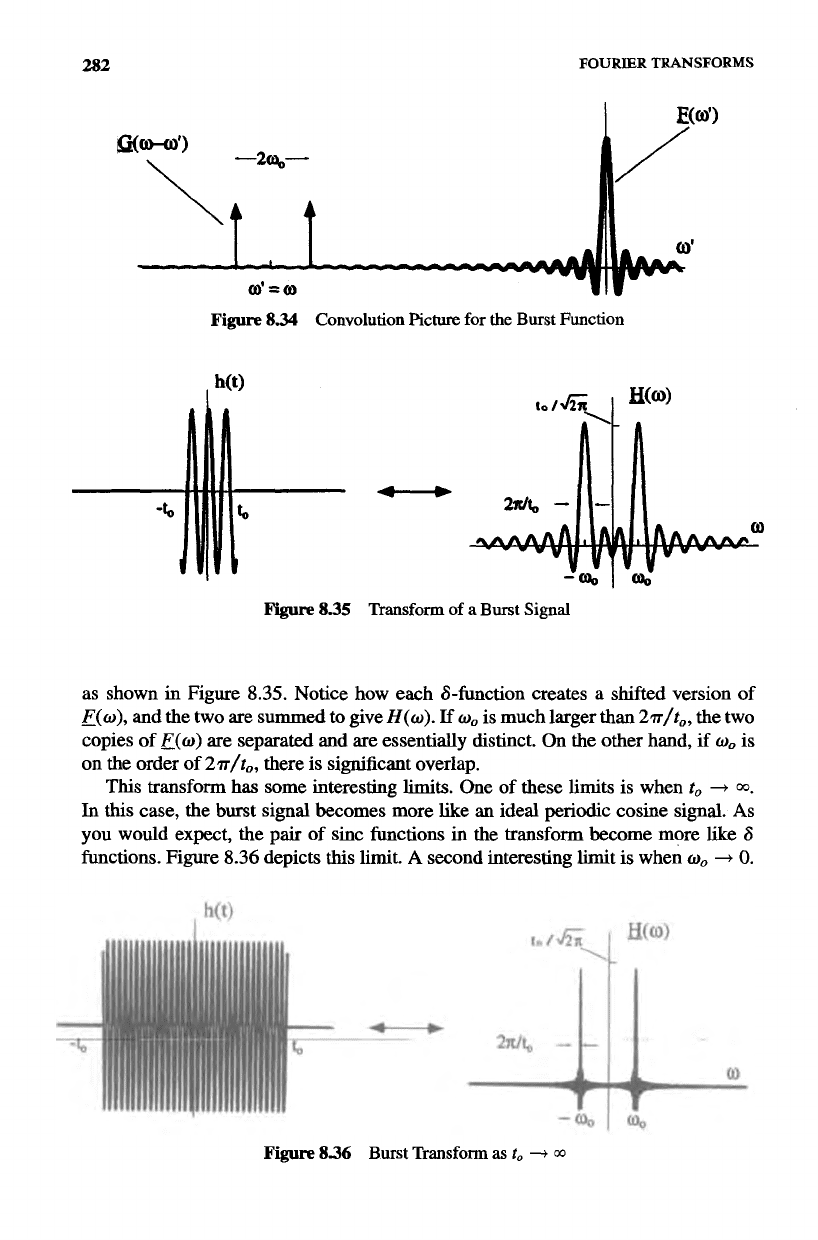
The spectrum for signals of this type can be obtained using convolution techniques.
Consider the function
cos(wot)
-to
<
t
<
to
otherwise
h(t)
=
{
(8.1 18)
shown in Figure 8.33. We could calculate the Fourier transform of this signal using the
standard Fourier integral. The transform is more easily obtained, however, by realizing
that
h(t)
is the product
of
two functions whose transforms
are
already known. That
is,
h(t)
=
f(t)g(t),
where
f(t)
is a square pulse of width
2t0
and unit amplitude, and
g(t)
is cos(w,,t). We already know the transforms of these two functions are
2
sin(wto)
F(w)
=
-~
-
G(w)
=
fi
[6(0
-
wo)
+
6(w
+
w,,)]
.
Trw
(8.119)
-
J
Because
h(t)
=
f(t)g(t),
-
1"
-
dw'
F(w')G(w
-
w').
(8.120)
Figure 8.34 shows a diagram
of
this convolution operation.
In this convolution,
G(w
-
w')
is the
sum
of two 6-functions.
This
makes the
convolution integral relatively easy, because the 6-functions will just sift out the
value
of
F(w)
where they overlap. If the expressions for
F(w)
and
C(w)
are inserted
into Equation 8.120, the sifting property
of
the 6-functions results
in
FOURIER
TRANSFORMS
282
Figure
8.34
Convolution
Picture
for
the
Burst
Function
Figure
8.35
Transform
of
a
Burst
Signal
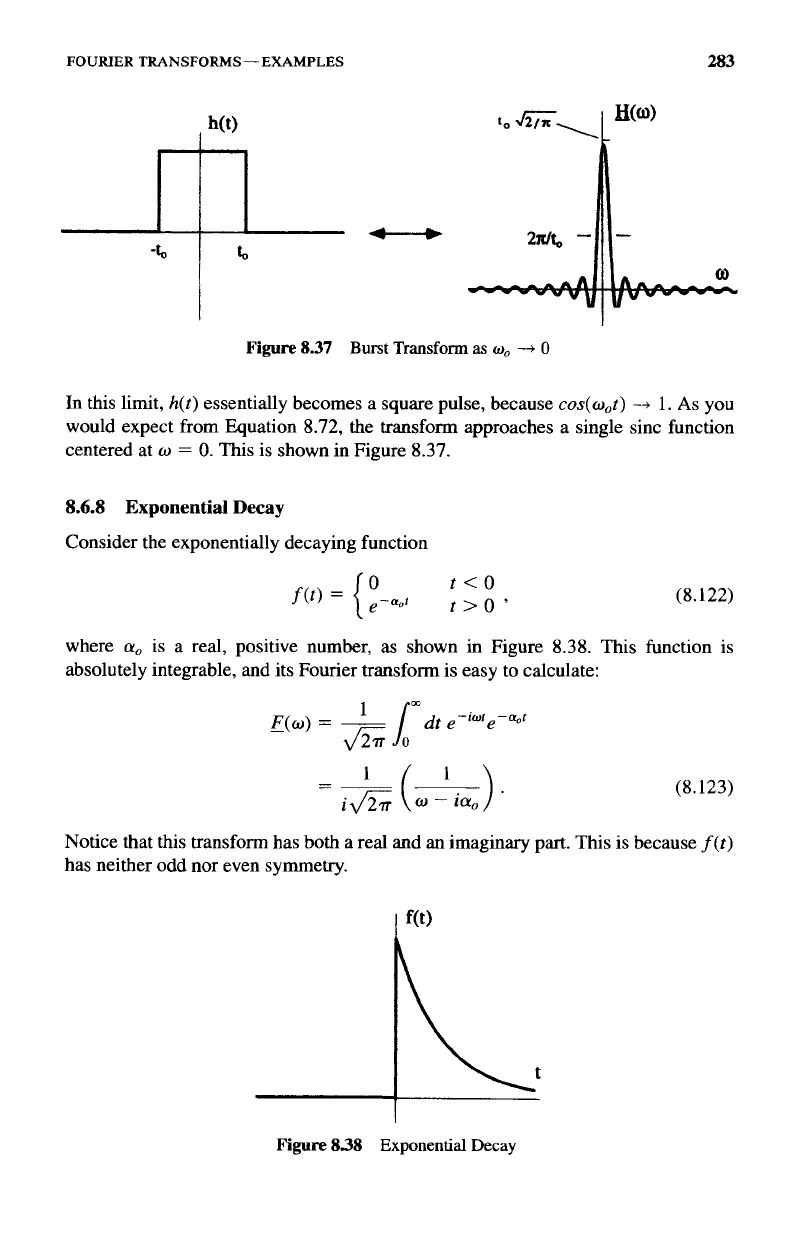
as
shown
in
Figure
8.35.
Notice how each 6-hction creates
a
shifted version of
-
F(w),
and the two are
summed
to giveH(w).
If
wo
is much larger than
2m/t0,
the two
copies
of
F(w)
are separated and are essentially distinct. On the other hand, if
wo
is
on the order
of
2m/t0,
there
is
signiticant overIap.
This transform has some interesting
limits.
One
of
these limits
is
when
to
+
a.
In
this
case, the burst signal becomes more like
an
ideal periodic cosine signal.
As
you
would expect, the pair of sinc functions in the transform become more like
S
functions. Figure
8.36
depicts
this
limit.
A
second interesting limit is when
wo
+
0.
Figure
836
Burst
Transform
as
to
+
w
FOURIER
TRANSFORMS
-EXAMPLES
283
Figure
8.37
Burst
Transform
as
w,
-+
0
In
this limit,
h(t)
essentially becomes a square pulse, because
cos(w,t)
+
1.
As
you
would expect from Equation 8.72, the transform approaches a single sinc function
centered at
w
=
0.
This
is shown in Figure 8.37.
8.6.8
Exponential Decay
Consider the exponentially decaying function
(8.122)
where
a,
is a real, positive number,
as
shown
in
Figure 8.38. This function is
absolutely integrable, and its Fourier transform is easy to calculate:
dt
e-iwre-aor
F(w)
=
-
-
60
Jm
(8.123)
Notice that this transform has both a real and an imaginary part. This is because
f(t)
has neither odd nor even symmetry.
Figure
8.38
Exponential
Decay
284
FOURIER
TRANSFORMS
.i
Figure
839
Inversion of Exponential Transform
in
the *-Plane
Now consider the inverse transform back to
f(t):
1"
iot
=-I
do-.
2m'
--m
o
-
ia,
(8.124)
In
Equation
8.124,
o
is
a pure real variable. The integral is easily calculated by
extending the integral into
the
complex @-plane, and then closing the contour. The
complex integral
is
igt
1
f(t)
=
-
1
do
-,
2m
g
-
ia,
(8.125)
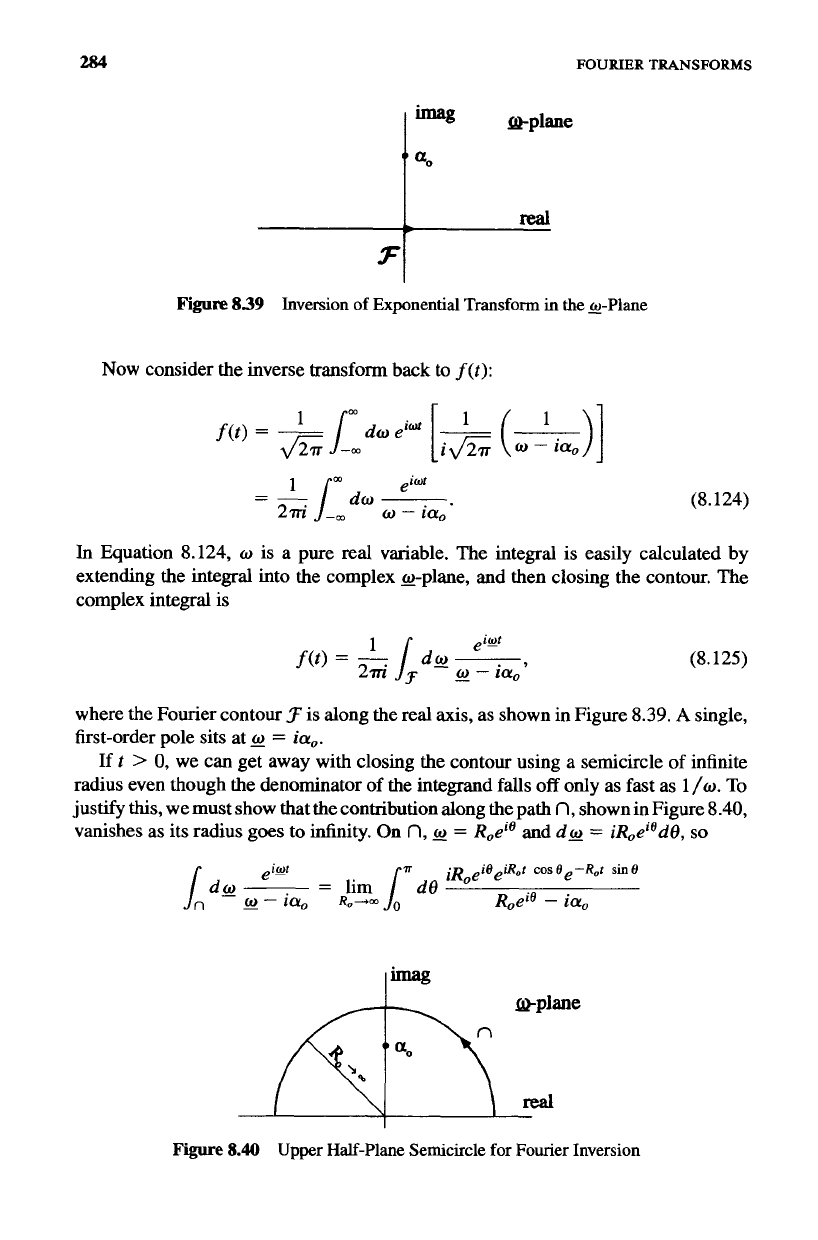
where the Fourier contour
F
is along the real
axis,
as shown in Figure
8.39.
A
single,
first-order pole sits at
o
=
ia,.
If
t
>
0,
we can get away with closing the contour using
a
semicircle of infinite
radius even though
the
denominator of the integrand falls
off
only
as fast as
1
/o.
To
justify
this,
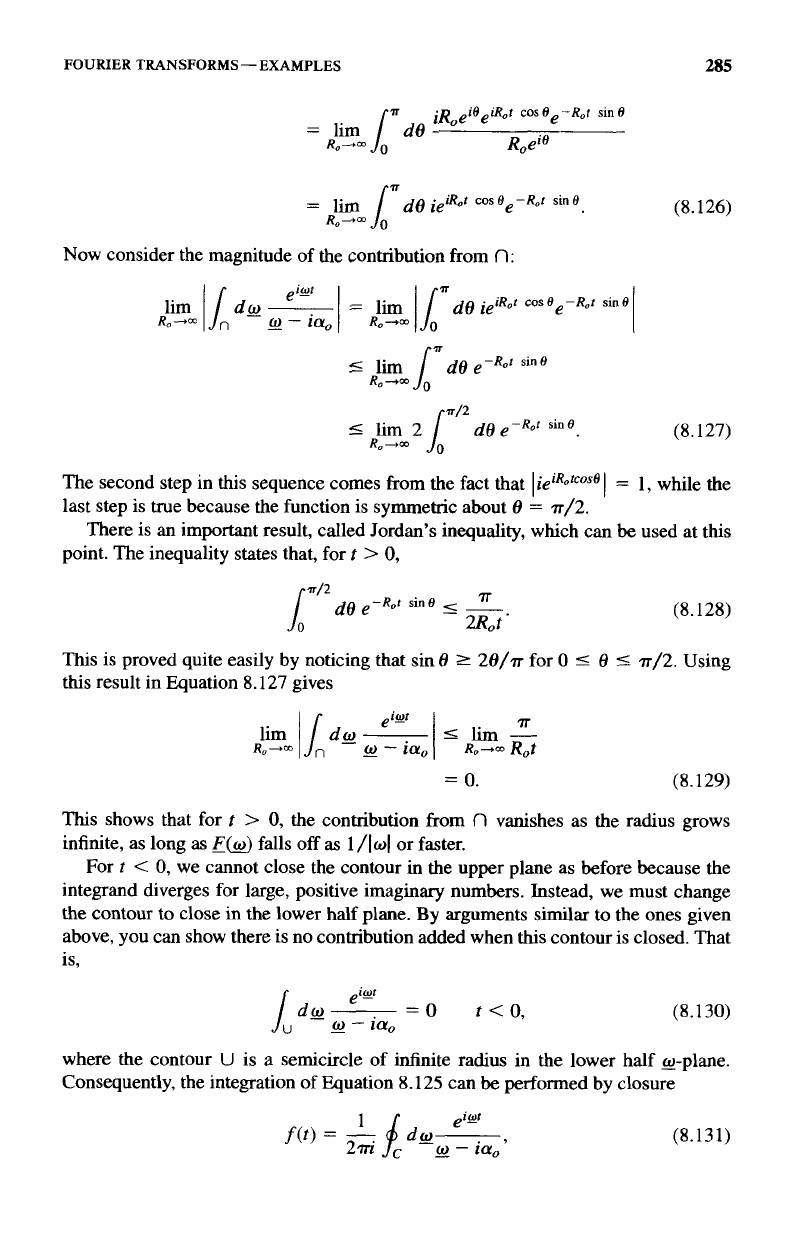
we must show that the contribution along the path
n,
shown in Figure
8.40,
vanishes as
its
radius goes to
infinity.
On
n,
g
=
Roeie
and
dg
=
iR,eiedO,
so
igf
iRoeieeiR0t
cos
Be-Rot
sin
0
dw-
=
lim
@-la,
Ro-+m
Roeie
-
ia,
Figure
8.40
Upper Half-Plane Semicircle for Fourier Inversion
FOURIER
TRANSFORMS
-
EXAMPLES
'TT
iRoeieeiRot
cos
Be-R,t
sin
8
Roeie
=
lim
1
d0
R,-m
Now consider the magnitude of the contribution from
fl
:
285
(8.126)
(8.127)
The second step in
this
sequence comes from the fact that
I
ieiRotcose
I
=
1, while the
last step
is
true because the function is symmetric about
0
=
~/2.
There is an important result, called Jordan's inequality, which can
be
used at this
point. The inequality
states
that, for
t
>
0,
(8.128)
This
is
proved quite easily by noticing that sin
0
2
20/~ for
0
5
0
5
~/2. Using
this result in Equation
8.127
gives
=
0.
(8.129)
This
shows that for
t
>
0,
the contribution from
fl
vanishes as the radius grows
infinite, as long as
Eb)
falls
off
as
1
/lo1
or faster.
For
t
<
0,
we cannot close the contour
in
the upper plane as before because the
integrand diverges for large, positive imaginary numbers. Instead, we must change
the contour to close
in
the lower half plane.
By
arguments similar to the ones given
above, you can show there is no contribution added when
this
contour
is
closed. That
is,
(8.130)
where the contour
U
is a semicircle of infinite radius in the lower half g-plane.
Consequently, the integration
of
Equation 8.125 can
be
performed by closure
(8.131)