
Kusse B.R., Westwig E.A. Mathematical Physics: Applied Mathematics for Scientists and Engineers
Подождите немного. Документ загружается.

2%
FOURIER
TRANSFORMS
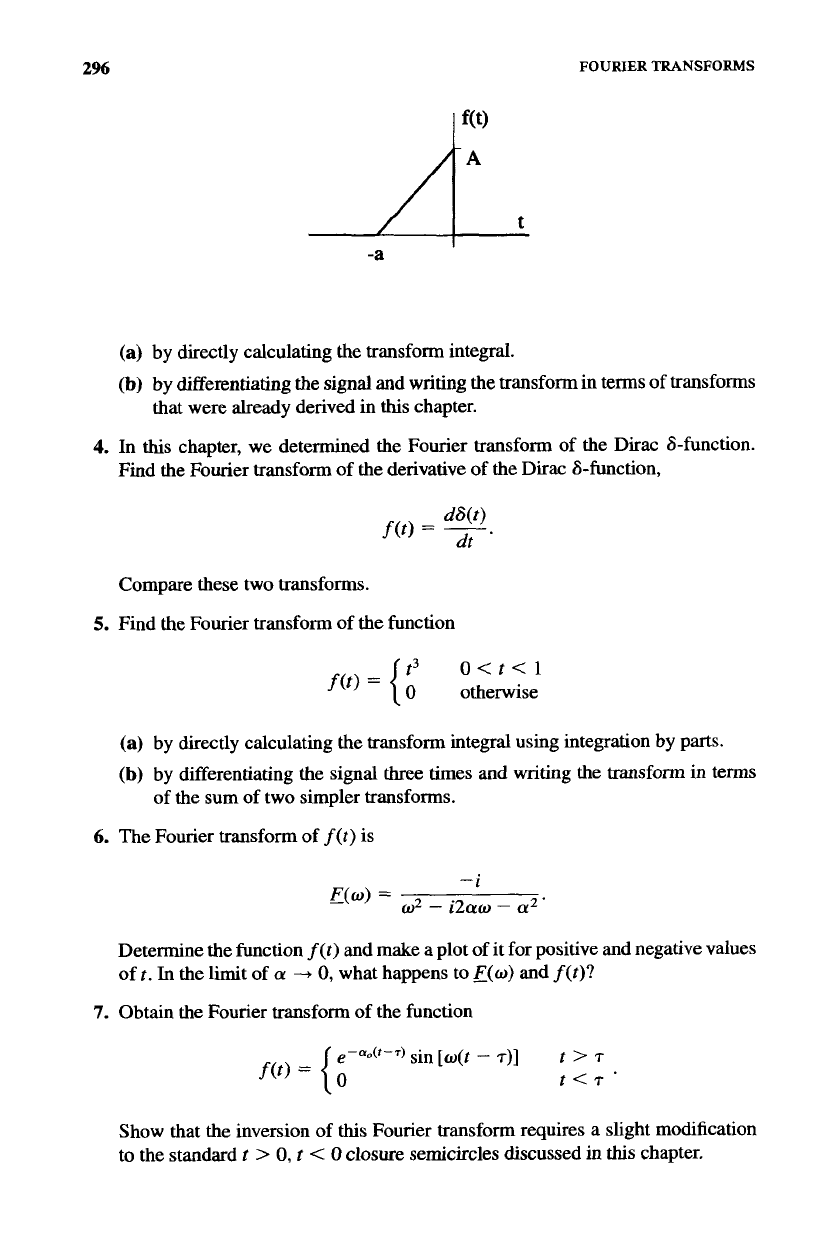
-a
(a)
by directly calculating the transform integral.
(b)
by
differentiating the signal and writing the transform
in
terms of transforms
4.
In
this
chapter, we determined the Fourier transform of the Dirac S-function.
that were already derived in
this
chapter.
Find the Fourier transform of the derivative
of
the Dirac 6-function,
Compare these two transforms.
5.
Find the Fourier transform of the function
(a)
by directly calculating the transform integral using integration by parts.
(b)
by
differentiating the signal three times and writing the transform in terms
of the sum of two simpler transforms.
6.
The Fourier transform of
f(t)
is
-2
=
o2
-
.
12aw
-
a2'
Determine the function
f(t)
and make
a
plot of
it
for positive and negative values
oft.
In
the limit of
a
-+
0,
what happens to
E(o)
and f(t)?
7.
Obtain the Fourier transform of the function
sin [o(t
-
T)]
-4t-T)
t
>
T
f(t)
=
{
0
t<r'
Show that the inversion of
this
Fourier transform requires a slight modification
to the standard
t
>
0,
t
<
0
closure semicircles discussed in
this
chapter.
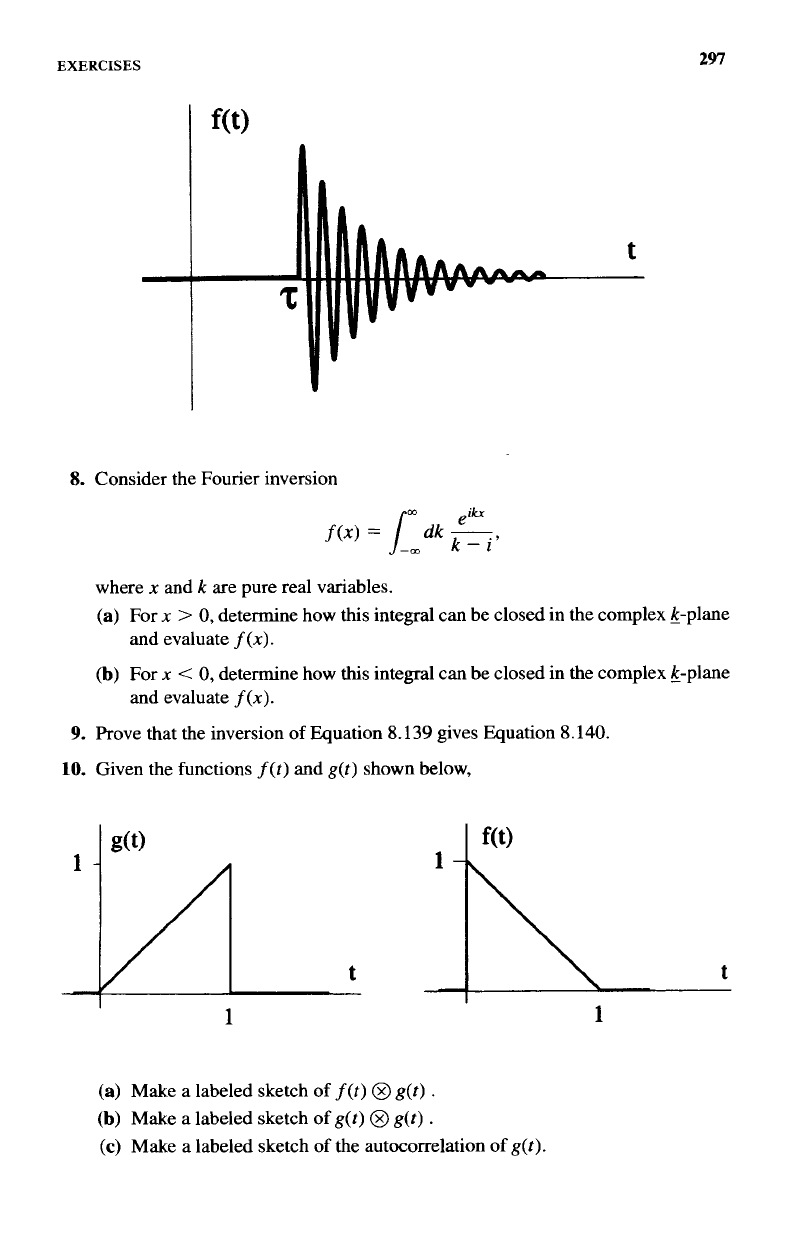
EXERCISES
8.
Consider the Fourier inversion
eikx
f(x)
=
s_m_dk
-
k-i’
where
x
and
k
are pure real variables.
(a)
For
x
>
0,
determine how this integral can be closed in the complex &-plane
(b)
For
x
<
0,
determine how
this
integral can be closed in the complex &-plane
and evaluate
f(x).
and evaluate
f(x).
9.
Prove that the inversion of Equation
8.139
gives Equation
8.140.
10.
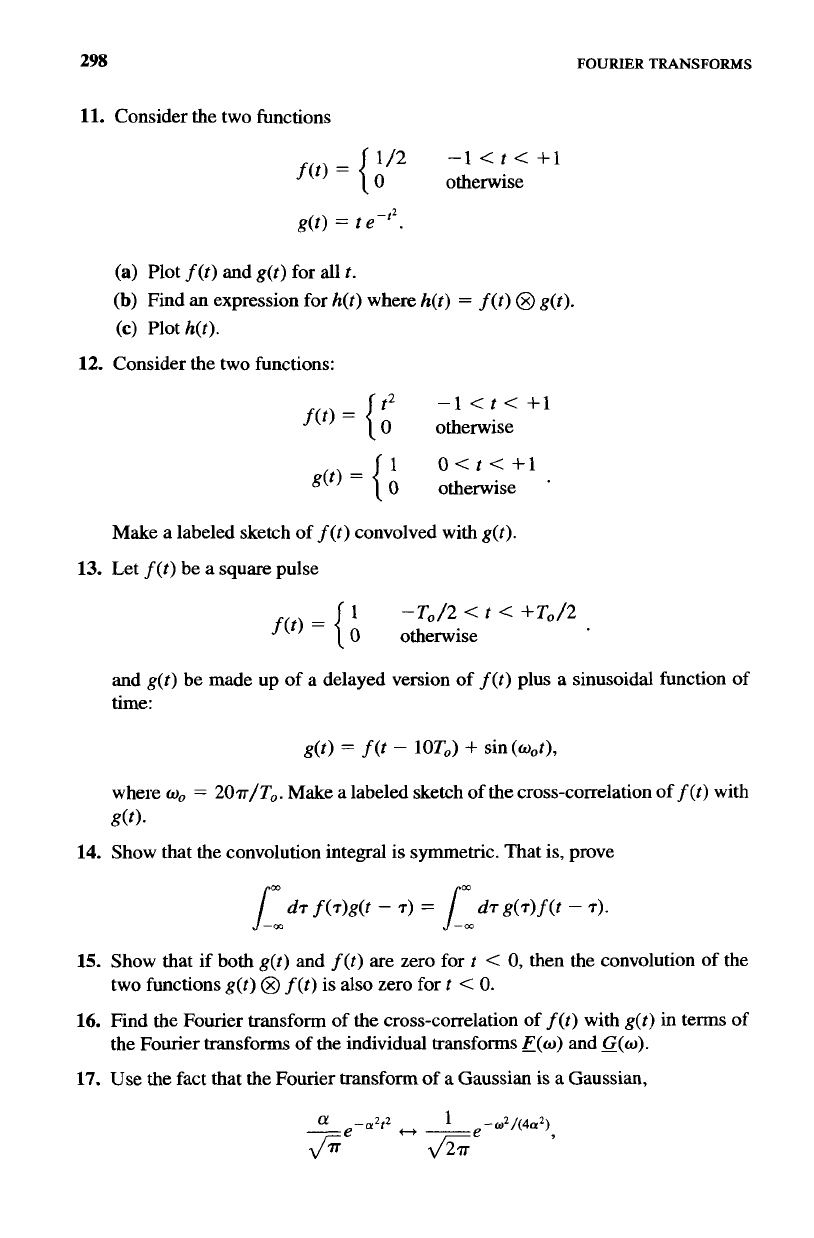
Given the functions
f(t)
and
g(t)
shown below,
(a)
Make a labeled sketch
of
f(t)
@
g(t)
.
(b)
Make a labeled sketch
of
g(t)
@
g(t)
.
(c)
Make a labeled sketch
of
the autocorrelation of
g(t).
298
FOURIER
TRANSFORMS
11.
Consider the two functions
-1
<
t
<
+1
otherwise
g(t>
=
t
e-12.
(a)
Plot
f(t)
and
g(t)
for
all
t.
(b)
Find an expression for
h(t)
where
h(t)
=
f(t)
0
g(t).
(c)
Plot
h(t).
12.
Consider the two functions:
Make a labeled sketch of
f(t)
convolved with
g(t).
13.
Let
f(t)
be a square pulse
-T0/2
<
t
+T0/2
=
{
i
otherwise
and
g(t)
be made up of a delayed version of
f(t)
plus a sinusoidal function of
time:
g(t)
=
f(t
-
lOT,)
+
sin(w,t),
where
w,
=
207r/T,.
Make a labeled sketch of the cross-correlation of
f(t)
with
m.
14.
Show that the convolution integral is symmetric. That is, prove
1:
dT
f(Mt
-
7)
=
dT
g(T)f(t
-
7).
1:
15.
Show that if both
g(t)
and
f(t)
are zero for
t
<
0,
then the convolution of the
two functions
g(t)
0
f(t)
is
also
zero for
t
<
0.
16.
Find the Fourier transform of
the
cross-correlation of f(t) with
g(t)
in terms of
the Fourier transforms of the individual transforms
F(w)
and
G(w).
17.
Use the fact that the Fourier transform of a Gaussian is a Gaussian,
EXERCISES
299
to evaluate the integral
1"
h(t)
=
-
~
1"
dr
e-'
e-(t-T'2.
On a single graph plot
h(t)
and
Ft2.
below.
18.
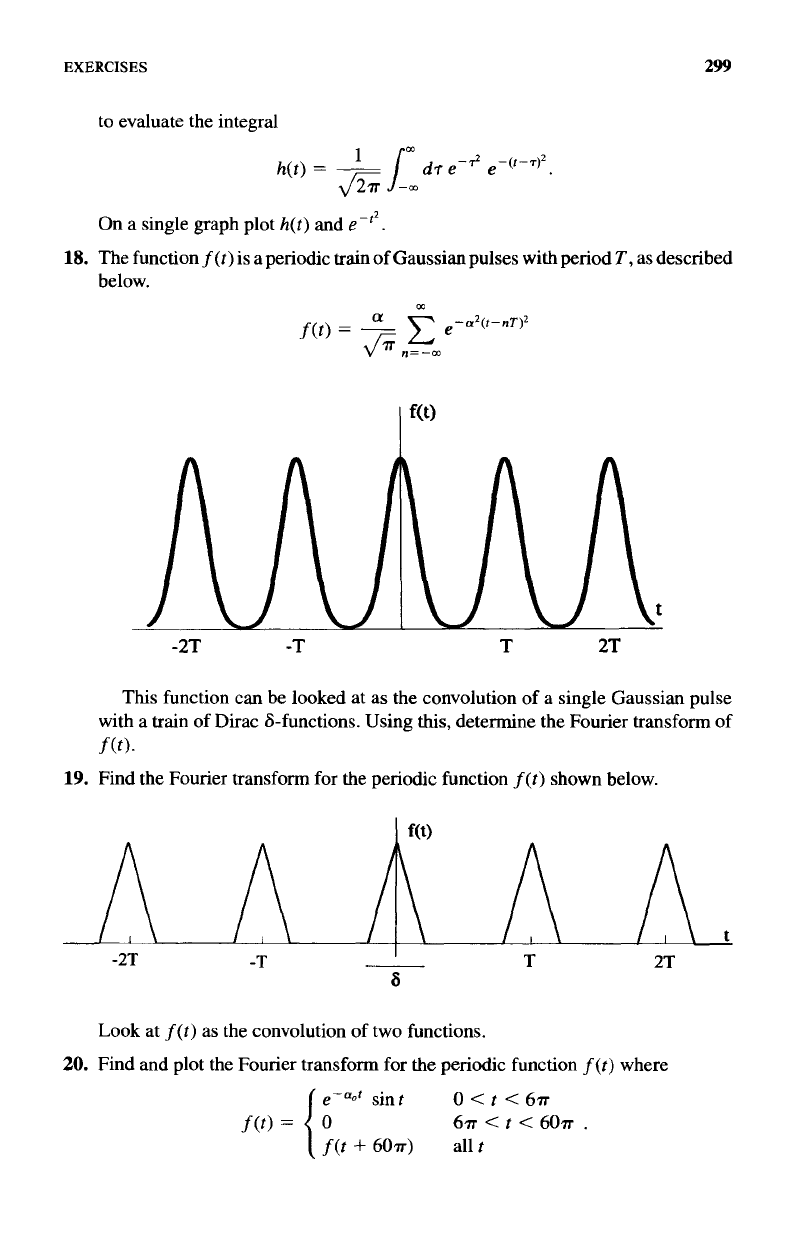
The function
f(t)
is
a periodic train of Gaussian pulses with period
T,
as described
m
t
-2T
-T
T
2T
This
function can be looked at as the convolution of a single Gaussian pulse
with a
train
of Dirac &functions. Using
this,
determine the Fourier transform of
f(t).
19.
Find the Fourier transform for the periodic function
f(t)
shown below.
I
-2T
-T
T
2T
6
Look
at f(t) as the convolution of two functions.
20.
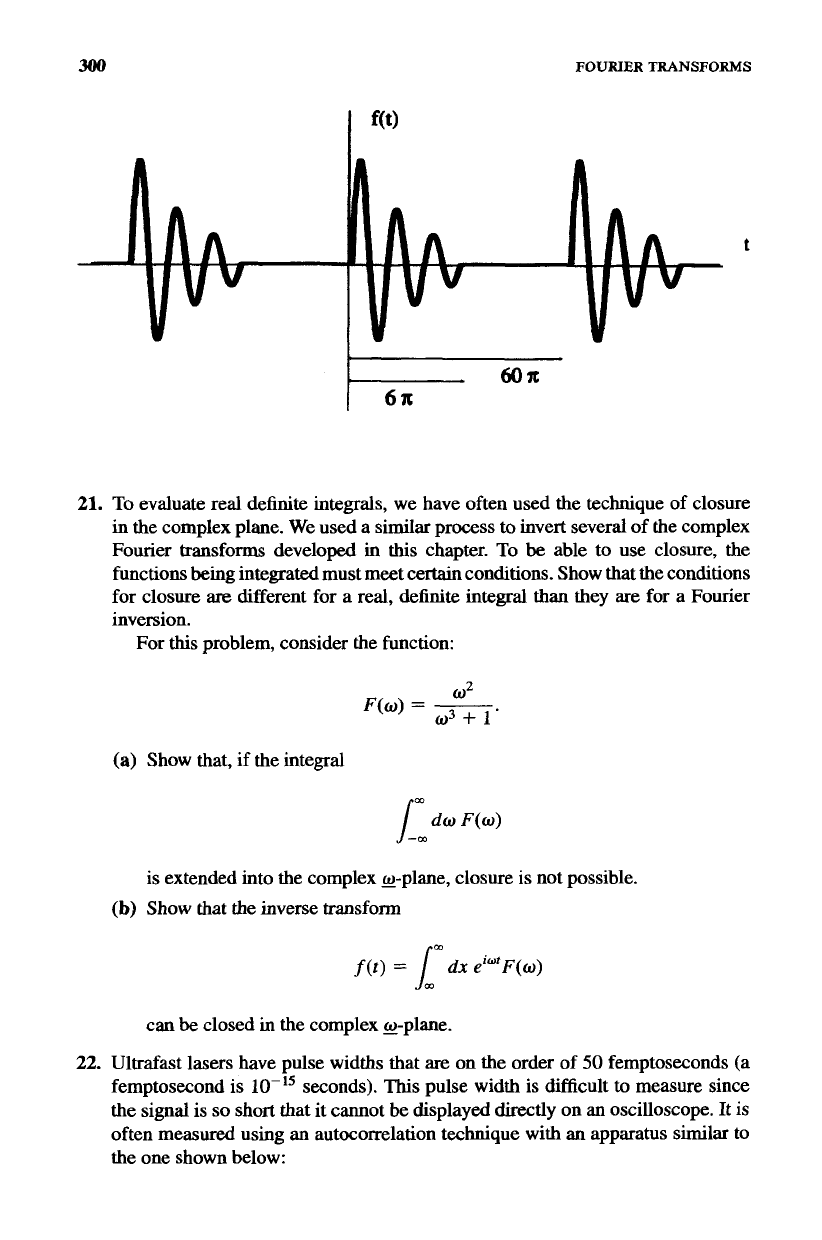
Find and plot the Fourier transform for the periodic function
f(t)
where
e-"J
sint
f
(t
+
60~)
0
<
t
<
67r
67r
<
t
<
607r
.
all t
FOURIER
TRANSFORMS
21.
To
evaluate real definite integrals, we have often used the technique of closure
in
the complex plane. We used a similar process to invert several
of
the complex
Fourier transforms developed in
this
chapter.
To
be
able to use closure, the
functions
being
integrated must meet
certain
conditions. Show that the conditions
for closure
are
different
for
a real, definite integral than they are for a Fourier
inversion.
For
this
problem, consider the function:
02
F(0)
=
-
03
+
1'
(a)
Show that, if the integral
is
extended into the complex g-plane, closure
is
not possible.
(b)
Show that the inverse transform
f(t)
=
Lrn
dx
eim'F(o)
can
be
closed in the complex g-plane.
22.
Ultrafast lasers have pulse widths that are on the order of
50
femptoseconds
(a
femptosecond is seconds).
This
pulse width is difficult to measure since
the
signal
is
so
short that it cannot be displayed directly on
an
oscilloscope.
It
is
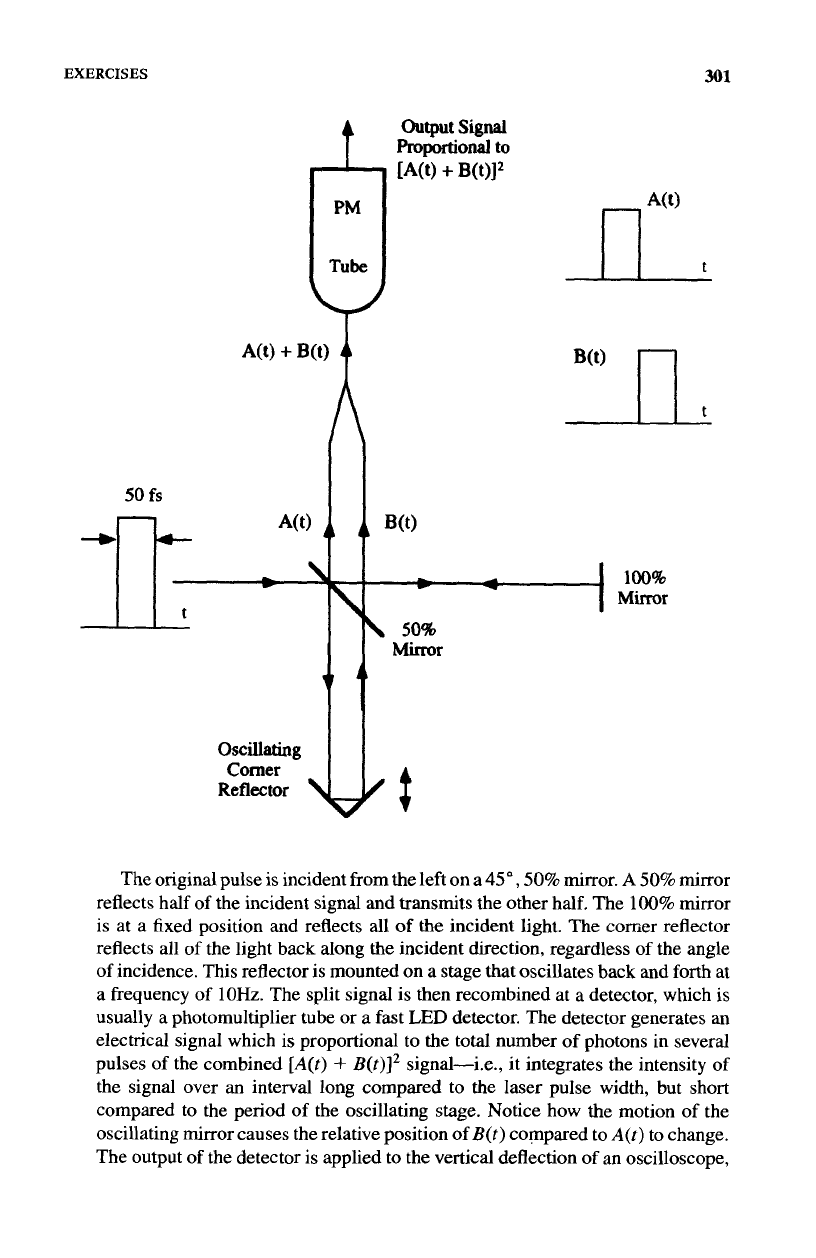
often measured using an autocorrelation technique with
an
apparatus similar
to
the one shown below:
EXERCISES
Output
Signal
t
Rowrtion~
to
301
oscillating
Comer
Reflector
The original pulse is incident from the left on a
45
',
50%
mirror.
A
50%
mirror
reflects half of the incident signal
and
transmits the other
half.
The
100%
mirror
is at
a
fixed position and reflects
all
of the incident light.
The
comer reflector
reflects
all
of
the
light back along the incident direction, regardless
of
the angle
of
incidence. This reflector is mounted on
a
stage that oscillates back and forth at
a frequency
of
10Hz.
The split signal is then recombined at a detector, which is
usually a photomultiplier tube or a fast
LED
detector. The detector generates an
electrical signal which is proportional to the total number of photons in several
pulses of the combined
[A(t)
+
B(t)J2
signal-i.e., it integrates the intensity
of
the signal over an interval long compared to the laser pulse width, but
short
compared to the period
of
the oscillating stage. Notice how the motion
of
the
oscillating mirror causes the relative position of
B(t)
compared to
A(t)
to change.
The output of the detector is applied to the vertical deflection of an oscilloscope,
302
FOURIER
TRANSFORMS
while the signal that drives the position
of
the comer reflector is applied
to
the
horizontal deflection.
(a)
How
far
does light travel
in
50
fs?
For red light, how many oscillations
of
the electric field occur
in
50
fs?
(b)
Assume a
train
of
50
fs
pulses is incident on
this
device, and one pulse is
separated
from
the next
by
0.01
ps.
Assuming the motion
of
the oscillating
reflector and the display
of
the oscilloscope
are
adjusted
so
the
B(t)
signal
moves from
200
fs
before
A(t)
to
200
fs
after
A(t),
what does the trace on
the oscilloscope
look
like?
To
keep things simple, assume the pulse shape is
square.
(c)
How should the
100%
mirror and the corner reflector be positioned with
respect to the
50%
mirror
so
that the operation in part (b) above is obtained?
(d)
How
is
the width of the signal on the oscilloscope related
to
the pulse width
of
the incident signal? Treat the motion
of
the reflector
as
linear in time in
the region where the two signals overlap.
LAPLACE
TRANSFORMS
n
this chapter, the Laplace transform is developed as a modification of the Fourier
ransform. The Laplace transform extends the realm of functions which can be trans-
ormed to include those which do not necessarily decay to zero as the independent
rariable grows to infinity. This is accomplished by introducing an exponentially de-
:aying term in the transform operation. The inverse Laplace operation can be viewed
is
a modification of the inverse Fourier transform, with the Fourier contour moved
~ff
the real w-axis into the complex @-plane.
B.1
LIMITS
OF
THE
FOURIER
TRANSFORM
We can motivate the development of the Laplace transform by examining a func-
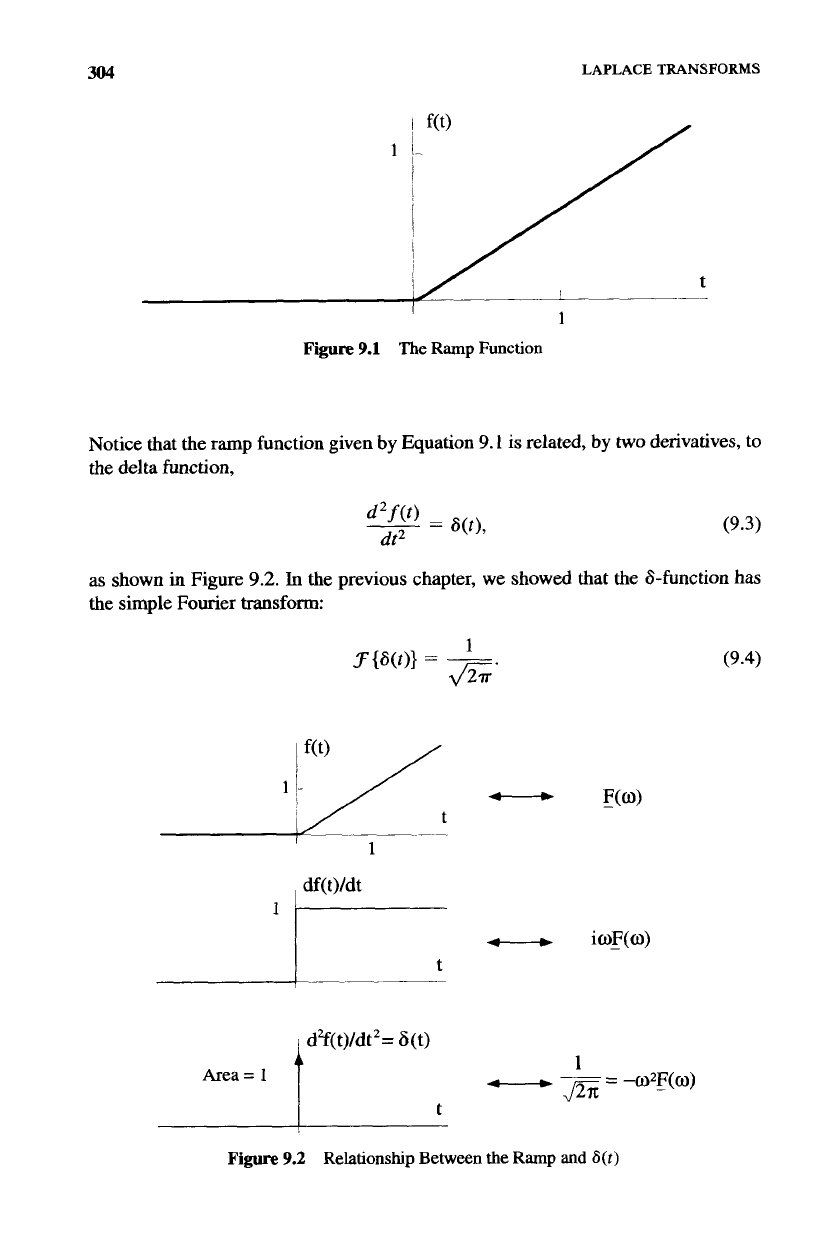
ion which clearly has no Fourier transform. Consider the ramp function shown in
3gure 9.1 and described
by
rhis function does not go to zero as
t
goes to infinity and thus does not have a Fourier
ransform.
However, from the previous chapter, we
know
that
a
derivative operation in the
ime domain is equivalent to multiplication by the factor of
iw
in the transformed
requency domain. In other words,
(9.2)
303
304
LAPLACE
TRANSFORMS
I
1
t
__
I
1
Figure
9.1
The Ramp
Function
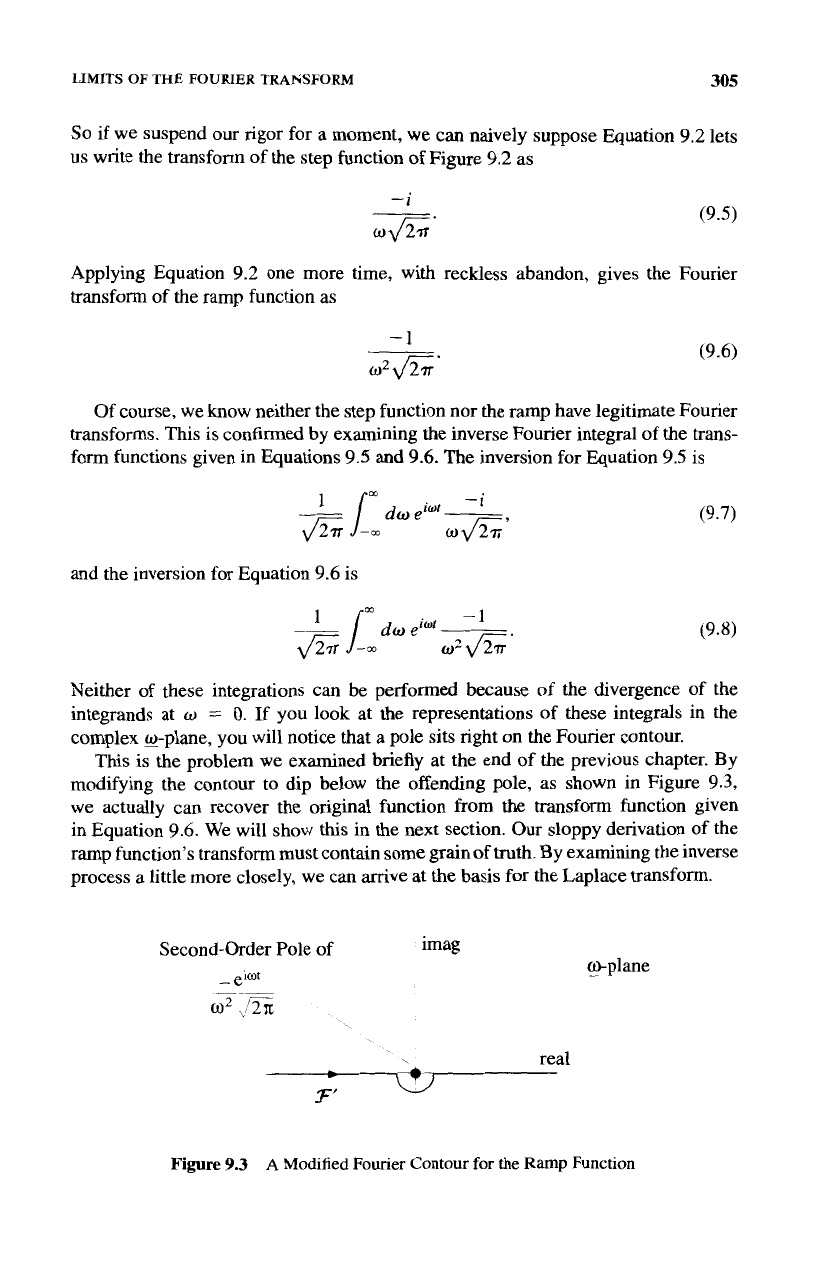
Notice that the ramp function given
by
Equation
9.1
is
related,
by
two derivatives, to
the delta function,
(9.3)
as
shown
in
Figure
9.2.
In
the previous chapter, we showed that the &function has
the simple Fourier transform:
1
df(t)/dt
i
d?(t)/dt2= 6(t)
1
Area=
1
1
-
~=-"'"Cw)
Figure
9.2
Relationship Between
the
Ramp
and
a(?)
(9.4)
305
LIMITS
OF
THE
FOURIER
TRANSFORM
So
if
we suspend
our
rigor for a moment, we can naively suppose Equation
9.2
lets
us write the transform of the step function
of
Figure 9.2 as
-i
wfi'
(9.5)
Applying Equation 9.2 one more time, with reckless abandon, gives the Fourier
transform of the ramp function as
-1
w2J2.rr'
(9.6)
Of course, we know neither the step function nor the ramp have legitimate Fourier
transforms. This is confirmed by examining the inverse Fourier integral of the
trans-
form functions given in Equations
9.5
and
9.6.
The inversion for Equation
9.5
is
and the inversion
for
Equation 9.6 is
(9.7)
Neither
of
these integrations can be performed because of the divergence of the
integrands at
w
=
0.
If
you
look
at the representations of these integrals in the
complex 9-plane, you will notice that a pole sits right on the Fourier contour.
This is the problem we examined briefly at the end of the previous chapter. By
modifying the contour
to
dip below the offending pole, as shown in Figure
9.3,
we actually can recover the original function
from
the transform function given
in Equation
9.6.
We will show
this
in the next section. Our sloppy derivation of the
ramp function's transform must contain some grain
of
truth. By examining the inverse
process a little more closely, we can
arrive
at the basis
for
the Laplace transform.
Second-Order Pole of imag
elcot
g-plane
o2
/-
\
2n
-
\
real
-
A
-
3
Figure
9.3
A
Modified Fourier Contour
for
the
Ramp
Function