
Kusse B.R., Westwig E.A. Mathematical Physics: Applied Mathematics for Scientists and Engineers
Подождите немного. Документ загружается.

306
LAPLACE
TRANSFORMS
9.2
THE
MODIFIED
FOURIER TRANSFORM
In
this
section,
we
show how the standard Fourier transform can be modified by
moving
the
inversion contour
off
the real axis. With
this
approach, we can transform
functions that would not normally possess valid Fourier transforms. We start with
some of the ideas introduced at the end of the previous chapter.
9.2.1
The
Modified
Transform
Pair
In
the previous section, we indicated that the ramp function of Equation 9.1 could be
recovered from the transform given in Equation
9.6
using
an
inversion integral
(9.9)
on the modified contour
y'
shown in Figure 9.3.
This
contour lies along the real
0-
axis, except at the origin where
it
dips below the pole. The discussion
of
the previous
chapter shows that we
can
use closure in the upper half gplane for
t
>
0,
and in the
lower half for
t
<
0.
Then, using the residue theorem, it
is
easy to show that
t<O
f(t){
P
t>O
(9.10)
The ramp is recovered by integrating the function given in Equation 9.6 along the
modified Fourier contour
7'.
This, however,
is
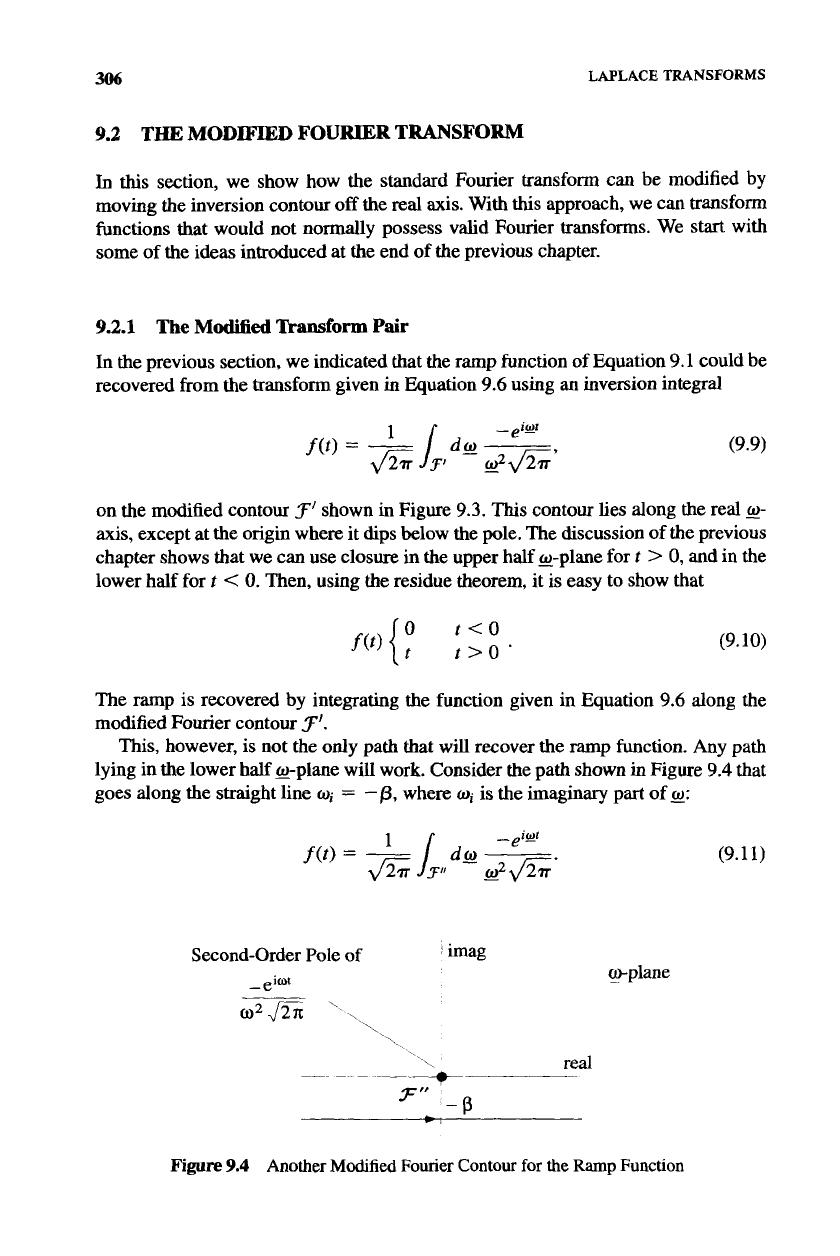
not the only path that will recover the ramp function. Any path
lying in the lower
half
@-plane will work. Consider
the
path shown in Figure
9.4
that
goes along the straight line
oi
=
-p,
where
oi
is
the
imaginary part
of
g:
Second-Order Pole
of
'
imag
-
w2Jiii
\\
\-\
\
(9.1
1)
%plane
Figure
9.4
Another
Modified
Fourier
Contour
for
the
Ramp Function
THE
MODIFIED
FOURIER
TRANSFORM
307
Second-Order Pole
@-plane
',
3
real
-
c
Figure
9.5
Inversion for
the
Ramp Function
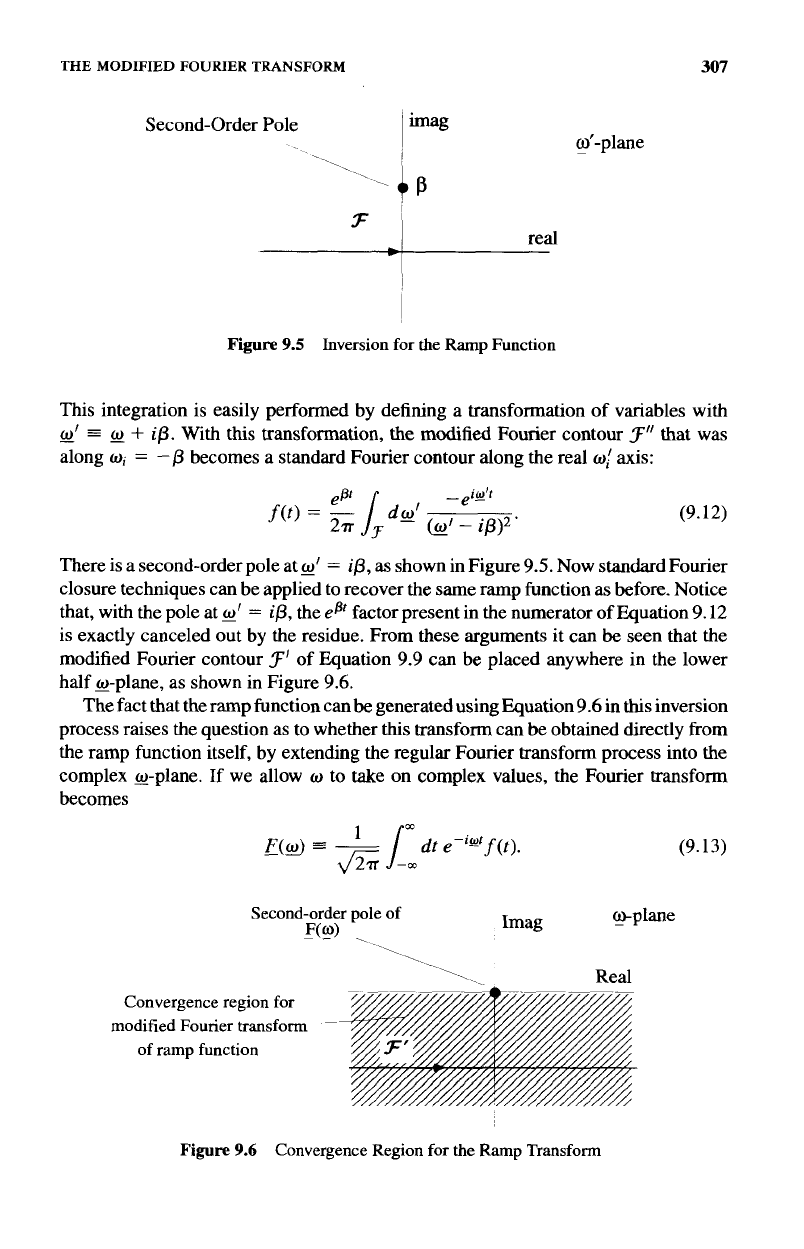
This integration is easily performed by defining a transformation of variables with
-
w'
=
g
+
ip.
With this transformation, the modified Fourier contour
Y"
that was
along
wi
=
-p
becomes a standard Fourier contour along the real
wi
axis:
(9.12)
There is a second-order pole at
g'
=
ip,
as
shown in Figure 9.5. Now standard Fourier
closure techniques can be applied to recover the same ramp function as before. Notice
that, with the pole at
g'
=
ip,
the
ep'
factor present in the numerator of Equation 9.12
is exactly canceled out by the residue. From these arguments it can
be
seen that the
modified Fourier contour
Y'
of Equation
9.9
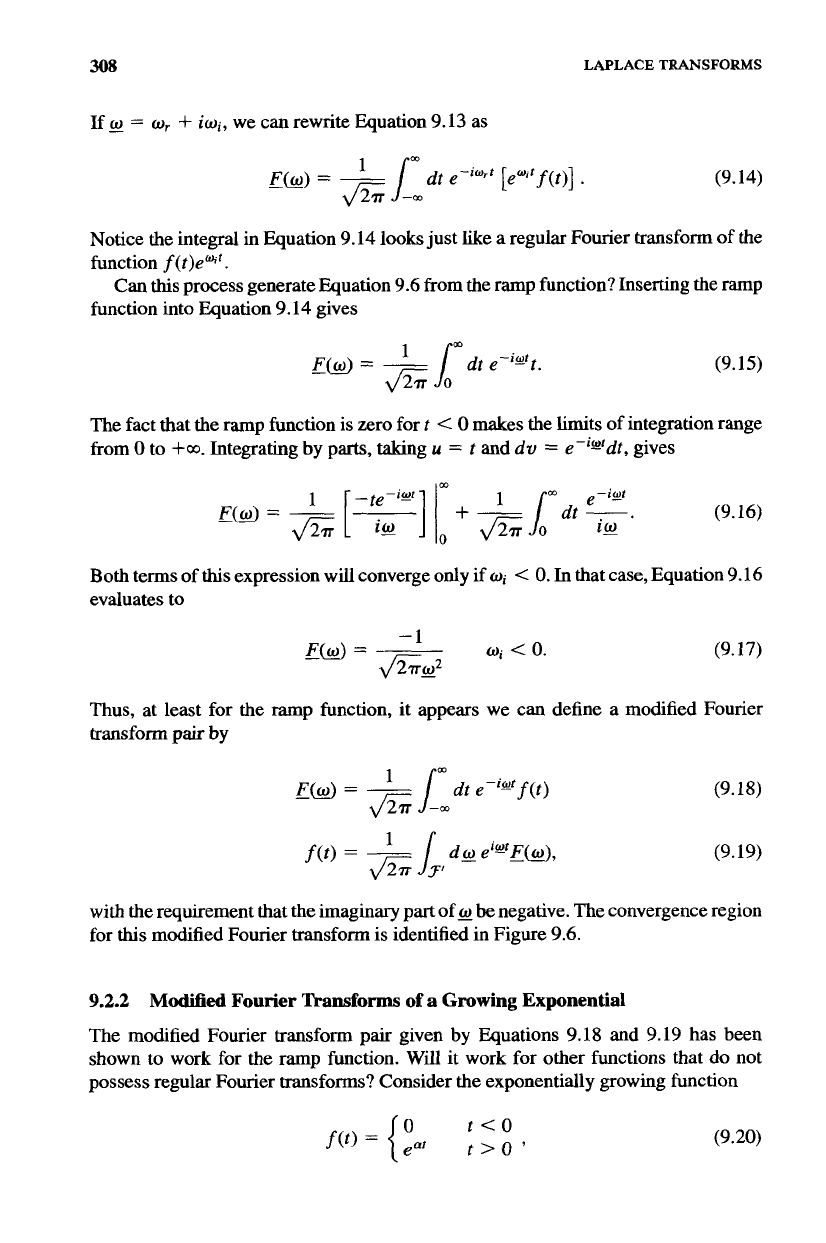
can be placed anywhere in the lower
half g-plane, as shown in Figure 9.6.
The fact that the ramp function can
be
generated using Equation 9.6
in
this
inversion
process raises the question as to whether
this
transform can be obtained directly from
the ramp function itself, by extending the regular Fourier transform process into the
complex g-plane.
If
we allow
w
to take on complex values, the Fourier transform
becomes
Second-order pole of
~
F(w)
,
-\
Imag
..
-,
'..
Real
Convergence region for
modified
Fourier
transform
-
of
ramp function
(9.13)
g-plane
Figure
9.6
Convergence Region for
the
Ramp
Transform
308
LAPLACE
TRANSFORMS
If
g
=
or
+
ioi,
we can rewrite Quation 9.13 as
(9.14)
Notice the integral in Equation 9.14 looks just like a regular Fourier transform of the
function
f(t)eW'.
Can
this
process generate Equation 9.6 from the ramp function? Inserting the ramp
function into Equation 9.14 gives
(9.15)
The fact that the ramp function
is
zero for
t
<
0
makes the
limits
of integration range
from
0
to
+co.
Integrating by
parts,
taking
u
=
t
and
dv
=
e-'*'dt,
gives
Both terms of
this
expression will converge
only
if
oi
<
0.
In that case, Equation 9.16
evaluates to
(9.17)
Thus, at least for the ramp function, it appears we can define a modified Fourier
transform pair by
1
f(t)
=
-
/
dg
eio'F@,
J2.I.
F'
(9.18)
(9.19)
with the requirement that the imaginary
part
of
0
be negative. The convergence region
for
this
modified Fourier transform is identified in Figure 9.6.
9.2.2
Modified
Fourier
Transforms
of
a Growing Exponential
The modified Fourier transform pair given by Equations 9.18
and
9.19 has been
shown to work for the ramp function. Will it work for other functions that
do
not
possess regular Fourier
transforms?
Consider the exponentially growing function
(9.20)
THE
MODIFIED
FOURIER TRANSFORM
309
imag @-plane
real
Pole
of
F(o)
~-
‘-
.T
I-
\
-a
I
-1
..
1.
Convergence
region
for
modified
Fourier
transform
Figure
9.7
Convergence Region for
Modified
Fourier
Transform
of
the Exponential Function
where
a
is a positive, real number. When this function is inserted into the modified
transform of Equation 9.18, you can easily show, as long as
oi
<
-a,
that
(9.21)
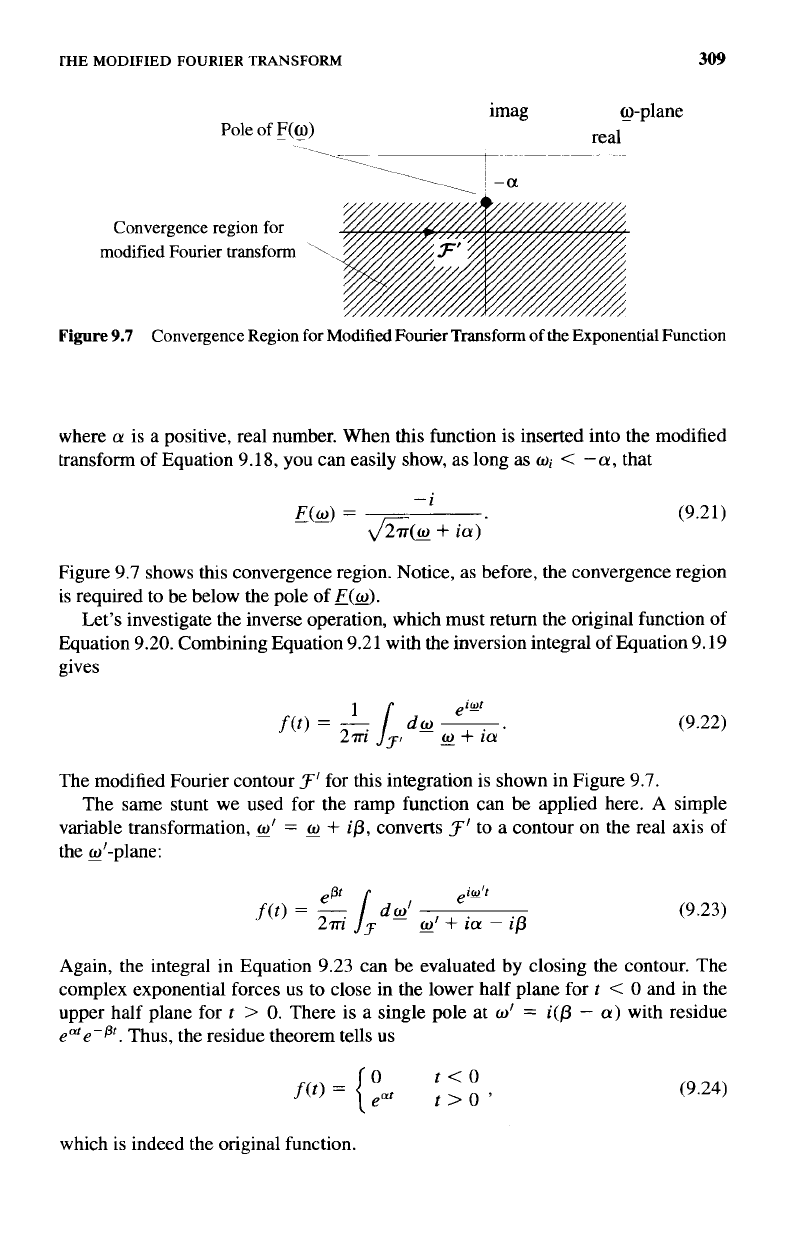
Figure 9.7 shows this convergence region. Notice, as before, the convergence region
is
required to be below the pole of
E(&.
Let’s investigate the inverse operation, which must return the original function of
Equation 9.20. Combining Equation 9.21 with the inversion integral of Equation 9.19
gives
(9.22)
The modified Fourier contour
y’
for this integration is shown in Figure 9.7.
The same stunt we used for the ramp function can be applied here. A simple
variable transformation,
0’
=
g
+
ip,
converts
y’
to a contour on the real axis of
the g’-plane:
(9.23)
Again, the integral in Equation 9.23 can be evaluated by closing the contour. The
complex exponential forces us to close in the lower half plane for
t
<
0
and in the
upper half plane for
t
>
0.
There is a single pole at
w’
=
i(p
-
a)
with residue
Pe-6‘.
Thus. the residue theorem tells
us
(9.24)
which is indeed the original function.
310
LAPLACE
TRANSFORMS
9.2.3
Closure
for
Contours
off
the
Real Axis
In the previous two examples, we made a variable change from
0
to
g’,
so
the
F‘
contour was changed into a contour along the real axis. The only reason we
did
this
was
so
we could use the standard arguments developed in Chapters
6
and
8
to show
the
contribution
of
the closing contour was zero. Actually,
this
step
is
not necessary. We can close directly in the g-plane, if we analyze the contribution
from the closing contour
a
little
more carefully.
This
is more work than the variable
transformation approach, but once
this
general argument
is
understood, it simplifies
the whole process.
To
see how
this
works, let’s return to the specific integration of Equation 9.22. For
t
<
0,
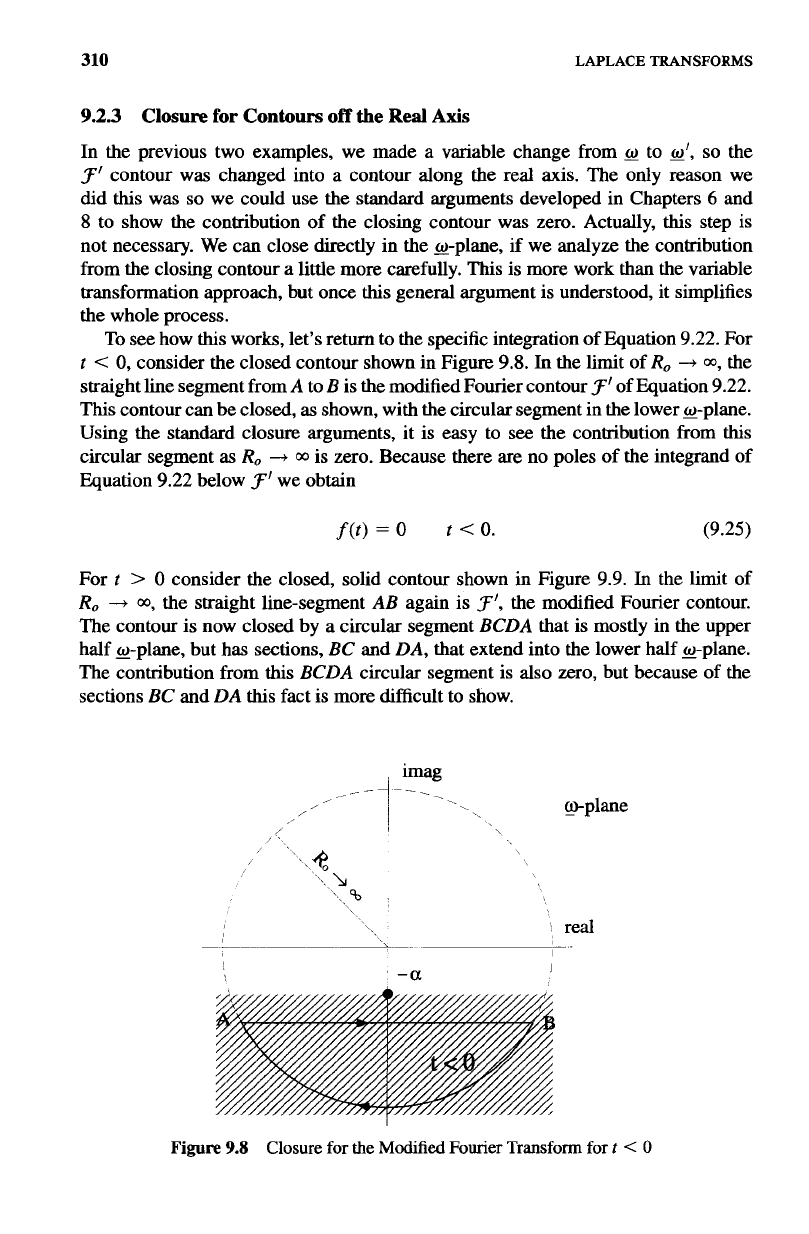
consider the closed contour shown in Figure 9.8.
In
the
limit of
Ro
--+
00,
the
straight line segment from
A
to
B
is
the
modified Fourier contour
F’
of Equation 9.22.
This contour can be closed,
as
shown, with the circular segment in
the
lower @-plane.
Using the standard closure arguments, it
is
easy to
see
the contribution from
this
circular segment
as
R,
+
03
is zero. Because there
are
no poles of the integrand
of
Equation 9.22 below
S’
we obtain
f(t)
=
0
t
<
0.
(9.25)
For
t
>
0
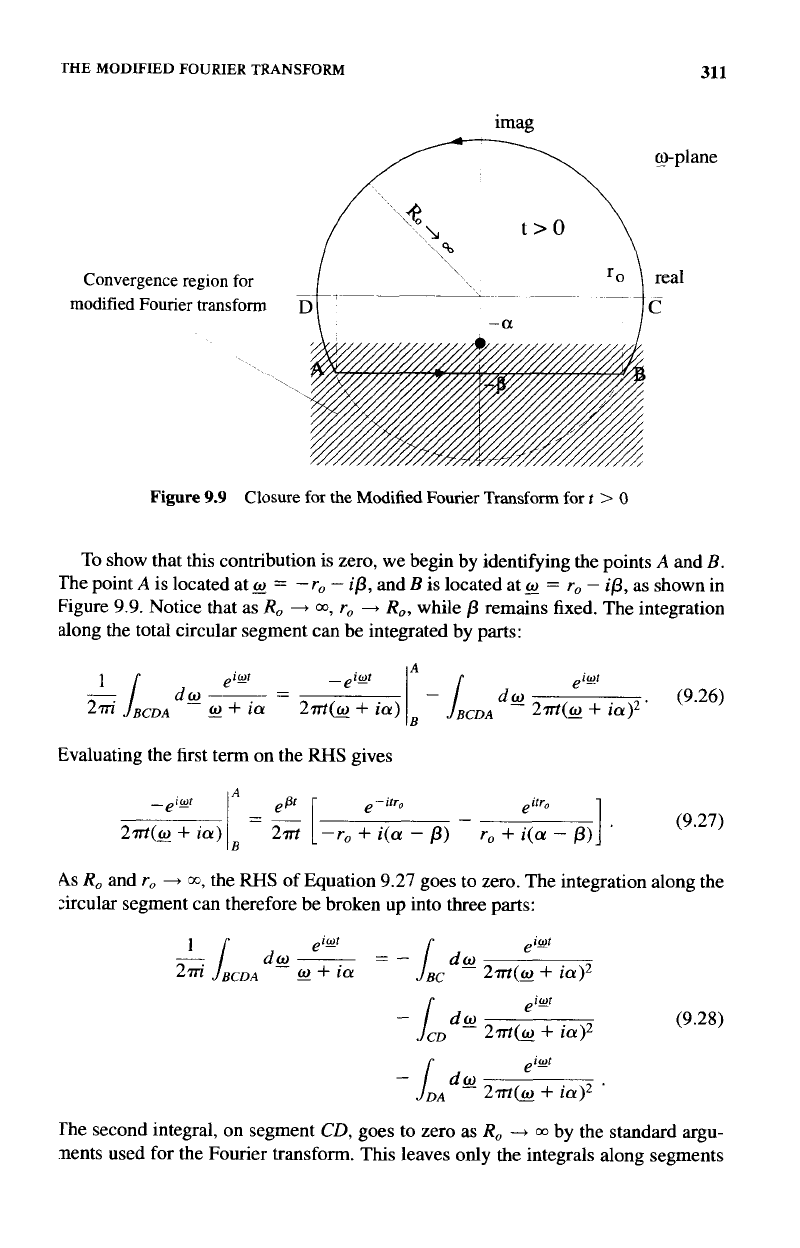
consider the closed, solid contour shown
in
Figure 9.9.
In
the limit of
R,
-+
00,
the straight line-segment
AB
again is
Y’,
the modified Fourier contour.
The contour is now closed by a circular segment
BCDA
that
is
mostly in the upper
half &-plane, but has sections,
BC
and
DA,
that extend into the lower half g-plane.
The contribution from
this
BCDA
circular segment is
also
zero, but because of the
sections
BC
and
DA
this
fact is more difficult to show.
g-plane
real
Figure
9.8
Closure for the
Modified
Fourier Transform for
t
<
0
311
THE MODIFIED FOURIER TRANSFORM
imag
Convergence region for
modified Fourier transform
Figure
9.9
Closure for the
Modified
Fourier Transform for t
>
0
To show that this contribution is zero, we begin by identifying the points
A
and
B.
The point
A
is located at
0
=
-
r,
-
ip,
and
B
is located at
g
=
r,
-
ip,
as shown in
Figure 9.9. Notice that as
R,
+
00,
r,
+
R,,
while
p
remains fixed. The integration
along the total circular segment can
be
integrated by parts:
Evaluating the first term on the
RHS
gives
As
R,
and
r,
+
a,
the
RHS
of
Equation 9.27 goes to zero. The integration along the
ircular segment can therefore be broken up into
three
parts:
igt
de-
-
The second integral, on segment
CD,
goes to zero
as
R,
-+
00
by the standard argu-
nents used for the Fourier transform.
This
leaves only the integrals along segments
312
imag
LAPLACE
TRANSFORMS
0
real
Figure
9.10
Closure
of
a
Modified
Fourier
Contour
BC
and
DA.
Consider the
BC
segment.
If
g
=
or
+
iwi,
everywhere along
this
segment
w,
2
r,
and
oi
2
-/3.
This
implies
eit(iJ&
+hi)
ept
eigt
1
E*
(9.29)
As
R,
4
a,
the integrand is dropping
off
as
1/R:
while the path length is limited
to a length of
/3.
Consequently, as
R,
---f
to,
the contribution from the
BC
section,
for any fixed value oft, goes to zero. The same arguments can be made
for
the
DA
section. Therefore, for t
>
0,
the integration along the circular segment
BCDA
goes
to
zero and we can close the contour. The pole at
9
=
-ia
is inside the contour
of
Figure
9.9,
and the residue theorem gives
1
@
+
ia)2
1
=
I
[wr
+
i(a
+
f(t)
=
eat
t
>
0.
(9.30)
To
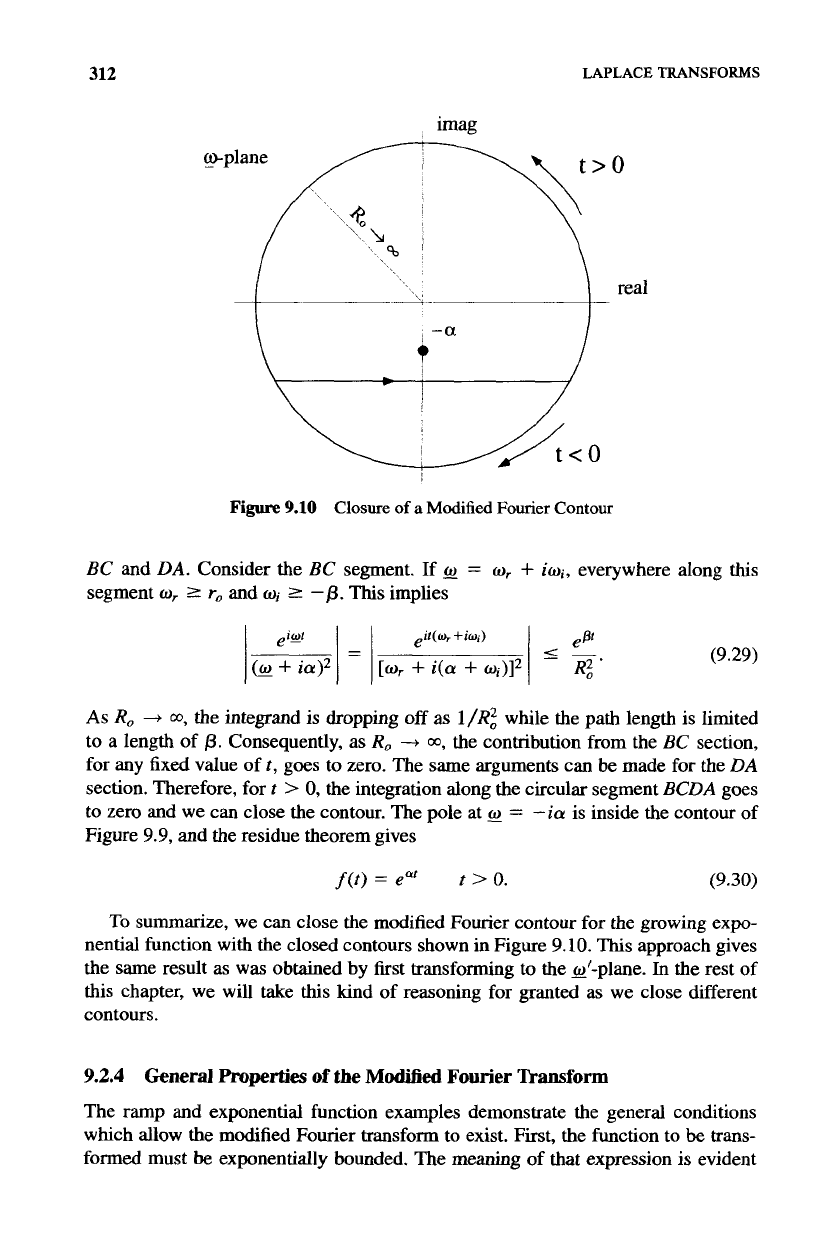
summarize, we
can
close the modified Fourier contour
for
the growing expo-
nential function with the closed contours shown
in
Figure
9.10.
This
approach gives
the same result as was obtained by first transforming to the @‘-plane.
In
the rest
of
this chapter, we will take
this
kind of reasoning for granted as we close different
contours.
9.2.4
General
Properties
of
the
Modified
Fourier
Transform
The ramp and exponential function examples demonstrate the general conditions
which allow the modified Fourier transform to exist. First, the function to
be
trans-
formed must
be
exponentially bounded. The meaning of that expression is evident
THE
LAPLACE
TRANSFORM
313
from looking at Equation
9.14.
It must be possible to find an
wi
such that
ewir
f
(t)
goes
to zero as
t
goes to infinity. If this is the case, the function
e"'f(t)
will have a regular
Fourier transform. Second, the function we want to transform must be zero for
t
<
0.
Actually, it is quite easy to develop the modified Fourier transform arguments
so
that
f(t) must be zero for all
t
<
to,
where to is any real number.
You
can explore this
idea further in one of the exercises at
the
end of
this
chapter.
The modified Fourier transform of Equation
9.18
will always exist for values of
-
w
with imaginary parts less than the imaginary parts of
all
the poles
of
Em.
This
implies the
s'
inversion contour of Equation
9.19
must also lie below all these poles.
The inversion can be accomplished by closing above the modified Fourier contour
fort
>
0
and below it for
t
<
0.
9.3
THE
LAPLACE
TRANSFORM
The standard Laplace transform is really just the modified Fourier transform we have
just discussed with a variable change and a rearrangement
of
the constants. The
variable change involves the simple complex substitution
s
=
ig.
(9.31)
Because the inversion equation is frequently evaluated using the residue theorem,
the constants are juggled around
so
the leading constant of the inversion is
1
/(2m').
With these changes, the Laplace transform pair follows directly from Equations
9.18
and
9.19:
(9.32)
(9.33)
It is implicitly assumed by the form of Equation
9.32
that f(t)
=
0
for all t
<
0.
These equations are sometimes written with a shorthand operator notation as:
F(s)
=
-w(r))
(9.34)
(9.35)
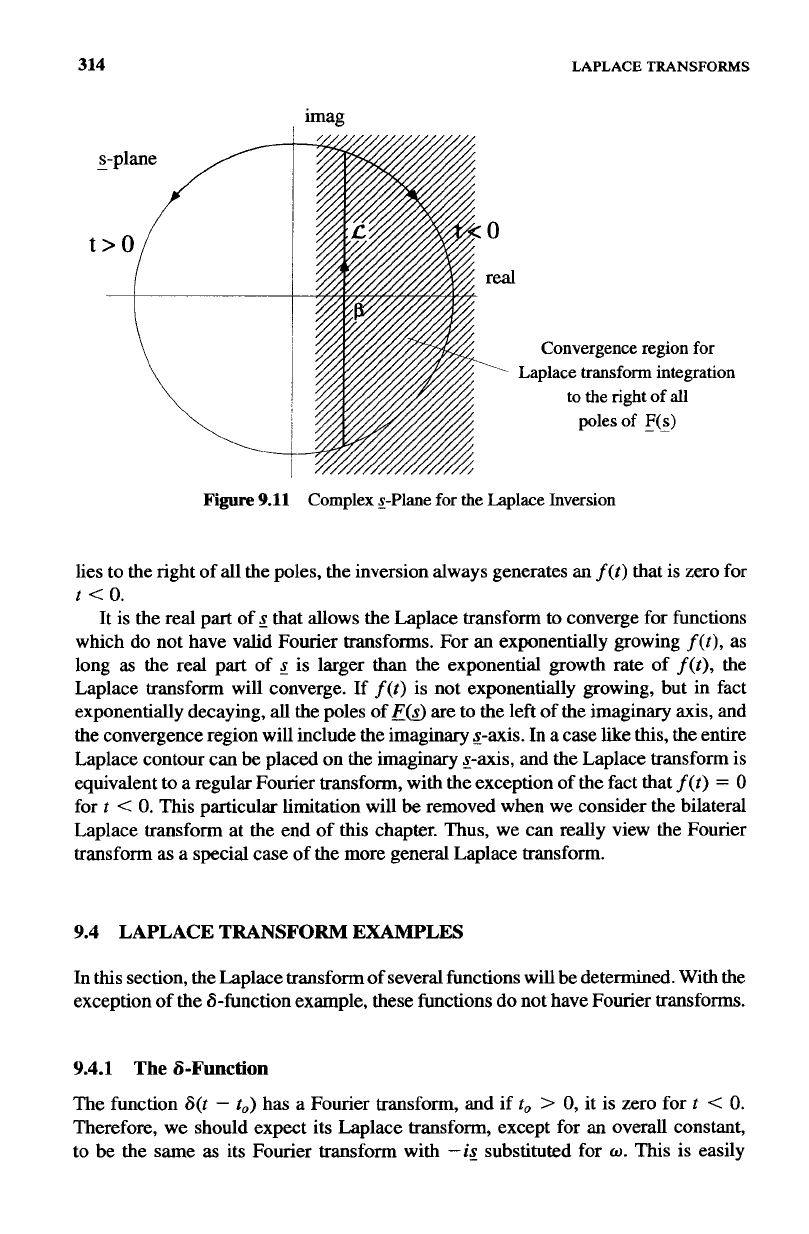
The picture of the Laplace inversion in the complex s-plane looks very much
like the pictures of the modified Fourier transform, except for a rotation of
~/2.
Figure
9.1
1
shows a typical convergence region and inversion contours. The Laplace
transform converges in the region to the right of all the poles of
E(s).
The Laplace
inversion contour
L,
which is called the Laplace or Bromwich contour, must lie
in this convergence region and extends from
g
=
p
-
i
~0
to
s
=
p
+
i
00.
The
inversion contour is almost always evaluated by closing the complex integral in
Equation
9.33.
Using similar arguments given for the modified Fourier transform, the
Laplace contour is closed to the right for
t
<
0
and to the left for t
>
0.
Because
1:
LAPLACE
TRANSFORMS
hag
314
0
real
Convergence region for
to
the
right
of
all
poles of
F(2)
'
Laplace transform integration
Figure
9.11
Complex i-Plane for
the
Laplace Inversion
lies to the right
of
all the poles, the inversion always generates an
f(t)
that
is
zero for
t
<
0.
It
is
the real part of
s
that allows the Laplace transform to converge for functions
which do not have valid Fourier transforms. For an exponentially growing
f(t),
as
long as the real part of
8
is larger than the exponential growth rate of
f(t),
the
Laplace transform will converge.
If
f(t)
is not exponentially growing, but in fact
exponentially decaying,
all
the poles of
I;@
are
to the left of the imaginary axis, and
the convergence region will include the imaginary z-axis.
In
a case like
this,
the entire
Laplace contour can be placed on the imaginary 8-axis, and the Laplace transform is
equivalent to
a
regular Fourier transform, with the exception
of
the fact that
f(t)
=
0
for
t
<
0.
This
particular limitation will
be
removed when we consider the bilateral
Laplace transform at the end
of
this
chapter.
Thus,
we can really view the Fourier
transform
as
a special
case
of the more general Laplace transform.
9.4 LAPLACE
TRANSFORM
EXAMPLES
In
this section, the Laplace transform of several functions will be determined. With the
exception of the 6-function example, these functions do not have Fourier transforms.
9.4.1
The
&Function
The function
6(t
-
to)
has a Fourier transform, and if
to
>
0,
it is zero for
t
<
0.
Therefore, we should expect
its
Laplace transform, except for an overall constant,
to be the same
as
its Fourier transform with
-is
substituted for
o.
This
is easily
LAPLACE
TRANSFORM
EXAMPLES
315
confirmed by performing the transform:
There is no limit on the real part of
g
for performing
this
integration, and therefore
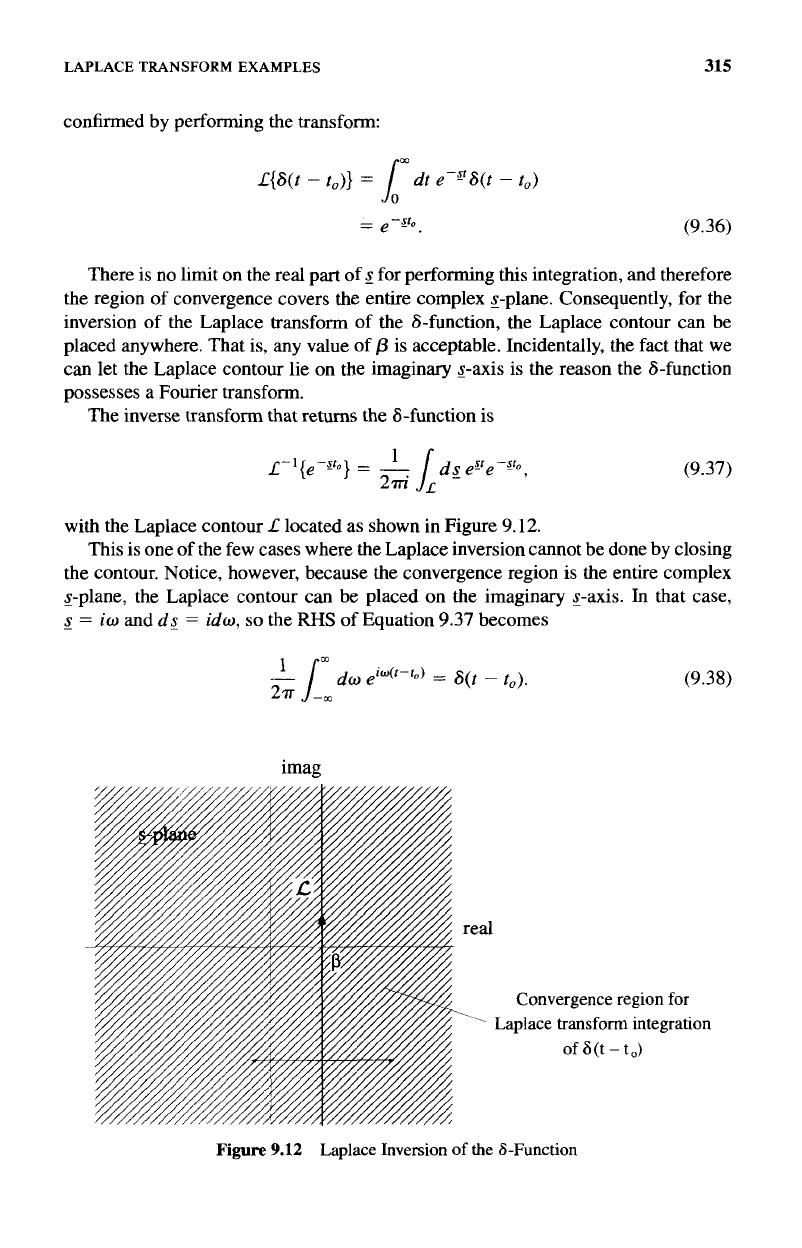
the region of convergence covers the entire complex $-plane. Consequently, for the
inversion of the Laplace transform of the &function, the Laplace contour can be
placed anywhere. That is, any value of
p
is acceptable. Incidentally, the fact that we
can let the Laplace contour lie on the imaginary z-axis is the reason the &function
possesses a Fourier transform.
The
inverse transform that returns
the
&function is
(9.37)
with the Laplace contour
L
located
as
shown in Figure 9.12.
This is one of the few cases where the Laplace inversion cannot be done by closing
the contour. Notice, however, because the convergence region is the entire complex
$-plane, the Laplace contour can be placed
on
the imaginary x-axis.
In
that case,
3
=
iw
and
dg
=
idw,
so
the
RHS
of
Equation 9.37 becomes
imag
real
(9.38)
Convergence region
for
Laplace
transform
integration
of
S(t
-
to)
Figure
9.12
Laplace Inversion
of
the &Function