
Kusse B.R., Westwig E.A. Mathematical Physics: Applied Mathematics for Scientists and Engineers
Подождите немного. Документ загружается.

336
LAPLACE
TRANSFORMS
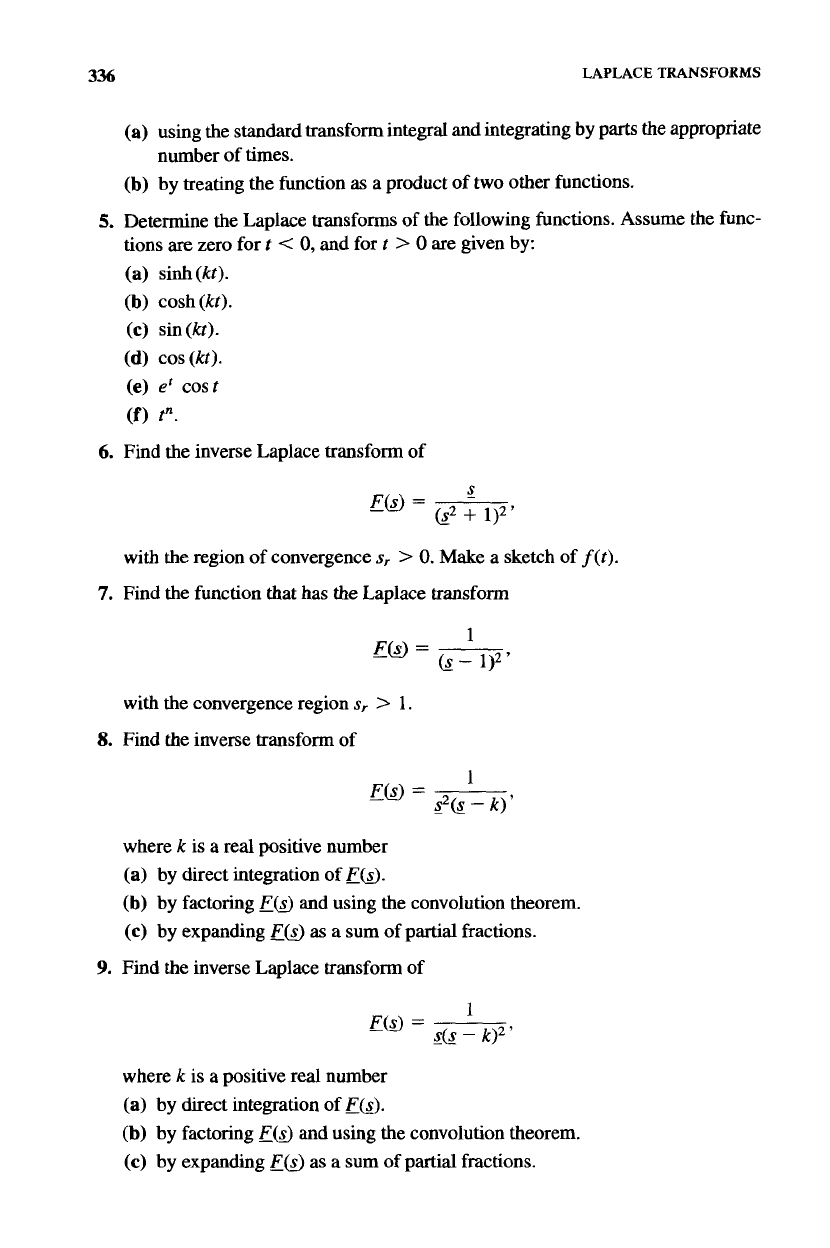
(a)
using the standard transform integral and integrating by parts the appropriate
(b)
by treating the function
as
a product of
two
other functions.
tions
are
zero for
t
<
0,
and for
t
>
0
are given by:
(a)
sinh(kt).
(b)
cosh
(kt).
(c)
sin(kt).
(d)
cos(kt).
(e)
e'
cost
(f)
t".
number of times.
5.
Determine the Laplace transforms of the following functions. Assume the func-
6.
Find the inverse Laplace transform of
with the region of convergence
s,
>
0.
Make a sketch of f(t).
7.
Find the function that has the Laplace transform
1
F(S)=---
-
6-
1)*'
with the convergence region
s,
>
1.
8.
Find the inverse transform of
1
z2(g
-
k)
'
F(sJ
=
-
where
k
is a real positive number
(a)
by direct integration of
EM.
(b)
by factoring
E(s>
and using the convolution theorem.
(c)
by
expanding
E(SJ
as
a
sum of partial fractions.
9.
Find the inverse Laplace transform of
where
k
is a positive real number
(a)
by direct integration of
EQ).
(b)
by factoring
E(sJ
and using the convolution theorem.
(c)
by expanding
as a sum of partial fractions.
EXERCISES
337
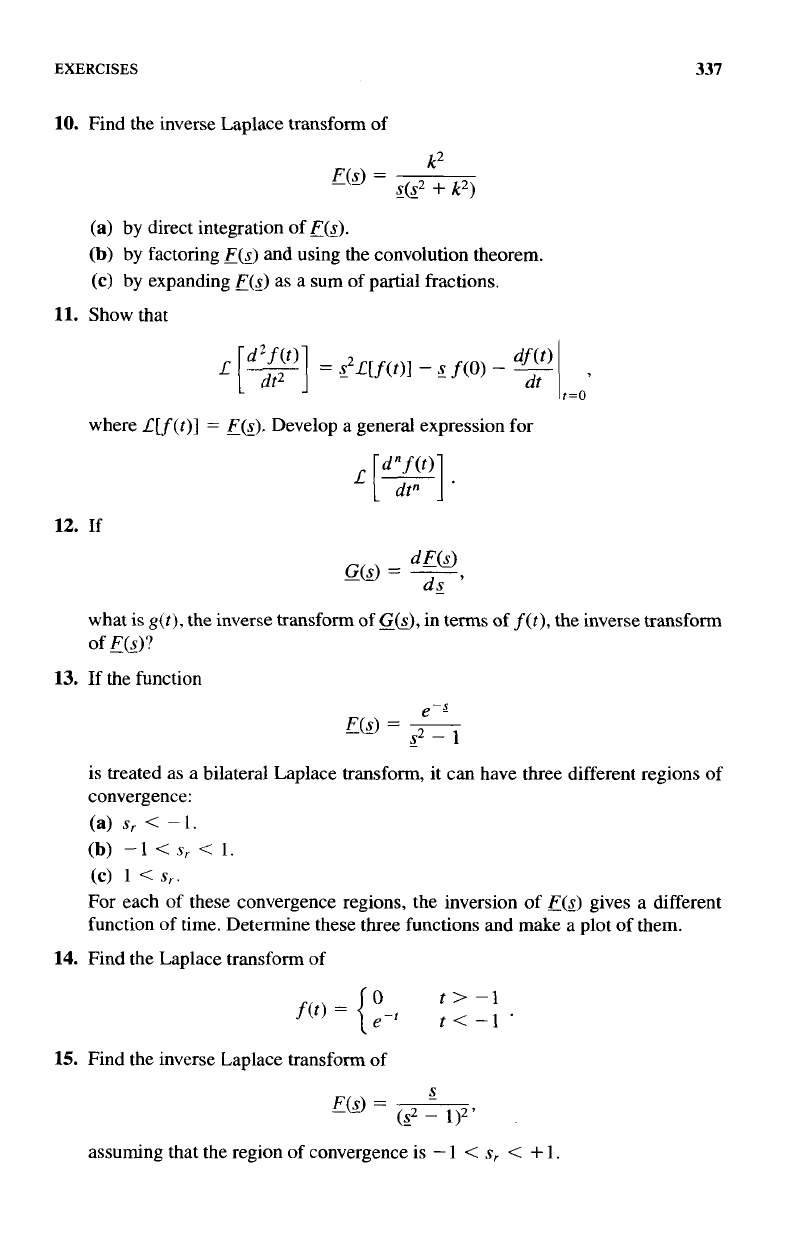
10.
Find the inverse Laplace transform of
1.2
(a)
by direct integration of
E(s).
(b)
by factoring
F(s)
and using the convolution theorem.
(c)
by expanding
F(g)
as a sum of partial fractions.
11.
Showthat
where
L[
f
(t)]
=
fe),
Develop a general expression for
.[%I.
12.
If
what
is
g(t),
the inverse transform
of
GO,
in terms
of
f(t),
the inverse transform
of
FQ)?
13.
If the function
is treated as a bilateral Laplace transform, it can have three different regions of
convergence:
(a)
s,
<
-1.
(b)
-1
<
S,
<
1.
(c)
1
<
s,.
For
each of these convergence regions, the inversion of
F(s)
gives a different
function
of
time. Determine these three functions and make a plot of them.
14.
Find the Laplace transform
of
15.
Find the inverse Laplace transform of
assuming that the region of convergence is
-
1
<
s,
<
+
1.
338
LAPLACE TRANSFORMS
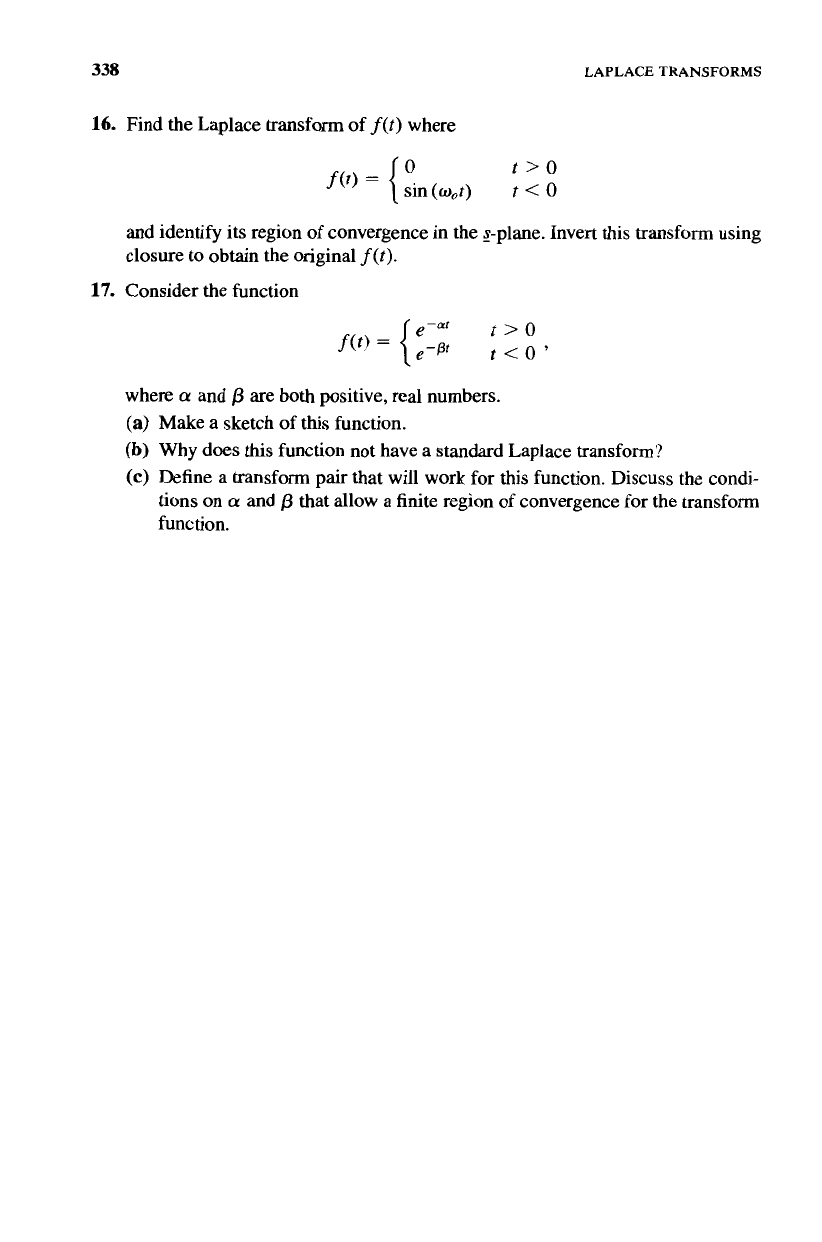
16.
17.
Find the Laplace transform of
f(t)
where
and identify its region of convergence in the g-plane. Invert this transform using
closure to obtain the original
f(t).
Consider the function
where
(Y
and
p
are both positive, real numbers.
(a)
Make a sketch
of
this function.
(b)
Why does
this
function not have a standard Laplace transform?
(c)
Define
a
transform pair that will work for this function. Discuss the condi-
tions on
a
and
p
that allow a finite region of convergence for the transform
function.
10
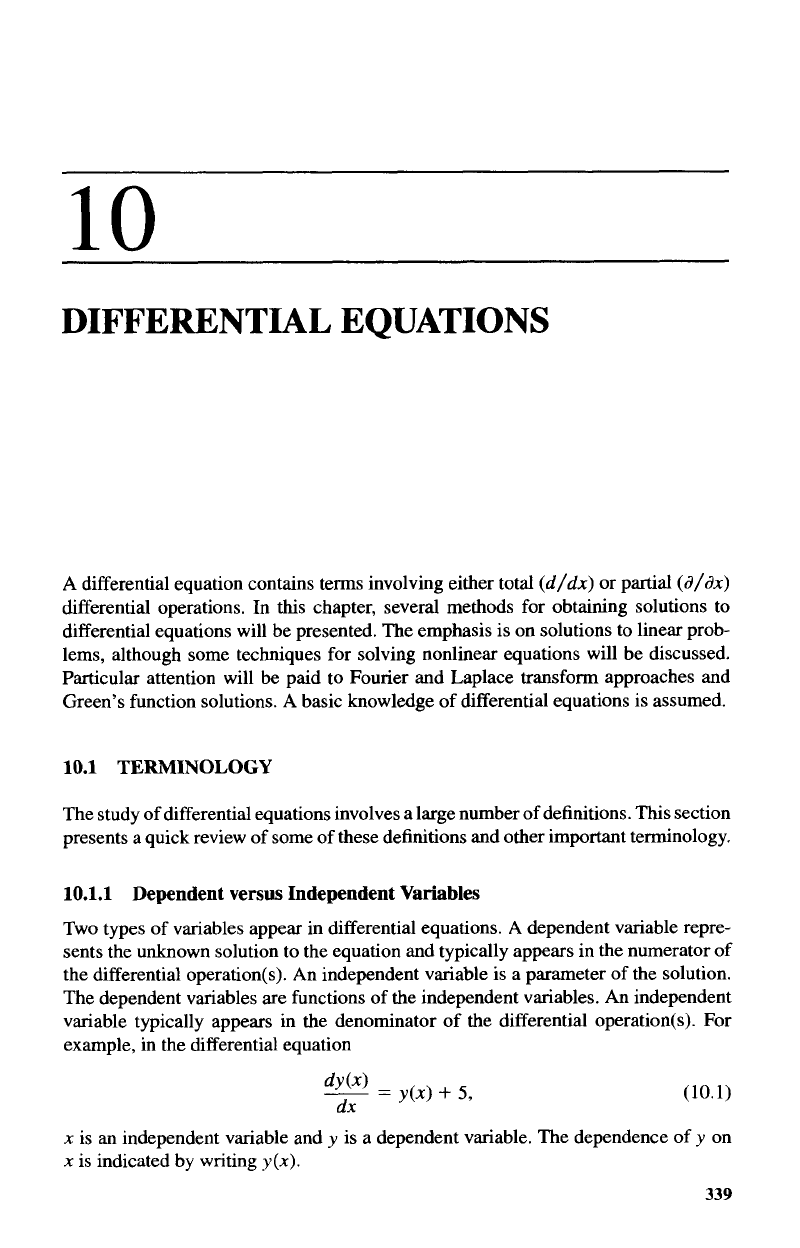
DIFFERENTIAL EQUATIONS
A
differential equation contains terms involving either total
(d/dx)
or partial
(a/dx)
differential operations.
In
this
chapter, several methods for obtaining solutions to
differential equations will be presented. The emphasis is on solutions to linear prob-
lems, although some techniques for solving nonlinear equations will be discussed.
Particular attention will be paid to Fourier and Laplace transform approaches and
Green’s function solutions. A basic knowledge
of
differential equations is assumed.
10.1
TERMINOLOGY
The study
of
differential equations involves a large number
of
definitions.
This
section
presents a quick review of some
of
these definitions and other important terminology.
10.1.1 Dependent versus Independent
Variables
Two types
of
variables appear in differential equations.
A
dependent variable repre-
sents the unknown solution to the equation and typically appears in the numerator
of
the differential operation(s). An independent variable is a parameter
of
the solution.
The dependent variables are functions
of
the independent variables.
An
independent
variable typically appears in the denominator of the differential operation(s).
For
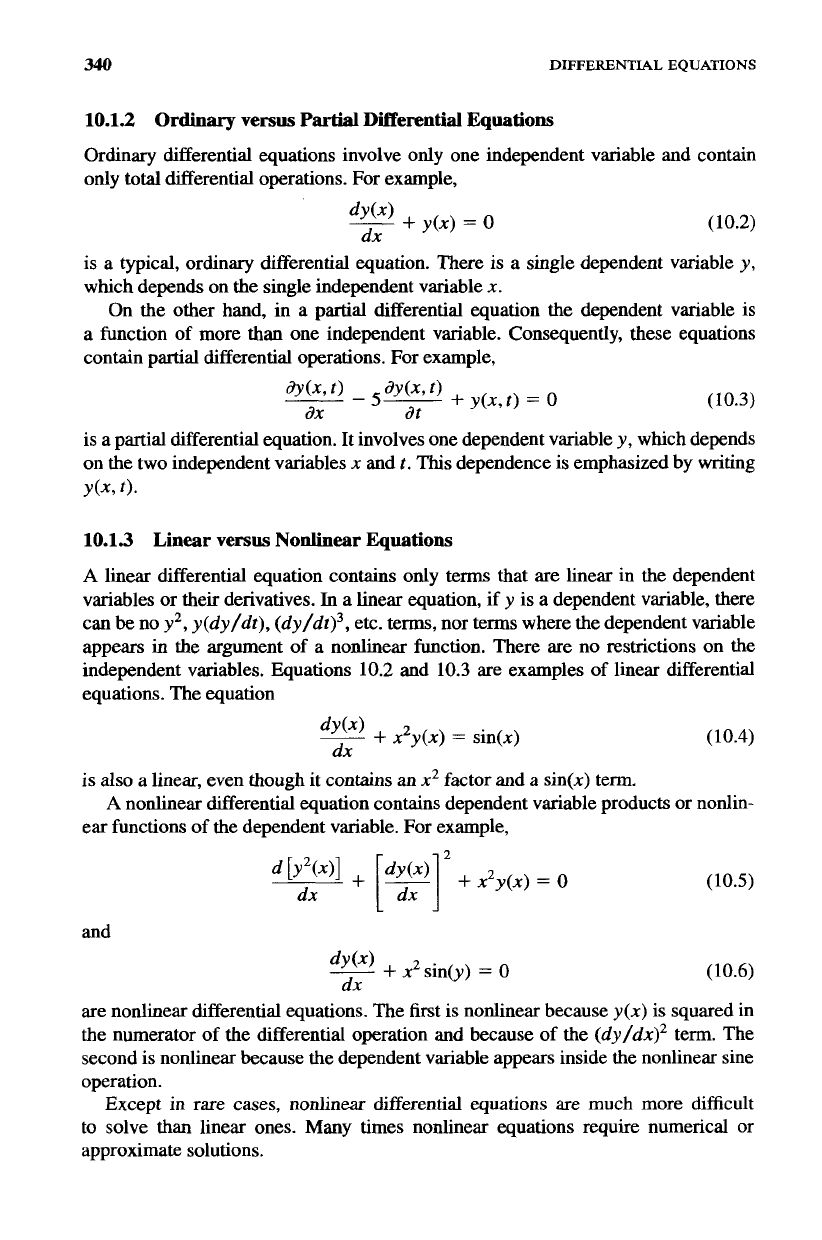
example, in the differential equation
=
y(x)
+
5,
dx
(10.1)
x
is
an independent variable and
y
is a dependent variable. The dependence
of
y
on
x
is indicated by writing
.y(x).
339
340
DIFFERENTIAL EQUATIONS
10.1.2
Ordinary
versus
Partial
Differential
Equations
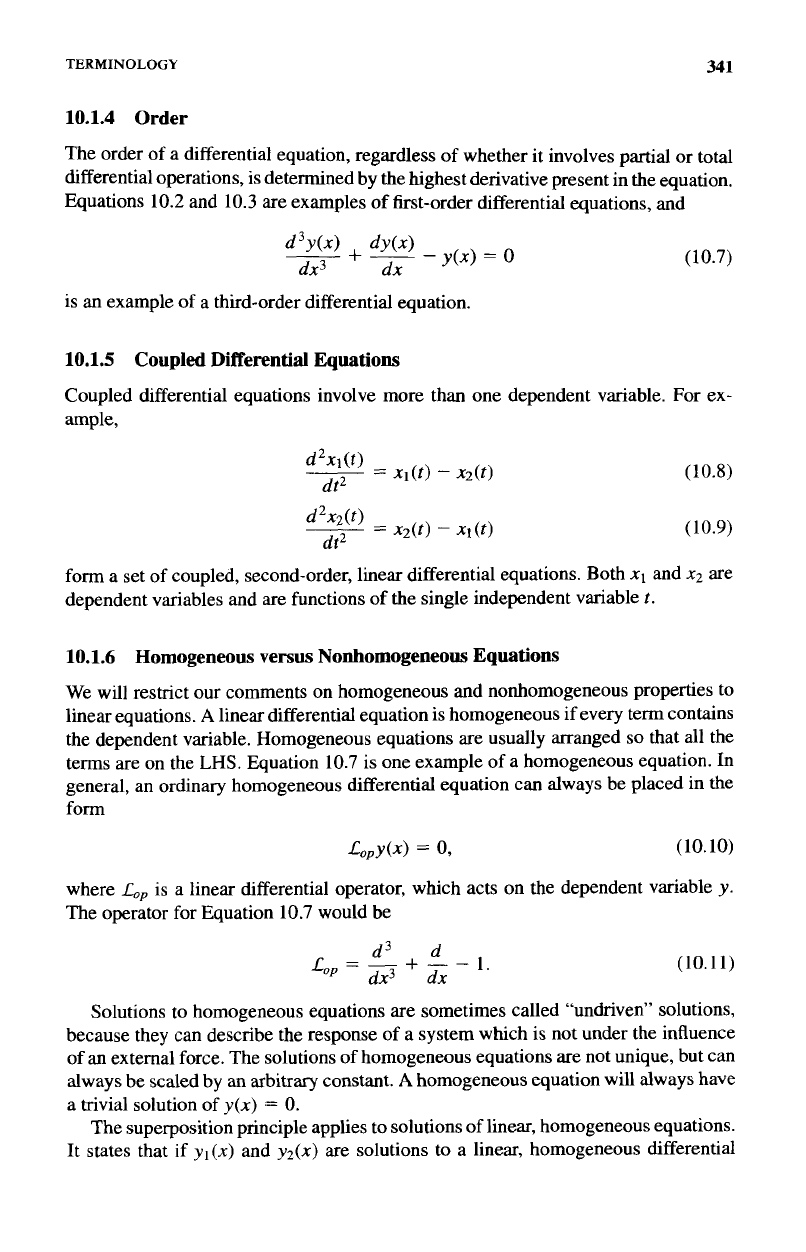
Ordinary differential equations involve only one independent variable and contain
only total differential operations. For example,
=
+
y(x)
=
0
dx
(10.2)
is a typical, ordinary differential equation. There is a single dependent variable y,
which depends on the single independent variable
x.
On the other hand, in a partial differential equation the dependent variable is
a function of more than one independent variable. Consequently, these equations
contain partial differential operations. For example,
(10.3)
is a partial differential equation. It involves one dependent variable y, which depends
on the two independent variables
x
and
t.
This
dependence is emphasized by writing
Y(X9
t).
10.1.3
Linear
versus
Nonlinear
Equations
A
linear differential equation contains only terms that are linear in the dependent
variables or their derivatives.
In
a linear equation,
if
y
is
a dependent variable, there
can
be
no y2, y(dy/dt), (dy/dtp, etc. terms, nor terms where the dependent variable
appears in the argument of a nonlinear function. There are no restrictions on the
independent variables. Equations 10.2 and
10.3
are examples of linear differential
equations. The equation
(10.4)
is
also a linear, even though it contains an x2 factor and a sin@) term.
ear functions of the dependent variable. For example,
A
nonlinear differential equation contains dependent variable products or nonlin-
2
d[Y2(X)]
+
dy(x)
~
dx
[-I
+
x2y(x)
=
0
and
*
+
x2
sin(y>
=
o
dx
(10.5)
(10.6)
are nonlinear differential equations. The first is nonlinear because y(x) is squared in
the numerator of the differential operation and because of the (dy/dx)’ term. The
second is nonlinear because the dependent variable appears inside the nonlinear sine
operation.
Except in rare cases, nonlinear differential equations are much more difficult
to
solve than linear ones. Many times nonlinear equations require numerical or
approximate solutions.
TERMINOLOGY
341
10.1.4
Order
The order of a differential equation, regardless
of
whether it involves partial or total
differential operations, is determined by the highest derivative present in the equation.
Equations 10.2 and 10.3 are examples
of
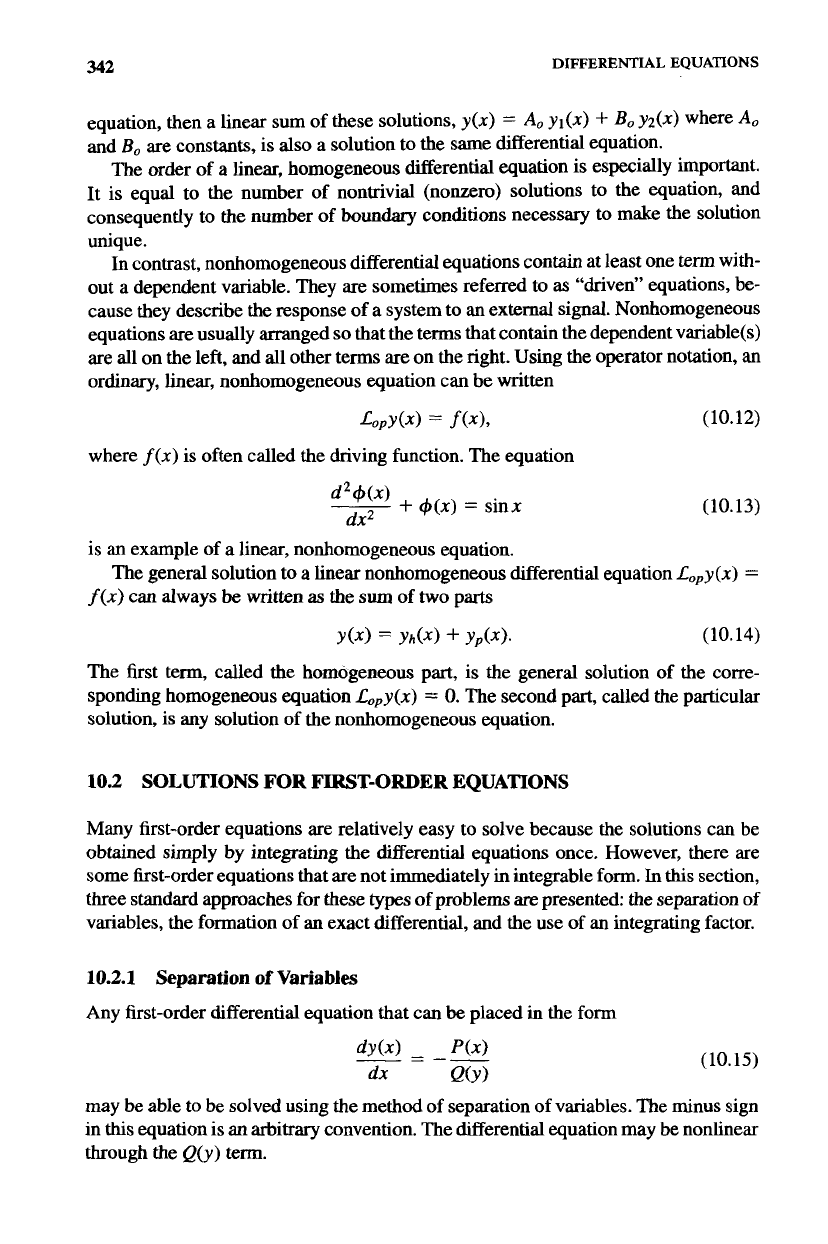
first-order differential equations, and
(10.7)
is an example
of
a third-order differential equation.
10.1.5
Coupled
Differential
Equations
Coupled differential equations involve more than one dependent variable. For ex-
ample,
d2X1(t)
=
q(t)
-
X2(t)
dt2
(10.8)
(10.9)
form a set of coupled, second-order, linear differential equations.
Both
x1
and
x2
are
dependent variables and are functions of the single independent variable
t.
10.1.6
Homogeneous versus Nonhomogeneous
Equations
We will restrict our comments on homogeneous and nonhomogeneous properties to
linear equations.
A
linear differential equation is homogeneous if every term contains
the dependent variable. Homogeneous equations are usually arranged
so
that all the
terms are on the
LHS.
Equation 10.7 is one example
of
a homogeneous equation. In
general, an ordinary homogeneous differential equation can always be placed in the
form
-&pY(X>
=
0,
(10.10)
where
Lop
is a linear differential operator, which acts on the dependent variable
y.
The operator for Equation 10.7 would be
d3 d
dx3
dx
Lop
=
-
+
-
-
1.
(10.1 1)
Solutions to homogeneous equations are sometimes called “undriven” solutions,
because they can describe the response of a system which is not under the influence
of
an external force. The solutions
of
homogeneous equations are not unique, but can
always be scaled by
an
arbitrary constant.
A
homogeneous equation will always have
a trivial solution
of
y(x)
=
0.
The superposition principle applies to solutions
of
linear, homogeneous equations.
It states that if
y,(x)
and
y2(x)
are solutions to a linear, homogeneous differential
DIFFERENTIAL EQUAnONS
342
equation, then a linear sum of these solutions,
y(x)
=
A,
yl(x)
+
B,
y2(x)
where
A,
and
B,
are constants, is also a solution to the same differential equation.
The
order of a linear, homogeneous differential equation is especially important.
It is equal to the number of nontrivial (nonzero) solutions to the equation, and
consequently to the number of
boundary
conditions necessary to make the solution
unique.
In
contrast, nonhomogeneous differential equations contain at least one
term
with-
out a dependent variable. They are sometimes referred to
as
“driven” equations, be-
cause they describe the response of a system to an external signal. Nonhomogeneous
equations are usually arranged
so
that the terms that contain the dependent variable(s)
are all on the left, and all other terms are on the right. Using the operator notation, an
ordinary, linear, nonhomogeneous equation can be written
LopY(X)
=
f(x),
(10.12)
where
f(x)
is often called the driving function. The equation
(10.13)
is an example of a linear, nonhomogeneous equation.
f(x)
can always
be
written
as
the
sum
of
two
parts
The general solution to
a
linear nonhomogeneous differential equation
LOpy(x)
=
Y(X>
=
Yh(X)
+
YpW.
(10.14)
The first term, called the homogeneous part, is the general solution of the corre-
sponding homogeneous equation
LOpy(x)
=
0.
The second part, called the particular
solution,
is
any solution of the nonhomogeneous equation.
10.2
SOLUTIONS
FOR FIRST-ORDER EQUATIONS
Many first-order equations are relatively easy to solve because the solutions can be
obtained simply by integrating the differential equations once. However, there are
some first-order equations that are not immediately in integrable form.
In
this
section,
three standard approaches
for
these types of problems
are
presented: the separation of
variables, the formation of an exact differential, and the use of an integrating factor.
10.2.1
Separation
of
Variables
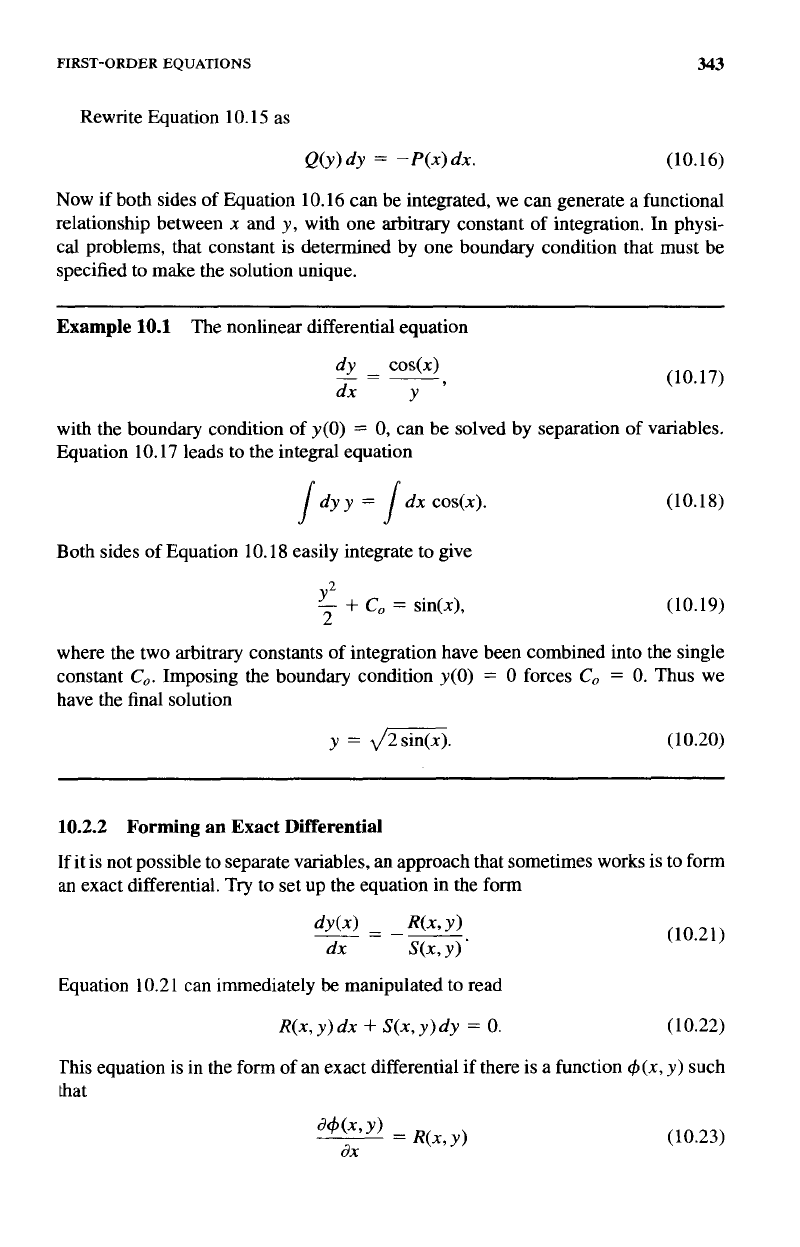
Any first-order differential equation that can
be
placed in the form
dY(4
-
P(X)
dx
Qol)
-
-
--
(10.15)
may be able to be solved using the method of separation of variables. The minus sign
in
this
equation is an arbitrary convention. The differential equation may be nonlinear
through the
Q(y)
term.
FIRST-ORDER
EQUATIONS
343
Rewrite Equation 10.15
as
Q(y) dy
=
-P(x)
dx.
(
10.16)
Now if both sides of Equation 10.16 can be integrated, we can generate a functional
relationship between
x
and
y,
with one arbitrary constant
of
integration. In physi-
cal problems, that constant is determined by one boundary condition that must be
specified
to
make the solution unique.
~ ~ ~ ~~ ~
Example 10.1
The nonlinear differential equation
dy
-
cos(x)
dx Y
’
(10.17)
with the boundary condition of
y(0)
=
0,
can be solved by separation of variables.
Equation 10.17 leads to the integral equation
1
dy y
=
/
dx
cos(x).
(
10.18)
Both sides of Equation 10.18 easily integrate to give
(10.19)
YL
-
+
C,
=
sin@),
2
where the two arbitrary constants
of
integration have been combined into the single
constant
C,.
Imposing the boundary condition
y(0)
=
0
forces
C,
=
0.
Thus we
have the final solution
y
=
dw.
(10.20)
10.2.2
Forming
an
Exact Differential
If
it is not possible to separate variables, an approach that sometimes works
is
to form
an
exact differential.
Try
to set up the equation in the form
(10.21)
Equation 10.21 can immediately be manipulated to read
R(x,
y) dx
+
S(x,
y) dy
=
0.
(10.22)
This equation is
in
the form of an exact differential if there is a function
4(x,
y)
such
that
(10.23)
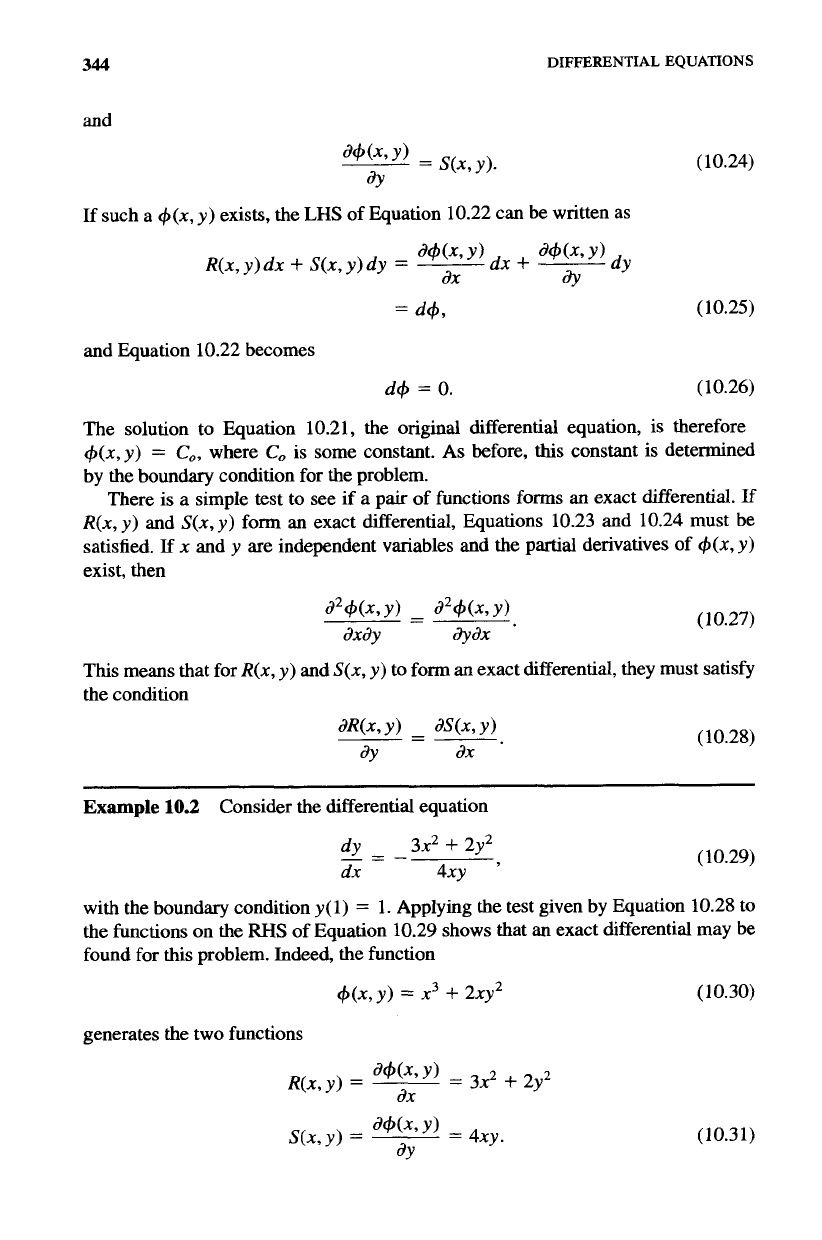
344
DIFFERENTIAL EQUATIONS
and
(10.24)
If such a
4(x,
y)
exists, the
LHS
of Equation
10.22
can be written as
=
d4,
(10.25)
and Equation
10.22
becomes
dcp
=
0.
(10.26)
The solution to Equation
10.21,
the original differential equation, is therefore
4(x,y)
=
C,,
where
C,
is
some constant.
As
before,
this
constant is determined
by the
boundary
condition for the problem.
There is
a
simple test to see if a pair of functions
forms
an exact differential.
If
R(x,
y)
and
S(x,
y)
form an exact differential, Equations
10.23
and
10.24
must be
satisfied.
If
x
and
y
are independent variables and the partial derivatives of
+(x,
y)
exist, then
(10.27)
This
means that for
R(x,
y)
and
S(x, y)
to form an exact differential, they must satisfy
the condition
(10.28)
~~~
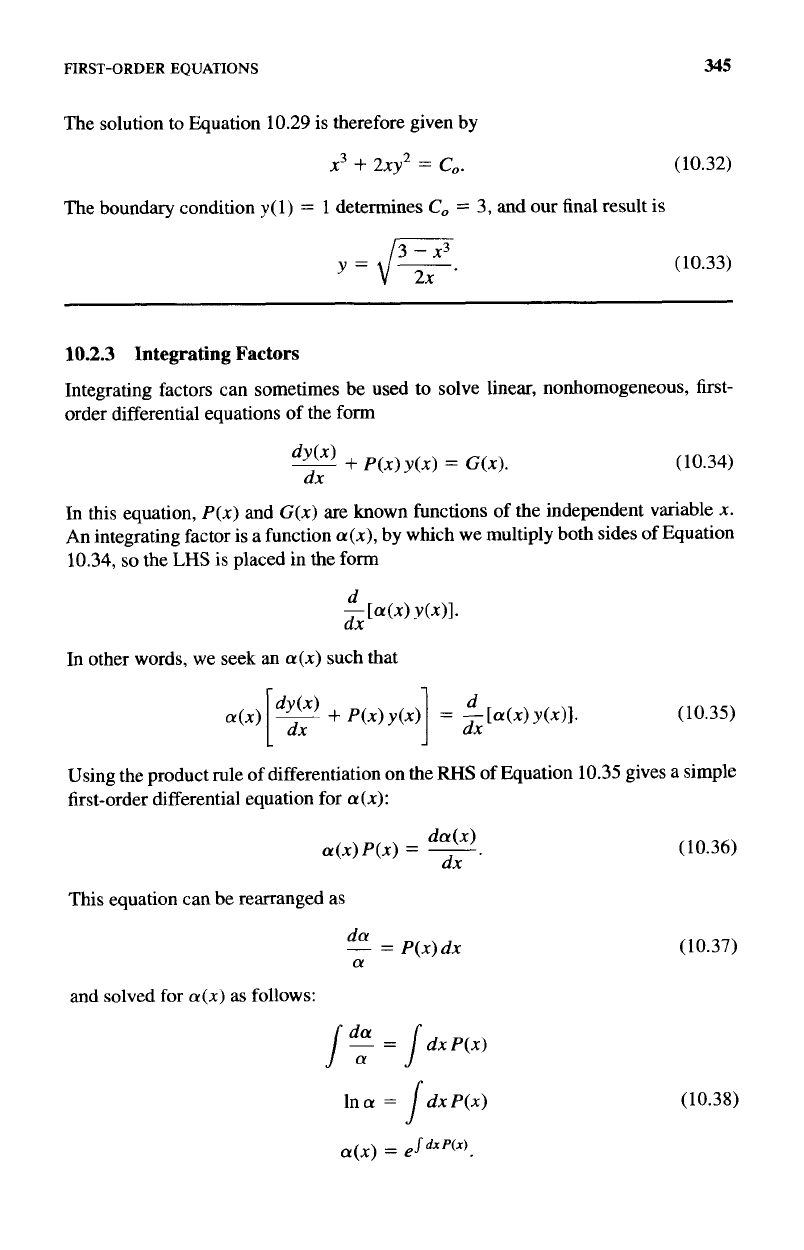
Example
10.2
Consider the differential equation
dy=-
3x2
+
2y2
dx 4XY
’
(10.29)
with the boundary condition
y(
1)
=
1.
Applying the test given by Equation
10.28
to
the functions on
the
RHS
of Equation
10.29
shows that
an
exact differential may be
found for this problem. Indeed, the function
4(x,y)
=
x3
+
2xy2
(1
0.30)
generates the two functions
(10.31)
FIRST-ORDER
EQUATIONS
345
The solution to Equation
10.29
is therefore given by
x3
+
2xy2
=
c,.
(10.32)
The boundary condition
y(
1)
=
1
determines
C,
=
3,
and
our
final result
is
y
=
Je
2x
,
(10.33)
10.2.3
Integrating Factors
integrating factors can sometimes be used to solve linear, nonhomogeneous, first-
order differential equations of the form
-
+
P(x)y(x)
=
G(x).
dx
(10.34)
In
this equation,
P(x)
and
G(x)
are
known
functions of the independent variable
x.
An integrating factor is a function
a(x),
by which we multiply both sides of Equation
10.34,
so
the
LHS
is
placed
in
the form
in other words, we seek
an
a(x)
such that
Using the product rule of differentiation on the
RHS
of Equation
10.35
gives a simple
first-order differential equation for
a(x):
This equation can be rearranged as
da
-
=
P(x)~x
a
and solved
for
a(x)
as
follows:
(10.36)
(10.37)
(10.38)