
Kusse B.R., Westwig E.A. Mathematical Physics: Applied Mathematics for Scientists and Engineers
Подождите немного. Документ загружается.

516
IY
ADVANCED TOPICS IN COMPLEX ANALYSIS
Y
y-plane
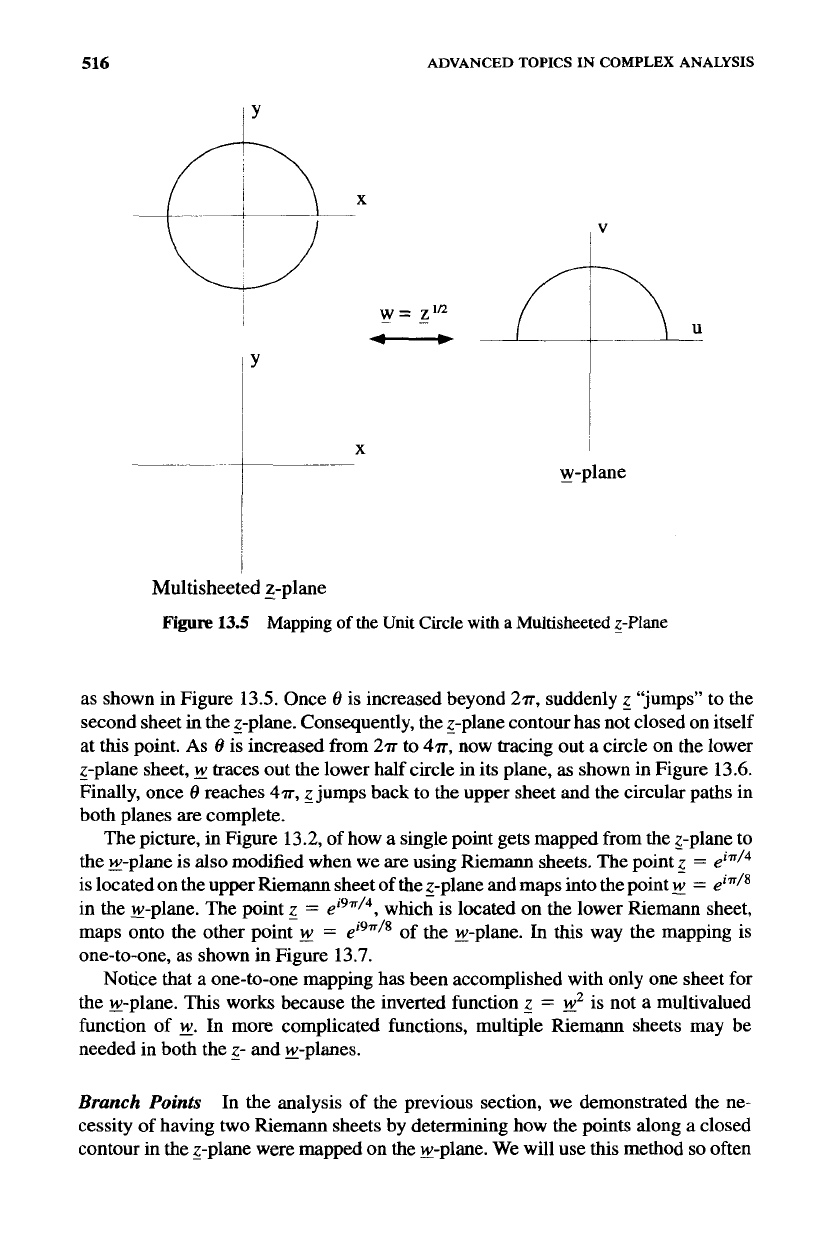
Multisheeted gplane
Figure
13.5
Mapping
of
the
Unit
Circle
with
a
Multisheeted Z-Plane
as shown in Figure 13.5. Once
0
is increased beyond 2~, suddenly
g
"jumps" to the
second sheet in the z-plane. Consequently, the z-plane contour has not closed on itself
at
this
point.
As
6
is
increased from
271
to
471,
now tracing out a circle
on
the lower
z-plane sheet,
y
traces out the lower half circle in its plane,
as
shown in Figure 13.6.
Finally, once
0
reaches
471,
z
jumps back to the upper sheet
and
the circular paths in
both planes
are
complete.
The picture, in Figure 13.2, of how
a
single point gets mapped from the z-plane to
the w-plane
is
also modified when we are
using
Riemann sheets. The point
=
ei"/4
is located on the upper Riemann sheet of the g-plane and maps into the point
3
=
in the y-plane. The point
z
=
ei9"l4,
which is located on the lower Riemann sheet,
maps onto the other point
=
ei9n/8
of the y-plane.
In
this
way the mapping is
one-to-one, as shown in Figure 13.7.
Notice that a one-to-one mapping has been accomplished with only one sheet for
the y-plane.
This
works because the inverted function
z
=
y2
is not a multivalued
function of
211.
In
more
complicated functions, multiple Riemann sheets may be
needed in both the
z-
and w-planes.
Branch
Points
In
the analysis of the previous section, we demonstrated the ne-
cessity of having two Riemann sheets by determining how the points along a closed
contour in the z-plane were mapped on the y-plane. We will use this method
so
often
522
ADVANCED TOPICS IN COMPLEX ANALYSIS
that connects the two branch points. It
is
for
this
reason that branch points must occur
in pairs. They provide the end
points
for the branch cuts. If there is only a single
branch point in the
finite
complex plane,
it
must
be
coupled with one at infinity. More
will be said about relocating branch cuts in the examples that follow.
13.1.3
Applications
of
Riemann
Sheet
Geometry
Now that the fundamentals of branch points and branch cuts have been introduced,
the details of Riemann sheet geometry are probably best understood by looking at
examples
of
specific functions. The examples that follow discuss increasingly more
complicated multivalued functions.
In
each case, we determine the location of the
branch
points
and
the number
of
Riemam
sheets
needed for a one-to-one mapping,
locate the branch cuts, and make the Riemann sheet connections.
~
Example
13.3
Consider the Riemann sheets associated with the function
=
z1I3.
For
this
function, each value of
z
generates
three
different values of
w,
so
it's likely
that there must be
three
Riemann sheets to describe the z-plane.
A
tour in the
g
plane
shows that
g
=
0
is a branch
point,
and it must be circled three times before
w
=
z1I3
returns to
its
starting
value.
This
confirms that there must be
three
-plane sheets.
Sheet
1
I
L
d
C
f
e
Sheet
3
C
d
e
f
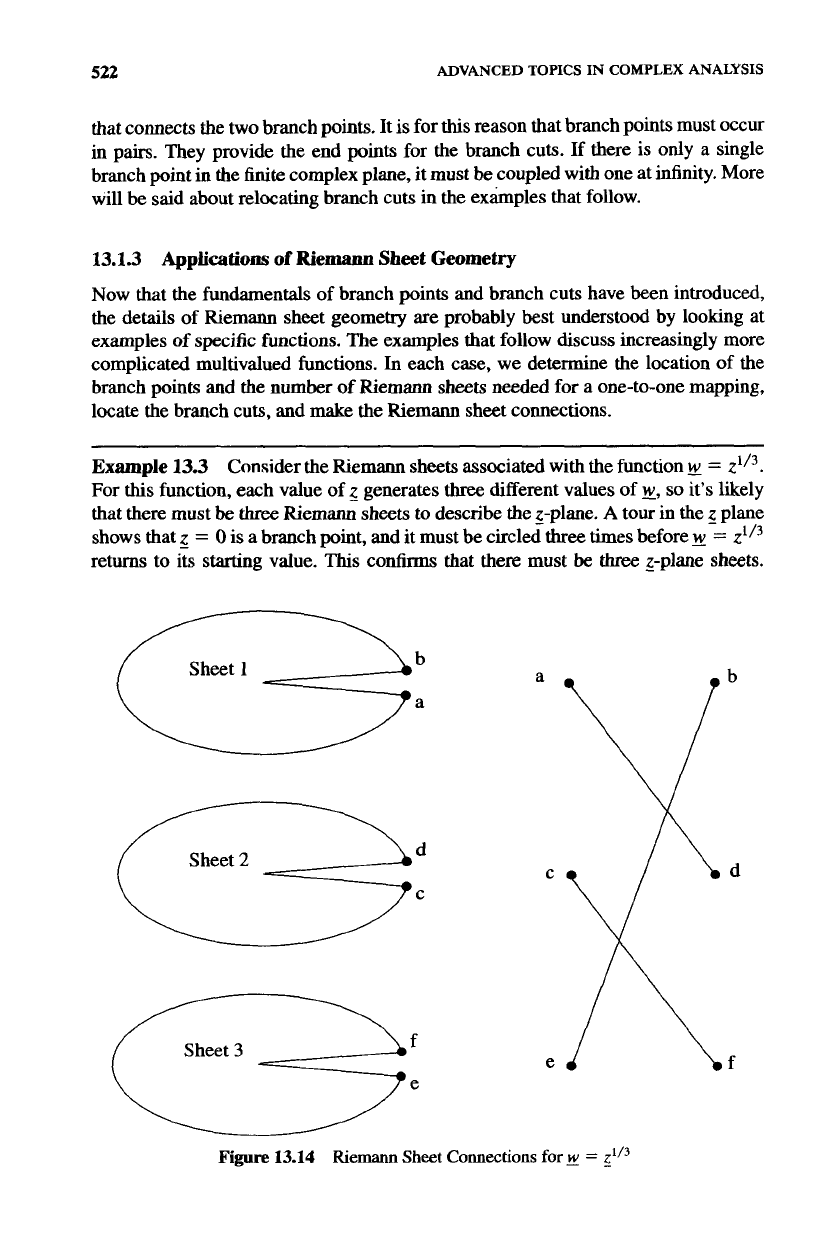
Figure
13.14
Riemann
Sheet
Connections
for
w
=
g1I3
518
ADVANCED
TOPICS
IN
COMPLEX
ANALYSIS
that we give
it
a special name. The paths used to determine the multivalued nature
of a function will be referred to as
lours.
With the function
=
g112,
we discovered
a single tour around the origin returned
g
to its initial value, but did not return
3
to its starting value.
Wo
successive tours, however, brought both
z
and
w
back to
their initial values.
This
is why we needed two Riemann sheets in order to make our
mapping one-to-one.
Still using the function
w
=
g112,
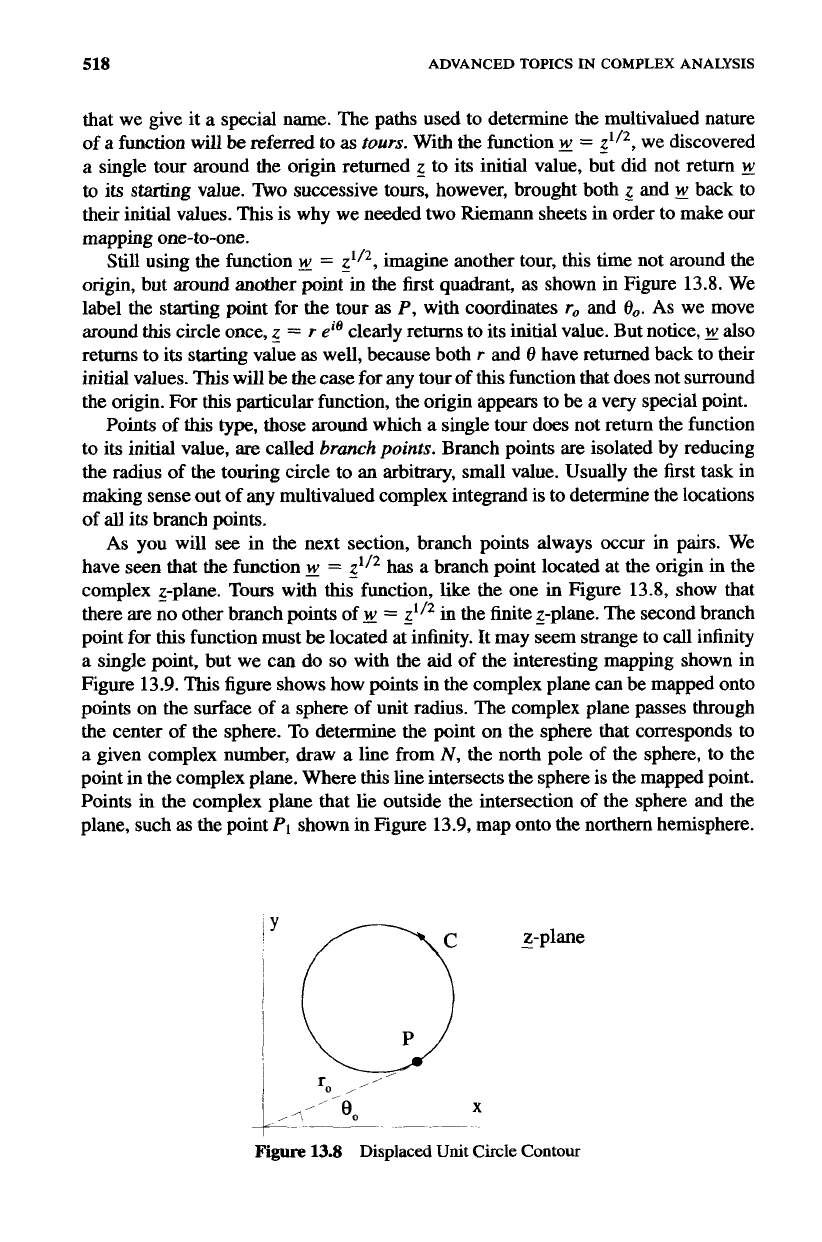
imagine another tour,
this
time not around the
origin, but around another
point
in the first quadrant, as shown in Figure 13.8. We
label the starting point for the tour
as
P,
with coordinates
r,
and
0,.
As
we move
around
this
circle once,
z
=
r
eie
clearly returns to its initial value. But notice,
w
also
returns to its starting value
as
well, because both
r
and
8
have returned back to their
initial values.
This
will be the case for any tour of
this
function that does not surround
the origin. For
this
pdcular function, the origin appears to
be
a very special point.
Points
of
this
type,
those around which a single tow does not return the function
to its initial value,
are
called
brunch
points.
Branch points are isolated by reducing
the radius of the touring circle to an arbitrary, small value. Usually the first task in
making sense out of any multivalued complex integrand is to determine the locations
of all
its
branch points.
As
you will see in the next section, branch points always occur in pairs. We
have seen that the function
w
=
z1I2
has a branch point located at the origin in the
complex g-plane.
Tours
with
this
function, like the one in Figure 13.8, show that
there are no other branch points of
w
=
g112
in the finite g-plane. The second branch
point for
this
function must
be
located at infinity. It may seem strange to call infinity
a single point, but we can do
so
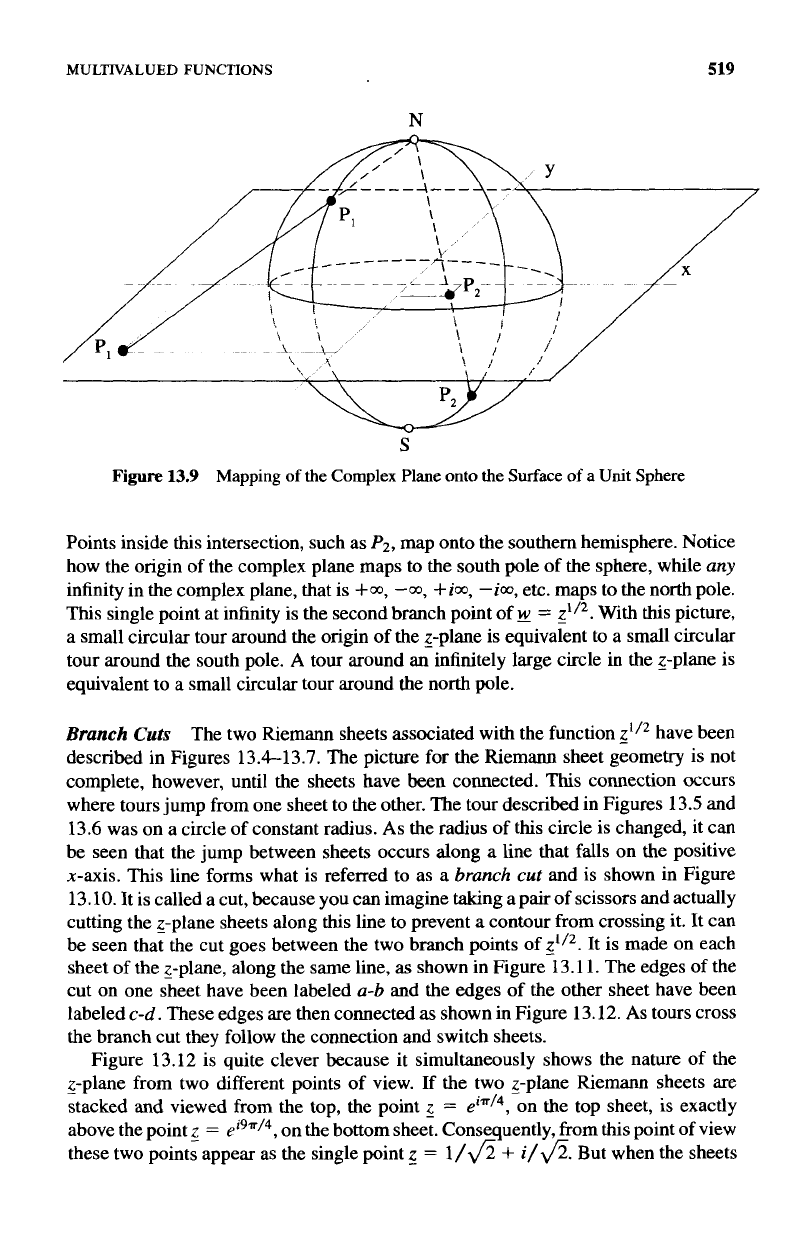
with the aid of the interesting mapping shown in
Figure
13.9.
This
figure shows how points in the complex plane can be mapped onto
points
on
the surface of a sphere of unit radius. The complex plane passes through
the center
of
the sphere.
To
determine the point on the sphere that corresponds to
a
given complex number, draw a line from
N,
the north pole
of
the sphere, to the
point in the complex plane. Where
this
line intersects the sphere is the mapped point.
Points
in
the complex plane that lie outside the intersection of the sphere and the
plane, such
as
the point
PI
shown in Figure
13.9,
map onto the northern hemisphere.
Figure
13.8
Displaced Unit Circle Contour
MULTIVALUED
FUNCTIONS
519
N
S
Figure
13.9
Mapping
of
the Complex Plane
onto
the Surface
of
a
Unit
Sphere
Points inside this intersection, such as
P2,
map onto the southern hemisphere. Notice
how the origin of the complex plane maps to the south pole of the sphere, while
uny
infinity in the complex plane, that is
+m, -m,
+im,
-iw,
etc. maps to the north pole.
This single point at infinity is the second branch point of
y
=
g112.
With
this
picture,
a small circular tour around the origin of the z-plane is equivalent to a small circular
tour around the south pole.
A
tour around
an
infinitely large circle in the g-plane is
equivalent to a small circular tour around
the
north pole.
Brunch
Cuts
The two Riemann sheets associated with the function
g112
have been
described in Figures
13.4-13.7.
The picture for the Riemann sheet geometry is not
complete, however, until the sheets have
been
connected.
This
connection occurs
where tours jump from one sheet to the other. The tour described in Figures
13.5
and
13.6
was on a circle of constant radius.
As
the radius of this circle is changed, it can
be seen that the jump between sheets occurs along a
line
that falls on the positive
x-axis.
This
line forms what is referred to as a
brunch
cut
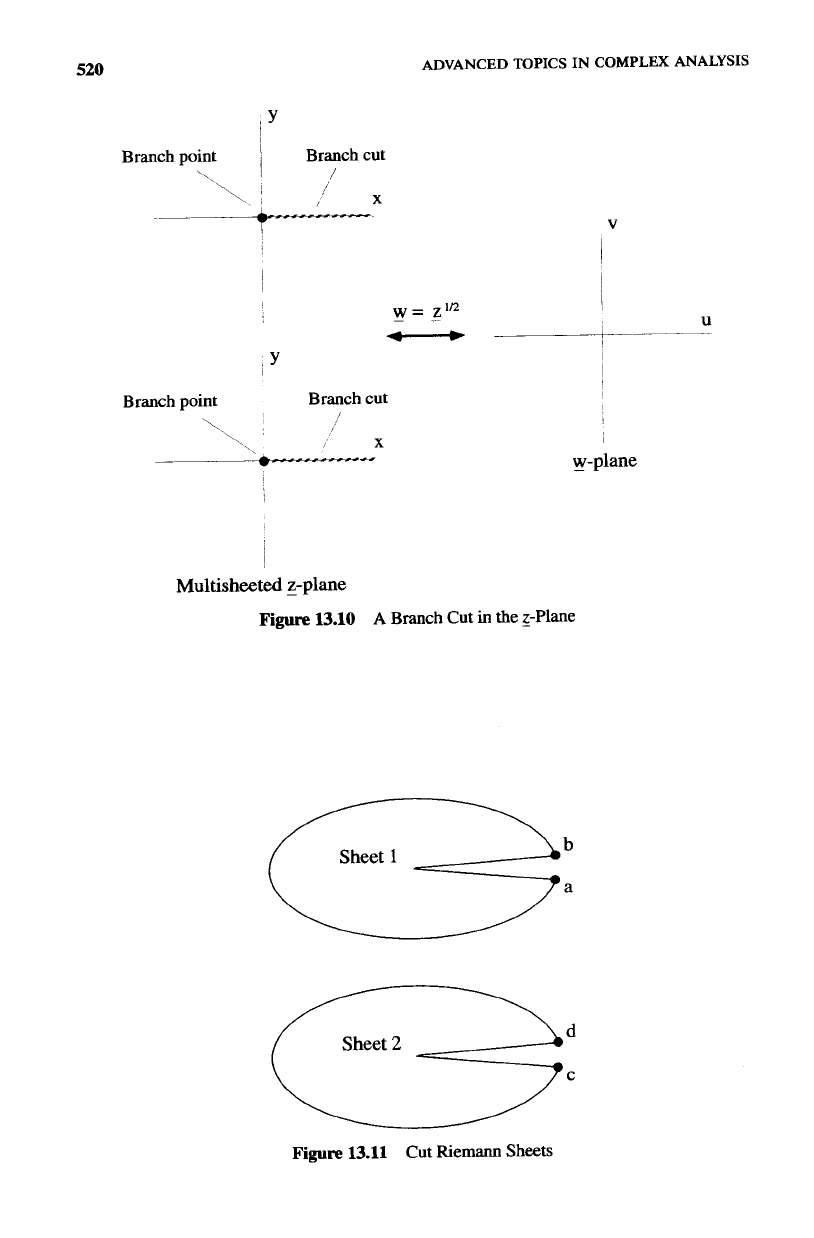
and is shown in Figure
13.10.
It is called
a
cut, because you can imagine taking a pair of scissors and actually
cutting the Z-plane sheets along
this
line to prevent a contour from crossing it. It can
be seen that the cut goes between the two branch points of
$I2.
It is made on each
sheet
of
the Z-plane, along the same line,
as
shown in Figure
13.1
1.
The edges
of
the
cut on one sheet have been labeled
a-b
and the edges of the other sheet have been
labeled
c-d.
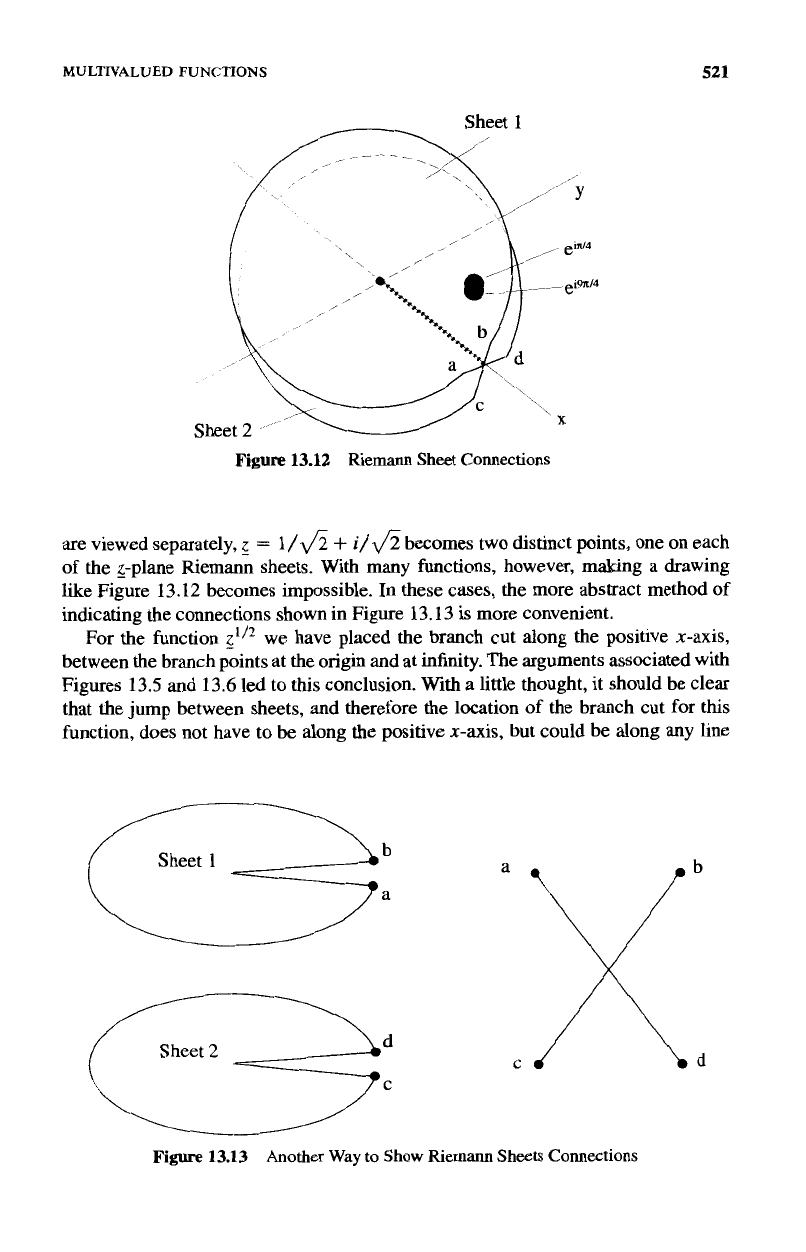
These edges are then connected as shown in Figure
13.12.
As
tours cross
the
branch cut they follow the connection and switch sheets.
Figure
13.12
is quite clever because it simultaneously shows the nature of the
z-plane from two different points of view.
If
the two g-plane Riemann sheets are
stacked and viewed from the top, the point
z
=
eiW14,
on the top sheet, is exactly
above the point
z
=
ei9W/4,
on the bottom sheet. Consequently,
from
this point
of
view
these two points appear
as
the single point
g
=
1/&
+
i/&.
But when the sheets
520
ADVANCED TOPICS IN COMPLEX ANALYSIS
Branch point
'
Branch cut
,\\
/
/x
-*--L---
'\
1
V
1
Branch point Branch cut
y-plane
Multisheeted ?-plane
Figure
13.10
A
Branch Cut in
the
?-Plane
b
a
Sheet
1
Figure
13.11 Cut
Riemann
Sheets
MULTIVALUED
FUNCTIONS
521
Figure
13.12
Riemann Sheet Connections
are viewed separately,
z
=
1
/fi
+
i/&
becomes two distinct points, one on each
of the g-plane Riemani sheets. With many functions, however, making a drawing
like Figure
13.12
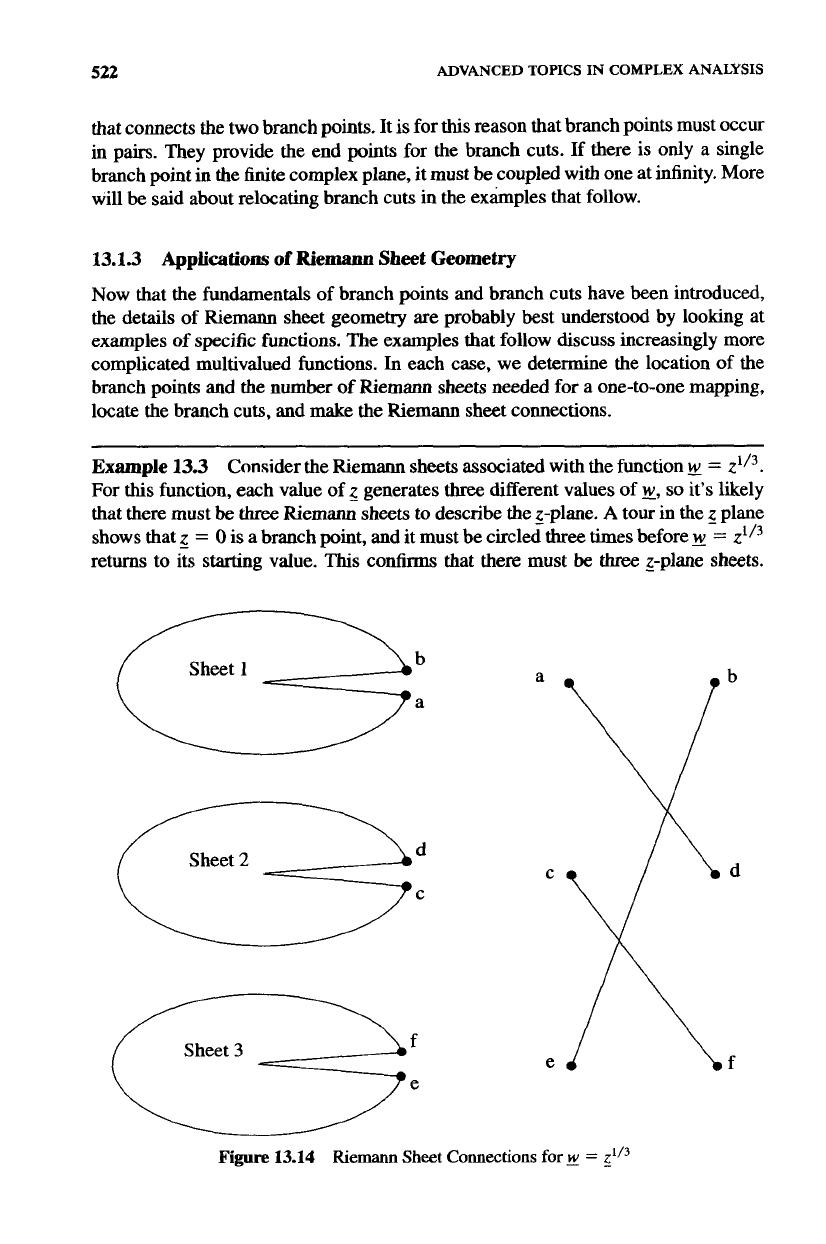
becomes impossible. In these cases, the more abstract method
of
indicating the connections shown in Figure
13.13
is more convenient.
For
the
function
z1I2
we have placed the branch cut along the positive x-axis,
between the branch points at the origin and at
infinity.
The arguments associated with
Figures
13.5
and
13.6
led to
this
conclusion. With a little thought, it should be clear
that the jump between sheets, and therefore the location of the branch cut for this
function, does not have to be along the positive x-axis, but could be along any line
Sheet
1
Sheet
2
C
d
C
Figure
13.13
Another
Way
to Show Riemann Sheets Connections
522
ADVANCED TOPICS IN COMPLEX ANALYSIS
that connects the two branch points. It
is
for
this
reason that branch points must occur
in pairs. They provide the end
points
for the branch cuts. If there is only a single
branch point in the
finite
complex plane,
it
must
be
coupled with one at infinity. More
will be said about relocating branch cuts in the examples that follow.
13.1.3
Applications
of
Riemann
Sheet
Geometry
Now that the fundamentals of branch points and branch cuts have been introduced,
the details of Riemann sheet geometry are probably best understood by looking at
examples
of
specific functions. The examples that follow discuss increasingly more
complicated multivalued functions.
In
each case, we determine the location of the
branch
points
and
the number
of
Riemam
sheets
needed for a one-to-one mapping,
locate the branch cuts, and make the Riemann sheet connections.
~
Example
13.3
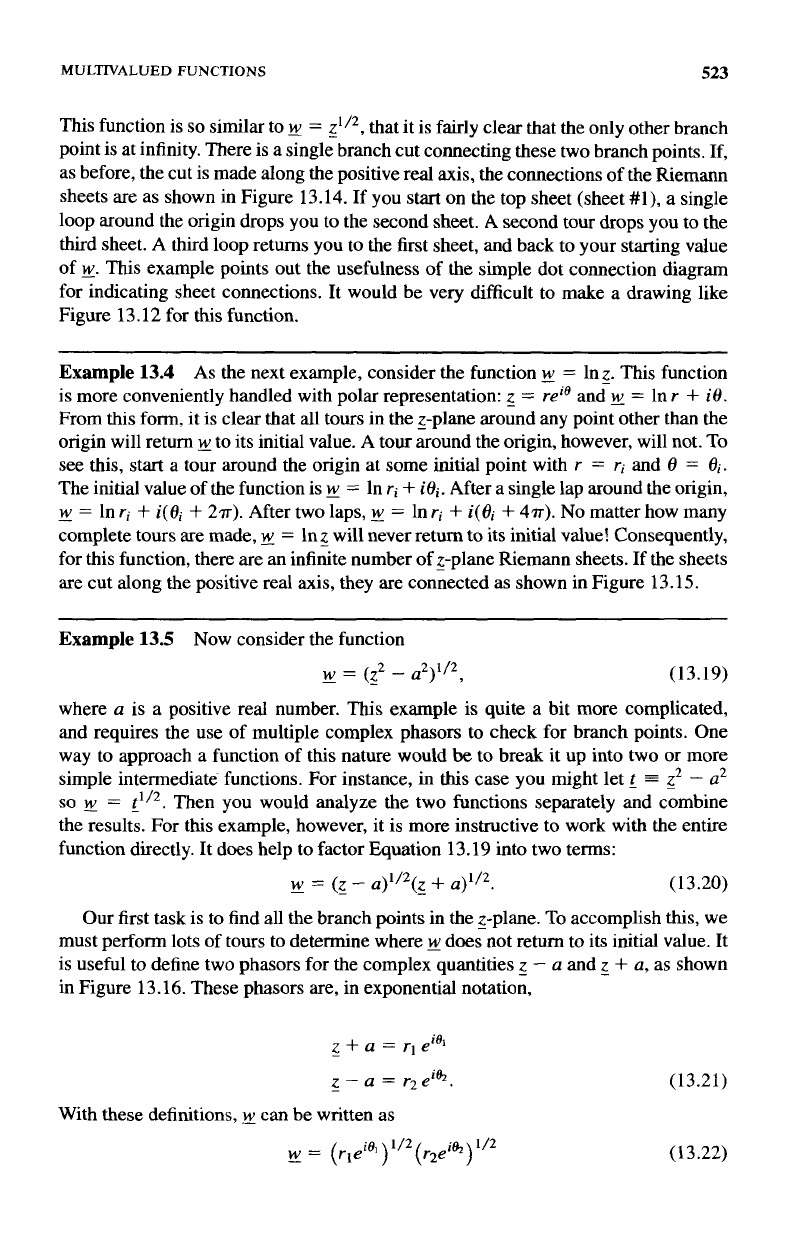
Consider the Riemann sheets associated with the function
=
z1I3.
For
this
function, each value of
z
generates
three
different values of
w,
so
it's likely
that there must be
three
Riemann sheets to describe the z-plane.
A
tour in the
g
plane
shows that
g
=
0
is a branch
point,
and it must be circled three times before
w
=
z1I3
returns to
its
starting
value.
This
confirms that there must be
three
-plane sheets.
Sheet
1
I
L
d
C
f
e
Sheet
3
C
d
e
f
Figure
13.14
Riemann
Sheet
Connections
for
w
=
g1I3
MULTIVALUED
FUNCTIONS
523
This
function is
so
similar to
w
=
g1l2,
that it is fairly clear that the only other branch
point is at infinity. There is a single branch cut connecting these two branch points. If,
as before, the cut is made along the positive real axis, the connections of the Riemann
sheets are as shown in Figure 13.14. If you
start
on the top sheet (sheet #l), a single
loop around the origin drops you to the second sheet. A second tour drops you to the
third sheet.
A
third loop returns you to the first sheet, and back to your starting value
of
g.
This
example points out the usefulness of
the
simple dot connection diagram
for indicating sheet connections. It would be very difficult to make a drawing like
Figure 13.12 for ths function.
~ ~ ~ ~~~~~ ~~
Example 13.4
As
the next example, consider the function
y
=
In
z.
This function
is more conveniently handled with polar representation:
z_
=
re''
and
y
=
In
r
+
i0.
From this
form.
it is clear that all tours in the 2-plane around any point other than the
origin will return
w
to its initial value.
A
tour around the origin, however, will not. To
see this, start a tour around the origin at some initial point with
r
=
r,
and
0
=
0,.
The initial value of the function is
y
=
In
rz
+
ill,.
After a single lap around the origin,
-
w
=
In
r,
+
i(0,
+
27~). After two laps,
w
=
In
r,
+
i(0,
+
4.n).
No
matter how many
complete tours are made,
g
=
In
g
will never return
to
its initial value! Consequently,
for this function, there are an infinite number of g-plane Riemann sheets. If the sheets
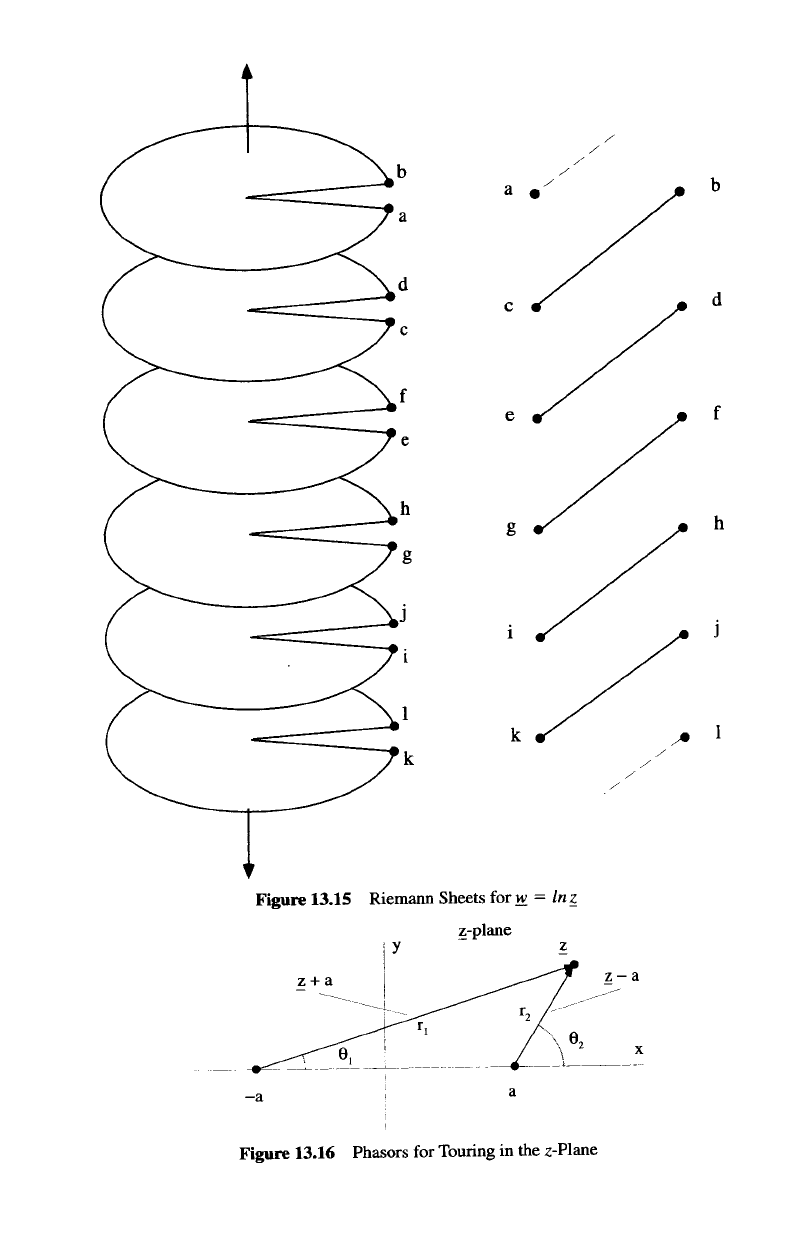
are cut along the positive real axis, they are connected as shown in Figure 13.15.
Example 13.5
Now consider the function
-
w
=
(z2
-
-
a2)1/2,
(13.19)
where
a
is a positive real number.
This
example is quite a bit more complicated,
and requires the use of multiple complex phasors to check for branch points. One
way to approach a function of this nature would
be
to break it up into two or more
simple intermediate functions. For instance,
in
this
case you might let
2
=
g2
-
u2
so
w
=
g112.
Then
you
would analyze the two functions separately and combine
the results. For this example, however, it is more instructive to work with the entire
function directly. It
does
help to factor Equation
13.19
into two terms:
g
=
(z
-
a)qg
+
a)?
(13.20)
Our first
task
is to find all the branch points in the g-plane.
To
accomplish
this,
we
must perform lots of tours to determine where
w
does not return to its initial value. It
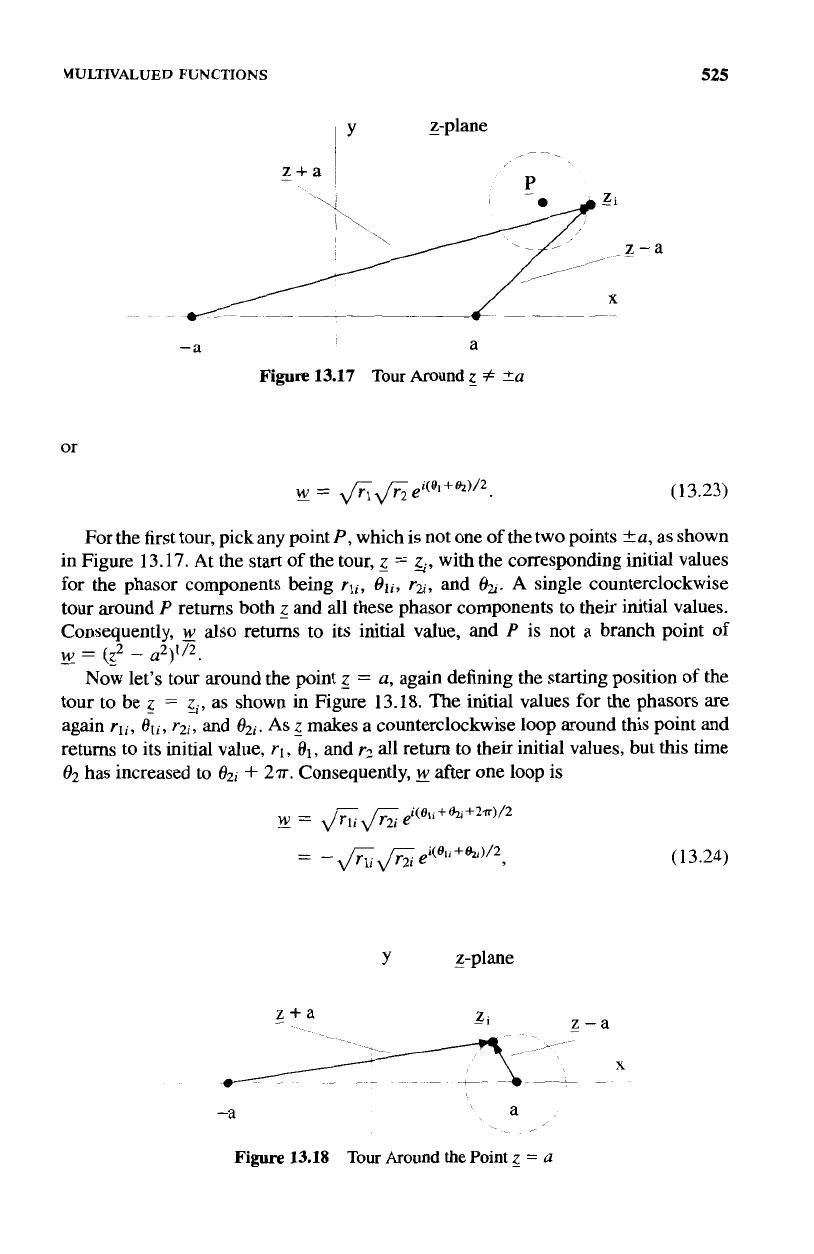
is useful to define two phasors for the complex quantities
2
-
a
and
z
+
a,
as shown
in Figure 13.16. These phasors are, in exponential notation,
With these definitions,
w
can be written
as
(13.21)
(13.22)
/
/
/
/
k
/
/
Figure
13.15
Riemann
Sheets
for
=
In
z
-
z-plane
z
-
b
d
-a
a
Figure
13.16
Phasors
for
Touring
in
the z-Plane
MULTIVALUED
FUNCTIONS
525
-
z-plane
IY
i
-
-
z+a
-
z-a
,'
X
~
-~~
__
-a
a
Figure 13.17
Tour
Around
z
f
+a
or
(13.23)
For the first tour, pick any point
P,
which is not one of the two points
+a,
as shown
in Figure 13.17. At the start of the tour,
g
=
5,
with the corresponding initial values
for the phasor components being
rl,,
el,,
r2,,
and
02,.
A
single counterclockwise
tour around
P
returns both
g
and all these phasor components to their initial values.
Consequently,
w
also returns
to
its initial value, and
P
is not a branch point of
Now let's tour around the point
z
=
u,
again defining
the
starting position
of
the
tour to be
z_
=
z,,
as shown in Figure 13.18. The initial values for the phasors
are
again
YI,,
el,,
r21,
and
02,.
As
z
makes a counterclockwise loop around this point and
returns to its initial value,
rl,
01,
and
r2
all return to their initial values, but
this
time
02
has increased to
02,
+
27~.
Consequently,
y
after one
loop
is
g
=
(52
-
a2)P
=
fifie1(B1,+h+2?r)/2
=
-
J.1I
fi
e4h
+
&<
)/2
(13.24)
Y
-
z-plane
-a a
Figure 13.18
Tour
Around
the
Point
=
a