
Kusse B.R., Westwig E.A. Mathematical Physics: Applied Mathematics for Scientists and Engineers
Подождите немного. Документ загружается.

486
SOLUTIONS
TO
LAPLACE'S EQUATION
28.
Because of their orthogonality and completeness properties the Legendre poly-
nomials can
be
used to make series expansions
of
functions
m
f(x)
=
c
CePe(4.
e=o.l,
...
Let
f(x)
be
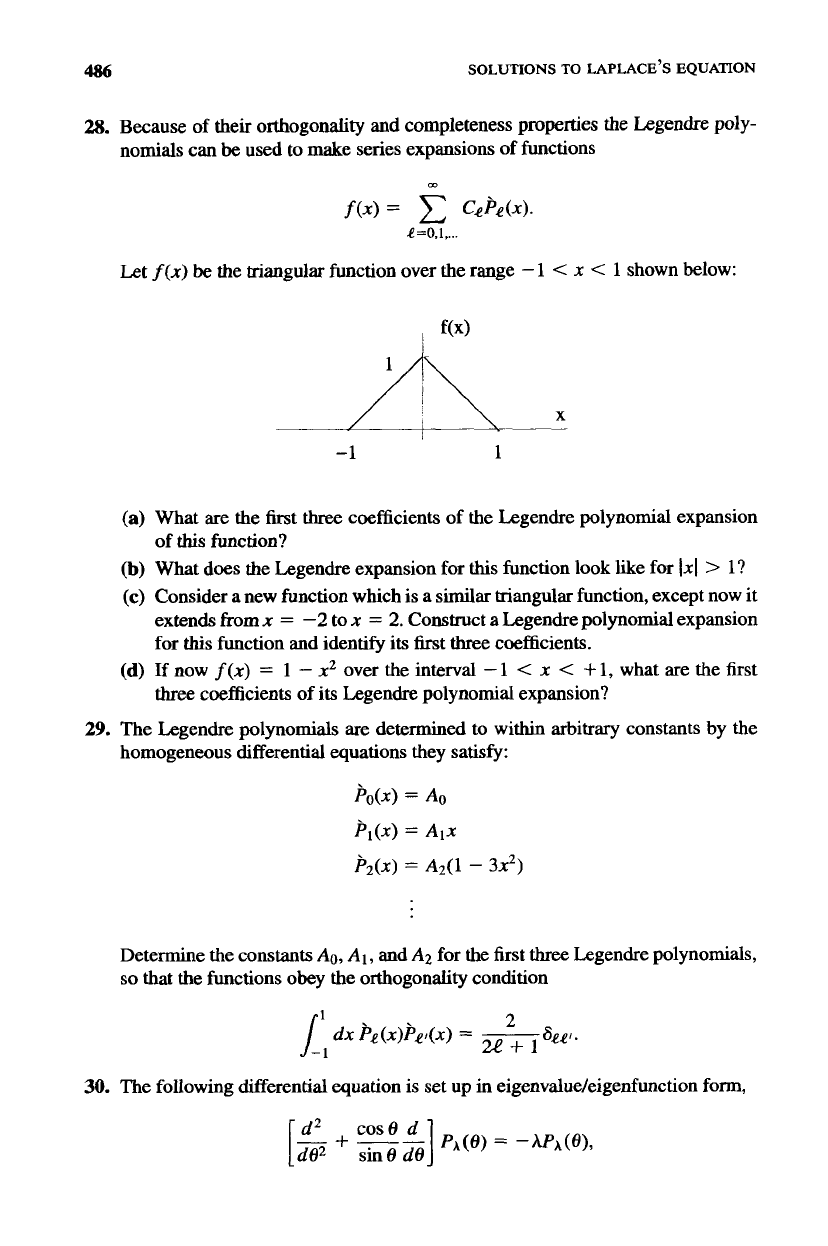
the triangular function over the range
-
1
<
x
<
1
shown below:
-1
1
(a)
What are the first three coefficients
of
the Legendre polynomial expansion
(b)
What does the Legendre expansion for
this
function look like for
1x1
>
l?
(c)
Consider
a
new function which
is
a similar triangular function, except now
it
extends
from
x
=
-2
to
x
=
2.
Construct a Legendre polynomial expansion
for
this
function and identify
its
first
three coefficients.
(a)
If
now
f(x)
=
1
-
x2
over the interval
-
1
<
x
<
+
1,
what are the first
three
coefficients of its Legendre polynomial expansion?
29.
The Legendre polynomials are determined to within arbitrary constants by the
of
this
function?
homogeneous differential equations they satisfy:
Po@)
=
A0
P,(x)
=
Alx
P~(x)
=
A2(l
-
3x2)
Determine the constants
Ao. Al,
and
A2
for the first
three
Legendre polynomials,
so
that the functions
obey
the orthogonality condition
30.
The following differential equation is set up in
eigenvalueJeigenfunction
form,
EXERCISES
487
where
8
ranges from zero to
T,
and
Ph(8)
is an eigenfunction of the differential
operator with the eigenvalue
A.
This operator is not Hermitian.
(a)
Place this differential equation in Sturm-Liouville form and show that the
(b)
Using this new Hermitian operator show that if
m
#
n
operator that results is Hermitian.
JG"
de
g(w,w,(o)
=
0
and determine the weighting function
g(8).
31.
Consider the differential equation
where
a
is a positive constant.
This
equation is
in
eigenfunction, eigenvalue
form.
(a)
If
A,
is assumed to be positive and real, show that the two solutions for the
eigenfunctions become
and that this form is valid
for
any value
of
A,
f
a2/4.
(b)
Now require that the eigenfunctions of part (a) satisfy the following boundary
conditions:
4,(0)
=
0
and
+&)
=
0.
These boundary conditions determine
the acceptable values
for
the
A,,
as
well as the acceptable
+&).
Use
the
n-index to identify these acceptable values
for
the
A,
and make a plot of the
first three acceptable eigenfunctions.
(c)
The differential equation given above is not in Sturm-Liouville form. Find
the appropriate multiplying function
and
place it in
S-L
form.
(d)
Determine the orthogonality conditions
for
the eigenfunctions of part (a)
that satisfy the boundary conditions
of
part (b). Be sure to identify the region
over which the functions are orthogonal and explain how you arrived at
your
answer.
32.
The Gram-Schmidt orthogonalization procedure generates a set of orthonormal
functions
(or
vectors) from a set of independent functions
(or
vectors). For this
problem start with the set
of
independent functions
y,(x)
=
x".
A
number of
different orthonormal sets can be constructed
from
these
y,(x),
depending
on
the weighting function used. Let
+&)
be
the set of functions generated from
different
sums
of the
y,(x),
and let the orthonormalization be given by the
488
SOLUTIONS
TO
LAPLACE'S
EQUATION
33.
following integration
la
dx +n(x)+m(x)e-x
=
snm,
where a weighting function
w(x)
=
e-x
has been used.
(a)
The first function
&(x)
is
determined by setting it equal to a constant times
y~(x)
and then normalizing:
What is
+&)?
(b)
The second function
C$~(X)
is set up as a linear sum of
yl(x)
and
&(x):
Find the constants
al
and
blo
that normalize
41
(x)
and simultaneously make
it orthogonal to
&(x).
(c)
Continue
this
process and construct
&(x).
Set up
&(x)
as a linear sum of
Y2(X),
b(xh
and
41w:
h(x)
=
a22
Y2G)
+
b20
b(x)
+
b21
41(x).
Find the constants
a22,
b20,
and
onal to
&(x)
and
41(x).
that normalize
&(x)
and make
it
orthog-
These
(pm(x)
functions are known
as
Leguerre polynomials. It is interesting to note
the Legendre polynomials can
be
generated by the Gram-Schmidt process using
the same set of independent functions
yn(x)
=
xn
and the orthonormalization
given by
The elliptical coordinates
(u.
u,
z)
are related to a set of Cartesian coordinates
by
the equations
x
=
pocoshucosv
y
=
p*sinhusinu
z
=
z,
where
po
is a positive constant needed to make the above equations dimensionally
correct. Laplace's equation for
U(u,
v,z)
becomes
EXERCISES
489
Assume
U(u,
u,
z)
can be separated, i.e., that
*(u,
u,
z)
=
f(u)g(v)h(z),
and
determine the three ordinary differential equations that
f(u),
g(v),
and
h(z)
satisfy. Define the necessary separation constants.
34.
Consider a two-dimensional Cartesian coordinate system and a two-dimensional
uv-system with the coordinates related by
x
=
-uv
y
=
(1/2)(u2
-
2).
In general, Laplace's equation in two dimensions can
be
written as
with
h?
=
(g)2
+
($)2.
(a)
In the xy-plane, sketch lines of constant
u
and constant
v.
(b)
Express Laplace's equation using the uv-coordinates.
(c)
Use the method of separation of variables
to
separate Laplace's equation in
35.
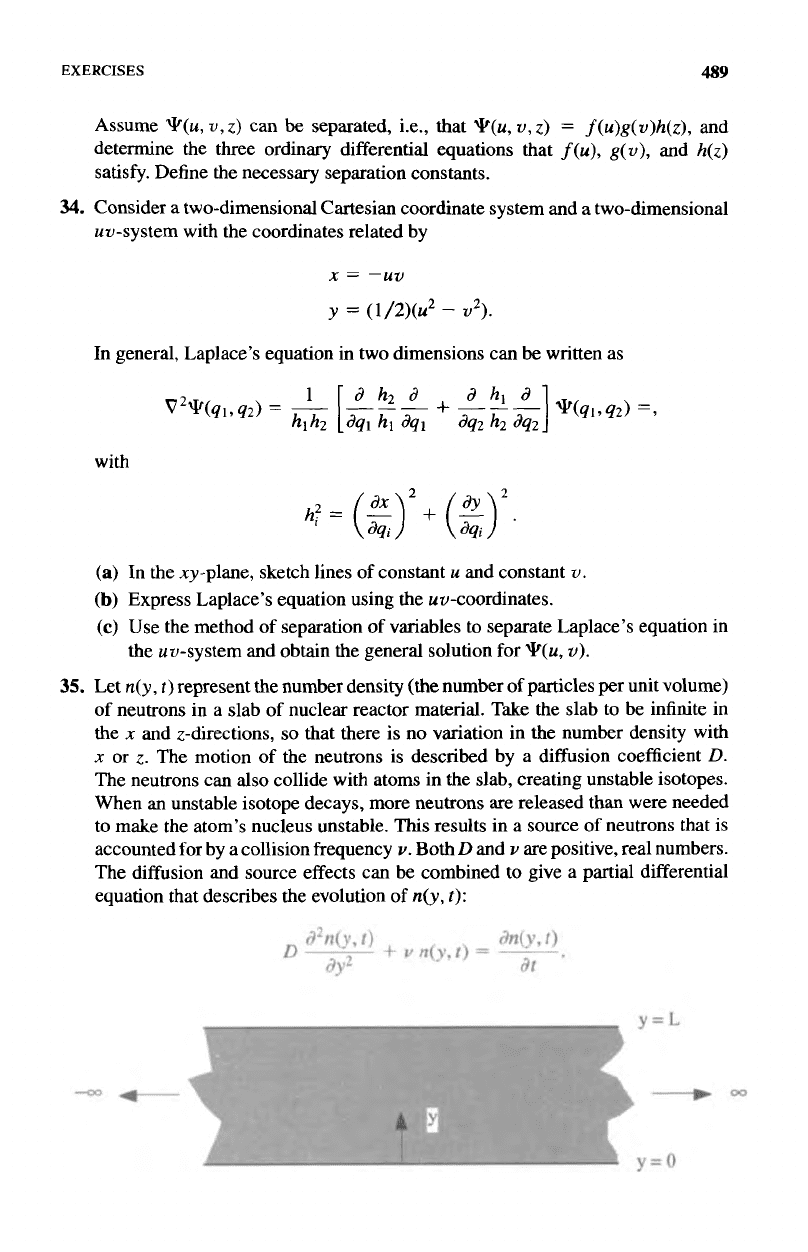
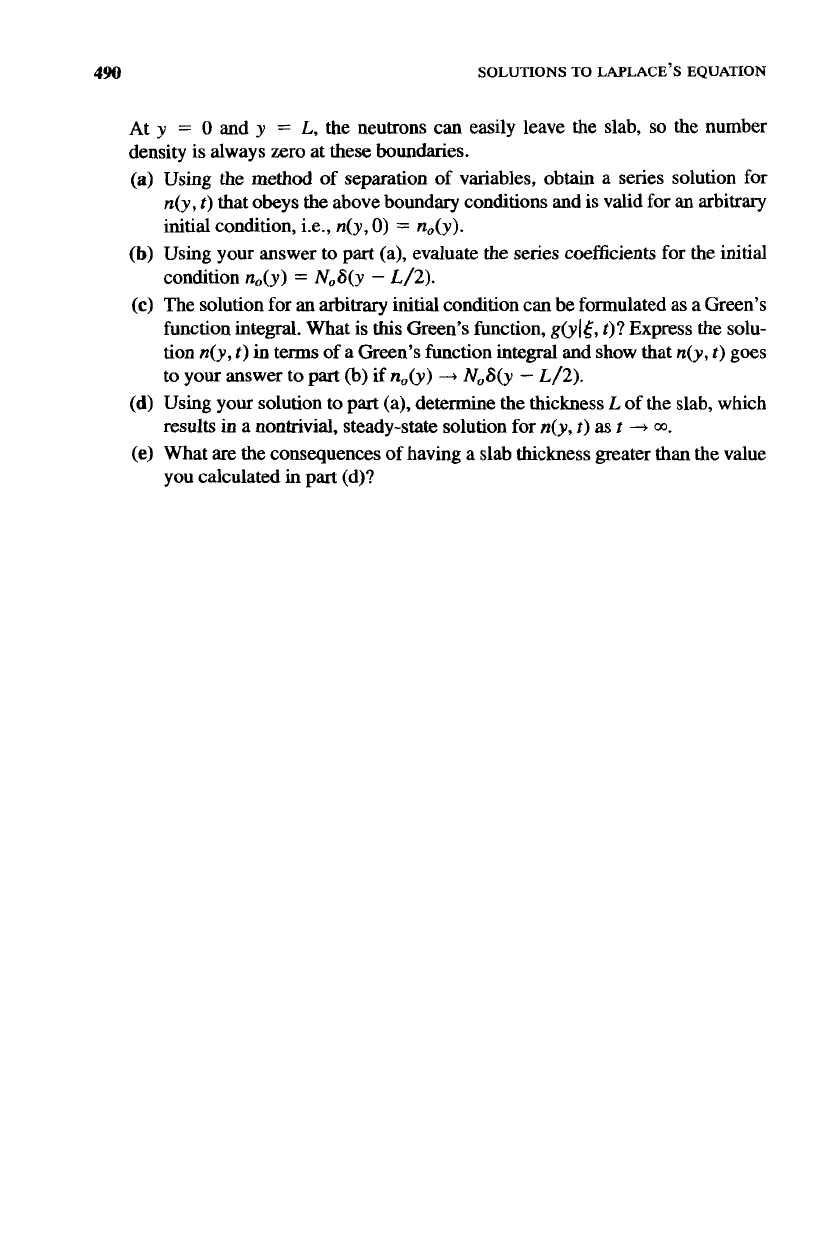
Let
n(y
,
t)
represent the number density
(the
number
of
particles per unit volume)
of
neutrons in a slab
of
nuclear reactor material. Take the slab to be infinite in
the
x
and z-directions,
so
that there
is
no variation in the number density with
x or
z.
The motion
of
the neutrons is described by a diffusion coefficient
D.
The neutrons can
also
collide with atoms in the slab, creating unstable isotopes.
When an unstable isotope decays, more neutrons are released than were needed
to make the atom's nucleus unstable.
This
results in a source
of
neutrons that is
accounted
for
by a collision frequency
v.
Both
D
and
v
are positive, real numbers.
The diffusion and source effects can be combined to give a partial differential
equation that describes the evolution of
n(y,
t):
the uv-system and obtain the general solution for
"(u,
v).
490
SOLUTIONS
TO
LAPLACE’S EQUATION
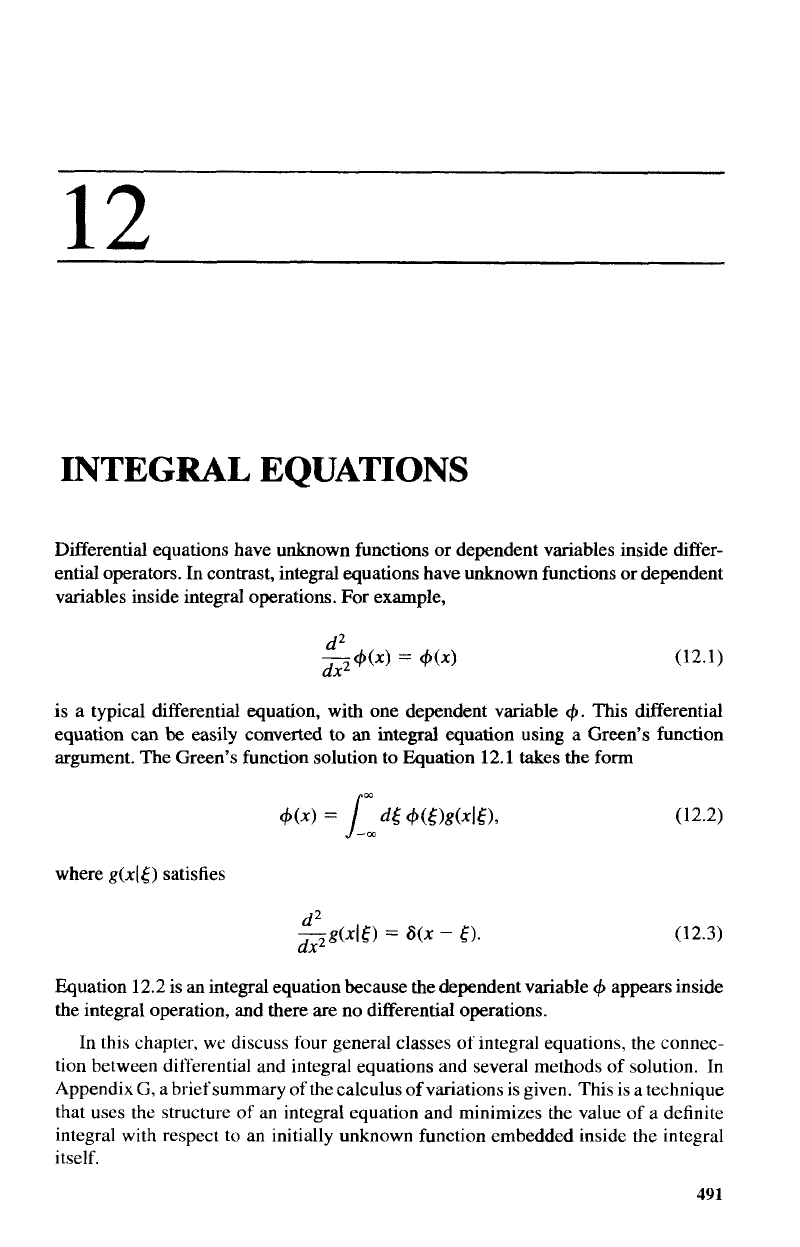
At
y
=
0
and
y
=
L,
the neutrons can easily leave the slab,
so
the number
density is always zero at these boundaries.
(a)
Using the method
of
separation
of
variables, obtain a series solution for
n(y,
t)
that obeys the above boundary conditions and
is
valid for
an
arbitrary
initial condition, i.e.,
n(y,
0)
=
no(y).
(b)
Using your answer to
part
(a), evaluate the series coefficients for the initial
condition
n,(y)
=
NoS(y
-
L/2).
(c)
The solution for an arbitrary initial condition can be formulated as a Green’s
function integral. What
is
this
Green’s function,
g(y(6,
t)?
Express
the
solu-
tion
n(y,
t)
in
terms
of
a Green’s function integral and show that
n(y,
t)
goes
to your answer to
part
(b)
if
n,(y)
-+
&S(y
-
L/2).
(d)
Using your solution to part (a), determine the thickness
L
of the slab, which
results
in
a nontrivial, steady-state solution
for
n(y,
t)
as
t
-+
00.
(e)
What are the consequences of having a slab thickness greater than the value
you calculated in
part
(d)?
12
INTEGRAL
EQUATIONS
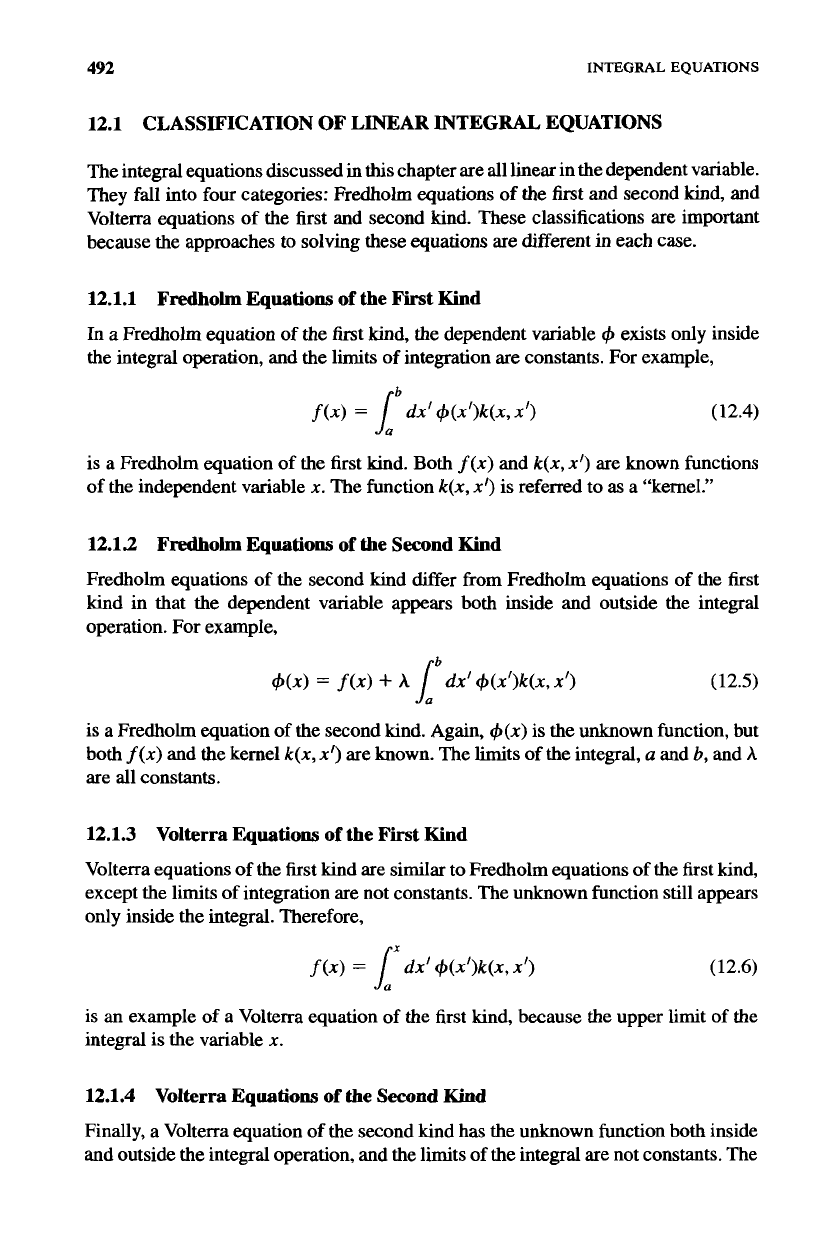
Differential equations have unknown functions
or
dependent variables inside differ-
ential operators. In contrast, integral equations have unknown functions or dependent
variables inside integral operations. For example,
(12.1)
is a typical differential equation, with one dependent variable
4.
This
differential
equation can be easily converted to
an
integral equation using a Green’s function
argument. The Green’s function solution to Equation
12.1
takes
the
form
where
g(x15)
satisfies
(12.2)
(12.3)
Equation
12.2
is
an
integral equation because the dependent variable
4
appears inside
the integral operation, and there are no differential operations.
In this chapter, we discuss four general classes
of
integral equations, the connec-
tion between differential and integral equations and several methods of solution.
In
Appendix
G,
a briefsummary of thecalculus of variations
is
given. This is a technique
that uses the structure of an integral equation and minimizes
the
value of
a
definite
integral with respect to an initially unknown function embedded inside the integral
itself.
491
492
INTEGRAL
EQUATIONS
12.1
CLASSIFICATION
OF
LINEAR INTEGRAL EQUATIONS
The integral equations discussed in
this
chapter are all linear in the dependent variable.
They fall into four categories: Fredholm equations
of
the
first
and second kind, and
Volterra equations of the first and second kind. These classifications are important
because the approaches to solving these equations are different in each case.
12.1.1
Fredholm
Equations
of
the First
Kind
In
a Fredholm equation
of
the
first
kind, the dependent variable
the integral operation, and the limits of integration are constants. For example,
exists only inside
f(x)
=
lbdx‘I#I(x’)k(x,x’)
(12.4)
is a Fredholm equation of the first kind. Both
f(x)
and
k(x, x’)
are known functions
of
the independent variable
x.
The function
k(x, x’)
is referred to
as
a “kernel.”
12.12
Fredholm
Equations
of
the
Second
Kind
Fredholm equations of the second kind differ from Fredholm equations of the first
kind in that the dependent variable appears both inside and outside the integral
operation. For example,
b
4(x)
=
f(x)
+
dx‘cP(x’)k(x,x’)
(12.5)
is a Fredholm equation of the second kind. Again,
I#I(x)
is
the unknown function, but
both
f(x)
and the kernel
k(x, x’)
are known. The limits of the integral,
a
and
b,
and
h
are all constants.
12.1.3
Volterra
F.cluations
of
the
First
Kind
Volterra equations
of
the first kind are similar to Fredholm equations of the first kind,
except the limits of integration are not constants. The unknown function still appears
only inside the integral. Therefore,
f(x)
=
LX
dx’ I#I(x’)k(x, x’)
(12.6)
is
an
example of a Volterra equation of the first kind, because the upper limit of the
integral
is
the variable
x.
12.1.4
Volterra
Equations
of
the
Second
Kind
Finally, a Volterra equation of the second kind has the unknown function both inside
and outside the integral operation, and the limits
of
the integral are not constants. The
rHE
CONNECTION BETWEEN DIFFERENTIAL AND INTEGRAL EQUATIONS
493
:quation
(12.7)
is
an example
of
a Volterra equation
of
the second kind.
12.2
THE CONNECTION BETWEEN DJFFERENTIAL
AND
INTEGRAL EQUATIONS
Differential equations can be converted to integral equations. In this process, the
boundary conditions associated with the differential equation are automatically in-
corporated into the integral equation. Thus, unlike differential equations, integral
equations will have unique solutions without specifying additional conditions.
Let’s see how a ordinary second-order,
linear
differential equation can be converted
to an integral equation. We
start
with the most general
form
+
A(x)S
+
B(x)y(x)
=
s(x),
d2yW
dx2 dx
(12.8)
where the functions
A(x), B(x)
and
s(x)
are
presumed to
be
known. Because this is
a second-order equation, two boundary conditions are required to make the solution
y(x)
unique.
For
this case, we will specify
y(x)
and its derivative at the point
x
=
a:
Y(a)
=
Yo
(12.9)
and
(12.10)
To
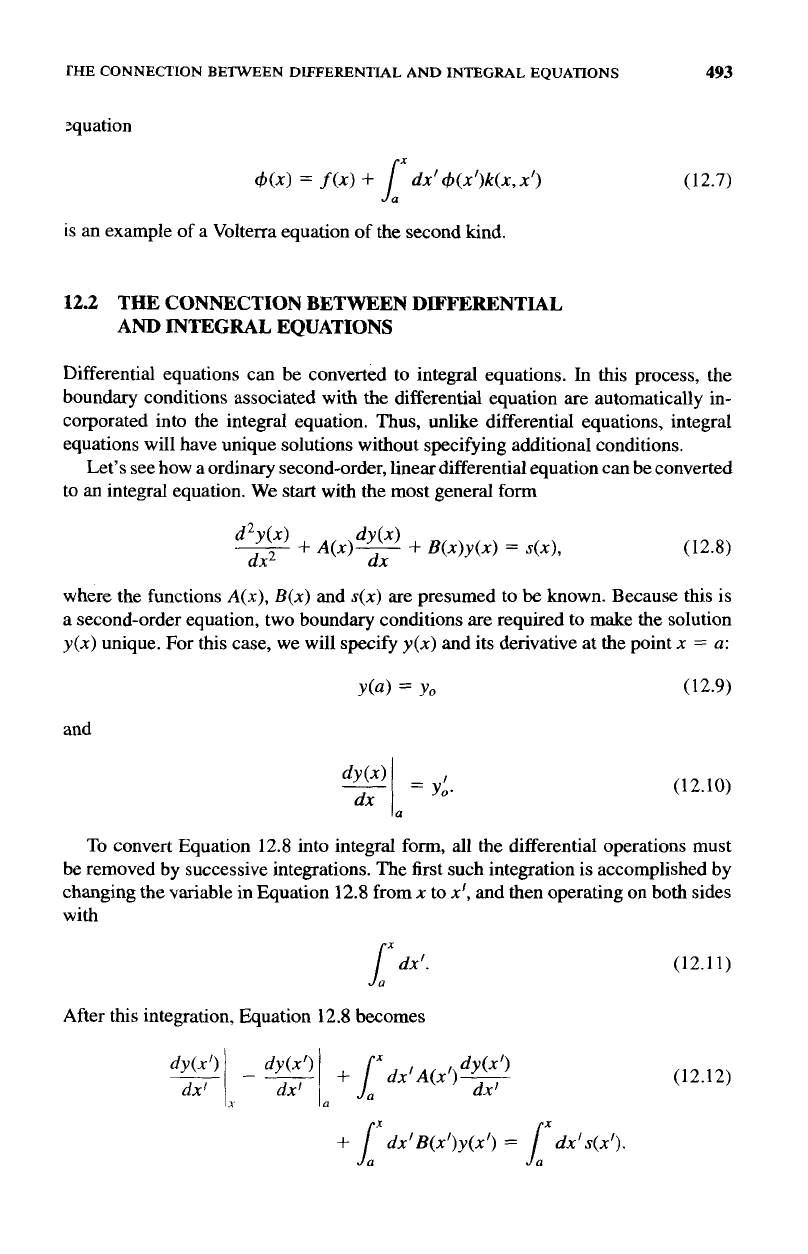
convert Equation 12.8 into integral form, all the differential operations must
be
removed by successive integrations. The first such integration is accomplished
by
changing the variable in Equation 12.8 from
x
to
x’,
and then operating
on
both sides
with
[
dx‘.
(12.11)
After this integration, Equation 12.8 becomes
(12.12)
+
lx
dx’B(x’)y(x’)
=
1’
dx’s(x’).
INTEGRAL
EQUATIONS
494
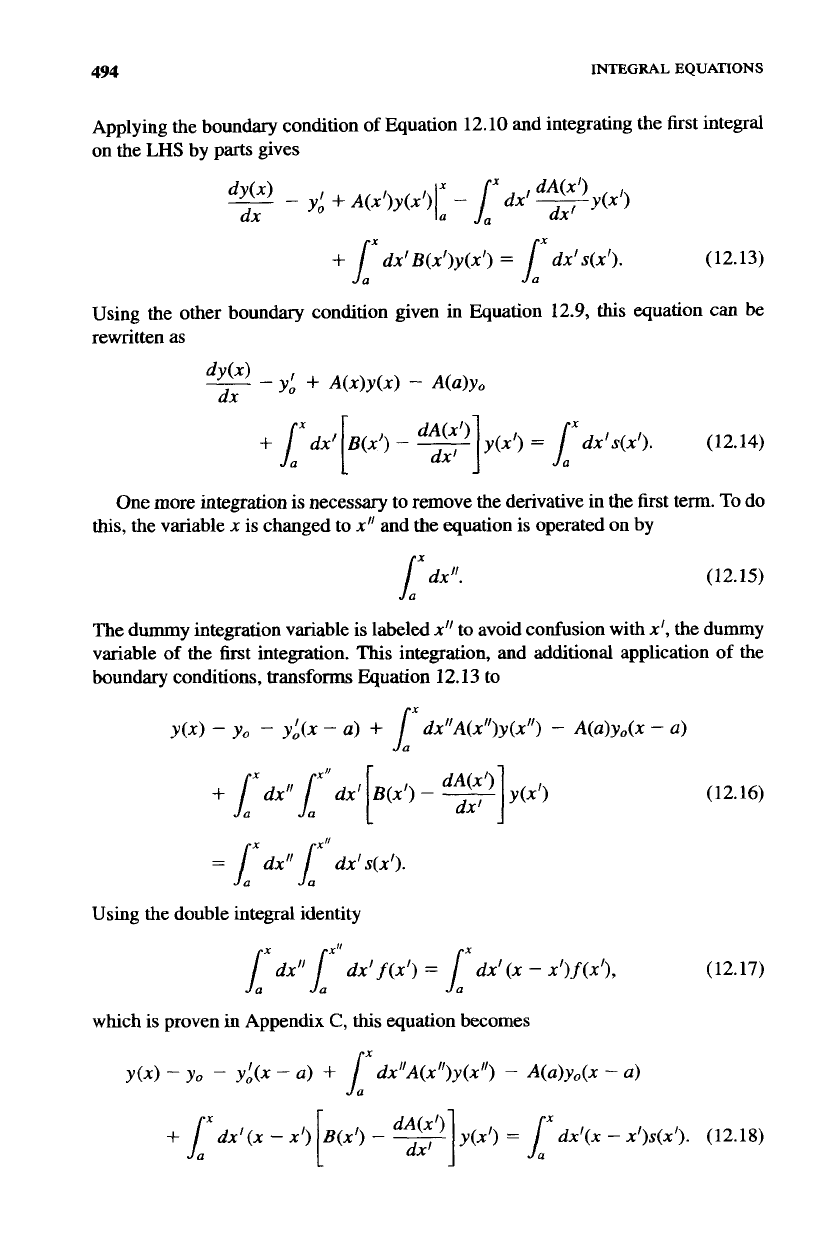
Applying the boundary condition
of
Equation 12.10 and integrating the first integral
on the
LHS
by parts gives
dA(x‘)
dx‘
-
Y (XI)
-
dY (X)
-
y:
+
A(x’)y(x‘)l’
-
1
dx
aa
dx‘
+
[
dx’B(x’)y(x’)
=
[
dx’s(x’).
(12.13)
Using the other boundary condition given in Equation
12.9,
this
equation can
be
rewritten as
--
dy(x)
y:
+
A(x)y(x)
-
A(u)yo
dx
+
[dx’b’)
-
-
y(x‘)
=
[
dx’s(x’).
(12.14)
dx’
One more integration is necessary to remove the derivative in the first term.
To
do
this,
the variable
x
is changed to
x‘‘
and the equation is operated on by
dx”.
(12.15)
The dummy integration variable is labeled
x’‘
to avoid confusion with
x‘,
the dummy
variable
of
the
first integration.
This
integration, and additional application
of
the
boundary conditions,
transforms
Equation
12.13
to
Y(X9
1
+
l’
dx“
l’”
dx’ b(x‘)
-
dA(x’)
7
=
Lx
dx”
L’”
dx’ s(x’).
Using the double integral identity
which is proven in Appendix
C,
this
equation becomes
(1
2.16)
(12.17)
dx’(x
-
x’)
[..’I
-
y]
y(x‘)
=
1
dx’(x
-
x’)s(x’).
(12.18)
+I
THE
CONNECTION BETWEEN DIFFERENTIAL AND INTEGRAL EQUATIONS
495
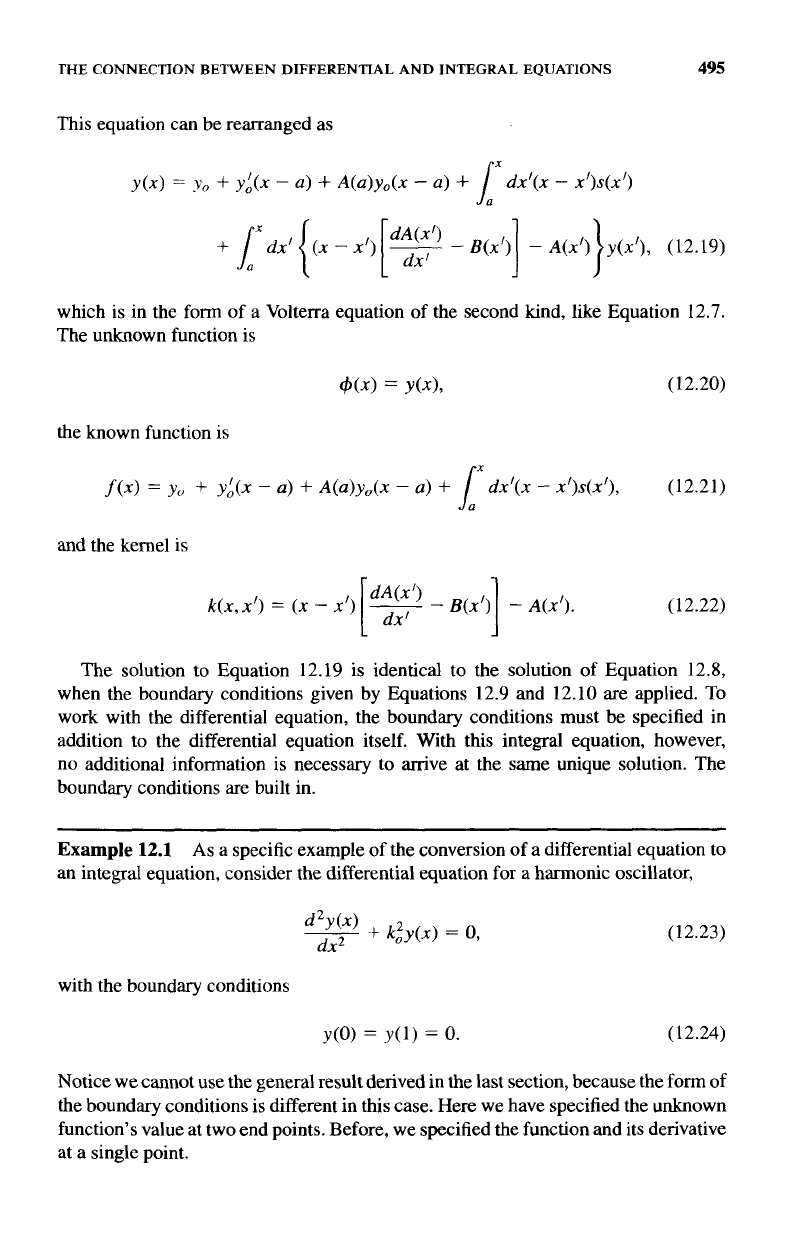
This equation can be rearranged as
y(x)
=
v,
+
yL(x
-
U)
+
A(u)y,(x
-
U)
+
~x’(x
-
x/)s(x’)
1
which is in the form
of
a
Volterra equation of the second kind, like Equation 12.7.
The unknown function is
the known function is
and the kernel is
k(x,x’)
=
(x
-
x’)
[
-
’:$’)
-
B(x’)]
-
A(x’).
(1 2.22)
The solution to Equation 12.19 is identical to the solution
of
Equation 12.8,
when the boundary conditions given by Equations 12.9 and 12.10 are applied. To
work with the differential equation, the boundary conditions must be specified in
addition to the differential equation itself. With this integral equation, however,
no additional information is necessary to arrive at the same unique solution. The
boundary conditions are built in.
Example
12.1
an integral equation, consider the differential equation for a harmonic oscillator,
As
a specific example
of
the conversion of a differential equation to
d2y(x)
+
k,2y(x)
=
0,
dx2
(12.23)
with the boundary conditions
y(0)
=
y(1)
=
0.
(12.24)
Notice we cannot use the general result derived in the last section, because the
form
of
the boundary conditions is different in
this
case. Here we have specified the unknown
function’s value at two end points. Before, we specified the function and its derivative
at a single point.