
Kusse B.R., Westwig E.A. Mathematical Physics: Applied Mathematics for Scientists and Engineers
Подождите немного. Документ загружается.

536
ADVANCED
TOPICS
IN
COMPLEX
ANALYSIS
Sheet
#1
Y
X
7-
Y
Sheet#2
1
Figure
13.30
Contour Deformation
with Two
Riemann Sheets
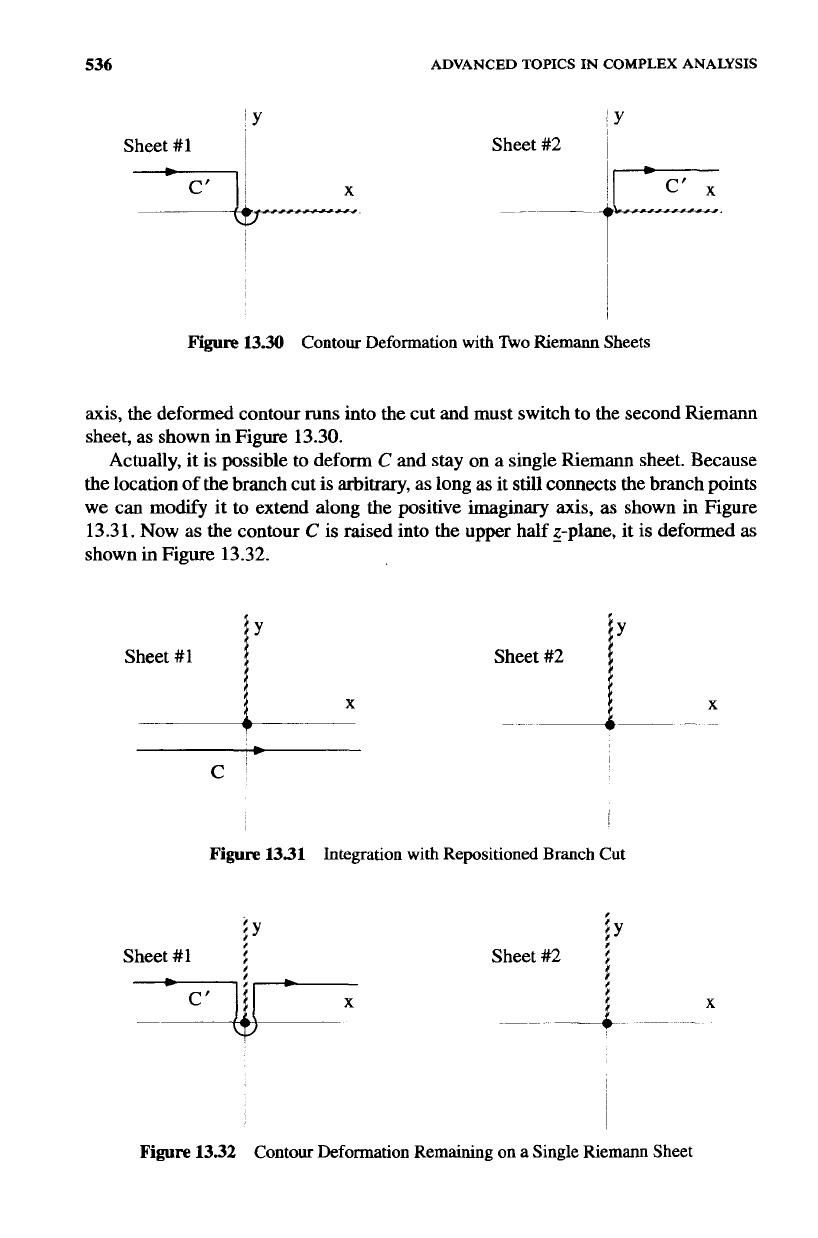
axis, the deformed contour runs into the cut and must switch to the second Riemann
sheet,
as
shown
in
Figure
13.30.
Actually, it is possible to deform
C
and
stay
on a single Riemann sheet. Because
the location
of
the branch cut is
arbitrary,
as long
as
it
still
connects the branch points
we
can mow it
to
extend along the positive
imaginary
axis,
as
shown
in
Figure
13.3
1.
Now
as the contour
C
is
raised into the upper half z-plane, it
is
deformed as
shown
in
Figure 13.32.
C
Figure
1331
Integration
with
Repositioned Branch Cut
I
Sheet
#1
I
Figure
13.32
Contour Deformation Remaining
on
a
Single Riemann Sheet
MULTIVALUED
FUNCTIONS
537
Figure
13.33
Integration Along
the
Branch Cut and Around
the
Branch Point
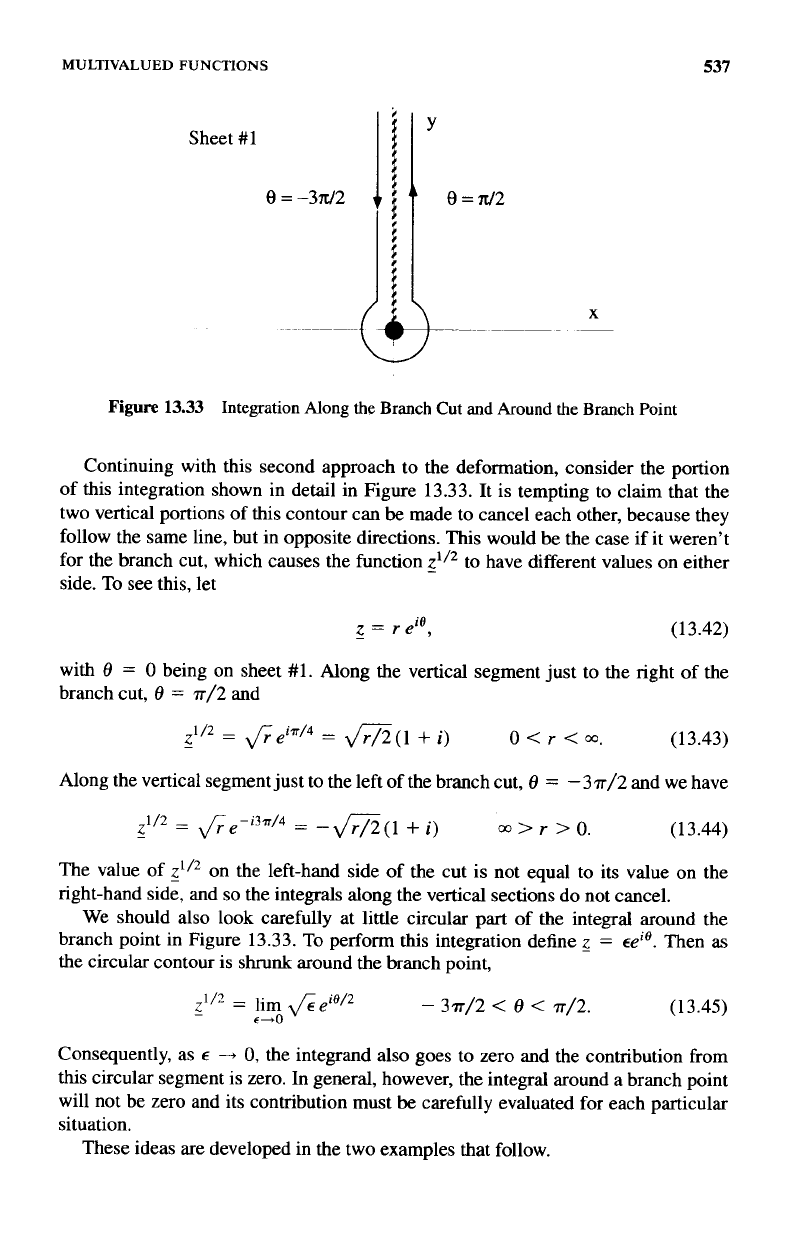
Continuing with this second approach to the deformation, consider the portion
of this integration shown in detail in Figure 13.33.
It
is tempting to claim that the
two vertical portions of this contour can
be
made
to
cancel each other, because they
follow the same line, but in opposite directions.
This
would be the case if it weren’t
for the branch cut, which causes the function
zl/*
to have different values on either
side.
To
see this. let
z
-
=
r
eie
(13.42)
with
8
=
0
being on sheet
#l.
Along the vertical segment just to the right
of
the
branch cut,
8
=
rr/2 and
g1I2
=
fieinI4
=
fi(1
+
i)
O<r<a.
(1 3.43)
Along the vertical segment just to the left of the branch cut,
8
=
-3rr/2 and we have
(1 3.44)
The
value of
gl/’
on the left-hand side of the cut is not equal to its value
on
the
right-hand side, and
so
the integrals along the vertical sections do not cancel.
We should
also
look carefully at
little
circular part of the integral around the
branch point in Figure 13.33.
To
perform
this
integration define
z
=
Eeie.
Then
as
the circular contour
is
shrunk
around the branch point,
lim
&
ei0I2
-
3~/2
<
8
<
~/2. (13.45)
Consequently, as
E
-
0,
the integrand also goes to zero and the contribution from
this circular segment is zero. In general, however, the integral around a branch point
will not be zero and its contribution must be carefully evaluated for each particular
situation.
p!
=
-
E’O
These ideas are developed in the two examples that follow.
538
ADVANCED
TOPICS
IN
COMPLEX
ANALYSIS
Figure
13.34
Complex Plane
Picture
for
Integration
of
Example
Example
13.7
As
an example
of
how contours involving multivalued functions can
be deformed
in
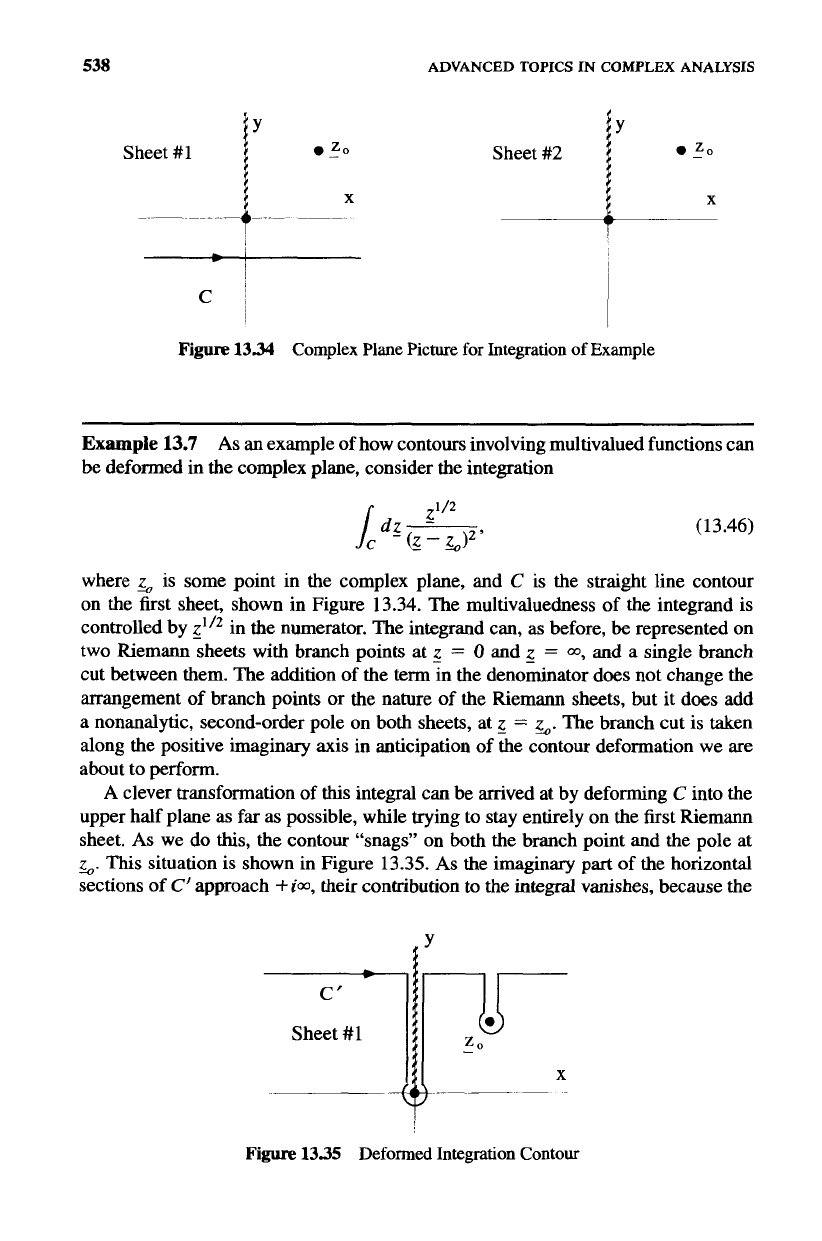
the complex plane, consider the integration
(13.46)
where
5
is some point in the complex plane, and
C
is the straight line contour
on the first sheet, shown in Figure 13.34. The multivaluedness
of
the integrand is
controlled by
g1I2
in the numerator. The integrand can,
as
before,
be
represented
on
two Riemann sheets with branch
points
at
g
=
0
and
z
=
03,
and a single branch
cut between them. The addition
of
the term in the denominator does not change
the
arrangement of branch points
or
the nature
of
the Riemann sheets, but it does add
a nonanalytic, second-order pole on both sheets, at
g
=
5.
The branch cut is taken
along the positive imaginary axis in anticipation
of
the contour deformation we are
about to perform.
A
clever transformation of
this
integral can be arrived at by deforming
C
into the
upper half plane
as
far
as possible, while trying to stay entirely on the first Riemann
sheet.
As
we
do
this,
the
contour “snags” on both the branch point and the pole at
G.
This
situation is shown in Figure 13.35.
As
the imaginary part of the horizontal
sections
of
C’
approach
+ia,
their contribution
to
the integral vanishes, because the
Figure
13.35
Deformed Inkgation Contour
MULTIVALUED
FUNCTIONS
539
Figure
13.36
Final Contours for Evaluating Integration
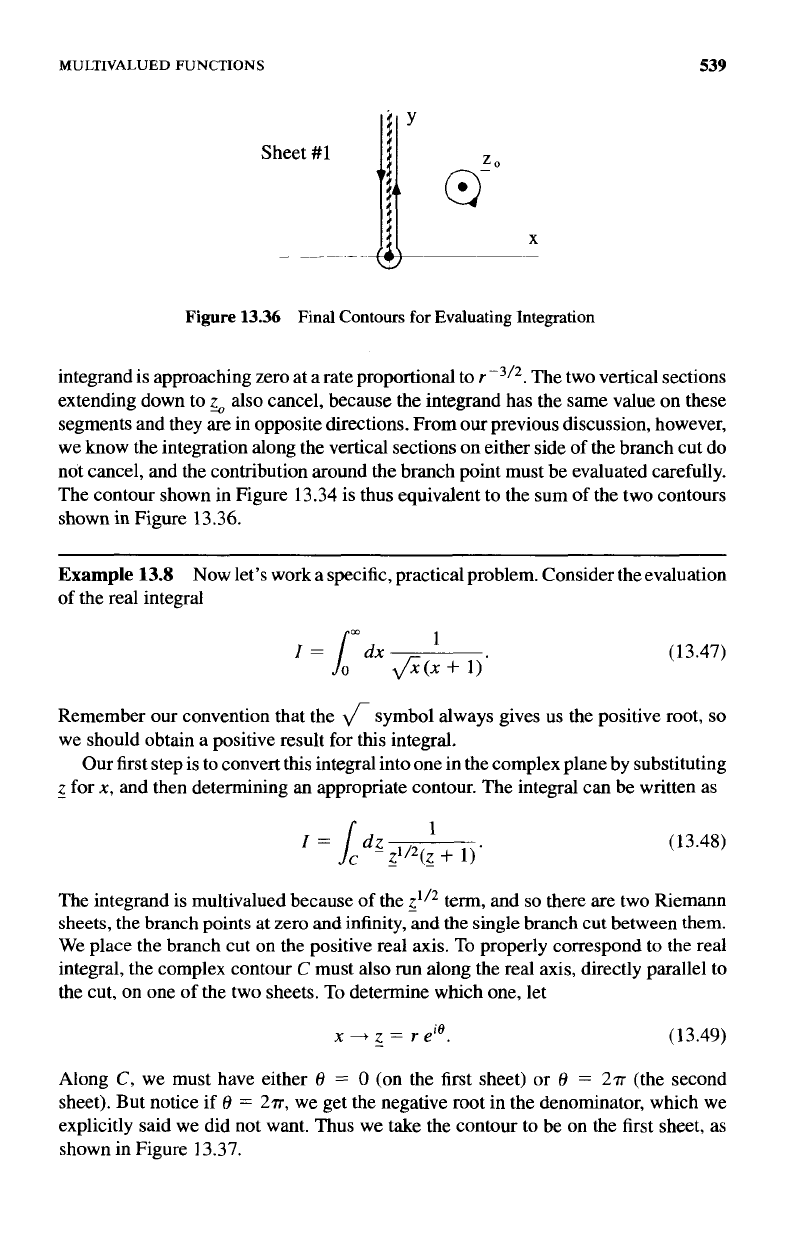
integrand is approaching zero at a rate proportional to
r-3/2.
The two vertical sections
extending down to
5
also cancel, because the integrand has the same value
on
these
segments and they are in opposite directions. From our previous discussion, however,
we know the integration along the vertical sections on either side of the branch cut do
not cancel, and the contribution around the branch point must be evaluated carefully.
The contour shown in Figure
13.34
is thus equivalent to the sum of the two contours
shown in Figure 13.36.
Example
13.8
of the real integral
Now
let's work a specific, practical problem. Consider the evaluation
1
m
I
=
b
dx
&x+
1)'
(13.47)
Remember our convention that the
we should obtain a positive result for
this
integral.
2
for
x,
and then determining
an
appropriate contour. The integral can be written as
symbol always gives us the positive root,
so
Our first step is to convert this integral into one in the complex plane by substituting
(I
3.48)
The integrand is multivalued because of the
2'12
term, and
so
there are two Riemann
sheets, the branch points at zero and infinity, and the single branch cut between them.
We place the branch cut
on
the positive real axis. To properly correspond to the real
integral, the complex contour
C
must also run along the real axis, directly parallel to
the cut, on one of the two sheets. To determine which one, let
x
-+
z
=
r
eie.
(13.49)
Along
C,
we must have either
0
=
0
(on the first sheet) or
0
=
27r
(the second
sheet). But notice if
0
=
27r,
we get the negative root in the denominator, which we
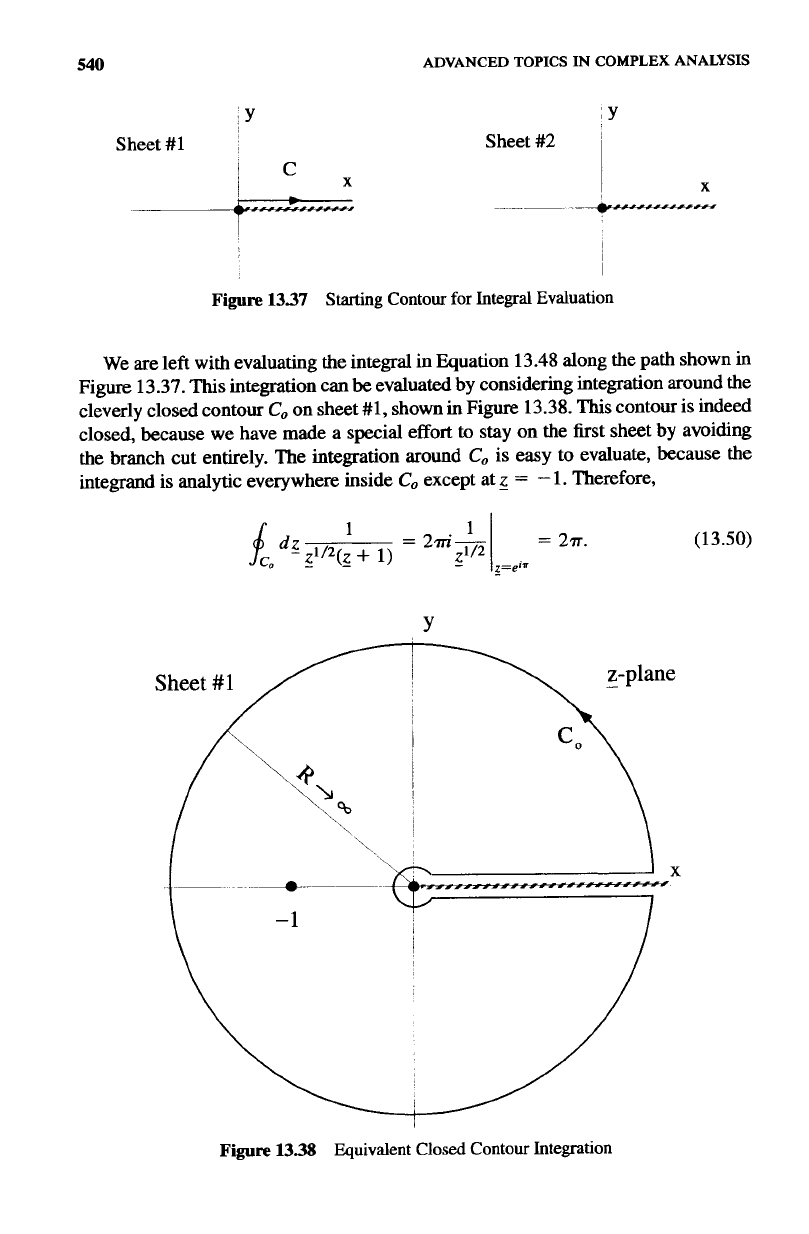
explicitly said we did not want. Thus we take the contour to be on the first sheet, as
shown in Figure 13.37.
540
Sheet
#1
cx
X
Figure
1337
Starting Contour
for
Integral
Evaluation
We are left with evaluating the integral in Equation
13.48
along the path shown in
Figure
13.37.
This
integration can
be
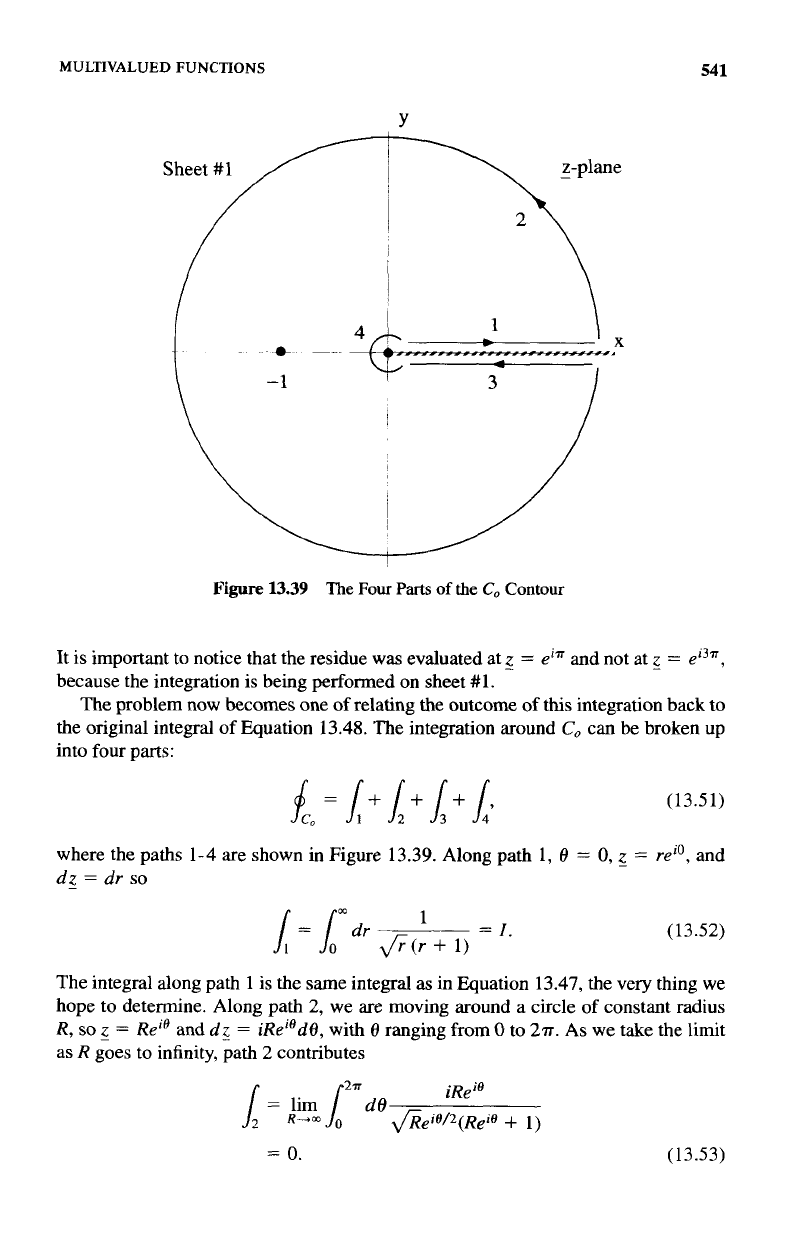
evaluated by considering integration around the
cleverly closed contour
C,
on sheet
#1,
shown in Figure
13.38.
This
contour is indeed
closed, because we have made a special effort to stay on the first sheet by avoiding
the branch cut entirely. The integration around
C,
is easy to evaluate, because the
integrand is analytic everywhere inside
C,
except at
g
=
-
1.
Therefore,
Y
(13.50)
Figure
13.38
Equivalent Closed Contour Integration
MULTIVALUED
FUNCTIONS
541
Y
*
-1
Figure
13.39
The
Four
Parts
of
the
C,
Contour
It is important to notice that the residue was evaluated at
z
=
eiT
and not at
z
=
ei3=,
because the integration
is
being performed on sheet
#l.
The problem now becomes one of relating the outcome of this integration back to
the original integral of Equation 13.48. The integration around
C,
can be broken up
into four parts:
(13.5 1)
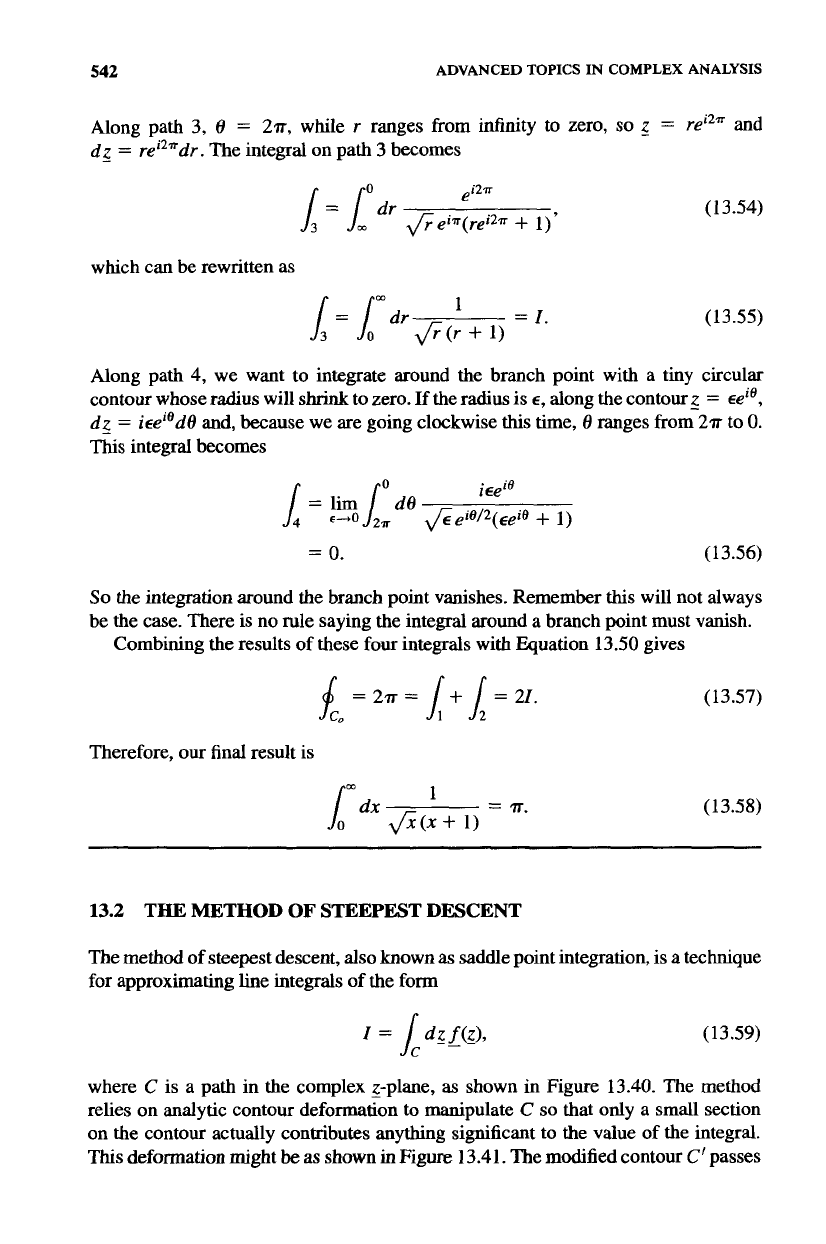
where the paths
1-4
are shown in Figure 13.39. Along path 1,
8
=
0,
z
=
re",
and
dz
=
dr
so
(13.52)
The integral along path
1
is
the
same integral as in Equation 13.47, the very thing we
hope to determine. Along path
2,
we are moving around a circle
of
constant radius
R,
so
z
=
Re"
and
dz
=
iReiedf3,
with
8
ranging from
0
to
2~.
As
we take the limit
as
R
goes to infinity, path
2
contributes
=
0.
(13.53)
542
ADVANCED
TOPICS
IN COMPLEX ANALYSIS
Along path
3,
8
=
2~,
while
r
ranges
from
infinity
to zero,
so
z
=
rei2=
and
dz
-
=
rei2*dr.
The integral on path
3
becomes
which can be rewritten as
(1
3.54)
(13.55)
Along path
4,
we want to integrate around the branch point with a tiny circular
contour whose
radius
will
shrink
to zero. If the radius is
E,
along the contour
3
=
EeiB,
dz
=
ieeied8
and, because we are going clockwise
this
time,
8
ranges from
27r
to
0.
This
integral becomes
=
0.
(13.56)
So
the
integration around
the
branch point vanishes. Remember
this
will not always
be the case. There is no rule saying the integral around a branch point must vanish.
Combining the results of these four integrals with Equation
13.50
gives
(13.57)
Therefore,
our
final result
is
-
-
T.
(13.58)
1
m
13.2
THE
METHOD
OF
STEEPEST DESCENT
The method of steepest descent,
also
known as saddle point integration,
is
a technique
for approximating
line
integrals of the form
(13.59)
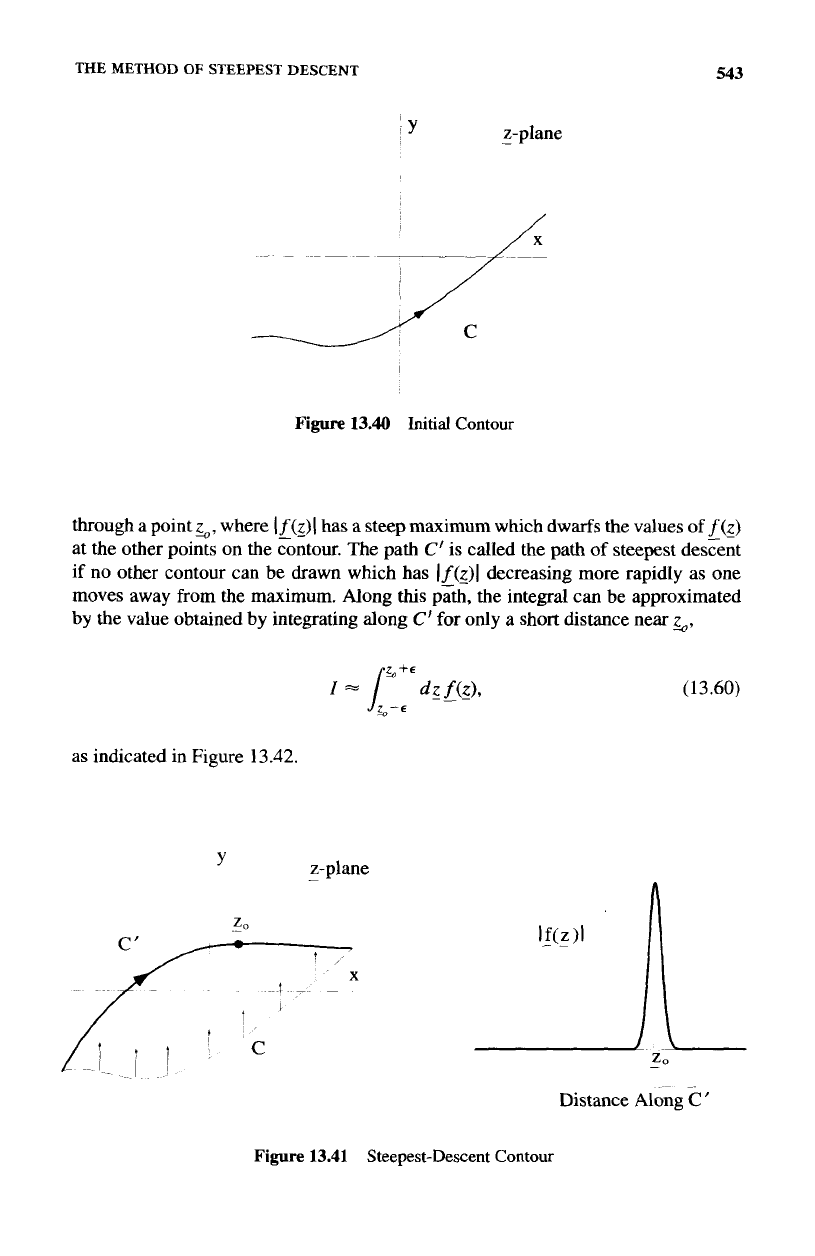
where
C
is
a path in the complex g-plane,
as
shown in Figure 13.40.
The
method
relies on analytic contour deformation to manipulate
C
so
that only a small section
on
the
contour actually contributes anything significant to the value of the integral.
This
deformation might
be
as shown
in
Figure
13.41. The modified contour
C'
passes
THE METHOD
OF
STEEPEST DESCENT
543
IY
-
z-plane
Figure
13.40
Initial Contour
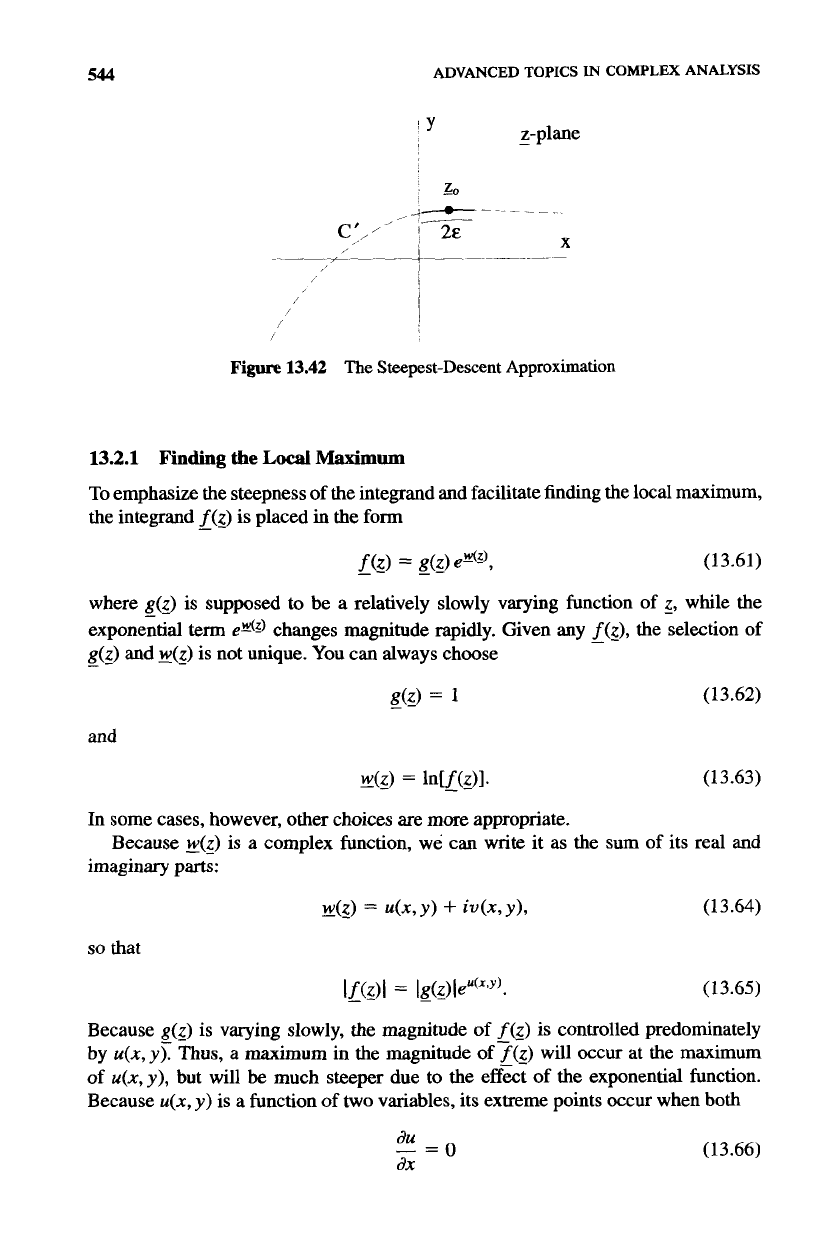
through a point
L,
where
If(z)l
has a steep maximum which dwarfs the values
of
f(z)
at the other points on the contour. The path
C‘
is
called the path of steepest descent
if no other contour can be drawn which has
If(g)I
decreasing more rapidly as one
moves away from the maximum.
Along
this
pgth, the integral can be approximated
by the value obtained by integrating along
C’
for only
a
short distance near
G,
as indicated in Figure
13.42.
z-plane
Y
-
(1
3.60)
a
Distance Along
C’
Figure
13.41
Steepest-Descent Contour
544
ADVANCED
TOPICS
IN
COMPLEX ANALYSIS
--f
z-plane
-
Y
Figure
13.42
The Steepest-Descent
Approximation
13.2.1
Finding
the
Locai
Maximum
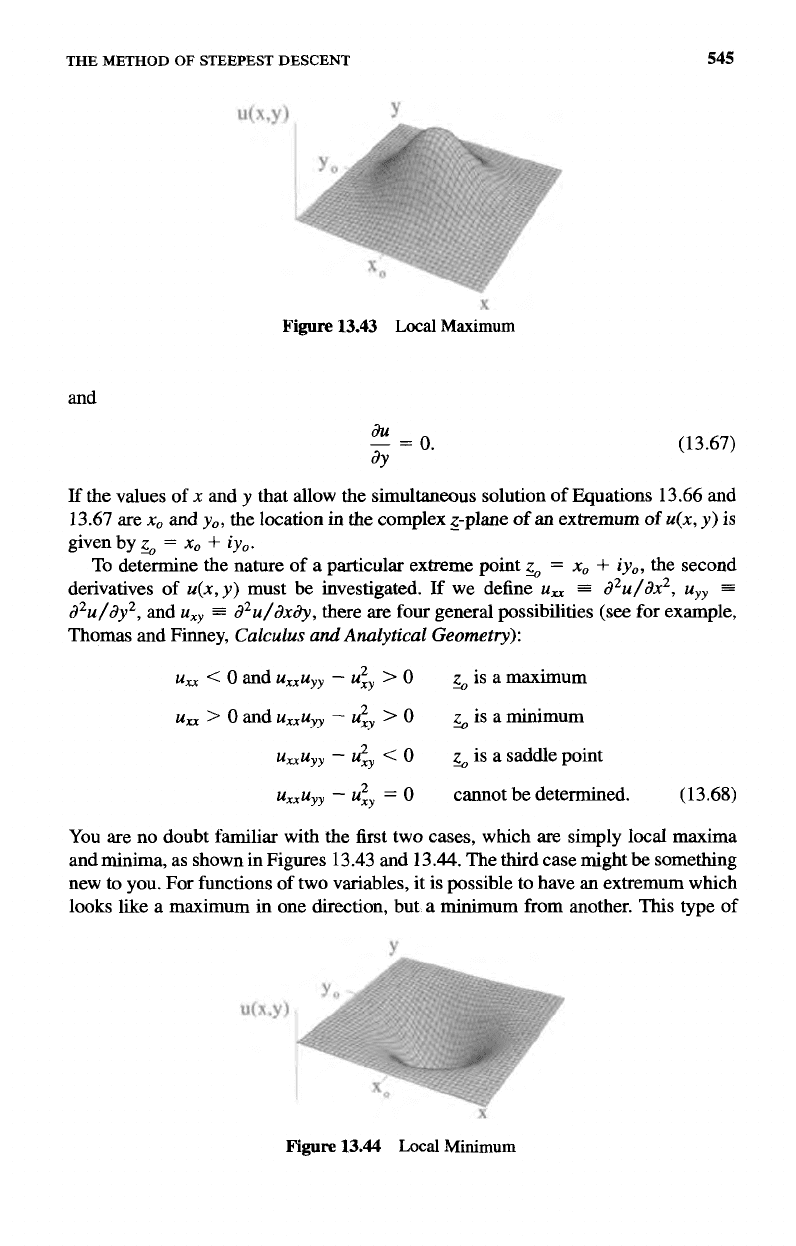
To
emphasize the steepness
of
the integrand and facilitate finding the local maximum,
the integrand
-
f(z)
is placed in the
form
(13.61)
where
g(g)
-
is
supposed to be a relatively slowly varying function
of
g,
while the
exponential term
&)
changes magnitude rapidly. Given any
-
f(&
the selection
of
g(z)
-
and
~(g)
is not unique.
You
can always choose
and
(13.62)
(13.63)
In
some
cases, however, other choices
are
more appropriate.
imaginary parts:
Because
~(z)
is
a
complex function, we can write it as the sum
of
its real and
so
that
Because
&)
is varying slowly, the magnitude of
f(z)
is controlled predominately
by
u(x,
y>7
Thus,
a
maximum in the magnitude
of
&)
will occur at the maximum
of
u(x,y),
but
will
be
much steeper due to the effkt
of
the exponential function.
Because
u(x,
y)
is
a function
of
two variables, its extreme points occur when both
(13.66)
THE METHOD
OF
STEEPEST DESCENT
545
X
Figure
13.43
Local
Maximum
and
-
0.
au
--
dY
(13.67)
If
the
values of
x
and
y
that allow the simultaneous solution of Equations 13.66 and
13.67 are
x,
and
yo,
the location in
the
complex g-plane of
an
extremum of
u(x,
y)
is
given by
z,
=
x,
+
iy,.
To
determine the nature of a particular extreme point
z,
=
x,
+
iy,,
the second
derivatives of
u(x,y)
must be investigated.
If
we define
u,
=
d2u/dx2,
uyy
=
d2u/dy2,
and
uxy
=
d2u/dxdy,
there
are
four general possibilities (see for example,
Thomas and Finney,
Calculus
and
Analytical Geometry):
u,
<
0
and
uxxuyy
-
u:y
>
0
u,
>
0
and
uxxuyy
-
u:~
>
0
u,uyy
-
u:y
<
0
u,uyy
-
u:y
=
0
cannot be determined. (13.68)
You are no doubt familiar with the first two cases, which are simply
local
maxima
and minima, as shown in Figures 13.43 and
13.44.
The third case might
be
something
new to you. For functions of two variables, it is possible to have
an
extremum which
looks
like a maximum in one direction, but a minimum from another.
This
type of
z,
is a maximum
z,
is a minimum
z,
is a saddle point
V
Figure
13.44
Local
Minimum