
Kusse B.R., Westwig E.A. Mathematical Physics: Applied Mathematics for Scientists and Engineers
Подождите немного. Документ загружается.

546
ADVANCED TOPICS
IN
COMPLEX
ANALYSIS
X
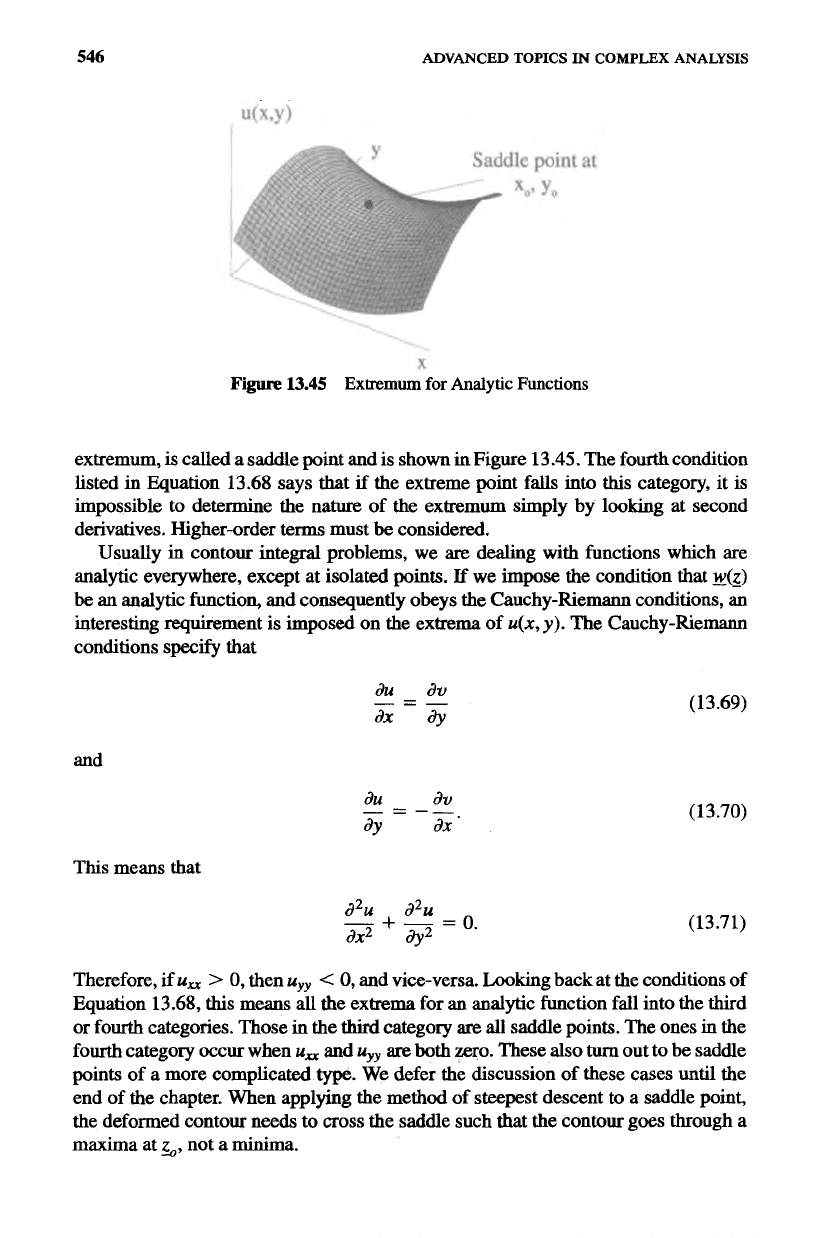
Figure
13.45
Extremum
for
Analytic
Functions
extremum,
is
called a saddle point and is shown in Figure
13.45.
The fourth condition
listed in Equation
13.68
says that
if
the extreme point falls into
this
category, it is
impossible to determine the nature of the extremum simply by looking at second
derivatives. Higher-order
terms
must
be
considered.
Usually in contour integral problems, we
are
dealing with functions which are
analytic everywhere, except at isolated
points.
If
we
impose
the condition that
~(z)
be
an analytic function, and consequently obeys the Cauchy-Riemam conditions,
an
interesting requirement
is
imposed on the extrema of
u(x,
y).
The Cauchy-Riemann
conditions
specify
that
and
This
means that
(13.69)
(13.70)
(13.7 1)
Therefore,
if u,
>
0,
then
uyy
<
0,
and vice-versa. Looking back at the conditions of
Equation
13.68,
this
means
all
the
extrema for
an
analytic function fall into the third
or
fourth
categories. Those
in
the
third
category
are
all
saddle points.
The
ones
in
the
fourth
category occur when
u,
and
uyy
are
both zero. These also
turn
out to be saddle
points of a more complicated
type.
We defer the discussion of these cases until the
end of the chapter. When applying the method of steepest descent to a saddle point,
the deformed contour needs to
cross
the saddle such that the contour goes through
a
maxima at
5,
not a minima.
THE
METHOD
OF
STEEPEST DESCENT
547
We already determined the extrema of
are located where
x
and
y
satisfy
Equations 13.66 and 13.67.
If
we
are dealing with analytic functions, these equations
also imply that
&/dx
and
&/dy
will
also
be zero at these points. Therefore, a simpler
way to determine the location of the saddle points of analytic functions is
by
using
the expression
du
dv
dw
-
+
i-
=
=
0
at the saddle points.
dx
dy
dg
(13.72)
13.2.2
The path of steepest descent is the path through the saddle point that makes the
peak
of
the curve, plotted in Figure 13.41,
as
narrow
as
possible. One simple way to visualize
this
is
to think of the area around the saddle point
as
a mountain pass, and the path of
steepest descent the shortest way through the pass. Alternatively, it is the path a skier
would take to descend from the saddle point the fastest. Notice, the course the path
takes is dependent on the details of the topology. It does not necessarily follow lines
of constant
y
or constant
x,
and in general
is
not even a straight line.
A
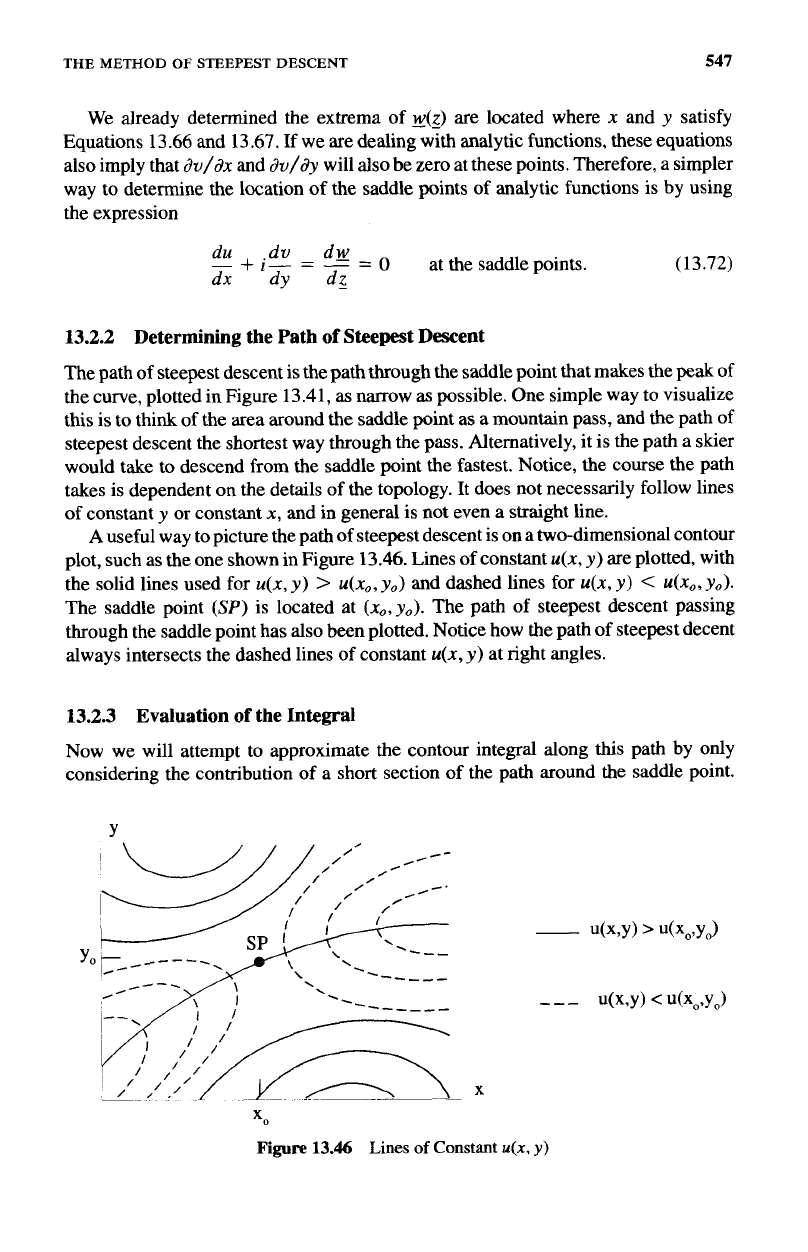
useful way to picture the path of steepest descent is on a two-dimensional contour
plot, such as the one shown
in
Figure 13.46. Lines of constant
u(x,
y)
are
plotted, with
the solid lines used for
u(x,
y)
>
u(xo,
yo)
and dashed lines for
u(x,
y)
<
u(xo,
yo).
The saddle point
(SP)
is located at
(xo,yo).
The path
of
steepest descent passing
through the saddle point has
also
been plotted. Notice how the path of steepest decent
always intersects the dashed lines
of
constant
u(x,
y)
at right angles.
Determining the Path
of
Steepest Descent
13.2.3 Evaluation
of
the Integral
Now we will attempt to approximate the contour integral along
this
path by only
considering the contribution of a short section of the path around the saddle point.
Y
X
XO
Figure
13.46
Lines
of
Constant
u(x,
y)
548
ADVANCED TOPICS
IN
COMPLEX ANALYSIS
X
xo
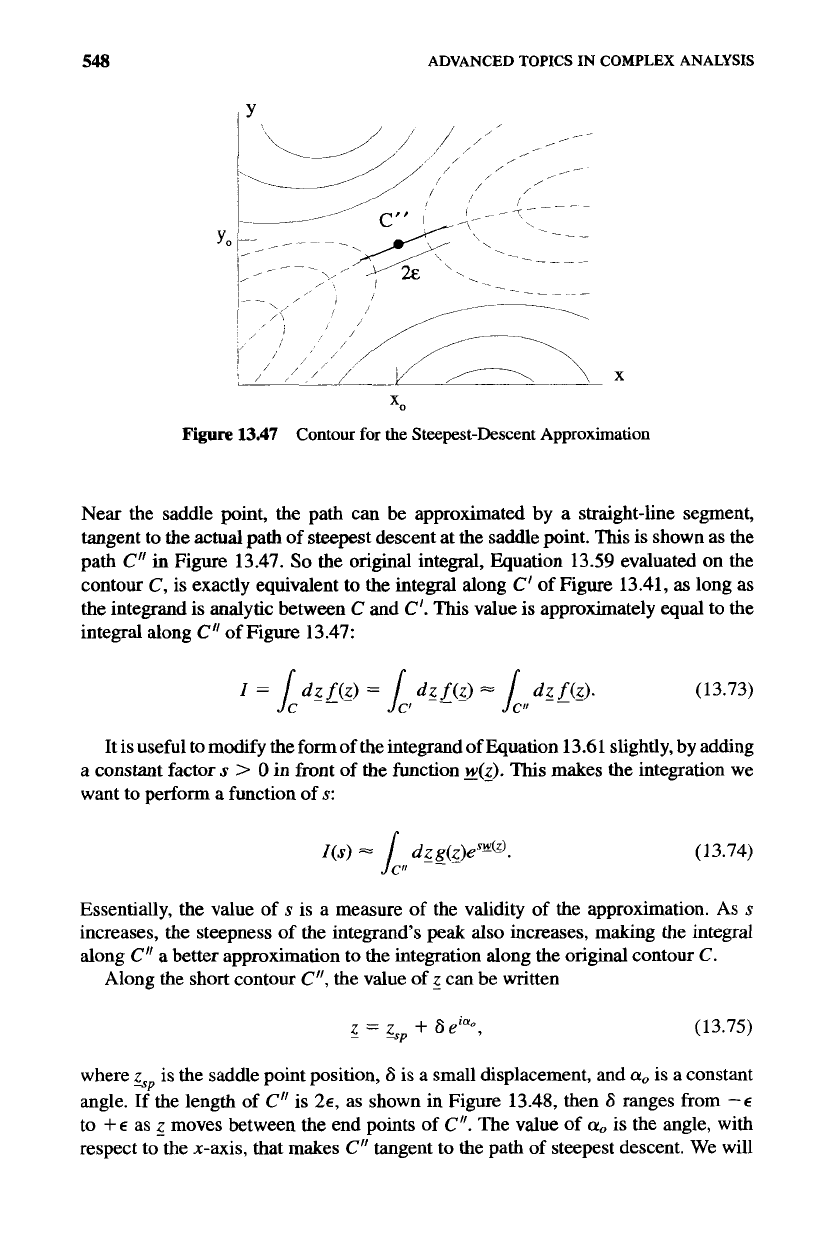
Figure
13.47
Contour for
the
Steepest-Descent Approximation
Near the saddle point, the path can be approximated by
a
straight-line segment,
tangent
to
the actual path of steepest descent at the saddle point.
This
is shown
as
the
path
C"
in
Figure
13.47.
So
the original integral, Equation
13.59
evaluated on the
contour
C,
is exactly equivalent to the integral along
C'
of
Figure
13.41,
as
long as
the integrand is analytic between
C
and
C'.
This
value is approximately equal to the
integral along
C"
of
Figure
13.47:
(13.73)
It is useful to modify the form of the integrand of Equation
13.61
slightly, by adding
a constant factors
>
0
in front of
the
function
~(3).
This
makes the integration we
want to perform a function of
s:
(13.74)
Essentially, the value of
s
is a measure
of
the validity
of
the approximation.
As
s
increases, the steepness of the integrand's
peak
also increases, making the integral
along C" a better approximation to the integration along the original contour
C.
Along the
short
contour
CN,
the value of
z
can be written
3
=
z,
+
6eiao,
(13.75)
where
z+,
is the saddle point position,
S
is
a small displacement, and
a.
is a constant
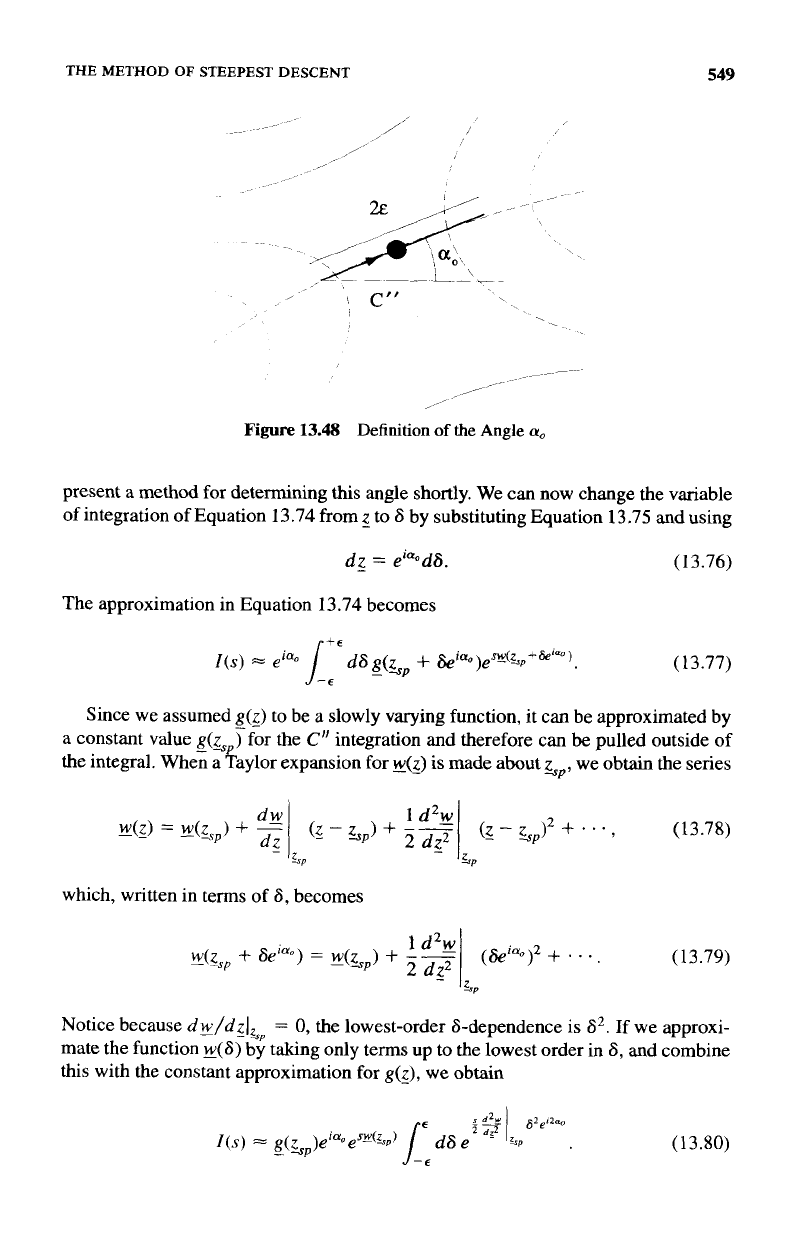
angle. If the length of
C"
is
2~,
as shown in Figure
13.48,
then
6
ranges
from
-E
to
+E
as
z
moves between the end points of
CN.
The value of
a,
is the angle, with
respect to the
x-axis,
that makes
C"
tangent to the path of steepest descent. We will
THE METHOD
OF
STEEPEST
DESCENT
549
Figure
13.48
Definition
of
the
Angle
a,
present a method for determining this angle shortly. We can now change the variable
of integration
of
Equation 13.74
from
z_
to
6
by substituting Equation 13.75 and using
dz_
=
e'"Od8.
(13.76)
The approximation in Equation 13.74 becomes
Since we assumed
g(z>
to be a slowly varying function, it can be approximated by
a constant value &,,for the
C"
integration and therefore
can
be
pulled outside of
the integral. When a Taylor expansion for
~(g)
is
made about
G,,
we obtain the series
which, written in terms of
6,
becomes
(13.79)
Notice because
d"t./dzlg
=
0,
the lowest-order &dependence is
6'.
If we approxi-
mate the function
~(6)
by taking only terms up to the lowest order in
6,
and combine
this with the constant approximation for
g(g),
we obtain
(13.80)
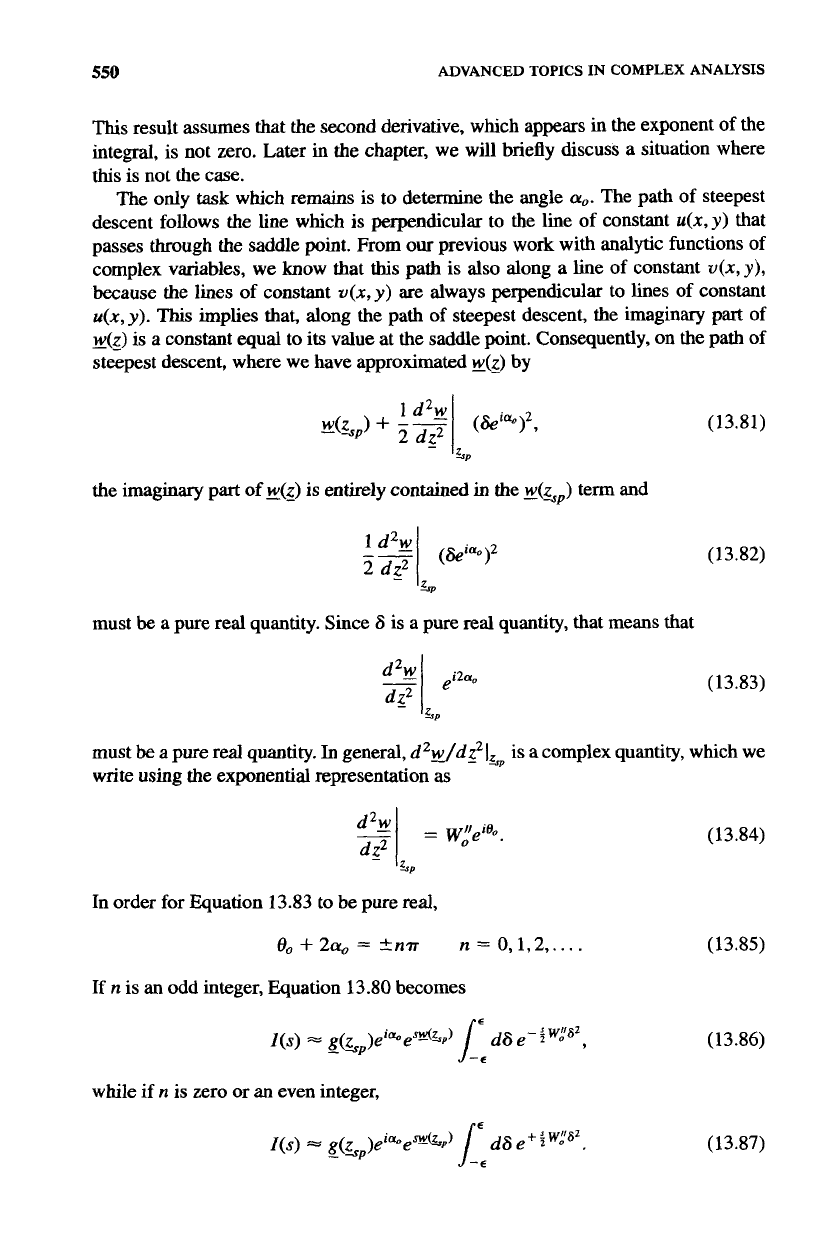
550
ADVANCED TOPICS IN COMPLEX ANALYSIS
This
result assumes
that
the second derivative, which appears in the exponent
of
the
integral,
is
not zero. Later in the chapter, we will briefly discuss a situation where
this
is not the case.
The only
task
which remains
is
to determine the angle
cw,.
The path
of
steepest
descent follows the line which
is
perpendicular to the line
of
constant
u(x,y)
that
passes through the saddle point. From
our
previous work with analytic functions
of
complex variables, we know that
this
path is
also
along a line
of
constant
u(x,
y),
because the lines
of
constant
v(x,y)
are always perpendicular
to
lines of constant
u(x,
y).
This
implies that, along the path
of
steepest descent, the imaginary part
of
w(z)
is
a
constant equal to
its
value at the saddle point. Consequently, on
the
path
of
steepest descent, where we have approximated
~(5)
by
the imaginary
part
of
~(z)
is entirely contained in the
IV(G~)
term and
'5p
must be a pure real quantity. Since
6
is
a pure real quantity, that means that
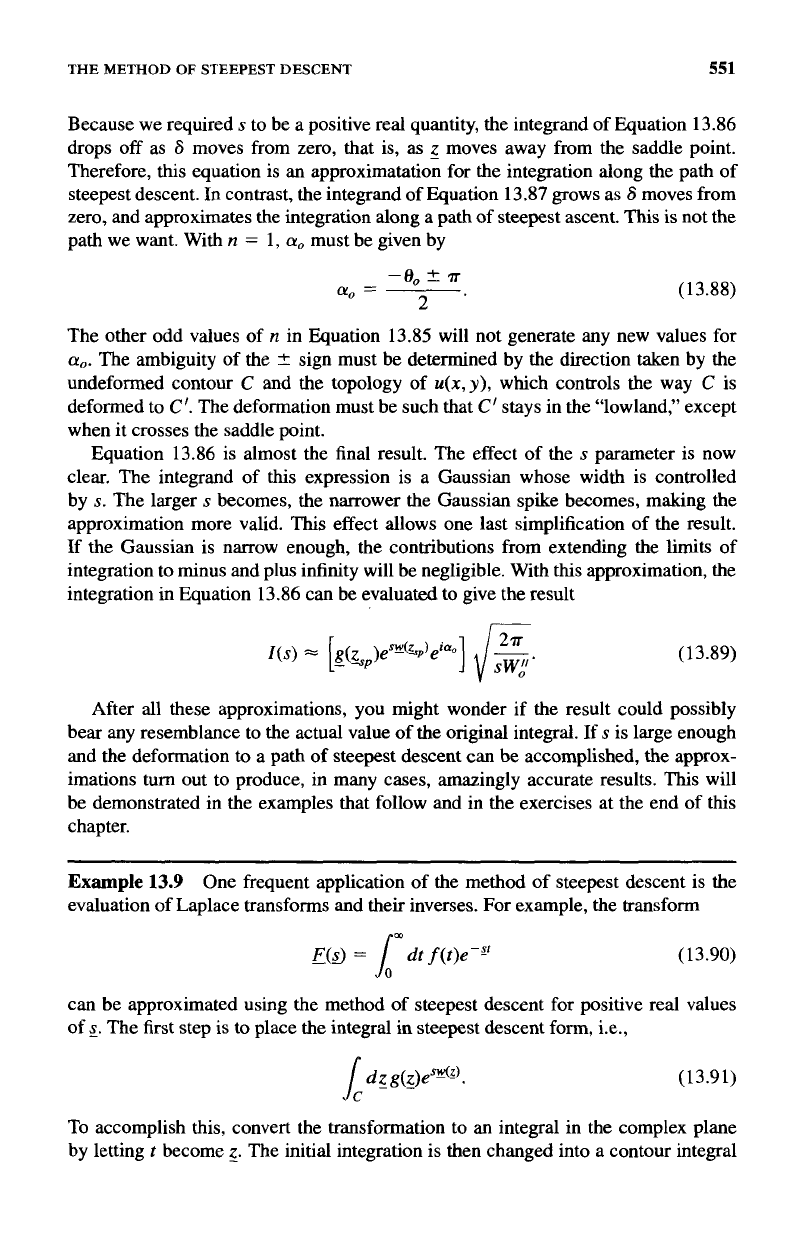
(13.81)
(13.82)
(13.83)
must
be
a pure real quantity.
In
general,
d2y/dg21Gp
is a complex quantity, which we
write
using the exponential representation
as
In order for Equation 13.83 to be pure real,
OO+2q,=
2nv
n=0,1,2
,....
If
n
is
an odd integer, Equation 13.80 becomes
while
if
n
is zero or
an
even integer,
(13.84)
(13.85)
(13.86)
(13.87)
THE METHOD
OF
STEEPEST DESCENT
551
Because we required
s
to be a positive real quantity, the integrand of Equation 13.86
drops
off
as
6
moves from zero, that is,
as
z
moves away from the saddle point.
Therefore,
this
equation is an approximatation for the integration along the path of
steepest descent.
In
contrast,
the
integrand of Equation 13.87 grows as
S
moves from
zero, and approximates the integration along a path of steepest ascent.
This
is not the
path we want. With
n
=
1,
a,
must be given by
(13.88)
The other odd values of
n
in Equation 13.85 will not generate any new values for
a,.
The ambiguity of the
%
sign must be determined by the direction taken by the
undeformed contour
C
and the topology of
u(x,y),
which controls the way
C
is
deformed to
C’.
The deformation must be such that
C’
stays in the “lowland,” except
when it crosses the saddle point.
Equation 13.86 is almost the final result. The effect of the
s
parameter is now
clear. The integrand of this expression is a Gaussian whose width is controlled
by
s.
The larger
s
becomes, the narrower the Gaussian spike becomes, making the
approximation more valid.
This
effect allows one last simplification of
the
result.
If the Gaussian is narrow enough, the contributions from extending the limits of
integration to minus and plus infinity will be negligible. With
this
approximation, the
integration
in
Equation 13.86 can be evaluated to give the result
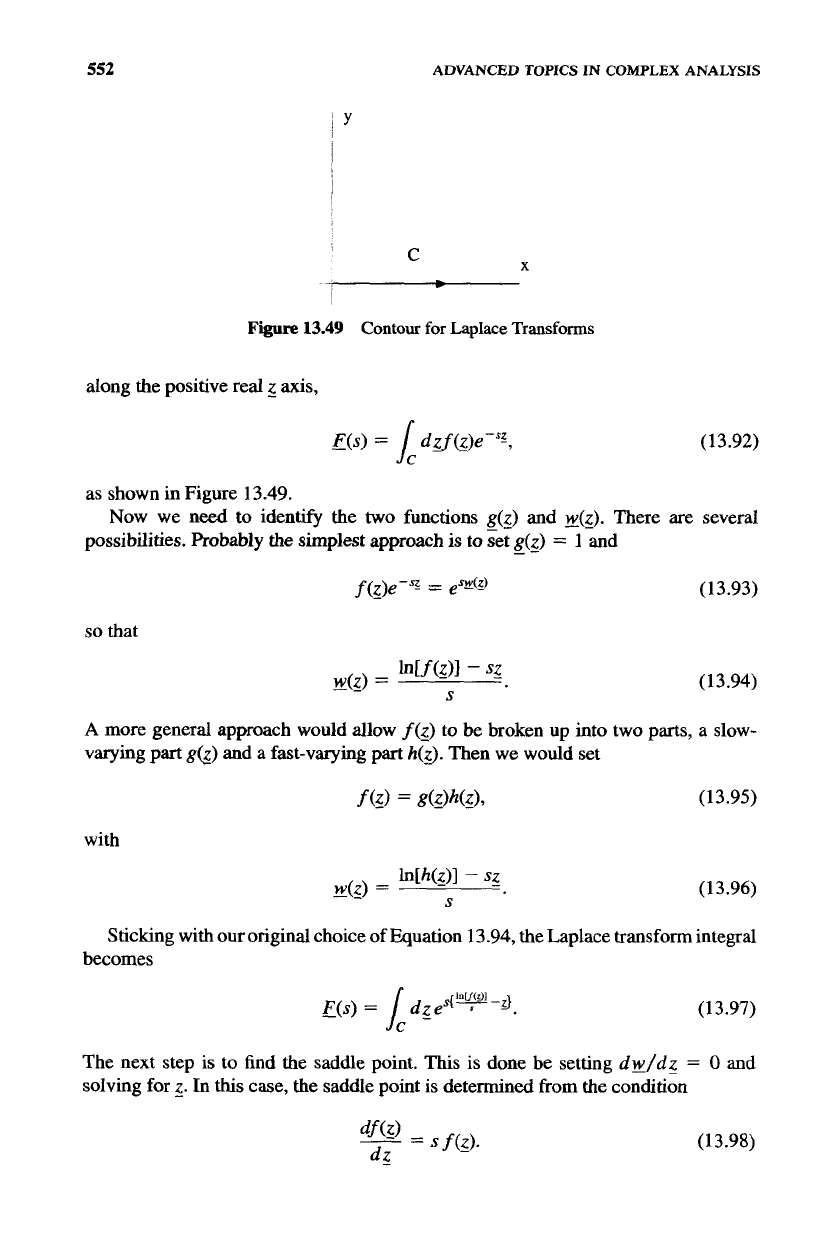
(13.89)
After all these approximations,
you
might wonder if the result could possibly
bear any resemblance to the actual
value
of the original integral. If
s
is large enough
and the deformation to a path of
steepest
descent
can
be
accomplished, the approx-
imations turn out to produce, in many cases, amazingly accurate results.
Thls
will
be demonstrated in the examples that follow and in the exercises at the end of this
chapter.
Example
13.9
evaluation of Laplace transforms and their inverses. For example, the transform
One frequent application
of
the
method of steepest descent is the
rm
(13.90)
can be approximated using the method of steepest descent for positive real values
of
s.
The first step is
to
place the integral in steepest descent form, i.e.,
To accomplish this, convert the transformation to
an
integral in the complex plane
by letting
t
become
z.
The initial integration is then changed into a contour integral
552
ADVANCED TOPICS IN COMPLEX ANALYSIS
C
X
Figure
13.49
Contour
for
Laplace
Transforms
along the positive real
z
axis,
as shown in Figure 13.49.
possibilities. Probably
the
simplest approach
is
to
get
g(z)
_-
=
1 and
Now we need to identify the
two
functions
g(z)
and
&J.
There are several
so
that
(13.94)
A
more general approach would allow
f(g)
to
be broken up into two parts, a slow-
varying part
g(z)
and a fast-varying part
h(z).
Then we would set
f(z)
=
g(z)h(z),
(13.95)
with
(13.96)
Sticking with
our
original choice
of
Equation 13.94, the Laplace
transform
integral
becomes
(
1 3.97)
The next step is to find the saddle point. This
is
done be setting
dw/dg
=
0
and
solving for
z.
In
this
case, the saddle point
is
determined from the condition
(13.98)
THE METHOD
OF
STEEPEST DESCENT
553
To complete the approximation, we need to determine the second derivative of
~(z)
at the saddle point, and identify the values
of
Wt
and
a,
to use in Equation 13.89.
These steps are straightforward, but the details
are
of course determined by the nature
of the function
-
f(g).
Example
13.10
As
a more specific example of the use of the method of steepest
descent, we will work out an approximate expression for the r-function, which
is
defined by the integral expression
(13.99)
For positive integer values
of
s,
this
turns
out to be intimately connected with the
factorial function:
r(s
+
1)
=
s!.
(1 3.100)
The r-function can be used to define factorials of negative and noninteger numbers.
To apply the method of steepest descent, we extend the integral into the complex
plane
by
replacing
p
with
I,
r(s
+
1)
=
J
cigfe-z,
(13.101)
where again
C
is along the positive real axis, the same contour shown in Figure 13.49.
The integral for the r-function must now be put into steepest descent form,
so
that
w(z)
and
g(z)
can be identified. Remember the desired form is
C
-
-
ryS
+
I)
=
dzg(z)eS”‘z)’.
(1 3.102)
Neither
zs
nor
0
appear to be slowly varying functions and
so
we will set
g(g)
=
1.
This
is always a safe choice. That means that
~(2)
in Equation 13.102 becomes
1-
(1
3.103)
Taking the derivative
of
this
function with respect to
g
and setting it equal to zero
gives the location
of
the saddle point:
Z
-
w(z)
=
In@
-
y.
(13.104)
-
z,
-
s.
Because
s
is supposed to be a positive real quantity, the saddle point
is
on the original
contour, and no deformation is necessary to make the contour cross it.
It is pretty clear that
a,
should be zero, but let’s see how
this
falls out
of
the
method.
To
find
a,
we first evaluate the second derivative of
~(z)
-
at the saddle point.
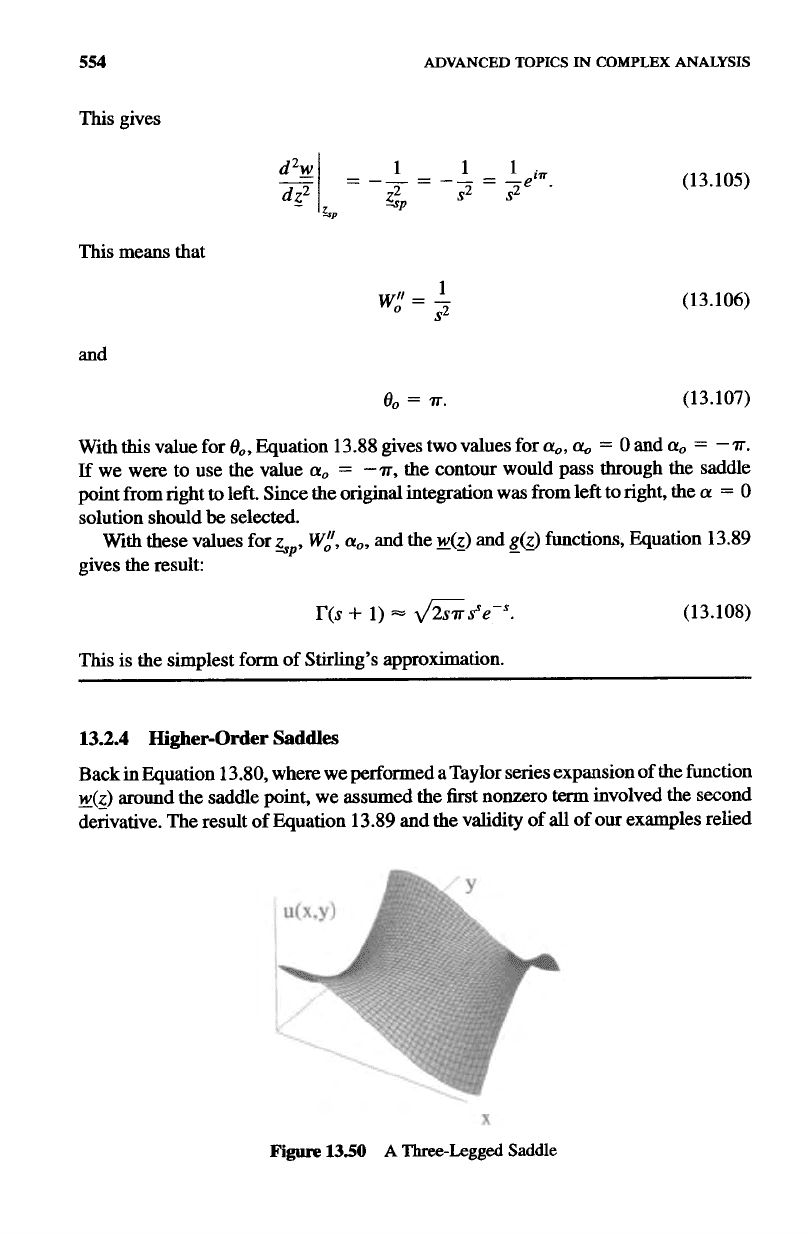
554
ADVANCED
TOPICS
IN
COMPLEX ANALYSIS
This
gives
(
13.105)
This
means that
(13.106)
and
0,
=
n-.
(1 3.107)
With
this
value for
6,,
Equation
13.88
gives two values for
a,,
cu,
=
0
and
a,
=
-T.
If
we were to use the value
a,
=
-n-,
the contour would pass through the saddle
point from right
to
left. Since the original integration was from left to right, the
a
=
0
solution should
be
selected.
With these values for
z+,
WL’,
a,,
and the
y(iJ
and
go
-
functions, Equation
13.89
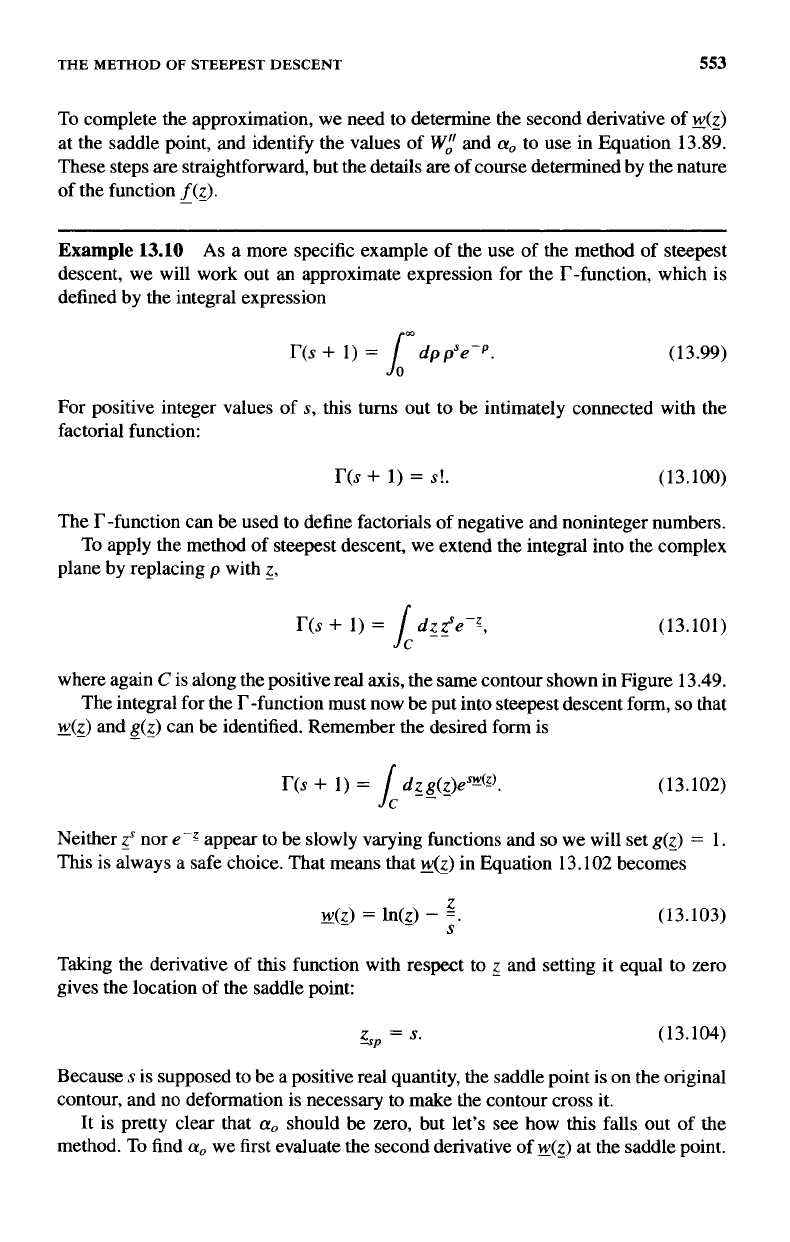
gives the result:
(1 3.108)
This
is
the simplest form of Stirling’s approximation.
13.2.4
Higher-Order
Saddles
Back in Equation
13.80,
where we performed a Taylor series expansion of the function
-
w(z)
around the saddle point, we
assumed
the first nonzero term involved the second
derivative. The result
of
wuation
13.89
and the validity
of
all
of
our
examples relied
X
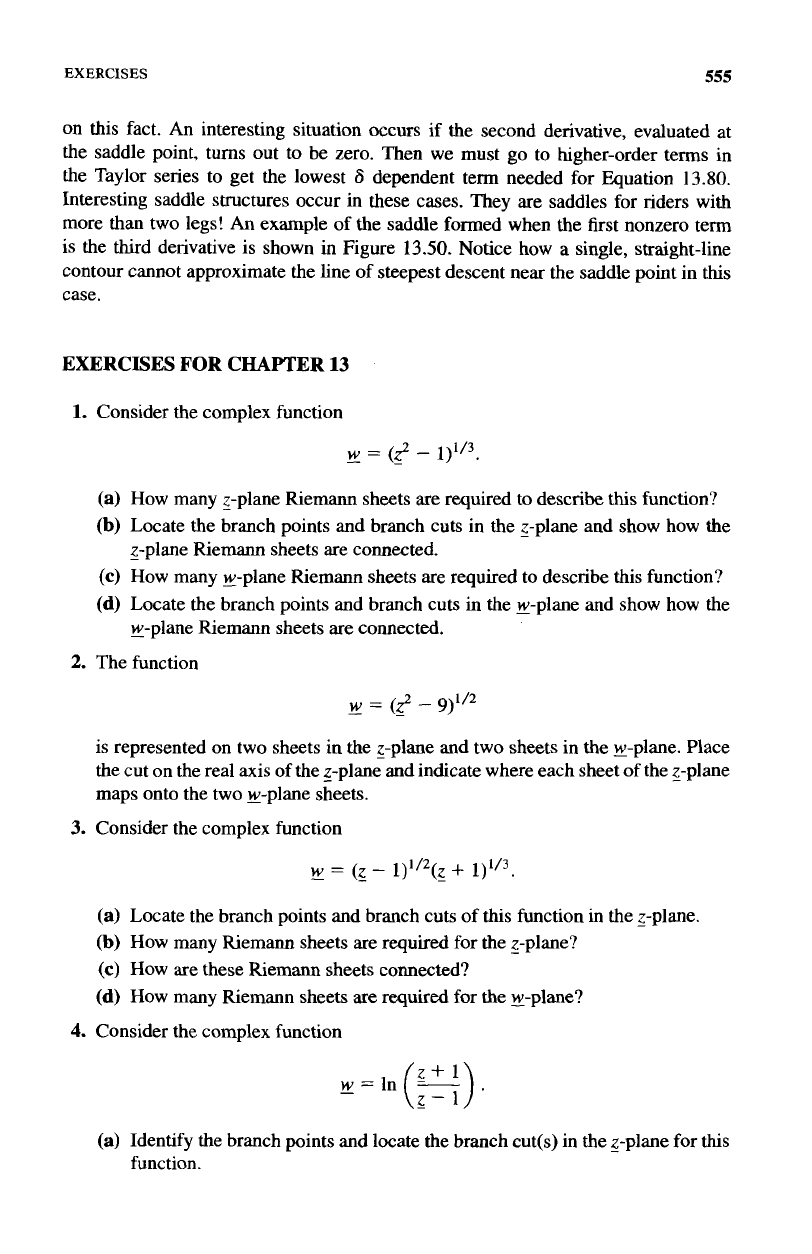
Figure
13.50
A
Three-Legged
Saddle
EXERCISES
555
on this fact. An interesting situation occurs
if
the second derivative, evaluated at
the saddle point, turns out to be zero. Then we must
go
to higher-order terms in
the Taylor series to get the lowest
6
dependent term needed for Equation
13.80.
Interesting saddle structures occur in these cases. They are saddles for riders with
more than two legs!
An
example
of
the saddle formed when the first nonzero term
is
the
thud
derivative is shown
in
Figure
13.50.
Notice how
a
single, straight-line
contour cannot approximate the line of steepest descent near the saddle point in
this
case.
EXERCISES
FOR
CHAPTER
13
1.
Consider the complex function
(a)
How
many z-plane Riemann sheets
are
required to describe
this
function?
(b)
Locate the branch points and branch cuts
in
the g-plane and show how the
(c)
How
many w-plane Riemann sheets are required to describe this function?
(d)
Locate the branch points and branch cuts
in
the w-plane and show how the
g-plane Riemann sheets are connected.
w-plane Riemann sheets are connected.
2.
The function
is represented on two sheets in the z-plane and two sheets in the y-plane. Place
the cut on the real
axis
of the z-plane and indicate where each sheet of the g-plane
maps onto the two E-plane sheets.
3.
Consider the complex function
(a)
Locate the branch points and branch cuts of
this
function in the g-plane.
(b)
How many Riemann sheets are required for the g-plane?
(c)
How are these Riemann sheets connected?
(d)
How many Riemann sheets are required for
the
y-plane?
4.
Consider the complex function
w
=
In
(-)
z+
1
-
g-1
(a)
Identify the branch points and locate the branch cut(s) in the g-plane for this
function.