
Kusse B.R., Westwig E.A. Mathematical Physics: Applied Mathematics for Scientists and Engineers
Подождите немного. Документ загружается.

566
TENSORS IN NON-ORTHOGONAL COORDINATE SYSTEMS
location.
This
phenomenon was first observed by Arthur Eddington, who measured
the small deflection of stars by the sun during the total eclipse of
1919.
The paths that
light rays follow through space are called geodesics.
A
natural choice for the grid lines
of
a localized, coordinate system follows these geodesics,
as
shown in Figure 14.2.
The basis vectors in such a coordinate system are both non-orthonormal and spatially
dependent. We will not discuss examples of
this
type of system, but instead restrict
our
comments to "skewed" systems, where the basis vectors are not orthonormal,
but are spatially invariant. The interested reader can investigate the very heavy book
Gravitation
by Misner, Thorne, and Wheeler for an introduction to general relativity.
14.2.1
A
Skewed
Coordinate
System
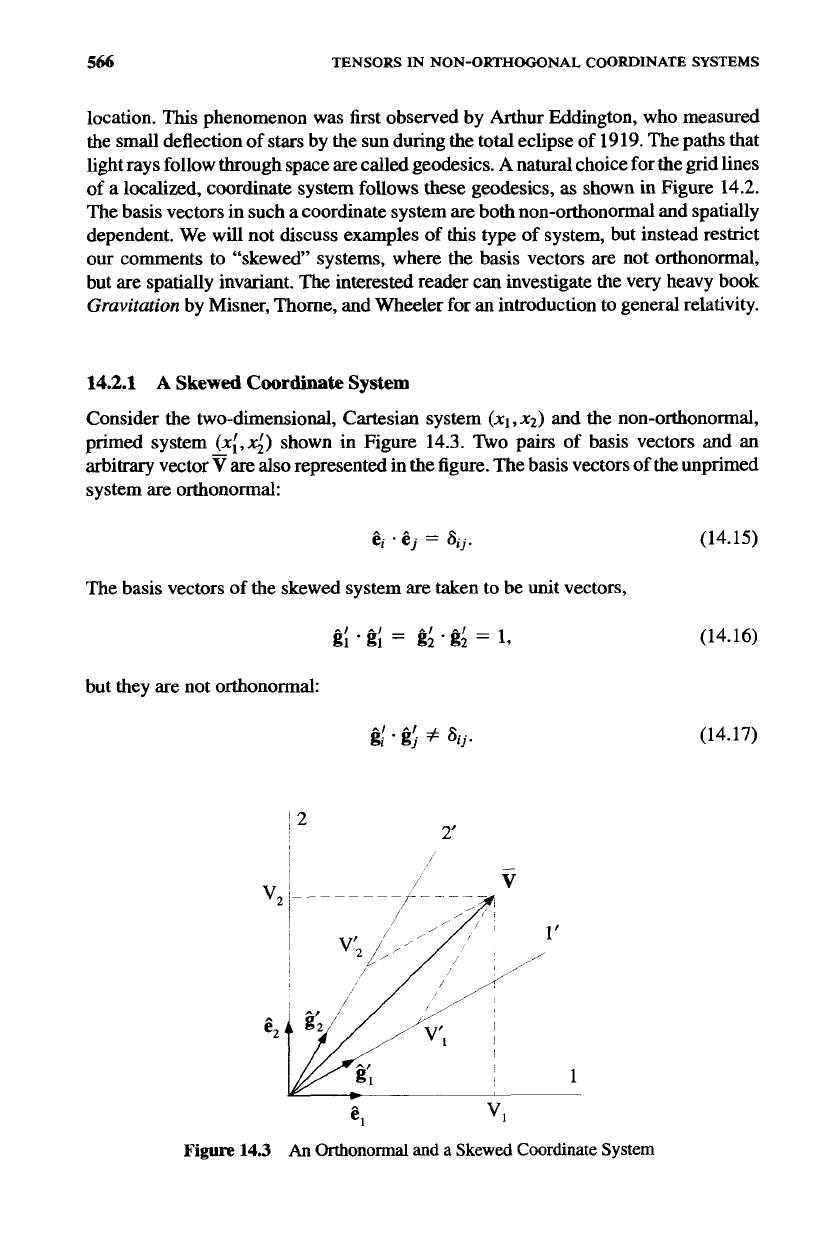
Consider the two-dimensional, Cartesian system
(XI,
x2)
and the non-orthonormal,
primed system
(n{,x:)
shown in Figure
14.3.
Two
pairs
of
basis vectors and
an
arbitrary vector
v
are
also represented
in
the figure. The basis vectors of the unprimed
system are orthonormal:
&.
1
.&.
J
=
6..
IJ.
(14.15)
The basis vectors
of
the skewed system are taken to be
unit
vectors,
g;
.
g;
=
g;
.
g;
=
1,
but they are not orthonormal:
2'
I
,
1'
1
Figure
@I
Vl
14.3
An
Orthonormal
and
a
Skewed
Coordinate
(14.16)
(14.17)
System
NON-ORTHONORMAL COORDINATE SYSTEMS
567
As
you will see, the formalism that is developed here does allow for systems with
basis vectors that are not unit vectors. However, to start out as simply as possible, we
assume the basis vectors of the skewed system satisfy Equation 14.16.
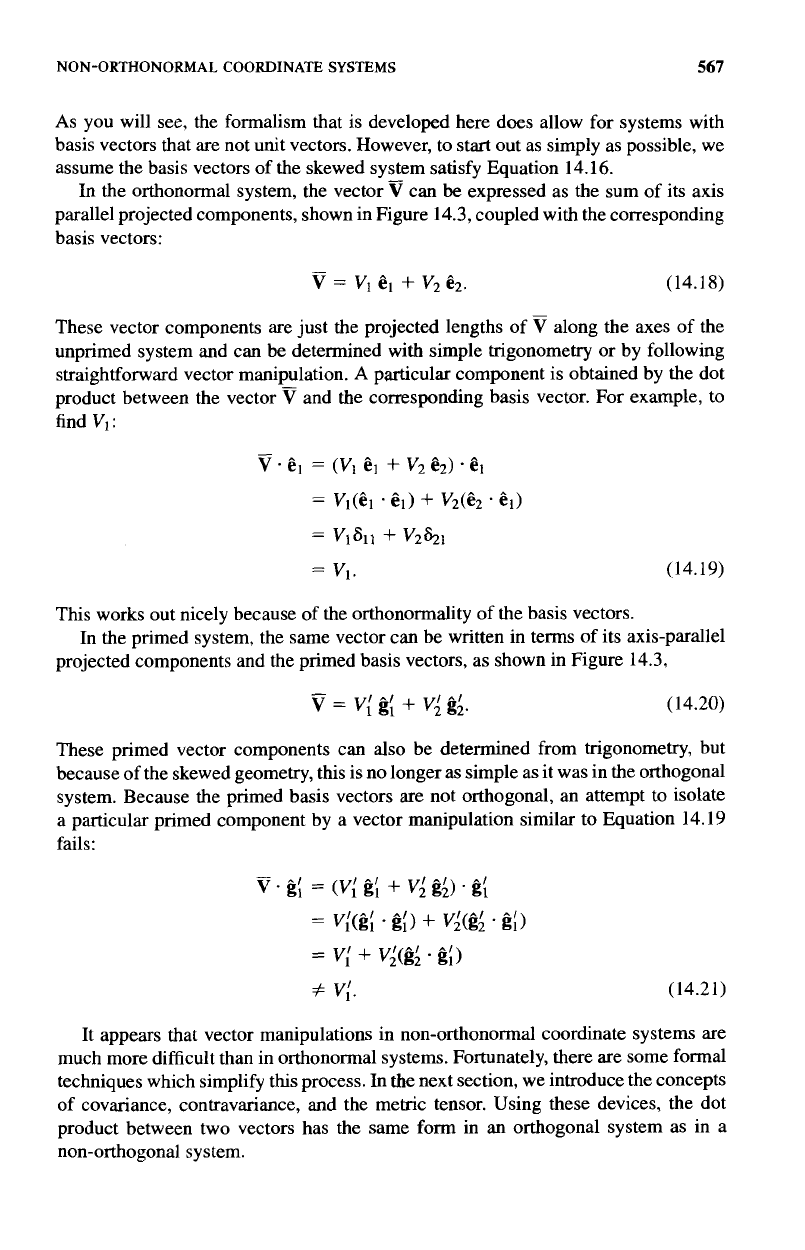
In the orthonormal system, the vector
v
can
be
expressed as the sum
of
its axis
parallel projected components, shown in Figure
14.3,
coupled with the corresponding
basis vectors:
v
=
v,
61
+
v,
62.
(14.18)
These vector components are just the projected lengths
of
v
along the axes
of
the
unprimed system and can be determined with simple trigonometry or by following
straightforward vector manipulation.
A
particular component is obtained by the dot
product between the vector
v
and the corresponding basis vector. For example,
to
find
Vl:
(
1
4.1
9)
This works out nicely because of the orthonormality
of
the basis vectors.
projected components and the primed basis vectors, as shown in Figure 14.3,
In the primed system, the same vector can be written in terms of its axis-parallel
-
v
=
v:
g;
+
v;
g;.
(14.20)
These primed vector components can
also
be determined from trigonometry, but
because
of
the skewed geometry, this is no longer
as
simple
as
it was in the orthogonal
system. Because the primed basis vectors are not orthogonal, an attempt to isolate
a particular primed component by
a
vector manipulation similar to Equation 14.19
fails:
-
v.
g;
=
(Vl
g;
+
v;
g;). g;
=
v;<g;
.
g;)
+
v;(g;
.
g;)
=
v:
+
v;(&
.
g;)
z
v:.
(14.21)
It appears that vector manipulations in non-orthonormal coordinate systems are
much more difficult than in orthonormal systems. Fortunately, there are some formal
techniques which simplify this process. In the next section, we introduce the concepts
of covariance, contravariance, and the metric tensor. Using these devices, the dot
product between two vectors has the same form in an orthogonal system as in a
non-orthogonal system.
568
TENSORS IN NON-ORTHOGONAL COORDINATE
SYSTEMS
14.2.2
Covariance, Contravariance,
and
the Metric
The basic complication introduced by a non-orthonormal coordinate system is evident
in
the dot product operation.
In
the two-dimensional orthonormal system described
above, the inner product between two vectors is given by
--
A.
B
=
A,@.
.
B.@.
11
I1
=
AiB
.6..
J
CJ
=
AlBl
+
A2B2.
(14.22)
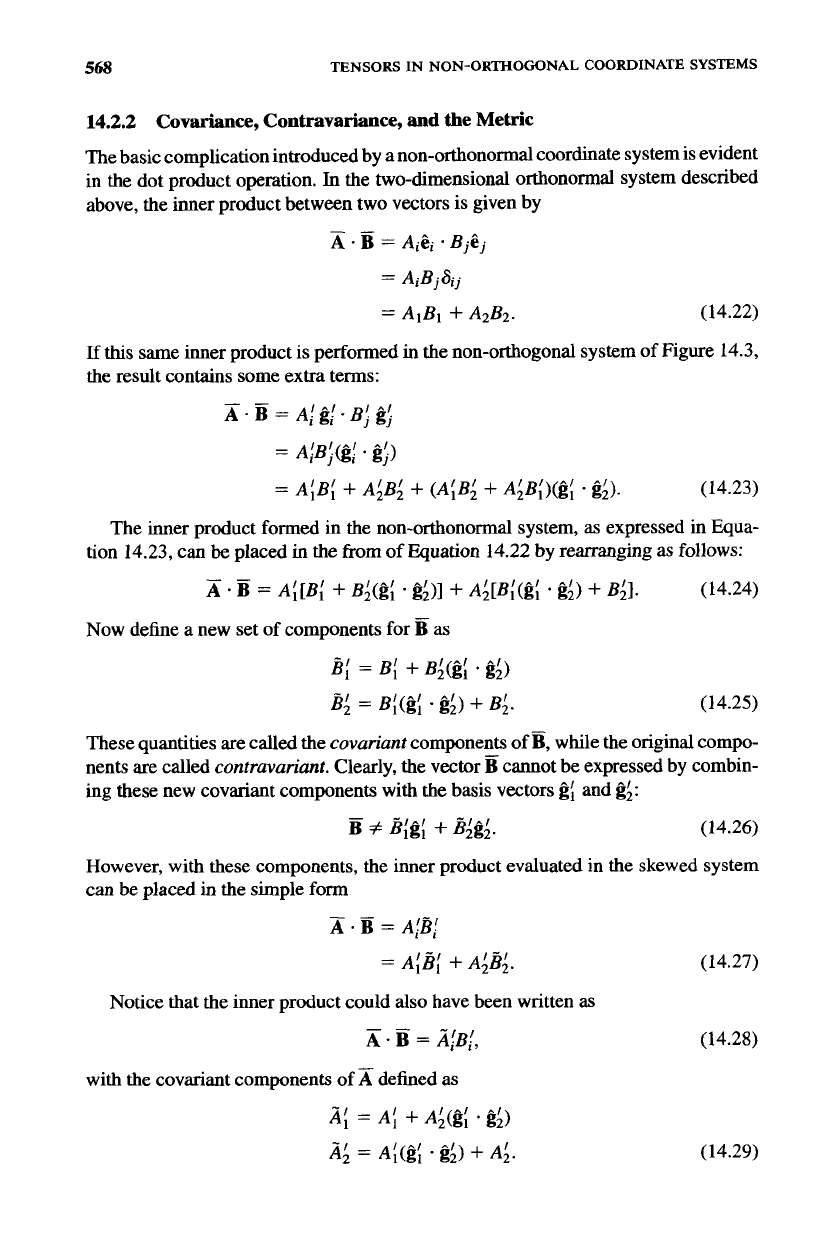
If
this
same inner product is performed
in
the non-orthogonal system
of
Figure 14.3,
the result contains some extra terms:
A.
B
=
B!
g'.
=
A!B!(~;.
g;)
=
A;&
+
AiBi
+
(AiBi
+
AiB[)(gi
.
gi).
JJ
11
(14.23)
The inner product formed
in
the non-orthononnal system,
as
expressed in
Equa-
tion 14.23, can
be
placed
in
the from
of
Equation
14.22
by rearranging as follows:
x
*
B
=
Ai[Bi
+
Bi(gi
.
gi)]
+
Ai[B[(gi
*
gi)
+
Bi].
(14.24)
Now define a new set of components for
B
as
(14.25)
These quantities are called the
covuriunt
components of
B,
while the original compo-
nents are called
contruvuriunt.
Clearly, the vector cannot be expressed by combin-
ing
these new covariant components with the basis vectors
g;
and
g::
E
#
Big:
+
Big;.
(14.26)
However, with these components, the inner product evaluated in the skewed system
can
be
placed
in
the simple form
x.
B
=
@,!
=
A;B{
+
A!$:.
(14.27)
Notice that the inner product could also have been written as
_-
A
*
B
=
A,'BI,
(14.28)
with the covariant components of
defined
as
A'
,
- -
Ai
+
Ai(gL
*
g:)
&
=
A;(g{
.
gi)
+
A;.
(14.29)
NON-ORTHONORMAL COORDINATE SYSTEMS
569
The inner product needs to be formed with mixed contravariant and covariant com-
ponents, but it does not matter which vector is expressed with which type.
These arguments can be extended to non-orthogonal systems
of
arbitrary dimen-
sions. The restriction that the basis vectors be normalized to unity can also be dropped.
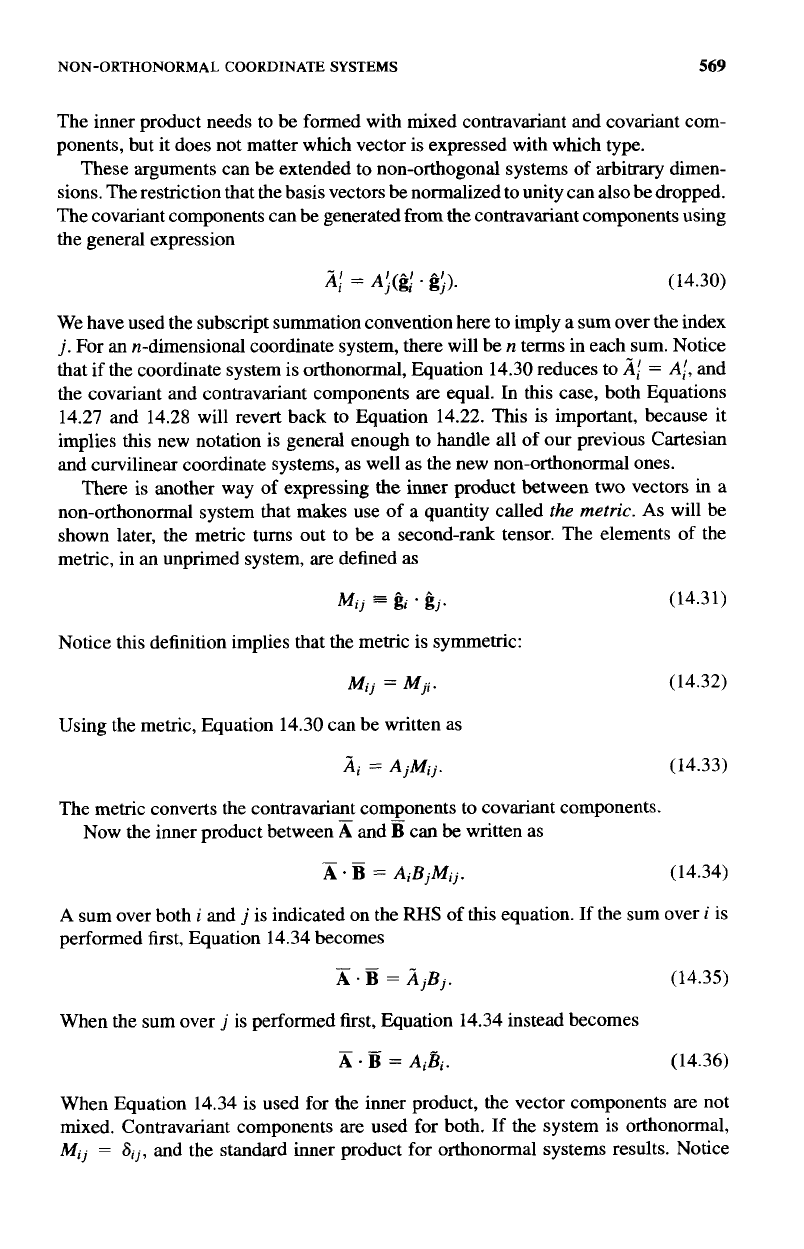
The covariant components can be generated from the contravariant components using
the general expression
=
AS(g,'
.
g'.)
J'
(14.30)
We have used the subscript summation convention here to imply a sum over the index
j.
For an n-dimensional coordinate system, there will be n terms in each sum. Notice
that if the coordinate system is orthonormal, Equation 14.30 reduces to
=
A;,
and
the covariant and contravariant components
are
equal.
In
this case, both Equations
14.27 and 14.28 will revert back to Equation 14.22.
This
is
important, because it
implies this new notation is general enough to handle all
of
our previous Cartesian
and curvilinear coordinate systems, as well as the new non-orthonormal ones.
There is another way of expressing the inner product between two vectors in a
non-orthonormal system that makes use
of
a quantity called
the
metric.
As
will be
shown later, the metric turns out to be a second-rank tensor. The elements of the
metric, in an unprimed system, are defined
as
M..
IJ
E
g..
1
&.
J'
(14.31)
Notice this definition implies that the metric is symmetric:
M..
=
M..
(14.32)
'J J'
'
Using the metric, Equation 14.30 can be written as
Ai
AjMij.
(14.33)
The metric converts the contravariant components to covariant components.
Now the inner product between
and
B
can
be
written as
--
A
*
B
=
AiBjMij.
(14.34)
A
sum over both
i
and
j
is indicated on the
RHS
of
this
equation. If the sum over
i
is
performed first, Equation 14.34 becomes
--
A
*
B
=
AjBj.
(14.35)
When the sum over
j
is performed first, Equation 14.34 instead becomes
--
A
.
B
=
AiBi.
(14.36)
When Equation 14.34 is used for the inner product, the vector components are not
mixed. Contravariant components are used for both. If the system is orthonormal,
Mij
=
6ij,
and the standard inner product
for
orthonormal systems results. Notice
570
TENSORS IN NON-ORTHOGONAL COORDINATE SYSTEMS
that the metric
is
determined solely by the basis vectors of the coordinate system.
This
turns out to be an important fact, and will allow us to identify the metric
as
a
second-rank tensor.
In
summary,
there
are
two ways to perform the inner product between two vectors
in
a
non-orthonormal system. One way is to use the covariant and contravariant
components,
as
was done
in
Equations 14.27 and 14.28.
A
completely equivalent
method is to use the metric and the regular contravariant vector components, as
demonstrated in Equation 14.34. These arguments can
be
naturally extended to inner
products between tensor quantities, but
this
generalization will
be
postponed until
the transformation equations for non-orthonormal systems
are
worked out.
14.2.3
Contravariant Vector Component Transformations
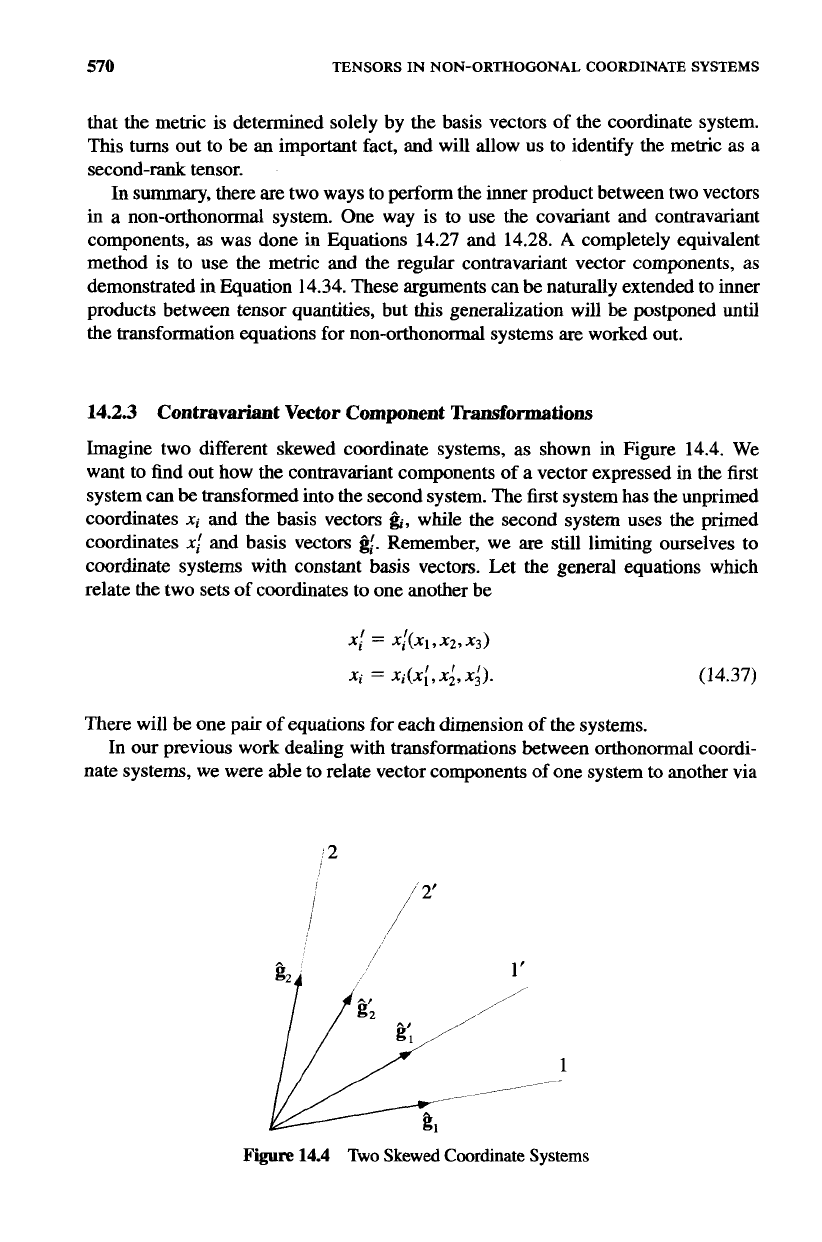
Imagine two different skewed coordinate systems, as shown in Figure 14.4. We
want to find out how the contravariant components
of
a
vector expressed in the first
system can
be
transformed into the second system. The first system has the unprimed
coordinates
xi
and the basis vectors
&.
while the second system uses the primed
coordinates
xi
and basis vectors
gi.
Remember, we
are
still limiting ourselves to
coordinate systems with constant basis vectors.
Let
the general equations which
relate the two sets of coordinates to one another be
xi'
=
X((X1,
x2,
xg)
xi
=
Xi(.[,
xi,
xi).
(14.37)
There
will
be one pair
of
equations for each dimension
of
the systems.
In our previous work dealing with transformations between orthonormal coordi-
nate systems, we were able to relate vector components of one system to another via
1
Figure
14.4
Two Skewed Coordinate Systems
NON-ORTHONORMAL COORDINATE
SYSTEMS
571
[a],
the transformation matrix:
v!
I
=
a..V.
11
1.
(14.38)
The restriction to orthonormal systems allowed us to invert this expression easily,
because it turned out that
a;'
=
aji.
We can still write a relationship similar to
Equation 14.38 for transformations between non-orthonormal systems, but we need to
be more careful, because the inverse of the transformation matrix is
no
longer simply
its transpose. To keep tabs on which transformations have
this
simple inversion and
which do not, we will reserve the matrix
[a]
for transformations between orthonormal
systems. The matrix
[t]
will represent transformations from unprimed coordinates to
primed coordinates, where the systems
may
be non-orthonormal:
v!
I
=
t..V.
11
I'
(14.39)
The reverse operation, a transformation from primed coordinates to unprimed coor-
dinates, will use the matrix
[g],
v.
1
=
g..v!
11
I'
(14.40)
where
gij
=
tl<'
#
tji.
By their very definition, it follows that
ti$$
=
&.
We will
discuss the relationship between the
[t]
and
[g]
matrices in more detail later.
In
both
these expressions, the vector components are the regular, contravariant components
of
v,
not the covariant components we introduced earlier.
All the vectors
at
a given point transform using the same
[t]
matrix.
To
determine
the
ti,
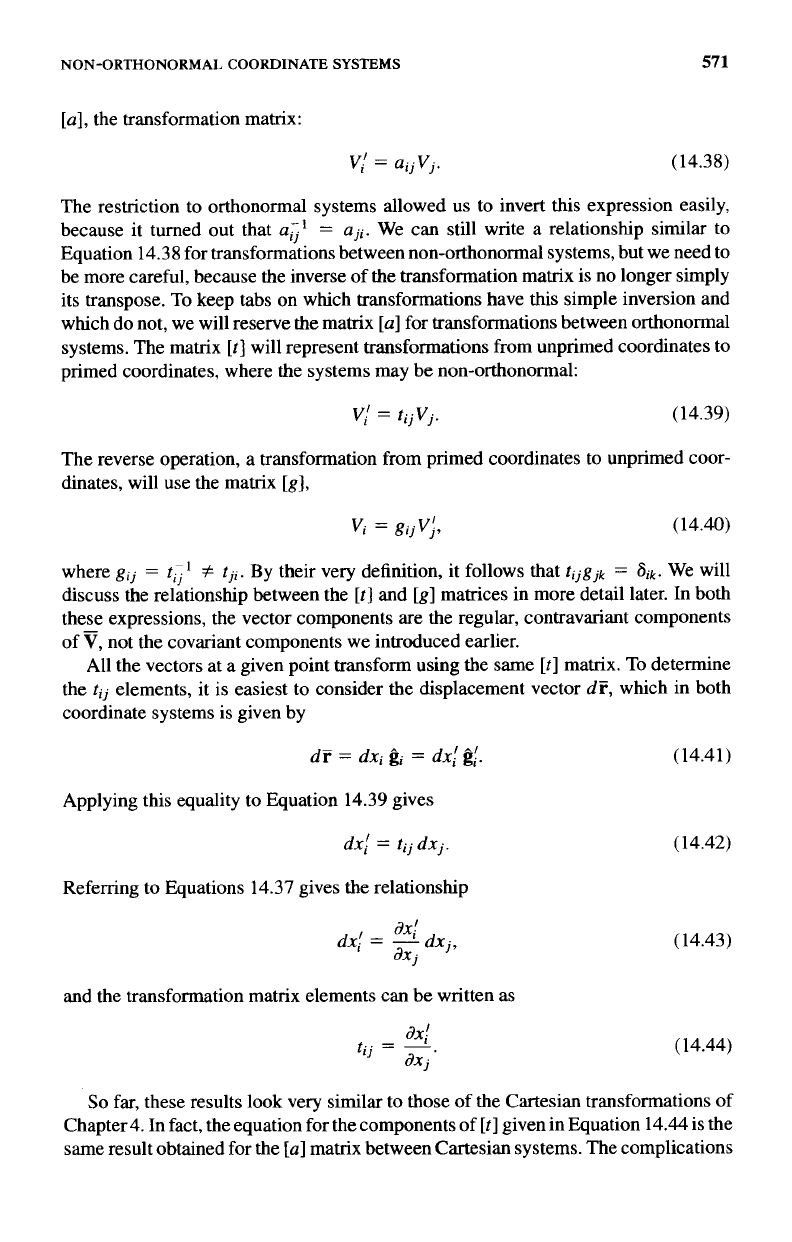
elements, it is easiest to consider the displacement vector
dF,
which in both
coordinate systems is given by
Applying this equality to Equation 14.39 gives
dX;
=
tijdxj.
(14.42)
Referring to Equations 14.37 gives the relationship
and the transformation matrix elements can be written as
(14.43)
(14.44)
So
far, these results look very similar to those of the Cartesian transformations
of
Chapter 4.
In
fact, the equation for the components of
[t]
given in Equation 14.44 is the
same result obtained for
the
[a]
matrix between Cartesian systems. The complications
572
TENSORS IN NON-ORTHOGONAL COORDINATE
SYSTEMS
arise when we
try
to invert these equations.
As
we mentioned before, the inversion
of
[t]
is
no longer simply its transpose.
A
general way to obtain
[tl-',
what we are
calling
[g],
is to use the expression
where
cji
is the ji-cofactor of the
tij
matrix. From matrix algebra,
this
cofactor is
defined
as
(-
l)i+j times the determinant of the
tij
matrix, with the jth row and the
ith column removed. The
[g]
matrix
can
also
be
obtained from the equations relating
the coordinates
in
exactly the same manner that led to muation 14.44:
(14.46)
The
[t]
and
[g]
matrices can also
be
used to relate the basis vectors to one another.
Using the contravariant components, any vector
v
can
be
expressed
in
the primed or
unprimed systems
as
Substituting Equation 14.39 into Equation 14.47 gives
Since
this
expression must
be
true for any
v,
we must have
gj
=
tij
g;.
(14.49)
Following the same steps above, using
[g]
instead of
[t]
gives
(14.50)
Notice the contravariant vector components are transformed by contractions over
the second subscript of either
ti,
or
gi,,
while the basis vectors are transformed by
contracting over the first subscript.
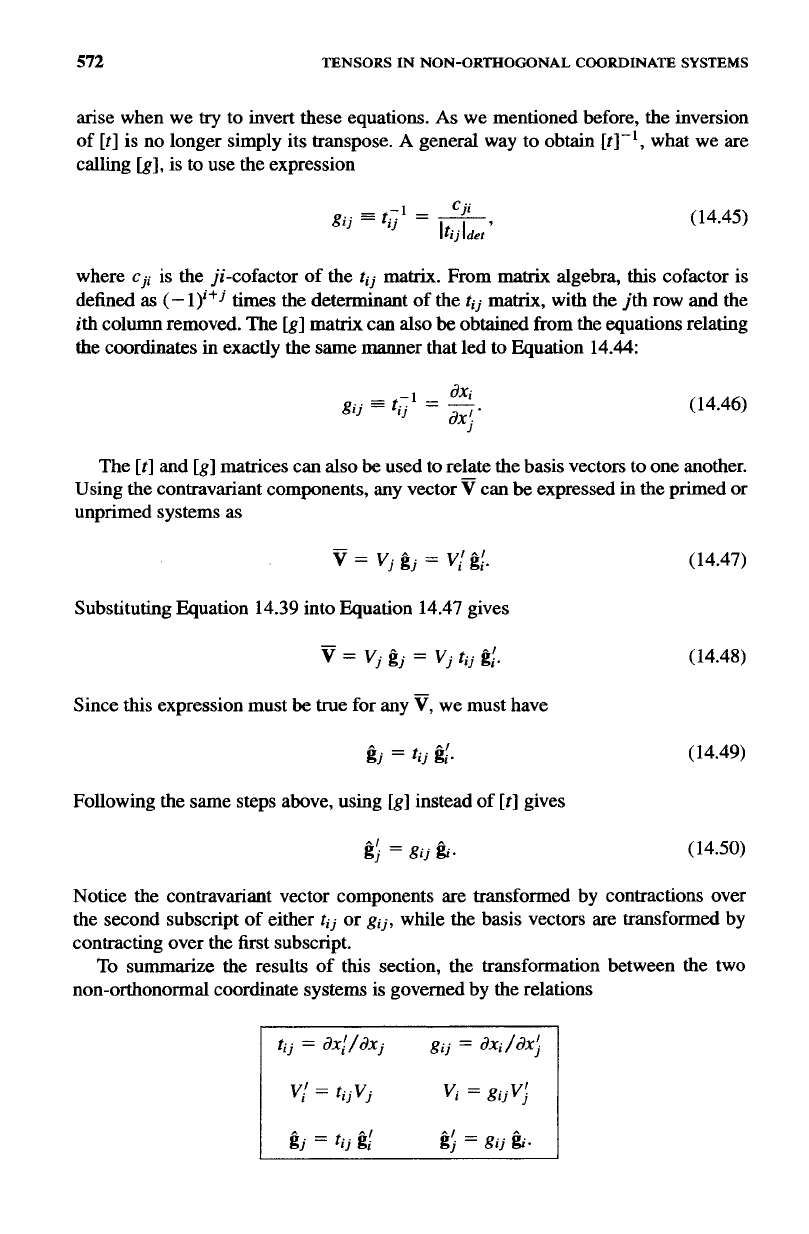
To
summarize the results of this section, the transformation between the two
non-orthonormal coordinate systems is governed by the relations
NON-ORTHONORMAL
COORDINATE
SYSTEMS
573
14.2.4
Subscript/Superscript
Notation
Before proceeding with a discussion of how covariant vector components transform,
it turns out to be convenient to introduce some new notation. The tilde
(vi)
notation we
have been using
for
the covariant vector components is clumsy. It is not obvious that
the following conventions are much better, but they do provide a valuable mechanism
for keeping track of which type of component (contravariant or covariant) should
be used in an expression. The standard, axis-parallel projected vector components,
which we have called the contravariant components, will now be labeled with a
superscript, while the new covariant components will use a subscript instead
of
a
tilde. For example, the contravariant components of the vector
v
are
V',
while the
covariant components are
Vi.
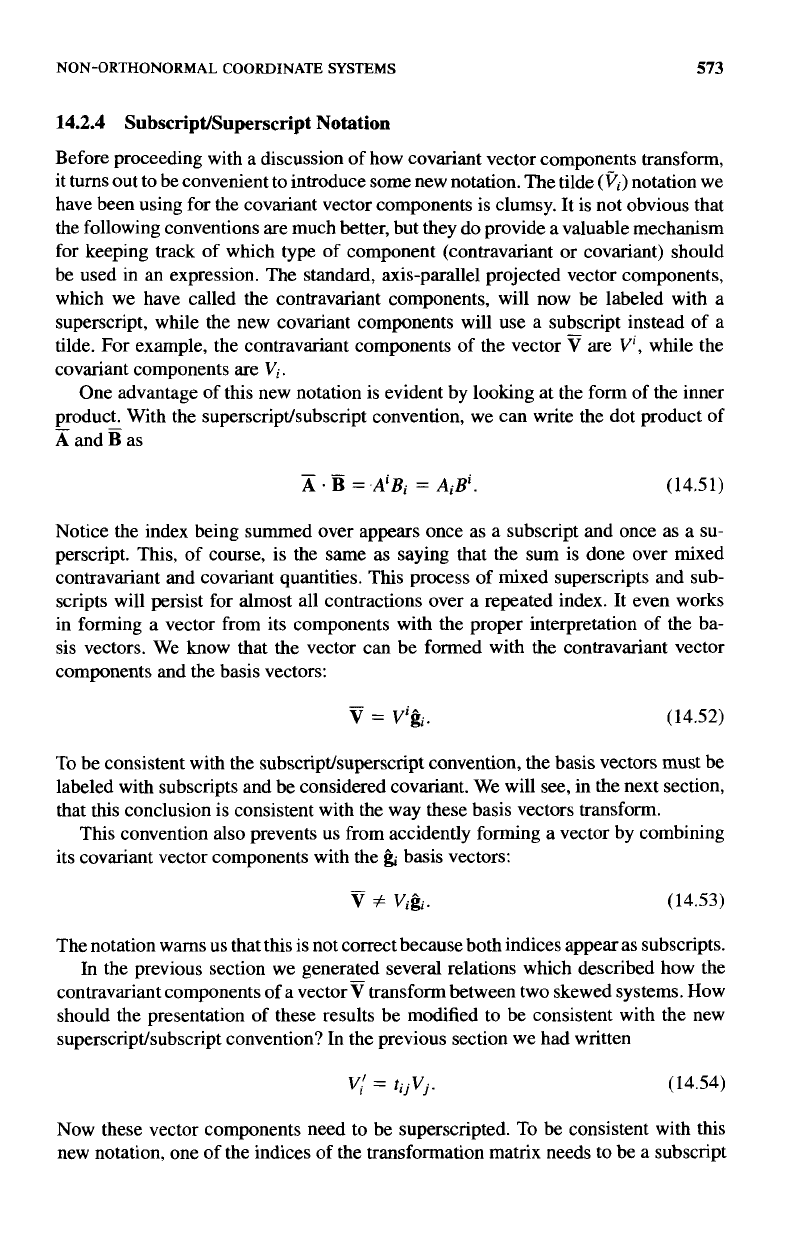
One advantage
of
this new notation is evident by looking at the
form
of
the inner
product. With the superscripthubscript convention, we can write the dot product
of
XandBas
Notice the index being summed over appears once as a subscript and once as a su-
perscript. This,
of
course, is the same
as
saying that the sum is done over mixed
contravariant and covariant quantities.
This
process of mixed superscripts and sub-
scripts will persist for almost all contractions over a repeated index. It even works
in forming a vector from its components with the proper interpretation
of
the ba-
sis vectors. We know that the vector can
be
formed with the contravariant vector
components and the basis vectors:
-
v
=
v'gi.
(14.52)
To
be consistent with the subscriptlsuperscript convention,
the
basis vectors must be
labeled with subscripts and be considered covariant. We will
see,
in the next section,
that this conclusion is consistent with the way these basis vectors transform.
This convention also prevents us from accidently forming a vector by combining
its covariant vector components with the
&
basis vectors:
-
v
#
vigi.
(14.53)
The notation warns us that this is not correct because both indices appear as subscripts.
In the previous section we generated several relations which described how the
contravariant components of a vectorv transform between two skewed systems. How
should the presentation
of
these results be modified to be consistent with the new
superscriptkubscript convention? In the previous section we had written
v!
I
=
t..V.
IJ
I'
(14.54)
Now these vector components need to be superscripted. To be consistent with this
new notation, one of the indices
of
the transformation matrix needs to be a subscript
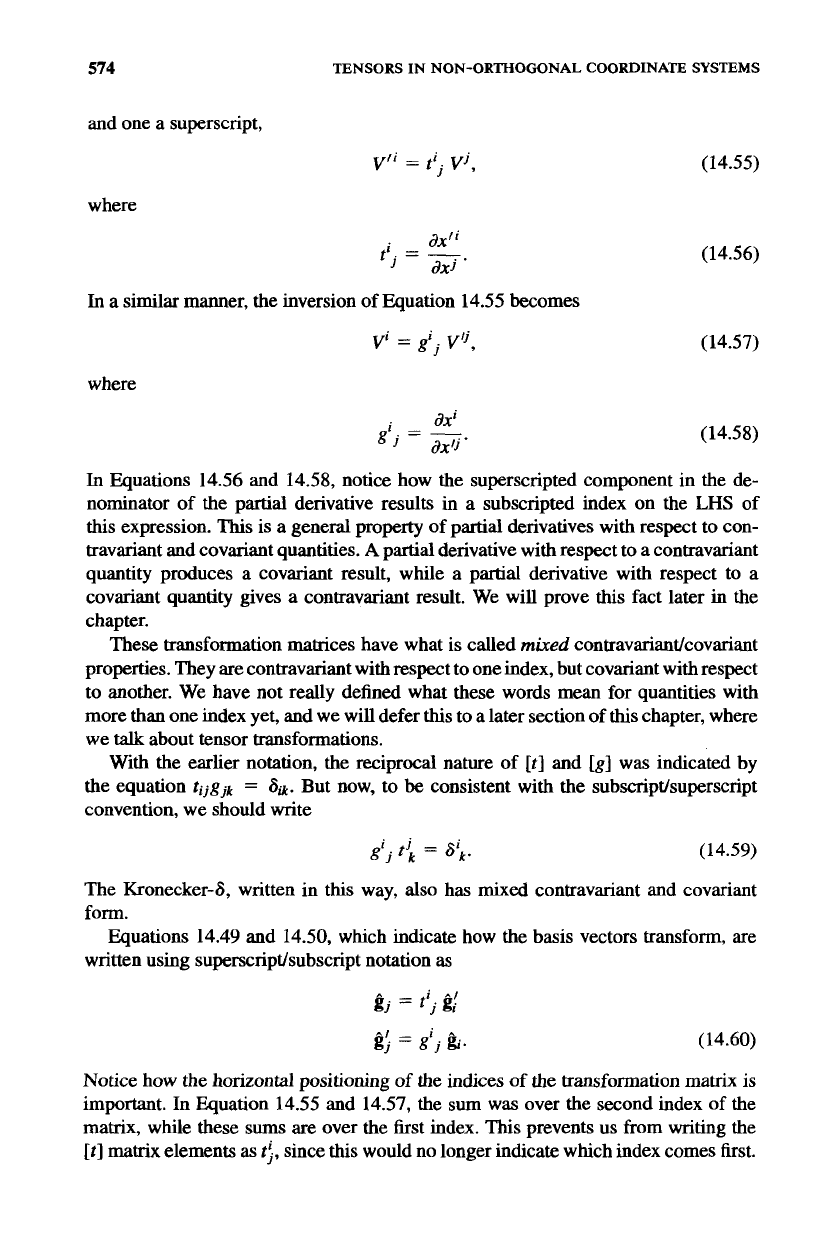
574
TENSORS IN NON-ORTHOGONAL COORDINATE
SYSTEMS
and one a superscript,
where
In
a similar manner, the inversion of Equation
14.55
becomes
where
(14.56)
(14.57)
(14.58)
In
Equations
14.56
and
14.58,
notice how the superscripted component in the de-
nominator of the partial derivative results in a subscripted index on the
LHS
of
this
expression.
This
is
a general
property
of
partial derivatives with respect to con-
travariant and covariant quantities.
A
partial derivative with respect to a contravariant
quantity produces a covariant result, while a partial derivative with respect to a
covariant quantity gives a contravariant result. We will prove
this
fact later in the
chapter.
These transformation matrices have what
is
called
mixed
contravariantkovariant
properties. They are contravariant with respect to one index, but covariant with respect
to another. We have not really defined what these words mean for quantities with
more than one index yet, and we will defer
this
to a later section of
this
chapter, where
we
talk
about tensor transformations.
With the earlier notation, the reciprocal nature
of
[t]
and
[g]
was indicated
by
the equation
tijgjk
=
6,.
But now, to
be
consistent with the subscriptlsuperscript
convention, we should write
(14.59)
The Kronecker-6, written in this way,
also
has mixed contravariant and covariant
form.
Equations
14.49
and
14.50,
which indicate how the basis vectors transform, are
written using superscripthubscript notation
as
(14.60)
Notice how the horizontal positioning
of
the
indices
of
the transformation matrix
is
important. In Equation
14.55
and
14.57,
the
sum
was
over the second index of the
matrix, while these
sums
are over the first index.
This
prevents
us
from
writing
the
[t]
matrix
elements
as
ti,
since
this
would no longer indicate which index comes first.
NON-ORTHONORMAL
COORDINATE
SYSTEMS
575
We should also rewrite the relations involving the metric using the new notation.
Our previous definition of the metric was in terms of the covariant basis vectors.
Consequently, Equation 14.3 1 remains unchanged:
M..
IJ
=
&.
I
,
g.
I'
(14.61)
and both indices remain as subscripts. Formed this way, the metric elements are purely
covariant because both indices
are
subscripts. The metric converts the contravariant
components of a vector to its covariant components, within the same coordinate
system. This operation can be written, using the superscripthbscript notation, as
v.
=
M..~J.
1J
(14.62)
Notice how the summation convention continues to work. This same operation in
a
primed system uses a primed metric,
M!.
=
g!
.
g!
(14.63)
IJ
1
I'
and
is
written
as
V/
=
M!.V'J.
1J
(14.64)
In
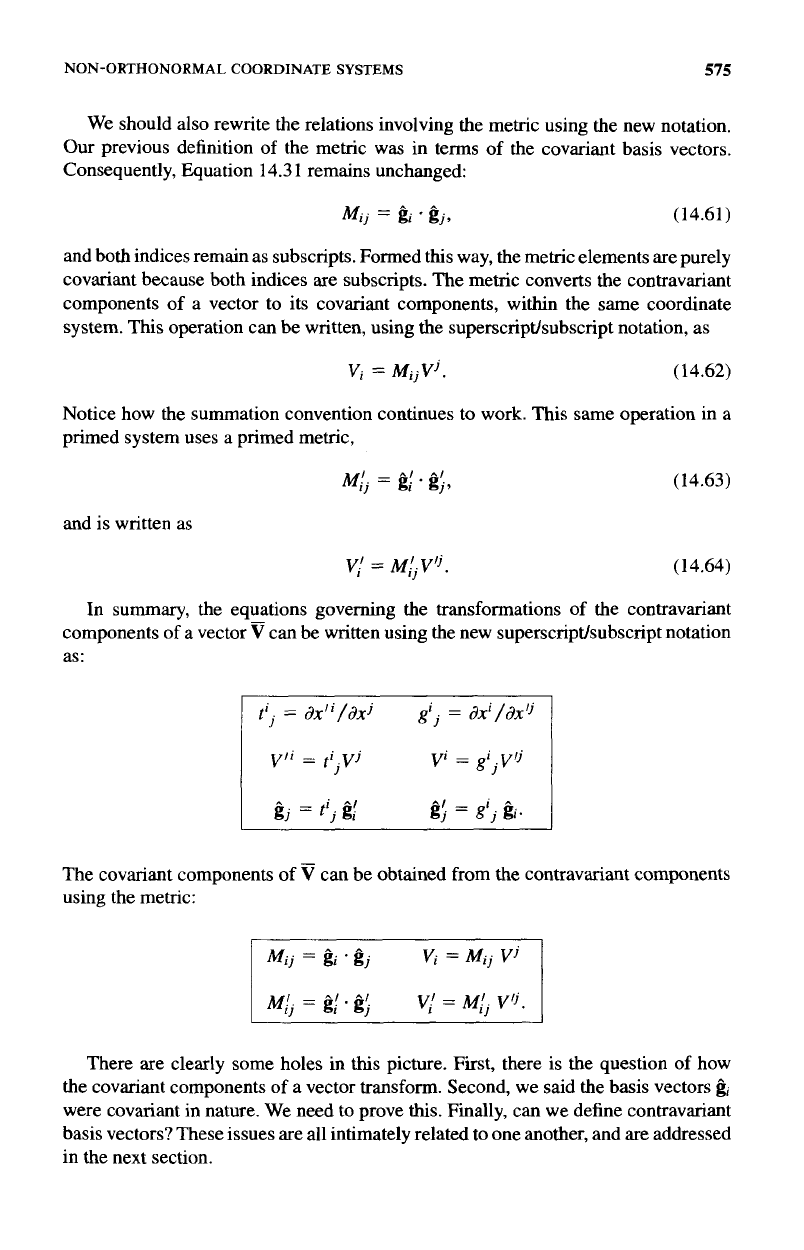
summary,
the equations governing the transformations of the contravariant
components
of
a vector
v
can be written using the new superscriptlsubscript notation
as
:
g.
=
ti,
g!
g!
=
g'
.
gi.
J
Jl
JJ
The covariant components of
v
can be obtained from the contravariant components
using the metric:
There
are
clearly some holes in
this
picture. First, there is the question of how
the covariant components of a vector transform. Second, we said the basis vectors
gi
were covariant in nature. We need to prove
this.
Finally, can we define contravariant
basis vectors? These issues are all intimately related
to
one another, and are addressed
in the next section.