
Kusse B.R., Westwig E.A. Mathematical Physics: Applied Mathematics for Scientists and Engineers
Подождите немного. Документ загружается.

596
TENSORS IN NON-ORTHOGONAL COORDINATE
SYSTEMS
while
E
is a frequency two-vector with the components
-
K
=
kg'
+
(w/c)g.
Why are these
k
and
o/c
components covariant quantities?
(d)
With these two-vectors defined, their inner product is
-_
K
-
R
=
kx
+
wt.
which
is
invariant to transformation. Since we are working in Minkowski
space, why wasn't the metric used to form
this
inner product?
(e)
The invariance of the quantity in part
(d)
says that
kx
+
wt
=
k'x'
+
w't'.
What is the physical interpretation of
this
invariance?
(f)
Use the Lorentz transformations to obtain expressions for
k'
and
w'/c
in
terms of
k
and
o/c
and identlfy the relativistic Doppler shift of the frequency
and the Lorentz contraction for the wavelength
as
observed
in
the moving
frame.
Does
this
agree with your intuitive answer to part
(b)?
(g)
Show that
if
p
4
1
your answer to part (f) goes to the classical limit
w'
=
w
+
kv
k'
=
k.
10.
Why does Equation 14.122 imply that you
cannot
accelerate
an
object past the
speed of light?
15
INTRODUCTION TO GROUP THEORY
Group theory provides a formal framework for taking advantage of the different types
of symmetries that pervade science.
In
this chapter, we introduce the mathematical
definition of a group, and present several examples of both discrete and continuous
groups that occur in physics and chemistry.
15.1
THE
DEFINITION
OF
A
GROUP
A
group is a set of abstract elements which can
be
"multiplied" together. In this
context, multiplication does not necessarily refer to the common operation between
real or complex numbers, but rather a more generalized operation which combines
two elements of the group together.
To
determine if something
is
actually a group,
you must first know both the group elements and the rule for multiplication.
We will typically denote an entire group using a capital letter, while the distinct
elements that make up the group are written with a small letter and a subscript. For
example, the
group
G
might have the elements
gl,
g2.g3,.
.
.
,
gh.
To
talk about
a
single, but arbitrary group element, we will often use a letter subscript. For example,
gi
refers to any one of the elements
gI,g2,
g3,
. .
.
In order for
G
to be called a group, its elements must obey the following four
rules:
1.
If
gi
and
g
,
are elements of
G,
then their product,
gk
=
gi
g,,
is also
an
element
2.
The multiplication operation is associative:
(gi
gj)gk
=
gi(gj
gk).
3.
One element
I
serves as an identity element, such that
Z
gi
=
gi
I
=
gi
for all
of
G.
gi
in
G.
597
598
INTRODUCTION TO
GROUP
THEORY
4.
Each element
of
G
has an inverse,
g,
=
g;',
that is also an element
of
G.
The
product of
gi
and its inverse equals the identity element:
gi
g;'
=
gi'
gj
=
1.
Keep in mind that rule
#2
does not require that the multiplication be commutative,
although it may be. That is,
gi
gj
does not have to equal
g,
gi.
If the multiplication is
commutative for all combinations of group elements, the group is called Abelian.
Where possible, we will identify the
first
group element
as
the identity element,
whose existence is required by
rule
#3.
That is,
gl
=
1.
Notice all operations with
this
particular element are necessarily commutative.
15.2 FINITE
GROUPS AND
THEIR
REPRESENTATIONS
In this section
we
present several examples
of
groups.
As
we progress, we will
gradually accumulate an arsenal
of
terminology to keep track
of
the different types
of groups and their properties.
15.2.1
The
Cyclic
Group
C,
Our
first example
of
a group consists
of
the elements
G
=
(1,
g2,
g3,
g4).
5.1)
The order
of
a group, which we will call
h,
is the number
of
distinct elements it
contains. The group described in Equation
15.1
has
h
=
4.
If
h
is finite, as it is in
this case, the elements form afinite
group
and the elements are discrete. In contrast,
infnite
groups
have
h
-+
m.
Infinite groups can have discrete or continuous elements.
In this chapter, we will limit our discussions to discrete, finite groups and continuous,
infinite groups.
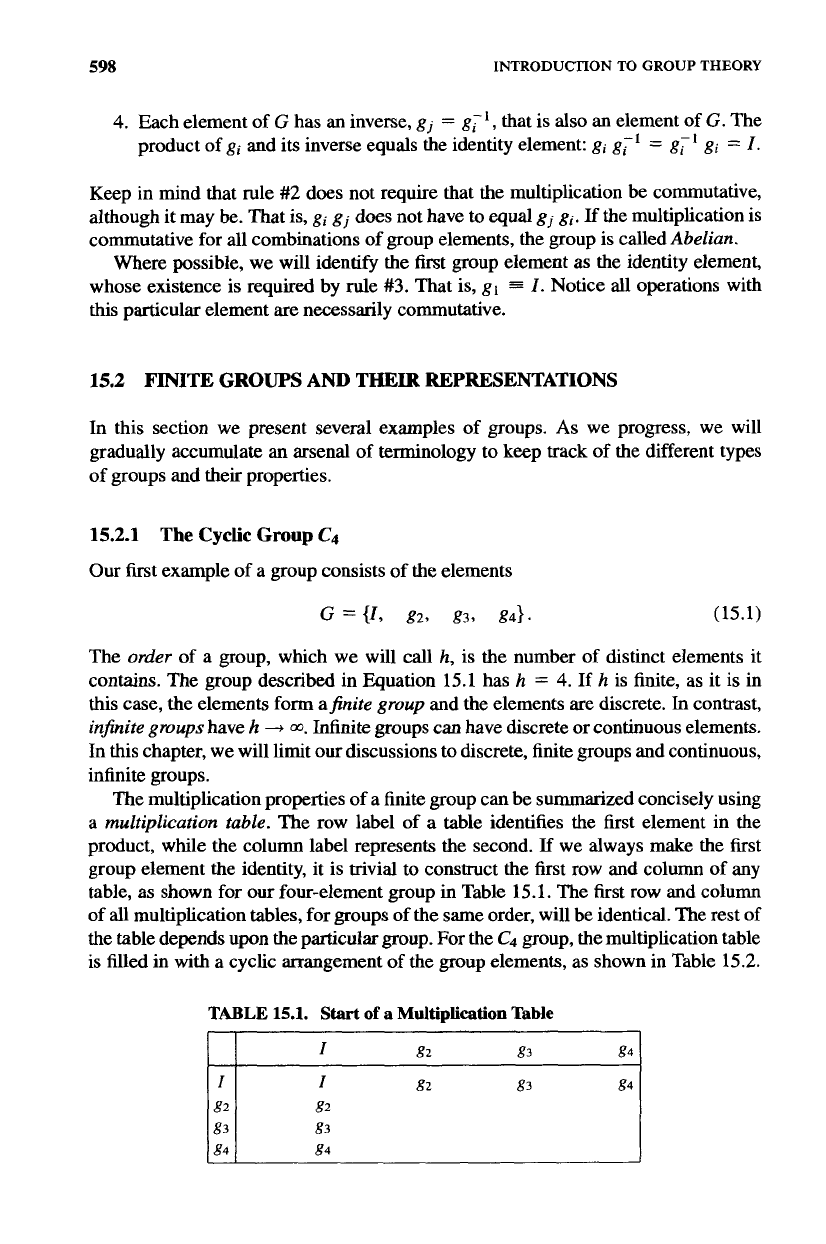
The multiplication properties of a finite group can be summarized concisely using
a multiplication table. The row label
of
a table identifies the first element in the
product, while the column label represents the second.
If
we always make the first
group element the identity,
it
is
trivial to construct the first row and column of any
table, as shown for our four-element group
in
Table 15.1. The first row and column
of all multiplication tables, for groups
of
the same order, will be identical. The rest
of
the table depends upon the particular
group.
For the
C,
group, the multiplication table
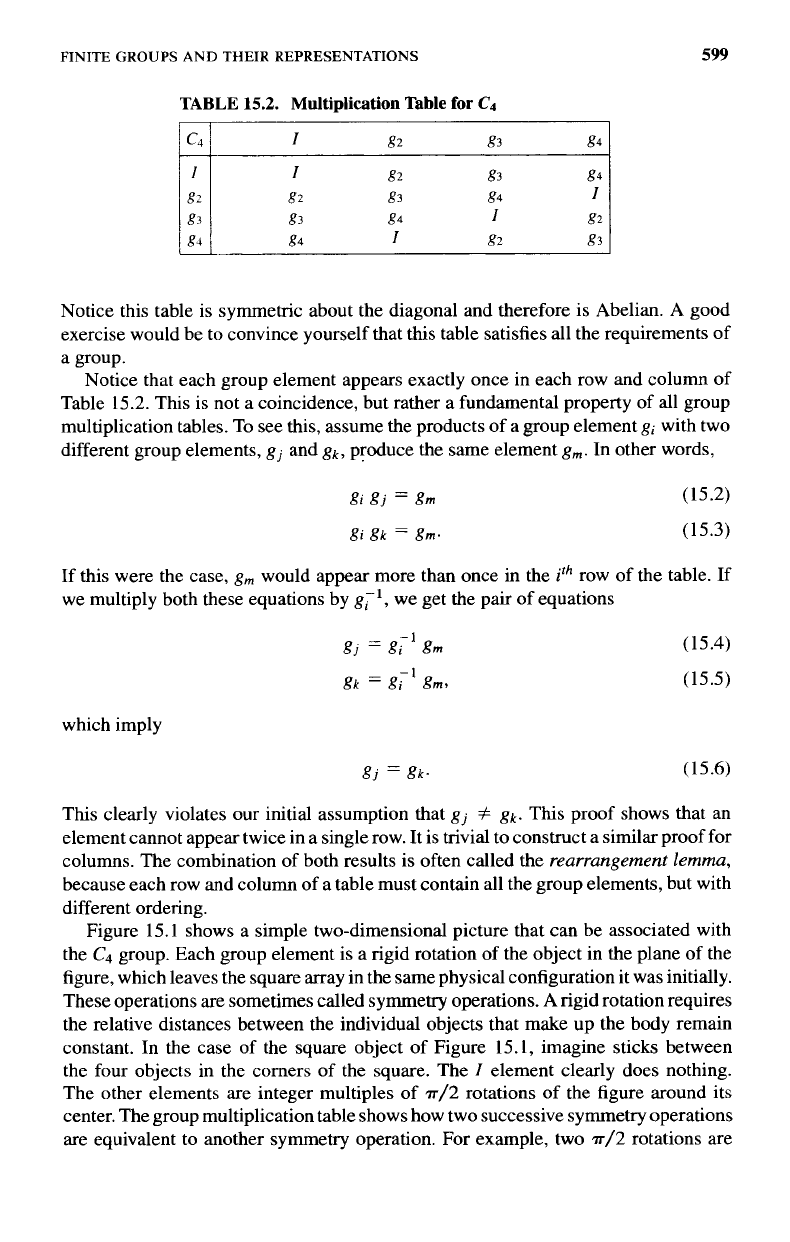
is filled in with a cyclic arrangement
of
the group elements, as shown
in
Table 15.2.
TABLE
15.1.
Start
of
a
Multiplication
Table
FINITE GROUPS AND THEIR REPRESENTATIONS
599
TABLE
15.2.
Multiplication
Table
for
Cd
Notice this table is symmetric about the diagonal and therefore is Abelian. A good
exercise would be to convince yourself that
this
table satisfies all the requirements of
a group.
Notice that each group element appears exactly once in each row and column of
Table
15.2.
This is not a coincidence, but rather a fundamental property
of
all group
multiplication tables. To see this, assume the products of a group element
gi
with two
different group elements,
g,
and
gk,
produce the same element
gm.
In other words,
If this were the case,
g,
would appear more than once in the
irh
row of the table.
If
we multiply both these equations by
g;',
we get the pair of equations
(15.4)
(15.5)
which imply
gj
=
gk.
(15.6)
This clearly violates our initial assumption that
gj
#
gk.
This proof shows that an
element cannot appear twice in a single row. It is trivial to construct a similar proof for
columns. The combination of both results is often called the
rearrangement lemma,
because each row and column of a table must contain all the group elements, but with
different ordering.
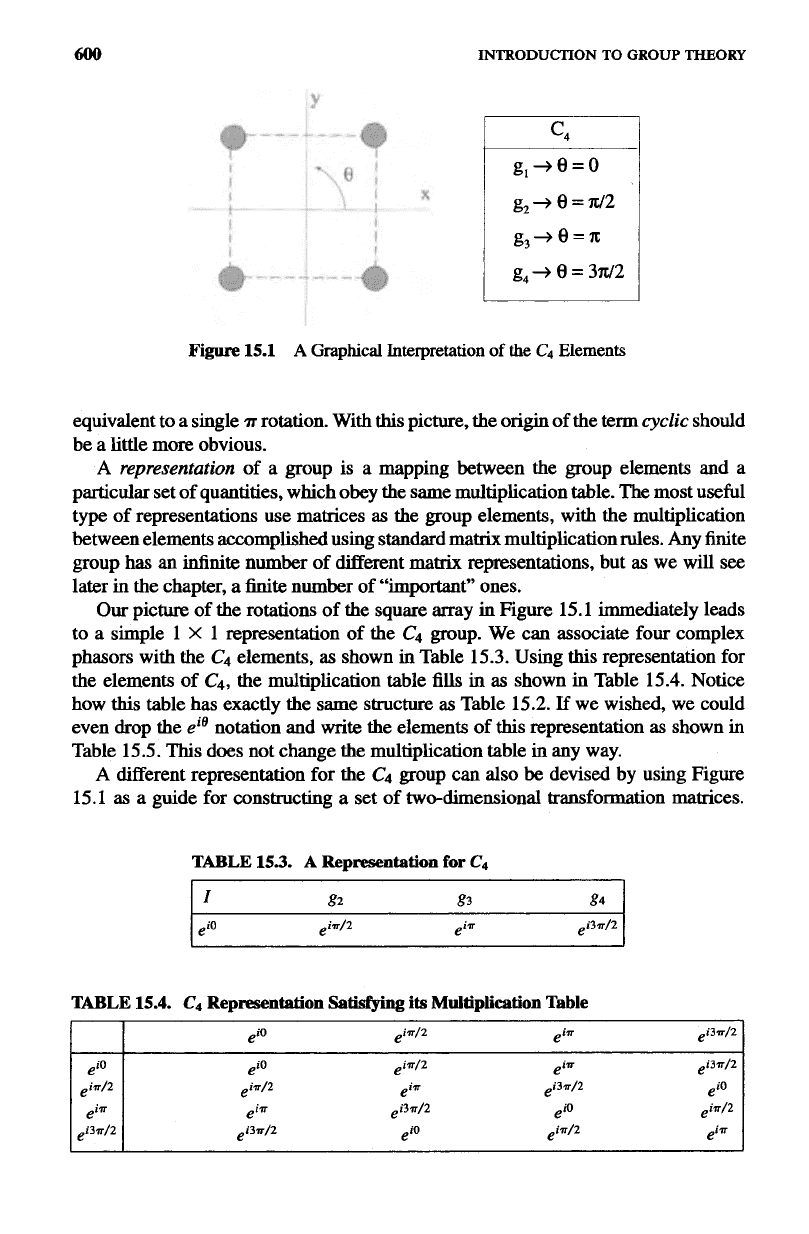
Figure
15.1
shows a simple two-dimensional picture that can be associated with
the
C,
group. Each group element is a rigid rotation of the object in the plane
of
the
figure, which leaves the square array in the same physical configuration it was initially.
These operations are sometimes called symmetry operations.
A
rigid rotation requires
the relative distances between the individual objects that make up the body remain
constant. In the case of the square object of Figure
15.1,
imagine sticks between
the four objects in the comers of the square. The
Z
element clearly
does
nothing.
The other elements are integer multiples of
7r/2
rotations
of
the figure around its
center. The group multiplication table shows how two successive symmetry operations
are equivalent to another symmetry operation. For example, two
7r/2
rotations are
INTRODUCTION
TO
GROUP THEORY
I
I
IY
I
--1)
.iO
.im/2
.im
.i3~/2
i0 ,p/2 .im
.i3m/2
.iO .i?r/Z
,in
.i3~/2
.im/2 .im .i3m/2 .iO
.im .i3m/2 i0 .im/2
.i3m/2 i0 ,id2 eim
X
~
Figure
15.1
A
Graphical
Interpretation
of
the
C,
Elements
equivalent to a single
T
rotation. With
this
picture, the
origin
of the term
cyclic
should
be a little more obvious.
A representation
of
a group is a mapping between the group elements and a
particular set
of
quantities, which obey the same multiplication table. The most useful
type of representations use matrices
as
the group elements, with the multiplication
between elements accomplished using standard
matrix
multiplication rules. Any finite
group
has
an
infinite
number of different matrix representations, but
as
we will see
later in the chapter, a
finite
number
of
‘‘jmportant’’ ones.
Our picture of the rotations of the square array in Figure
15.1
immediately leads
to a simple
1
X
1
representation
of
the
C4
group. We can associate four complex
phasors with the
C4
elements,
as
shown in Table
15.3.
Using
this
representation for
the
elements of
C,,
the multiplication table
fills
in
as
shown in Table
15.4.
Notice
how
this
table has exactly the same structure
as
Table
15.2.
If
we wished, we could
even drop the
eie
notation and
write
the elements of
this
representation
as
shown in
Table
15.5.
This
does not change the multiplication table in any way.
A
different representation for the
C4
group can also
be
devised by using Figure
15.1
as
a guide for constructing a set of two-dimensional transformation matrices.
TABLE
153.
A
Representation
for
C4
I
g2
g3
g4
eiO eim/2
.im
.i3~/2
TABLE 15.4.
C,
Representation
Satisfging
its
Multiplication
Table
FINITE GROUPS AND THEIR REPRESENTATIONS
601
TABLE
15.5. Another
Form
of
the
C,
Representation
I
g2
g3
g4
1
2
-1
-i
Y
X’
I
*-
X
Y!
-
+
Figure
15.2
7r/2
Rotation
for
gp
of
the
C4
Group
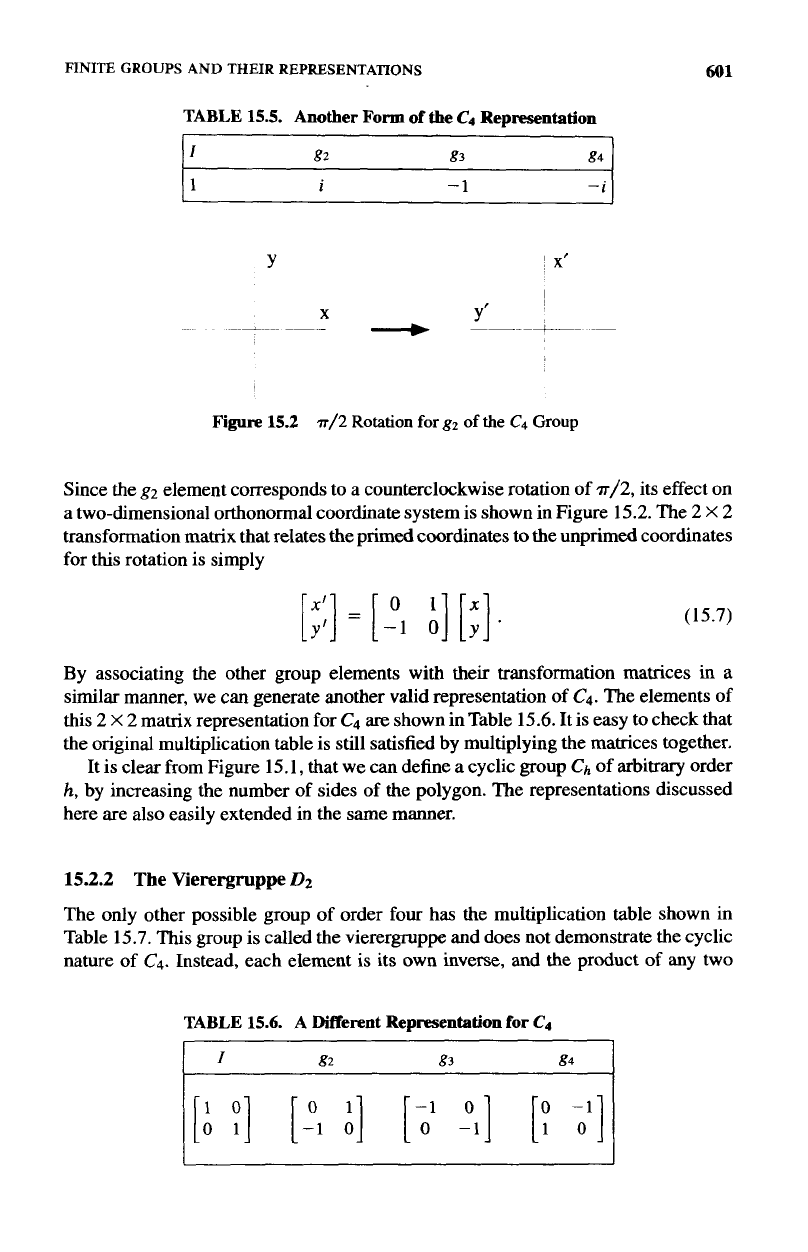
Since the
g2
element corresponds to a counterclockwise rotation
of
72/2,
its effect
on
a two-dimensional orthonormal coordinate system is shown in Figure
15.2.
The
2
X
2
transformation matrix that relates the
primed
coordinates to the unprimed coordinates
for this rotation is simply
(15.7)
By associating the other
group
elements with their transformation matrices
in
a
similar manner, we can generate another valid representation of
C4.
The elements
of
this
2
X
2
matrix representation for
C4
are
shown in Table
15.6.
It is easy to check that
the original multiplication table is still satisfied by multiplying the matrices together.
It is clear from Figure
15.1,
that we can define a cyclic group
ch
of arbitrary order
h,
by increasing the number
of
sides
of
the polygon. The representations discussed
here are also easily extended in
the
same manner.
15.2.2
The Vierergruppe
D2
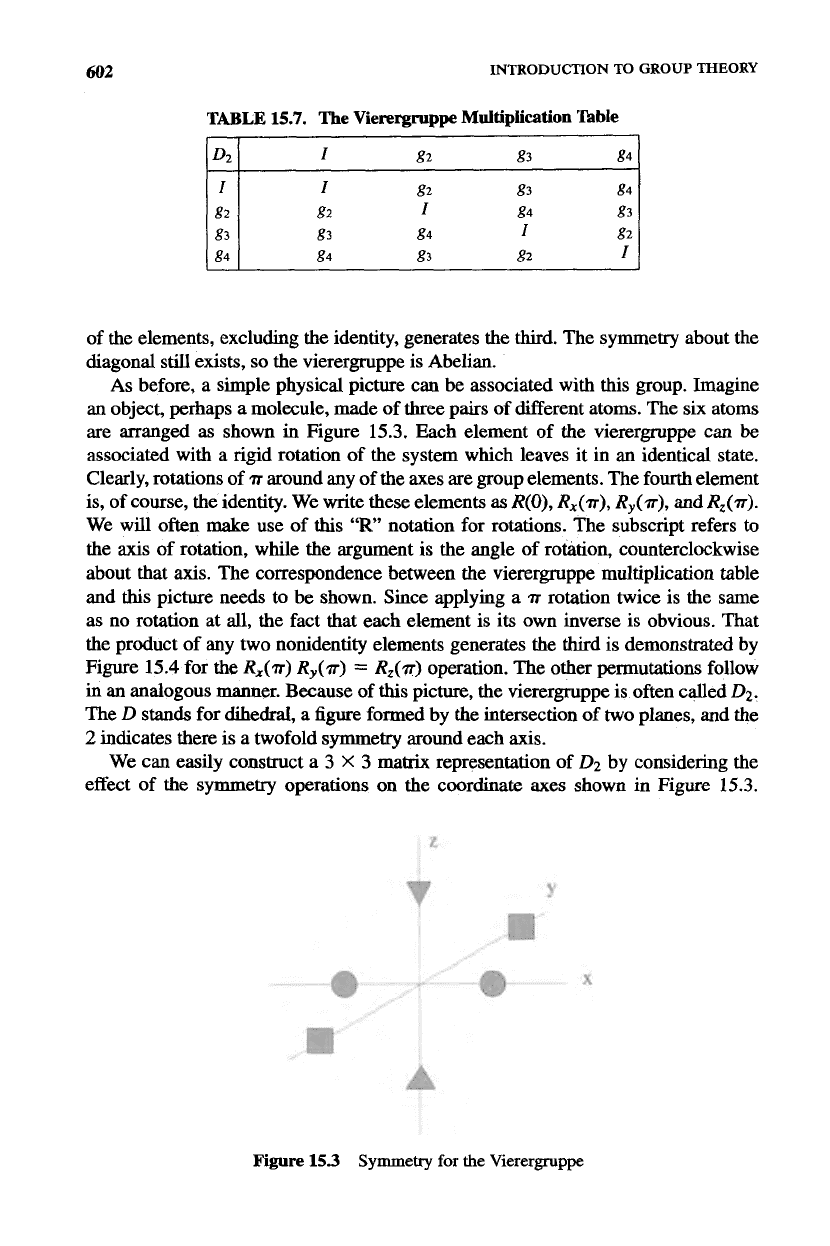
The only other possible group
of
order
four
has
the
multiplication table shown in
Table
15.7.
This
group
is
called the vierergruppe and does not demonstrate the cyclic
nature
of
C4.
Instead, each element is its own inverse, and the product
of
any two
TABLE
15.6.
A
Different Representation for
C4
602
INTRODUCTION
TO
GROUP
THEORY
TABLE
15.7.
The Vierergruppe Multiplication Table
of the elements, excluding the identity, generates the third. The symmetry about the
diagonal
still
exists,
so
the vierergruppe is Abelian.
As
before, a simple physical picture can be associated with this group. Imagine
an object, perhaps a molecule, made of three pairs of different atoms. The six atoms
are arranged
as
shown
in
Figure 15.3. Each element of the vierergruppe can
be
associated with a rigid rotation of the system which leaves it in an identical state.
Clearly, rotations
of
rn
around any of the axes are group elements. The fourth element
is, of course, the identity. We write these elements
as
R(O),
RX(v),
R,,(T),
and
RZ(m-).
We will often
make
use of
this
“R”
notation for rotations. The subscript refers to
the
axis
of rotation, while the argument is the angle of rotation, counterclockwise
about that
axis.
The correspondence between the vierergruppe multiplication table
and
this
picture needs
to
be shown. Since applying a
rn
rotation twice
is
the same
as no rotation at
all,
the fact that each element is its own inverse is obvious. That
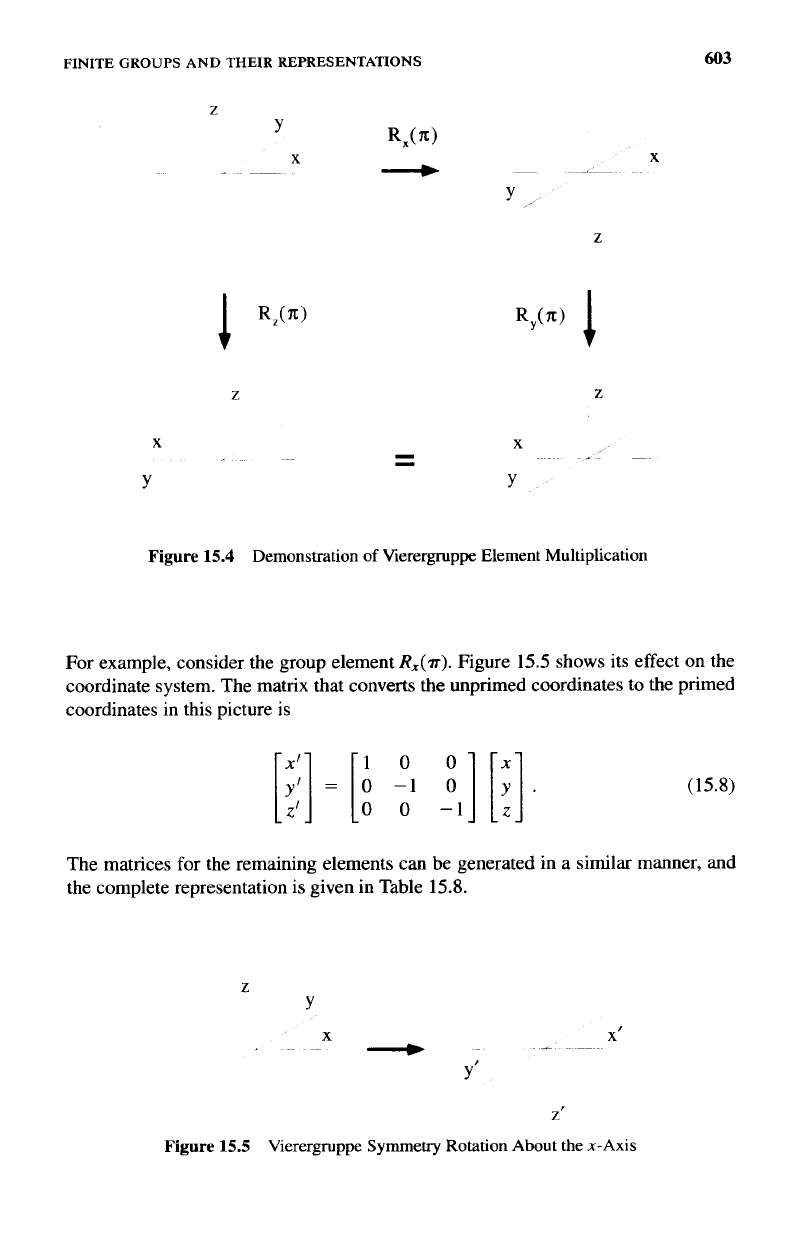
the product of any two nonidentity elements generates the third
is
demonstrated by
Figure 15.4 for the
RAT)
RY(w)
=
R,(T)
operation. The other permutations follow
in
an analogous manner. Because of
this
picture, the vierergruppe is often called
Dz.
The
D
stands
for dihedral, a figure formed by the intersection of
two
planes, and the
2
indicates there
is
a twofold symmetry around each
axis.
We can easily construct a 3
X
3
matrix
representation of
Dz
by considering the
effect
of
the symmetry operations on
the
coordinate axes shown
in
Figure 15.3.
Y
X
figure
153
Symmetry for
the
Vierergruppe
FINITE GROUPS AND
THEIR
REPRESENTATIONS
603
Z
X
Y
Z
Z
z
X
-
-
Y
Figure
15.4
Demonstration
of
Vierergmppe Element Multiplication
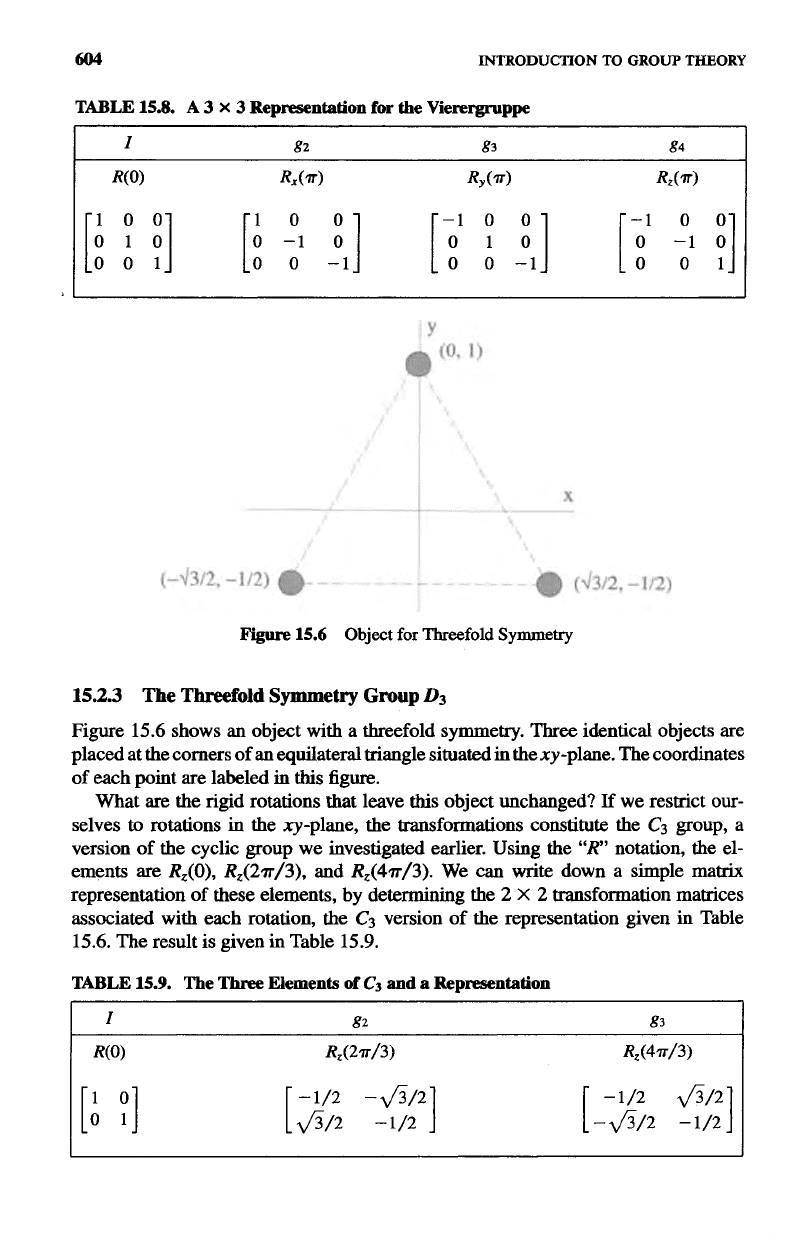
For example, consider the group element
Rx(m).
Figure
15.5
shows its effect on the
coordinate system. The matrix that converts the unprimed coordinates to the primed
coordinates in this picture is
[ij]
=
[a
11
pI]
[;I
(15.8)
The matrices for the remaining elements can be generated in a similar manner, and
the complete representation is given in Table
15.8.
Z
Y
Z’
Figure
15.5
Vierergruppe
Symmetry
Rotation
About
the
x-Axis
604
INTRODUCTION TO GROUP THEORY
TABLE 15.8.
A
3
X
3
Representation
for
the
Vierergruppe.
I
IY
/
//
j
‘\\
/
/
I
‘\
/
I
\
\
I
\
X
/
/
(-4312,
~
-1/2)
I
I
\
\
(4312,
-
,112)
Figure
15.6
Object
for
Threefold
Symmetry
15.2.3
The
Threefold
Symmetry
Group
03
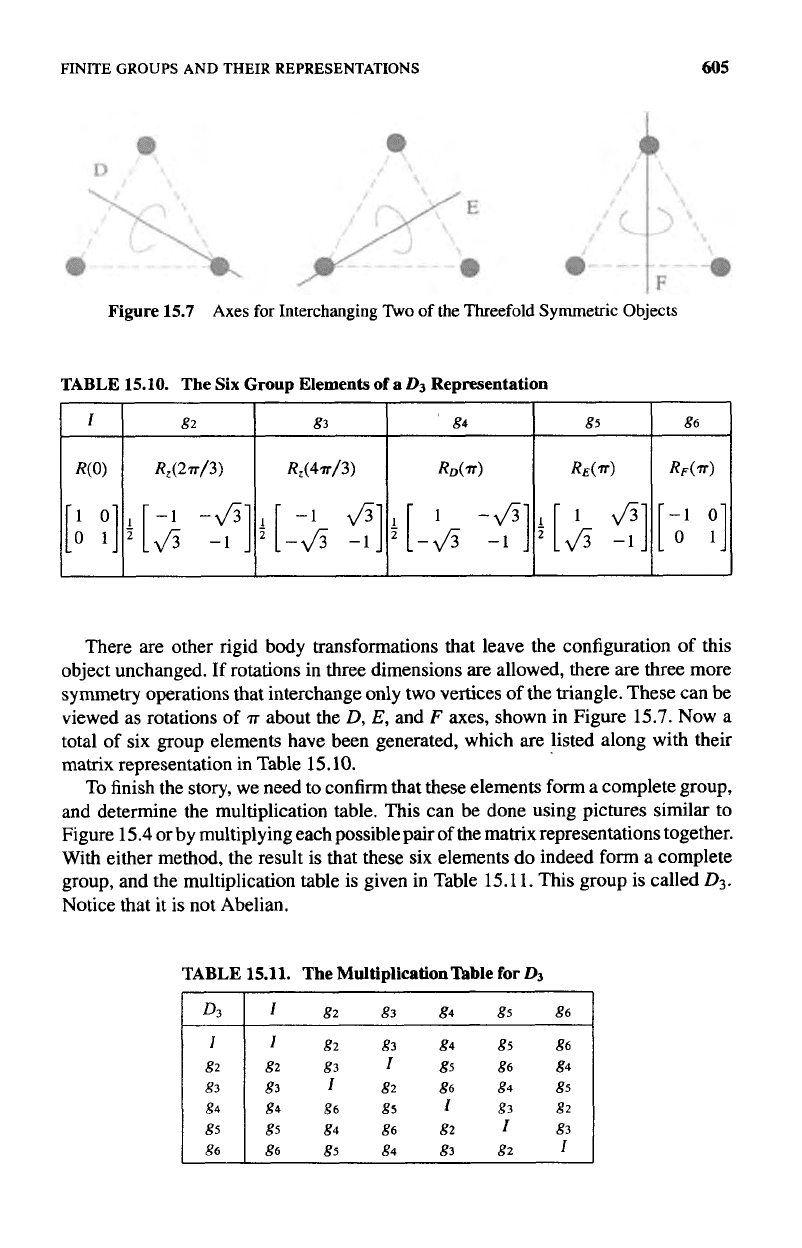
Figure 15.6 shows an object with a threefold symmetry.
Three
identical objects are
placed at
the
comers of an equilateral triangle situated in the xy-plane. The coordinates
of
each point are labeled in
this
figure.
What are the rigid rotations that leave
this
object unchanged?
If
we restrict
our-
selves to rotations
in
the xy-plane, the transformations constitute the
C3
group, a
version of the cyclic group we investigated earlier. Using the
“R”
notation, the el-
ements are
R,(O),
R2(2.rr/3), and Rz(4.rr/3). We can write down a simple matrix
representation
of
these elements, by determining the 2
X
2 transfomtion matrices
associated with each rotation, the
C3
version of the representation given
in
Table
15.6.
The result is given in Table
15.9.
TABLE 15.9.
The
Three
Elements
of
C3
and
a
Representation
FINITE
GROUPS
AND THEIR REPRESENTATIONS
605
Figure
15.7
Axes for Interchanging
Two
of the Threefold Symmetric Objects
TABLE
15.10.
The
Six
Group Elements
of
a
DJ
Representation
There are other rigid body transformations that leave the configuration
of
this
object unchanged.
If
rotations in three dimensions are allowed, there are three more
symmetry operations that interchange only two vertices of the triangle. These can be
viewed as rotations
of
T
about the
D,
E,
and
F
axes, shown in Figure
15.7.
Now a
total
of
six group elements have been generated, which are listed along with their
matrix representation in Table
15.10.
To finish the story, we need
to
confirm that these elements form a complete group,
and determine the multiplication table. This can be done using pictures similar to
Figure
15.4
or
by multiplying each possible pair
of
the
matrix representations together.
With either method, the result is that these six elements do indeed form a complete
group, and the multiplication table is given in Table
15.1
1.
This group is called
D3.
Notice that it is not Abelian.