
Kusse B.R., Westwig E.A. Mathematical Physics: Applied Mathematics for Scientists and Engineers
Подождите немного. Документ загружается.

616
INTRODUCTION
TO
GROUP
THEORY
set would
be
by trial and error.
A
more educational method is to derive it using the
orthogonality relations of the irreducible representations, a topic we explore later in
this
chapter.
Example
15.4
As
another example
of
representation reduction, consider the
03
group. We showed a
2
X
2
matrix representation for
this
group
in
Table 15.10.
An
attempt to diagonalize
this
representation
in
the same way we did for the previous
example fails. Therefore,
it
is
an
irreducible representation, which we will call
DY].
As
always,
Dyl
is the trivial one-dimensional irreducible representation.
A
3
X
3
matrix representation for
this
group can
be
constructed from the operator
representation developed
in
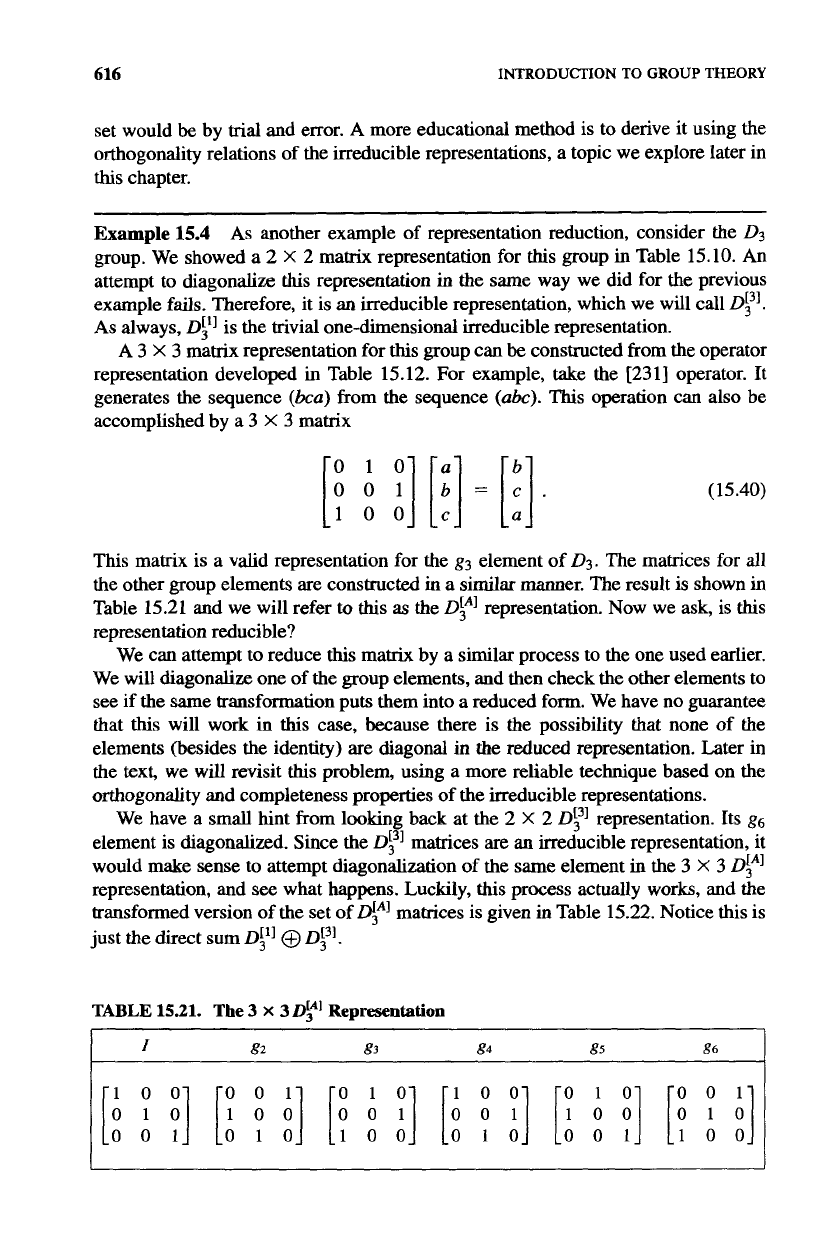
Table 15.12. For example, take the [231] operator.
It
generates the sequence
(ha)
from the sequence
(ah).
This
operation can also be
accomplished by a 3
X
3
matrix
(15.40)
This matrix is a valid representation for the
g3
element
of
D3.
The matrices for
all
the other group elements are constructed
in
a
similar manner. The result is shown in
Table 15.21 and we will refer
to
this
as
the
DY]
representation. Now we ask, is
this
representation reducible?
We can attempt to reduce
this
matrix by a similar process to the one used earlier.
We will diagonalize one of the group elements, and then check the other elements to
see if the same transformation puts them into a reduced form. We have no guarantee
that
this
will work
in
this
case, because there
is
the possibility that none of the
elements (besides the identity) are diagonal in the reduced representation. Later
in
the text, we will revisit
this
problem, using a more reliable technique based on the
orthogonality and completeness properties of the irreducible representations.
We have a small hint from looking back at the
2
X
2
Drl
representation. Its
gg
element is diagonalized. Since the
OF1
matrices are an irreducible representation, it
would make sense to attempt diagonalization of the same element
in
the 3
X
3 DY1
representation, and
see
what happens. Luckily,
this
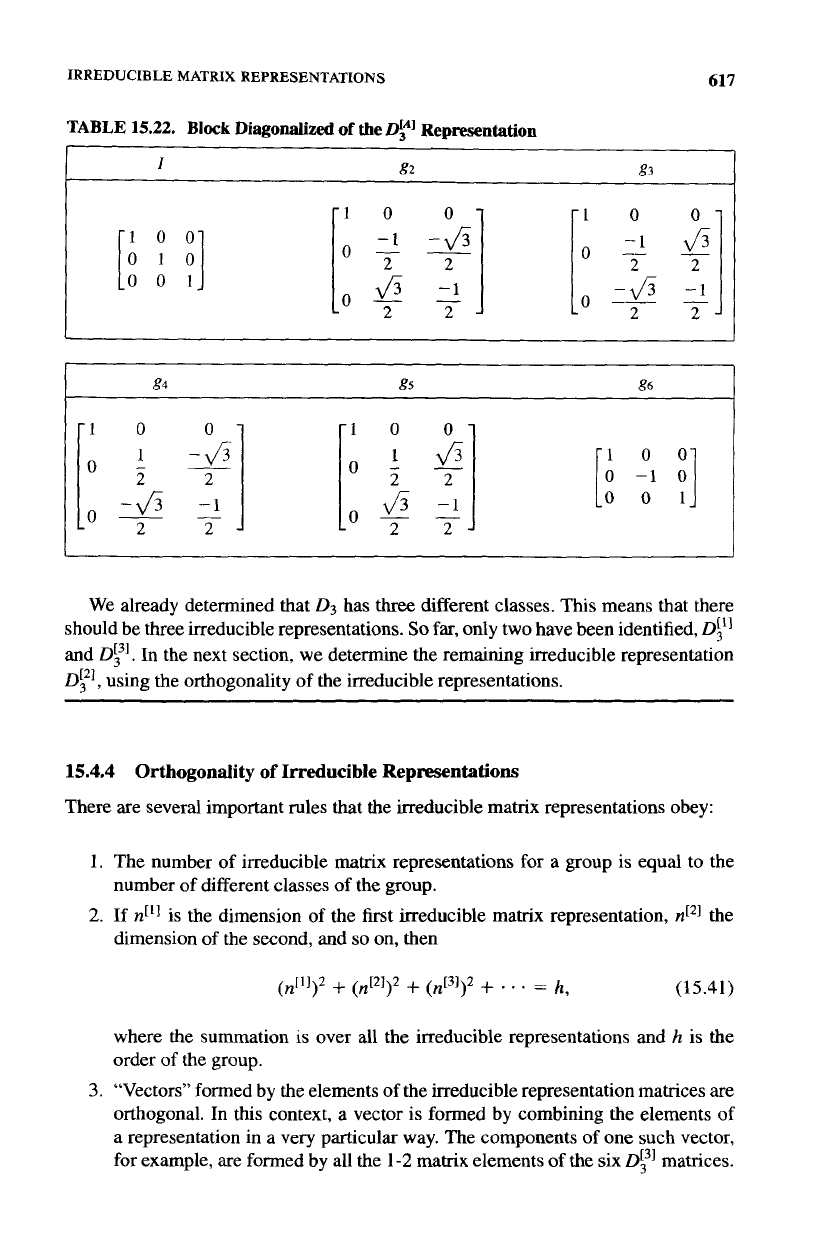
process actually works, and the
transformed version of the set of
dtl
matrices is given in Table 15.22. Notice this is
just
the direct
sum
DF1
@
Df].
TABLE
15.21.
The
3
X
3
0,"'
Representation
I
g2
g3
g4
gs
g6
100
001
010
100
010
[x
t
:I
[:
:
xl
[;
x
tl
[:
:
tl
1:
x
:I
[8
x
bl
617
IRREDUCIBLE
MATRIX
REPRESENTATIONS
TABLE
15.22.
Block
Diagonalized
of
the
Dfl
Representation
g2
g3
I
I
g4
We already determined that
03
has
three
different classes. This means that there
should be three irreducible representations.
So
far, only two have been identified,
DY1
and
DY1.
In the next section, we determine the remaining irreducible representation
DY1,
using the orthogonality
of
the irreducible representations.
15.4.4
Orthogonality
of
Irreducible
Representations
There are several important rules that the irreducible matrix representations
obey:
1.
The number of irreducible matrix representations
for
a group is equal to the
2.
If is the dimension of the first irreducible matrix representation,
ni2]
the
number of different classes
of
the group.
dimension
of
the second, and
so
on, then
where the summation
is
over all the irreducible representations
and
h
is
the
order
of
the group.
3.
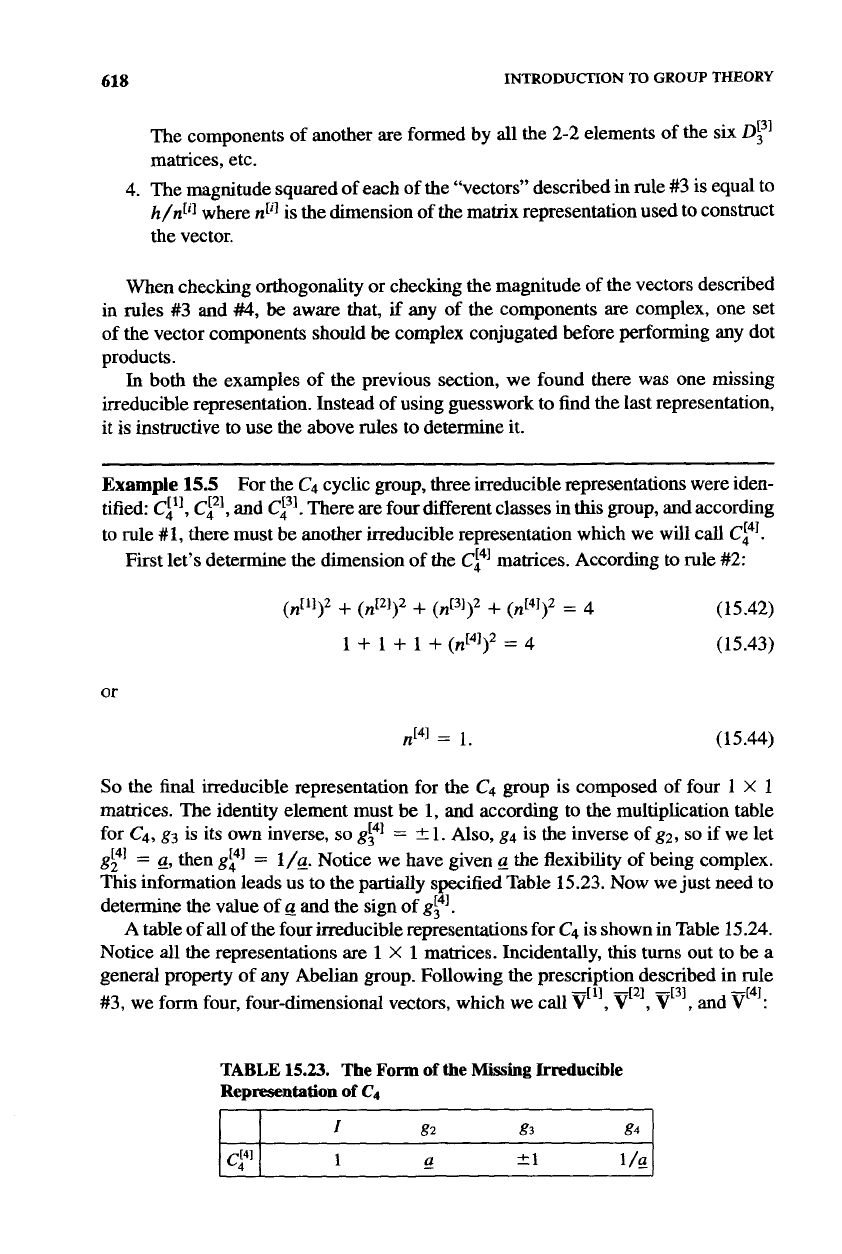
“Vectors” formed by the elements of the irreducible representation matrices are
orthogonal. In this context, a vector is formed by combining the elements
of
a representation in a very particular way. The components of one such vector,
for example, are formed by all the
1-2
matrix elements
of
the six
DY1
matrices.
618
INTRODUCTION TO GROUP THEORY
The components of another are formed by all the
2-2
elements of the
six
Dyl
matrices, etc.
4.
The magnitude squared of each of the “vectors” described in rule
#3
is equal to
h/n[‘l
where
dil
is
the dimension of the matrix representation
used
to construct
the vector.
When checking orthogonality or checking the magnitude
of
the vectors described
in rules
#3
and
#4,
be
aware that,
if
any of the components are complex, one set
of the vector components should
be
complex conjugated before performing any dot
products.
In both the examples of the previous section, we found there
was
one missing
irreducible representation. Instead of using guesswork to find the last representation,
it
is
instructive to use the above rules to determine it.
Example
15.5
For the
C4
cyclic group, three irreducible representations were iden-
tified:
C?],
CY],
and
Ci3].
There are four different classes in
this
group, and according
to rule
#
1, there must be another irreducible representation which we will call
Cfl.
First let’s determine the dimension of the
Ci4]
matrices. According to rule #2:
(#1)2
+
(n121)2
+
(n[31)2
+
(#J)2
=
4
1
+
1
+
1
+
(n[41)2
=
4
(15.42)
(15.43)
or
n~41
=
1.
(15.44)
So
the final irreducible representation for the
C4
group
is
composed of four 1
X
1
matrices. The identity element must be
1,
and according to the multiplication table
for
~4,
g3
is its
own
inverse,
so
grl
=
-t
1.
MSO,
g4
is the inverse of
g2,
so
if we let
grl
=
g,
then
gyl
=
l/g.
Notice we have given
a
the flexibility of being complex.
This information leads
us
to the partially specified Table 15.23.
Now
we just need
to
determine the value
of
g
and the sign of
gf].
A
table of
all
of the four irreducible representations for
C,
is shown in Table 15.24.
Notice all the representations are
1
X
1
matrices. Incidentally,
this
turns out
to
be a
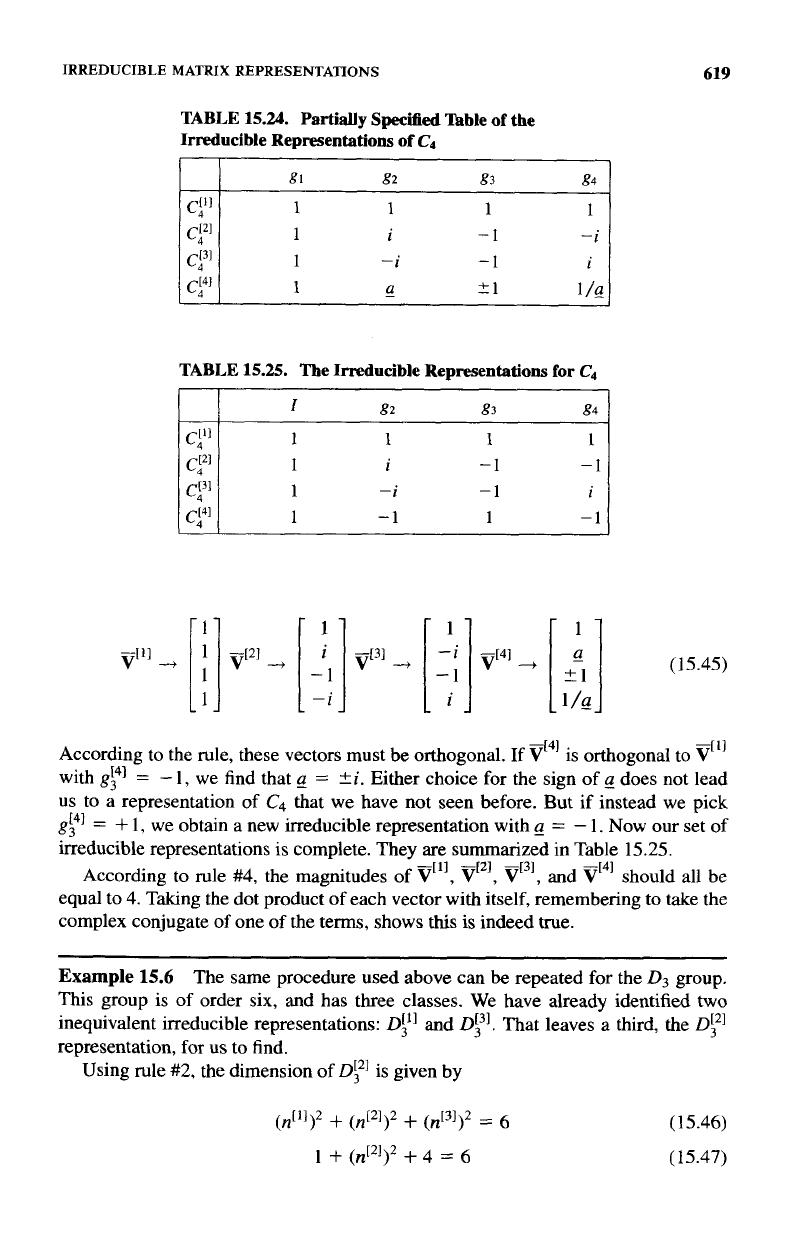
general property of any Abelian group. Following the prescription described in rule
#3,
we form four, four-dimensional vectors, which we call
V
,
V
,
V
,
and
Vf4]:
-111
-121
-[31
TABLE
15.23.
The
Form
of
the
Missing
Irreducible
Representation
of
C,
I
‘I
J
IRREDUCIBLE MATRIX REPRESENTATIONS
619
TABLE 15.24.
Partially
Speci6ed
Table
of
the
Irreducible Representations
of
C4
I
I
-1
-1
1
-
a
21
1
/c
1
-i
-1
i
TABLE
15.25.
The Irreducible Representations
for
C,
Ci*]
-1
-1
q31
1
-i
-1
I
Cf'
1
-1
1
-1
-[41
.
According to the rule, these vectors must be orthogonal. If
V
is
orthogonal to
V1l1
with
grl
=
-
1,
we find that
g
=
+i.
Either choice for the sign of
g
does not lead
us
to a representation of
C,
that we have not seen before. But
if
instead we pick
grJ
=
+
1,
we obtain a new irreducible representation with
g
=
-
1.
Now
our set
of
irreducible representations is complete.
They
are summarized in Table
15.25.
According to rule
#4,
the magnitudes of
V
,
V
,
V
,
and
VL4]
should all be
equal to
4.
Taking the dot product of each vector with itself, remembering to take the
complex conjugate of one of the terms, shows
this
is indeed
true.
Example
15.6
The same procedure used above can
be
repeated for the
03
group.
This group is of order six, and has three classes. We have already identified two
inequivalent irreducible representations:
D:']
and
0k3].
That leaves a third, the
DYJ
representation, for
us
to find.
-111
-[Zl
331
Using rule
#2,
the dimension
of
DrJ
is given
by
(15.46)
(15.47)
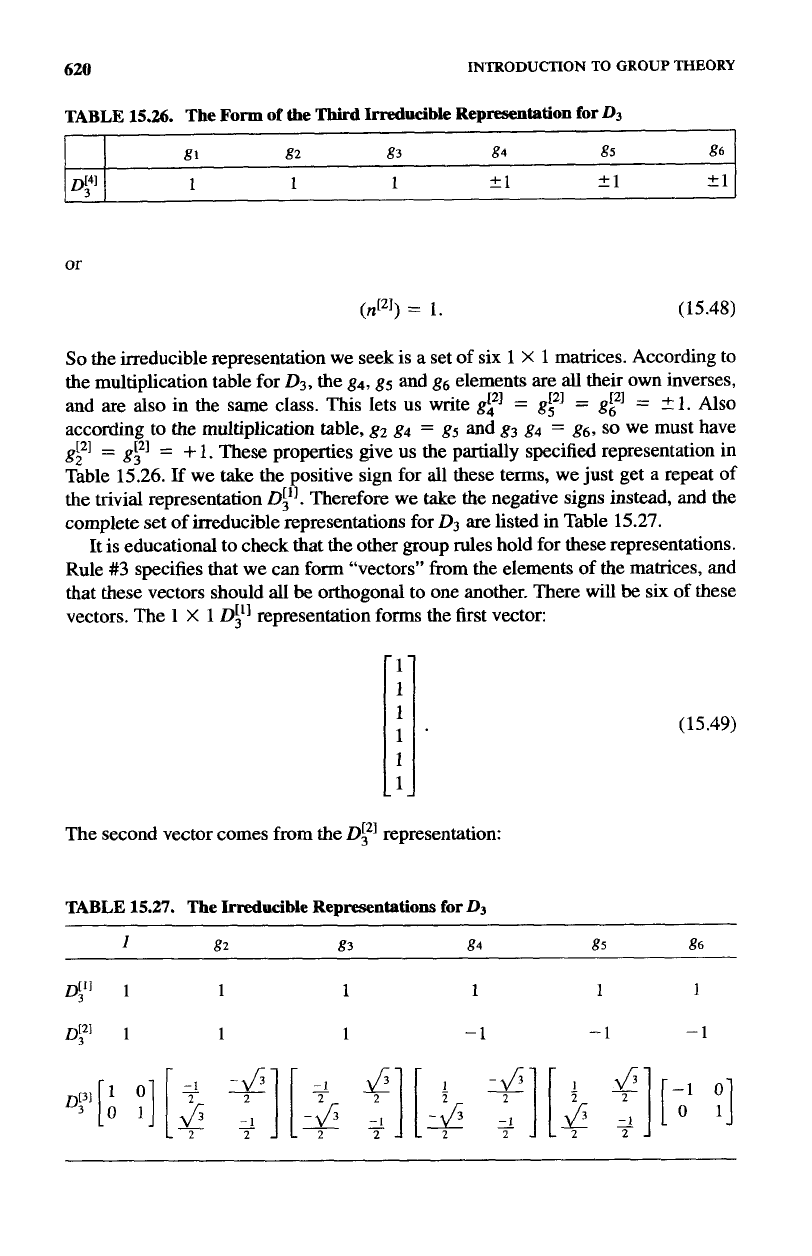
620
INTRODUCTION
TO
GROUP
THEORY
Df]
g1
g2 g3
g4
g5
g6
1
1
1
?1
21
’1
or
(nq
=
1.
(15.48)
So
the irreducible representation we
seek
is a set of six
1
X
1
matrices. According to
the multiplication table for
D3,
the
g4, g5
and
g6
elements are
d
their own inverses,
and are
also
in the same class.
This
lets us write
gi2]
=
gyl
=
grl
=
5
1.
Also
according
to
the multiplication table,
gz
g4
=
g5
and
g3 g4
=
g6,
so
we must have
gfl
=
grl
=
+
1.
These properties give us the partially specified representation in
Table 15.26.
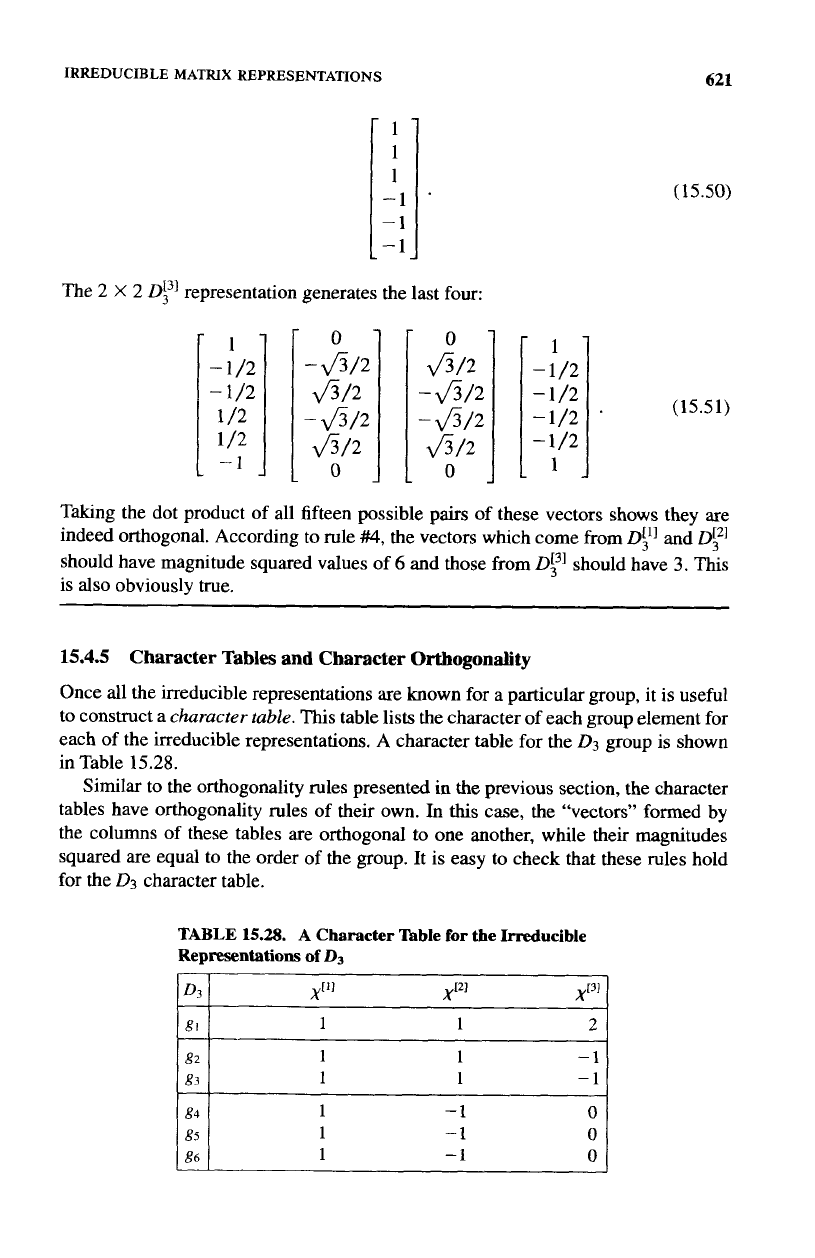
If
we take the positive sign for all these terms, we just get a repeat
of
the trivial representation
0:’’.
Therefore we take the negative signs instead, and the
complete
set
of irreducible representations for
03
are listed in Table 15.27.
It is educational to check that the other group rules hold for these representations.
Rule
#3
specifies that we can form “vectors”
from
the elements of the matrices, and
that these vectors should all
be
orthogonal to one another. There will be
six
of these
vectors. The
1
X
1
Dill
representation forms the first vector:
The second vector comes from the
Dk2’
representation:
TABLE 15.27.
The Irreducible Representations
for
D3
(15.49)
I
g2
g3
g4
g5
g6
DY1
1
1
1
1
1
I
Di2]
1
1 1
-1
-1
-1
IRREDUCIBLE
MATRIX
REPRESENTATIONS
--
1
1
1
-1
.
-1
-
-1
-
-
1
-1/2
-1/2
1
/2
1
/2
-1
621
(15.50)
-
1
-
0
-I-
0
--
-&/2
&2
-
1/2
&/2
-&/2 -&2 -1/2
.
&/2 &/2
-&/2 -1/2 (15.51)
-1/2
1
0
0
-
--
The
2
X
2 DY1
representation generates the last four:
03
gl
g2
g3
g4
g5
g6
xI1l
x121
xr3,
1
1
2
1
1
-1
1
1
-1
1
-1
0
1 -1
0
1
-1
0
Taking the dot product of all fifteen possible pairs of these vectors shows they are
indeed orthogonal. According to rule
#4,
the vectors which come
from
OF1
and
DY1
should have magnitude squared values of
6
and those
from
DY1
should have
3.
This
is also obviously true,
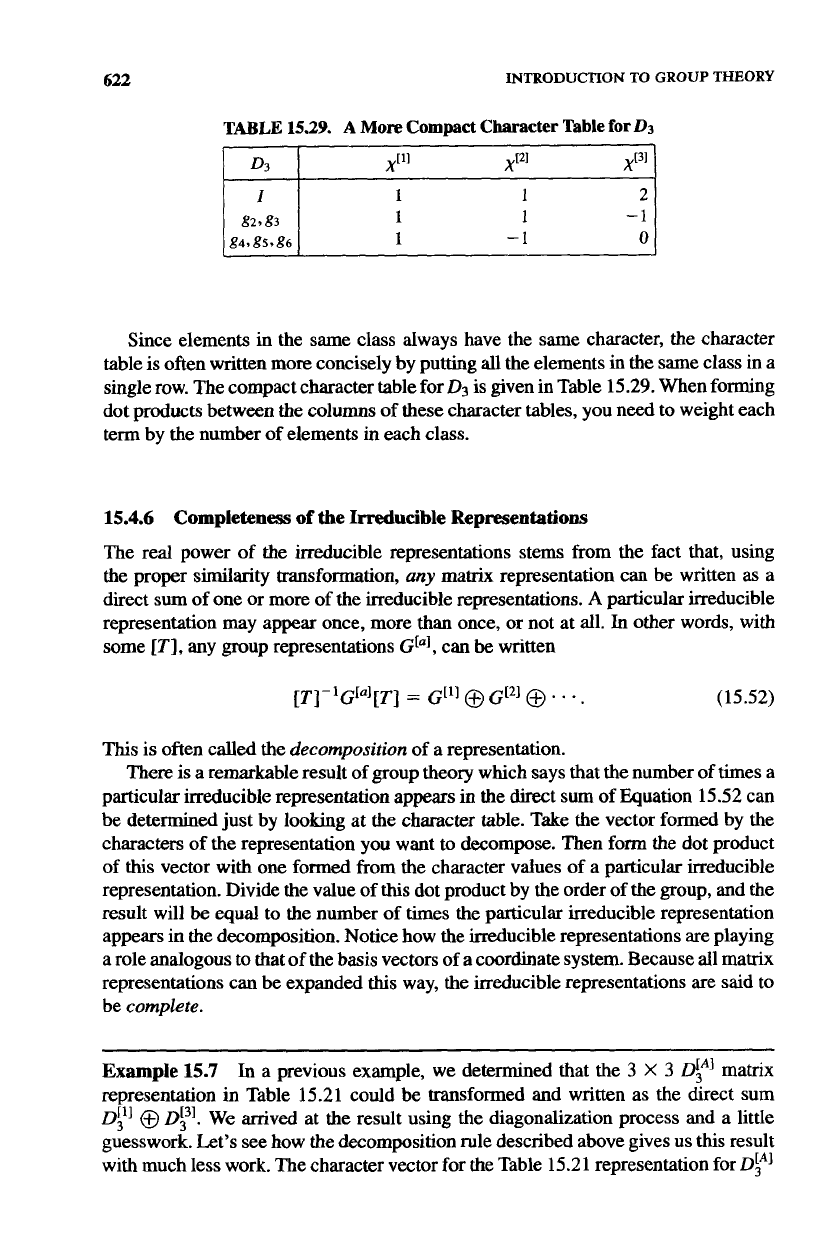
15.4.5
Character Tables and Character
Orthogonality
Once
all
the irreducible representations
are
known for a particular group, it is useful
to
construct a
character table.
This table lists the character of each group element for
each of the irreducible representations. A character table for the
03
group is shown
in Table
15.28.
Similar to the orthogonality rules presented in the previous section, the character
tables have orthogonality rules of their own.
In
this
case,
the
“vectors” formed by
the columns of these tables are orthogonal to
one
another, while their magnitudes
squared are equal to the order
of
the
group.
It is
easy
to check that these rules hold
for the
03
character table.
622
INTRODUCTION
TO GROUP THEORY
4
TABLE
15.29.
A
More
Compact Character Table
for
D3
x[ll
xr21
x[31
I
g29
g3
g4r
gS9
g6
1
1
2
1
1 -1
1
-1
0
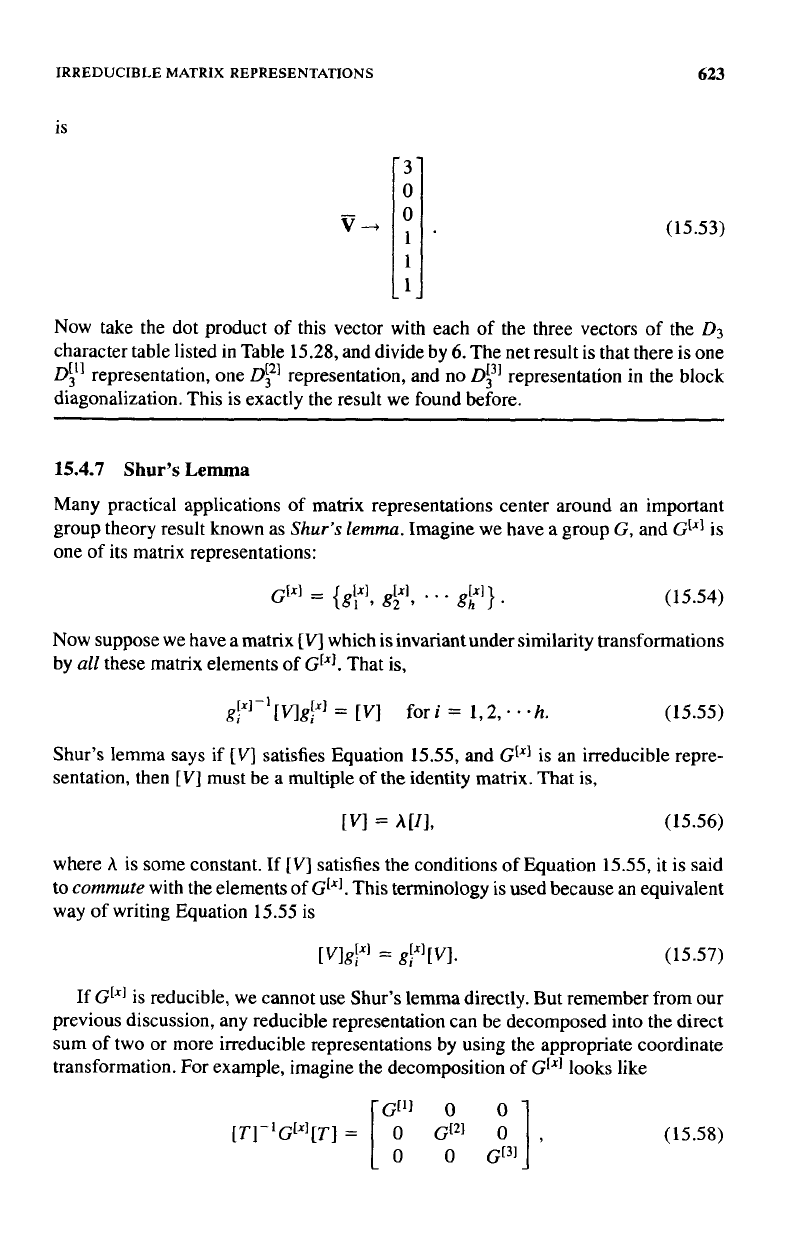
Since elements in the same class always have the same character, the character
table is often written more concisely by putting
all
the elements in the same class in a
single row. The compact character table for
D3
is given in Table
15.29.
When forming
dot products between the columns of these character tables, you need to weight each
term by the number of elements
in
each class.
15.4.6
Completeness
of
the
Irreducible
Representations
The real power of the irreducible representations stems from the fact that, using
the proper
similarity
transformation,
any
matrix representation can be written
as
a
direct
sum
of one or more of the irreducible representations.
A
particular irreducible
representation
may
appear once, more than once, or not at all.
In
other words, with
some
[TI,
any group representations
Gral,
can
be
written
This
is often called the
decomposition
of
a representation.
There
is
a remarkable result of group theory which says that the number
of
times a
particular irreducible representation appears in the direct sum of Equation
15.52
can
be
determined just by
looking
at the character table. Take the vector formed by the
characters of the representation you want to decompose. Then form the dot product
of
this
vector with one formed from the character values of a particular irreducible
representation. Divide the value of
this
dot product by the order of the group, and
the
result will
be
equal to the number of times the particular irreducible representation
appears
in
the decomposition. Notice how the irreducible representations are playing
a role
analogous
to that of the basis vectors of a coordinate system. Because all matrix
representations can be expanded
this
way, the irreducible representations are said to
be
complete.
Example
15.7
In
a previous example, we determined that the
3
X
3
Dyl
matrix
representation in Table
15.21
could be transformed and written as the direct
sum
Dyl
@
Oh3].
We arrived at the result using the diagonalization process and a little
guesswork. Let's see how the decomposition rule described above gives
us
this result
with much less work. The character vector for the Table
15.21
representation
for
Drl
IRREDUCIBLE MATRIX REPRESENTATIONS
623
is
(15.53)
Now take the dot product of this vector with each of the three vectors of the
03
character table listed in Table
15.28,
and divide by
6.
The
net
result is that there is one
DY1
representation, one
DY1
representation, and
no
DY1 representation in the block
diagonalization. This is exactly the result we found before.
15.4.7
Shur's
Lemma
Many practical applications of matrix representations center around an important
group theory result known as
Shur's
lemma.
Imagine we have a group
G,
and
GLX1
is
one of its matrix representations:
(15.54)
Now suppose we have a matrix
[
v]
which is invariant under similarity transformations
by
ull
these matrix elements of
GEXl.
That
is,
gj"I-l[~g,fXI
=
[VI
for
i
=
1,2,
*
-
.h.
(15.55)
Shur's lemma says if
[V]
satisfies Equation
15.55,
and
GLxl
is an irreducible repre-
sentation, then
[
V]
must be a multiple of the identity matrix. That is,
[Vl
=
AVI,
(15.56)
where
A
is
some constant. If [V] satisfies the conditions of Equation
15.55,
it
is said
to
commute
with the elements of
Grxl.
This terminology
is
used because an equivalent
way of writing Equation
15.55
is
[Vlgjx]
=
gj"][V].
(15.57)
If
Grxl
is reducible, we cannot use Shur's lemma directly. But remember from
our
previous discussion, any reducible representation can be decomposed into the direct
sum of two or more irreducible representations by using the appropriate coordinate
transformation. For example, imagine
the
decomposition of
GIX1
looks like
G[']
0 0
[T]-'C["'[T]
=
[
Gr
231]
,
(15.58)
624
INTRODUCTION
TO
GROUP
THEORY
where
GI1], G['],
and
Gf31
are irreducible representations
of
dimension
1,
2,
and 4
respectively, and
[TI
is the transformation matrix that puts the matrices into the block
diagonal form.
If
[VJ
commutes with
all
the elements of
Grx1,
the transformed matrix
[V']
=
[T]-'[VJ[T]
wiU
commute with
all
the elements of the transformed
Grxl
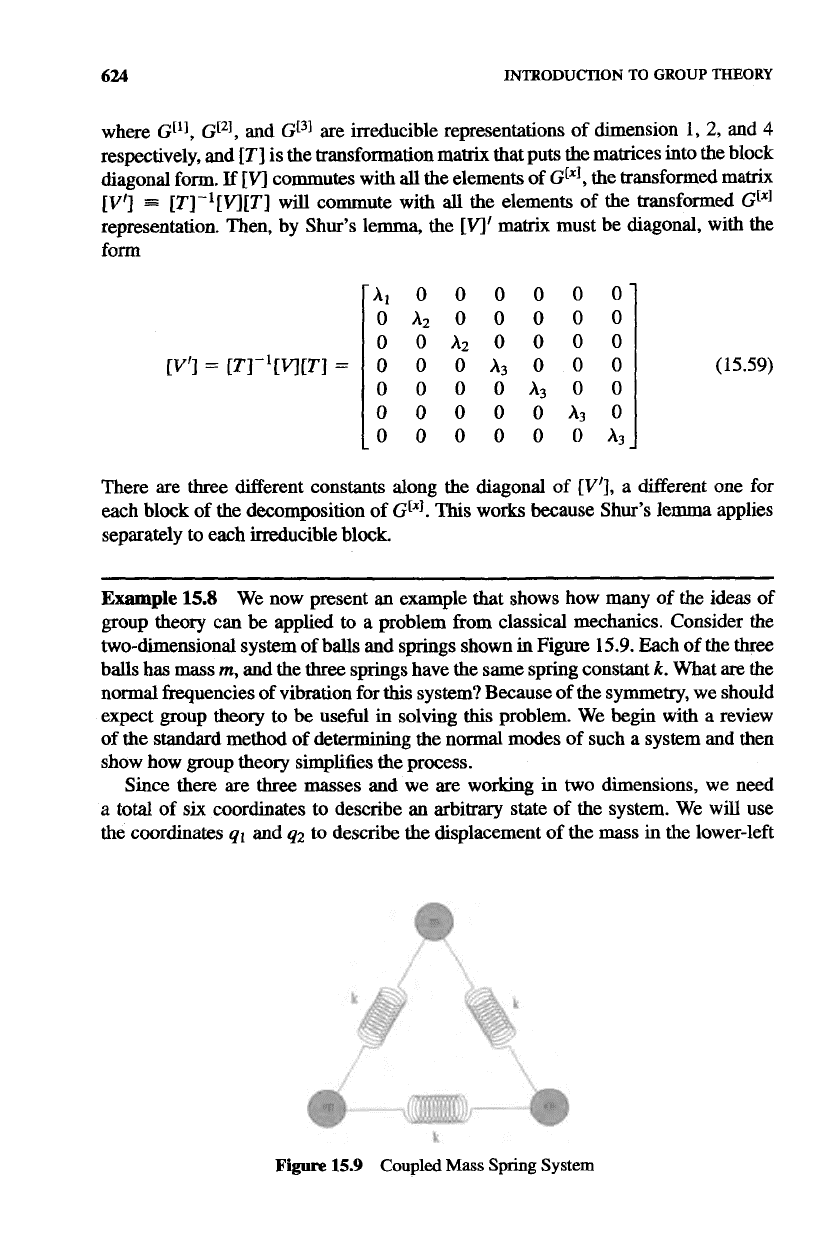
representation. Then, by Shur's
lemma,
the
[VJ'
matrix must be diagonal, with the
form
[V']
=
[T]-'[vJ[T]
=
AlOOOOOO
OA~OOOOO
OOhzOOOO
000h~000
0000h300
0
0
0
0 0
h3
0
000000h3
There are three different constants ;-mg the diagonal
of
[V'],
i
(15.59)
lifferent one
for
each block of the decomposition of
GLXl.
This
works because Shur's lemma applies
separately to each irreducible block.
Example
15.8
We now present
an
example that shows how many
of
the ideas
of
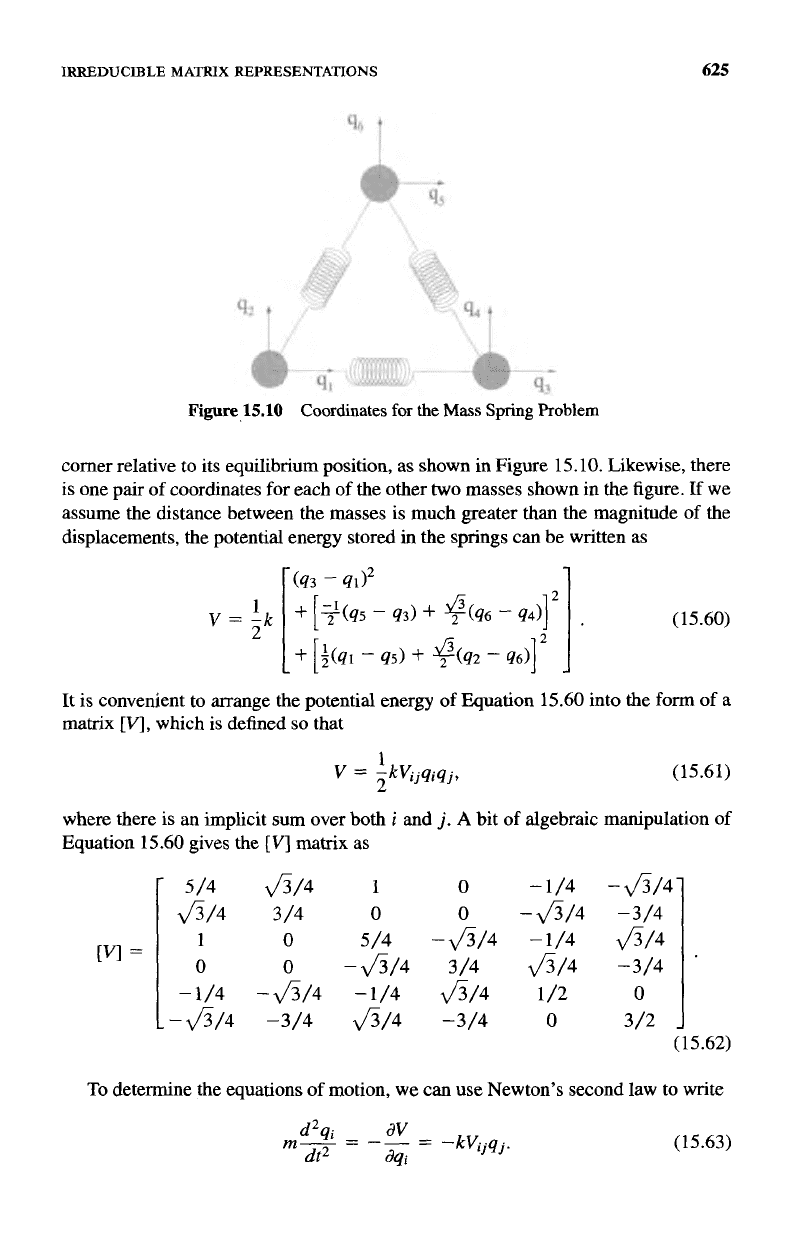
group theory can be applied to a problem from classical mechanics. Consider the
two-dimensional system of balls and springs shown in Figure 15.9. Each
of
the
three
balls
has
mass
m,
and the
three
springs have the
same
spring constant
k.
What
are
the
normal frequencies of vibration for
this
system? Because
of
the symmetry, we should
expect group
theory
to
be
useful
in
solving
this
problem. We
begin
with
a
review
of
the standard method of determining the nod modes of such a system and then
show how group theory simplifies
the
process.
Since there are
three
masses and we are working in
two
dimensions, we need
a
total
of
six
coordinates to describe
an
arbitrary state of the system. We will use
the coordinates
41
and
42
to describe the displacement of the mass in the lower-left
k
Figure
15.9
Coupled
Mass
Spring
System
IRREDUCIBLE MATRIX REPRESENTATIONS
-
5/4 &/4
1
0
-1/4 -fi/4-
&/4 3/4
0 0
-&/4 -3/4
0
-&/4
3/4 &/4 -3/4
-1/4 -4/4
-1/4
&I4
1/2
0
1
0
5/4 -&/4 -1/4 &/4
[VI
=
--&/4
-3/4
&/4
-3/4
0
3/2
A
625
'
Figure.lS.10
Coordinates
for
the
Mass
Spring
Problem
To determine the equations
of
motion, we can use Newton's second law to write
(15.63)