
Kusse B.R., Westwig E.A. Mathematical Physics: Applied Mathematics for Scientists and Engineers
Подождите немного. Документ загружается.

INTRODUCTION
TO
GROUP THEORY
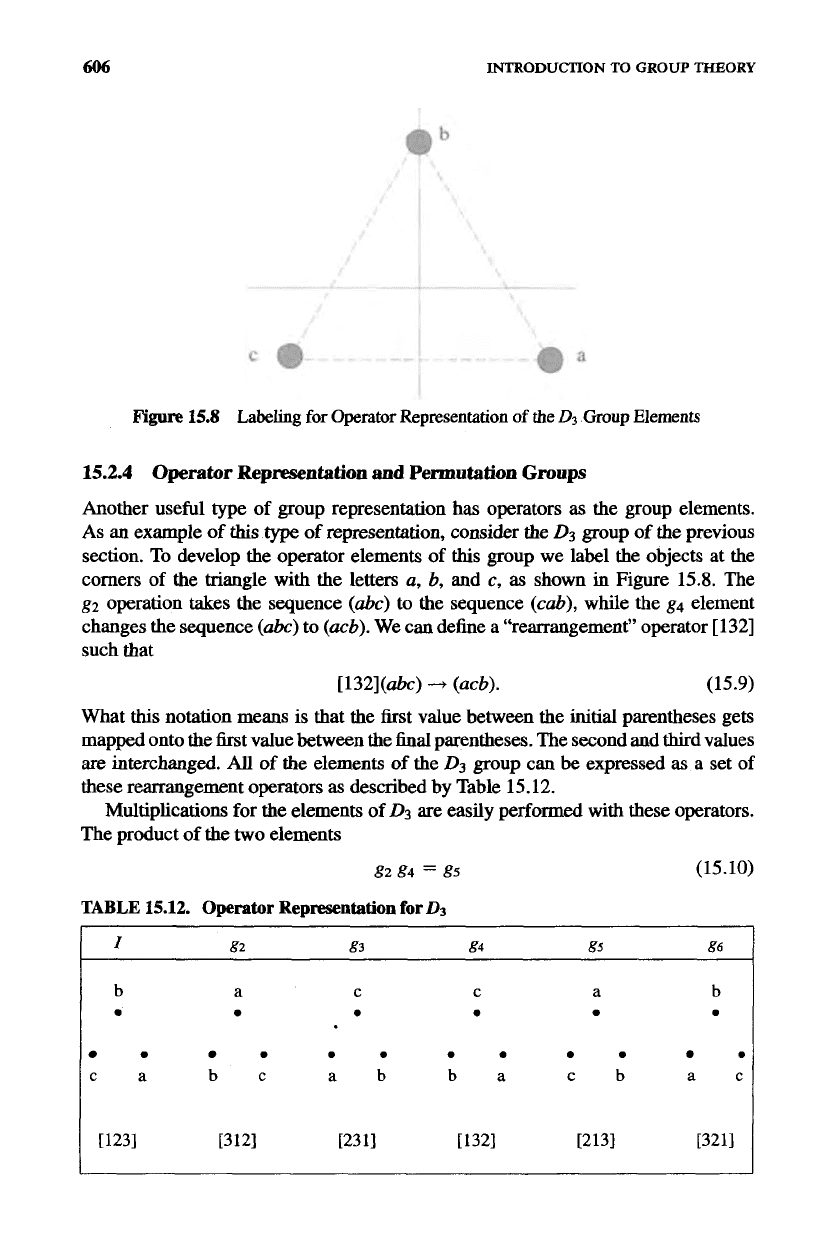
figure
15.8
Labeling
for
Operator
Representation
of
the
4
Group Elements
25.24
Operator
Representation
and
Permutation Groups
Another useful type
of
group representation has operators
as
the group elements.
As
an example
of
this
type
of
representation, consider the
D3
group
of
the previous
section. To develop the operator elements
of
this
group we label the objects at the
corners
of
the triangle with the letters
a,
b,
and
c,
as
shown
in
Figure 15.8. The
g2
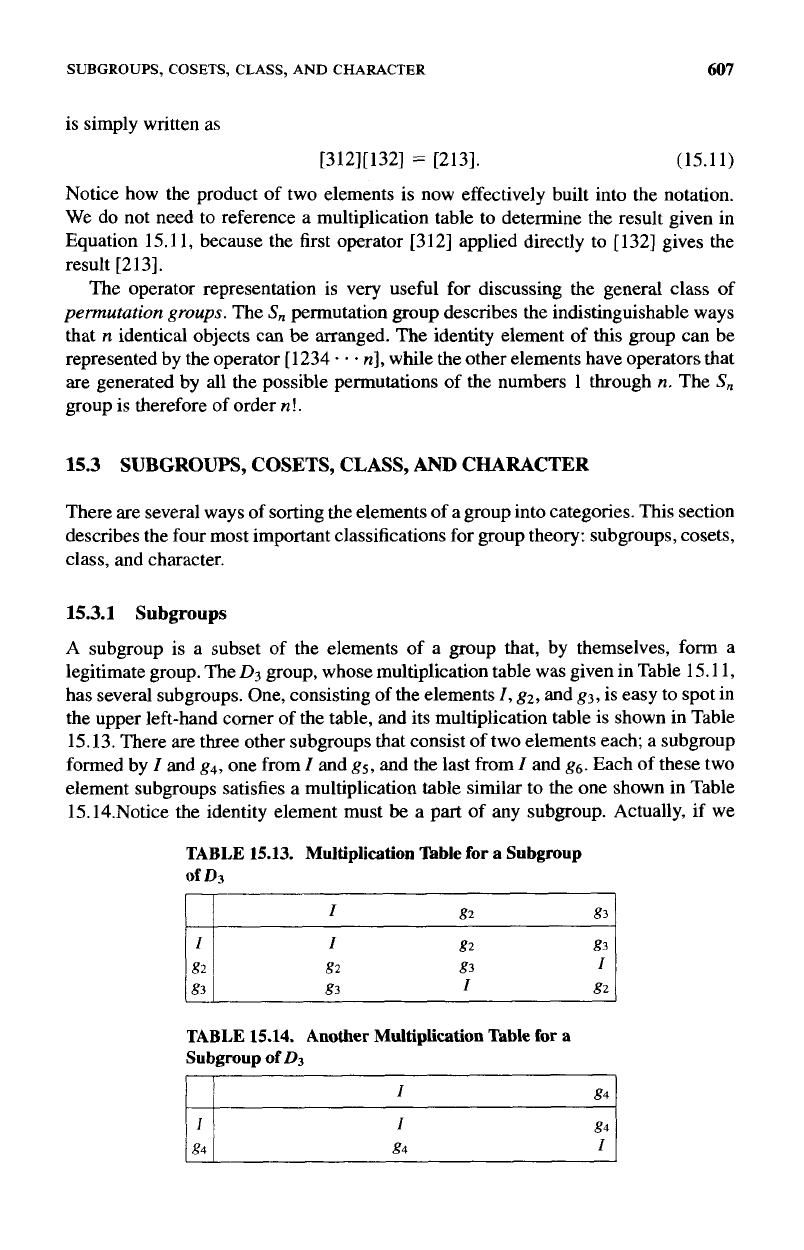
operation takes the sequence
(abc)
to the sequence
(cub),
while the
g4
element
changes the sequence
(ubc)
to
(acb).
We can define a “rearrangement” operator
[
1321
such that
[132](abc)
--+
(ucb).
(15.9)
What
this
notation means is that the first value between the initial parentheses gets
mapped onto the first value between the
hal
parentheses. The second and third values
are interchanged.
All of
the elements
of
the
D3
group can
be
expressed
as
a set
of
these rearrangement operators
as
described by Table 15.12.
Multiplications for the elements
of
D3
are easily performed with these operators.
The product
of
the
two elements
(1 5.10)
g2
g4
=
g5
TABLE
15.12.
Operator
Representation
for
D3
I
g2
g3
g4
g5
g6
lb a
C
C
a
b
a a
a
a
a
m
a a
m
a a
a a a a
ca bc ab ba cb ac
SUBGROUPS, COSETS,
CLASS,
AND
CHARACTER
607
I
84
is simply written as
I
g4
I
g4
g4
I
[312][132]
=
[213]. (15.11)
Notice how the product of two elements is now effectively built into the notation.
We do not need to reference a multiplication table to determine the result given in
Equation 15.1 1, because the first operator [312] applied directly to [132] gives the
result [213].
The operator representation is very useful for discussing the general class of
permutation
groups.
The
S,
permutation group describes the indistinguishable ways
that
n
identical objects can be arranged. The identity element of
this
group can be
represented by the operator
[
1234
.
*
*
n],
while the other elements have operators that
are generated by all the possible permutations of the numbers 1 through
n.
The
S,
group is therefore of order
n!.
15.3
SUBGROUPS,
COSETS,
CLASS,
AND
CHARACTER
There are several ways of sorting the elements of a group into categories. This section
describes the four most important classifications for group theory: subgroups, cosets,
class, and character.
15.3.1
Subgroups
A
subgroup is a subset of the elements of a group that, by themselves, form a
legitimate group. The
03
group, whose multiplication table was given in Table 15.1
1,
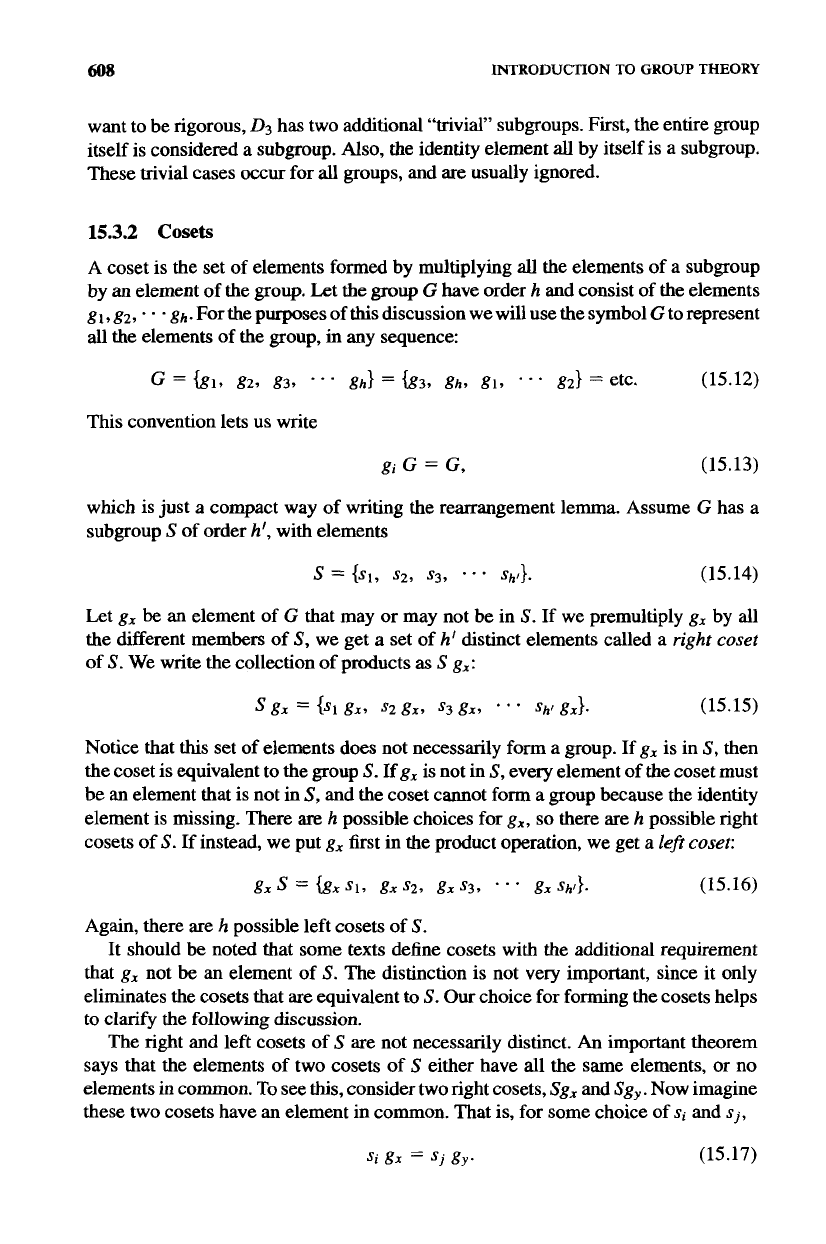
has several subgroups. One, consisting
of
the elements
I,
g2,
and
g3,
is easy to spot in
the upper left-hand comer of the table, and its multiplication table is shown in Table
15.13. There are three other subgroups that consist of two elements each; a subgroup
formed by
I
and
g4,
one from
Z
and
g5,
and the last from
I
and
gg.
Each of these two
element subgroups satisfies a multiplication table similar to the one shown in Table
15.14.Notice the identity element must
be
a part of any subgroup. Actually, if we
TABLE
15.13.
Multiplication Table
for
a
Subgroup
of
D3
608
INTRODUCTION TO GROUP
THEORY
want to be rigorous,
03
has two additional
"trivial"
subgroups. First, the entire group
itself is considered a subgroup.
Also,
the identity element
all
by itself is a subgroup.
These trivial cases
occur
for
all
groups, and are usually ignored.
15.3.2
Cosets
A coset is the set of elements formed by multiplying
all
the elements
of
a subgroup
by
an
element of the group. Let the group
G
have order
h
and consist of the elements
gl,
gz,
*
-
-
gh.
For
the
purposes
of
this
discussion we will use the symbol
G
to represent
all the elements of the group,
in
any sequence:
G
=
(sl.
gz.
g3.
*--
gd
=
(g3,
gh,
gl,
.
-*
82)
=
etc. (15.12)
This convention lets us write
gi
G
=
G,
(1
5.13)
which is just a compact way of writing the rearrangement lemma. Assume
G
has a
subgroup
S
of order
h',
with elements
S
=
{Sl,
s2,
s3,
*- *
Sh'}.
(1
5.14)
Let
gx
be
an element of
G
that may or may not be in
S.
If we premultiply
gx
by all
the different members
of
S,
we
get a set of
h'
distinct elements called a
right
coset
of
S.
We write the collection of products
as
S
gx:
S
gx
=
{Sl
gx9
s2
gx,
s3
gx,
-
* *
Sh'
gxl.
(15.15)
Notice that
this
set of elements does not necessarily form a group. If
gx
is
in
S,
then
the coset is equivalent
to
the group
S.
Ifg,
is not in
S,
every element of the coset must
be
an
element that is not in
S,
and the coset cannot
form
a group because the identity
element is missing. There
are
h
possible choices for
g,,
so
there are
h
possible right
cosets of
S.
If instead, we put
g,
first
in
the product operation, we get a
left
coset:
gx
S
=
kx
s1,
gx
s29
gx
s33
. .
'
gx
Sh'}.
(15.16)
Again, there are
h
possible left cosets of
S.
It
should be noted that some texts define cosets with the additional requirement
that
gx
not
be
an
element of
S.
The distinction
is
not very important, since it only
eliminates the cosets that are equivalent to
S.
Our
choice for forming the cosets helps
to
clarify the following discussion.
The right and left cosets of
S
are not necessarily distinct.
An
important theorem
says that the elements of two cosets of
S
either have all the same elements, or no
elements in common.
To
see
this,
consider two right cosets,
Sg,
and
Sg,.
Now imagine
these two cosets have an element in common. That is, for some choice of
si
and
s,,
SUBGROUPS,
COSETS, CLASS, AND CHARACTER
609
Premultiplying this expression by
sil
and postmultiplying by
g;'
gives
sy1
si
=
g,
g;l.
(15.18)
The element generated
on
the
LHS
of this equation
is
an
element
of
S,
so
the product
gy gL1
on the
RHS
must be an expression for this same element of
S.
Thus we can
write
s
gy
g;'
=
s,
(15.19)
or equivalently
sgy
=
sgx.
(15.20)
Consequently, if the same element appears in two different cosets, the two cosets
have all their elements in common. Conversely, if a particular element is present in
one coset but not another coset, there can
be
no common elements between these two
cosets.
The elements in any single coset
are
distinct. That is, no element can appear more
than once in any given coset.
This
is a direct result of the rearrangement lemma-
every element must appear once and only once in every row and column of the
table. Therefore, every coset contains exactly
h'
different group elements. Therefore,
because any two cosets will either have all elements in common
or
no elements in
common, the order of the group
h
must be
an
integer multiple of the number of
elements in any of its subgroups. That is,
h
=
nh'
where
n
=
a
positive integer.
(15.21)
This is demonstrated quite nicely by the subgroups of
D3,
discussed earlier. The
03
group has six elements, while its nontrivial subgroups have orders two and three.
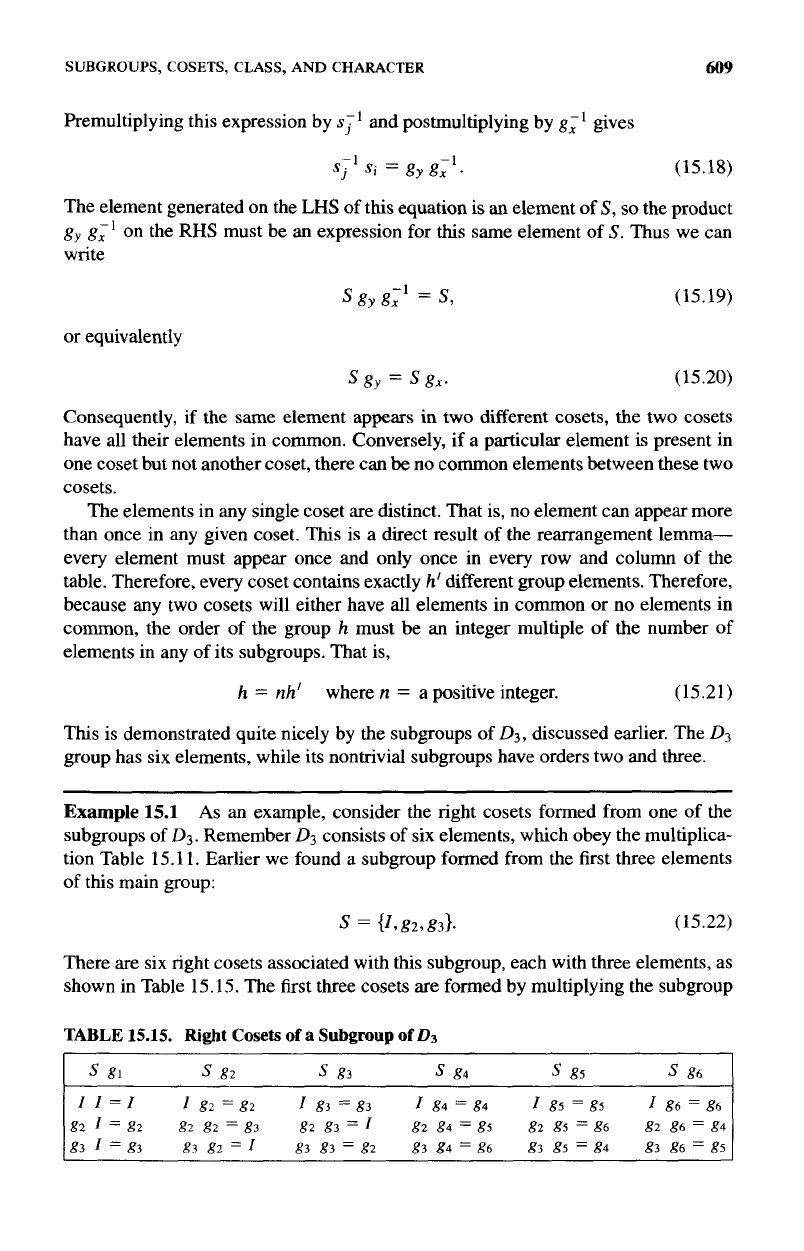
Example
15.1
As
an
example, consider the right cosets formed from one
of
the
subgroups of
03.
Remember
03
consists of
six
elements, which obey the multiplica-
tion Table 15.1
1.
Earlier we found a subgroup formed from the first three elements
of
this main group:
S
=
{Z,gz,g3).
(15.22)
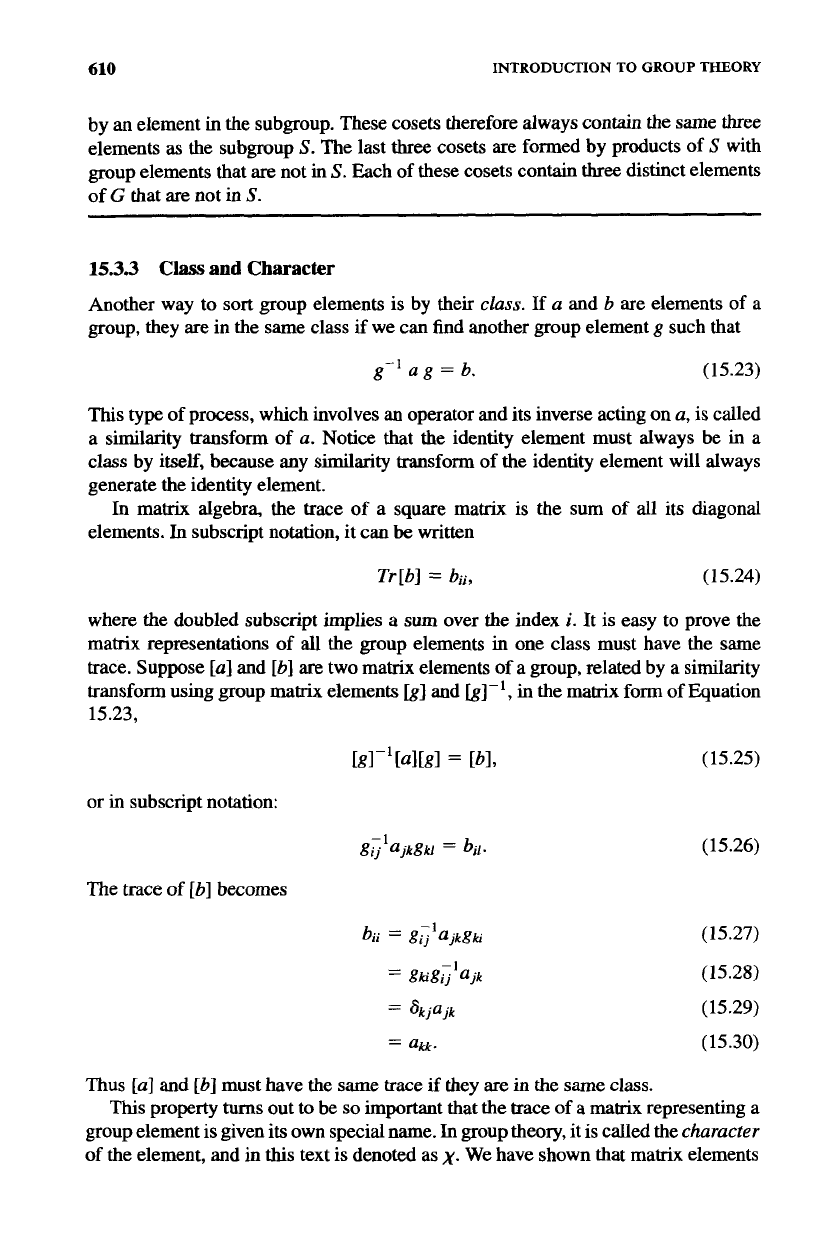
There are six right cosets associated with
this
subgroup, each with three elements,
as
shown in Table
15.15.
The first three cosets
are
formed by multiplying the subgroup
TABLE
15.15.
Right
Cosets
of
a
Subgroup
of
D3
I
Sg1
s
g2
s
g3
s
g4
s
g5
s
g6
1
610
INTRODUCTION TO GROUP THEORY
by
an
element in the subgroup. These cosets therefore always contain the same
three
elements
as
the subgroup
S.
The last three cosets are formed by products of
S
with
group elements that
are
not in
S.
Each of these cosets contain three distinct elements
of
G
that are not in
S.
15.33
Class
and
Character
Another way to sort group elements is by their
class.
If
a
and
b
are elements of a
group, they are in the same class
if
we can
find
another group element
g
such that
(15.23)
-1
g
ag=b.
This
type
of
process, which involves an operator
and
its inverse acting
on
a,
is
called
a similarity transform of
a.
Notice that the identity element must always be
in
a
class by
itself,
because any similarity transform
of
the identity element will always
generate the identity element.
In
matrix algebra, the trace
of
a square matrix is the sum
of
all its diagonal
elements.
In
subscript notation, it can
be
written
Tr[b]
=
bii,
(15.24)
where the doubled subscript implies a sum over the index
i.
It
is
easy to prove the
matrix representations of
all
the group elements
in
one class must have the same
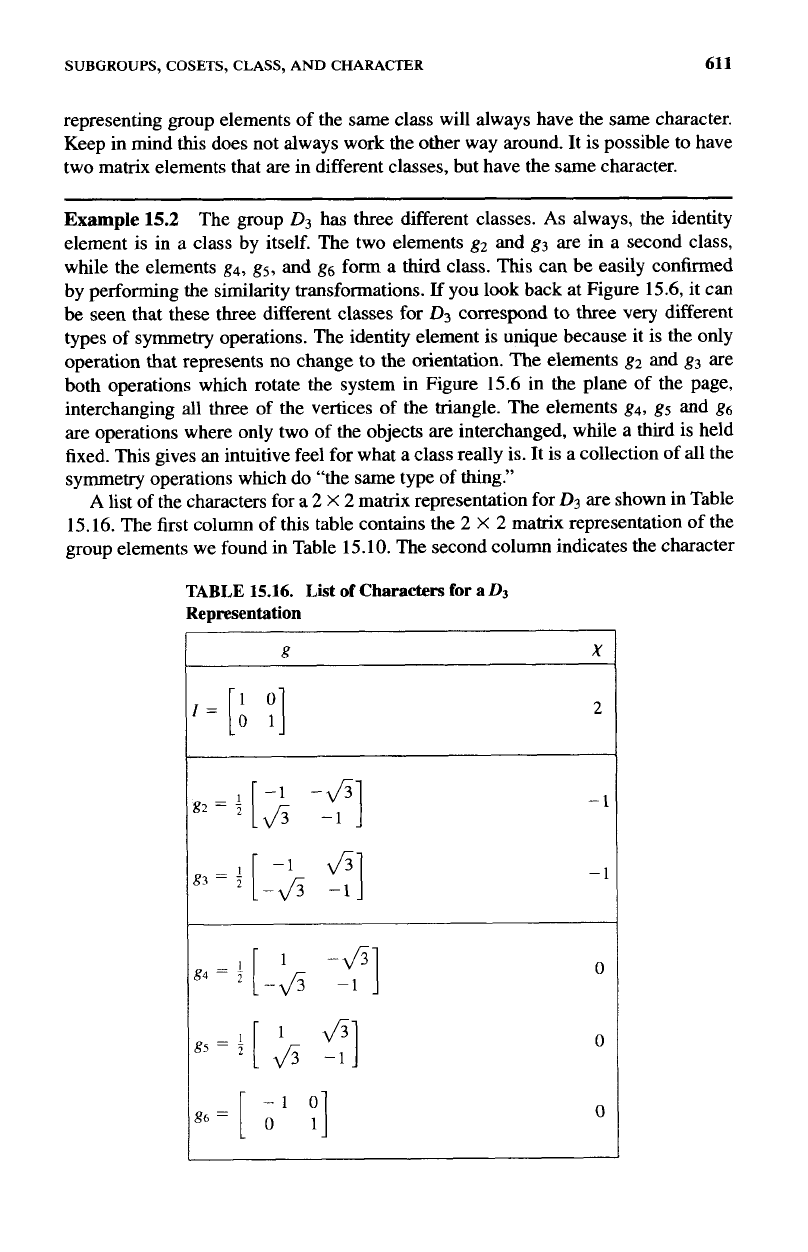
trace. Suppose
[a]
and [b]
are
two matrix elements
of
a group, related by a similarity
transform using group matrix elements
k]
and
k]-',
in
the matrix form of Equation
15.23,
[gl-'[al[gl
=
[bl,
(15.25)
or in subscript notation:
The trace of
[b]
becomes
(15.27)
(15.28)
(15.29)
(15.30)
Thus
[a]
and
[b]
must have the same trace
if
they are
in
the same class.
This
property
turns
out to be
so
important that the trace of
a
matrix representing a
group element is given
its
own special name.
In
group theory, it
is
called the
character
of
the element, and
in
this
text
is
denoted as
x.
We have shown that matrix elements
SUBGROUPS,
COSETS,
CLASS,
AND
CHARACTER
611
representing group elements of the same class will always have the same character.
Keep in mind
this
does not always work the other way around. It is possible to have
two matrix elements that are in different classes, but have the same character.
Example
15.2
The group
03
has three different classes.
As
always, the identity
element
is
in
a
class by itself. The two elements
g2
and
g3
are
in a second class,
while the elements
g4,
g5,
and
g6
form a third class.
This
can be easily confirmed
by performing the similarity transformations.
If
you look back at Figure 15.6, it can
be seen that these three different classes for
03
correspond to three very different
types
of
symmetry operations. The identity element
is
unique because it is the only
operation that represents no change to the orientation. The elements
g2
and
g3
are
both operations which rotate the system in Figure 15.6 in the plane
of
the page,
interchanging all three
of
the vertices
of
the triangle. The elements
g4,
g5
and
g6
are operations where only two
of
the objects
are
interchanged, while a third is held
fixed. This gives an intuitive
feel
for what a class really
is.
It
is
a collection
of
all
the
symmetry operations which do “the same type of thing.”
A
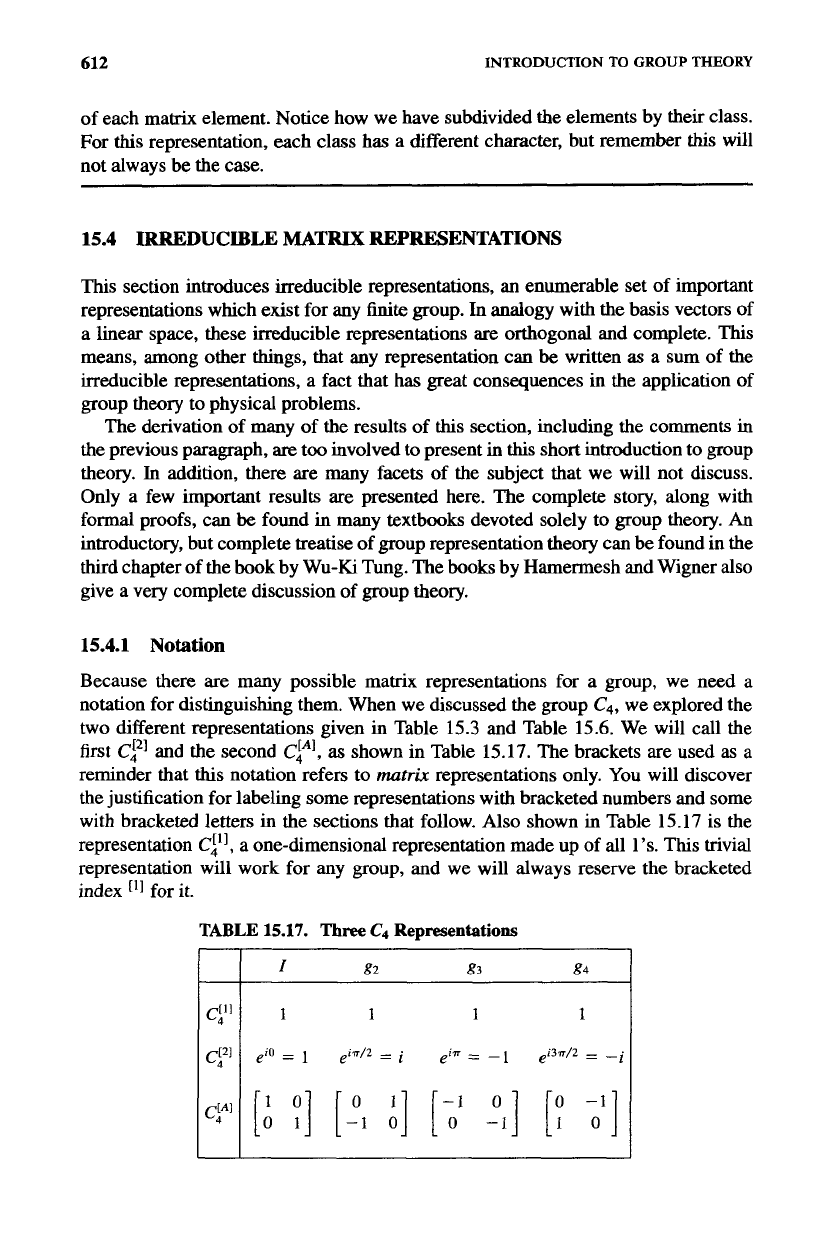
list of the characters for a
2
X
2
matrix representation for
03
are shown in Table
15.16. The first column of this table contains the
2
X
2
matrix representation
of
the
group elements we found in Table 15.10. The second column indicates the character
TABLE 15.16. List
of
Characters
for
a
Ds
Representation
R
X
2
1
-1
R5=4
A-
J3]
g6=
[
;’
:]
0
0
0
612
INTRODUCTION
TO
GROUP
THEORY
of each matrix element. Notice how we have subdivided the elements by their class.
For
this
representation, each class has
a
different character, but remember
this
will
not always be the case.
15.4
IRREDUCIBLE
MATRIX
REPRESENTATIONS
This
section introduces irreducible representations, an enumerable set of important
representations which exist for any
finite
group.
In
analogy
with the basis vectors of
a linear space, these irreducible representations are orthogonal and complete.
This
means, among other things, that any representation can be written
as
a sum of the
irreducible representations, a fact that has great consequences
in
the application of
group theory to physical problems.
The derivation of many of the results of
this
section, including the comments in
the previous paragraph,
are
too involved to present
in
this
short introduction to group
theory.
In
addition, there are many facets of the subject that we will not discuss.
Only a few important results are presented here. The complete story, along with
formal proofs, can
be
found
in
many textbooks devoted solely to group theory.
An
introductory, but complete treatise of group representation theory can be found
in
the
third chapter of the
book
by Wu-Ki Tung. The
books
by Hamermesh and Wigner also
give a very complete discussion of group theory.
15.4.1
Notation
Because there are many possible matrix representations for a group, we need a
notation for distinguishing them. When we discussed the group
C4,
we explored the
two different representations given
in
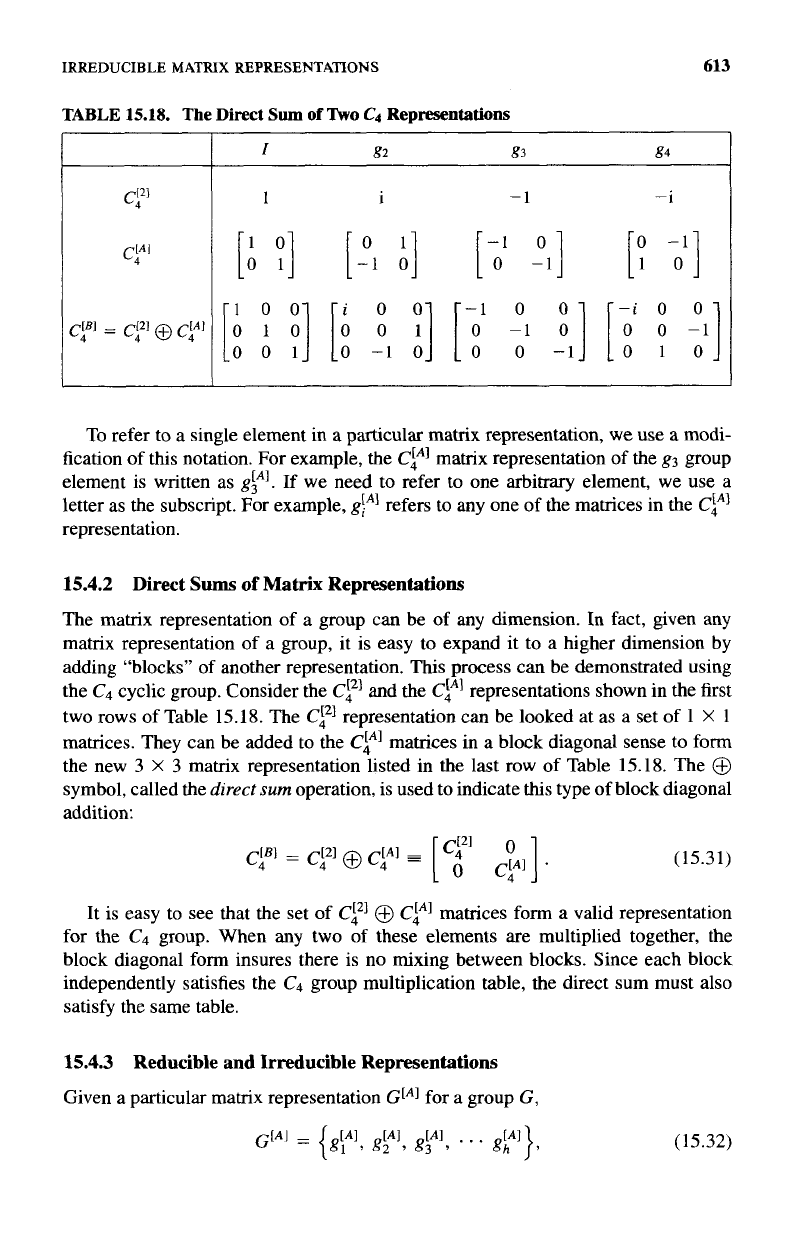
Table 15.3 and Table 15.6. We will call the
first
Ci2]
and the second
CY],
as
shown in Table 15.17. The brackets are used as a
reminder that
this
notation refers to
matrix
representations only. You will discover
the justification for labeling some representations with bracketed numbers and some
with bracketed letters
in
the sections that follow. Also shown in Table 15.17 is the
representation
C:'],
a one-dimensional representation made up
of
all 1's. This trivial
representation will work for any group, and we will always reserve the bracketed
index
['I
for
it.
TABLE
15.17.
Three
C.+
Representations
III
g2
83
g4
IRREDUCIBLE
MATRIX REPRESENTATIONS
613
TABLE
15.18.
The
Direct
Sum
of
Two
C4
Representations
I
82
g3
g4
I
1
i
-1
-i
[o
100
101
[k
00
0
‘1
[jl
p1
!l]
[;
B
3
001
-1
0
To refer to a single element in a particular matrix representation, we use a modi-
fication of this notation. For example, the
Cyl
matrix representation of the
g3
group
element is written as
@I.
If
we need to refer to one arbitrary element, we use a
letter as the subscript. For example,
gfA1
refers to any one of the matrices in the
Crl
representation.
15.4.2
Direct
Sums
of
Matrix Representations
The matrix representation of a group can be of any dimension. In fact, given any
matrix representation
of
a group, it is easy to expand it to a higher dimension by
adding “blocks” of another representation.
This
process can be demonstrated using
the
C4
cyclic group. Consider the
Cfl
and the
Cyl
representations shown in the first
two rows
of
Table 15.18. The
Ci2]
representation can be looked at
as
a set of 1
X
1
matrices. They can be added to the
Crl
matrices in a block diagonal sense to form
the new 3
X
3 matrix representation listed in the last row of Table 15.18. The
@
symbol, called the
direct
sum
operation, is used to indicate
this
type of block diagonal
addition:
(15.3 1)
It is easy to see that the set of
Ci2]
@
Cyl
matrices form a valid representation
for the
C4
group. When any two
of
these elements are multiplied together, the
block diagonal form insures there is no mixing between blocks. Since each block
independently satisfies the
C4
group multiplication table, the direct sum must also
satisfy the same table.
15.4.3
Reducible and Irreducible Representations
Given a particular matrix representation
GIA]
for a group
G,
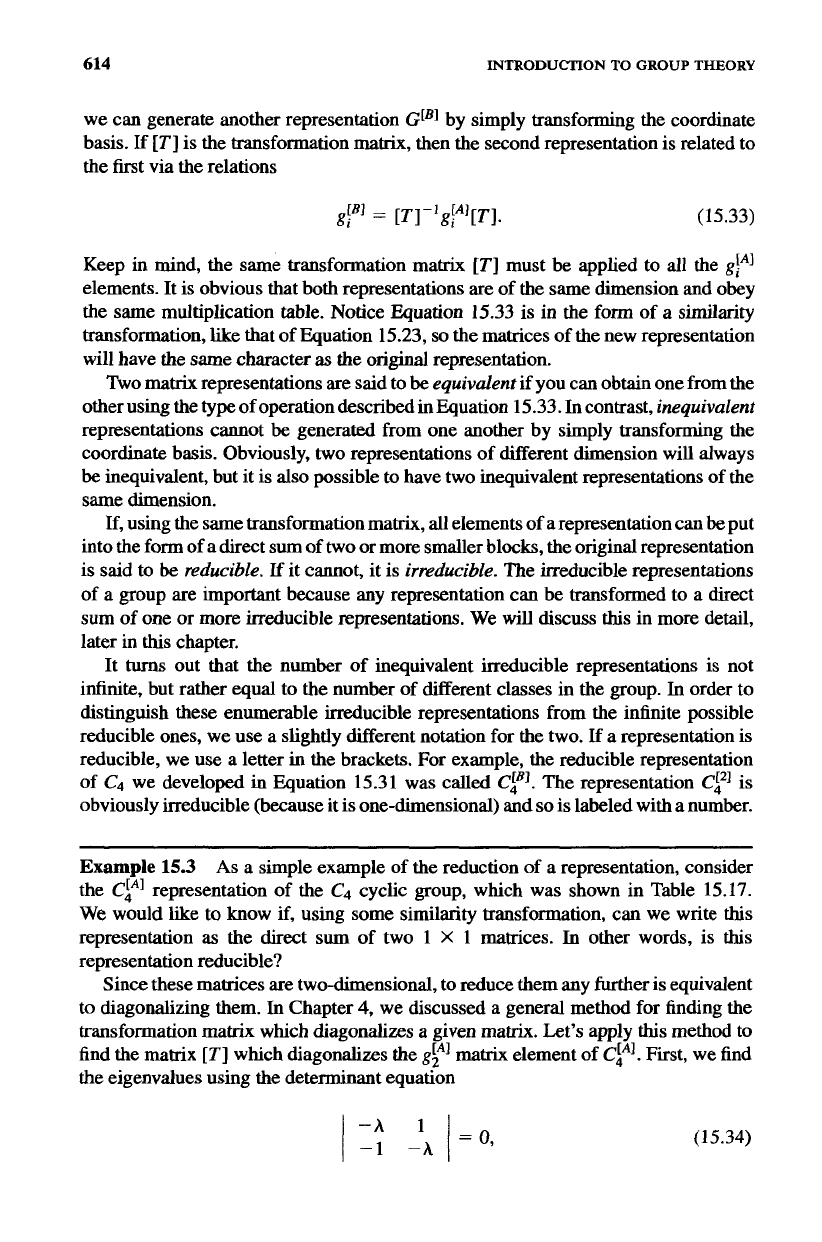
(15.32)
614
INTRODUCTION
TO
GROUP
THEORY
we can generate another representation
GLEl
by simply transforming the coordinate
basis.
If
[TI
is the transformation matrix, then the second representation is related to
the first via the relations
(15.33)
Keep
in
mind, the same transformation matrix
[TI
must be applied to all the
giA1
elements. It is obvious that both representations are of the same dimension and obey
the same multiplication table. Notice Equation
15.33
is in the form of a
similarity
transformation, like that of Equation
15.23,
so
the matrices of the new representation
will have the same character
as
the
original
representation.
Two matrix representations are said to
be
equivalent
if
you can obtain one from the
other using the type of operation described in quation
15.33.
In
contrast,
inequivalent
representations cannot
be
generated from one another by simply transforming the
coordinate basis. Obviously,
two
representations of different dimension will always
be inequivalent, but it
is
also possible to have two inequivalent representations of the
same dimension.
If, using the same transformation matrix, all elements of a representation can
be
put
into the form of
a
direct
sum
of two or more smaller blocks, the original representation
is said to be
reducible.
If
it cannot, it
is
irreducible.
The irreducible representations
of a group are important because any representation can be transformed to a direct
sum
of
one
or
more irreducible representations. We will discuss
this
in more detail,
later in
this
chapter.
It
turns
out that the number of inequivalent irreducible representations is not
infinite, but rather equal to the number of different classes in the group.
In
order to
distinguish these enumerable irreducible representations from the infinite possible
reducible ones, we use a slightly different notation for the two.
If
a representation is
reducible, we use a letter
in
the brackets. For example, the reducible representation
of
C4
we developed in Equation
15.31
was called
CiEJ.
The
representation
Ci2]
is
obviously irreducible (because it is one-dimensional) and
so
is labeled with a number.
~ ~~ ~ ~~~ ~ ~
Example
15.3
As
a simple example of the reduction of a representation, consider
the
Cyl
representation of the
C4
cyclic group, which was shown in Table
15.17.
We would like to know if, using some similarity transformation, can we write
this
representation
as
the direct
sum
of two
1
X
1
matrices.
In
other words, is
this
representation reducible?
Since these matrices are two-dimensional,
to
reduce them any further is equivalent
to diagonalizing them.
In
Chapter
4,
we discussed a general method for finding the
transformation matrix which diagonalizes
a
given matrix. Let's apply
this
method to
find the matrix
[TI
which diagonalizes the
gyl
matrix element of
CY].
First, we find
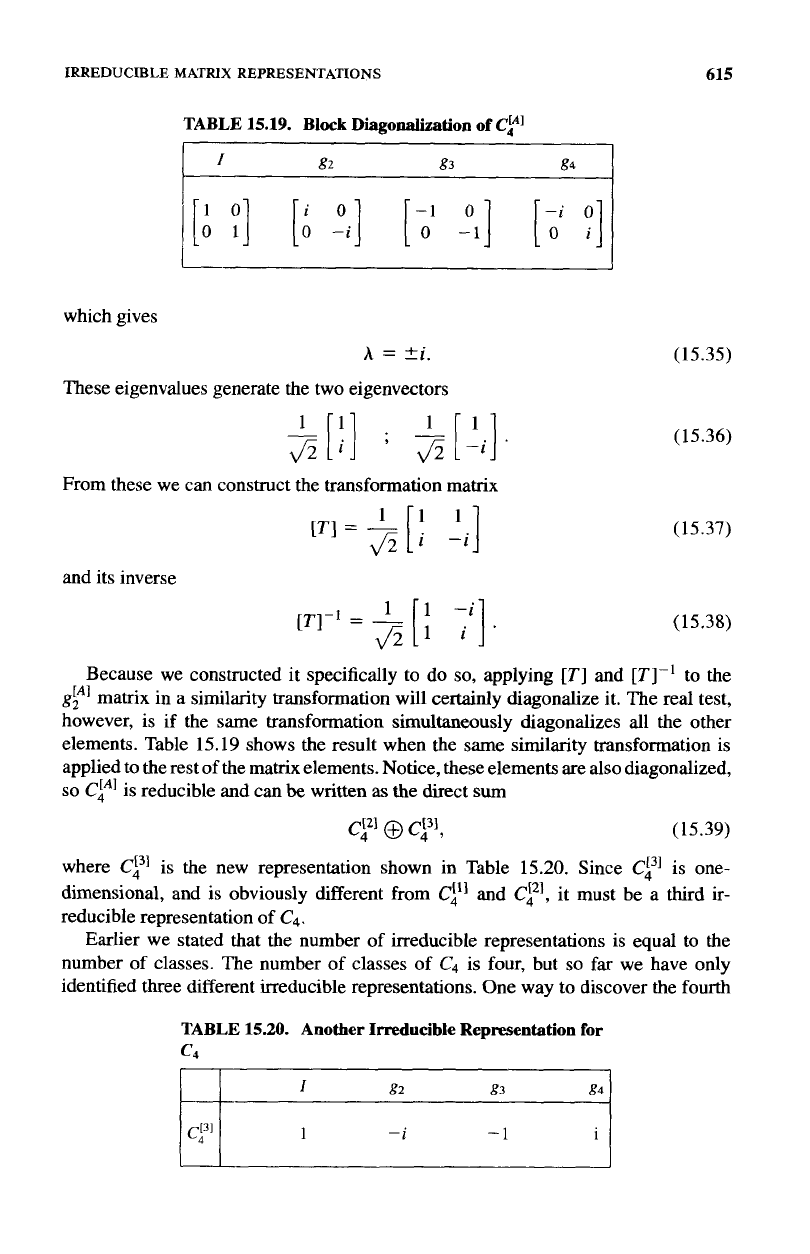
the eigenvalues using the determinant equation
(1
5.34)
IRREDUCIBLE
MATRIX REPRESENTATIONS
615
TABLE
15.19.
Block
Diagonalization
of
CiA1
g2
g3
g4
which gives
A
=
+i.
(15.35)
These eigenvalues generate the two eigenvectors
"11
;
=&[!J
1
Jz
From these we can construct the transformation matrix
[TI=-[;
1
li]
Jz
and its inverse
[TI-'
=
-
1
[;
3.
Jz
(15.36)
(15.37)
(15.38)
Because we constructed it specifically
to
do
so,
applying
[TI
and
[TI-'
to the
gp1
matrix in a similarity transformation will certainly diagonalize it. The real test,
however, is if the same transformation simultaneously diagonalizes all the other
elements. Table 15.19 shows the result when the same similarity transformation is
applied to the rest
of
the matrix elements. Notice, these elements are
also
diagonalized,
so
CiA1
is reducible and can
be
written
as
the direct sum
CY'
@
cp,
(15.39)
where
Cyl
is the new representation shown in Table 15.20. Since
Ci3]
is one-
dimensional, and
is
obviously different from
Cyl
and
Ci2',
it must be a third ir-
reducible representation
of
C,.
Earlier we stated that the number
of
irreducible representations is equal to the
number of classes. The number of classes of
C,
is four, but
so
far we have only
identified three different irreducible representations. One way
to
discover the fourth
TABLE
15.20.
Another Irreducible Representation
for
c4
-i
-1