
Kusse B.R., Westwig E.A. Mathematical Physics: Applied Mathematics for Scientists and Engineers
Подождите немного. Документ загружается.

636
INTRODUCTION TO GROUP THEORY
(a)
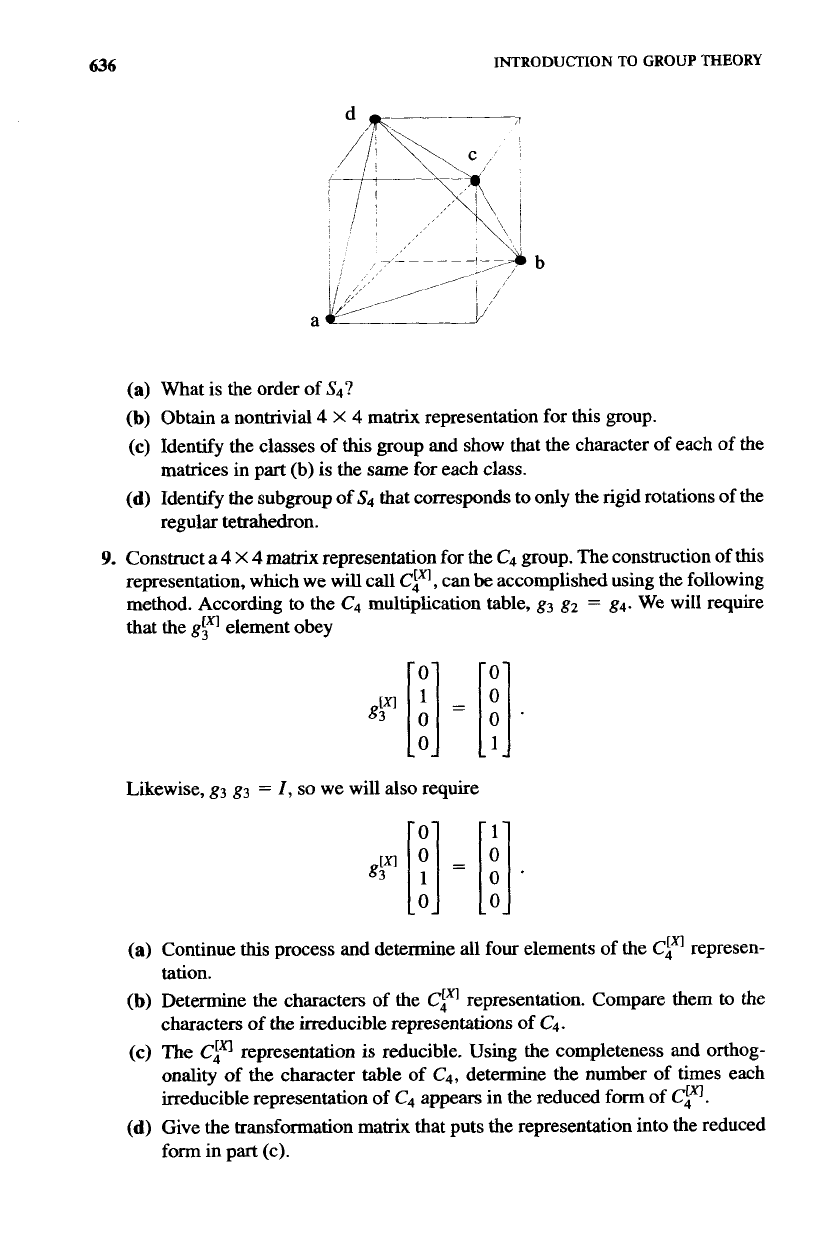
What is the order of
S4?
(b)
Obtain a nontrivial
4
X
4
matrix representation for
this
group.
(c)
Identify the classes of
this
group and show that the character of each of the
(d)
Identify the subgroup of
S4
that corresponds to only the rigid rotations of the
matrices in part (b) is the same for each class.
regular tetrahedron.
9.
Construct a
4
x
4
matrix representation for the
C4
group. The construction
of
this
representation, which we will call
C,["l,
can
be
accomplished using the following
method. According
to
the
C4
multiplication table,
g3
g2
=
g4.
We will require
that the
ghw
element obey
Likewise,
g3
g3
=
I,
so
we will also require
(a)
Continue
this
process and determine all four elements of the
C:"]
represen-
tation.
(b)
Determine the characters of the
Ciw
representation. Compare them to the
characters of the irreducible representations
of
C4.
(c)
The
Cia
representation is reducible. Using the completeness and
orthog-
onality of the character table
of
C4,
determine the number of times each
irreducible representation of
C4
appears in the reduced form of
Ciw.
(d)
Give the transformation
matrix
that
puts the representation into the reduced
form in part (c).
EXERCISES
637
10.
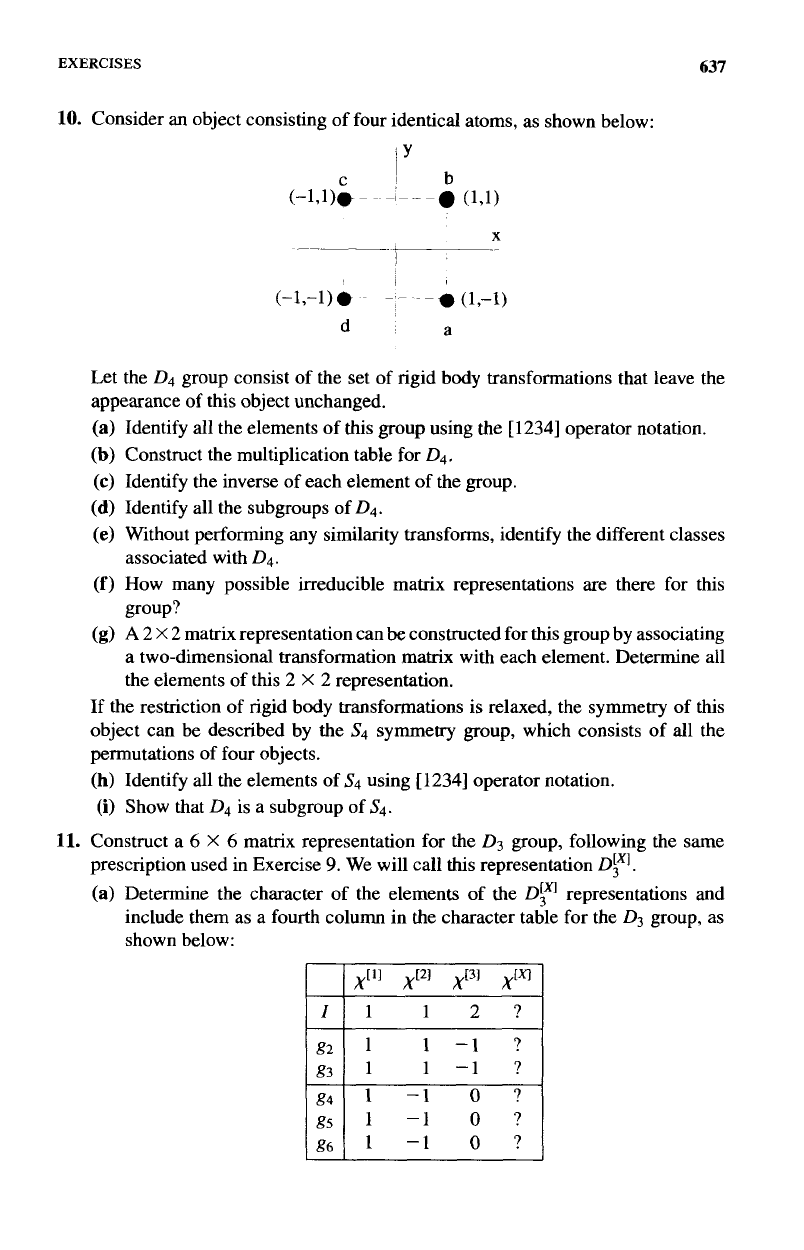
Consider an object consisting of four identical atoms, as shown below:
IY
C
Ib
(-lJ)*
~ ~
-I--
-
(1,l)
X
-1
I
t--I,-l)*
~-
-1,
(1,-1)
d
a
Let the
04
group consist
of
the set of rigid body transformations that leave the
appearance
of
this object unchanged.
(a)
Identify all the elements
of
this group using the
[
12341 operator notation.
(b)
Construct the multiplication table
for
04,
(c)
Identify the inverse of each element of the group.
(d)
Identify all the subgroups of
04.
(e)
Without performing any similarity transforms, identify the different classes
associated with
04.
(f)
How many possible irreducible matrix representations are there for this
group?
(g)
A
2
X
2
matrix representation can
be
constructed for
this
group by associating
a two-dimensional transformation matrix with each element. Determine all
the elements of this
2
X
2 representation.
If the restriction of rigid body transformations is relaxed, the symmetry of this
object can be described by the
S4
symmetry group, which consists of all the
permutations of four objects.
(h)
Identify all the elements of
S4
using
[
12341 operator notation.
(i)
Show that
04
is a subgroup of
S4.
11.
Construct
a
6
X
6
matrix representation for the
03
group, following the same
prescription used in Exercise
9.
We will call
this
representation
OF1.
(a)
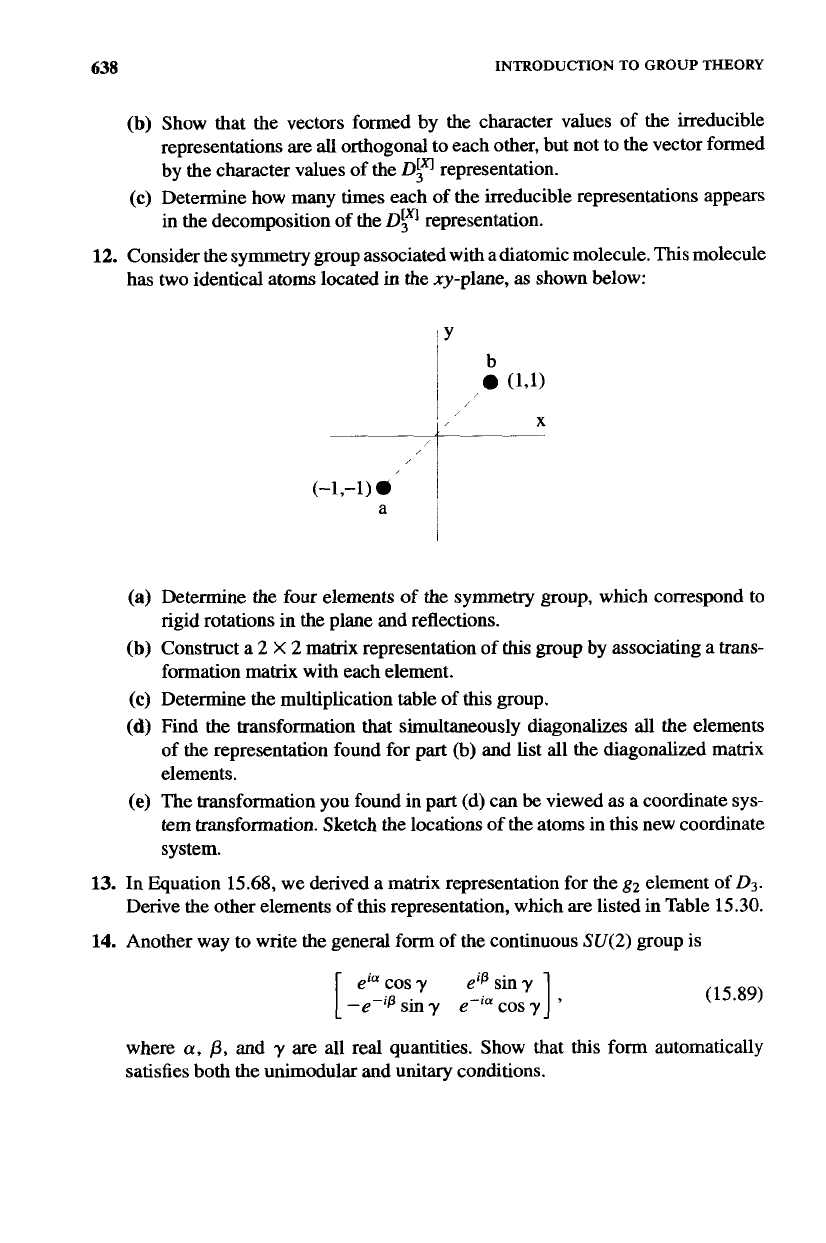
Determine the character
of
the elements of the
DbN
representations and
include them as a fourth column in the character table for the
03
group, as
shown below:
638
INTRODUCTION
TO
GROUP
THEORY
(b)
Show that the vectors formed by the character values of the irreducible
representations are
all
orthogonal to each other, but not
to
the vector formed
by the character values of the
Diw
representation.
(c)
Determine how many times each of the irreducible representations appears
in the decomposition of the
Din
representation.
12.
Consider the symmetry group associated with a diatomic molecule.
This
molecule
has
two identical atoms located
in
the xy-plane, as shown below:
(a)
Determine the
four
elements of the symmetry group, which correspond to
(a)
Construct a
2
X
2
matrix representation
of
this
group by associating a trans-
(e)
Determine the multiplication table of
this
group.
(d)
Find the transformation that simultaneously diagonalizes all the elements
of
the representation found for part (b) and list all the diagonalized matrix
elements.
(e)
The transformation you found in part (d) can be viewed
as
a coordinate sys-
tem transformation. Sketch the locations
of
the atoms in
this
new coordinate
system.
rigid rotations in the plane and reflections.
formation matrix with each element.
13.
In Equation
15.68,
we derived a matrix representation for the
g2
element of
D3.
Derive the other elements of
this
representation, which are listed in Table
15.30.
14.
Another way to write the general form
of
the continuous
SU(2)
group is
eia
cos
y
(15.89)
where
a,
p,
and
y
are
all
real quantities. Show that
this
form
automatically
satisfies both the unimodular and unitary conditions.
cosy
1
'
eiP
sin
y
-e-iP
e-ia
[
THE LEVI-CIVITA IDENTITY
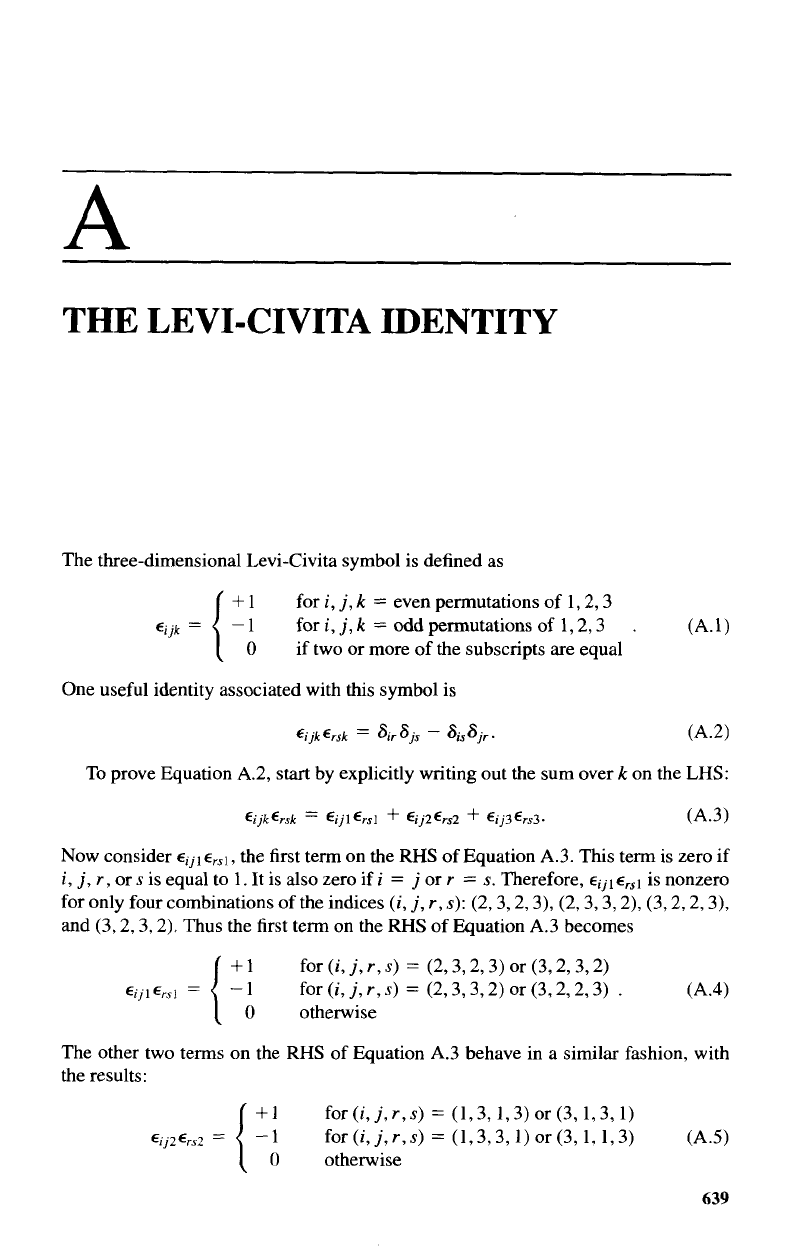
The three-dimensional Levi-Civita symbol is defined as
+1
fori,j,k
=
evenpermutationsof 1,2,3
-
1
for
i,
j,
k
=
odd
permutations
of
1,2,3
.
(A.l)
0
if two or more of the subscripts are equal
One useful identity associated with this symbol is
EijkErsk
=
&8js
-
&ssjr.
64.2)
To prove Equation A.2,
start
by
explicitly writing out the sum over
k
on the
LHS:
EijkErsk
=
6jIErsl
+
Eij2Ers2
+
Eij3Ers3.
64.3)
Now consider
eijl
E,],
the first term
on
the
FWS
of Equation A.3. This term
is
zero if
i,
j,
I,
or
s
is
equal
to
1.
It is also zero if i
=
j
or r
=
s.
Therefore,
~ijl
E,I
is nonzero
for only four combinations
of
the indices
(i,
j,
r,
s):
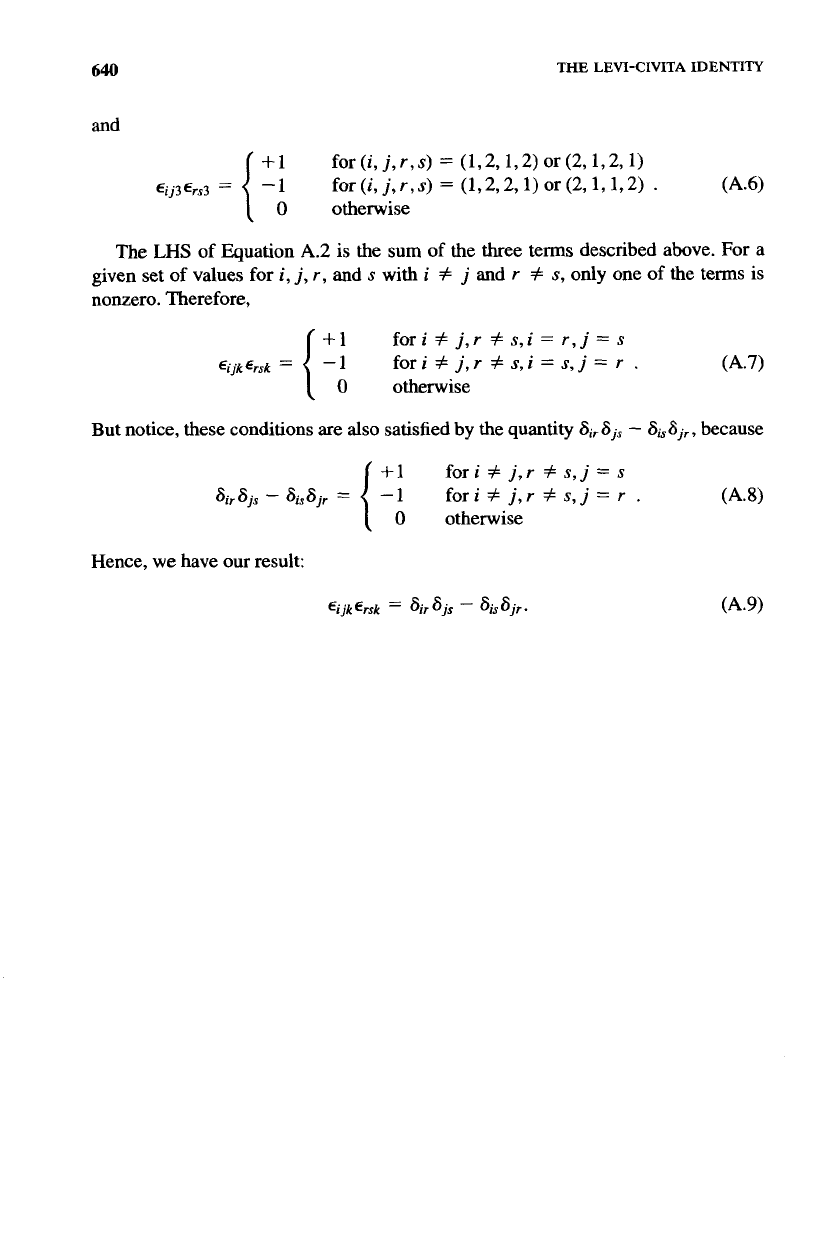
(2,3,2,3), (2,3,3,2), (3,2,2,3),
and (3,2,3,2). Thus the first term
on
the
RHS
of
Equation A.3 becomes
+1
for(i,j,r,s)
=
(2,3,2,3)or(3,2,3,2)
~j~l~~~~
=
-1
for(i,j,r,s)= (2,3,3,2)or(3,2,2,3)
.
(A.4)
{
0
otherwise
The other two terms on the
RHS
of Equation A.3 behave in a similar fashion, with
the results:
+1
for(i,j,r,s)
=
(1,3,1,3)0r(3,1,3,1)
-1
for
(i, j,r,s)
=
(1,3,3,1) or (3,
1,
1,3)
(A.5)
0
otherwise
639
THE
LEVI-CIVITA
IDENTITY
640
and
+1
for(i,j,r,s)=(l,2,1,2)or(2,1,2,1)
eij3erS3
=
-1
for(i,j,r,s)
=
(1,2,2,1)0r(2,1,1,2)
.
(A.6)
I
0
otherwise
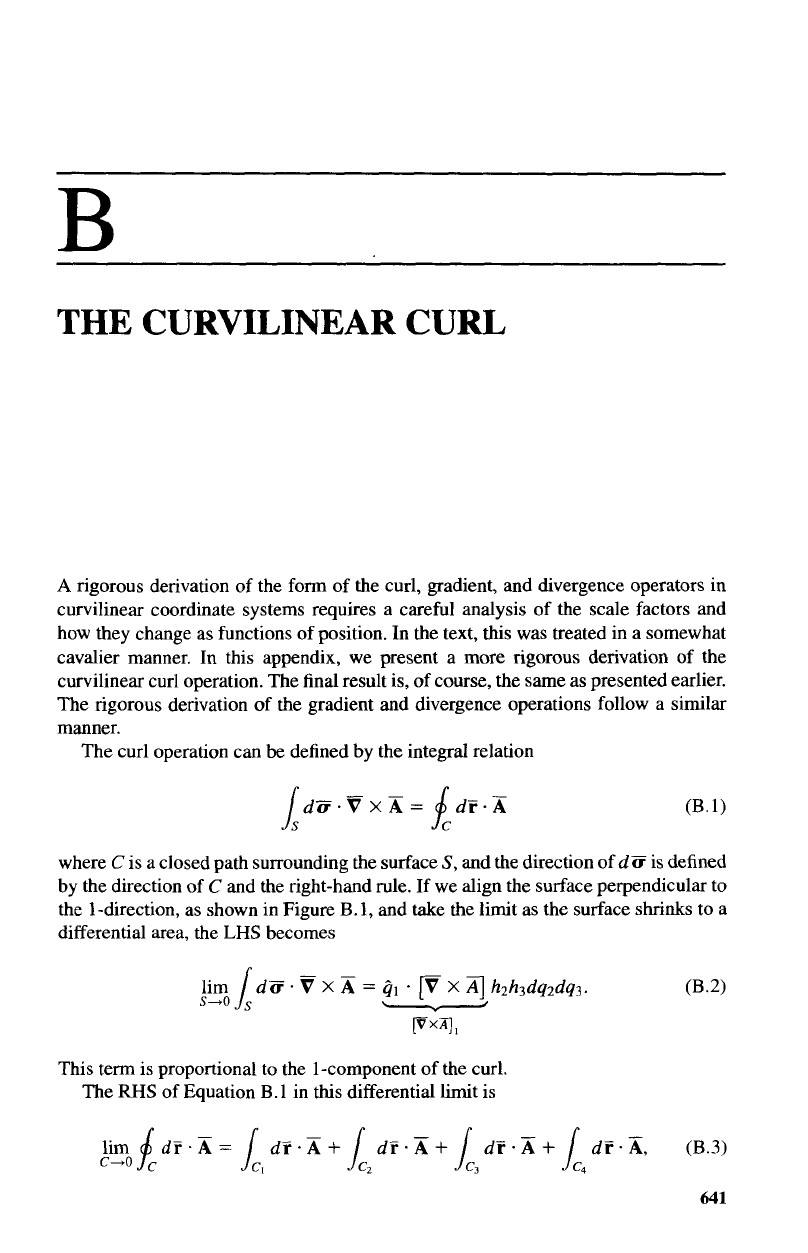
The
LHS
of Equation A.2 is the
sum
of the three terms described above. For a
given set of values for
i,
j,
r,
and
s
with i
#
j
and
r
#
s,
only one of the terms is
nonzero. Therefore,
+1
fori
#
j,r
#
s,i
=
r,
j
=
s
EijkE&
=
-
1
for
i
#
j,
r
#
s,
i
=
s,
j
=
r
.
64.7)
{
0
otherwise
But notice, these conditions are
also
satisfied by the quantity
6ir6jS
-
6is6jr,
because
+1
fori# j,r
#s,j=s
6.6.
-6.6.
=
-1
fori#j,r#s,j=r.
(A.8)
0
otherwise
ir
js
IS
jr
Hence, we have our result:
THE CURVILINEAR CURL
A
rigorous derivation
of
the
form
of the curl, gradient, and divergence operators in
curvilinear coordinate systems requires a careful analysis of the scale factors and
how they change as functions
of
position. In the text,
this
was treated
in
a somewhat
cavalier manner. In this appendix, we present
a
more rigorous derivation of the
curvilinear curl operation. The
final
result is, of course, the same as presented earlier.
The rigorous derivation
of
the gradient
and
divergence operations follow
a
similar
manner.
The curl operation can be defined by the integral relation
where
C
is a closed path surrounding the surface
S,
and the direction
of
dB
is defined
by the direction of
C
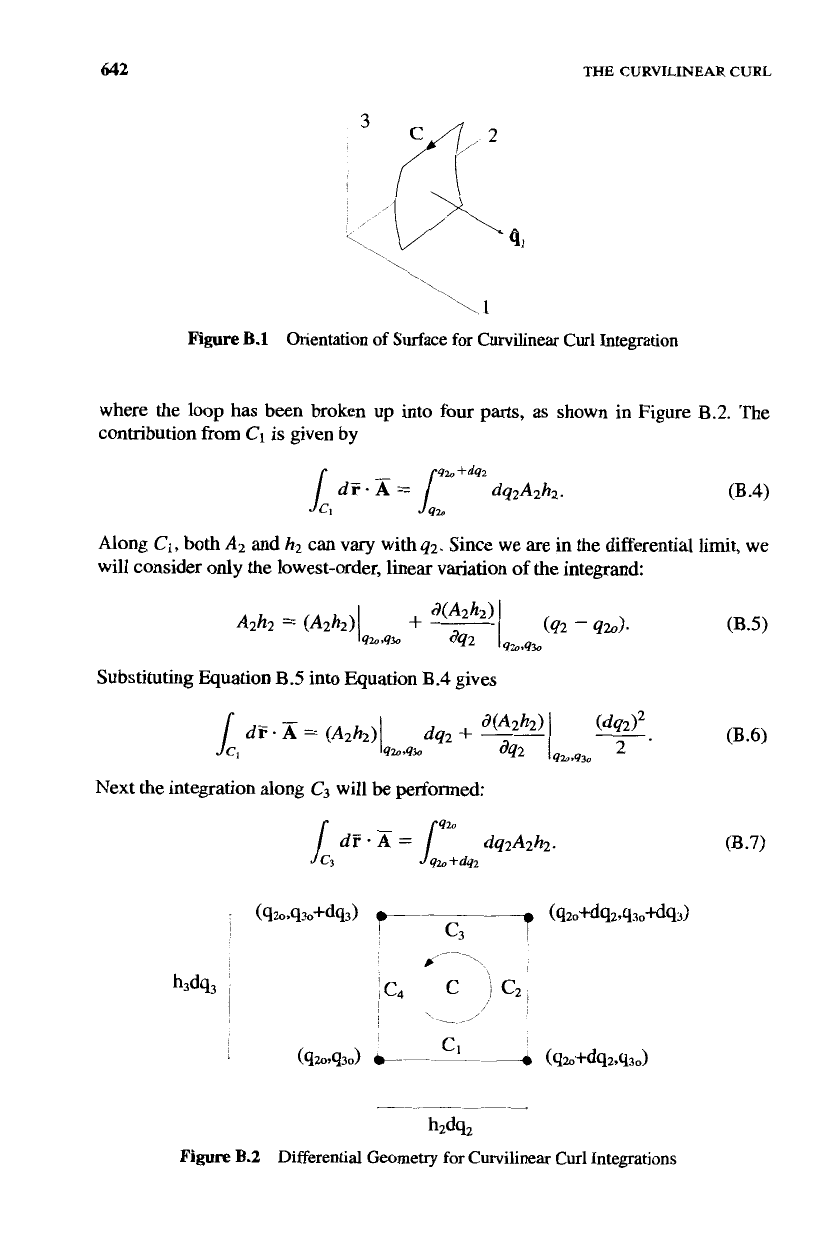
and the right-hand rule. If we align the surface perpendicular to
the 1-direction, as shown in Figure
B.
1, and take the limit
as
the surface shrinks to a
differential area, the
LHS
becomes
This term is proportional
to
the 1-component of the curl.
The
RHS
of
Equation
B.1
in
this
differential limit is
641
642
THE
CURVILINEAR CURL
Figure
B.l
Orientation
of
Surface for Curvilinear Curl Integration
where the loop has been broken up into four parts, as shown in Figure B.2. The
contribution
from
C1
is
given by
420
+42
1,dF.A
=
Lb
dq2A2hz.
03.4)
Along
C1,
both
A2
and
h2
can vary with
q2.
Since we are in the differential limit, we
will consider only the lowest-order, linear variation of the integrand:
Substituting Equation
B.5
into Equation B.4 gives
Next the integration along
C,
will
be
performed:
-~
__---_
h2dq2
Figure
B.2
Differential Geometry
for
Curvilinear Curl Integrations
THE
CURVILINEAR CURL
643
hlcil
h242
h343
hlAl
h2A2
h3A3
VXA=---
a/aq,
d/%2
d/aq3
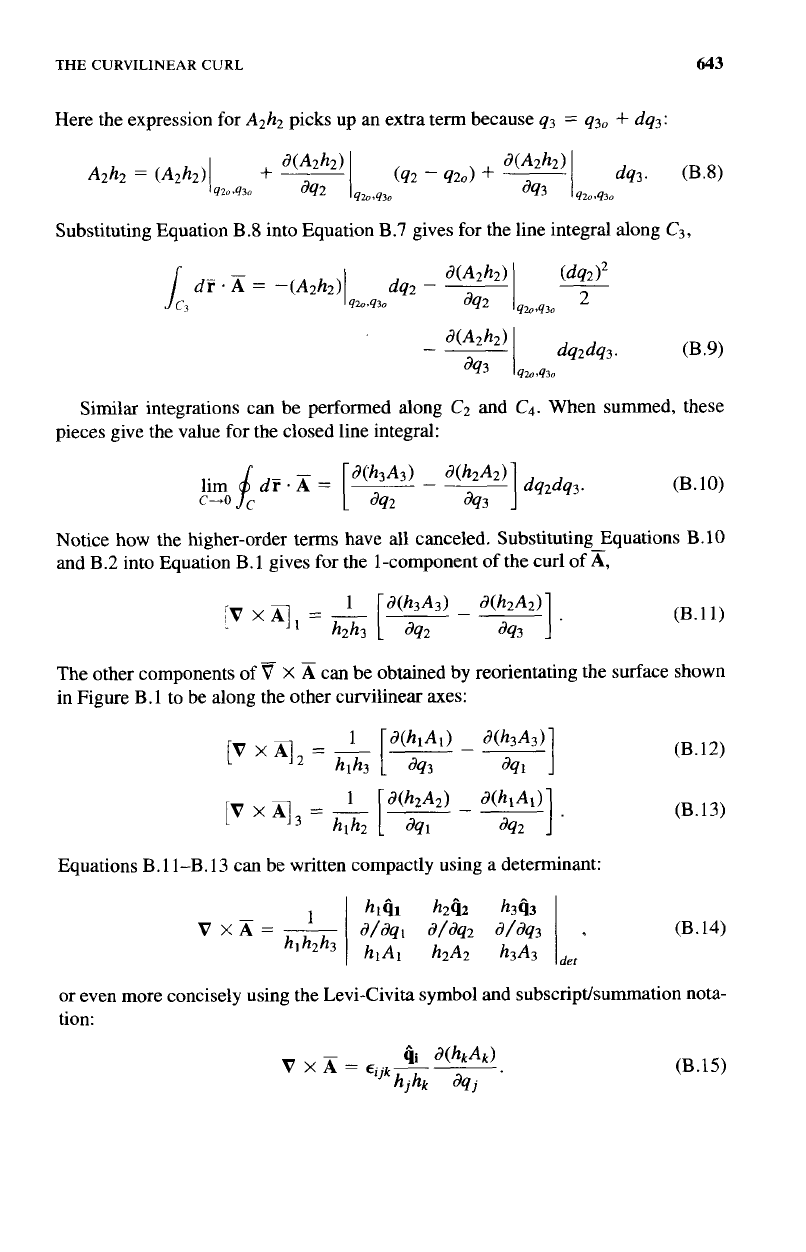
Here the expression for
A2h2
picks up an extra term because
q3
=
q30
+
dq3:
I
(B.
14)
der
Substituting Equation B.8 into Equation
B.7
gives for the line integral along
C3,
Similar
integrations can be performed along
C2
and
C,.
When summed, these
pieces give the value for the closed line integral:
(B.lO)
Notice how the higher-order terms have all canceled. Substituting Equations
B.
10
and
B.2
into Equation B.l gives for the 1-component
of
the curl
of
A,
(B.ll)
The
other components of
7
X
in Figure
B.
1
to
be along the other curvilinear axes:
can be obtained by reorientating the surface shown
(B.12)
(B.13)
(B.15)

This Page Intentionally Left Blank
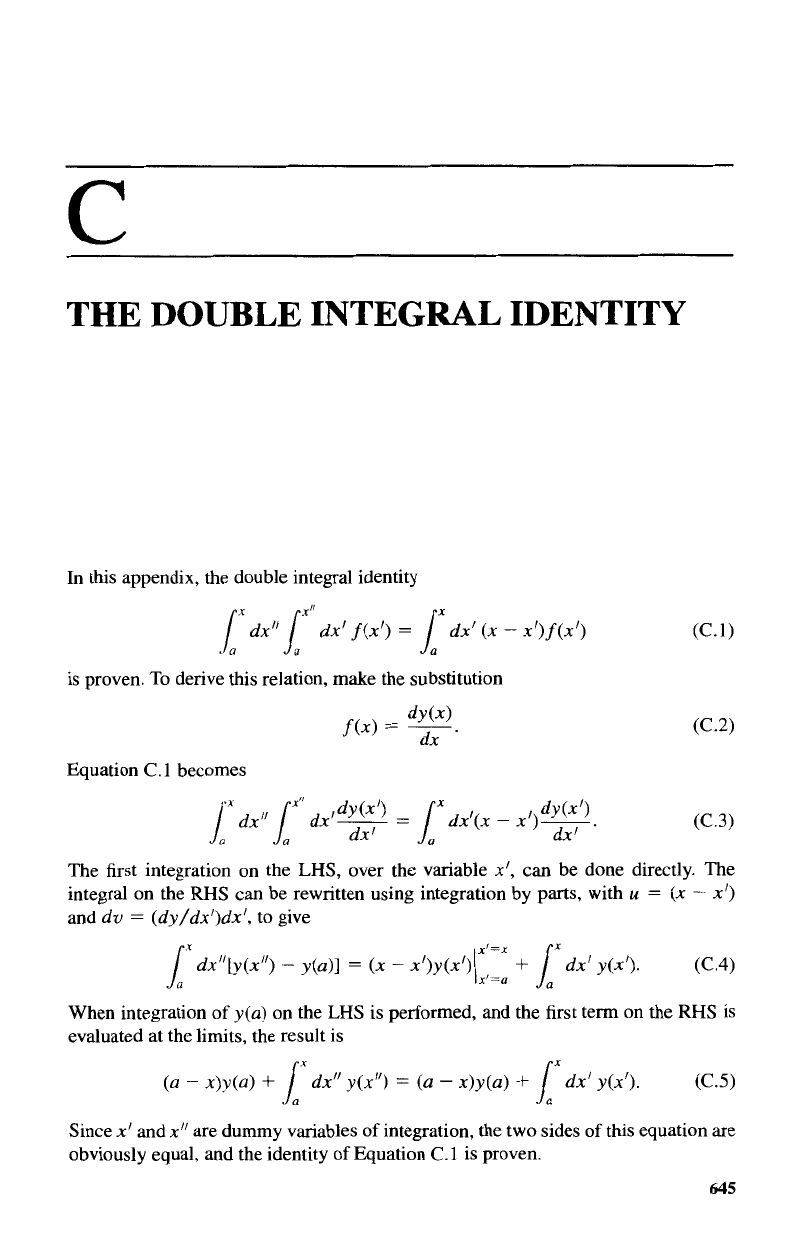
THE DOUBLE INTEGRAL IDENTITY
In this appendix, the double integral identity
[
dx”
I”
dx’
f(x’)
=
[
dx’
(x
-
x’)f(x’)
is proven. To derive this relation, make the substitution
Equation
C.
1 becomes
The first integration on the
LHS,
over the variable
x’,
can be done directly. The
integral on the
F2HS
can be rewritten using integration by parts, with
u
=
(x
-
x‘)
and
du
=
(dy/dx‘)dx’,
to give
.I‘
dx”[y(x”)
-
y(a)]
=
(x
-
x’)y(x’)
lx‘=‘
x’=a
+
[
dx’ y(x’).
(C.4)
When integration
of
y(a)
on the
LHS
is performed, and the first term on the
RHS
is
evaluated at the limits, the result is
(a
-
x)y(a)
+
l’
dx” y(x”)
=
(a
-
x)y(a)
+
lx
dx’
y(x’).
(C.5)
Since
x’
and
x”
are dummy variables
of
integration, the two sides
of
this equation are
obviously equal, and the identity
of
Equation
C.
1
is
proven.
645