
Kusse B.R., Westwig E.A. Mathematical Physics: Applied Mathematics for Scientists and Engineers
Подождите немного. Документ загружается.


This Page Intentionally Left Blank
D
GREEN’S
FUNCTION
SOLUTIONS
In Chapter
10,
the Green’s function solution for a linear, nonhomogeneous, second-
order equation was obtained using a superposition argument. We first solved the
special case of a &function drive for the nonhomogeneous term. Then we argued
that the general solution, with an arbitrary nonhomogeneous term, could be obtained
by simply forming
an
infinite weighted sum of these &function solutions. This proof
relied on a certain amount of intuition.
A
formal proof of this solution can be obtained
by directly inserting the Green’s function solution into the differential equation, and
showing that the nonhomogeneous differential equation and the boundary conditions
are satisfied.
Consider the general linear, nonhomogeneous, second-order differential equation:
This equation is in Sturm-Liouville form, but
keep
in mind any linear, second-
order equation
can
be put into this
form
with a little manipulation. We want to find
the function
y(x)
which solves Equation
D.l
and satisfies the set of homogeneous
boundary conditions:
Ix=a
648
GREEN'S
FUNCTION SOLUTIONS
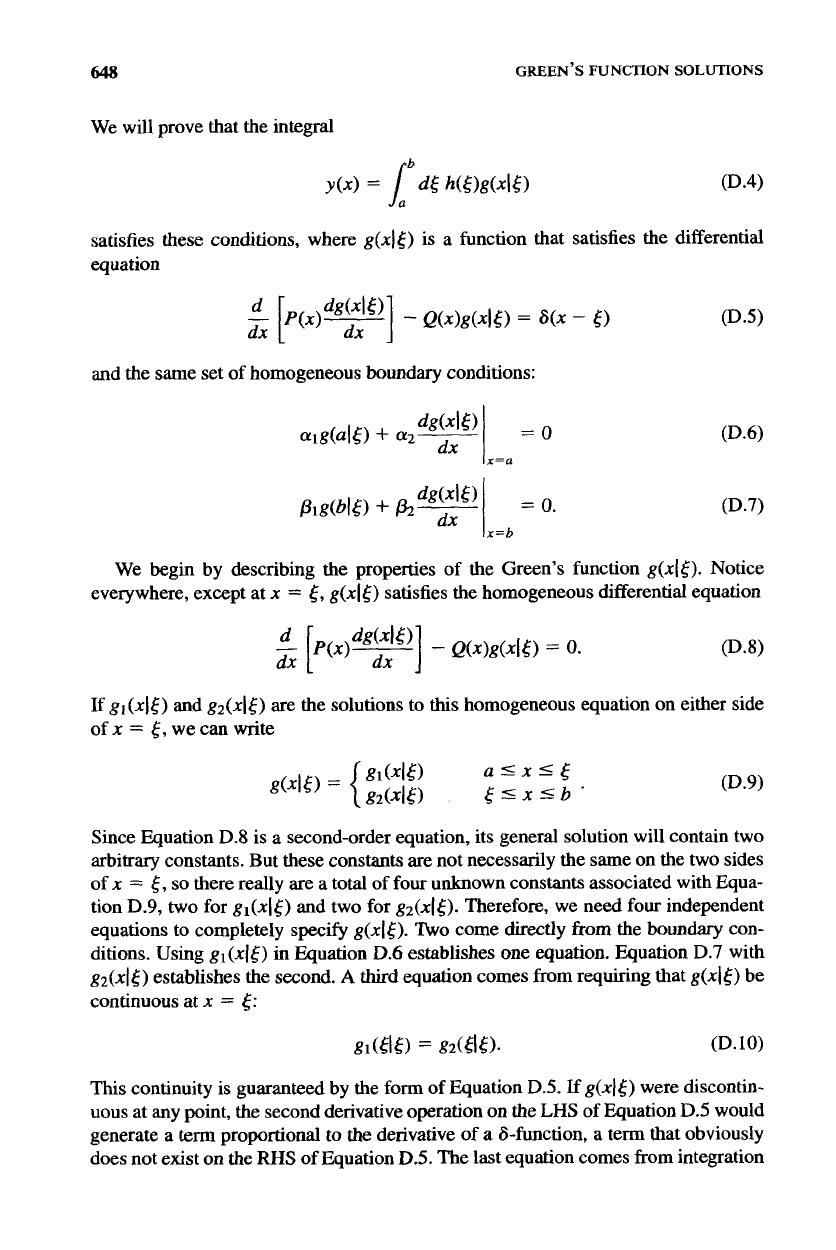
We will prove that the integral
satisfies these conditions, where
g(x16)
is a function that satisfies the differential
equation
and the same set of homogeneous
boundary
conditions:
We
begin by describing the properties of the Green's function
g(x15).
Notice
everywhere, except at
x
=
6,
g(xl6)
satisfies the homogeneous differential equation
If
gI(x15)
and
gz(x15)
are the solutions to
this
homogeneous equation on either side
of
x
=
5,
we can write
Since Equation
D.8
is a second-order equation, its general solution will contain two
arbitrary constants. But these constants are not necessarily the same on the two sides
of
x
=
6.
so
there really are a total of four unknown constants associated with Equa-
tion
D.9,
two
for
gI(x15)
and
two for
gz(x15).
Therefore, we need four independent
equations to completely specify
g(x15).
'bo
come
directly
from
the
boundary
con-
ditions. Using
gI(x15)
in
Equation
D.6
establishes one equation. Equation
D.7
with
gz(xl&)
establishes the second.
A
third equation comes from requiring that
g(x16)
be
continuous at
x
=
5:
This continuity is guaranteed by the
form
of
Equation
D.5.
If
g(x15)
were discontin-
uous at any point, the second derivative operation
on
the
LHS
of Equation
D.5
would
generate a
term
proportional
to
the derivative of a 8-function, a term that obviously
does not exist
on
the
RHS
of
Equation
D.5.
The last equation comes from integration
GREEN'S
FUNCTION
SOLUTIONS
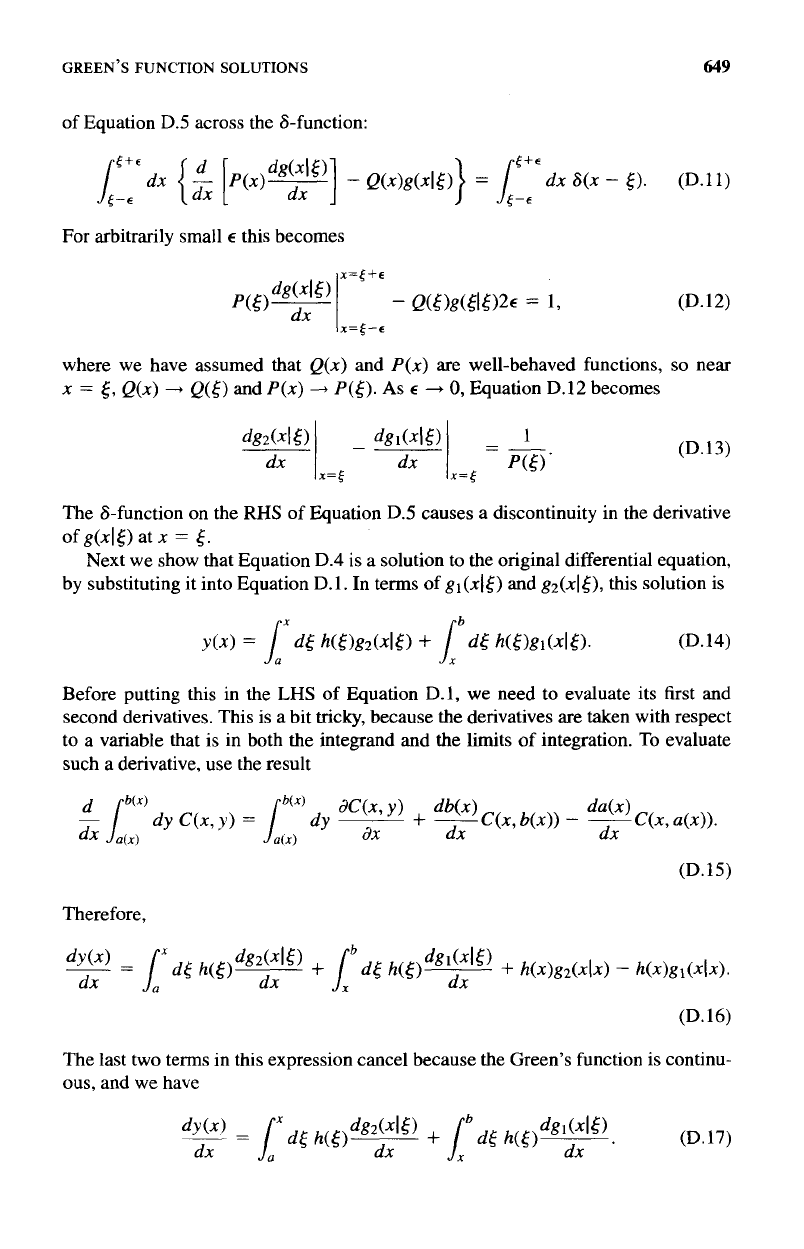
of Equation
D.5
across the &function:
For arbitrarily small
E
this becomes
649
(D.
1 1)
(D.12)
where we have assumed that
Q(x)
and
P(x)
are well-behaved functions,
so
near
x
=
f,
Q(x)
-+
Q(5)
and
P(x)
-+
P(5).
As
E
+
0,
Equation
D.12
becomes
(D.13)
The &function on the
RHS
of Equation
D.5
causes a discontinuity in the derivative
of
g(x15)
at
x
=
,$.
Next we show that Equation
D.4
is a solution to the original differential equation,
by substituting it into Equation
D.l.
In
terms of
gl(x15)
and
g2(xI(),
this solution is
Y(X)
=
Id5
h(5)g2(x15)
+
d5
h(Ogl(xl0.
(D.14)
Before putting this in the
LHS
of
Equation
D.l,
we need to evaluate its first and
second derivatives. This is a bit tricky, because the derivatives are taken with respect
to a variable that is
in
both the integrand and the limits
of
integration. To evaluate
such a derivative, use the result
b
(D.15)
Therefore,
(D.
16)
The last two terms in this expression cancel because the Green's function is continu-
ous, and we have
650
GREEN’S
FUNCTION
SOLUTIONS
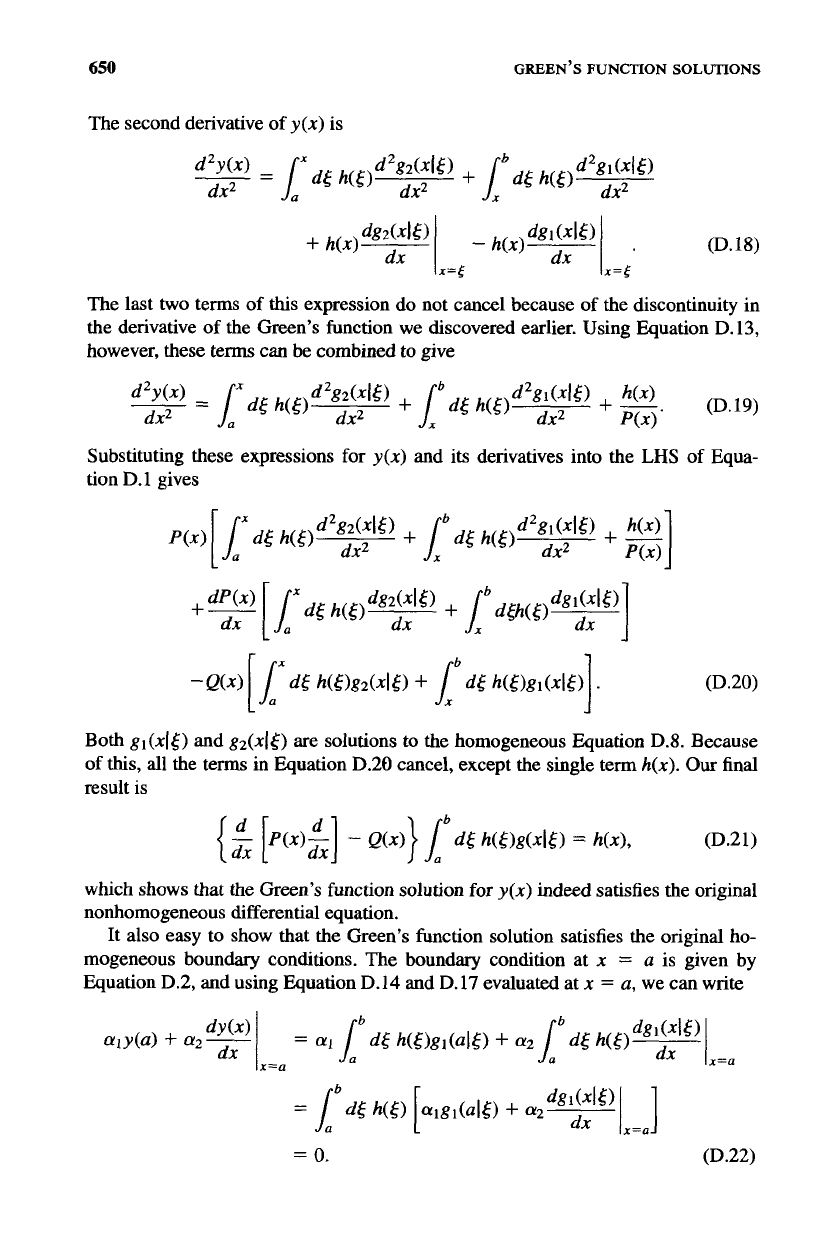
The second derivative
of
y(x)
is
(D.18)
(XI0
-
h(x)-----
dg2
(XI
5)
+
h(x)---
dx dx
The last two terms
of
this
expression do not cancel because
of
the discontinuity in
the derivative of the Green’s function we discovered earlier. Using Equation
D.
13,
however, these
terms
can be combined to give
Substituting these expressions for
y(x)
and
its
derivatives into the
LHS
of Equa-
tion
D.l
gives
(D.20)
Both
gl(x(5)
and
gz(xl6)
are solutions to the homogeneous Equation
D.8.
Because
of this, all the terms in Equation
D.20
cancel, except the single term
h(x).
Our
final
result is
which shows that the Green’s function solution
for
y(x)
indeed satisfies the original
nonhomogeneous differential equation.
It
also easy to show that the Green’s function solution satisfies the original
ho-
mogeneous boundary conditions. The boundary condition at
x
=
a
is
given by
Equation
D.2,
and using Equation
D.14
and
D.17
evaluated at
x
=
a,
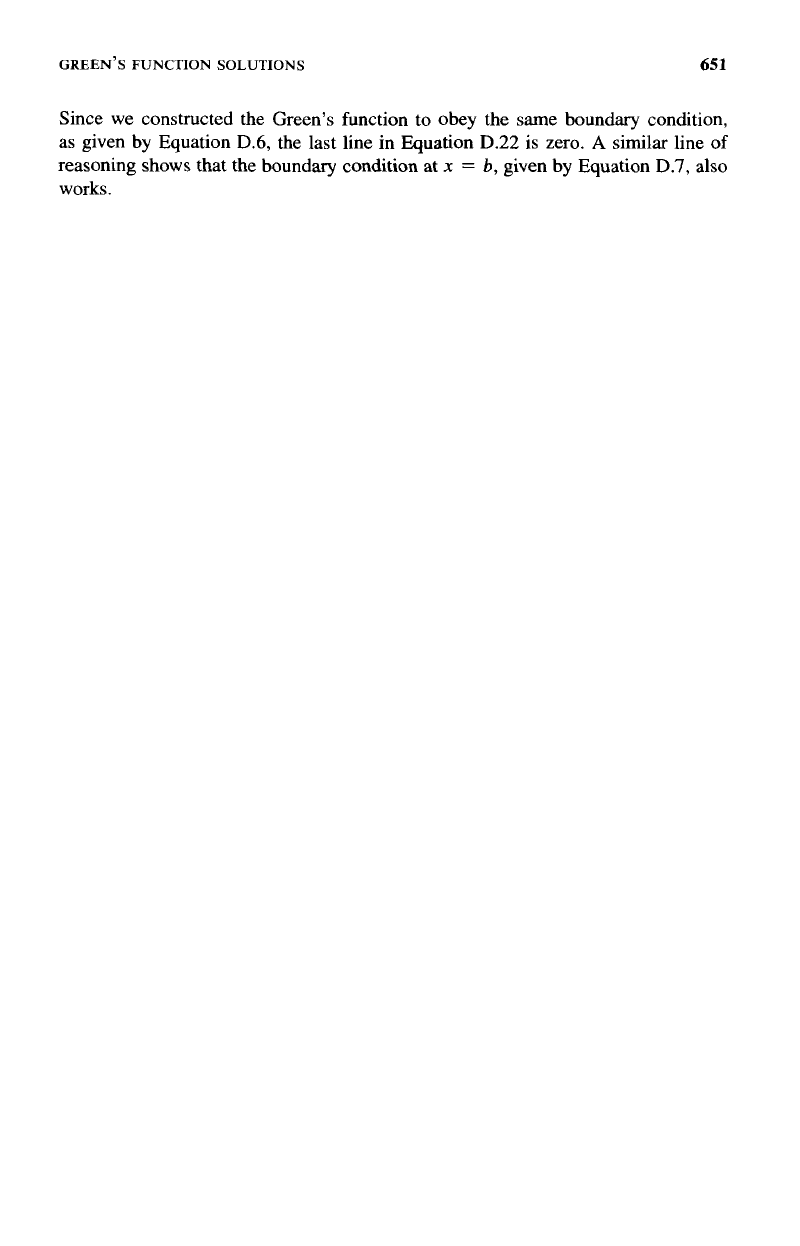
we can write
=
0.
(D.22)
GREEN’S
FUNCTION
SOLUTIONS
651
Since we constructed the Green’s function to obey the same boundary condition,
as given by Equation
D.6,
the last line in
Equation
D.22
is
zero.
A
similar line of
reasoning shows that the boundary condition at
x
=
b,
given by Equation
D.7,
also
works.

This Page Intentionally Left Blank
E
PSEUDOVECTORS
AND
THE
MIRROR
TEST
The mirror test provides an intuitive way to identify a pseudovector.
A
“regular”
polar vector will reflect, as you would expect, in a mirror but a pseudovector will be
reversed.
An
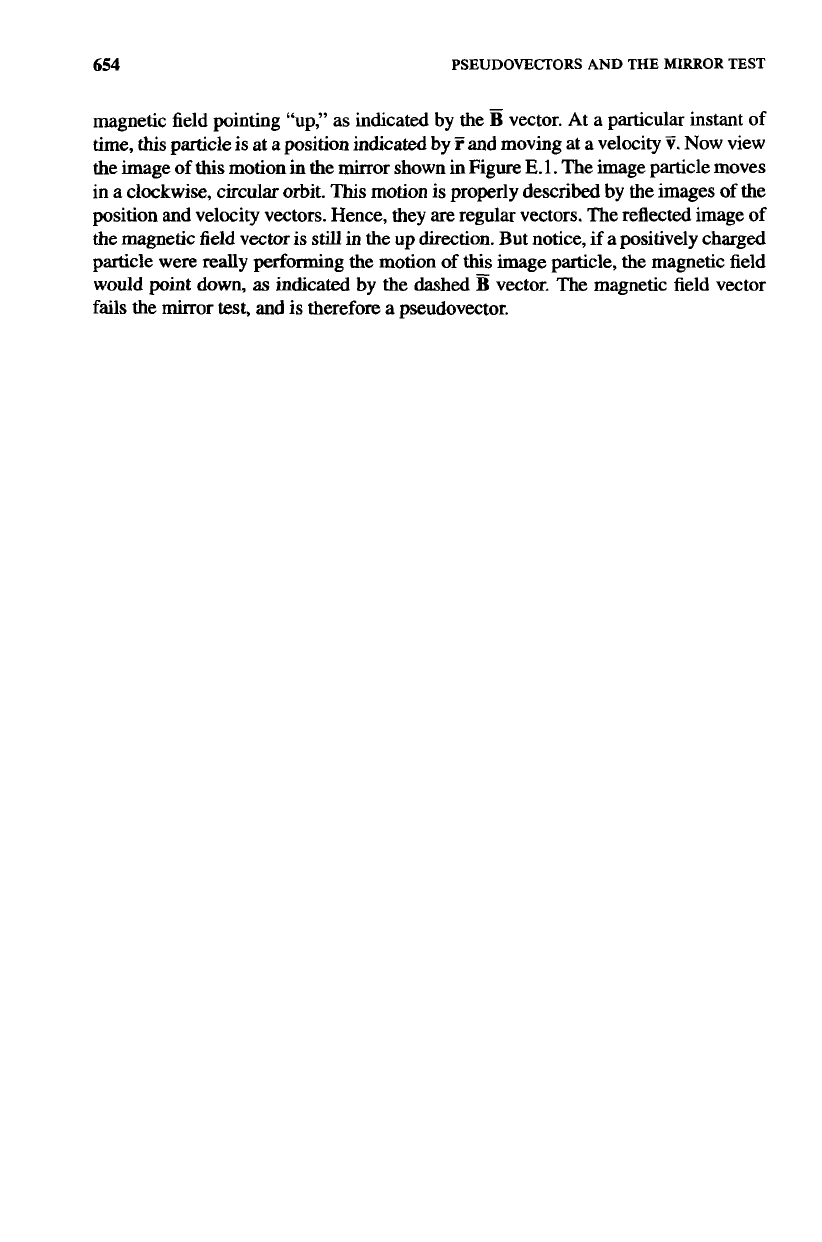
example of this test, taken from electromagnetism,
is
described in Figure
E.
1.
The real system on
the
left is a positively charged particle moving in
a
circular
orbit. counterclockwise when viewed from above.
This
motion results in the average
~
B
/S+
r
Real object
!B
Mirror image
Figure
E.l
The
Mirror
Test
for
Pseudovectors
653
654
PSEUDOVECTORS AND
THE
MIRROR
TEST
magnetic field pointing “up,” as indicated by the
B
vector. At
a
particular instant of
time,
this
particle
is
at a position indicated by
i
and moving at a velocity
V.
Now view
the image
of
this
motion in the mirror shown in Figure
E.
1.
The image particle moves
in a clockwise, circular orbit.
This
motion is properly described by the images
of
the
position and velocity vectors. Hence, they
are
regular vectors. The reflected image
of
the magnetic field vector
is
still
in the up direction. But notice, if a positively charged
particle were really performing the motion of
this
image particle, the magnetic field
would point down,
as
indicated by the dashed
B
vector. The magnetic field vector
fails the mirror test, and is therefore
a
pseudovector.
CHRISTOFFEL SYMBOLS AND
COVARIANT DERIVATIVES
Non-orthonormal coordinate systems become more complicated if the basis vectors
are position dependent.
An
example of a two-dimensional coordinate system of
this
type
is
shown in Figure F.
1.
In
this
system, the displacement vector can still be written
as
Since
dT
=
(af)
dX'
dx'
+
(z)
8x2 dx2,
the covariant basis vectors are still identified as
but now are functions of position. The effect of nonconstant basis vectors is most
evident when applying derivatives to vector and scalar fields.
In Chapter
14,
the gradient operation was discussed for skewed coordinate systems,
where the basis vectors
gradient was defined as
were not orthonormal and had constant basis vectors. The
655