
Lehner G. Electromagnetic Field Theory for Engineers and Physicists
Подождите немного. Документ загружается.


64 Basics of Electrostatics
by which the surface element is seen from the field point. The element of the
solid angle is the projection of the surface element onto a unit sphere centered
about the field point, as illustrated in Fig. 2.21. It can be calculated by eq. (2.70).
Consequently, and are dimensionless quantities. This definition is in
analogy to that of the “plane” angle (see Section 2.5.4, on line dipoles and in
particular Fig. 2.29, which is the equivalent of Fig. 2.21 for that case).
The result is
.
(2.71)
Specifically, for a surface with uniform surface density of the dipole moment we
find
,
(2.72)
where is the solid angle under which the uniform dipole layer appears when
looking from the field point. Confusion with the electric flux (for which was
also used) should not be an issue.
As an example, let us consider a sphere whose surface is uniformly covered
with outwardly facing dipoles. We may picture this uniform dipole layer as
consisting of two concentric spheres with opposite charges, where the charge is
very large and the difference of their radius is very small. For all points inside the
sphere we have (the negative sign is a result of the definition of in
Fig. 2.20). Conversely, for all points outside we have . Therefore (for
outwardly oriented dipoles) we get
.
(2.73)
When passing through the dipole layer from inside to outside, the potential
experiences a discontinuity by .
This result can be generalized. It applies to a dipole layer of any shape and is
independent of whether is uniform or not. Passing through a dipole layer in the
direction of the dipole increases the potential by , where is now a function
of the location. The potential difference depends on how one passes through the
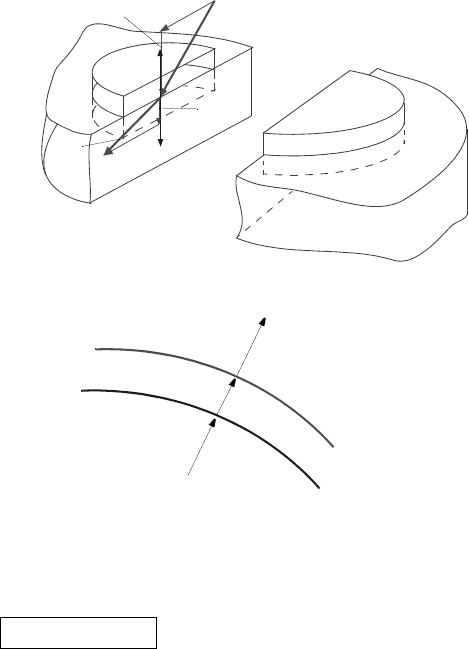
dipole layer. One proves this generalized claim by beginning with a surface that is
covered with electric charges. Let the surface charge density at a particular point be
and the electric displacement just above that point be , and the one
underneath . One can split and into their parallel (tangential) and
perpendicular (normal) components with respect to the surface (Fig. 2.22).
Now, one applies eq. (2.4) to the small cylinder shown in Fig. 2.22 whose extent
perpendicular to the surface shall be so small that the contribution of the sides of
the cylinder vanishes. The remaining contribution is
A'd
dΩ
dΩΩ
ϕ
1
4πε
0
------------
τdΩ
A
∫
=
ϕ
τ
4πε
0
------------
Ω =
Ω
Ω
Ω 4π–= θ
Ω 0=
ϕ
τ
ε
0
-----– inside
0 outside
=
τε
0
⁄
τ
τε
0
⁄τ
σ D
1
D
2
D
1
D
2
D
t
D
n
2.5 The Ideal Dipole 65
or
.
(2.74)
Notice that we did not make any statement about the tangential components, here,
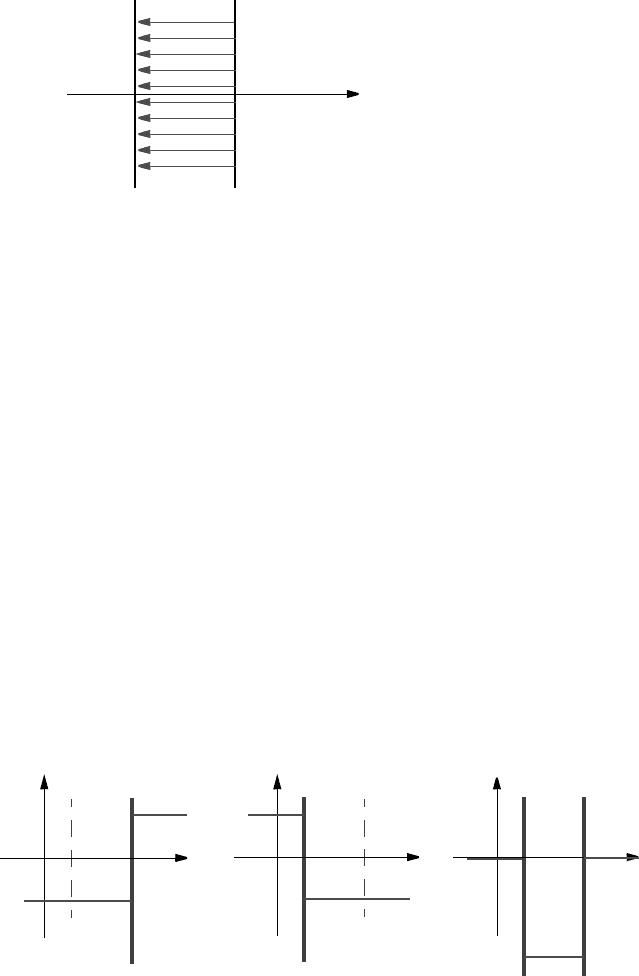
which will be covered in a later section. Now consider the case of two parallel
surfaces in close vicinity with surface charges of opposite sign (Fig. 2.23), for
which one finds:
,
From these two equations it follows:
and
Therefore, the normal component of D remains unchanged by the dipole layer. The
normal component of D within the layer is decreased by the value of . The
voltage when passing through the layer in perpendicular, positive direction is:
Fig. 2.22
σ
D
1t
D
1n
dA–
D
1
dA
D
2t
D
2
D
2n
D
2n
D
1n
–()dA σdA=
D
2n
D
1n
– σ =
Fig. 2.23
+σ
-σ
D
1n
D
2n
D
0n
D
0n
D
1n
– σ–=
D
2n
D
0n
–+σ=
D
2n
D
1n
D
n
==
D
0n
D
n
σ–=
σ
66 Basics of Electrostatics
.
(2.75)
As before, the positive direction is the direction of the dipole moment. is finite,
while d is arbitrarily small and is large enough to make finite, i.e., precisely
.
(2.76)
With eq. (2.75) we obtain for the potential difference or voltage
,
(2.77)
which completes the proof.
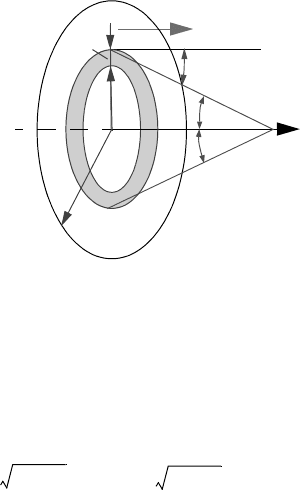
Particularly simple is the case of two infinitely wide parallel planes with
homogeneous surface charges (Fig. 2.24). For symmetry reasons, D has an x-
component depending on x only. Fig. 2.25 illustrates (a) the field of a surface with
the surface charge , (b) the field of a surface with the surface charge , and
(c) the superposition of the two fields. For case (a) we get
.
For symmetry reasons
,
δϕ E
0n
d–
D
0n
ε
0
---------
d–
D
n
σ–
ε
0
----------------
d–== =
D
n
σσd
σd τ=
δϕ
σd
ε
0
------
τ
ε
0
-----==
Fig. 2.24
D
xx
2
x
1
+σ-σ
+σ -σ
Fig. 2.25
x
x
2
x
1
+σ
-σ
D
x
D
2x
σ
2
---=
D
1x
σ
2
---–=
x
x
2
x
1
D
x
D
1x
σ
2
---=
D
2x
σ
2
---–=
x
x
2
x
1
+σ
D
x
D
x
σ–=
(a)
(b) (c)
D
2x
D
1x
– σ=
D
2x
D
1x
–=
2.5 The Ideal Dipole 67
or
.
(2.78)
For case (b), in a similar way one obtains
.
(2.79)
The superposition gives a non-zero field only for the area between the two planes
and it points from the positive plane to the negative one (Fig. 2.24)
.
(2.80)
Therefore
.
(2.81)
and
.
(2.82)
This equation is exact even for finite distances d, while for the general case, i.e.,
when deriving eq. (2.75), an infinitesimal distance d was required.
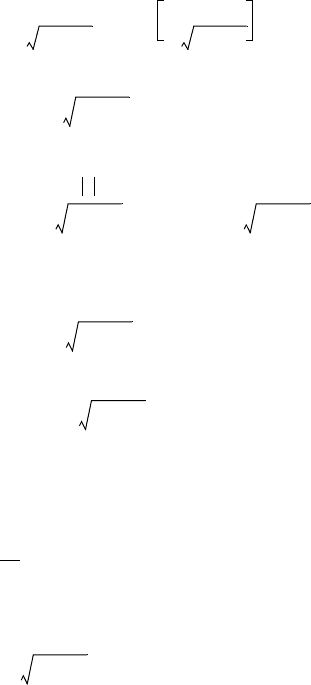
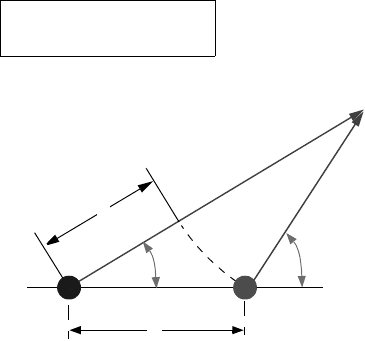
Here is another example on how to apply eq. (2.72). To calculate the potential
at the axis of a disk, uniformly coated with dipoles (Fig. 2.26). One needs to find
the solid angle . From eq. (2.70), follows for z>0:
.
Now, substituting as a new variable. Then and thus
D
2x
D
1x
–
σ
2
---==
D
2x
D
1x
–
σ
2
---–==
D
x
σ–=
E
x
σ
ε
0
-----–=
δϕ E
x
d–
σd
ε
0
------
τ
ε
0
-----===
Fig. 2.26
r
0
z
p
θ
θ
θ
dr
r
Ω
Ω dΩ
∫
2πr
r
2
z
2
+
----------------
θcos rd
0
r
0
∫
==
2πr
r
2
z
2
+
----------------
zrd
r
2
z
2
+
--------------------
0
r
0
∫
2πz
rrd
r
2
z
2
+
3
-----------------------
0
r
0
∫
==
r
2
dr
2
2rdr=
68 Basics of Electrostatics
.
For z < 0, on the other hand,
.
So
.
There is a discontinuity at z = 0, where jumps from to ,
which results in an overall discontinuity of , as expected. The electric field on
the axis is
and is calculated to be
.
vanishes when approaches infinity, as necessary. Now, we come back to the
case of Fig. 2.24, for which the field is non-zero only inside the layer.
Ωπz
r
2
d
r
2
z
2
+
3
-----------------------
0
r
0
2
∫
πz
2
r
2
z
2
+
--------------------–
0
r
0
2
==
2π 1
z
r
0
2
z
2
+
--------------------–
2π 1 θ
0
cos–()==
Ω 2π 1
z
r
0
2
z
2
+
--------------------–
–2π 1–
z
r
0
2
z
2
+
--------------------–
==
ϕ
τ
2ε
0
--------
1
z
r
0
2
z
2
+
--------------------–
for z 0>
τ
2ε
0
--------
1–
z
r
0
2
z
2
+
--------------------–
for z 0<
=
ϕτ2ε
0
()⁄– τ 2ε
0
()⁄
τε
0
⁄
E
z
z∂
∂ϕ
–=
E
z
τ
2ε
0
--------
r
0
2
r
0
2
z
2
+
3
-----------------------
=
E
z
r
0
2.5 The Ideal Dipole 69
2.5.4 Line Dipoles
It is possible to cover lines with dipoles, which is illustrated by a simple example.
According to eq. (2.46), the potential of an infinitely long, straight line charge is
.
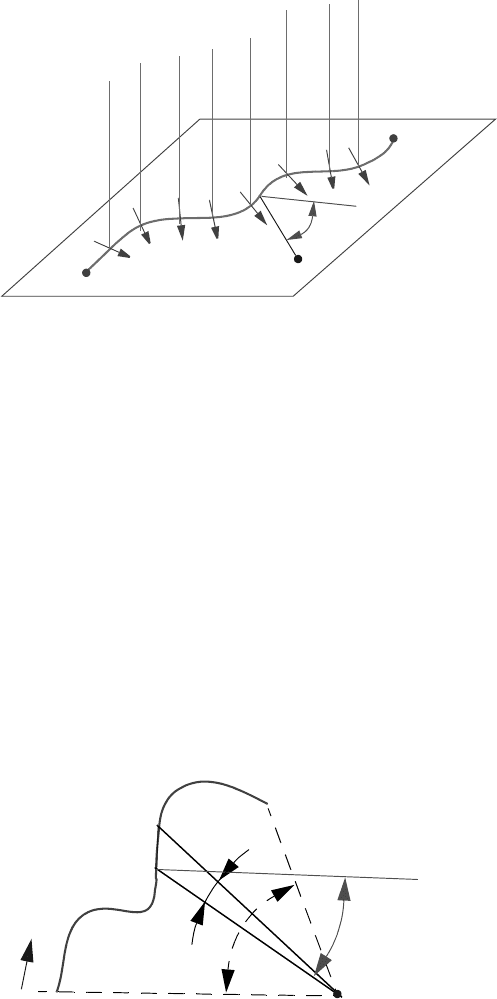
Two parallel line charges in close vicinity form a line dipole (Fig. 2.27), with the
potential
,
which holds as long as
.
We now require that
and
.
Then , . Furthermore , and
because the power series of for ,
becomes
,
(2.83)
Fig. 2.27
r
-
r
+
θ
-
θ
+
δ
-q
+q
d
ϕ
q
2πε
0
------------
r
r
B
-----ln–=
ϕ
q
2πε
0
------------
r
+
r
B
-----ln–
q
2πε
0
------------
r
-
r
B
-----ln+=
q
2πε
0
------------
r
+
r
-
-----ln–
q
2πε
0
------------
r
-
δ–
r
-
-------------ln–==
q
2πε
0
------------
1
δ
r
-
----–
ln–=
r
B1
r
B2
r
B
==
dr
+
«
dr
-
«
θ
+
θ
-
θ≈≈ δ r
-
r
+
– d θ r
-
«cos⋅≈= r
+
r
-
r≈≈
1 x–()ln xx
2
2⁄…++()–=1x 1≤≤– ϕ
ϕ
q
2πε
0
------------
δ
r
--
qd() θcos
2πε
0
r
-----------------------
≈≈
70 Basics of Electrostatics
where (qd) is the line dipole density (dipole moment per unit length) and is the
potential of the infinitely long line dipole. The result should be compared to
eq. (2.60), which represents the potential of a dipole. When comparing with
eq. (2.60), replace p with (qd), use 2
π
instead of 4
π
, r instead of r
2
, and let
. We should keep in mind that r in eq. (2.60) represents the distance of the
field point from the dipole, while in eq. (2.83) r represents the perpendicular
distance to the line dipole.
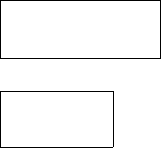
From line dipoles that are parallel to each other, one can construct cylindrical
dipole layers (Fig. 2.28 and Fig. 2.29 ).
The surface density of the dipole moment is
and thus the potential becomes
,
ϕ
r
1
0=
Fig. 2.28
θ
A
B
r
C
Fig. 2.29
θ
α
dα
ds
s
τ s()
dqd()
ds
--------------=
ϕ
τθcos ds
2πε
0
r
---------------------
C
∫
=
2.5 The Ideal Dipole 71
where the integral from A to B is evaluated along the contour C. Now,
is the angular element, under which the line element ds appears when looking from
the field point. Therefore
.
(2.84)
If is constant, this gives
.
(2.85)
These two relations are equivalent to eq. (2.71) and eq. (2.72), respectively. There,
we discussed general spatial problems, while here we are dealing with the
cylindrical case, which is also called the plane case because it is independent of
one of the spatial coordinates.
When the contour C is closed, the result is a closed cylinder. If, furthermore,
is constant and the dipoles point outwardly, then
and thus
As expected, there is the discontinuity of the potential .
dα
θcos ds
r
------------------=
ϕ
1
2πε
0
------------
τdα
C
∫
=
τ
ϕ
τα
2πε
0
------------
=
τ
α
2π– inside
0 outside
=
ϕ
τ
ε
0
-----– inside
0 outside.
=
τε
0
⁄
72 Basics of Electrostatics
2.6 Behavior of a Conductor in an Electric Field
One finds in nature two quite distinct types of materials. There are materials
containing charges which can move freely and there are materials where this is not
the case. The former are called conductors, while latter are called insulators (or
dielectrics). Consider the behavior of materials in the presence of an electric field
for the case of a conductor. We refrain from discussing this broad classification
further, but limit our discussion to the consequences for conductors in an electric
field, and then tackle the problem of dielectrics in an electric field.
A conductor in an electric field experiences a force, which is actually exerted
on the free charges within it. These start to move, and their motion will cease only
if
everywhere inside the conductor and
.
(2.86)
The surface of the conductor has to have the same potential everywhere, i.e. it has
to be an equipotential surface. Outside of the conductor, will not vanish. Its
tangential component has to be zero at the conductor surface
,
(2.87)
as otherwise the surface would not be an equipotential surface. The perpendicular
component of , however, will not vanish. There will be surface charges at the
surface, such that the external field does not penetrate the conductor, i.e., by
eq. (2.74) we obtain
.
(2.88)
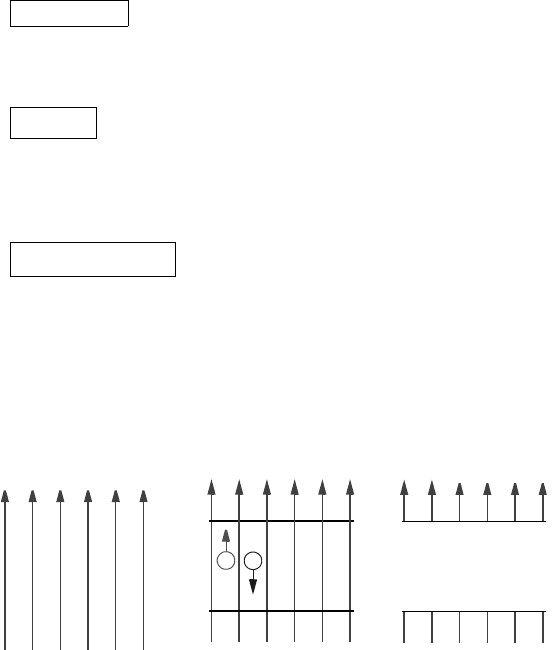
To illustrate this, consider this simple example: We choose an infinitely wide,
conducting plate within a uniform electric field which is perpendicular to the
surface of the plate (Fig. 2.30). Depending on their sign, the free charges move in
the direction of the field or opposite to it, until they reach the surface of the plate.
This is so, regardless of whether there are only negative, positive, or both types of
charges available. The result is a surface charge which is positive on one end, and
Fig. 2.30
E
σε
0
E=
abc
-
+
++++++
------
σε
0
E–=
E 0=
ϕ const =
E
E
t
0 =
E
n
E
D
n
ε
0
E
n
σ ==
2.6 Behavior of a Conductor in an Electric Field 73
negative on the other. The inside is free of any field if . The field of the
surface charges exists only inside. It originates at the positive charges (sources) and
ends at the negative charges (sinks). i.e., it is exactly opposite to the external field
but of the same magnitude. The external field is thus identically cancelled. The
superposition of the fields of Fig. 2.30b and Fig. 2.24 results in Fig. 2.30c.
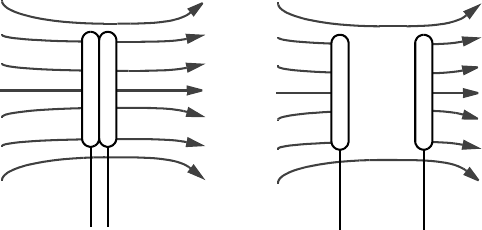
The thereby created surface charges are also called influence charges. They
can be used to measure the electric field by magnitude and direction. A pair of
conducting plates does the job. The plates are brought into the field while in
contact with each other. In the field, they are separated, and by trying different
orientations, one can find the direction of the field (Fig. 2.31).
To calculate the field created by a conductor, together with an external field in
full generality is rather difficult. In the following, we will solve some problems that
are, however, rather easy to solve.
2.6.1 Metallic Sphere in the Field of a Point Charge
By now, we have already calculated a number of fields and in principle, we know
their equipotential surfaces. One may imagine each such equipotential surface as
the surface of a conductor. In light of this, we have already solved many problems
of this kind. In Section 2.4, we have found that the equipotential surface of
two point charges with opposite sign is that of a sphere (Fig. 2.10). Take a sphere of
radius , centered at the origin of a Cartesian coordinate system, and a charge Q
1
to be located at (0,0,z
1
). Because of eq. (2.54) and eq. (2.55), a second charge Q
2
at
location (0,0,z
2
) will make the sphere an equipotential surface provided,
,
(2.89)
σε±
0
E=
Fig. 2.31
-
-
-
-
+
+
+
+
-
-
-
-
+
+
+
+
ϕ 0=
r
s
z
2
r
s
2
z
1
-----=