
Lehner G. Electromagnetic Field Theory for Engineers and Physicists
Подождите немного. Документ загружается.

84 Basics of Electrostatics
This is of practical value when one wants to optimize capacitor structures.
The unit of capacitance is the Farad. The definition of C determines
,
as already mentioned in Section 1.13.
Two conductors form a capacitor not only when separated by vacuum, but
also if the separating medium is an insulator. In this case, one finds that the
presence of the insulator permeating the gap increases the capacitance by a
characteristic factor. With the same charge, the result is a reduced voltage, or a
reduced electric field. The voltage vanishes completely inside a conductor. Inside
an insulator it is just reduced. Both situations have a similar cause. There are also
charges inside an insulator. They, however, can not move about freely. The result is
a limited shielding of the external field. This will be discussed in the next section.
The concept of capacitance can be generalized for systems that consist of
several conductors. This will be covered in Chapter 3.
2.8 E and D inside Dielectrics
All matter consists of atoms, which themselves consist of a positively charged
nucleus and negatively charged electrons. Inside a conductor, some of the electrons
are free to move, and this leads to the effects described the last two sections. This is
not the case for an insulator (dielectrics). Nevertheless, a certain displacement of
positive charges versus the negative ones is still possible. If, in a medium, the
centers of positive and negative charges of its atoms or molecules do not coincide,
then they acquire a dipole moment. Two cases are of importance.
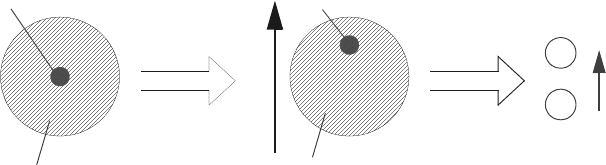
1. Frequently, atoms and molecules have no initial dipole moment in the
absence of an applied external field. However, an applied external field
exerts a force on the charges, which deforms the atoms (or molecules),
creating a dipole moment (Fig. 2.44). The so created dipole has its own
field which tends to weaken the external field. This process is termed
polarization of the dielectric (see also Section 2.5.2). The quantitative
measure is the resulting dipole moment per unit volume. The general
assumption is that the polarization is proportional to the electric field.
(2.99)
For a given voltage and outer radius
, the maximum of the electric
field takes is lowest value if
, i.e., for
spherical cylindrical
r
o
E
max
∂E
max
∂r
i
⁄ 0=
r
i
r
o
2
----= r
i
r
o
e
----
r
o
2.718…
-------------------==
1F
1C
1V
-------1
As
V
------
==
P ε
0
χE =
2.8 E and D inside Dielectrics 85
This is not necessarily exact, but often times provides a suitable approx-
imation, provided that the magnitude of electric field is not too large.
2. It is also possible that the atoms or molecules possess a “natural dipole
moment”, i.e. their respective centers of charge do not coincide, even in
the absence of an externally applied field. Nevertheless, in the general
case, the substance is still not polarized without an external field. The
reason is that the dipoles are typically randomly oriented inside the
material, and cancel each other, so that the system has no net dipole
moment. When an external field is applied, a torque is exerted on the
dipoles which tries to orient them along the external field. This may not
be entirely successful. Thermal motion continually attempts to destroy
this order created by the outside field. The orientation along the external
field is therefore only partial, and less complete the higher the tempera-
ture. However, the polarization is still, approximately proportional to the
external field. That is, equation eq. (2.99) for the polarization applies for
this case as well.
There is also the case that the dipoles maintain their orientation without
an external field. Such a substance is called permanently polarized. This
is then also referred to as electret, in analogy to a permanent magnet.
The factor in eq. (2.99) is called the electric susceptibility. Depending on
whether the material corresponds to case two (or one), will be (not be) a function
of temperature.
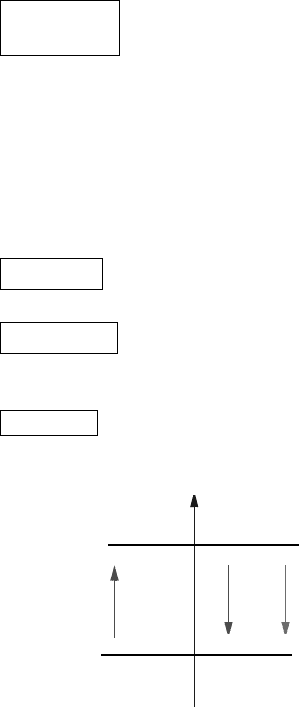
We now turn to the case of a polarized, plane plate (Fig. 2.45). An outside
field E
a
, is applied perpendicular to the plate. As a reaction, an opposing field E
g
is
created inside. The resulting net field inside is weakened:
Those fields are all uniform because of the plane geometry. Therefore, the
polarization
Fig. 2.44
nucleus (positive)
electron cloud (negative)
E
+
-
dipole
nucleus (positive)
electron cloud (negative)
applying
a field
χ
χ
E
i
E
a
E
g
+=
P ε
0
χE
i
=
86 Basics of Electrostatics
is also uniform. Notice that was used. The reason is that equation (2.99) uses
the net field at the particular field point. The uniformly polarized dielectric carries
the surface charge at its surface, as discussed in Section 2.5.2. Also, if
we just take the magnitude
or
so that
i.e.
(2.100)
and
.
(2.101)
Now, we may write
.
(2.102)
Here, is the so-called dielectric constant or permittivity of the insulator and
the so-called relative dielectric constant, defined by
.
(2.103)
Note that is dimensionless and defined by
,
(2.104)
Finally, one may complete the definition of , which up to now was only defined
for vacuum. For linear media we define the electric displacement as
(2.105)
Fig. 2.45
+σ
σ–
E
i
E
a
E
g
+=
E
a
D
g
E
g
E
i
σ P
n
±=
D
g
+σ +P==
E
g
D
g
ε
0
------
σ
ε
0
-----+
P
ε
0
-----
+
ε
0
χE
i
ε
0
--------------
+χE
i
=== = =
E
i
E
a
χE
i
–=
E
i
E
a
1 χ+
------------
=
E
g
χ
1 χ+
------------
E
a
=
ε
0
E
a
ε
0
1 χ+()E
i
ε
0
ε
r
E
i
εE
i
===
εε
r
εε
0
ε
r
=
ε
r
ε
r
1 χ += ε
r
1>
D
D εE =

2.8 E and D inside Dielectrics 87
Thus, because of eq. (2.102) . In the general case, when is not
perpendicular to the insulator surfaces, we have to restrict this statement to apply to
the normal components of D:
(2.106)
This is an important statement. It gives insight into the meaning of the definition of
. The electric field intensity is discontinuous at the boundaries of the insulator, in
such a way that only the normal component of remains continuous. Thus, the
influence of polarization is taken into account automatically.
There is no absolute necessity to make a distinction between , and . Not
to introduce and solely work with the relations for vacuum is also possible. This
requires an explicit consideration of all charges, including the surface charges due
to the polarization. These cause a discontinuity in the normal component of . The
above definition of , in contrast, considers these effects implicitly. If there are
additional surface charges that are not caused by polarization, then these have to be
taken into account explicitly in any case. To better distinguish those charges, the
terms free charges and bound charges are used. Polarization causes bound charges.
Accordingly, one introduces two charge densities
.
(2.107)
Then
,
i.e.
.
(2.108)
This relation shall generally apply, i.e. is always defined by eq. (2.108), and is
even done in the case of a permanent polarization (electret). Applying the general
definition (2.108) to the special case of linear media results again in (2.105).
Taking the divergence of (2.108) gives
,
i.e., with (2.66)
(2.109)
and
(2.110)
To avoid confusion here requires one to make a clear and conscious distinction
between free and bound charges. This means to either calculate the electric field by
considering all charges (free and bound), or to calculate the electric displacement
from the free charges alone.
Note that one is still dealing with electrostatics (i.e. the time independent
case) only. Nevertheless it shall be noted, that after applying an electric field, it
takes some finite amount of time before the system reaches its final state. If one
D
a
D
i
= E
D
na
D
ni
=
D
D
ED
D
E
D
ρρ
free
ρ
bound
+ ρ
f
ρ
b
+==
D εE ε
0
ε
r
E ε
0
1 χ+()E== =
ε
0
E ε
0
χE+ ε
0
EP+==
D ε
0
EP +=
D
ε
0
E()∇• ρ ρ
f
ρ
b
+ D∇• P∇•–== =
P∇• ρ
b
–=
D∇• ρ
f
=
88 Basics of Electrostatics
applies alternating electric fields of sufficiently high frequency, then the
equilibrium condition can not be reached anymore, and so and are actually
frequency dependent. So far, we have been dealing only with and in the limit
of zero frequency.
Moreover, many dielectrics are not isotropic, i.e. their polarization depends
on the direction of the applied electric field and shows a preference for certain
directions. In this case, however, is no longer a scalar, but a tensor. Eq. (2.105) is
then replaced by the more complicated expression
(2.111)
or in tensor notation
.
(2.112)
is a quantity with nine components whose individual components behave like
products of vector components (e.g., during a transformation). The scalar
multiplication of a tensor of rank two (that is ) with a vector results in a vector.
Note that is a symmetric tensor, thus
(2.113)
If in (2.100) we set , then . This suggests that in some respect,
conductors behave like dielectrics with infinite susceptibility. The plausible reason
is that a conductor has free charges which, when an electric field is applied, creates
arbitrarily large dipole moments.
2.9 The Capacitor with a Dielectric
One is now able to understand why a dielectric increases the capacitance of a
capacitor. As shown in Fig. 2.46, there are charges on the plates, and the space
between them is filled with a dielectric of permittivity . Then
χε
χε
ε
D
x
ε
xx
E
x
ε
xy
E
y
ε
xz
E
z
++=
D
y
ε
yx
E
x
ε
yy
E
y
ε
yz
E
z
++=
D
z
ε
zx
E
x
ε
zy
E
y
ε
zz
E
z
++=
D e E •=
e
e
e
ε
ik
ε
ki
=
χ
∞= E
i
0=
Fig. 2.46
+σσ
free
Q
A
----==
σ–
Q–
+QQ
free
=
ε
Q±
ε
σ
Q
A
------- D εE ε
V
d
------
====
2.9 The Capacitor with a Dielectric 89
and therefore
(2.114)
Comparison with eq. (2.95) reveals that C has increased by the factor . This
results quite plausibly from the fact, that for a given charge on the plate of the
capacitor, the bound charges on the surfaces of the dielectric reduce the total charge
and thereby also the electric field.
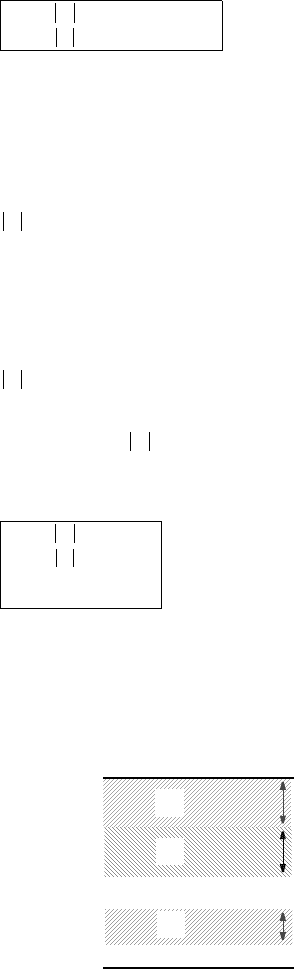
As another example, let us analyze a plane capacitor with a layered medium
(Fig. 2.47). The voltage is
.
On the other hand
is the same everywhere. Therefore
,
or
.
(2.115)
C
Q
V
------- ε
A
d
---
ε
0
ε
r
A
d
---
===
ε
r
Fig. 2.47
+σ
Q
A
----=
σ–
Q
A
----–=Q–
+Q
ε
1
ε
2
ε
i
d
1
d
2
d
i
V
E
i
d
i
i
∑
=
ε
i
E
i
D=
V
D
ε
i
----
d
i
i
∑
D
d
i
ε
i
----
i
∑
==
σ
d
i
ε
i
----
i
∑
Q
A
-------
d
i
ε
i
----
i
∑
==
C
Q
V
-------
A
d
i
ε
i
----
i
∑
----------
==
90 Basics of Electrostatics
2.10 Boundary Conditions for E and D and Refraction of Force
Lines
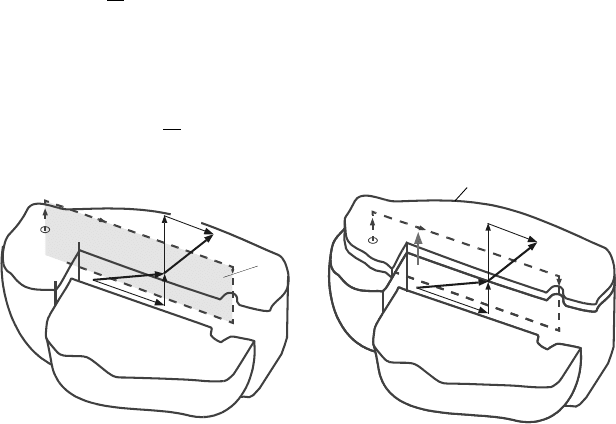
Here, we analyze the boundary that separates two regions. Perhaps it is the
boundary of two materials of different permittivities, or perhaps it carries a surface
charge etc. The conditions that have to be met at such boundaries result from
Maxwell’s equations. We start with Faraday’s law, eq. (1.68)
.
Integrating about the small area A shown in Fig. 2.48 gives
The reason is that the area becomes arbitrarily small when its perpendicular extent
approaches zero. This implies that there is no voltage along the infinitesimal path
element perpendicular to the boundary. This condition is not met for a dipole layer
which is shown in Fig. 2.49, in which case the relation becomes:
.
The reason is that the dipole layer causes a discontinuity of the potential in the
direction of by the factor (2.77). Thus
E∇×
t∂
∂
B–=
E dA•∇×
A
∫
E ds•
∫
°
ds E
2t
E
1t
–()==
t∂
∂
B dA•
∫
–0==
Fig. 2.49
E
1t
E
2
E
2t
E
1t
dsds
p
s
1
s
2
E
1t
E
1
E
2
E
2t
dipole layer
Fig. 2.48
E
1t
ds
A
E
1t
E
1
E
2
E
2t
E ds•
∫
°
E
2t
ds
τ s
2
()
ε
0
------------ E
1t
ds
τ s
1
()
ε
0
------------––+=
0=
p τε
0
⁄
ds E
2t
E
1t
–()
τ s
1
()τs
2
()–
ε
0
-------------------------------
τ s
1
()τs
1
ds+()–
ε
0
-------------------------------------------==
1
ε
0
-----
dτ
ds
-----
ds–=
2.10 Boundary Conditions for E and D and Refraction of Force Lines 91
i.e.,
(2.116)
This is a special case. It describes the discontinuity of along a given direction
on the dipole layer as shown in Fig. 2.49. , are the tangential components
of the electric field in this direction, where is the component of in this
direction whereby is the two-dimensional gradient in the plane of the dipole
layer. We can lift this restriction on the direction by writing
.
(2.117)
Equation (2.116) results from this by scalar multiplication with the unit vector in
the chosen direction.
Without the dipole layer, one obtains as in the beginning of this section,
.
(2.118)
The tangential component of E has to be continuous, as long as there is no dipole
layer present.
A boundary condition for D follows from eq. (1.23) or its equivalent eq.
(1.20) namely eq. (2.74), already derived in Section 2.5.3,
.
(2.119)
In agreement with our discussion of Section 2.8, this is generally true only, if
merely represents the free, but not bound charges. The normal component of is
continuous only if . Otherwise, it too is discontinuous.
The boundary conditions for and induce kinks (refraction) of the
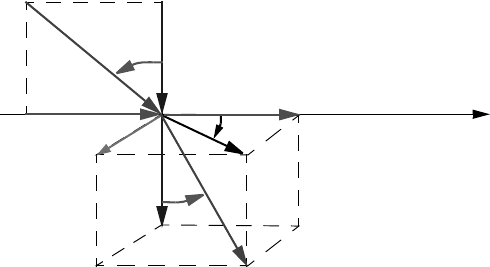
electric lines of force when entering another medium, or when passing through a
dipole layer, or through a surface charge. With Fig. 2.50 it follows:
E
2t
E
1t
–
1
ε
0
-----
dτ
ds
-----
–=
E
t
E
1t
E
2t
dτ ds⁄τ∇
τ∇
E
2t
E
1t
–
1
ε
0
-----
τ ∇–=
E
2t
E
t1
=
D
2n
D
1n
– σ =
σ
D
σ 0=
Fig. 2.50
σ
E
1t
E
1n
E
1
E
2
α
1
α
2
E
2t
dipole layer
E
2n
DE
E
2t
E
1t
1
ε
0
-----
dτ
ds
-----
–=

92 Basics of Electrostatics
and
.
So
and
i.e.
(2.120)
Specific cases of this relation are
1. Refraction at a boundary where
(2.121)
2. Refraction at a surface with free surface charges where ( )
(2.122)
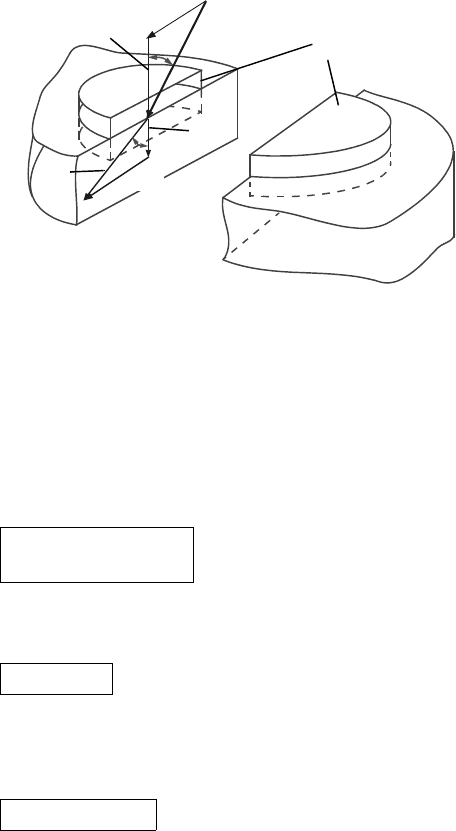
Generally, if there is a dipole layer, the electric field is not only refracted, but also
rotated by the angle with respect to the plane of incidence. Using eq. (2.117) and
the illustration shown in Fig. 2.51:
and therefore
E
2n
D
2n
ε
2
---------
D
1n
σ+
ε
2
-------------------==
ε
1
E
1n
σ+
ε
2
------------------------=
α
2
tan
E
2t
E
2n
---------
E
1t
1
ε
0
-----
dτ
ds
-----
–
ε
1
ε
2
-----
E
1n
σ
ε
2
-----+
--------------------------==
α
1
tan
E
1t
E
1n
---------=
α
2
tan
α
1
tan
--------------
1
1
ε
0
E
1t
-------------
dτ
ds
-----
–
ε
1
ε
2
-----
σ
ε
2
E
1n
--------------+
-----------------------------
=
ε
1
ε
2
≠σ, 0=
α
2
tan
α
1
tan
--------------
ε
2
ε
1
-----=
ε
1
ε
2
ε
0
==
α
2
tan
α
1
tan
--------------
1
1
σ
ε
0
E
1n
--------------+
------------------------=
β
E
2t
E
1t
1
ε
0
-----
τ∇–=
E
2t ||
E
1t
1
ε
0
-----
τ∇()
||
–=
2.11 A Point Charge inside a Dielectric 93
.
This results in
and
.
2.11 A Point Charge inside a Dielectric
2.11.1 Uniform Dielectric
Consider a point charge at the center of a hollow sphere made up of a dielectric
material (Fig. 2.52).
For the entire space,
.
For vacuum
,
and inside the dielectric, hollow sphere
Fig. 2.51
E
2t ||
E
1n
E
1t
E
1
α
1
E
2n
β
E
2t
E
2t⊥
E
2
α
2
boundary
plane of
incidence
E
2t⊥
1
ε
0
-----
τ∇()
⊥
–=
βtan
E
2t⊥
E
2t ||
-----------=
α
2
tan
E
2t
E
2n
---------=
D
Q
4πr
3
------------
r=
E
Q
4πε
0
r
3
-----------------
r=