
Lehner G. Electromagnetic Field Theory for Engineers and Physicists
Подождите немного. Документ загружается.

54 Basics of Electrostatics
This is even true for rotationally symmetric charge distributions of all kinds, not
only for the case of the two point charges discussed here.
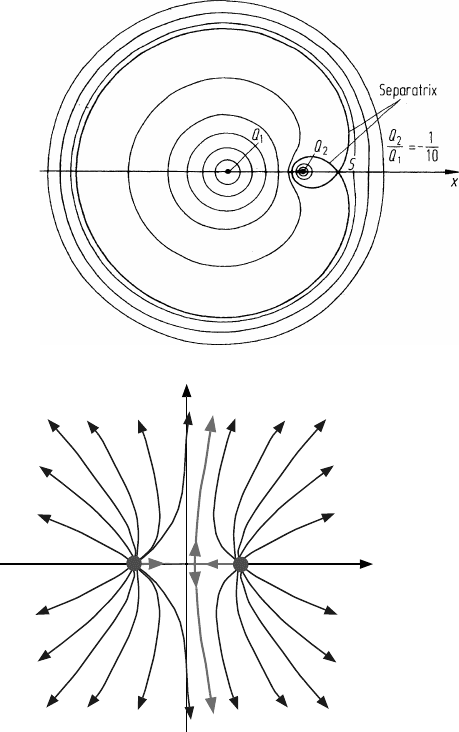
If there are more than two charges, the configurations can become rather
complicated. Then, knowing the location of the stagnation points, is a particularly
useful means to understand the structure of such a field.
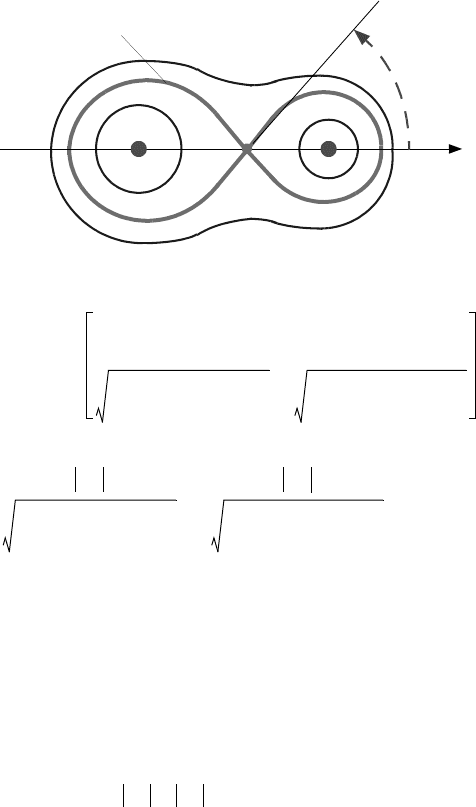
For future purposes, we investigate here the equipotential surface for
the special case of two opposite charges, where
Fig. 2.7
Fig. 2.8
separatrix
x
y
Q
2
Q
1
S
Q
1
Q
2
------ 1 . 5=
ϕ 0=
2.4 The Field Generated by two Point Charges 55
or
Taking the square gives
or
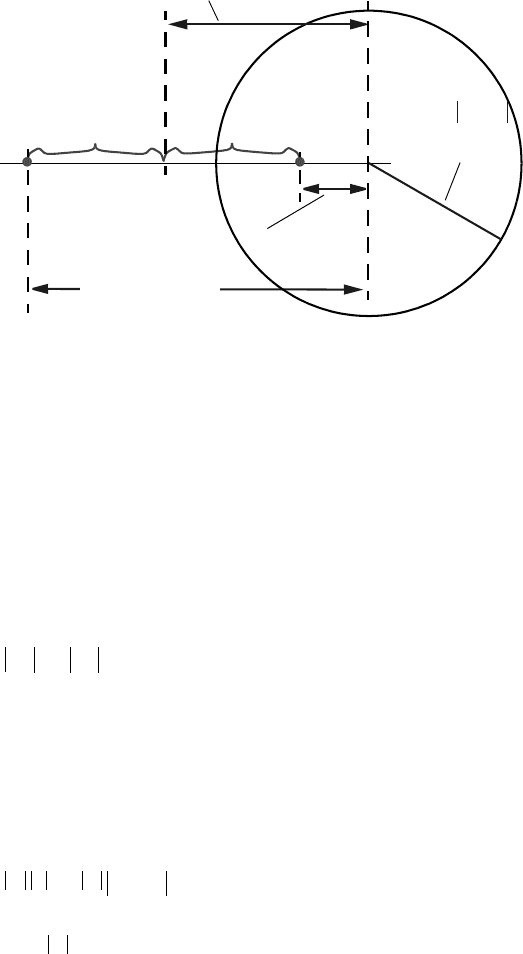
which is the equation for a sphere. Its characteristics are illustrated in Fig. 2.10. As
before, we assumed . The distances of the charge from the center of the
sphere are
(2.52)
(2.53)
From this, we find
Fig. 2.9
separatrix
Q
2
Q
1
α
S
x
0
1
4πε
0
------------
Q
1
x
d
2
---+
2
y
2
z
2
++
-----------------------------------------------------
Q
2
x
d
2
---–
2
y
2
z
2
++
----------------------------------------------------+=
Q
1
x
d
2
---+
2
y
2
z
2
++
-----------------------------------------------------
Q
2
x
d
2
---–
2
y
2
z
2
++
----------------------------------------------------=
Q
1
2
x
2
dx–
d
2
4
----- y
2
z
2
+++
Q
2
2
x
2
dx
d
2
4
----- y
2
z
2
++++
=
x
d
2
---
Q
1
2
Q
2
2
+
Q
1
2
Q
2
2
–
--------------------
–
2
y
2
z
2
++
d
2
Q
1
2
Q
2
2
Q
1
2
Q
2
2
–()
2
----------------------------=
Q
1
Q
2
>
r
1
x
s
d
2
---+ d
Q
1
2
Q
1
2
Q
2
2
–
--------------------
==
r
2
x
s
d
2
---– d
Q
2
2
Q
1
2
Q
2
2
–
--------------------
==
56 Basics of Electrostatics
(2.54)
and
,
(2.55)
that is, the product of the two distances equals the square of the radius of the
sphere. We will use this result when we discuss image charges.
Also interesting is the case of opposite charges having the same magnitude.
that is
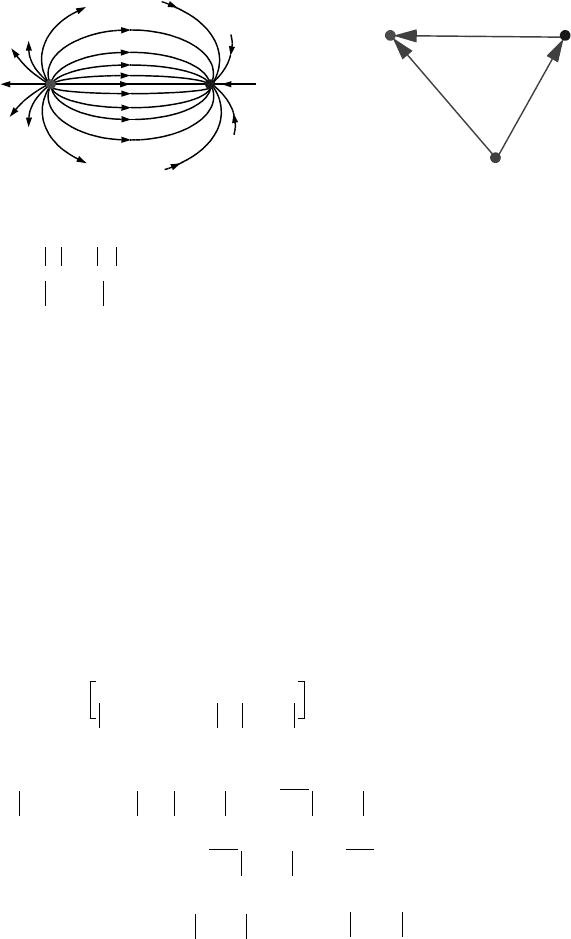
Based on eq. (2.51), the stagnation point has now moved to infinity. All force
lines that originate at (if is positive) end at . This results in a field as
illustrated in Fig. 2.11, and is called a dipole field. One can assign a dipole moment
to these charges (Fig. 2.12). The dipole moment is a vector quantity which points
from the positive to the negative charge, whose magnitude is
,
where
(2.56)
Fig. 2.10 0
Q
1
d
2
---
d
2
---
x
S
d
2
---
Q
1
2
Q
2
2
+
Q
1
2
Q
2
2
–
--------------------
⋅=
r
S
dQ
1
Q
2
Q
1
2
Q
2
2
–
-------------------=
r
1
Q
1
2
d
Q
1
2
Q
2
2
–
-------------------=
r
2
Q
2
2
d
Q
1
2
Q
2
2
–
-------------------=
Q
2
r
1
r
2
----
Q
1
2
Q
2
2
-------=
r
1
r
2
d
2
Q
1
2
Q
2
2
Q
1
2
Q
2
2
–()
2
---------------------------- r
S
2
==
Q
1
Q
2
Q==
Q
2
Q
1
–=
Q
1
Q
1
Q
2
Qd Qr
+
r
-
–=
p Q r
+
r
-
–()=
2.5 The Ideal Dipole 57
(2.57)
. (2.58)
If we let Q approach infinity and d approach zero in such a manner that p
remains finite, then we have created an ideal dipole. It will be discussed in detail in
the next section.
2.5 The Ideal Dipole
2.5.1 The Ideal Dipole and its Potential
Consider a charge be at location and a charge located at . The
dipole moment is (see Fig. 2.12)
.
Imagine increasing Q and decreasing at the same time, in such a way as to
keep fixed. The related potential for the charges is
.
In terms of the Taylor expansion:
.
The gradient operator is marked with the index to express the fact that the
derivatives are with respect to the components of , The potential is now
Fig. 2.12
-Q
+Q
r
-
r
+
r
+
- r
-
Fig. 2.11
p
p Qd==
d r
+
r
-
–=
Q– r
1
+Q r
1
dr
1
+
p Qdr
1
=
dr
1
p
ϕ
Q
4πε
0
------------
1
rr
1
dr
1
+()–
------------------------------------
1
rr
1
–
----------------–=
1
rr
1
dr
1
+()–
------------------------------------
1
rr
1
–
---------------- dx
1
x
1
∂
∂ 1
rr
1
–
---------------- ++=
+ dy
1
y
1
∂
∂ 1
rr
1
–
---------------- dz
1
z
1
∂
∂ 1
rr
1
–
------------- …++
1
rr
1
–
---------------- dr
1
∇
r
1
1
rr
1
–
----------------
…+• +=
r
1
r
1
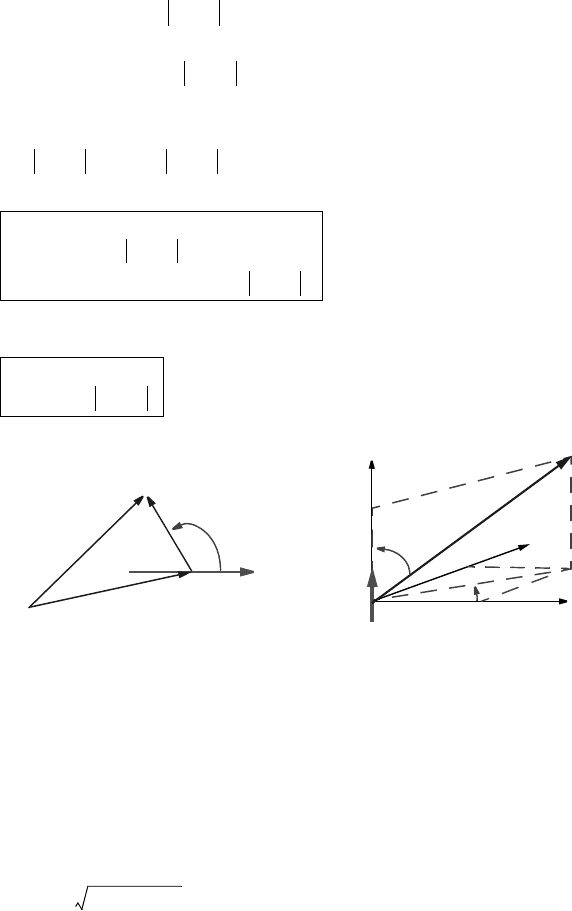
58 Basics of Electrostatics
having used the fact that
.
Finally we get for the potential
,
(2.59)
where is the observation point and the location of the dipole . Using the
angle between and as illustrated in Fig. 2.13, we write
(2.60)
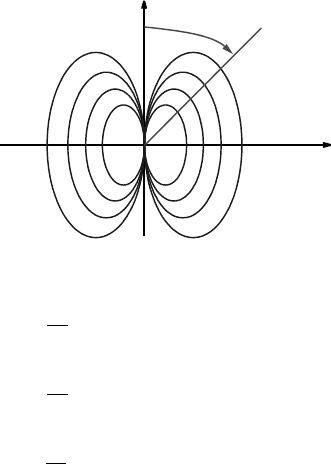
The dipole field shall be discussed in more detail. It is rotationally symmetric
around the axis parallel to the orientation of . We choose that to be the z-axis of a
Cartesian coordinate system (Fig. 2.14). For this situation one obtains
,
with
.
Consequently
ϕ
Q
4πε
0
------------
dr
1
∇
r
1
1
rr
1
–
----------------
• =
Q
4πε
0
------------
dr
1
∇
r
1
rr
1
–
----------------
• ,– =
∇
r
1
1
rr
1
–
----------------
∇
r
1
rr
1
–
----------------
–=
ϕ
p ∇
r
1
rr
1
–
----------------
•
4πε
0
---------------------------------–
prr
1
–()•
4πε
0
rr
1
–
3
--------------------------------
==
rr
1
p
θ prr
1
–
ϕ
p θcos
4πε
0
rr
1
–
2
--------------------------------=
Fig. 2.14
z
x
y
r
θ
p
ϕ
Fig. 2.13
rr
1
–
r
p
θ
r
1
p
ϕ
p θcos
4πε
0
r
2
-----------------
pz
4πε
0
x
2
y
2
z
2
++()
32/
-----------------------------------------------------==
θcos
z
x
2
y
2
z
2
++
--------------------------------=
2.5 The Ideal Dipole 59
(2.61)
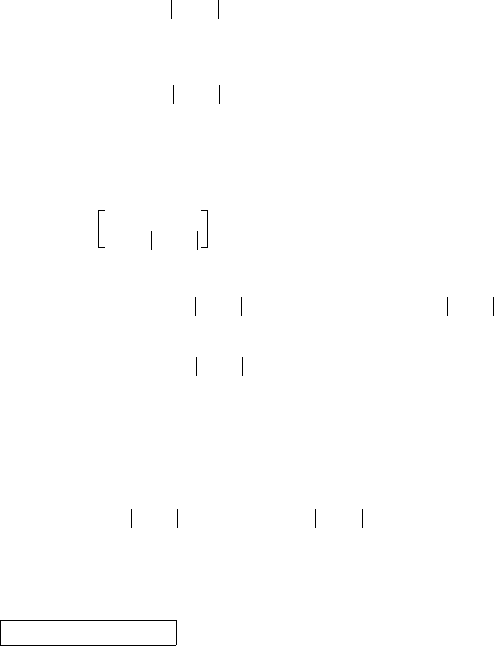
Because of the rotational symmetry, it is sufficient to calculate the field in a plane,
e.g., for the x-z-plane (y=0) (see Fig. 2.15).
(2.62)
If we transform to spherical coordinates ( ) then the azimuthal component
vanishes. The remaining components are:
(2.63)
All lines of force pass through the origin. This may initially seem surprising, but is
quite plausible if we consider Fig. 2.15 as having emerged as the limit from
Fig. 2.11.
E
x
x∂
∂ϕ
–
3pxz
4πε
0
x
2
y
2
z
2
++()
52/
-----------------------------------------------------==
E
y
y∂
∂ϕ
–
3pyz
4πε
0
x
2
y
2
z
2
++()
52/
-----------------------------------------------------==
E
z
z∂
∂ϕ
–
p
4πε
0
x
2
y
2
z
2
++()
32/
-----------------------------------------------------
3
z
2
x
2
y
2
z
2
++
----------------------------
1–
==
Fig. 2.15
z
x
θ
E
x
3pxz
4πε
0
x
2
z
2
+()
52/
-----------------------------------------
3p θcos θsin
4πε
0
r
3
------------------------------==
E
y
0=
E
z
p 3 θcos
2
1–()
4πε
0
r
3
-----------------------------------=
r θϕ,,
E
r
E
x
θsin E
z
θcos+
2p θcos
4πε
0
r
3
------------------==
E
θ
E
x
θcos E
z
θsin–
p θsin
4πε
0
r
3
-----------------==
60 Basics of Electrostatics
Oftentimes, one deals not with individual dipoles, but rather a collection of
dipoles distributed over a volume, surface, or a line, more or less densely filled
with dipoles. Like for potentials for volume, surface, or line charges, where one
employs the superposition principle to integrate over the potentials of point
charges, one similarly makes use of the superposition of the potentials (2.59) of the
“point dipole”.
2.5.2 Volume Distribution of Dipoles
If the dipoles are distributed within a volume, the resulting volume density is
defined by the quantity
.
This is the polarization, which turns out to be an important quantity. This
distribution generates a potential
(2.64)
This expression leads to interesting consequences. We start by considering the
following integral
where we have used the vector formula
.
Thus
.
(2.65)
Comparison of this equation with equations (2.20) and (2.26) reveals that it is
possible to think of a volume distribution of dipoles as the result of superposition
of a volume charge distribution and a surface charge distribution, namely by
(2.66)
P
dp
dτ
------=
ϕ
Pr'() ∇
r
1
rr'–
---------------
•τ'd
4πε
0
------------------------------------------------
∫
–=
+
Pr'() ∇
r '
1
rr'–
---------------
•τ' d
4πε
0
-----------------------------------------------------
∫
=
1
4πε
0
------------
∇
r'
Pr'()
1
rr'–
---------------
•τ'd
∫
1
4πε
0
------------
∇
r '
Pr'()•
rr'–
-------------------------
τ'd
∫
1
4πε
0
------------
Pr'() ∇
r '
1
rr'–
---------------
•τ'd
∫
+=
1
4πε
0
------------
Pr'() dA'•
rr'–
---------------------------
,
∫
°
=
fa()∇• f a∇• a ∇f•+=
ϕ
1
4πε
0
------------
∇
r
'
Pr'()•
rr'–
-------------------------
τ'd
∫
–
1
4πε
0
------------
Pr'() dA'•
rr'–
---------------------------
∫
°
+=
ρ r'() Pr'() ∇•–=
2.5 The Ideal Dipole 61
and
(2.67)
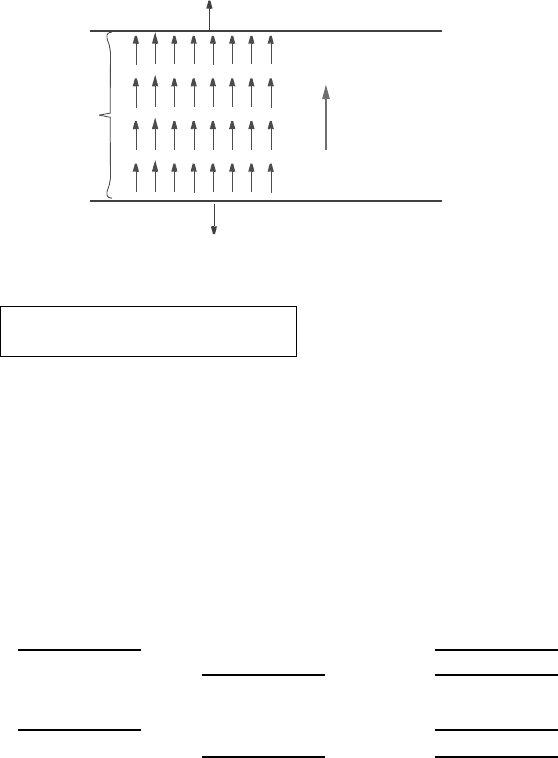
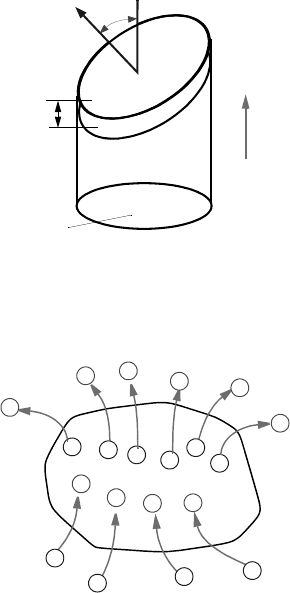
This important result can also be made plausible, by considering this example.
Consider the disk shown in Fig. 2.16, filled with uniform polarization .
The charges of the dipoles inside the volume cancel each other. Only at the surface,
there will be a net, bound charge. The net charge at the top is a positive surface
charge and the one at the bottom is negative. One may think of this as the result of
two disks of uniform volume charge which are slightly displaced against each other
(Fig. 2.17). If the volume charges are and , and the displacement is d, then
we find for the polarization and the surface charges are . The
reason is that is perpendicular to the surface of the disk.
The general case is illustrated in Fig. 2.18, where the surface charge is given by
,
which is also the result previously obtained in a more formal manner. If the
polarization is not uniform, then the charges inside do not cancel entirely and there
remains a net volume charge. Fig. 2.19 illustrates this case. It shows a volume with
σ r'()
Pr'() dA'•
dA'
--------------------------- Pr'() n• ==
P
Fig. 2.16
dipoles
P
dA
dA
+ρ -ρ
P ρd= ρd± P±=
P
Fig. 2.17
+ + + +
+ + + +
+ + + +
- - - -
- - - -
- - - -
+=
+ + + +
- - - -
+ρ
-ρ
σ -P=
σ +P=
σ r'()
ρddA γcos⋅⋅
dA
----------------------------------
Pr'() dA•
dA
--------------------------==
62 Basics of Electrostatics
dipoles inside. At the end of each dipole vector, there is a positive and at its
beginning a negative charge. We have
,
i.e., the overall flux of the polarization over the surface is equivalent to the
negative of the charge in the volume (a vector that points outward represents a
negative charge inside). Conversely,
,
and comparison mandates that
.
Fig. 2.18
+
+ + + + +
+ +
+ + + + +
+ + + + +
+ + +
P
dA
dA γcos
+ + + + +
+ +
+ + + + +
+ + + + +
+ + + +
d
γ
Fig. 2.19
-
-
-
-
-
-
+
+
+
+
-
-
-
-
+
+
+
+
+
P
+
P dA•
∫
°
Q– ρτd
V
∫
–==
P
P
P dA•
∫
°
P∇• τd
V
∫
=
ρ P∇•–=
2.5 The Ideal Dipole 63
2.5.3 Surface Distributions of Dipoles (Dipole Layers)
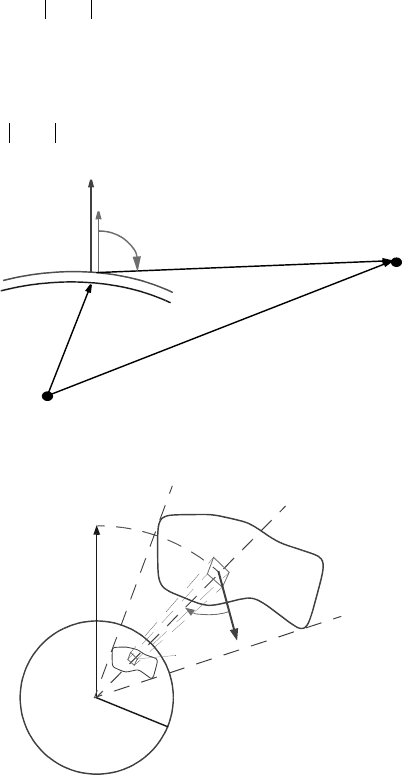
If we place dipoles on a surface, one obtains a so-called double layer or dipole
layer. The name stems from the fact that it is equivalent to two layers of opposite
charges. As shown in Fig. 2.20, let point in the direction of . We define the
surface density of the dipole moment
(2.68)
Using (2.60), we find for the potential
.
(2.69)
With the solid angle element
(2.70)
p dA'
Fig. 2.20
p
dA'
r'
origin
field point
+
-
rr'–
r
θ
dipole layer
τ
dp
dA'
--------=
ϕ
τ r'() θcos
4πε
0
rr'–
2
------------------------------
A'd
A
∫
=
Fig. 2.21
r
A
1 unit length
Ω
dΩ
dA’
θ
dΩ
θ A'dcos
rr'–
2
--------------------=