
Lehner G. Electromagnetic Field Theory for Engineers and Physicists
Подождите немного. Документ загружается.

94 Basics of Electrostatics
.
The associated polarization is
.
and, as will be shown later (in 3.42)
,
which means that there are no bound volume charges inside the dielectric.
Nevertheless, there are bound surface charges, specifically
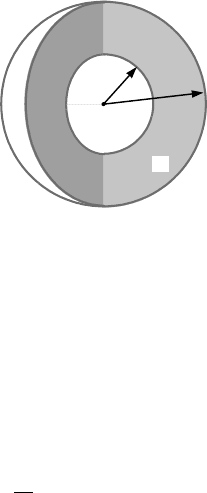
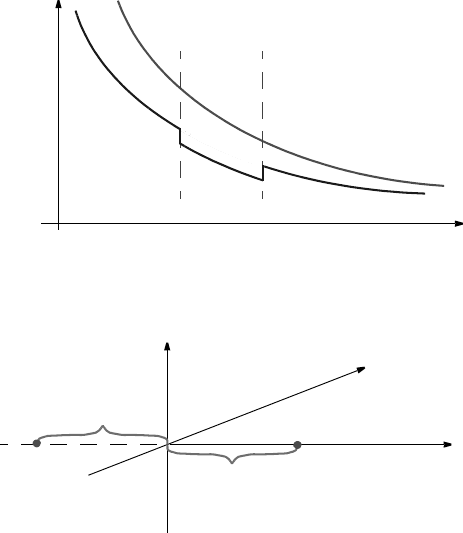
Fig. 2.53 illustrates the behavior of D and E as functions of r. Now we let
approach zero, but shall go to infinity. As a result, one finds the net charge
inside
.
This means that the charge appears to be reduced as a result of the bound charges
by the factor . The overall field, where now the dielectric fills the entire space, is
Fig. 2.52
r
1
r
2
ε
0
ε
0
ε
E
Q
4πεr
3
---------------
r
Q
4πε
0
ε
r
r
3
----------------------
r==
P ε
0
χE
ε
r
1–
ε
r
-------------
Q
4πr
3
------------
r==
ρ
b
P∇•–
1
r
2
-----
r∂
∂
r
2
ε
r
1–
ε
r
-------------
Q
4πr
3
------------
r
–0== =
σ
b
ε
r
1–
ε
r
-------------
Q
4πr
1
2
------------
– for rr
1
,=
+
ε
r
1–
ε
r
-------------
Q
4πr
2
2
------------
for rr
2
.=
=
r
1
r
2
Q' Q
ε
r
1–
ε
r
-------------
Q
4πr
1
2
------------
4πr
1
2
– Q
ε
r
1–
ε
r
-------------
Q–
Q
ε
r
----===
ε
r
E
Q
4πε
0
ε
r
r
3
----------------------
r=
2.11 A Point Charge inside a Dielectric 95
,
i.e., the field is reduced relative to vacuum by the same factor , as was the
charge.
2.11.2 Plane Boundaries between two Dielectrics
Let a point charge reside in a space that is filled with two different dielectrics that
are separated by a plane boundary (Fig. 2.54). Material 1 ( ) occupies the half-
space x>0; material 2 ( ) occupies the half-space x<0. One can show that
1. The field in half-space 1 can be expressed as the superposition of the
field of Q and the field of a fictitious charge (image charge) Q’ , located
in half-space 2 at the same distance (a) from the boundary as Q.
2. The field in half-space 2 can be expressed as the field of the fictitious
charge Q’’, located at the same point as Q.
Fig. 2.53
r
2
r
1
E
r
r()
D
r
r()
D
r
E
r
,
r
Q'
4πε
0
r
3
-----------------
r=
ε
r
ε
1
ε
2
Fig. 2.54
y
z
x
Q’
Q
a
a
(Q’’)
ε
1
ε
2
96 Basics of Electrostatics
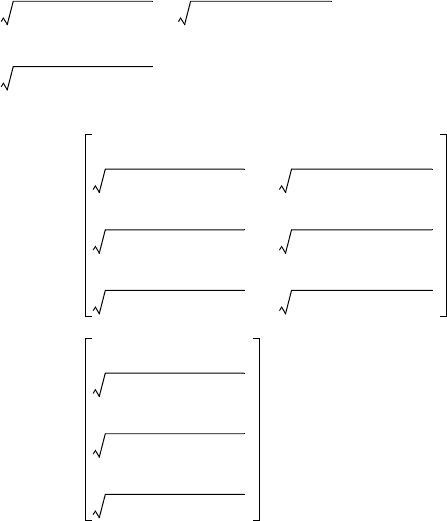
This justifies the following Ansatz.
.
From this follow the electric fields
,
The tangential components of E, that is and , as well as the normal
component of , that is , have to be continuous on the boundary x=0. and
, are continuous if
,
and is continuous if
.
One may verify that the Ansatz is correct by showing that the appropriate choice of
Q’ and Q’’ fulfills the boundary conditions everywhere on the boundary x=0, i.e.,
for all y and all z, which is not at all self-evident. Calculating Q’ and Q’’ from these
two equations gives
,
.
Q’’ always has the same sign as Q has, while Q’ may have either one. In particular
for , we find Q’ = 0 and Q’’ = Q, as expected. In the limit of
ϕ
1
1
4πε
1
------------
Q
xa–()
2
y
2
z
2
++
----------------------------------------------
Q'
xa+()
2
y
2
z
2
++
-----------------------------------------------+
=
ϕ
2
1
4πε
2
------------
Q''
xa–()
2
y
2
z
2
++
----------------------------------------------
=
E
1
ϕ
1
∇–
1
4πε
1
------------
Qx a–()
xa–()
2
y
2
z
2
++
3
-------------------------------------------------
Q' xa+()
xa+()
2
y
2
z
2
++
3
-------------------------------------------------+
Qy
xa–()
2
y
2
z
2
++
3
-------------------------------------------------
Q'y
xa+()
2
y
2
z
2
++
3
-------------------------------------------------+
Qz
xa–()
2
y
2
z
2
++
3
-------------------------------------------------
Q'z
xa+()
2
y
2
z
2
++
3
-------------------------------------------------+
⋅==
E
2
ϕ
2
∇–
1
4πε
2
------------
Q'' xa–()
xa–()
2
y
2
z
2
++
3
-------------------------------------------------
Q''y
xa–()
2
y
2
z
2
++
3
-------------------------------------------------
Q''z
xa–()
2
y
2
z
2
++
3
-------------------------------------------------
⋅==
E
y
E
z
D εE
x
E
y
E
z
QQ'+
ε
1
----------------
Q''
ε
2
------=
εE
x
Q' Q''+ Q=
Q' Q
ε
1
ε
2
–
ε
1
ε
2
+
----------------
=
Q'' Q
2ε
2
ε
1
ε
2
+
----------------
=
ε
1
ε
2
= ε
2
2.12 A Dielectric Sphere in a Uniform Electric Field 97
approaching infinity, one finds Q’ = -Q, the same result as for the image charge at a
conducting plane. As already mentioned, a conductor behaves in many ways like a
dielectric with infinite permittivity. We will return to this topic in a later section.
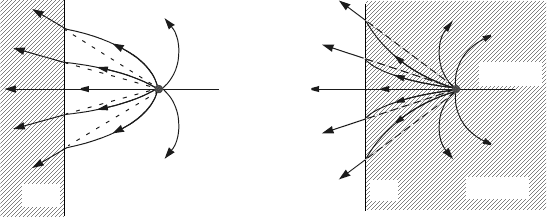
The field configuration for
is illustrated in Fig. 2.55 and for in Fig. 2.56. The curvature of the force
lines depends on the sign of . For and we have , i.e. and
attract each other, which results in field lines as shown in Fig. 2.55. For
and , however, we have , i.e., and repel each other, which
results in field lines as shown in Fig. 2.56.
2.12 A Dielectric Sphere in a Uniform Electric Field
2.12.1 The Field of a Uniformly Polarized Sphere
In order to solve the problem of a dielectric sphere, it is useful to consider the
electric field of a uniformly polarized sphere. When is the radius of the sphere
and P its uniform polarization, then the overall dipole moment is
.
(2.123)
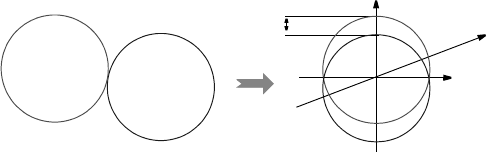
One may think of a uniformly polarized sphere as being created by two spheres,
charged with opposite charges that are slightly displaced against each other
(Fig. 2.57). When is its volume charge and d the displacement, then
.
Outside of the sphere, the field is that of a dipole at the origin, namely
.
(2.124)
This is still correct for the surface of the sphere, where
Fig. 2.56
ε
1
ε
2
>
Q> 0
ε
2
ε
1
Fig. 2.55
ε
1
ε
2
<
ε
1
Q> 0
ε
2
ε
1
ε
2
<
ε
1
ε
2
>
Q' ε
1
ε
2
< Q 0> Q'0< Q
Q' ε
1
ε
2
>
Q 0> Q'0> QQ'
r
s
p
PV
4πr
s
3
3
------------
P==
ρ±
P ρd=
ϕ
p θcos
4πε
0
r
2
-----------------
Pr
s
3
θcos
3ε
0
r
2
---------------------==
98 Basics of Electrostatics
.
(2.125)
By means of theorems about the uniqueness of solutions of potentials, which we
will deal with in Chapter 3, it is possible to show that the potential inside the sphere
has to be
.
(2.126)
There is another way to prove this without using those theorems. The components
of E at the sphere’s outer surface are
,
(2.127)
which results from (2.63). The surface charge at the sphere’s surface (bound
charges due to polarization) is
.
(2.128)
This means that decreases by when passing through the surface
from the outside towards the inside of the sphere, while the other components
remain unchanged. At the inside surface of the sphere, one therefore obtains
(2.129)
Consequently the electric field E written in terms of its Cartesian components is
Fig. 2.57
y
x
z
-ρ
+ρ
+
+
+
+
-
-
-
-
d
+
+
+
+
-
-
-
-
ϕϕ
s
Pr
s
θcos
3ε
0
--------------------
Pz
3ε
0
--------== =
ϕ
Pz
3ε
0
--------=
E
r
2p θcos
4πε
0
r
s
3
------------------
2P θcos
3ε
0
-------------------==
E
θ
p θsin
4πε
0
r
s
3
-----------------
P θsin
3ε
0
---------------==
E
ϕ
0=
σ
b
P θcos=
E
r
P θcos()ε
0
⁄
E
r
P θcos
3ε
0
----------------–=
E
θ
P θsin
3ε
0
---------------=
E
ϕ
0 .=
2.12 A Dielectric Sphere in a Uniform Electric Field 99
(2.130)
So, E has only a z-component which, furthermore, has the same value everywhere
(on the inside surface). The inside of the sphere is free of (bound) volume charges
and we therefore conclude that the whole inside space is filled with the same field.
The related potential is , as was already suggested. Also notice that in
connection with eq. (2.128), a conducting sphere within a uniform electric field
carries a surface charge proportional to (see .eq. (2.94)). Obviously, the field
of the surface charge identically cancels the external field, i.e., it creates a uniform
field inside the sphere. Outside, it creates a dipole field, as we have also seen when
analyzing the conducting sphere. We obtain the same results when we apply these
results to the current case.
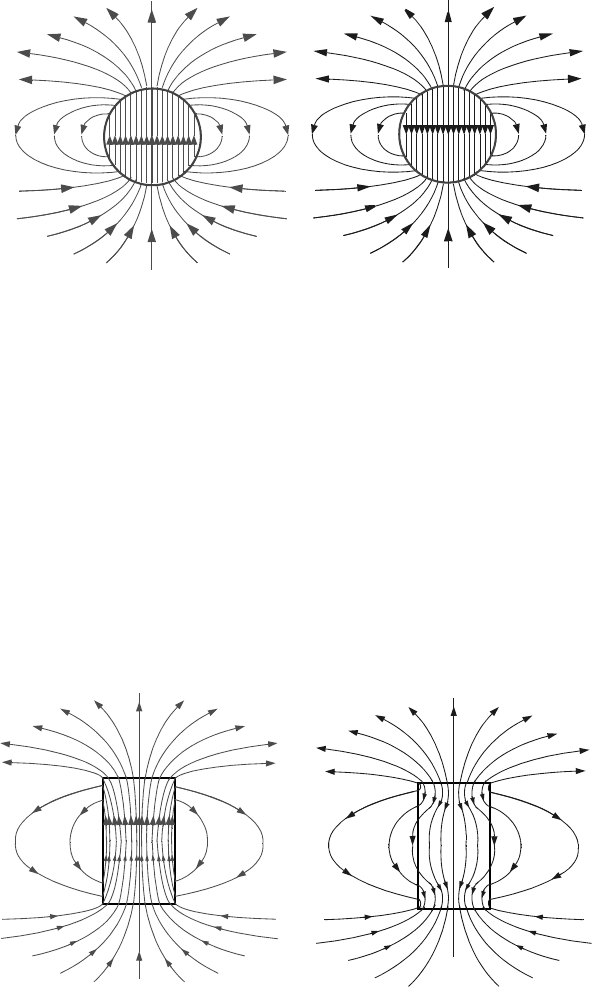
Summarizing, we may state that a uniformly polarized sphere (polariza-
tion P) creates an electric dipole field outside and a uniform electric field
inside .
This provides the field of a permanently, uniform polarized sphere (i.e., that of a
uniform electret). The field in its interior is
.
E
x
E
r
θsin ϕcos E
θ
θcos ϕcos+0==
E
y
E
r
θsin ϕsin E
θ
θcos ϕsin+0==
E
z
E
r
θcos E
θ
θsin–
P
3ε
0
--------– .==
ϕ Pz 3ε
0
⁄=
θcos
P 3ε
0
⁄()–
DPε
0
E+ P
P
3
---–
2
3
---
P===
100 Basics of Electrostatics
Here (Fig. 2.58), D and E point in different directions: they are anti-parallel, not
parallel as usual. Furthermore, a remarkable fact is that (as always in electrostatics)
E is irrotational but not source free, while D is source free but not irrotational.
Besides spherical bodies, only ellipsoids have such simple characteristics.
The general relation between P and E or D and E, respectively, is rather
complicated. In particular, D and E may point in entirely different directions.
Fig. 2.59 illustrates the fields of a uniformly polarized cuboid. On the inside of it,
the fields of D and E have very different shapes. Of course, on the outside, there is
the usual relation between E and D: .
So far in this section, we have not asked what causes polarization. It could be
due to permanent polarization as illustrated in Fig. 2.58 and Fig. 2.59. It could also
be due to an external, uniform field, which then would need to be considered as
well.
Fig. 2.58
DE
Fig. 2.59
DE
D ε
0
E=
2.12 A Dielectric Sphere in a Uniform Electric Field 101
2.12.2 An Externally Applied Uniform Field as the Cause of Polariza-
tion
When a sphere is exposed to a uniform field, an additional field is created as the
sphere is polarized. This field needs to be superimposed onto the original field. As
we have just seen for uniform polarization, the internal field is uniform as well.
Uniform polarization would thus cause an overall uniform field inside, which on
the other hand causes uniform polarization. We may therefore state that a uniform
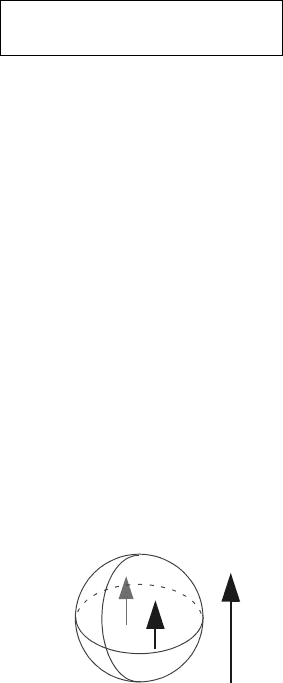
electric field uniformly polarizes a dielectric sphere. Using the relations from
Fig. 2.60, one is now able to write
.
from which one finds
.
(2.131)
Furthermore,
(2.132)
and
.
(2.133)
2.12.3 Dielectric Sphere (ε
i
) and Dielectric Space (ε
a
)
Let us generalize the previous problem some more. The space outside the sphere
shall now be a dielectric as well. Now, the field outside consists of a, so far,
unknown dipole field and the uniform field , i.e., we may write
Fig. 2.60
χ
E
a ∞,
E
i
P
E
i
E
a ∞,
P
3ε
0
--------– E
a ∞,
ε
0
χE
i
3ε
0
--------------–==
E
i
E
a ∞,
3
3 χ+
------------
E
a ∞,
3
2 ε
r
+
--------------
==
D
i
D
a ∞,
3ε
r
2 ε
r
+
--------------
=
PE
a ∞,
3ε
0
χ
2 ε
r
+
--------------
E
a ∞,
3ε
0
ε
r
1–
ε
r
2+
--------------
==
E
a ∞,
102 Basics of Electrostatics
(2.134)
C is a constant that is initially undetermined. It depends on the polarization of
both, the outside space as well as the inside of the sphere. Inside, we have the yet
undetermined uniform field , i.e.,
(2.135)
One can show that with the proper choice of C and , all boundary
conditions at the sphere’s surface ( ) can be fulfilled. Only this is the
justification for the Ansatz in (2.134) and (2.135). has to be continuous for
, i.e.,
.
Furthermore, also for , has to be continuous, i.e.,
.
Solving those equations gives
(2.136)
and
(2.137)
(2.136) generalizes (2.131) and both coincide for .
The polarization inside is
(2.138)
and uniform in z-direction. The polarization in the outside space is not uniform, but
it is nevertheless divergenceless (source free), so that there are no bound charges in
the outside space:
E
ra
2C θcos
4πε
0
r
3
------------------- E
a ∞,
θcos+=
E
θa
C θsin
4πε
0
r
3
----------------- E
a ∞,
θsin–=
E
ϕa
0 .=
E
i
E
ri
E
i
θcos=
E
θi
E
i
θsin–=
E
ϕi
0 .=
E
i
rr
s
=
E
θ
rr
s
=
C θsin
4πε
0
r
s
3
----------------- E
a ∞,
θsin– E
i
θsin–=
rr
s
= D
r
εE
r
=
ε
a
2C θcos
4πε
0
r
s
3
-------------------
ε
a
E
a ∞,
θcos+ ε
i
E
i
θcos=
E
i
3ε
a
ε
i
2ε
a
+
-------------------
E
a ∞,
=
C 4πε
0
ε
i
ε
a
–
ε
i
2ε
a
+
-------------------
E
a ∞,
r
s
3
=
ε
a
ε
0
=
P
i
ε
0
χ
i
E
i
ε
i
ε
0
–()E
i
3ε
a
ε
i
ε
0
–
ε
i
2ε
a
+
-------------------
E
a ∞,
== =
ρ
ba,
P
a
∇•– ε
a
ε
0
–()E
a
∇•–==

2.12 A Dielectric Sphere in a Uniform Electric Field 103
.
The expression used here for the divergence in spherical coordinates will be
derived later. Bound charges exist solely at the surface of the sphere, namely
.
Outside of the sphere, this charge brings about a dipole field which corresponds to
the dipole moment
.
Note eqs. (2.67) and (2.123). The constant C of the previous Ansatz is just the
dipole moment, caused by the polarization of the inside and outside space, which
justifies the Ansatz (2.134) and also illustrates the formal result of (2.137).
Together, the dipole field and, the uniform field bring about the potential in
the outside space
.
(2.139)
To compare this potential with that of a conducting sphere in a uniform electric
field as described by eq. (2.91) is an interesting exercise. It can be derived from the
just obtained potential by the limit approaching zero. In some way, a
conductor behaves like a dielectric in the limit of infinite permittivity. The law of
refraction (2.121) illustrates this fact. Lines of force have to be perpendicular to the
conductor surface. According to the law of refraction, this is also the case for a
dielectric of infinite permittivity.
in (2.136) also determines ,
.
(2.140)
ε
a
ε
0
–()
1
r
2
-----
r∂
∂
r
2
E
ra
1
r θsin
-------------
θ∂
∂
θsin E
θa
+
–=
0=
σ
b
σ
bi,
σ
ba,
+=
ε
0
χ
i
E
ri
ε
0
χ
a
E
ra
–()
rr
s
=
=
ε
i
ε
0
–()E
i
θcos ε
a
ε
0
–()
2C
4πε
0
r
s
3
----------------- E
a ∞,
+
θcos–=
3ε
0
ε
i
ε
a
–
ε
i
2ε
a
+
-------------------
E
a ∞,
θcos=
p
4π
3
------
r
s
3
3ε
0
ε
i
ε
a
–
ε
i
2ε
a
+
-------------------
E
a ∞,
=
4πε
0
ε
i
ε
a
–
ε
i
2ε
a
+
-------------------
E
a ∞,
r
s
3
=
ϕ
a
E
a ∞,
θcos
r
s
3
r
2
-----
ε
i
ε
a
–
ε
i
2ε
a
+
-------------------
r–
=
ε
a
ε
i
⁄
E
i
D
i
D
i
3ε
i
ε
i
2ε
a
+
-------------------
D
a ∞,
=