
Lehner G. Electromagnetic Field Theory for Engineers and Physicists
Подождите немного. Документ загружается.

104 Basics of Electrostatics
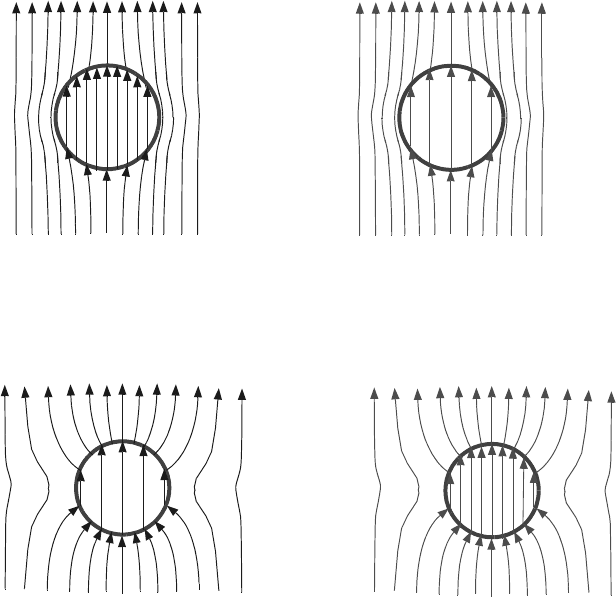
This result allows one to sketch the fields in Fig. 2.62 (for ) and Fig. 2.61
(for ). In all figures, D has no divergence. E, in contrast, because of the
bound surface charges is not free of a divergence. For the case of Fig. 2.61, i.e. for
( ), it is and . In contrast, for the case of Fig. 2.62, i.e.
for ( ), it is and .
2.12.4 Generalization: Ellipsoids
From our considerations of the plane disk discussions in Section 2.8, with uniform
polarization perpendicular to its surface, one finds that
.
(2.141)
The result for a sphere was
Fig. 2.61
ED
ε
a
3ε
i
=
ε
a
ε
i
>
Fig. 2.62
E
D
3ε
a
ε
i
=
ε
a
ε
i
<
ε
a
ε
i
> E
i
E
a ∞,
> D
i
D
a ∞,
<
ε
a
ε
i
< E
i
E
a ∞,
< D
i
D
a ∞,
>
E
i
E
a
1
ε
0
-----
P–=
2.12 A Dielectric Sphere in a Uniform Electric Field 105
.
(2.142)
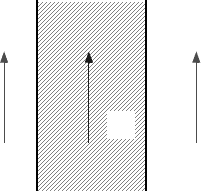
We may add the trivial case of a plane disk that is polarized parallel to its surface
(Fig. 2.63), where the boundary condition causes
.
(2.143)
The factor in front of P in all those equations is called the de-electrification factor.
In above three cases, this factor is , , and 0, respectively.
We have already stressed the fact, that an arbitrarily shaped body of uniform
polarization does by no means have a uniform field inside. This is only the case for
ellipsoids and their limits (plane plates, cylinders, spheres). The proof shall not be
provided here. The equation for an ellipsoid is
An elliptical cylinder results from the limit of
.
For this case, if also , a circular cylinder results
.
For an ellipsoid with we get a sphere
.
Two parallel plates emerge when two half-axes, for example, a and b approach
infinity:
,
i.e.,
.
E
i
E
a ∞,
1
3ε
0
--------
P–=
Fig. 2.63
E
a
E
a
E
a
E
i
E
a
0 P⋅– E
a
==
1 ε
0
⁄ 13ε
0
⁄
x
2
a
2
-----
y
2
b
2
-----
z
2
c
2
-----++ 1=
c ∞→
x
2
a
2
-----
y
2
b
2
-----+1=
ab=
x
2
y
2
+ a
2
=
abc==
x
2
y
2
z
2
++ a
2
=
z
2
c
2
=
zc±=

106 Basics of Electrostatics
We shall not calculate ellipsoids in any depth here, but merely provide the results,
which may be obtained by means of the Ansatz, originated by Dirichlet, that a
uniform polarization
(2.144)
creates a uniform internal field
.
(2.145)
Therefore, the vectors P and E point generally in different directions. (2.145) could
also be written in the following form
.
(2.146)
The three constants A, B, C are the de-electrification factors for the ellipsoid. A, B,
C are different from each other for an ellipsoid with three distinct axes and
determined by certain integrals, for example,
.
Of course, the expressions for B and C are analogous. Remarkable is that in any
case.
(2.147)
For symmetry reasons, the relation for a sphere has to be ,
confirming our previous result. For a circular cylinder whose axis is oriented
parallel to the z-axis, we have and . This result can easily
be derived by the method previously used for a sphere. It is an easy exercise to
convince oneself that the field outside the cylinder is that of a line dipole at the axis
of the cylinder. For a plane plate whose normal component is parallel to the z-axis,
the constants are and , which again, is consistent with our
previous result.
Later, in conjunction with problems of magnetism, we will meet similar
factors, which are termed de-magnetizing factors.
2.13 Polarization Current
The chapter discussing electrostatic problems is not the most appropriate place to
cover polarization currents. Nevertheless, we have introduced polarization and
want to also introduce the polarization current, which results from time dependent
polarization. We start from
.
P P
x
P
y
P
z
,,〈〉=
E AP–
x
BP–
y
CP–
z
,,〈〉=
E
A 00
0 B 0
00C
– P=
A
abc
2ε
0
---------
ξd
a
2
ξ
2
+()
32/
b
2
ξ
2
+()
12/
c
2
ξ
2
+()
12/
------------------------------------------------------------------------------------------
0
∞
∫
=
ABC++
1
ε
0
-----
=
ABC13ε
0
⁄===
C 0= AB12ε
0
⁄==
AB0== C 1 ε
0
⁄=
P∇• ρ
b
–=
2.13 Polarization Current 107
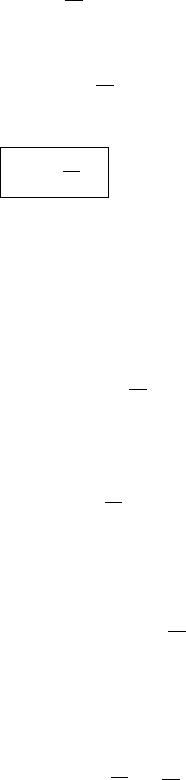
If P is time dependent, then has to be time dependent as well. The charge
conservation principle applies also to bound charges. If we call the related current
density , then according to the continuity equation (1.58), we obtain
.
(2.148)
or
,
(2.149)
i.e.,
,
(2.150)
if we also assume that any, by (2.149) still possible divergence-free, additional
term vanishes. This current density of the bound charges is called the polarization
current density.
The overall charge density is
,
and the total current density is
.
To prevent misconceptions, let us discuss how this applies, for instance, to
Maxwell’s first equation (1.61).
.
There are two possible approaches. Either we explicitly consider all charges and
treat the given space as if it were vacuum, or we only consider the free charges and
consider the space to be a dielectric. The first case gives
and
,
i.e.,
.
In the second case, the current density is
and
,
ρ
b
g
b
g
b
∇•
t∂
∂ρ
b
+0=
g
b
∇•
t∂
∂
P
∇•–0=
g
b
t∂
∂
P =
ρρ
b
ρ
f
+=
gg
b
g
f
+
t∂
∂
Pg
f
+==
H∇× g
t∂
∂D
+=
gg
f
g
b
+ g
f
t∂
∂
P+==
D ε
0
E=
H∇× g
f
t∂
∂
P
t∂
∂
ε
0
E++=
gg
f
=
D ε
0
EP+=
108 Basics of Electrostatics
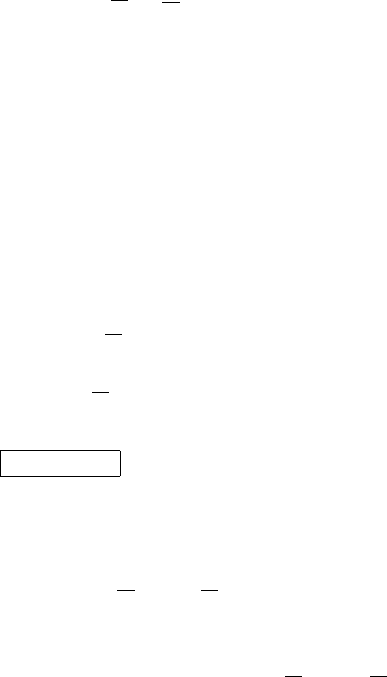
i.e.,
.
Both viewpoints lead to the same result, although care is needed in order not to
confuse those two approaches.
2.14 Energy Principle
2.14.1 Energy Principle in its General Form
The energy principle of electrostatics is just a special case of the general energy
principle of electrodynamics which we will cover here, although it is not strictly
part of electrostatics. Starting point are the following two Maxwell’s equations.
.
(2.151)
. (2.152)
We define the so-called Poynting vector.
,
(2.153)
whose significance we will recognize in the following. We take its divergence,
,
(2.154)
then using Maxwell’s equations:
.
(2.155)
The significance of this equation is illustrated by integrating over a volume V:
(2.156)
Although this equation will loose its generality, we will perform some more
algebra, using the relations:
(2.157)
So far, we have used the equation for vacuum only for which .
However, we will use its generalization, which will be discussed later. Then
H∇× g
f
t∂
∂
P
t∂
∂
ε
0
E++=
H∇× g
t∂
∂D
+=
E∇×
t∂
∂
B–=
SEH ×=
S∇• EH×()∇• HE∇×()• EH∇×()•–==
S∇• H
t∂
∂
B•– E
t∂
∂
D•– Eg•–=
S∇•()τd
V
∫
S dA•
A
∫
°
H
t∂
∂
B• E
t∂
∂
D•+
τd
V
∫
– Eg•()τd
V
∫
–==
D εE=
B µH=
g κE=
B µH= µµ
0
=

2.14 Energy Principle 109
,
(2.158)
and finally, using (2.156) gives
(2.159)
or using (2.155)
.
(2.160)
Those two, equivalent relations represent the energy principle in integral and
differential from, respectively. To interpret it, we apply the following reasoning.
Imagine some system that contains the energy W in whatever form. This
energy is distributed somehow within the space of that system, where it has the
spatial density (energy density)
The energy may be distributed differently at different times, i.e., it may flow from
one point to another point. The energy per unit time and unit area that flows
through an area element is called energy flux density. It is a vector and shall be
named v. Energy W is not necessarily a conserved quantity, since one type of
energy may be transformed into another type. Of course this same fraction of
energy has to exist in that other form of energy. The transformed energy per unit
time and unit volume shall be called u. The energy balance is then:
(2.161)
i.e., the energy that is lost from the overall volume consists of two parts. One flows
away through the surface ( ) and one is transformed into another form of
energy ( ). This equation is comparable to eq. (2.159). When written in
differential form it may be compared to (2.160). Applying Gauss’ theorem we get
and thus
.
(2.162)
Comparison allows identification of the different terms:
E
t∂
∂D
•
t∂
∂ 1
2
---
εE
2
=
H
t∂
∂B
•
t∂
∂ 1
2
---
µH
2
=
Eg•κE
2
g
2
κ
-----==
t∂
∂ 1
2
---
εE
2
1
2
---
µH
2
+
τd
V
∫
g
2
κ
-----
τd
V
∫
S dA•
A
∫
°
++ 0 =
t∂
∂ 1
2
---
εE
2
1
2
---
µH
2
+
g
2
κ
----- S∇•++ 0 =
w
dW
dτ
--------=
v dA•
A
∫
°
u τd
V
∫
+
t∂
∂
w τd
V
∫
–=
v dA•
A
∫
°
u τd
V
∫
v∇• u
dw
dτ
-------++
τd
V
∫
0=
v∇• u
dw
dτ
-------++ 0=
110 Basics of Electrostatics
1. S is the energy flux (density) of the electromagnetic field
2. is the electromagnetic energy density, which consists of
an electric ( ) and a magnetic ( ) part.
3. is the fraction of electromagnetic energy that is lost per unit time
and unit volume, and is nothing else than the heat loss of electromag-
netic energy converted to heat energy due to the current (resistance), as
we shall show.
We will now analyze a cylindrical conductor with constant conductivity . It shall
have the length l, cross section A, and shall carry the current of constant density g.
Then the transformed power in its volume is
(2.163)
because the total current is
,
and the voltage is
.
Furthermore, we have used
.
(2.164)
R is the resistance of the conductor measured in Ohm (
Ω
) (see Section 1.13). Here,
is the power transformed into heat due to the current. This confirms our
hypothesis. Ohm’s law is obtained in its usual form
.
(2.165)
This represents the integral form, of what has previously been introduced as Ohm’s
law
or
Multiplication by gives .
An important point to highlight is that eqs. (2.155) and (2.156) are much more
general than eqs. (2.159) and (2.160), which we obtained using the more restrictive
relations of eq.(2.157). The former also apply to nonlinear media as well as to
moving charges (current densities) of any kind, which are possibly not caused by a
conducting medium.
1
2
---
εE
2
1
2
---
µH
2
+
εE
2
2⁄µH
2
2⁄
g
2
κ⁄
κ
g
2
κ
-----
τd
V
∫
g
2
κ
-----
Al gA()
2
l
κA
-------
I
2
R== =
gA()
g
κ
---
lgA()El() IV== =
IgA=
VlE=
R
l
κA
-------=
I
2
RIV=
VRI=
g κE=
g κE
I
A
--- κ
V
l
---
===
l κ⁄ IR V=
2.14 Energy Principle 111
2.14.2 Electrostatic Energy
We focus now on electrostatic energy. Its spatial density has been determined in a
rather formal way to be
.
It must be possible to also obtain this expression from purely electrostatic
considerations.
By eq. (2.18), a point charge Q
1
at location is the source of the potential
If we move a second charge Q
2
from infinity to point , the thereby stored energy
is
,
(2.166)
using
.
The potential created by both charges is
.
A third charge moved from infinity to point adds to the stored energy
,
The total energy is now
.
If we add more charges the relation becomes
.
Using the following abbreviation in eq. (2.166)
w
εE
2
2
---------
DE•
2
--------------==
r
1
ϕ
Q
1
4πε
0
rr
1
–
-----------------------------=
r
2
W
12
Q
1
Q
2
4πε
0
r
2
r
1
–
--------------------------------
Q
1
Q
2
4πε
0
r
12
--------------------==
r
12
r
2
r
1
–=
ϕ
Q
1
4πε
0
rr
1
–
-----------------------------
Q
2
4πε
0
rr
2
–
-----------------------------+=
r
3
W
13
W
23
+
Q
1
Q
3
4πε
0
r
13
--------------------
Q
2
Q
3
4πε
0
r
23
--------------------+=
W
Q
1
Q
2
4πε
0
r
12
--------------------
Q
1
Q
3
4πε
0
r
13
--------------------
Q
2
Q
3
4πε
0
r
23
--------------------++=
W
Q
1
Q
2
4πε
0
r
12
--------------------
Q
1
Q
3
4πε
0
r
13
-------------------- …
Q
1
Q
n
4πε
0
r
1n
--------------------+++=
Q
2
Q
3
4πε
0
r
23
-------------------- …
Q
2
Q
n
4πε
0
r
2n
--------------------++
…… +
Q
n 1–
Q
n
4πε
0
r
n 1– n,
-----------------------------+
112 Basics of Electrostatics
,
(2.167)
the energy can be written as
.
(2.168)
The sum extends over all indices i and k, where however, i and k have to be
different. For , the magnitude would be infinite because of .
Basically, every point charge stores an infinite amount of energy in its field
(sometimes called
self-energy), which we omit. This merely represents a certain
normalization of the energy. The only contributions we need to consider are those
that stem from interaction of the different point charges. The factor is
necessary because of duplicate counting of contributions, as the sum in eq. (2.168)
contains besides also , while only one, either or may be
counted.
If instead the charge is continuously distributed over the space, the sum turns
into an integral.
,
(2.169)
or with
.
(2.170)
The potential according to eq. (2.20) is
.
This allows to rewrite (2.170):
.
(2.171)
Because of the vector identity
the energy can also be expressed as
.
W
ik
Q
i
Q
k
4πε
0
r
ik
-------------------=
W
1
2
---
W
ik
ik≠
∑
=
ik= r
ii
0=
12⁄
W
12
W
21
W
12
W
21
W
1
2
---
Q r'()dQr''()d
4πε
0
r' r''–
---------------------------------
V
∫
V
∫
=
Q r'()d ρ r'()dτ' ρ r'()dx'dy'dz'==
Q r''()d ρ r''()dτ'' ρ r''()dx''dy''dz''==
W
ρ r'()ρr''()⋅
8πε
0
r' r''–
-----------------------------
dτ'dτ''
V
∫
V
∫
=
ϕ r''()
1
4πε
0
------------
ρ r'()τ'd
r'' r'–
-------------------
V
∫
=
W
1
2
---
ρ r''()ϕr''()⋅ dτ''
V
∫
1
2
---
ϕ r() D∇•()τd
V
∫
==
Dϕ()∇• D ϕ∇•ϕD∇•+=
W
1
2
---
D ϕ∇•τd
V
∫
–
1
2
---
Dϕ()∇• τd
V
∫
+=
1
2
---
ED•τd
V
∫
1
2
---
Dϕ dA•
∫
°
+=
2.14 Energy Principle 113
If we now consider the entire space whose surface has moved to infinity where
, then
.
(2.172)
i.e., we obtain just the volume integral over the electrostatic energy density.
Of course, we may add surface charges. Then eq. (2.171) is replaced by
.
(2.173)
or, if there are only surface charges
.
For a plane capacitor (Fig. 2.64), for instance, the work becomes
.
.
Because of (2.95), one can express the energy that is stored in the field of
the capacitor in several ways.
.
(2.174)
On the other hand, the energy is of course
.
As necessary, the result is the same.
ϕ 0=
W
1
2
---
ED•τd
V
∫
=
W
1
2
---
ρ r() ϕr()⋅ dτ
V
∫
1
2
---
ϕ r()σr()dA
A
∫
°
+=
W
1
2
---
ϕ r()σr()dA
A
∫
°
=
Fig. 2.64
+σ
σ–
ϕ
1
ϕ
2
W
1
2
---
ϕ
1
σdA
A
∫
°
1
2
---
ϕ
2
σ–()dA
A
∫
°
+=
ϕ
1
ϕ
2
–
2
------------------
σA
QV
2
--------==
QCV=
W
1
2
---
QV
1
2
---
CV
2
1
2
---
Q
2
C
-------
== =
W
εE
2
2
---------
τd
V
∫
ε
2
---
V
d
---
2
Ad
1
2
---
V
2
εA
d
------
1
2
---
CV
2
== ==