
Lehner G. Electromagnetic Field Theory for Engineers and Physicists
Подождите немного. Документ загружается.

124 Formal Methods of Electrostatics
.
(3.22)
Using the unit vectors of a coordinate system,
,
,
,
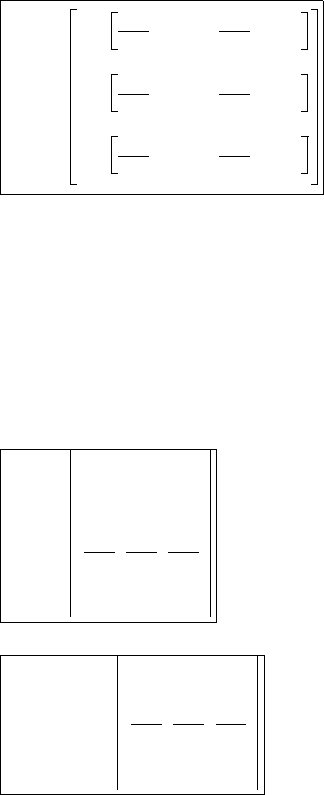
we may also write curl a in its determinant form
(3.23)
or
.
(3.24)
3.3 Some Important Coordinate Systems
Of the many interesting coordinate systems, this book will only employ three:
Cartesian, cylindrical, and spherical coordinates. We will summarize the results of
our previous discussion for these coordinate systems.
a∇×
1
t
2
t
3
--------
u
2
∂
∂
a
3
t
3
()
u
3
∂
∂
a
2
t
2
()–
1
t
3
t
1
--------
u
3
∂
∂
a
1
t
1
()
u
1
∂
∂
a
3
t
3
()–
1
t
1
t
2
--------
u
1
∂
∂
a
2
t
2
()
u
2
∂
∂
a
1
t
1
()–
=
e
u
1
e
u
2
e
u
3
,,
e
u
1
t
1
t
1
----=
e
u
2
t
2
t
2
----=
e
u
3
t
3
t
3
----=
a∇×
e
u
1
t
2
t
3
--------
e
u
2
t
3
t
1
--------
e
u
3
t
1
t
2
--------
u
1
∂
∂
u
2
∂
∂
u
3
∂
∂
a
1
t
1
a
2
t
2
a
3
t
3
=
a∇×
1
t
1
t
2
t
3
-------------
t
1
t
2
t
3
u
1
∂
∂
u
2
∂
∂
u
3
∂
∂
a
1
t
1
a
2
t
2
a
3
t
3
=
3.3 Some Important Coordinate Systems 125
3.3.1 Cartesian Coordinates
For Cartesian coordinates, the scale factors are, of course, and
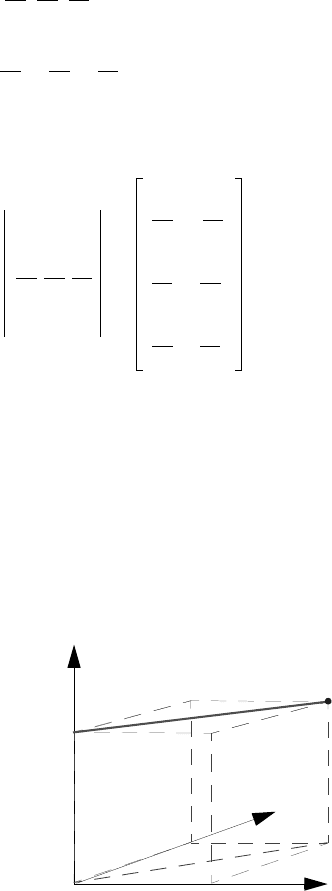
from eq. (3.19) through eq. (3.24), we obtain the familiar expressions
.
.
.
.
3.3.2 Cylindrical Coordinates
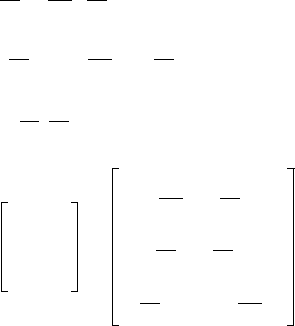
The case of cylindrical coordinates is illustrated in Fig. 3.5. The coordinates are
,
(3.25)
t
1
t
2
t
3
1===
∇ϕ
x∂
∂ϕ
y∂
∂ϕ
z∂
∂ϕ
,,〈〉=
a∇•
x∂
∂a
x
y∂
∂a
y
z∂
∂a
z
++=
∇
2
ϕ
∂
2
ϕ
∂x
2
---------
∂
2
ϕ
∂y
2
---------
∂
2
ϕ
∂z
2
---------++=
a∇×
e
x
e
y
e
z
x∂
∂
y∂
∂
z∂
∂
a
x
a
y
a
z
y∂
∂a
z
z∂
∂a
y
–
z∂
∂a
x
x∂
∂a
z
–
x∂
∂a
y
y∂
∂a
x
–
==
Fig. 3.5
z
x
y
r
u
1
r=
u
2
ϕ=
u
3
z=
126 Formal Methods of Electrostatics
or expressed in Cartesian coordinates
.
(3.26)
With this, eq. (3.10), and (3.11) it follows for the tangent vectors in Cartesian
coordinates:
,
(3.27)
i.e.,
,
(3.28)
and consequently for the volume element and the (squared) distance element
,
(3.29)
, (3.30)
and furthermore
.
(3.31)
. (3.32)
. (3.33)
(3.34)
Be careful not to confuse the angle with the potential , which was up to now
also labeled with . We will identify the potential with some other symbol
wherever confusion with the angle is anticipated.
xrϕcos=
yrϕsin=
zz=
t
1
ϕcos ϕsin 0,,〈〉=
t
2
r ϕsin– r ϕcos 0,,〈〉=
t
3
001,,〈〉=
t
2
1
1=
t
2
2
r
2
=
t
3
2
1=
dτ rdrdϕdz=
ds
2
dr
2
r
2
dϕ
2
dz
2
++=
∇φ
r∂
∂
1
r
---
ϕ∂
∂
z∂
∂
,,〈〉φ=
a∇•
1
r
---
r∂
∂
ra
r
1
r
---
ϕ∂
∂
a
ϕ
z∂
∂
a
z
++=
∇
2
φ
1
r
---
r∂
∂
r
r∂
∂ 1
r
2
-----
∂
2
∂ϕ
2
---------
∂
2
∂z
2
--------++
φ=
a∇×
a∇×()
r
a∇×()
ϕ
a∇×()
z
1
r
---
ϕ∂
∂
a
z
z∂
∂
a
ϕ
–
z∂
∂
a
r
r∂
∂
a
z
–
1
r
---
r∂
∂
ra
ϕ
()
1
r
---
ϕ∂
∂
a
r
–
==
ϕφ
ϕ
3.3 Some Important Coordinate Systems 127
3.3.3 Spherical Coordinates
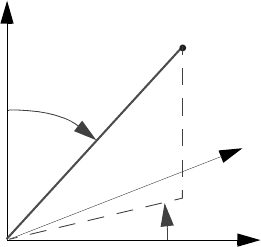
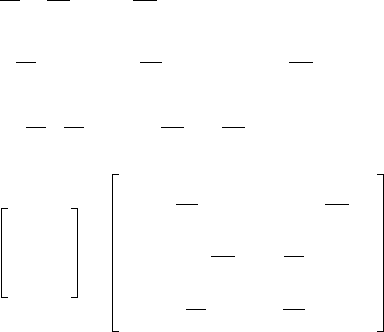
Fig. 3.6 illustrates the spherical coordinate system.
The spherical coordinates are,
,
(3.35)
or expressed in terms of the Cartesian coordinates
.
(3.36)
For the tangent vectors
,
(3.37)
and
,
(3.38)
and consequently for the volume element and (squared) distance element
,
(3.39)
, (3.40)
Fig. 3.6
z
x
y
r
ϕ
θ
u
1
r=
u
2
θ=
u
3
ϕ=
xrθsin ϕcos=
yrθsin ϕsin=
zrθcos=
t
1
θsin ϕcos θsin ϕsin θcos,,〈〉=
t
2
r θcos ϕcos r θcos ϕsin r θsin–,,〈〉=
t
3
r θsin ϕsin– r θsin ϕcos–0,,〈〉=
t
2
1
1=
t
2
2
r
2
=
t
3
2
r
2
θsin
2
=
dτ r
2
θsin drdθdϕ=
ds
2
dr
2
r
2
dθ
2
r
2
θsin
2
dϕ
2
++=
128 Formal Methods of Electrostatics
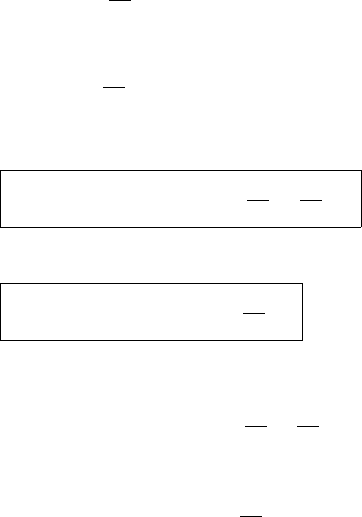
and
,
(3.41)
, (3.42)
, (3.43)
(3.44)
3.4 Some Properties of Poisson’s and Laplace’s Equations
(Potential Theory)
Poisson’s and Laplace’s equation (2.11) and (2.12), respectively are the basis for
the formal treatment of electrostatics.
3.4.1 Problem Description
A large class of electrostatic problems are described in the following way:
Consider an arbitrarily shaped region, with an arbitrary distribution of volume
charges inside. Given is the potential on its boundary or the perpendicular
component of the electric field on the boundary, i.e., . This
represents Neumann’s boundary value problem when is prescribed. On the
other hand, when is prescribed, it is called Dirichlet’s boundary value problem.
Of course, it is possible to prescribe on part of the boundary and on the
other part, in which case one is dealing with a mixed boundary value problem.
The region in question may be bounded by any number of arbitrarily shaped
surface areas.
One can uniquely solve these kind of boundary value problems using the
methods of potential theory . Its proof involves Green’s integral theorems.
3.4.2 Green’s Theorems
The starting point is Gauss’ integral theorem
∇φ
r∂
∂
1
r
---
θ∂
∂
1
r θsin
-------------
ϕ∂
∂
,,〈〉φ=
a∇•
1
r
2
-----
r∂
∂
r
2
a
r
1
r θsin
-------------
θ∂
∂
θsin a
θ
1
r θsin
-------------
ϕ∂
∂
a
ϕ
++=
∇
2
φ
1
r
2
-----
r∂
∂
r
2
r∂
∂ 1
r
2
θsin
----------------
θ∂
∂
θ
θ∂
∂
sin
1
r
2
θsin
2
------------------
∂
2
∂ϕ
2
---------
++
φ=
a∇×
a∇×()
r
a∇×()
θ
a∇×()
ϕ
1
r θsin
-------------
θ∂
∂
θsin a
ϕ
1
r θsin
-------------
ϕ∂
∂
a
θ
–
1
r θsin
-------------
ϕ∂
∂
a
r
1
r
---
r∂
∂
ra
ϕ
–
1
r
---
r∂
∂
ra
θ
()
1
r
---
θ∂
∂
a
r
–
==
ρ r() ϕ
∇ϕ()
n
∂ϕ ∂n⁄=
∂ϕ ∂n⁄
ϕ
ϕ∂ϕ∂n⁄
3.4 Some Properties of Poisson’s and Laplace’s Equations 129
.
Define a vector a as
,
where and are arbitrary scalar functions. When substituting, one obtains
(3.45)
This is Green’s first identity. It is permissible to exchange and , as they
are arbitrary anyway. This gives
(3.46)
Now we use:
and ,
as well as
and similarly
.
Using these relations and subtracting (3.46) from (3.45) yields Green’s second
identity, also known as Green’s theorem.
(3.47)
On the other hand, if we let in one of the two equations (3.46) or (3.45),
then we obtain one of Green’s integral theorems:
.
(3.48)
If the functions and depend on two variables only, then (3.47) and (3.48)
reduce even more:
and
.
a∇• τd
V
∫
a dA•
A
∫
°
=
a ψ∇φ=
ψφ
a∇• τd
V
∫
ψ∇φ()∇• τd
V
∫
ψ∇φ∇•()∇ψ()∇φ()•+[]τd
V
∫
==
ψ∇φ dA•
A
∫
°
=
ψφ
φ∇ψ()∇• τd
V
∫
φ∇ψ∇•()∇φ()∇ψ()•+[]τd
V
∫
=
φ∇ψ dA•
A
∫
°
=
∇φ()∇• ∇
2
φ= ∇ψ()∇• ∇
2
ψ=
∇ψ dA•∇ψndA•∇ψ()
n
dA==
n∂
∂ψ
dA ,=
∇φ dA•
n∂
∂φ
dA=
ψ∇
2
φφ∇
2
ψ–()τd
V
∫
ψ
n∂
∂φ
φ
n∂
∂ψ
–
dA
∫
°
=
φψ=
φ∇
2
φ∇φ()
2
+()τd
V
∫
φ
n∂
∂φ
dA
∫
°
=
φψ
ψ∇
2
φφ∇
2
ψ–()Ad
A
∫
ψ
n∂
∂φ
φ
n∂
∂ψ
–
ds
∫
°
=
φ∇
2
φ∇φ()
2
+()Ad
A
∫
φ
n∂
∂φ
ds
∫
°
=

130 Formal Methods of Electrostatics
For the one dimensional case this gives
,
and
.
These are simple integrations by parts. Green’s integral theorems are thus simply
generalizations of integrations by parts to two or three dimensions, respectively.
3.4.3 Proof of Uniqueness
Suppose (for our Neumann, Dirichlet, or mixed problem) there are two solutions
and . This means that
,
and the boundary conditions shall also be satisfied.
We define a new function as the difference
then
,
which means that it has to satisfy Laplace’s equation. Furthermore, the potential
along the boundary is
or
or – in case of mixed problems – one of the equations along part of the boundary
and the other equation along the remainder of the boundary. We apply Green’s
theorem in its form (3.48) to and obtain
.
Since is always positive, this can only be true if the integrand is identically
zero
or
ψφ'' φψ''–()xd
x
1
x
2
∫
ψφ' φψ'–[]
x
1
x
2
=
φφ'' φ'
2
+()xd
x
1
x
2
∫
φφ'[]
x
1
x
2
=
ϕ
1
ϕ
2
∇
2
ϕ
1
ρ r()
ε
0
----------–=
∇
2
ϕ
2
ρ r()
ε
0
----------–=
ϕ
˜
ϕ
1
ϕ
2
–=
∇
2
ϕ
˜
∇
2
ϕ
1
∇
2
ϕ
2
–0==
ϕ
˜
0=
n∂
∂
ϕ
˜
0=
ϕ
˜
∇ϕ
˜
()
2
τd
V
∫
0=
∇ϕ
˜
()
2
∇ϕ
˜
0=
131
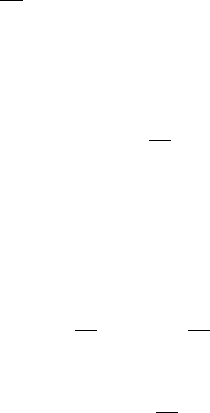
.
The case of a Dirichlet, or even the mixed boundary value problem requires
that everywhere. For Neumann’s problem, is determined, except for a
physically insignificant constant.
The problem may also be posed in a different way. Given is the charge of a
conductor in an electric field. Then
(The negative sign in is due to the fact that the normal component
points outwardly, relative to the region that contains the field, which means it
points into the conductor). Therefore
.
Thus, it is not that is prescribed along the boundary but the integral
. Furthermore, is constant on the surface, although its value is yet
unknown. If we now have two solutions and , then, as before, Laplace’s
equation applies to both, and to their difference. Integrating both solutions over the
boundary gives
.
Therefore
.
,
as before. Again we find
and
.
These uniqueness proofs have a common theme, and are formally based on eq.
(3.48), which concludes that if the boundary conditions require on the
surface, together with , that then has to vanish everywhere. There is a
plausible way to understand this. One can prove that in an area where ,
may neither have a maximum nor a minimum. If there were a maximum (or a
minimum) of at any point inside the region, then in a neighborhood of this point,
all lines of had to point towards (or away from) it. Any surface in the vicinity
ϕ
˜
const=
ϕ
˜
0=
ϕ
˜
n∂
∂ϕ
E
n
–
σ
ε
0
-----==
E
n
σε
0
⁄–=
Q σ Ad
∫
ε
0
n∂
∂ϕ
Ad
∫
==
∂ϕ dn⁄
∂ϕ dn⁄()Ad
∫
ϕ
ϕ
1
ϕ
2
Q ε
0
n∂
∂ϕ
1
Ad
∫
ε
0
n∂
∂ϕ
2
Ad
∫
==
∇ϕ
˜
()
2
τd
V
∫
ϕ
˜
n∂
∂
ϕ
˜
Ad
A
∫
=
ϕ
1
ϕ
2
–()
∂ϕ
1
ϕ
2
–()
∂n
-------------------------
Ad
∫
ϕ
1
ϕ
2
–()
∂ϕ
1
ϕ
2
–()
∂n
--------------------------
Ad
∫
==
ϕ
1
ϕ
2
–()
QQ–
ε
0
--------------
0==
∇ϕ
˜
0=
ϕ
˜
const=
∇
2
ϕ 0=
ϕ 0= ϕ
∇
2
ϕ 0=
ϕ
ϕ
∇ϕ
3.4 Some Properties of Poisson’s and Laplace’s Equations

132 Formal Methods of Electrostatics
of the maximum (or minimum) would be penetrated by a non-vanishing electrical
flux. This is only possible if there are volume charges present, which would require
. Therefore, the assumption of a maximum or minimum inside of this area
would lead to a contradiction. Then, if on the boundary, it can not be larger
inside, but it can also not be smaller than zero inside and consequently
everywhere in the region. In other words: If in a region , then the
function may have its maximum or minimum values only on the boundary of that
region. Uniqueness of the solution of Dirichlet’s boundary value problem is an
immediate consequence of this statement.
3.4.4 Models
The equation has a frequent occurrence in physical science and it
describes a vast number of problems. This enables one to frequently map physical
problems onto a corresponding electrostatic problem. For example, the two-
dimensional Laplace’s equation
also describes the displacement of a membrane suspended on a frame which is
considered to be small. The boundary (frame) defines and inside .
Such a membrane can be considered a model for electrostatic problems.
3.4.5 Dirac’s Delta Function (δ-Function)
The -function is particularly useful in the following, which is why we will
introduce it here. It shall be noted that our exposition here does not substitute a
rigorous mathematical introduction.
A rough, illustrative way to describe the character of the -function is to note
that it vanishes everywhere except for one particular point of its argument (namely
0), where it takes an infinite value, exactly such that its integral equals 1.
(3.49)
(3.50)
The -function is not a function in the usual sense. It belongs to a more general
category of functions, which sometimes are called improper functions, generalized
functions, or distributions. Another possibility is to imagine the -function as the
limit of a series of functions. It can be constructed in various ways, for example,
1. The limit of a series of rectangular functions as illustrated in Fig. 3.7.
Thus
∇
2
ϕ 0≠
ϕ 0=
ϕ 0=
∇
2
ϕ 0=
ϕ
∇
2
ϕ 0=
x
2
2
∂
∂
y
2
2
∂
∂
+
ϕ 0=
ϕ∇
2
ϕ 0=
δ
δ
δ xx'–()
0 forxx'≠
∞ for xx'=
=
δ xx'–()xd
∞–
+∞
∫
1=
δ
δ
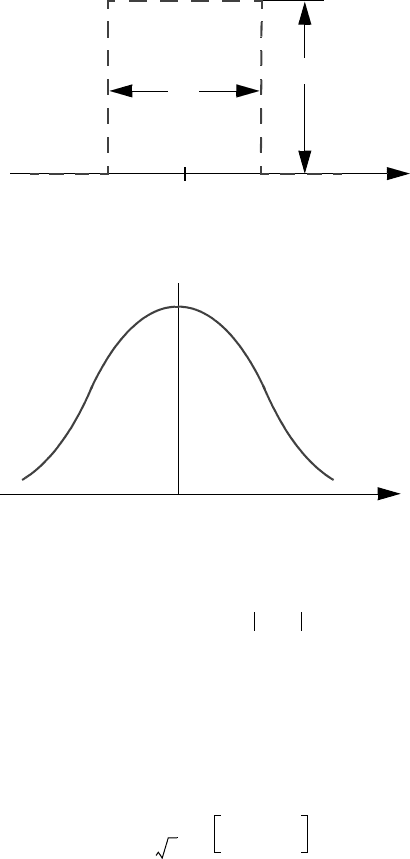
133
and
2. The limit of a series of Gaussian functions as illustrated in Fig. 3.8. Now
where
and
Fig. 3.7
x
x=x’
1/h
h
g
h
x()
g
h
x()
h for xx'–
1
2h
------
≤
0else
=
δ xx'–() g
h
x()
h ∞→
lim=
Fig. 3.8
x
x=x’
f
a
x()
f
a
x()
1
a π
----------
xx'–()
2
a
2
-------------------–exp=
f
a
x()xd
∞–
+∞
∫
1=
3.4 Some Properties of Poisson’s and Laplace’s Equations