
Lehner G. Electromagnetic Field Theory for Engineers and Physicists
Подождите немного. Документ загружается.


134 Formal Methods of Electrostatics
.
The -function is an idealization and useful mathematical tool. Nature does
not have -functions. It helps provide use with a formal analogue to the point
charge, which is also an idealization. A point charge may formally be described by
a charge density , which vanishes everywhere but at one particular location,
where it becomes infinitely large. We will generalize the one-dimensional
-function for this purpose.
.
(3.51)
This allows to describe a point charge Q at the location r’ by
.
Integrating over the entire space gives
as we had expected.
An important property of the -function that follows from above discussion
is:
(3.52)
Thus, the -function has the defining property of filtering a particular value from a
smooth function when integrated.
One may write as well
Similarly for a function , defined in the entire space
,
(3.53)
which results from multiple applications of (3.52).
The -function is symmetric
,
(3.54)
It is possible to differentiate it as well as integrate it. Its indefinite integral is
Heaviside’s step function.
(3.55)
Indeed,
δ xx'–() f
a
x()
a 0→
lim=
δ
δ
ρ
δ
δ rr'–()δxx'–()δyy'–()δzz'–()=
ρ r() Qδ rr'–()=
ρ r()τd
V
∫
Qδ xx'–()δyy'–()δzz'–()xdydzd
∫
=
Q δ xx'–()xd δ yy'–()
∫
yd δ zz'–()
∫
zd
∫
=
Q 111⋅⋅⋅ Q ,==
δ
fx()δxx'–()xd
∞–
+∞
∫
fx'()=
δ
fx()δxx'–()xd
∞–
+
∞
∫
fx'()δxx'–()xd
∞–
+
∞
∫
=
fx'() δxx'–()xd
∞–
+∞
∫
fx'()1 .⋅==
f r()
f r()δrr'–()xd
entire
space
∫
f r'()=
δ
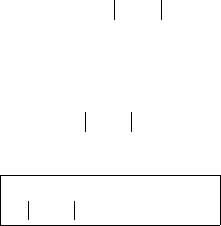
δ xx'–()δxx'–[]–()δx' x–()==
Hx x'–()
0forxx'<
1forxx'>
=
135
,
or
.
conversely
,
i.e., differentiating the step function (which is not possible with ordinary functions)
results in the -function.
To avoid confusion about the dimensions, we note that by eq. (3.50), the
-function carries a dimension, namely the inverse of its argument, i.e., . When
the argument of the δ-function is a vector, then based on the definition of (3.51) its
dimensions are for example, for the three-dimensional case.
3.4.6 Point Charge and δ-Function
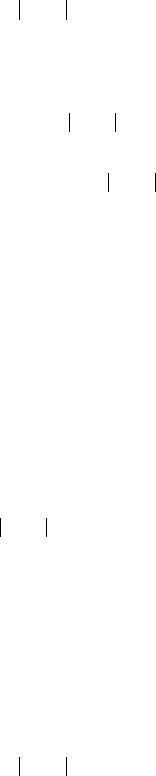
Poisson’s equation applies to the case of a point charge.
,
where
,
i.e.,
,
We know its solution already
,
i.e., we may now write for all locations, including the location of the point charge,
(which was previously impossible)
,
or
.
(3.56)
In Section 2.3, we had to exclude the locations of the point charges, because we
were unable to differentiate there. With the use of the -function, those difficulties
or restrictions are now removed.
δ x'' x'–()x''d
∞–
x
∫
0 for xx'<
1 for xx'>
=
δ x'' x'–()x''d
∞–
x
∫
Hx x'–()=
dH x x'–()
dx
------------------------- δ xx'–()=
δ
δ x
1–
x
3–
∇
2
ϕ
ρ
ε
0
-----–=
ρ r() Qδ rr'–()=
∇
2
ϕ
Qδ rr'–()
ε
0
-------------------------–=
ϕ
Q
4πε
0
------------
1
rr'–
---------------
⋅–=
∇
2
Q
4πε
0
------------
1
rr'–
---------------
⋅
Q
ε
0
-----
δ rr'–()⋅–=
∇
2
1
rr'–
---------------
4πδ rr'–()–=
δ
3.4 Some Properties of Poisson’s and Laplace’s Equations
136 Formal Methods of Electrostatics
The potential for an arbitrary charge distribution we previously found
by superposition to be
.
It is worthwhile to also formally prove this result. Applying the Laplace operator to
this equation gives
this shows that the expression for fulfills Poisson’s equation, proving its validity.
For completeness, we note that there exists a more general (nevertheless, not
the most general) solution for
,
which is given by
.
Only the boundary condition at infinity makes the solution unique and
forces the constant to vanish.
3.4.7 Potential in a Bounded Region
When considering the entire space with all its charges, then is given by the usual
integral
.
In contrast, if we just consider a finite space and only those charges inside this
region, then Green’s theorem (3.47) allows certain statements about this situation.
For this purpose we use (3.47) and substitute
where
and
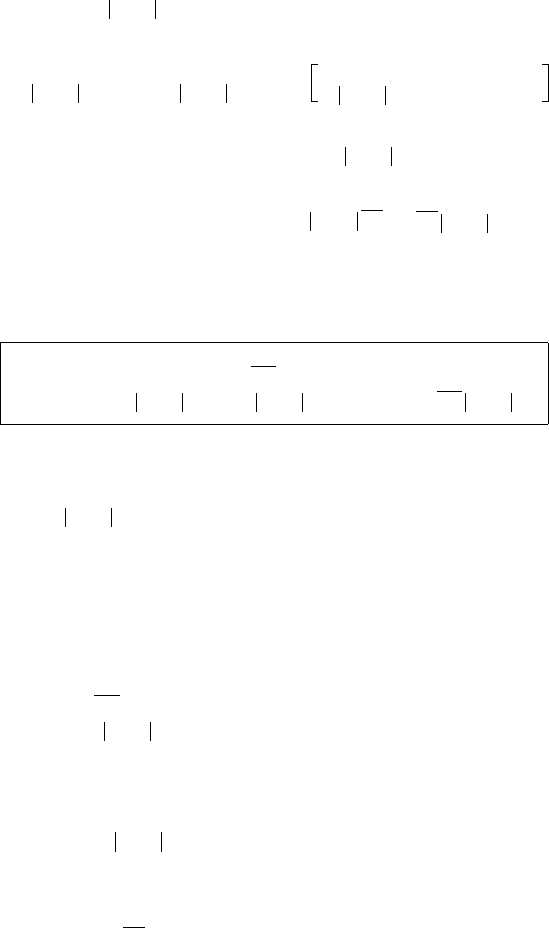
ρ r()
ϕ r()
1
4πε
0
------------
ρ r'()
rr'–
---------------
τ'd
∫
⋅=
∇
2
ϕ r()
1
4πε
0
------------
∇
r
2
ρ r'()
rr'–
---------------
τ'd
∫
⋅=
1
4πε
0
------------
ρ r'()∇
r
2
1
rr'–
---------------
τ'd
∫
⋅=
1
4πε
0
------------
ρ r'() 4π–()δrr'–()τ'd
∫
⋅=
ρ r()
ε
0
-----------– ,=
ϕ
∇
2
ϕ
Qδ rr'–()
ε
0
-------------------------–=
ϕ
Q
4πε
0
------------
1
rr'–
---------------
⋅– const+=
ϕ 0=
ϕ
ϕ r()
1
4πε
0
------------
ρ r'()
rr'–
---------------
τ'd
∫
⋅=
φϕ= ∇
2
ϕ
ρ r()
ε
0
-----------–=
137
This gives
This result assumes that the point r’ is inside the respective volume. If that point is
at its surface, then the factor needs to be replaced (in case of a “smooth
surface” as in Section 8.2.1) by the factor , and if that point is outside the
volume, then the factor becomes 0. Exchanging r and r’ gives
(3.57)
This result is peculiar and is sometimes called Kirchhoff theorem or Green’s
formula. It states that , besides its usual term
,
which results from charges inside a volume, gets additional contributions from the
boundary. Evidently, these represent charges that may possibly be located outside
the volume. These formally derived contributions also have a plausible
explanation.
1. The term
can be regarded as the potential of a distribution of surface charges (see
(2.26)).
with
.
2. The term
ψ
1
rr'–
---------------=
1
rr'–
---------------
∇
2
ϕϕ∇
2
1
rr'–
---------------
–
τd
V
∫
ρ r()–
ε
0
rr'–
-------------------- ϕ r()4πδ rr'–()+ τd
V
∫
=
ρ r()
ε
0
rr'–
--------------------
τd
V
∫
–4πϕ r'()+=
1
rr'–
---------------
n∂
∂ϕ
ϕ
n∂
∂ 1
rr'–
---------------–
dA
∫
°
=
4π
2π
ϕ r()
1
4πε
0
------------
ρ r'()τ'd
rr'–
-------------------
V
∫
1
4π
------
n'∂
∂
ϕ r'()
rr'–
-------------------
∫
°
dA'
1
4π
------
ϕ r'()
n'∂
∂ 1
rr'–
---------------dA'
∫
°
–+=
ϕ
1
4πε
0
------------
ρ r'()τ'd
rr'–
-------------------
V
∫
1
4π
------
n'∂
∂
ϕ r'()
rr'–
-------------------
∫
°
dA'
1
4πε
0
------------
σ r'()
rr'–
---------------
A'd
∫
σε
0
n∂
∂ϕ
=
3.4 Some Properties of Poisson’s and Laplace’s Equations
138 Formal Methods of Electrostatics
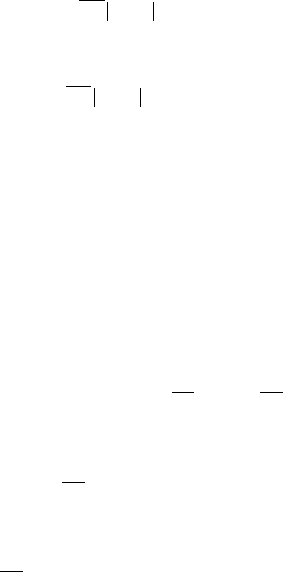
can be regarded as the potential of a dipole layer (see (2.69)),
with
.
Thus, by choosing the proper combination of dipole layer and surface charges, one
can simulate the effects that all possible charges outside the volume have on the
inside. This result then does not describe the field outside the region of
consideration. On the contrary, the dipole layer causes the boundary to have a
potential , while the surface charge causes the boundary to exhibit
. When we label the quantities at the inside with the index i and
those at the outside with the index a, then
,
and because of
follows the claim that
.
Furthermore, it is
.
Because of
follows our claim that
.
The surface charge and the dipole layer cause discontinuities of and
, respectively, which is of paramount importance in field theory. This point will
be discussed in more detail (Section 8.2.1 and 8.2.2).
The quantities mentioned are closely related to the method of image charges
which we have already discussed (Section 2.6.1). Our previous discussion used the
reverse arguments, where the effects of surface charges were replaced by
appropriate image charges.
In closing, we add a note of caution with regards to a potential
misinterpretation of eq. (3.57). It does by no means allow, when inside the
1
4π
------
ϕ r'()
n'∂
∂ 1
rr'–
---------------dA'
∫
°
–
1
4πε
0
------------
τ
n'∂
∂ 1
rr'–
---------------
dA'
∫
°
–
τε
0
ϕ=
ϕ
a
0=
∂ϕ ∂n⁄()
o
0=
D
a
D
i
– σε
0
n∂
∂ϕ
a
– ε
0
n∂
∂ϕ
i
+==
σε
0
n∂
∂ϕ
i
=
n∂
∂ϕ
a
0=
ϕ
a
ϕ
i
–
τ
ε
0
-----=
τε
0
ϕ
i
–=
ϕ
a
0=
∂ϕ ∂n⁄
ϕ
ρ r()
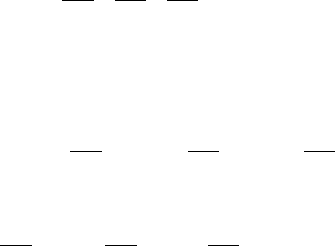
3.5 Separation of Laplace’s Equation in Cartesian Coordinates 139
region was already given, to arbitrarily choose and on the surface, and
from there calculate inside by (3.57). If we were to independently prescribe
and on the surface, then the problem would be overdetermined. To specify
one of the two quantities, already makes the problem unique This means that
eq. (3.57) merely expresses that is of this general form if the values for and
are compatible. Nevertheless, it is possible to use this relation as starting
point for a solution, if by means of suitable Green functions, either one or the other
of these two terms is eliminated. We will omit the details of this discussion, but
will return to apply Green functions for concrete situations. Eq. (3.57) represents
an important basis for analytical and numerical methods to solve boundary value
problems, in particular the boundary element method (Sections 8.2 and 8.8).
Eq. (3.57) is also related to the Helmholtz theorem. We will come back to this
in Appendix A.5, where the significance of these two surface integrals will become
even more apparent.
3.5 Separation of Laplace’s Equation in Cartesian
Coordinates
3.5.1 Separation of Variables
In the following few sections, we will solve Laplace’s equation by separation of
variables for a number of different coordinate systems. We demonstrate the
methodology by applying it to the simplest example, that is, to the Cartesian
coordinate system. The equation to solve is
.
(3.58)
Writing as
(3.59)
and inserting this in (3.58), gives
.
Divide this equation by to obtain
(3.60)
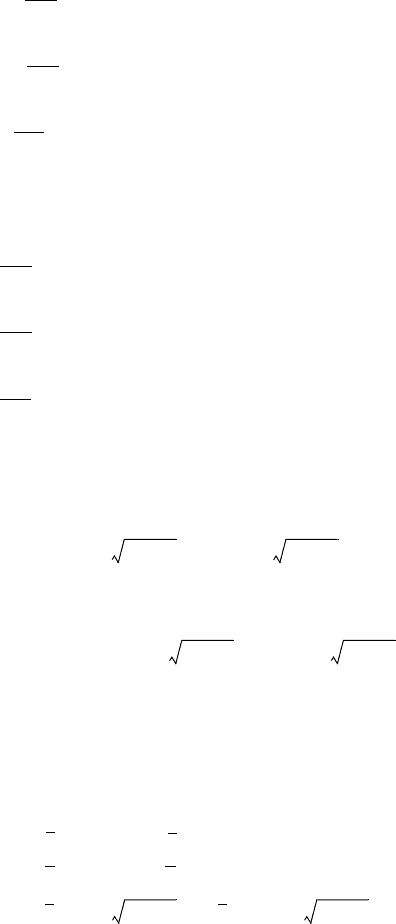
It is important to observe that the first term depends only on x, the second only on
y, and the third only on z. The sum vanishes. This is possible only, if each of the
three terms is constant. This enables one to write:
ϕ∂ϕ∂n⁄
ϕϕ
∂ϕ ∂n⁄
ϕϕ
∂ϕ ∂n⁄
∇
2
ϕ
x
2
2
∂
∂
y
2
2
∂
∂
z
2
2
∂
∂
++
ϕ 0==
ϕ
ϕ Xx()Yy()Zz()=
YZ
x
2
2
∂
∂
Xx() XZ
y
2
2
∂
∂
Yy() XY
z
2
2
∂
∂
Zz()++ 0=
ϕ XYZ=
1
X
---
x
2
2
∂
∂
Xx()
1
Y
---
y
2
2
∂
∂
Yy()
1
Z
---
z
2
2
∂
∂
Zz()++ 0=
140 Formal Methods of Electrostatics
(3.61)
This introduces two arbitrary constants, the so-called constants of separation.
Slightly rewriting this yields
(3.62)
These are ordinary differential equations. Their general solutions are:
(3.63)
This gives
(3.64)
The separation constants k and l may be chosen at will. The resulting solution for
is thus only a very specific one. The general solution is, however, obtained by
the superposition of all possible solutions (i.e., using all possible values of k and l).
We can choose other functions, i.e., instead of cos and sin, we could have chosen
exp(ikx) and exp(-ikx), or exp(kx) and exp(-kx), respectively, which resulted in
writing X, Y, Z in a form different from above:
.
(3.65)
This does not actually introduce anything new, because of
1
X
---
x
2
2
∂
∂
Xx() k
2
–=
1
Y
---
y
2
2
∂
∂
Yy() l
2
–=
1
Z
---
z
2
2
∂
∂
Zz() k
2
l
2
+=
x
2
2
∂
∂
Xx() k
2
Xx()–=
y
2
2
∂
∂
Yy() l
2
Yy()–=
z
2
2
∂
∂
Zz() k
2
l
2
+()Zz()=
XA kxcos⋅ Bksin x⋅+=
YC lycos⋅ Dlsin y⋅+=
ZE k
2
l
2
+ zcosh⋅ Fk
2
l
2
+sinh z⋅+=
ϕ Akxcos⋅ Bksin x⋅+()Clycos⋅ Dlsin y⋅+()
Ek
2
l
2
+ zcosh⋅ Fk
2
l
2
+sinh z⋅+()
=
ϕ
XA ikx()exp⋅ Bikx–()exp⋅+=
Y C ily()exp⋅ D ily–()exp⋅+=
ZE k
2
l
2
+ z()exp⋅ Fk
2
l
2
+–()z()exp⋅+=
3.5 Separation of Laplace’s Equation in Cartesian Coordinates 141
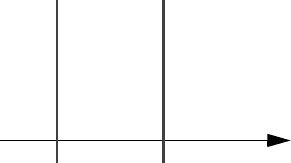
.
(3.66)
Whether one finds by superposing functions of type (3.63) or (3.65) is of lesser
importance. For a specific case, however, there may be reasons to select one over
the other. Depending on the type of problem, one needs to use functions with all
values of k and l, or just specific values of k and l. This will be clarified when some
specific examples are considered.
In very simple cases, one would find a quicker solution and not use the
method of separation of variables. Let us consider the problem of finding the
potential between two, infinite, parallel plates whose potentials are given constants
(Fig. 3.9).
One may proceed as follows: First, observe that can only depend on x. Therefore
with the general solution
The integration constants A and B are determined by
i.e.,
and
or
ikx±()exp kxcos iksin x±=
kx±()exp kzcosh ksinh z±=
ϕ
Fig. 3.9
x
ϕ
1
ϕ
2
x=0 x=d
ϕ
∇
2
ϕ
∂
2
ϕ
∂x
2
--------- 0==
ϕ ABx+=
ϕ
1
AB0⋅+=
ϕ
2
ABd⋅+=
A ϕ
1
=
B
ϕ
2
ϕ
1
–
d
------------------=
ϕϕ
1
ϕ
2
ϕ
1
–
d
------------------
x+=
142 Formal Methods of Electrostatics
which already solves this simple problem. Of course the formal route using
separation is open as well, i.e., using the Ansatz
.
The reason why k has to approach zero is, that because of the independence of y
and z, both l, as well as k
2
+l
2
, have to vanish. This results in
,
when substituting and . Note that even for , B may be
finite, as may assume any, even infinitely large values.
We will apply this method of separation of variables to other coordinate
systems as well. It shall be noted, however, that the method of separation of
variables is not generally applicable, but rather is a specific property of certain
orthogonal coordinate systems which allow for the separation of certain equations.
Besides Cartesian, cylindrical, and spherical coordinates, there are 8 more, for a
total of 11 coordinate systems which permit separation of the three-dimensional
Laplace equation and the Helmholtz equation, yet to be introduced. Besides these,
there are arbitrarily many coordinates systems that permit separation of the two-
dimensional or plane Laplace equation. Finally, there is the possibility to expand
the meaning of the term separability (now R separability, to distinguish it from
simple separability), which then allows for the separation of Laplace’s equation in
a few more coordinate systems. A very useful summary of all these problems is
provided by [2].
3.5.2 Examples
3.5.2.1 Dirichlet Boundary Value Problem without Charges Inside
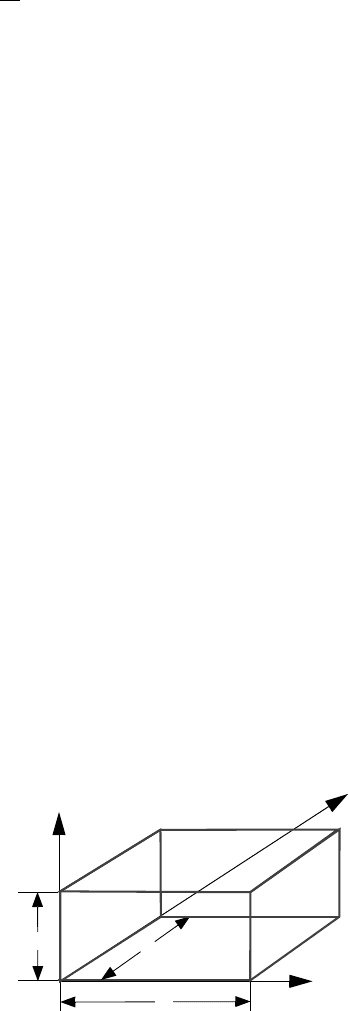
The problem is to find the electric potential inside a cuboid whose sides are of
lengths a, b, c (in x, y, z direction, as shown in Fig. 3.10). The boundary conditions
are
E
x
x∂
∂ϕ
–
ϕ
2
ϕ
1
–
d
------------------–==
ϕ A
˜
kxcos⋅ B
˜
ksin x⋅+= k 0→
ϕ A
˜
B
˜
kx+ ABx+==
AA
˜
= BB
˜
k= k 0→
B
˜
Fig. 3.10
z
x
y
a
c
b
3.5 Separation of Laplace’s Equation in Cartesian Coordinates 143
on all faces except on one (for example, the top one where
),
on this one face for .
There shall be no charges inside the volume. For the solution, according to
eq. (3.63), we make the Ansatz for the x-dependency
Since for , it must be and , which leads to
(3.67)
Since also for
.
Consequently
(3.68)
and
,
where n is a whole number. This means that the boundary conditions force k to take
on very specific values:
.
(3.69)
Those values are often called eigenvalues of the problem. Putting everything
together, gives
(3.70)
In similar manner, we find
.
(3.71)
To find the z-dependency, we start with the Ansatz
for so that and therefore
.
(3.72)
ϕ 0=
zc=
ϕϕ
c
xy,()= zc=
XA
k
kxcos B
k
ksin x+= for k 0≠
XA
0
B
0
x+= for k 0=
ϕ 0= x 0= A
k
0= A
0
0=
XB
k
ksin x= for k 0≠
XB
0
x= for k 0=
ϕ 0= xa=
B
k
ksin x 0=
B
0
x 0=
B
0
0=
ka nπ,= k
nπ
a
------=
kk
n
nπ
a
------==
XB
n
nπx
a
---------sin=,n 123…,,,=
YD
m
mπx
b
-----------sin=, m 123…,,,=
ZE k
2
l
2
+ zcosh⋅ Fk
2
l
2
+sinh z⋅+=
ϕ 0= z 0= E 0=
ZF
nm
nπ
a
------
2
mπ
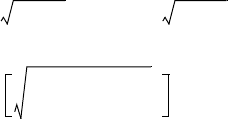
b
-------
2
+ zsinh=