
Lehner G. Electromagnetic Field Theory for Engineers and Physicists
Подождите немного. Документ загружается.

144 Formal Methods of Electrostatics
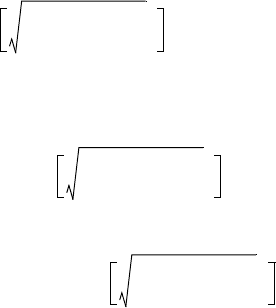
Substituting
we get
,
(3.73)
with n and m being positive integers. That poses no restriction on the generality of
this solution, because the sine function is anti-symmetric, the negative numbers are
redundant. The general solution is therefore
.
(3.74)
It meets all boundary conditions, except for . There, it has to be
.
(3.75)
The task is now to find the coefficients to satisfy this boundary condition also.
This is a known problem, namely to expand into a two-dimensional
Fourier series. This may require some introductory explanation. A Fourier series is
a means to expand a periodic function, over a given interval, as a linear
combination of sines and cosines. This function may, in specific cases, be
symmetric or anti-symmetric with respect to the center of the interval. There will
only be cosines in the symmetric case and only sines in the anti-symmetric case. In
our case, we may for example., choose for x the interval , although our
interest is only in the range . We may think of this function as periodic
and anti-symmetric in the said interval, which justifies the expansion by the above
method. The same is true for the y-dependency in the interval .
To find the coefficients , we make use of the orthogonality relations
,
(3.76)
where is the so-called Kronecker symbol:
We multiply (3.75) by
B
n
D
m
F
nm
C
nm
=
ϕ C
nm
nπx
a
---------sin
mπy
b
-----------sin
nπ
a
------
2
mπ
b
-------
2
+ zsinh=
ϕ C
nm
nπx
a
---------sin
mπy
b
-----------sin
nπ
a
------
2
mπ
b
-------
2
+ zsinh
nm, 1=
∞
∑
=
zc=
ϕ
c
xy,() C
nm
nπx
a
---------sin
mπy
b
-----------sin
nπ
a
------
2
mπ
b
-------
2
+ csinh
nm, 1=
∞
∑
=
C
nm
ϕ
c
xy,()
a– xa≤≤
0 xa≤≤
b– xb≤≤
C
nm
nπx
a
---------sin
n'πx
a
----------sin dx
0
a
∫
a
2
---
δ
nn'
,= nn'1≥,
mπy
b
-----------sin
m'πy
b
------------sin dx
0
b
∫
b
2
---
δ
mm'
,= mm'1≥,
δ
nm
δ
nm
1 nm=
0 nm≠
=
n'πx
a
----------sin
m'πy
b
------------sin
3.5 Separation of Laplace’s Equation in Cartesian Coordinates 145
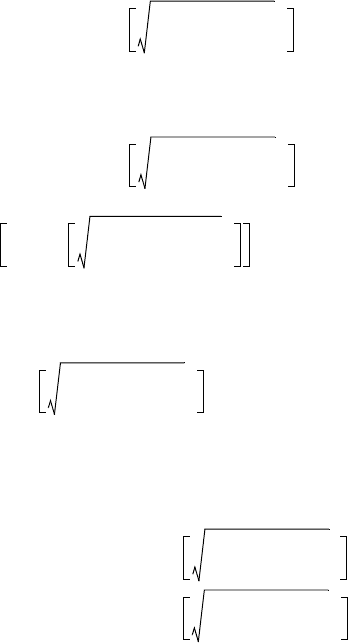
and then integrate x from 0 to a and y from 0 to b to get
.
Now we have found :
.
(3.77)
And finally the solution to our problem is
(3.78)
This so derived function satisfies Laplace’s equation and all the boundary
conditions. Because of the uniqueness theorem, it is the only solution. For
the result has to be of course , which we may also write as
(3.79)
On the other hand, since x and y are inside the integration boundary
.
(3.80)
ϕ
c
xy,()
n'πx
a
----------sin
m'πy
b
------------sin xdyd
0
b
∫
0
a
∫
C
nm
nπ
a
------
2
mπ
b
-------
2
+ csinh
nm, 1=
∞
∑
⋅=
nπx
a
---------sin
n'πx
a
----------
nxdsin
0
a
∫
⋅
mπy
b
-----------sin
m'πy
b
------------sin yd
0
b
∫
⋅
C
nm
nπ
a
------
2
mπ
b
-------
2
+ csinh
nm, 1=
∞
∑
δ
nn'
δ
mm'
ab
4
------
⋅=
ab
4
------
n'π
a
-------
2
m'π
b
---------
2
+ csinh C
n'm'
=
C
nm
C
nm
4 ϕ
c
xy,()
nπx
a
---------sin
mπy
b
-----------sin xdyd
0
b
∫
0
a
∫
ab
nπ
a
------
2
mπ
b
-------
2
+ csinh
-----------------------------------------------------------------------------------=
ϕ xyz,,()
4
ab
------
ϕ
c
x' y',()
nπx'
a
----------sin
mπy'
b
------------sin x'dy'd
0
b
∫
0
a
∫
nm, 1=
∞
∑
=
nπx
a
---------sin
mπx
b
-----------sin
nπ
a
------
2
mπ
b
-------
2
+ zsinh
nπ
a
------
2
mπ
b
-------
2
+ csinh
-------------------------------------------------------------
.⋅
ϕ
zc=
ϕ
c
xy,()
ϕ xyc,,()ϕ
c
xy,()
4
ab
------
ϕ
c
x' y',()
0
b
∫
0
a
∫
==
nπx'
a
----------sin
nπx
a
---------sin
n 1=
∞
∑
mπy'
b
------------sin
mπy
b
-----------sin
m 1=
∞
∑
x'dy' .d⋅
ϕ xyc,,()
4
ab
------
ϕ
c
x' y',()δxx'–()δyy'–()x'dy'd()
0
b
∫
0
a
∫
=
146 Formal Methods of Electrostatics
Comparison of the two equations for reveals that within the interval
and the following holds
(3.81)
This important relation is called the completeness or closure relation. The reason
for this name will be discussed. It is possible to derive this in a different way.
Consider the task to expand the δ-function into a Fourier series relation. We
attempt to expand
and determine by means of the orthogonality relation (3.76) to obtain
or
and therefore as suggested
.
If we consider this as a function of the entire x space, then the sum represents an
anti-symmetric function in the interval , which repeats itself
periodically, i.e., it represents positive δ-functions at all values where
and negative δ-functions at all values where and p is
a whole number but otherwise arbitrary. This means that as long as we do not
restrict ourselves to , the following is true:
.
The more general Dirichlet problem, where the potential is prescribed on the
entire surface, can be reduced to the problem discussed above. Observe that it is
possible to choose another of the faces where to prescribe the potential (to be non-
zero), while it is zero on the other five faces. Overall, there are thus six such
ϕ
c
xy,()
0 xa≤≤ 0 xb≤≤
2
a
---
nπx'
a
----------sin
nπx
a
---------sin
n 1=
∞
∑
δ xx'–()=
2
b
---
mπy'
b
------------sin
mπy
b
-----------sin
m 1=
∞
∑
δ yy'–()=
δ xx'–() C
n
x'()
nπx
a
---------sin
n 1=
∞
∑
=
C
n
x'()
δ xx'–()
n'πx
a
----------sin dx
0
a
∫
C
n
x'()
nπx
a
---------sin
n'πx
a
----------sin dx
0
a
∫
n 1=
∞
∑
=
a
2
---
C
n
x'()δ
nn'
n 1=
∞
∑
a
2
---
C
n'
x'()==
C
n
x'()
2
a
---
δ xx'–()
nπx
a
---------sin dx
0
a
∫
2
a
---
nπx'
a
----------sin==
δ xx'–()
2
a
---
nπx
a
---------sin
nπx'
a
----------sin
n 1=
∞
∑
=
a– xa≤≤
xx'2pa+= xx'–2pa+=
0 xa≤≤
2
a
---
nπx
a
---------sin
nπx'
a
----------sin
n 1=
∞
∑
δ xx'–2pa–()δxx'2pa–+()–
p ∞–=
+∞
∑
=
3.5 Separation of Laplace’s Equation in Cartesian Coordinates 147
solutions and the general solution is obtained by linear superposition of those
solutions.
For the most part, the methodology with which the current problem was
solved can also be applied to Neumann or mixed type problems.
3.5.2.2 Dirichlet Boundary Value Problem with Charges Inside the Volume
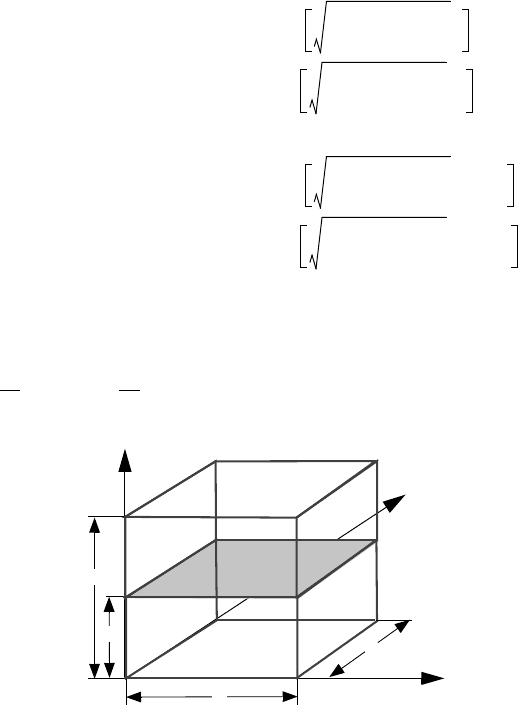
The task is to find the electric potential inside a cuboid with the edges a, b, c where
on the total surface , while there are surface charges on the plane
located inside the cuboid ( ) (Fig. 3.11).
In this case, we need to write a separate Ansatz for each volume,
and . We use the results from the previous example, i.e., use (3.74) to
write ϕ
in the following way: In volume 1 where we found
,
(3.82)
and in volume 2 where the potential is
.
(3.83)
Those trial functions fulfill the required boundary condition on the
entire surface. Furthermore, it has the property to make ϕ continuous at the area
. Therefore
ϕ 0= σ xy,()
zz
0
=0z
0
c<<
Fig. 3.11
z
x
y
a
c
b
z
0
1
2
0 zz
0
≤≤
z
0
zc≤≤
0 zz
0
≤≤
ϕ
1
C
nm
nπx
a
---------sin
mπy
b
-----------sin
nπ
a
------
2
mπ
b
-------
2
+ zsinh
nπ
a
------
2
mπ
b
-------
2
+ z
0
sinh
---------------------------------------------------------------
nm, 1=
∞
∑
=
z
0
zc≤≤
ϕ
2
C
nm
nπx
a
---------sin
mπy
b
-----------sin
nπ
a
------
2
mπ
b
-------
2
+ cz–()sinh
nπ
a
------
2
mπ
b
-------
2
+ cz
0
–()sinh
-----------------------------------------------------------------------------
nm, 1=
∞
∑
=
ϕ 0=
zz
0
=
x∂
∂ϕ
1
zz
0
=
x∂
∂ϕ
2
zz
0
=
=

148 Formal Methods of Electrostatics
and
i.e., the tangential components of the electric field are continuous, as they have to
be. A further requirement is
,
(3.84)
from which one can find the coefficients . For this purpose we also need to
expand :
,
(3.85)
We use the orthogonality relation (3.76) to calculate
that is
.
(3.86)
The condition (3.84) can now be formulated as
.
Comparing coefficients yields
y∂
∂ϕ
1
zz
0
=
y∂
∂ϕ
2
zz
0
=
=
z∂
∂ϕ
1
z∂
∂ϕ
2
–
zz
0
=
σ xy,()
ε
0
-----------------=
C
nm
σ xy,()
σ xy,() σ
nm
nπx
a
---------sin
mπy
b
-----------sin
nm, 1=
∞
∑
=
σ xy,()
n'πx
a
----------sin
m'πy
b
------------sin xdyd
0
b
∫
0
a
∫
σ
nm
nπx
a
---------sin
n'πx
a
----------
xdsin
0
a
∫
mπy
b
-----------sin
m'πy
b
------------sin yd
0
b
∫
nm, 1=
∞
∑
=
σ
nm
a
2
---
δ
nn'
b
2
---
δ
mm'
nm, 1=
∞
∑
σ
n'm'
ab
4
------
==
σ
nm
4
ab
------
σ x' y',()
nπx'
a
----------sin
mπy'
b
------------sin x'dy'd
0
b
∫
0
a
∫
=
C
nm
nπx
a
---------sin
mπy
b
-----------sin
nπ
a
------
2
mπ
b
-------
2
+
nπ
a
------
2
mπ
b
-------
2
+ z
0
cosh
nπ
a
------
2
mπ
b
-------
2
+ z
0
sinh
-----------------------------------------------------------------------------------------------------------
nm, 1=
∞
∑
+
nπ
a
------
2
mπ
b
-------
2
+
nπ
a
------
2
mπ
b
-------
2
+ cz
0
–()cosh
nπ
a
------
2
mπ
b
-------
2
+ cz
0
–()sinh
------------------------------------------------------------------------------------------------------------------------
+
σ
nm
ε
0
----------
nπx
a
---------sin
mπy
b
-----------sin
nm, 1=
∞
∑
=
3.5 Separation of Laplace’s Equation in Cartesian Coordinates 149
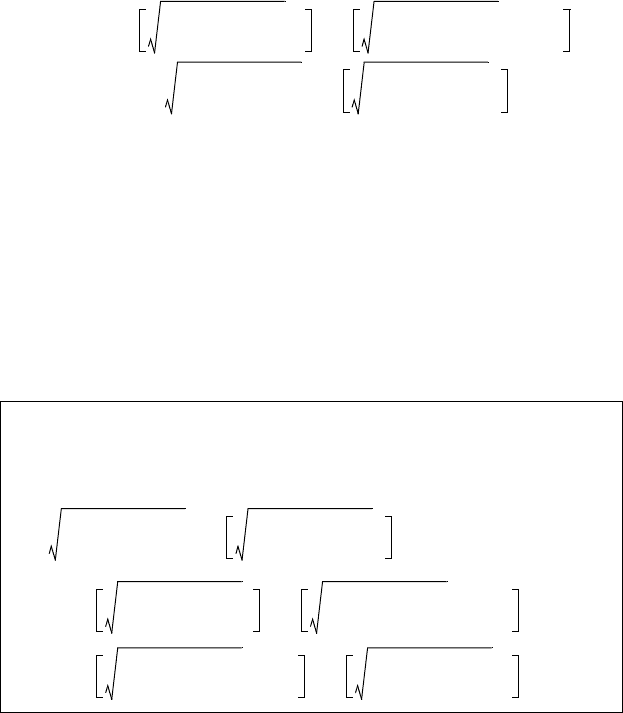
,
(3.87)
where the trigonometric identity was
used to rewrite the hyperbolic functions.
Of particular interest is a special case of this result. Let us assume that there is
a point charge Q at location . This is equivalent to a surface charge
.
(3.88)
Based on (3.86), this gives
.
(3.89)
Combining this with eqs. (3.82), (3.83), and (3.87) yields the somewhat
lengthy result:
(3.90)
Although lengthy, is basically a simple function and the solution to
Poisson’s equation
,
(3.91)
where the boundary condition is prescribed on the whole surface of the
cuboid. This is referred to as its Green’s function:
.
(3.92)
Its significance lies in the fact, that it allows one to reduce every charge distribution
in the cuboid to this equation, for which one has
C
nm
σ
nm
ε
0
----------
nπ
a
------
2
mπ
b
-------
2
+ z
0
sinh
nπ
a
------
2
mπ
b
-------
2
+ cz
0
–()sinh
nπ
a
------
2
mπ
b
-------
2
+
nπ
a
------
2
mπ
b
-------
2
+ csinh
---------------------------------------------------------------------------------------------------------------------------------------------
=
xy+()sinh xycoshsinh xcosh ysinh+=
x
0
y
0
z
0
,,
σ xy,()Qδ xx
0
–()δyy
0
–()=
σ
nm
4Q
ab
-------
nπx
0
a
------------sin
mπy
0
b
-------------sin=
ϕ
12,
4Q
abε
0
-----------
nπx
a
---------sin
nπx
0
a
------------sin
mπy
b
-----------
mπy
0
b
-------------sinsin
nm, 1=
∞
∑
⋅=
1
nπ
a
------
2
mπ
b
-------
2
+
nπ
a
------
2
mπ
b
-------
2
+ csinh
-------------------------------------------------------------------------------------------------------
⋅⋅
nπ
a
------
2
mπ
b
-------
2
+ zsinh
nπ
a
------
2
mπ
b
-------
2
+ cz
0
–()sinh vol. 1
nπ
a
------
2
mπ
b
-------
2
+ cz–()sinh
nπ
a
------
2
mπ
b
-------
2
+ z
0
sinh vol. 2
⋅
ϕϕ
12,
=
∇
2
ϕ
Q
----
δ xx
0
–()δyy
0
–()δzz
0
–()
ε
0
------------------------------------------------------------------–
δ rr
0
–()
ε
0
----------------------–==
ϕ 0=
ϕ
Q
---- G rr
0
,()Gxyzx
0
y
0
z
0
,,,,,()==
ρ r()

150 Formal Methods of Electrostatics
.
(3.93)
This is apparent from the superposition principle but may also be proven formally
by inserting it into Poisson’s equation.
Green’s function has another, very interesting property. If in Green’s
theorem (3.47), we choose
and
,
then it follows from (3.47) that
and since G vanishes on the surface
.
Therefore
.
(3.94)
Notice that in eq. (3.94) is a solution of Laplace’s equation. This reveals that
Green’s function solves at the same time Dirichlet’s boundary value problem for
Laplace’s equation. If one prescribes arbitrary values for on the surface then
in the whole volume is determined by eq. (3.94). It is revealing to compare it with
the previously derived eq. (3.57). There, the first term vanishes because of
. However, the difference is that (3.57), besides the surface integral with
, also contains a term with , which is not the case in (3.94). This is the
reason, why (3.57) is not suitable to solve this kind of boundary value problem. Eq.
ϕ r() G rr
0
,()ρr
0
()τ
0
d
V
∫
=
∇
2
ϕ
ρ
ε
0
-----–=
∇
2
ϕ∇
2
G rr
0
,()ρr
0
()τ
0
d
V
∫
=
∇
r
2
G rr
0
,()ρr
0
()τ
0
d
V
∫
=
δ rr
0
–()
ε
0
----------------------
ρ r
0
()τ
0
d
V
∫
–=
ρ r
0
()
ε
0
-------------–=
G rr
0
,()
φ G where ∇
2
G
δ rr
0
–()
ε
0
----------------------– , == G 0 on the boundary=
ψϕ where ∇
2
ϕ 0 , == ϕ arbitrary on the boundary
ϕ∇
2
GG∇
2
ϕ–()τd
V
∫
ϕ
n∂
∂G
G
n∂
∂ϕ
–
dA
∫
°
=
ϕ
δ rr
0
–()
ε
0
----------------------
τd
V
∫
– ϕ
n∂
∂G
dA
∫
°
=
ϕ r
0
() ε
0
ϕ r()
n∂
∂
G rr
0
,()dA
∫
°
–=
ϕ
ϕϕ
ρ r() 0=
ϕ∂ϕ∂n⁄

3.5 Separation of Laplace’s Equation in Cartesian Coordinates 151
(3.94) also allows one to solve the problem of Section 3.5.2.1 by means of Green’s
function, derived in the current section (3.5.2.2). In fact, one can prove that Green’s
function as of (3.90) is a solution to the example of Section 3.5.2.1,
yielding the solution given in (3.78).
The results from these examples may be generalized to solve any problem of
this kind. The derivation of (3.94) is not specific to that particular example but is
valid for arbitrary surfaces, provided that G is suitable for that surface.
Green’s function (or more precisely, Green’s function for Dirichlet’s prob-
lem) plays a peculiar double role. It yields the solution of Poisson’s equa-
tion when the potential vanishes everywhere on the surface, and also the
solution of Laplace’s equation when the potential is prescribed every-
where on the surface. Eqs. (3.93) and (3.94) are the respective defining
relations.
Correspondingly, there is a Green function for Neumann’s problem that plays a
similar role. We will prove this here by comparing the two cases side by side.
Consider a region with an arbitrary surface whose surface area we will call A.
There is a unit charge inside the region at point . The solution of the related
Poisson equation with the boundary condition that the potential vanishes
everywhere on the surface, or the normal derivative of the potential is kept
constant on the surface, respectively. These are referred to as Green’s function of
the first kind or second kind, respectively or also Green’s function of Dirichlet’s
problem or Neumann’s problem.
For the derivative of in the normal direction to be constant (for the inside
Neumann problem), it has to exactly assume the given value. The reason is that
, which is achieved by the above choice
of the constant.
The solution of the general Poisson equation
Dirichlet problems Neumann problems
(3.95)
(3.96)
for r on the surface for r on the surface
(3.97)
G ϕ
12,
Q⁄=
r
0
∂ϕ ∂n⁄
∇
r
2
G
D
rr
0
;()
δ rr
0
–()
ε
0
----------------------–= ∇
r
2
G
N
rr
0
;()
δ rr
0
–()
ε
0
----------------------–=
G
D
rr
0
;()0=
n∂
∂
G
N
rr
0
;()
1
ε
0
A
---------–=
G
N
1 Q⁄()DAd•
∫
ε
0
∂G
N
∂n⁄()Ad
∫
–1==
∇
2
ϕ r()
ρ r
0
()
ε
0
-------------–=

152 Formal Methods of Electrostatics
with the respective boundary conditions is thus
The solution of the Laplace equation
with the prescribed values at the surface
can also be obtained from Green’s functions, namely
The values of for the inner Neumann problem can not be to prescribed
arbitrarily. Since there are no volume charges, the electric flux through the surface
has to vanish, which provides for an additional constraint. While (3.101) was
already proven for Dirichlet’s problem, this is still to do for Neumann’s problem.
We achieve this by Green’s theorem eq. (3.47), using
and
where eq. (3.99) and eq. (3.100) define . Therefore
,
and with eq. (3.95) and (3.96)
,
which, after exchanging and , yields eq. (3.101). The constant is determined
to be:
.
(3.98)
(3.99)
(3.100)
(3.101)
ϕ r() ρr
0
()G
D
rr
0
;()τ
0
d
V
∫
= ϕ r() ρr
0
()G
N
rr
0
;()τ
0
d
V
∫
=
∇
2
ϕ r() 0=
ϕ r()
∂ϕ r()
∂n
--------------
,
∂ϕ r
0
()
∂n
-----------------
dA
0
∫
°
0=
ϕ r() ε
0
ϕ r
0
()
∂G
D
rr
0
;()
∂n
--------------------------
dA
0
∫
°
–=
ϕ r() ε
0
∂ϕ r
0
()
∂n
-----------------
G
N
rr
0
;()dA
0
∫
°
C+=
∂ϕ ∂n⁄
φ G
N
=
ψϕ=
ϕ
ϕ∇
r
2
G
N
G
N
∇
2
ϕ–()τd
V
∫
ϕ
n∂
∂G
N
G
N
n∂
∂ϕ
–
dA
∫
°
=
1
ε
0
-----
ϕ r()δrr
0
–()τd
V
∫
–
ϕ r()
ε
0
A
-----------
dA
∫
°
–
∂ϕ r()
∂n
--------------
G
N
rr
0
,()dA
∫
°
–=
ϕ r
0
()
ε
0
--------------–
1
ε
0
A
---------
ϕ r()dA
∫
°
–
∂ϕ r()
∂n
--------------
G
N
rr
0
;()dA
∫
°
–=
r
0
r
C
ϕ r()dA
∫
°
A
---------------------=
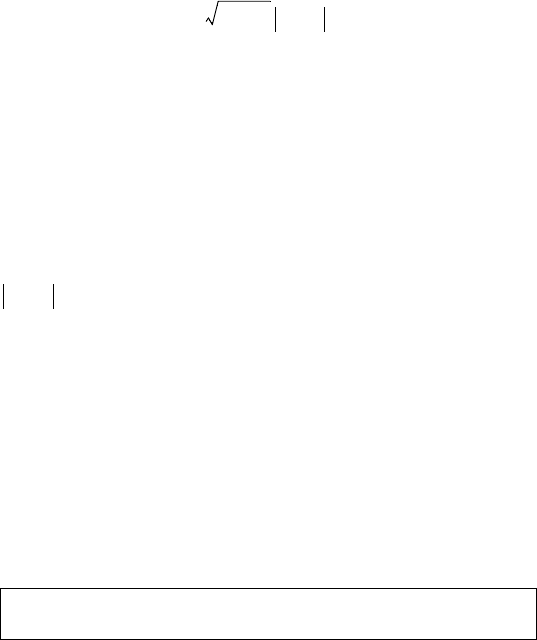
3.5 Separation of Laplace’s Equation in Cartesian Coordinates 153
3.5.2.3 Point Charge in Infinite Space
Consider the infinite plane with a surface charge . We make the
simplifying assumption that is symmetric with respect to the point
( ), that is
.
(3.102)
We choose the following Ansatz for the potential
(3.103)
The two cosines are a consequence of the symmetry assumed for . Because
of its infinite extend, there are no special values for k or l. Since we have to accept
any value for k and l, the sum is replaced by the integral, or rather, because of the
two dimensions, a double integral (Fourier integral). The trial function for the z-
dependency is chosen such that vanishes for , as required by physics.
Exponential functions thereby provide us with more convenient expansion
functions, as compared with hyperbolic functions. As in Section 3.5.2.2, we deal
with two regions, region 1 where and region 2 where . Certain
boundary conditions have to be met for , where we require that
(3.104)
The Ansatz (3.103) guarantees that the tangential components of the electric field
are continuous. Furthermore, because of the surface charges, the normal
component of D has to be discontinuous by
.
(3.105)
To solve this, we expand
.
(3.106)
This asks for applying the orthogonality relation
.
(3.107)
From (3.106) and (3.107) we obtain
zz
0
= σ xy,()
σ xy,()
x
0
y
0
,
σ xx
0
y,–()σx
0
xy
0
,–()=
σ xy y
0
–,()σxy
0
y–,()=
ϕ
12,
fkl,() kx x
0
–()[]cos ly y
0
–()[]cos
0
∞
∫
0
∞
∫
=
k
2
l
2
+ zz
0
––[]dkdl .exp⋅
σ xy,()
ϕ z ∞±→
zz
0
≤ zz
0
≥
zz
0
=
zz
0
–
zz
0
– for zz
0
≥ (region 2)
z
0
z– for zz
0
≤ (region 1) .
=
∂ϕ
1
∂z
---------
zz
0
=
∂ϕ
2
∂z
---------
zz
0
=
–
σ xy,()
ε
0
-----------------=
σ xy,()
σ xy,() σ
˜
kl,() kx x
0
–()[]cos ly y
0
–()[]cos kdld
0
∞
∫
0
∞
∫
=
kx x
0
–()[]cos k' xx
0
–()[]cos xd
∞–
+∞
∫
πδ kk'–()πδkk'+() +=
σ xy,() k ' xx
0
–()[]cos l ' yy
0
–()[]cos xdyd
∞–
+∞
∫
∞–
+∞
∫