
Lehner G. Electromagnetic Field Theory for Engineers and Physicists
Подождите немного. Документ загружается.

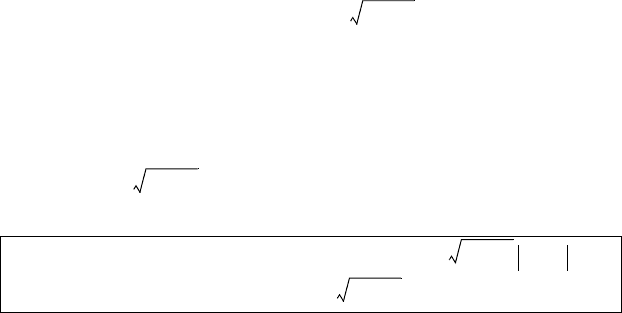
154 Formal Methods of Electrostatics
renaming and yields
.
(3.108)
For now, we are only interested in a point charge Q at location , for
which
(3.109)
The boundary condition (3.105) can now be written in the following way:
.
i.e.,
.
(3.110)
This solves the problem:
(3.111)
Since also
σ
˜
kl,() kx x
0
–()[]cos ly y
0
–()[]cos kdld
0
∞
∫
0
∞
∫
∞–
+∞
∫
∞–
+∞
∫
=
k' xx
0
–()[]cos l ' yy
0
–()[]cos dxdy⋅
σ
˜
kl,() kx x
0
–()[]cos k' xx
0
–()[]xdcos
∞–
+∞
∫
0
∞
∫
0
∞
∫
=
ly y
0
–()[]cos l' yy
0
–()[]cos yd
∞–
+∞
∫
kdld⋅
σ
˜
kl,()π
2
δ kk'–()δkk'+()+[]δll'–()δll'+()+[]kdld
0
∞
∫
0
∞
∫
=
π
2
σ
˜
k' l ',() .=
k' k⇒ l' l⇒
σ
˜
kl,()
1
π
2
------
σ xy,() kx x
0
–()[]cos ly y
0
–()[]cos xdyd
∞–
+∞
∫
∞–
+∞
∫
=
x
0
y
0
z
0
,,
σ
˜
kl,()
Q
π
2
------
δ xx
0
–()δyy
0
–()kx x
0
–()[]cos ly y
0
–()[]cos xdyd
∞–
+∞
∫
∞–
+∞
∫
=
Q
π
2
------
.=
fkl,() kx x
0
–()[]cos ly y
0
–()[]k
2
l
2
+cos 2 kdld
0
∞
∫
0
∞
∫
Q
π
2
ε
0
-----------
kx x
0
–()[]cos ly y
0
–()[]cos kdld
0
∞
∫
0
∞
∫
=
f
kl,()
Q
2π
2
ε
0
k
2
l
2
+
-----------------------------------=
ϕ
12,
Q
2π
2
ε
0
--------------
kx x
0
–()[]cos ly y
0
–()[]k
2
l
2
+ zz
0
––[]expcos
k
2
l
2
+
-----------------------------------------------------------------------------------------------------------------------------
dkdl
0
∞
∫
0
∞
∫
=

3.5 Separation of Laplace’s Equation in Cartesian Coordinates 155
,
a comparison reveals that
(3.112)
This is the Fourier integral for the inverse distance.
We have solved a quite simple problem with rather complicated means. We
had already known the potential of a point charge in the infinite space when we
calculated it earlier by much simpler means. The purpose of this example was to
illustrate the methodology. As a by-product did we obtain the important relation
(3.112) for which there may not exist a simpler derivation.
3.5.2.4 Appendix to Section 3.5: Fourier Series and Fourier Integrals
The topic of Fourier series and Fourier integrals with respect to one or two
dimensions automatically arose when separating Laplace’s equation in Cartesian
coordinates. This is a specific case of the more general expansion of functions by
certain orthogonal and complete systems of functions, whose occurrence is typical
for problems of this kind. We will begin the next section (3.6) with general
observations on such systems of functions, which will retroactively highlight the
role of Fourier series and Fourier integrals from a more general point of view.
Sections 3.7 and 3.8 will provide some examples for the expansion by orthogonal
and complete systems of functions. Here, we summarize the most important
formulas for Fourier series and Fourier integrals.
a) Fourier Series
A periodic function f(x) may be represented as a Fourier series. If c is the period,
then the series is represented by
(3.113)
It describes the value of f(x) everywhere, except where f is discontinuous. Where f
is discontinuous the series takes the value
(3.114)
That is, it assumes the average of the left and right sided limit at that point.
ϕ
Q
4πε
0
xx
0
–()
2
yy
0
–()
2
zz
0
–()
2
++
---------------------------------------------------------------------------------------------=
1
xx
0
–()
2
yy
0
–()
2
zz
0
–()
2
++
--------------------------------------------------------------------------------
2
π
---
kx x
0
–()[]cos ly y
0
–()[]k
2
l
2
+ zz
0
––[]dkdlexpcos
k
2
l
2
+
-----------------------------------------------------------------------------------------------------------------------------------------
0
∞
∫
0
∞
∫
=
fx() a
n
2πn
c
----------
x
cos
n 0=
∞
∑
b
n
2πn
c
----------
x
sin
n 1=
∞
∑
+=
a
n
2πn
c
----------
x
cos
n 0=
∞
∑
b
n
2πn
c
----------
x
sin
n 1=
∞
∑
+
fx ε–()fx ε+()+
2
-------------------------------------------
ε 0→
lim=

156 Formal Methods of Electrostatics
The coefficients and of the expansion (3.113) can be found by means
of an orthogonality relation for trigonometric functions.
The integration is carried out over a full period, but does not require to span from 0
to c, it could be any x
0
to x
0
+c. Multiply the expansion Ansatz (3.113) by
and , respectively, then integrate the resulting
equation over a full period while making use of (3.115) and (3.116). This gives
(3.117)
(3.118)
In particular, when f(x) is an “even” or “symmetric” function [ ]
then by (3.118) all , that is, the result is a pure “cosine series”. Conversely
when f(x) is an “odd” or “anti-symmetric” function [ ] then by
(3.118) all , that is, the result is a pure “sine series”.
Another option is to expand f(x) as a complex Fourier series
.
(3.121)
Because of
(3.115)
(3.116)
(3.119)
(3.120)
a
n
b
n
2πn
c
----------
x
cos
2πm
c
-----------
x
cos xd
0
c
∫
c
2
---
δ
nm
for n or m 1≥
c for nm0==
=
2πn
c
----------
x
sin
2πm
c
-----------
x
sin xd
0
c
∫
c
2
---
δ
nm
for n or m 1≥
c for nm0==
=
2πnx c⁄()cos 2πnx c⁄()sin
a
n
2
c
---
fx()
2πn
c
----------
x
cos xd
0
c
∫
for n 1≥
1
c
---
fx()xd
0
c
∫
for n 0=
=
b
n
2
c
---
fx()
2πn
c
----------
x
sin xd
0
c
∫
= for n 1≥
f
x() fx–()=
b
n
0=
f
x() fx–()–=
a
n
0=
fx() a
n
2πn
c
----------
x
cos
n 0=
∞
∑
= fx() even[]
fx() b
n
2πn
c
----------
x
sin
n 1=
∞
∑
= fx() odd[]
fx() d
n
i
2πn
c
----------
x
exp
n ∞–=
+∞
∑
=

3.5 Separation of Laplace’s Equation in Cartesian Coordinates 157
we may also write
This establishes the relationship between the expansions (3.113) and (3.121).
(3.122)
or the inverse relation
(3.123)
To immediately calculate the coefficients use Ansatz (3.121) and apply the
orthogonality relation
(3.124)
which yields
(3.125)
b) Fourier Integrals
Under certain, very general conditions which we will not discuss here, a function
may be represented as a Fourier integral:
.
(3.126)
We have introduced an arbitrary factor C because the Fourier integral is defined
differently by different authors. The inverse is the Fourier transform of f(x)
.
(3.127)
This is a result of (3.126) and the orthogonality relation
iα()exp αcos i αsin+=
fx() d
n
2πn
c
----------
x
cos id
n
2πn
c
----------sin x+
n ∞–=
+∞
∑
=
d
0
d
n
d
n–
+()
2πn
c
----------
x
cos id
n
d
n–
–()
2πn
c
----------sin x+
n 1=
∞
∑
+=
d
0
a
0
=
d
n
d
n–
+ a
n
=
id
n
d
n–
–()b
n
=
n 1≥
d
0
a
0
=
d
n–
a
n
ib
n
+
2
-------------------=
d
+n
a
n
ib
n
–
2
------------------- d
n–
*
==
n 1≥
d
n
i
2πn
c
----------
x
exp i
2πm
c
-----------
– x
exp xd
0
c
∫
cδ
nm
=
d
n
1
c
---
fx() i
2πn
c
----------
– x
exp xd
0
c
∫
=
fx() Cf
˜
k() ikx()exp kd
∞–
+∞
∫
=
f
˜
k()
1
2πC
-----------
fx() ikx–()exp xd
∞–
+∞
∫
=

158 Formal Methods of Electrostatics
.
(3.128)
Multiplying (3.126) by and then integrate over x from through
just yields (3.127), when also considering (3.128).
When f(x) = f(-x) i.e., f(x) is an even function, then
that is
.
(3.129)
and
.
(3.130)
On the other hand, when f(x) = -f(-x) i.e., f(x) is an odd function, then
that is
.
(3.131)
and
.
(3.132)
Thus there are basically three Fourier integrals
1. the exponential Fourier integral (3.126) and its inverse (3.127)
2. the cosine Fourier integral (3.130) and its inverse (3.129)
3. the sine Fourier integral (3.132) and its inverse (3.131)
To directly derive eqs. (3.129) and (3.130), or (3.131) and (3.132) is possible when
using the orthogonality relations
(3.133)
(3.134)
The choice of the factor C is a mere matter of convenience. Frequently, it is set to
in (3.126), which causes a factor of in (3.127). Another frequent
choice is which makes (3.126) and (3.127) “symmetric”, that is, the
same factor occurs in (3.127). Similarly, the sine and cosine transforms are
by no means uniquely defined. Frequently the definition of yields the
factor in (3.130) to become one, or when defining , the factor in (3.132)
becomes one.
ikx()exp ik'– x()exp xd
∞–
+∞
∫
2πδ kk'–() =
ik'– x()exp ∞–
+∞
f
˜
k()
1
2πC
-----------
fx() kx()cos xd
∞–
+∞
∫
=
f
˜
k()
1
πC
-------
fx() kx()cos x d
0
+∞
∫
=
fx() 2Cf
˜
k() kx()cos k d
0
+∞
∫
=
f
˜
k()
i
2πC
-----------– fx() kx()sin xd
∞–
+∞
∫
=
f
˜
k()
i
πC
-------
fx() kx()sin x d
0
+∞
∫
–=
fx() 2iC f
˜
k() kx()sin k d
0
+∞
∫
=
kx()cos k'x()cos xd
0
+∞
∫
π
2
---
δ kk'–()
π
2
---
δ kk'+() +=
kx()sin k'x()sin xd
0
+∞
∫
π
2
---
δ kk'–()
π
2
---
δ kk'+() –=
C 1=12π⁄
C 12π⁄=
12π⁄
C 12⁄=
Ci–2⁄=

3.6 Complete Orthogonal Systems of Functions 159
As a practical matter, because of the different definitions, it is advisable not to
define this factor too early in the calculations. Errors can be excluded when
selecting the best fitting approach (while leaving the factor open), and then
calculate the coefficients by means of the orthogonality relation.
3.6 Complete Orthogonal Systems of Functions
Before starting Separation of Variables for Laplace’s equation in cylindrical and
spherical coordinates, we will generalize the terminology, derived previously from
rather specific examples. Furthermore, their rather hidden analogy to vector
calculus shall be illustrated. Solving boundary value problems, under suitable
conditions, leads to systems of functions which are orthogonal to each other and
are complete in the sense that all possible functions, defined in the given region can
be constructed from them by superposition. Our analysis be in one dimension, as
multiple ones will not change the principle nature of the relations which we are
interested in.
A function f(x), defined in an interval , can be thought of as a vector.
So to speak, x acts as continuous index which identifies the components of the
vector f(x). An integral
(3.135)
can be regarded as the scalar product of the two vectors f(x) and g(x). f* is the
conjugate complex function to f. Oftentimes we deal with real functions, in which
case it is of course
.
In Vector Calculus one introduces a number of basis vectors, depending on the
spatial dimensions, to construct every vector
.
(3.136)
The system of basis vectors is orthogonal and normalized if
.
(3.137)
The expansion of the vector a by its basis system e
i
is achieved by scalar
multiplication of eq. (3.136) by e
k
. This yields
.
i.e.,
,
(3.138)
and thus
cxd≤≤
f
*
x()gx()xd
c
d
∫
f g 〈〉=
f
*
x()gx()xd
c
d
∫
f g 〈〉 fx()gx()xd
c
d
∫
==
a a
i
e
i
i 1=
n
∑
=
e
i
e
k
•δ
ik
=
ae
k
• a
i
e
i
e
k
•
i 1=
n
∑
a
i
δ
ik
i 1=
n
∑
a
k
===
a
k
ae
k
•=

160 Formal Methods of Electrostatics
,
(3.139)
It is worthwhile to analyze the parts of this sum.
is the projection of a onto the direction given by e
i
. One may think of this
undetermined product e
i
e
i
(frequently called dyadic product) to be an operator
which transforms a into another vector, namely the vector that results form
projecting it on e
i
. Thus e
i
e
i
is also called projection operator. The resulting vector
is
.
(3.140)
Of course, the sum of all projections has to yield the vector itself, if the system of
basis vectors is complete. In this case, the sum of all basis vectors has to result in
the identity operator (identity tensor):
.
(3.141)
This represents the completeness relation. Eqs. (3.139) and (3.141) are equivalent
and both express completeness of the basis system. The dyadic product is an
operator that has the form of a matrix when writing it in component form. The
dyadic product ab has the components (matrix elements)
The unit vectors of, for example, a three dimensional Cartesian coordinate
system are
.
The three projection operators result thereof
Their sum is indeed the identity operator
.
Applied to a vector
aae
i
•()e
i
i 1=
n
∑
e
i
e
i
()a•
i 1=
n
∑
==
e
i
e
i
()a•
a
i
a
i
e
i
ae
i
e
i
• e
i
e
i
a•== =
e
i
e
i
i 1=
n
∑
1=
ab()
ik
a
i
b
k
()=
e
1
100,,〈〉=
e
2
010,,〈〉=
e
3
001,,〈〉=
e
1
e
1
100
000
000
=
e
2
e
2
000
010
000
=
e
3
e
3
000
000
001
=
e
i
e
i
i 1=
3
∑
100
010
001
δ
ik
() 1===
a a
1
a
2
a
3
,,〈〉=

3.6 Complete Orthogonal Systems of Functions 161
gives
which is the respective projection.
All this can be applied to functions treated as vectors of an infinite
dimensional space. We first build f(x) from a complete system of orthogonal
functions. There are two cases, depending on whether the eigenvalues are discrete
or continuous (or expressed in different words: whether they form a discrete or a
continuous spectrum). Examples for both were given in Section 3.5.
We have therefore the following expansions for f(x):
For the continuous case, the integration has to be over all possible values of k. The
expansions are based on the orthogonality relations for the basis functions which
are assumed to be normalized.
where
Discrete spectrum Continuous spectrum
(3.142)
(3.143)
(3.144)
e
1
e
1
a•
100
000
000
a
1
a
2
a
3
a
1
00,,〈〉==
fx() a
n
ϕ
n
x()
n 1=
∞
∑
= fx() ak()ϕkx;()kd
∫
=
ϕ
n
x()ϕ
m
*
x()xd
c
d
∫
δ
nm
= ϕ kx;()ϕ
*
kx;()xd
c
d
∫
δ kk'–()=
fx()ϕ
m
*
x()xd
c
d
∫
= fx()ϕ
*
kx;()xd
c
d
∫
=
a
n
ϕ
n
x()ϕ
m
*
x()xd
c
d
∫
n 1=
∞
∑
=
a
n
δ
nm
n 1=
∞
∑
a
m
==
ak()ϕkx;()ϕ
*
k' x;()xdkd
c
d
∫∫
=
ak()δkk'–()kd
∫
ak'()==
a
n
fx()ϕ
n
*
x()xd
c
d
∫
=
ϕ
n
x() fx()〈〉=
ak() fx()ϕ
*
kx;()xd
c
d
∫
=
ϕ kx;() fx()〈〉=

162 Formal Methods of Electrostatics
This determines the coefficients of the expansion, the components of the vector so
to speak, where relation (3.144) is entirely equivalent to (3.138). The projection
onto the “direction” of and , respectively is then
For completeness, the sum of all those projections has to result in the function
itself, i.e.,
At the same time, it also is
By comparison, we obtain the completeness relations
On the other hand, to calculate the expansion coefficients by means of the
completeness relation is also possible. First, one may apply the identity operator,
that is in our case basically the δ-function, to any function. So we start with
Substituting gives
what immediately leads to the coefficients of the expansion
Let us now consider two functions f(x) and g(x) whose scalar product we aim to
find. f(x) shall have the components
(3.145)
,
ϕ
n
x() ϕkx;()
a
n
ϕ
n
x
()
=
ϕ
n
x()ϕ
n
*
x'()fx'()x'd
c
d
∫
=
ϕ
n
x()ϕ
n
x'()fx'()〈〉=
a
k()
ϕ
k
x;
()
=
ϕ kx;()ϕ
*
kx';()fx'()x'd
c
d
∫
=
ϕ kx;()ϕkx';()fx'()〈〉=
fx() a
n
ϕ
n
x()
n 1=
∞
∑
==
ϕ
n
x()ϕ
n
*
x'()fx'()x'd
n 1=
∞
∑
c
d
∫
=
fx() ak()ϕkx;()kd
∫
==
ϕ kx;()ϕ
*
kx';()dk f x'()x' .d⋅
c
d
∫∫
=
f
x() δxx'–()fx'()x'd
c
d
∫
=
ϕ
n
x()ϕ
n
*
x'()
n 1=
∞
∑
δ xx'–()=
ϕ kx;()ϕ
*
kx';()kd
∫
δ xx'–()=
f
x() δxx'–()fx'()x'd
c
d
∫
=
fx() ϕ
n
x()ϕ
n
*
x'()
n 1=
∞
∑
fx'()x'd
c
d
∫
=
fx() ϕkx;()ϕ
*
kx';()kd
∫
fx'()x'd
c
d
∫
=
a
n
ϕ
n
*
x'()fx'()x'd
c
d
∫
= ak() ϕ
*
kx';()fx'()x'd
c
d
∫
=
a
n
ak()

3.6 Complete Orthogonal Systems of Functions 163
while the components of g(x) shall be
Then
Therefore
which is in complete analogy to Vector Calculus, especially for the case of the
discrete spectrum.
In closing this section we shall provide a few explanatory words on integral
operators. We have already met some of those integral operators when studying the
various Green’s functions in the previous Section 3.5. They cause a transformation
of a function into another function in the form of some integral
transform:
.
(3.147)
The δ-function is just one such integral operator. It projects a function onto itself.
The image function is then equal to
.
(3.146)
b
n
bk()
fx() a
n
ϕ
n
x()
n 1=
∞
∑
=
fx() ak()ϕkx;()kd
∫
=
gx() b
n
ϕ
n
x()
n 1=
∞
∑
=
gx() bk()ϕkx;()kd
∫
=
gf 〈〉 fx()g
*
x()xd
c
d
∫
==
gf 〈〉 fx()g
*
x()xd
c
d
∫
==
a
n
b
m
*
ϕ
n
x()ϕ
m
*
x()xd
c
d
∫
nm, 1=
∞
∑
=
ak()b
*
k'()ϕkx;()ϕ
*
k' x;()xdkddk'
c
d
∫∫∫
=
a
n
b
m
*
δ
nm
n 1=
∞
∑
=
ak()b
*
k'()δkk'–()kddk'
∫∫
=
a
n
b
n
*
n 1=
∞
∑
=
ak()b
*
k()kd
∫
=
fx() f
˜
x()
f
˜
x() Oxx',()fx'()x'd
c
d
∫
=
f
˜
x()
f
x()
f
˜
x() δxx'–()fx'()x'd
c
d
∫
fx()==