
Lehner G. Electromagnetic Field Theory for Engineers and Physicists
Подождите немного. Документ загружается.


164 Formal Methods of Electrostatics
The δ-function thus acts as the identity operator. The function is called the
kernel of the integral transform. It is also possible to expand these kernels, for
example, for the discrete case we have
.
(3.148)
We obtain
i.e.,
(3.149)
Therefore, it is on one hand
and on the other, we can expand
.
The components of result from in the following way:
,
(3.150)
that is by matrix multiplication, again in total harmony with standard vector
calculus. The situation for the continuous spectrum is quite similar.
(3.151)
where
Oxx',()
Oxx',()
O
ik
ϕ
i
x()ϕ
k
*
x'()
ik, 1=
∞
∑
=
Oxx',()ϕ
i'
*
x()ϕ
k'
x'()xdx'd
c
d
∫
c
d
∫
=
O
ik
ik, 1=
∞
∑
ϕ
i
x()ϕ
i'
*
x()xd
c
d
∫
ϕ
k
*
x'()ϕ
k'
x'()x'd
c
d
∫
=
O
ik
ik, 1=
∞
∑
δ
ii'
δ
kk'
O
i'k'
==
O
ik
Oxx',()ϕ
i
*
x()ϕ
k
x'()xdx'd
c
d
∫
c
d
∫
=
f
˜
x() Oxx',()fx'()x'd
c
d
∫
==
O
ik
ik, 1=
∞
∑
ϕ
i
x()ϕ
k
*
x'()
a
l
ϕ
l
x'()
l 1=
∞
∑
x'd
c
d
∫
=
O
ik
ikl,,
∞
∑
ϕ
i
x()a
l
δ
kl
O
ik
ik,
∞
∑
a
k
ϕ
i
x()==
f
˜
x()
f
˜
x()
a
˜
i
ϕ
i
x()
i
∑
=
f
˜
x() f
a
˜
i
O
ik
a
i
k
∑
=
Oxx',() Okk',()ϕkx;()ϕ
*
k' x';()kdk'd
∫∫
=

3.7 Separation of Variables of Laplace’s Equation 165
(3.152)
and the projection of onto is performed by
,
(3.153)
so that we also obtain an integral transformation for the continuous case. Integral
transformations are the continuous analogues of matrix multiplications.
3.7 Separation of Variables of Laplace’s Equation in
Cylindrical Coordinates
3.7.1 Separation of Variables
Laplace’s equation for the potential F is given by eq. (3.33)
.
(3.154)
To find its solution, the following separation Ansatz shall be used
(3.155)
to obtain
.
(3.156)
The first two terms solely depend on r and ϕ, the third depends only on z.
This allows us to introduce the separation constant k
2
.
(3.157)
There are several representations to express the result, for example,
(3.158)
or
.
(3.159)
Now we tackle the r-
ϕ
dependent part of eq. (3.156) which takes the form
Multiplying by r
2
gives
.
This allows to continue the separation process. Substitute
Okk',() Oxx',()ϕ
*
kx;()ϕk' x';()xdx'd
c
d
∫
c
d
∫
=
fx() f
˜
x()
a
˜
k() Okk',()ak'()k'd
∫
=
1
r
---
r∂
∂
r
r∂
∂ 1
r
2
-----
∂
2
∂ϕ
2
---------
∂
2
∂z
2
--------++
F 0=
Frϕ z,,()Rr()φϕ()Zz()=
1
Rr()
-----------
1
r
---
r∂
∂
r
r∂
∂
Rr()
1
r
2
φϕ()
-----------------
∂
2
∂ϕ
2
---------
φϕ()
1
Zz()
----------
∂
2
∂z
2
--------
Zz()++0=
1
Zz()
----------
∂
2
∂z
2
--------
Zz() k
2
=
ZA
1
kzcosh A
2
kzsinh+=
ZA
˜
1
kz()exp A
˜
2
kz–()exp+=
1
Rr()
-----------
1
r
---
r∂
∂
r
r∂
∂
Rr()
1
r
2
φϕ()
-----------------
∂
2
∂ϕ
2
---------
φϕ() k
2
++0=
r
Rr()
-----------
r∂
∂
r
r∂
∂
Rr() k
2
r
2
1
φϕ()
-----------
∂
2
∂ϕ
2
---------
φϕ()++ 0=

166 Formal Methods of Electrostatics
,
(3.160)
and obtain
,
(3.161)
or alternatively
.
(3.162)
Where m has to be a whole number because of the necessary periodicity of ϕ. What
remains for R is
After dividing by , and introducing the dimensionless coordinate
, this becomes
(3.163)
. (3.164)
This is one of the most famous equations in mathematical physics, the so-
called Bessel differential equation. Its solution is a linear combination of two
different, linearly independent functions, the so-called cylindrical functions, which
may be chosen in various ways. Such a pair of functions consists of for example,
the so-called Bessel function and the so-called Neumann function
, that is,
.
(3.165)
Another possibility is to separate the equations in a different manner by
substituting:
,
(3.166)
so that
(3.167)
or
.
(3.168)
This, together with the dimensionless variable
,
(3.169)
yields for R again the Bessel differential equation
and its solution is
.
(3.170)
1
φ
---
∂
2
∂ϕ
2
---------
φ m
2
–=
φ B
1
mϕcos B
2
mϕsin+=
φ B
˜
1
imϕ()exp B
˜
2
imϕ–()exp+=
r
r∂
∂
r
r∂
∂
Rr() k
2
r
2
m
2
–()R+0=
k
2
r
2
ξ kr=
1
ξ
---
ξ∂
∂
ξ
ξ∂
∂
R ξ() 1
m
2
ξ
2
-------
–
R ξ()+0 =
J
m
ξ() J
m
kr()=
N
m
ξ() N
m
kr()=
Rr() C
1
J
m
kr()C
2
N
m
kr() +=
1
Zz()
----------
∂
2
∂z
2
--------
Zz() k
2
–=
ZA
1
kzcos A
2
kzsin+=
ZA
˜
1
ikz()exp A
˜
2
ikz–()exp+=
η ikr=
1
η
---
η∂
∂
η
η∂
∂
R η() 1
m
2
η
2
-------–
R η()+0=
Rr() C
1
J
m
ikr()C
2
N
m
ikr() +=

167
It depends on the type of problem to determine which kind of separation is more
appropriate. We will discuss this in the context of several examples. Both
approaches are equivalent and it is possible to transpose from one to the other by
substituting k by ik and vice versa. If the problem is independent of z, then .
This special case leads to fundamental functions R(r), which we will discuss in
Section 3.7.3.5 (see eqs. (3.263) and (3.264).
The functions and have significantly different properties
than the functions and . The argument (ikr) occurs so frequently
that the so-called modified Bessel functions were introduced. The modified Bessel
functions of the first kind are defined by
(3.171)
and the modified Bessel functions of the second kind are defined by
(3.172)
This makes it therefore possible to also write the general solution (3.170) in the
following way:
(3.173)
It shall also be noted that there are specific problems where the separation
constants might have to be chosen differently, e.g., if one wants to specify the
potential at a certain surfaces to be . We will not discuss this any
further, but just note that in this case, m will not be a whole number.
3.7.2 Some Properties of Cylindrical Functions
Here we can only sketch some of the most important characteristics of the
cylindrical functions. Properties of those functions are found in suitable reference
books [3 - 7].
For small arguments behaves like ,
,
(3.174)
while diverges for small arguments, namely
,
(3.175)
. (3.176)
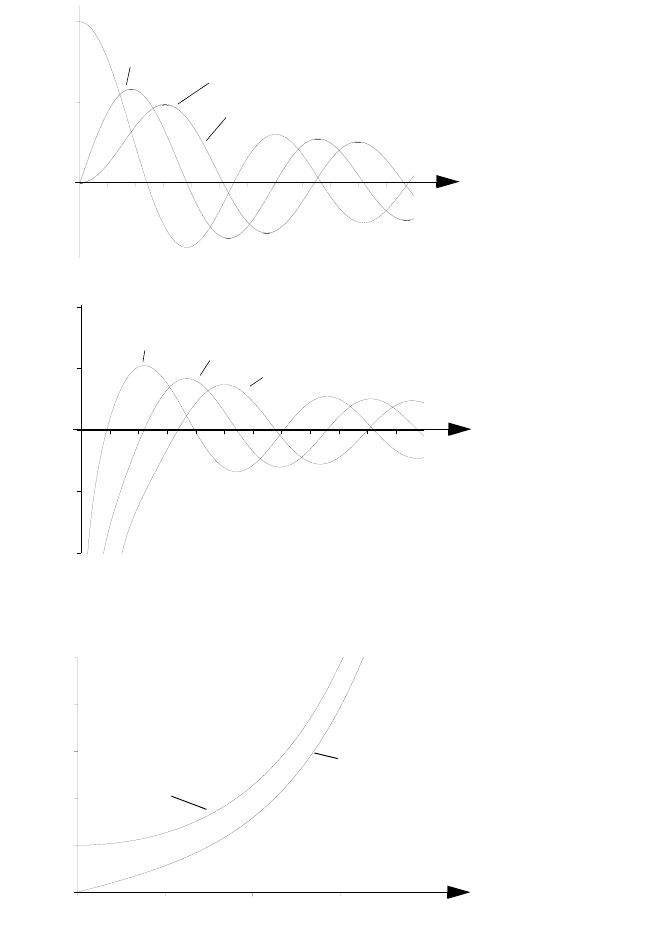
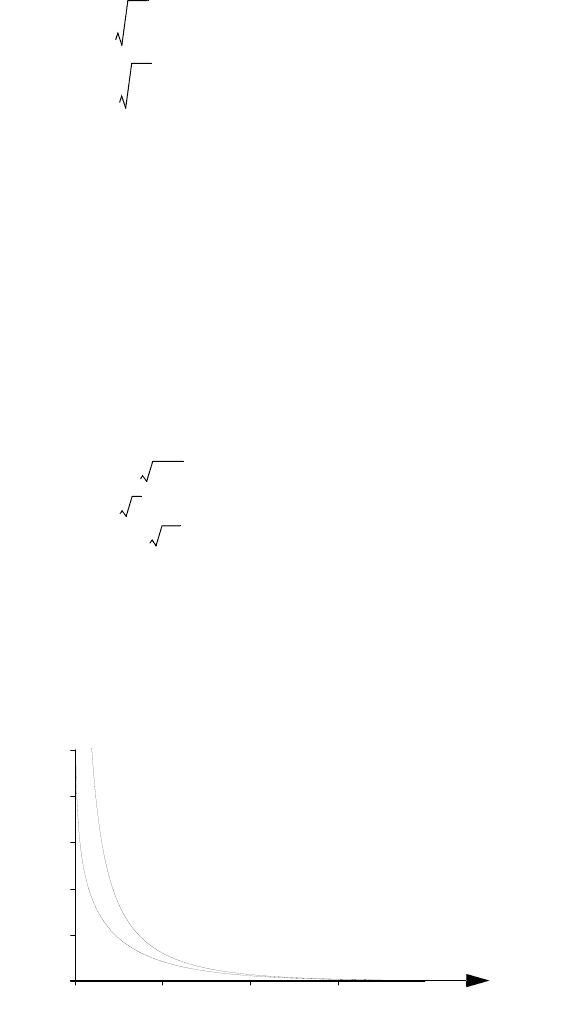
The graph of some of those functions is illustrated in Figures 3.12 through 3.15.
For very large arguments (asymptotic behavior), and behave basically
like damped trigonometric functions, that is
k 0=
J
m
kr() N
m
kr()
J
m
ikr() N
m
ikr()
I
m
x() i
m–
J
m
ix()=
K
m
x()
π
2
---
i
m 1+
J
m
ix()iN
m
ix()+[]=
Rr() C
˜
1
I
m
kr()C
˜
2
K
m
kr() +=
ϕ const=
J
m
x() x
m
J
m
x()
x
2
---
m
1
m!
------
≈ for x 1«
N
m
x()
N
m
x()
m 1–()!
π
--------------------
2
x
---
m
–≈ for x 1 and m«12…,,=
N
0
x()
2
π
---
γx
2
-----ln
2
π
---
xln≈≈ for x 1, γ 1.781≈()«
J
m
N
m
3.7 Separation of Variables of Laplace’s Equation
168 Formal Methods of Electrostatics
-0.5
0
0.5
1
01234567891011
Fig. 3.12
J
0
x()
J
1
x()
J
2
x()
x
-1
-0.5
0
0.5
1
01234567891011
Fig. 3.13
N
1
x()
N
0
x()
N
2
x()
x
0
1
2
3
4
5
0123
I
1
x()
I
0
x()
x
Fig. 3.14
169
.
(3.177)
For small arguments the modified Bessel functions behave somewhat like and
. Here we have
,
(3.178)
, (3.179)
. (3.180)
For large arguments, however, they differ significantly from and where
they behave like exponential functions, namely
.
(3.181)
The different asymptotic behavior for large arguments of , (like
trigonometric functions) and , (like exponential functions) is important and
will be significant in the following examples. It will also be important that and
are finite at the origin, while and diverge there. In closing, a few
important relations for cylindrical functions are summarized:
0
1
2
3
4
5
0123
K
1
x()
K
0
x()
x
Fig. 3.15
J
m
x()
2
πx
------ x
π
4
---–
mπ
2
-------–
cos≈
N
m
x()
2
πx
------ x
π
4
---–
mπ
2
-------–
sin≈
for x ∞→
J
m
N
m
I
m
x()
x
2
---
m
1
m!
------
≈ for 0 x 1«<
K
m
x()
m 1–()!
2
--------------------
2
x
---
m
≈ for 0 x 1≤< and m 12… ,, ,=
K
0
x()
γx
2
-----ln– xln–≈≈ for 0 x 1≤< , γ 1.781≈()
J
m
N
m
I
m
x()
x()exp
2πx
-----------------
≈
K
m
x()
π x–()exp
2x
----------------------------
≈
for x ∞→
J
m
N
m
I
m
K
m
J
m
N
m
I
m
K
m
3.7 Separation of Variables of Laplace’s Equation

170 Formal Methods of Electrostatics
Bessel function: Neumann function:
Specifically:
Specifically:
and
Modified Bessel function of the
first kind:
Modified Bessel function of the
second kind
Specifically: Specifically:
and
J
n 1–
x() J
n 1+
x()+
2n
x
------
J
n
x()= N
n 1–
x() N
n 1+
x()+
2n
x
------
N
n
x()=
J
n 1–
x() J
n 1+
x()–2J
n
' x()= N
n 1–
x() N
n 1+
x()–2N
n
' x()=
J
n–
x() 1–()
n
J
n
x()= N
n–
x() 1–()
n
N
n
x()=
xd
d
J
n
x() J
n 1–
x()
n
x
---
J
n
x()–=
xd
d
N
n
x() N
n 1–
x()
n
x
---
N
n
x()–=
x
n 1+
J
n
x()xd
∫
x
n 1+
J
n 1+
x()= x
n 1+
N
n
x()xd
∫
x
n 1+
N
n 1+
x()=
x
n–1+
J
n
x()xd
∫
x
n–1+
– J
n 1–
x()= x
n–1+
N
n
x()xd
∫
x
n–1+
– N
n 1–
x()=
J
0
' x() J
1
x()–=
N
0
' x() N
1
x()–=
J
n
x()N
n 1+
x() J
n 1+
x()N
n
x()–
2
πx
------–=
I
n 1–
x() I
n 1+
x()+2I
n
' x()= K
n 1–
x() K
n 1+
x()+2K
n
' x()–=
I
n 1–
x() I
n 1+
x()–
2n
x
------
I
n
x()= K
n 1–
– x() K
n 1+
x()+
2n
x
------
K
n
x()=
I
n–
x() I
n
x()= K
n–
x() K
n
x()=
xd
d
I
n
x() I
n 1–
x()
n
x
---
I
n
x()–=
xd
d
K
n
x() K
n 1–
x()–
n
x
---
K
n
x()–=
x
n 1+
I
n
x()xd
∫
x
n 1+
I
n 1+
x()= x
n 1+
K
n
x()xd
∫
x
n 1+
K
n 1+
x()–=
x
n–1+
I
n
x()xd
∫
x
n–1+
I
n 1–
x()=
x
n–1+
K
n
x()xd
∫
x
n–1+
K
n 1–
x()–=
I
0
' x() I
1
x()= K
0
' x() K
1
x()–=
K
n
x()I
n 1+
x() K
n 1+
x()I
n
x()+
1
x
---=
171
3.7.3 Examples
3.7.3.1 A Cylinder with Surface Charges
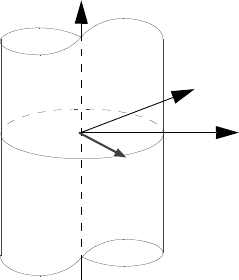
An infinitely tall circular cylinder of radius r
0
(Fig. 3.16) carries a rotationally
symmetric surface charge, mirrored at the x-y axis (z = 0), that is
.
(3.182)
We want to find its potential. This requires us to solve Laplace’s equation for
region 1 (inside the cylinder surface) and for region 2 (outside the cylinder
surface). Both solutions will be joined together via the boundary conditions. There
is no azimuthal dependency because of the rotational symmetry. Consequently m,
one of the separation constants vanishes
.
(3.183)
This leaves a dependency on z and r, for which we choose the Ansatz according to
(3.167) and (3.173):
(3.184)
The cosine sum suffices for this problem because of the symmetry ( ).
There are no restrictions on k. In region 1, C
2
has to vanish because of the
divergence of K
0
at the origin, which would cause the potential to diverge.
Conversely, in region 2, C
1
has to vanish because I
0
diverges at infinity. This
allows for an Ansatz like this:
(3.185)
Fig. 3.16
z
x
12
y
r
0
0
σ z() σ z–()=
m 0=
ZA
1
kzcos A
2
kzsin+=
RC
1
I
0
kr()C
2
K
0
kr()+=
A
2
0=
ϕ
1
f
1
k() kz()cos I
0
kr()kd⋅
0
∞
∫
=
ϕ
2
f
2
k() kz()cos K
0
kr()kd⋅
0
∞
∫
=
3.7 Separation of Variables of Laplace’s Equation
172 Formal Methods of Electrostatics
On the surface it has to be
that is
(3.186)
and
that is
.
(3.187)
The condition (3.186) gives
,
(3.188)
and the condition (3.187), when using
(3.189)
and
(3.190)
gives
.
(3.191)
To continue, we need the Fourier transform of ,
.
(3.192)
It follows from (3.188) that
,
and by (3.191), using (3.192) gives
,
which yields and :
.
rr
0
=
E
z1
()
rr
0
=
E
z2
()
rr
0
=
=
z∂
∂ϕ
1
rr
0
=
z∂
∂ϕ
2
rr
0
=
–0=
D
r2
()
rr
0
=
D
r1
()
rr
0
=
– σ=
r∂
∂ϕ
1
rr
0
=
r∂
∂ϕ
2
rr
0
=
–
σ
ε
0
-----=
kkz()sin f
2
k()K
0
kr
0
()f
1
k()I
0
kr
0
()–[]kd
0
∞
∫
0=
I
0
' ξ()
ξd
d
I
0
ξ() +I
1
ξ()==
K
0
' ξ()
ξd
d
K
0
ξ() K
1
ξ()–==
kkz()cos f
1
k()I
1
kr
0
()f
2
k()K
1
kr
0
()+[]kd
0
∞
∫
σ
ε
0
-----=
σ z()
σ z() σ
˜
z() kz()cos kd
0
∞
∫
=
f
1
k()I
0
kr
0
() f
2
k()K
0
kr
0
()–0=
f
1
k()I
1
kr
0
()f
2
k()K
1
kr
0
()
σ
˜
k()
ε
0
k
-----------–+0=
f
1
f
2
f
1
k()
σ
˜
k()K
0
kr
0
()
ε
0
kK
0
kr
0
()I
1
kr
0
()K
1
kr
0
()I
0
kr
0
()+[]
-----------------------------------------------------------------------------------------------=
f
2
k()
σ
˜
k()I
0
kr
0
()
ε
0
kK
0
kr
0
()I
1
kr
0
()K
1
kr
0
()I
0
kr
0
()+[]
-----------------------------------------------------------------------------------------------=
173
By means of the relation (see Section 3.7.2)
.
(3.193)
this simplifies to
.
(3.194)
This solves our problem:
.
(3.195)
To continue further is generally only possible with numerical methods. The
very general result contains some interesting special cases. For example, consider
the case of a uniformly charged circular loop for which
.
(3.196)
Where q is its line charge with units [C/m]. We use the orthogonality relation
(3.107) to calculate
that is
(3.197)
and
,
or
.
(3.198)
This reveals another important fact about the δ-function: Its Fourier transform is a
constant (i.e., its spectrum contains all frequencies with the same amplitude). This
K
0
kr
0
()I
1
kr
0
()K
1
kr
0
()I
0
kr
0
()+
1
kr
0
-------=
f
1
k()
σ
˜
k()r
0
K
0
kr
0
()
ε
0
-------------------------------------=
f
2
k()
σ
˜
k()r
0
I
0
kr
0
()
ε
0
----------------------------------=
ϕ
1
r
0
ε
0
-----
σ
˜
k() kz()cos K
0
kr
0
()I
0
kr()kd
0
∞
∫
=
ϕ
2
r
0
ε
0
-----
σ
˜
k() kz()cos I
0
kr
0
()K
0
kr()kd
0
∞
∫
=
σ z() qδ z()=
σ
σ z() k'z()cos zd
∞–
∞
∫
σ
˜
k() kz()cos k'z()cos kdzd
0
∞
∫
∞–
∞
∫
=
πσ
˜
k()δkk'–()kd
0
∞
∫
πσ
˜
k'() ,==
σ
˜
k()
1
π
---
σ z() kz()cos zd
∞–
∞
∫
=
1
π
---
qδ z() kz()cos zd
∞–
∞
∫
q
π
---
0cos
q
π
---===
qδ z()
q
π
---
kz()cos kd
0
∞
∫
=
δ z()
1
π
---
kz()cos kd
0
∞
∫
=
3.7 Separation of Variables of Laplace’s Equation