
Lehner G. Electromagnetic Field Theory for Engineers and Physicists
Подождите немного. Документ загружается.

174 Formal Methods of Electrostatics
is expressed in eq. (3.198), which represents at the same time, both, an interesting
and an important representation of the δ-function. Eq. (3.197) in (3.195) allows to
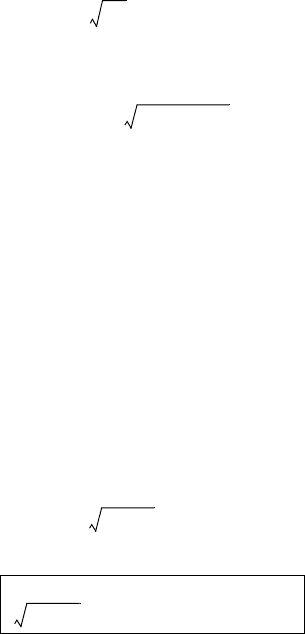
represent the potential of the uniformly charged circular loop as:
.
(3.199)
Of course, to calculate the potential of the circular loop by much simpler means is
also possible. Integrating according to (2.29) gives.
,
(3.200)
where represents the total elliptic integral of the first kind:
,
(3.201)
and
.
(3.202)
In fact, one can prove that the results in (3.199) and (3.200) are identical. One
needs to show that the Fourier transform of basically yields the elliptic
integral of the first kind. For more details refer to [5], volume 1, p 49, eq. (46).
One might further specialize this problem. For and , in such a
way that . Then the result has to be again that of a point charge at the
origin. (This has to be the potential of while becomes irrelevant):
.
(3.203)
On the other hand, this must be
,
so that
.
(3.204)
The two relations (3.203) and (3.204) represent the series expansion for the inverse
distance in cylindrical coordinates and correspond to the similar equations (3.111)
and (3.112). In both cases, the calculation of a simple, known problem by means of
a complicated approach is not a superficial luxury. Rather, sometimes to solve
ϕ
1
qr
0
πε
0
--------
kz()cos K
0
kr
0
()I
0
kr()kd
0
∞
∫
=
ϕ
2
qr
0
πε
0
--------
kz()cos I
0
kr
0
()K
0
kr()kd
0
∞
∫
=
ϕ
qr
0
2πε
0
------------
l
rr
0
-----------
K
π
2
---
l,
=
K
π
2
---
l,
K
π
2
---
l,
ψd
1 l
2
ψsin
2
–
--------------------------------
0
π
2⁄
∫
=
l
2
4rr
0
r
2
z
2
r
0
2
2rr
0
+++
---------------------------------------------=
K
0
I
0
r
0
0→ q ∞→
2πr
0
qQ=
ϕ
2
ϕ
1
ϕ
Q
2π
2
ε
0
--------------
kz()cos K
0
kr()kd
0
∞
∫
=
ϕ
Q
4πε
0
r
2
z
2
+
---------------------------------=
1
r
2
z
2
+
--------------------
2
π
---
kz()cos K
0
kr()k d
0
∞
∫
=
175
particular problems, requires one to have certain expansions at ones disposal. The
next example shall demonstrate this.
3.7.3.2 Point Charge on the Axis of a Dielectric Cylinder
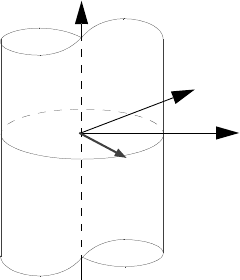
We want to find the potential caused by a point charge Q at the axis of a dielectric,
circular cylinder ( ). For the remaining space, we assume a different dielectric
( ) (see Fig. 3.17).
This is by no means a trivial problem, but it can be solved with the results obtained
from the previous example. We need to solve Laplace’s equation in region 2, what
is certainly possible with an approach similar to (3.185):
.
(3.205)
The factor in front of the integral is just for convenience and could as well be
regarded as belonging to . In region 1, we have to solve Poisson’s equation
for a point charge. This may be done by superposition of the point charge potential
according to (3.203) and the general solution of Laplace’s equation according to
(3.185), i.e., by
(3.206)
Remember that the general solution of the inhomogeneous (Poisson) equation is
obtained from the superposition of the specific solution of the inhomogeneous
equation and the general solution of the homogeneous (Laplace) equation.
Significant is now, to know the potential of the point charge in the specific form
that fits this problem. Another way to view the trial functions of (3.205) and
(3.206) is by superposition of the point charge potential and the potential of bound
surface charges at the cylinder surface (wall). The following boundary conditions
apply for :
ε
1
ε
2
Fig. 3.17
z
x
12
y
r
0
0
ε
2
ε
1
ϕ
2
Q
2π
2
ε
1
--------------
kz()cos K
0
kr()g
2
k()kd
0
∞
∫
=
g
2
k()
ϕ
1
Q
2π
2
ε
1
--------------
kz()cos K
0
kr()I
0
kr()g
1
k()+[]kd
0
∞
∫
=
rr
0
=
3.7 Separation of Variables of Laplace’s Equation
176 Formal Methods of Electrostatics
.
This gives
and
or
Solved for and yields
.
(3.207)
Hereby we used equations (3.189), (3.190), and (3.193). For , we find that
and , that is, , agreeing with (3.203), as expected.
z∂
∂ϕ
1
rr
0
=
z∂
∂ϕ
2
rr
0
=
–0=
ε
1
r∂
∂ϕ
1
rr
0
=
ε
2
r∂
∂ϕ
2
rr
0
=
–0=
Q
2π
2
ε
1
--------------
kkz()sin K
0
kr
0
()I
0
kr
0
()g
1
k() K
0
kr
0
()g
2
k()–+[]kd
0
∞
∫
0=
Q
2π
2
ε
1
--------------
kkz()cos ε
1
K
1
kr
0
()– ε
1
I
1
kr
0
()g
1
k() ε
2
K
1
kr
0
()g
2
k()++[]kd
0
∞
∫
0=
K
0
kr
0
()I
0
kr
0
()g
1
k() K
0
kr
0
()g
2
k()–+0=
ε
1
K
1
kr
0
()– ε
1
I
1
kr
0
()g
1
k() ε
2
K
1
kr
0
()g
2
k()++ 0 .=
g
1
g
2
g
1
k()
1
ε
2
ε
1
-----–
kr
0
K
0
kr
0
()K
1
kr
0
()
1
ε
2
ε
1
-----1–
kr
0
I
0
kr
0
()K
1
kr
0
()+
----------------------------------------------------------------------------=
g
2
k()
1
1
ε
2
ε
1
-----1–
kr
0
I
0
kr
0
()K
1
kr
0
()+
----------------------------------------------------------------------------=
ε
1
ε
2
=
g
1
0= g
2
1= ϕ
1
ϕ
2
ϕ==
Fig. 3.19
ε
1
ε
2
>
Fig. 3.18
ε
1
ε
2
<
177
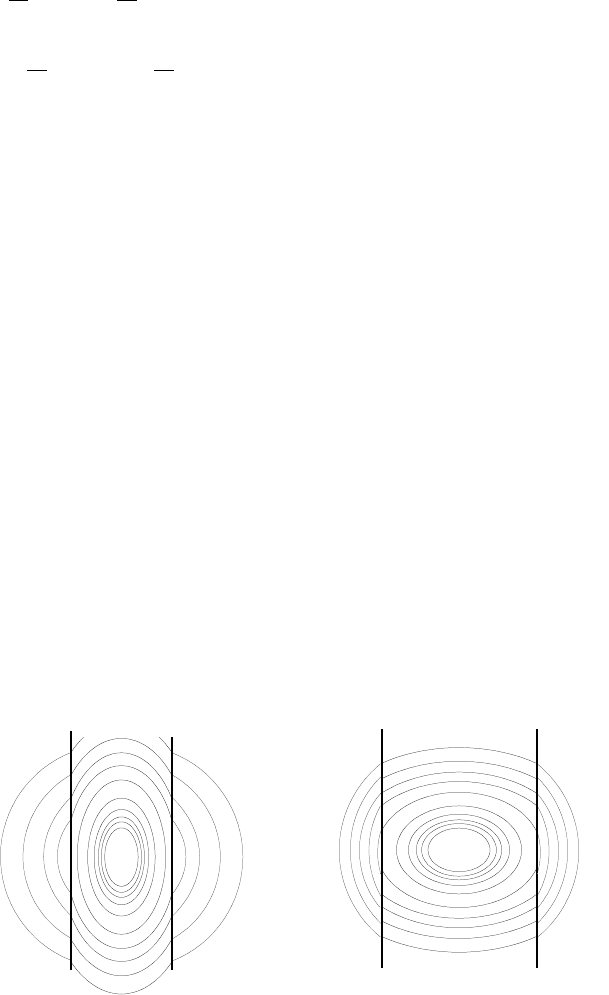
The solution obtained by substituting (3.207) in (3.205) and (3.206) needs to
be solved numerically. Qualitative illustrations are presented in Fig. 3.18 ( )
and Fig. 3.19 ( ). Those figures compare to Fig. 2.55 and Fig. 2.56, whereby
it is to note that field lines are shown there, while the equipotential surfaces are
drawn here.
3.7.3.3 Dirichlet’s Boundary Value Problem and the Fourier-Bessel Series
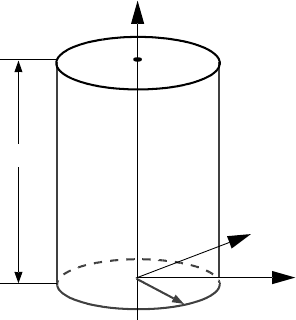
Consider the cylinder shown in Fig. 3.20 with radius and height h. We want to
find the potential inside the charge-free cylinder with the following boundary
conditions.
This is the cylindrical analogue to the example in Section 3.5.2.1. Again,
because of the rotational symmetry. For the radial part R, we may choose
either J
0
or I
0
, but not N
0
or K
0
since those let the potential at the axis diverge. The
potential has to also vanish for . J
0
has zeros for real arguments, I
0
does not.
The convenient choice is thus J
0
, For the z-dependency, we may choose an
approach, for example, based on (3.158) where only the sinh is an option because
of the restriction for . We suggest that solving the problem is
possible by superposing expressions of the form:
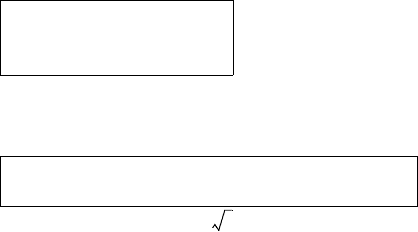
.
Hereby, the condition
(3.208)
ε
1
ε
2
<
ε
1
ε
2
>
Fig. 3.20
z
x
y
r
0
h
r
0
ϕϕ
h
r()= for zh=
ϕ 0= on the remaining surface .
m 0=
rr
0
=
ϕ 0= z 0=
J
0
kr() kzsinh
J
0
kr
0
()0=
3.7 Separation of Variables of Laplace’s Equation
178 Formal Methods of Electrostatics
has to be fulfilled. has an infinite number of zeros, like a trigonometric
function, which it approaches for large arguments. Suppose the zeros are at
then
(3.209)
where
,
(3.210)
and
or
.
(3.211)
This determines the eigenvalues of our problem. Note the similarity to the example
of Section 3.5.2.1, in particular eq. (3.69). This determines the Ansatz for this
problem:
.
(3.212)
This introduces us to a new kind of series expansions, i.e., expansions by functions
, which are typical for cylindrical problems, just as Fourier series are for
Cartesian problems. This is known as the Fourier-Bessel series – a fitting name,
which simultaneously expresses its similarity to Fourier series and its relation to
Cylindrical problems.
Before continuing to solve this problem, we would like to discuss Fourier-
Bessel series some more. They are generally understood as being series expansions
of the function , defined within the interval and are of the form
,
(3.213)
where is the n
th
zero of . Such expansions are useful only if the functions
form a complete system within this interval. This is the case. They are
also orthogonal to each other in the following sense
.
(3.214)
Strictly speaking, the functions are orthogonal to each other. This can
also be expressed in the following form: In the interval , the functions
are orthogonal with the weight function x. Using eq. (3.214) enables us
to write the coefficients of the expansion given in eq. (3.213):
J
0
λ
0n
J
0
λ
0n
()0= n 12…,,=
λ
01
λ
02
λ
03
…<<<
kr
0
λ
0n
=
kk
n
λ
0n
r
0
--------==
ϕ C
n
J
0
k
n
r() k
n
z()sinh
n 1=
∞
∑
=
J
0
k
n
r()
fx() 0 x 1≤≤
fx() C
n
J
m
λ
mn
x()
n 1=
∞
∑
=
λ
mn
J
m
J
m
λ
mn
x()
xJ
m
λ
mn
x()J
m
λ
mn'
x()xd
0
1
∫
1
2
---
J
m
' λ
mn
()[]
2
δ
nn'
=
xJ
m
λ
mn
x()
0 x 1≤≤
J
m
λ
mn
x()
C
n

179
so that
.
(3.215)
Substituting in the expansion (3.213) and comparison with
yields the completeness relation. In this case we have
.
(3.216)
With this result, we return to our example, i.e. the statement in eq. (3.212). It
fulfills all boundary conditions, except the one at . There, it shall be
, thus
and substituting
gives
where , i.e., . By eq. (3.215) it is now
Since
,
(3.217)
we finally obtain
fx()xJ
m
λ
mn'
x()xd
0
1
∫
C
n
xJ
m
λ
mn
x()J
m
λ
mn'
x()xd
0
1
∫
n 1=
∞
∑
=
C
n
1
2
---
J
m
' λ
mn
()[]
2
δ
nn'
n 1=
∞
∑
=
C
n'
1
2
---
J
m
' λ
mn'
()[]
2
=
C
n
2 xf x()J
m
λ
mn
x()xd
0
1
∫
J
m
' λ
mn
()[]
2
-----------------------------------------------------
=
C
n
fx() δ xx'–()fx'()x'd
∫
=
2x'J
m
λ
mn
x()J
m
λ
mn
x'()
J
m
' λ
mn
()[]
2
---------------------------------------------------------
n 1=
∞
∑
δ xx'–() =
zh=
ϕϕ
h
r()=
ϕ
h
r() C
n
J
0
k
n
r() k
n
h()sinh
n 1=
∞
∑
=
C
n
J
0
λ
0n
r
r
0
----
λ
0n
h
r
0
----
sinh
n 1=
∞
∑
=
ξ
r
r
0
----=
ϕ
h
r
0
ξ() C
n
λ
0n
h
r
0
----
sinh J
0
λ
0n
ξ()
n 1=
∞
∑
=
0 rr
0
≤≤ 0 ξ 1≤≤
C
n
λ
0n
h
r
0
----
sinh
2 ξ'J
0
λ
0n
ξ'()ϕ
h
r
0
ξ'()ξ'd
0
1
∫
J
0
' λ
0n
()[]
2
-------------------------------------------------------------------
=
J
0
' J
1
–=
3.7 Separation of Variables of Laplace’s Equation
180 Formal Methods of Electrostatics
.
(3.218)
As an example, consider the simple special case where
.
Here, one has to evaluate the integral
Where the relation was used. The final result is
.
(3.219)
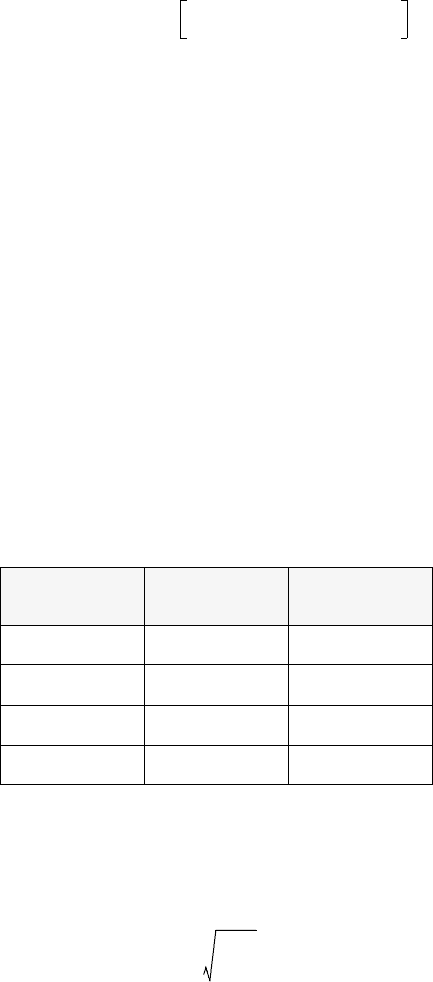
Table 3.1 lists the first four zeros of and the corresponding values of :
It follows, by the way, from eq. (3.177) that for large arguments
(3.220)
where
(3.221)
which is already rather accurate for .
Table 3.1
n
1 2.4048 + 0.5192
2 5.5201 - 0.3403
3 8.6537 + 0.2715
4 11.7915 - 0.2325
ϕξz,()
2 ξ'J
0
λ
0n
ξ'()ϕ
h
r
0
ξ'()ξ'd
0
1
∫
J
0
λ
0n
ξ()
λ
0n
z
r
0
-----------
sinh
J
1
λ
0n
()[]
2
λ
0n
h
r
0
----
sinh
---------------------------------------------------------------------------------------------------------------------------
n 1=
∞
∑
=
ϕ
h
r() ϕ
0
=
ϕ
0
ξ'J
0
λ
0n
ξ'()ξ'd
0
1
∫
ϕ
0
λ
0n
2
---------
zJ
0
z()zd
0
λ
0n
∫
ϕ
0
λ
0n
2
---------
zJ
1
z()[]
0
λ
0n
==
ϕ
0
λ
0n
2
---------
λ
0n
J
1
λ
0n
()
ϕ
0
J
1
λ
0n
()
λ
0n
-------------------------
.==
zJ
0
z()zd
∫
zJ
1
z()=
ϕ rz,() ϕ
0
2J
0
λ
0n
r
r
0
----
λ
0n
z
r
0
----
sinh
λ
0n
J
1
λ
0n
() λ
0n
h
r
0
----
sinh
-----------------------------------------------------------
n 1=
∞
∑
=
J
0
J
1
λ
0n
J
1
λ
0n
()
λ
0n
n
1
4
---–
π≈
J
1
λ
0n
() 1–()
n 1–
2
πλ
0n
------------≈
n 4=

181
3.7.3.4 Rotationally Symmetric Surface Charges in the Plane z = 0 and the
Hankel Transformation
Consider the surface charges that are distributed in the plane in a
rotationally symmetric way. The task is to find the thereby created potential.
Obviously, the potential may not diverge, neither at nor in the limit
. The Ansatz
(3.222)
meets these restrictions. For we have to fulfill
.
The first restriction immediately yields
.
With this result, the second restriction then gives
.
(3.223)
The task is now to solve this equation for f(k), that is, to express f(k) as a function
of . We have dealt with a similar example previously, which could be solved
by Fourier transformation in Cartesian coordinates (Sect. 3.5.2.3, but see also Sect.
3.7.3.1). However, the integral equation, which eq. (3.223) represents and needs
evaluation, can not be solved by Fourier transforms. On the other hand, we were
able to solve finite problems of similar kind by the Fourier series for the Cartesian
case, and by the analogous Fourier-Bessel series in case of cylindrical problems.
What we therefore need is, in analogy to the Fourier transform, an integral
transform for cylindrical problems, where for example, Bessel functions replace
the exponential functions. Such transforms do indeed exist. Those are the so-called
Hankel transforms. This relation is better expressed in the seldom used name
Fourier-Bessel transform. The Hankel transforms assigns to the function a
new function (its Hankel transform) in the following form:
(3.224)
and its inverse
.
(3.225)
σ r() z 0=
r 0=
z ∞±→
ϕ
1
f
1
k()J
0
kr() +kz()exp kd
0
∞
∫
=for z 0<()
ϕ
2
f
2
k()J
0
kr() kz–()exp kd
0
∞
∫
for z 0>()=
z 0=
r∂
∂ϕ
1
z 0=
r∂
∂ϕ
2
z 0=
–0=
z∂
∂ϕ
1
z 0=
z∂
∂ϕ
2
z 0=
–
D
2
D
1
–
ε
0
-------------------
σ r()
ε
0
-----------==
f
1
k() f
2
k() fk()==
fk()J
0
kr()2kkd
0
∞
∫
σ r()
ε
0
-----------=
σ r()
fx()
f
˜
k()
f
˜
k() x fx()J
m
kx()x d
0
∞
∫
=
fx() k f
˜
k()J
m
kx()k d
0
∞
∫
=
3.7 Separation of Variables of Laplace’s Equation

182 Formal Methods of Electrostatics
This relation rests upon the orthogonality relation
.
(3.226)
Multiplying (3.225) by , then integrating it from 0 to yields
This is just (3.224). The result of specifically expanding the δ-function is
and thus
.
(3.227)
That is just the completeness relation. Just as before for the Fourier transform, this
is an example of expanding by a basis system with a continuous eigenvalue
spectrum. The general formalism was explained in Sect. 3.6, It shall be noted that it
is possible (and actually done) to define the Hankel transform differently – that is,
with different factors. We have chosen a definition that makes the eqs. (3.224) and
(3.225) entirely symmetric.
Now, we are enabled to solve eq. (3.223). We multiply it by and then
integrate over r from 0 to
i.e.,
and
(3.228)
which solves our problem.
A simple example of how to apply these results is that of the uniformly
charged circular loop with
,
where q is its line charge. Then we write
kxJ
m
kx()J
m
k'x()xd
0
∞
∫
δ kk'–() =
xJ
m
k'x() ∞
fx()xJ
m
k'x()xd
0
∞
∫
kf
˜
k()J
m
kx()xJ
m
k'x()kd
0
∞
∫
xd
0
∞
∫
=
f
˜
k()δkk'–()kd
0
∞
∫
f
˜
k'() .==
δ xx'–()
f
˜
k() x'J
m
kx'()=
δ xx'–() kx'J
m
kx'()J
m
kx()x d
0
∞
∫
=
rJ
0
k'r()
∞
fk()J
0
kr()2krJ
0
k'r()kdrd
0
∞
∫
0
∞
∫
1
ε
0
-----
σ r()rJ
0
k'r()rd
0
∞
∫
=
2fk()δkk'–()kd
0
∞
∫
2fk'()
1
ε
0
-----
σ
˜
k'()==
fk()
1
2ε
0
--------
σ
˜
k()=
ϕ
12,
1
2ε
0
--------
σ
˜
k()J
0
kr() k– z()exp kd
0
∞
∫
=
σ
˜
k() rσ r()J
0
kr()rd
0
∞
∫
=
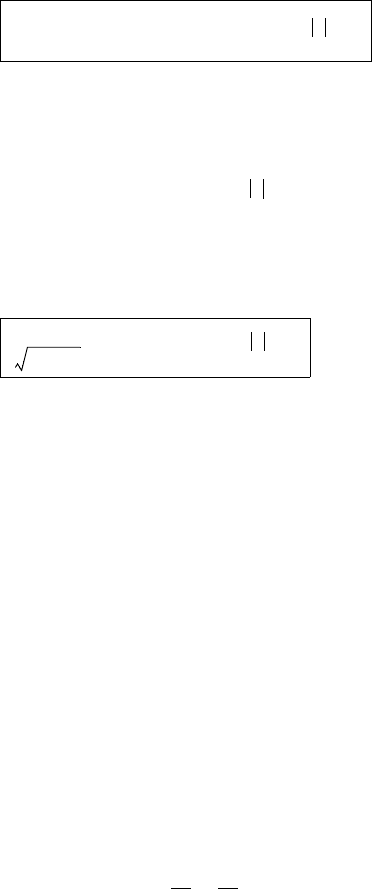
σ r() qδ rr
0
–()=
183
and
.
(3.229)
This represents a potential which we have already solved in a different way. As
previously (3.199), so eq. (3.229) is also identical to (3.200) (refer to [5], Vol. II, p
14, eq. (17)).
We may proceed with a point charge ( ) and obtain
,
(3.230)
having used
.
From this follows the requirement that
(3.231)
(refer to [5], Vol. II, p 9, eq. (18)).
3.7.3.5 Charge Distributions that are not Rotationally Symmetric
So far, we discussed problems with rotational symmetry. For this reason, the
parameter m was always zero ( ). Now, we want to solve problems by
separation in cylindrical coordinates that lack rotational symmetry. Consider a
cylinder of radius with a surface charge density of
(3.232)
that is a point charge at . The potential F can be written in the form
(3.233)
The expression at the top is for while the bottom one is for . This
Ansatz was chosen in such a way that F, together with the tangential component of
the electric field, is continuous for . Furthermore, it has to be
(3.234)
i.e.,
σ
˜
k() qrδ rr
0
–()J
0
kr()rd
0
∞
∫
qr
0
J
0
kr
0
()==
ϕ
12,
qr
0
2ε
0
--------
J
0
kr
0
()J
0
kr() k– z()exp k d
0
∞
∫
=
Q 2πr
0
qr
0
0 q ∞→,→,=
ϕ
12,
Q
4πε
0
------------
J
0
kr() k– z()exp kd
0
∞
∫
=
J
0
0() 1=
1
r
2
z
2
+
--------------------
J
0
kr() k– z()exp k d
0
∞
∫
=
m 0=
r
0
σϕz,()
Q
r
0
----
δ z()δϕ ϕ
0
–()=
z 0 ϕ,ϕ
0
==
F
ia,
I
m
kr()K
m
kr
0
()
I
m
kr
0
()K
m
kr()
f
m
k() mϕcos g
m
k() msin ϕ()+[]kz()cos kd
0
∞
∫
m 0=
∞
∑
=
rr
0
≤ rr
0
≥
rr
0
=
E
ar
E
ir
–()
rr
0
=
r∂
∂F
i
r∂
∂F
a
–
rr
0
=
Q
ε
0
r
0
----------
δ z()δϕ ϕ
0
–()==
3.7 Separation of Variables of Laplace’s Equation