
Lehner G. Electromagnetic Field Theory for Engineers and Physicists
Подождите немного. Документ загружается.


184 Formal Methods of Electrostatics
(3.235)
By means of the relations of Section 3.7.2, we obtain
.
(3.236)
Multiply (3.235) with and , respectively. Then
integrate over z and ϕ, using the orthogonality relation to obtain
(3.237)
(3.238)
. (3.239)
Now we substitute for z, that is, the charge is located at . With
these coefficients the result is
(3.240)
We obtain for the inverse distance between the points and
(3.241)
This formula is more general than the previous result of eq. (3.204). which may be
obtained in the limit and . The rational behind this is that
and for , that is, . Now, only the bottom
expression is of interest since .
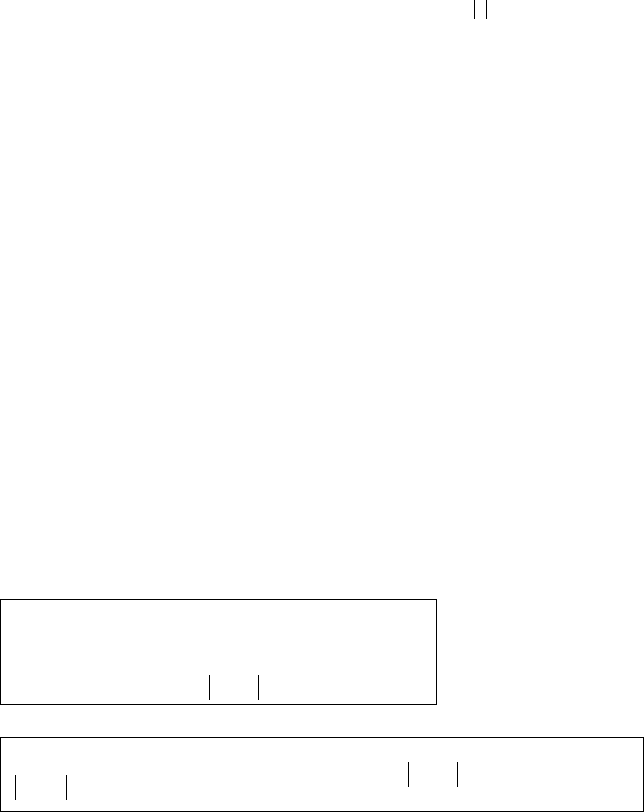
A different approach is also possible. Consider the plane carrying the
point charge Q at , which is represented by the surface charge density
.
(3.242)
The Ansatz for the potential is now
kkz()cos I
m
' kr
0
()K
m
kr
0
()I
m
kr
0
()K
m
' kr
0
()–[]
0
∞
∫
m 0=
∞
∑
f
m
k() mϕcos g
m
k() msin ϕ()+[]dk⋅
Q
r
0
----
δ z()δϕ ϕ
0
–()=
I
m
' kr
0
()K
m
kr
0
()I
m
kr
0
()K
m
' kr
0
()–
1
kr
0
-------=
k'zm'ϕcoscos k'zm'sin ϕcos
f
0
k()
Q
2π
2
ε
0
--------------=
f
m
k()
Q
π
2
ε
0
-----------
mϕ
0
cos ,= m 1≥
g
m
k()
Q
π
2
ε
0
-----------
msin ϕ
0
=
zz
0
– r
0
r
0
ϕ
0
z
0
,,()
F
ia,
Q
2π
2
ε
0
--------------
I
m
kr()K
m
kr
0
()
I
m
kr
0
()K
m
kr()
0
∞
∫
m 0=
∞
∑
=
kz z
0
–()[]cos m ϕϕ
0
–()[]cos 2 δ
0m
–()k . d⋅
r r ϕ z,,()r
0
r
0
ϕ
0
z
0
,,()
1
rr
0
–
----------------
2
π
---
I
m
kr()K
m
kr
0
()
I
m
kr
0
()K
m
kr()
0
∞
∫
m 0=
∞
∑
=
kz z
0
–()[]cos m ϕϕ
0
–()[]cos 2 δ
0m
–()k . d⋅
r
0
0= z
0
0=
I
0
0() 1= I
m
0() 0= m 1≥ I
m
0() δ
0m
=
rr
0
≥ 0=
z 0=
r
0
r
0
ϕ
0
0,,()
σ r ϕ,()
Q
r
0
----
δ rr
0
–()δϕϕ
0
–()=
185
.
(3.243)
This Ansatz was particularly chosen so that at the boundary , F and its
tangential derivatives are continuous. Furthermore we have
.
(3.244)
One uses the same procedure again: multiply with and
, respectively, then integrate over r and ϕ, apply the
orthogonality relation, and finally obtain
(3.245)
(3.246)
. (3.247)
All that remains now for a charge located at point , is to replace z by
. Applying the just obtained coefficients gives
(3.248)
and the inverse distance is
(3.249)
These equations represent a generalization of the previously found eqs. (3.230) and
(3.231). One obtains these equations by setting , and making use of
the fact that .
We were able to be rather brief here, as the procedure is similar to that of
Sections (3.7.3.1) and (3.7.3.4). Dividing the potentials (3.240) and (3.248) by Q
yields the respective Green’s functions . If there are arbitrary surface
charges
(3.250)
FJ
m
kr()f
m
k() mϕcos g
m
k() msin ϕ()+[]kz–()exp kd
0
∞
∫
m 0=
∞
∑
=
z 0=
E
z
z 0>()E
z
z 0<()–[]
z 0=
2kJ
m
kr()
0
∞
∫
m 0=
∞
∑
=
f
m
k() mϕcos g
m
k() msin ϕ()+[]kd⋅
Q
ε
0
r
0
----------
δ rr
0
–()δϕϕ
0
–()=
rJ
m
k'r() m'ϕ()cos⋅
rJ
m
k'r() m'ϕ()sin⋅
f
0
k()
Q
4πε
0
------------
J
0
kr
0
()=
f
m
k()
Q
2πε
0
------------
J
m
kr
0
()mϕ
0
cos ,= m 1≥
g
m
k()
Q
2πε
0
------------
J
m
kr
0
()msin ϕ
0
=
r
0
r
0
ϕ
0
z
0
,,()
zz
0
–
F r()
Q
4πε
0
------------
2 δ
0m
–()J
m
kr()J
m
kr
0
()
0
∞
∫
m 0=
∞
∑
=
kz z
0
––[]m ϕϕ
0
–()[]cosexp k d⋅
1
rr
0
–
----------------
2 δ
0m
–()J
m
kr()J
m
kr
0
() kz z
0
––[]m ϕϕ
0
–()[]cosexp k.d
0
∞
∫
m 0=
∞
∑
=
r
0
0 z
0
, 0==
J
m
kr
0
() J
m
0() δ
0m
==
G rr
0
,()
σσz ϕ,() =
3.7 Separation of Variables of Laplace’s Equation
186 Formal Methods of Electrostatics
or
(3.251)
prescribed on the cylinder at or on the plane surface , then the
related potentials are
,
(3.252)
where those integrals have to be evaluated over the cylinder surface or the plane
where
(3.253)
or
.
(3.254)
Notice that the rotationally symmetric charge distributions of Sections 3.7.3.1 and
3.7.3.4 are contained in this solution as special cases. Another special case shall be
discussed here as an example. Suppose that on the surface of a cylinder at ,
there exists a surface charge
.
(3.255)
This allows one to calculate based on (3.240) to obtain
(3.256)
Since the charge distribution (3.255) is independent of , integration over
yields
,
(3.257)
and one needs to investigate the Bessel functions for vanishing arguments. Using
eqs. (3.178) through (3.180) gives
(3.258)
and
,
(3.259)
where C, although it becomes infinitely large, is still insignificant and may be
arbitrarily chosen. Finally, one obtains
σσr ϕ,() =
rr
0
= zz
0
=
F r() G rr
0
,()σr
0
() A
0
d
∫
=
A
0
dr
0
dϕ
0
dz
0
=
A
0
dr
0
dϕ
0
dr
0
=
rr
0
=
σσ
0
nϕ cos=
F
ia,
r()
F
ia,
ϕ
0
d
0
2π
∫
z
0
d
∞–
+∞
∫
kd
0
+∞
∫
σ
0
2π
2
ε
0
--------------
I
m
kr()K
m
kr
0
()
I
m
kr
0
()K
m
kr()
m 0=
∞
∑
=
kz z
0
–()[]cos m ϕϕ
0
–()[]cos 2 δ
0m
–()r
0
nϕ
0
cos⋅
z
0
z
0
kz z
0
–()[]cos z
0
d
∞–
+∞
∫
2πδ k()=
I
n
kr()K
n
kr
0
()
k 0→
lim
1
2n
------
r
r
0
----
n
=
I
n
kr
0
()K
n
kr()
k 0→
lim
1
2n
------
r
0
r
----
n
=
for n 0≠
I
0
kr()K
0
kr
0
()
k 0→
lim Cr
0
ln–=
I
0
kr
0
()K
0
kr()
k 0→
lim Crln–=
for n 0=

187
(3.260)
and
,
(3.261)
where has been chosen. For the current case, it is easier to derive this
result by not using the general formulas. The independence of z, makes it possible
to start from the differential equation
,
(3.262)
which results from eqs. (3.156) and (3.160) with . We can immediately write
its solutions
,
(3.263)
. (3.264)
Thus, for a cylinder of radius (carrying arbitrary surface charges) we obtain
,
(3.265)
. (3.266)
Again, the coefficients were chosen such that the potential and thereby the
tangential components of the electric field are continuous at the surface of the
cylinder . If the surface charge (3.255) is prescribed, then the following
must hold
(3.267)
Obviously, except for A
n
, all terms A
m
and B
m
vanish:
F
ia,
σ
0
r
0
2nε
0
-----------
r
r
0
----
n
r
0
r
----
n
nϕ cos= for n 0≠
F
ia,
σ
0
r
0
ε
0
-----------
0
r
r
0
----ln
–= for n 0=
Cr
0
ln=
r
r∂
∂
r
r∂
∂
Rr() m
2
Rr()=
k 0=
RAr
m
B
1
r
m
------
+=for m 0≠
RABrln+= for m 0=
r
0
F
i
r
r
0
----
m
A
m
mϕ cos B
m
msin ϕ +()
m 1=
∞
∑
0+=
F
a
r
0
r
----
m
A
m
mϕ cos B
m
msin ϕ +()
m 1=
∞
∑
A
0
r
r
0
----ln+=
rr
0
=
E
ra
E
ri
–()
rr
0
=
r∂
∂F
i
r∂
∂F
a
–
rr
0
=
=
2m
r
0
-------
A
m
mϕ cos B
m
msin ϕ +()
A
0
r
0
------–
m 1=
∞
∑
=
σ
0
ε
0
------
nϕ cos=
3.7 Separation of Variables of Laplace’s Equation

188 Formal Methods of Electrostatics
,
(3.268)
, (3.269)
which just leads to the potentials provided above (3.260) and (3.261). Thus it
becomes now obvious that the direct calculation of the potentials is indeed simpler
than by using the general formulas. The reason for this is that here, the modified
Bessel functions converge onto the elementary solutions (3.263) for and
(3.264) for , which is obvious from eqs. (3.178) through (3.180). For
, we obtain the solutions we already know, i.e., the logarithmic potential
outside and a constant potential inside, where the reference point was chosen such
that the potential vanishes at the cylinder surface . Since,
,
(3.270)
thus
.
(3.271)
3.8 Separation of Variables for Laplace’s Equation in
Spherical Coordinates
3.8.1 Separation of Variables
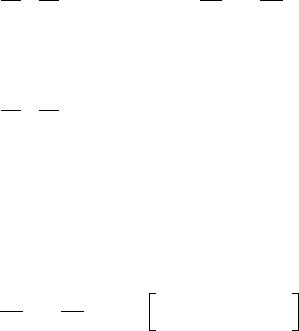
By eq. (3.43), the potential equation for the potential F in spherical polar
coordinates is
.
(3.272)
We attempt to separate this equation via the product solution
.
(3.273)
Multiplying eq. (3.272) by
yields
.
(3.274)
The first two terms solely depend on r and
θ
, the last solely on ϕ. This allows us to
separate the equations, for example, by substituting
A
n
σ
0
r
0
2nε
0
-----------= for n 0≠
A
o
σ
0
r
0
ε
0
-----------–= for n 0=
m 0≠
m 0=
n 0=
rr
0
=
2πr
0
σ
0
q=
F
a
σ
0
r
0
ε
0
-----------–
r
r
0
----ln
q
2πε
0
------------–
r
r
0
----ln==
1
r
2
-----
r∂
∂
r
2
r∂
∂ 1
r
2
θsin
----------------
θ∂
∂
θ
θ∂
∂
sin
1
r
2
θsin
2
------------------
∂
2
∂ϕ
2
---------
++
F 0=
Frθϕ,,()Rr()D θ()φϕ()=
r
2
θsin
2
Rr()D θ()φϕ()
------------------------------------
θsin
2
Rr()
-------------
r∂
∂
r
2
r∂
∂
Rr()
θsin
D θ()
------------
θ∂
∂
θ
θ∂
∂
D θ()sin
1
φϕ()
-----------
∂
2
∂ϕ
2
---------
φϕ()++0=
189
,
(3.275)
with its general solution
(3.276)
or equivalently
.
(3.277)
Here, m is an integer if the dependency on ϕ is periodic with the period . Then,
after dividing eq. (3.274) by we obtain
.
(3.278)
Now the first term solely depends on r, while the others solely depend on
θ
. This
permits further substitution
,
(3.279)
from which we obtain the general solution
,
(3.280)
which may instantly be verified by substitution. Substituting (3.279) into (3.278)
and multiplying by gives
.
(3.281)
This important differential equation is identified as the generalized Legendre
equation, and its solutions are the Associated Legendre functions. For the special
case of , they are called Legendre functions. Since this is a differential
equation of second order, there must be two linearly independent solutions, i.e., the
associated Legendre functions of the first and second kind. Only functions of the
first kind are finite everywhere on the sphere, i.e., for all values of
θ
, while the ones
of the second kind have singularities at the poles (at and ).
Therefore, when solving a problem that includes the poles, one has to exclude the
associated Legendre functions of the second kind, since they would cause the
potential to diverge. For this reason, we will not study them further, realizing that
we exclude certain boundary value problems, namely those which do not contain
the poles or . (Notice also that our choice of integer values for m
represents another restriction on the generality, as we always take the whole space
of angles and not just a fraction thereof). So, we only study the
associated Legendre functions of the first kind. These are finite only for n being
whole numbers. They are labelled by , and we have
.
(3.282)
1
φϕ()
-----------
∂
2
∂ϕ
2
---------
φϕ() m
2
–=
φ A
1
imϕ()exp A
2
imϕ–()exp+=
φ A
˜
1
mϕ()cos A
˜
2
mϕ()sin+=
2π
θsin
2
1
Rr()
-----------
r∂
∂
r
2
r∂
∂
Rr()
1
θsin D θ()
------------------------
θ∂
∂
θ
θ∂
∂
D θ()sin
m
2
θsin
2
-------------–+0=
1
Rr()
-----------
r∂
∂
r
2
r∂
∂
Rr() nn 1+()=
Rr() B
1
r
n
B
2
r
n 1+
------------+=
D θ()
1
θsin
-----------
θ∂
∂
θ
θ∂
∂
D θ()sin nn 1+()
m
2
θsin
2
-------------– D θ()+0=
m 0=
θ 0= θπ=
θ 0= θπ=
0 ϕ 2π≤≤
P
n
m
D θ() P
n
m
θcos()=
3. Separation of Variables of Laplace’s Equation8

190 Formal Methods of Electrostatics
Specifically for
.
(3.283)
Frequently, the variable
.
(3.284)
is introduced. This changes the differential equation (3.281) into
.
(3.285)
and
.
(3.286)
The functions
(3.287)
or
(3.288)
are called spherical harmonics, which is the same name as for the functions
.
(3.289)
The name reflects on the fact that when holding r fixed, the angles address all
points on the sphere with . The various sorts of spherical harmonics are
all solutions of the differential equation
,
(3.290)
which emerges from (3.274), when one separates only the radial part.
The can be expressed in the following way:
.
(3.291)
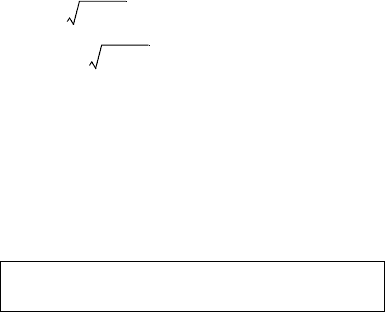
This makes the simplest spherical harmonics (Legendre polynomials)
.
(3.292)
etc. The simplest associated Legendre functions are
m 0=
D θ() P
n
0
θcos()P
n
θcos()==
ξθcos dξ,θsin dθ–==
ξ∂
∂
1 ξ
2
–()
ξ∂
∂
D ξ() nn 1+()
m
2
1 ξ
2
–
--------------– D ξ()+0=
D ξ() P
n
m
ξ()=
P
n
m
θcos()mϕ()cos
P
n
m
θcos()mϕ()sin
Y
n
m
P
n
m
θcos()imϕ()exp=
θϕ,
r const=
1
θsin
-----------
θ∂
∂
θ
θ∂
∂
sin nn 1+()
1
θsin
2
-------------
∂
2
∂ϕ
2
---------
++ F θϕ,()0=
P
n
m
P
n
m
ξ()
1 ξ
2
–()
m 2⁄
2
n
n!
----------------------------
d
nm+
dξ
nm+
-----------------
ξ
2
1–()
n
=
P
0
0
P
0
1==
P
1
0
P
1
ξθcos===
P
2
0
P
2
1
2
---
3ξ
2
1–()
1
2
---
3 θcos
2
1–()
1
4
---
32θcos 1+()== = =
191
(3.293)
etc. It is only necessary to evaluate m-values which are less or equal to n, as
.
(3.294)
To expand an arbitrary function within the interval by is possible.
For this purpose, use the orthogonality relation
.
(3.295)
As we have already seen before, the angular functions are orthogonal. For the
given interval , the orthogonality relations are
.
(3.296)
The exponential functions are also orthogonal
.
(3.297)
Note that according to the definition (3.135), the scalar product of complex
functions requires the use of the complex conjugate, that is, . The
relations (3.296) and (3.297) are equivalent because of
Of course, there is a continuum analogue for (3.297), which shall be given for
comparison:
.
(3.298)
This formula is the basis for the exponential Fourier transformation. It also reveals
an important expression for the δ-function.
.
(3.299)
Because of the symmetry of the cosine function and the anti-symmetry of the sine
function, this allows one to write
P
1
1
1 ξ
2
– θsin==
P
2
1
3ξ 1 ξ
2
–3θsin θcos 3 2⁄()2θsin== =
P
2
2
31 ξ
2
–()3 θsin
2
3
2
---
12θcos–()===
P
n
m
0= for mn>
1 ξ 1≤≤– P
n
m
P
n
m
ξ()P
n'
m
ξ()ξd
1–
+1
∫
2 nm+()!
2n 1+()nm–()!
-----------------------------------------
δ
nn'
=
0 ϕ 2π≤≤
mϕ()cos m'ϕ()cos ϕd
0
2π
∫
2
π
δ
mm'
f
or m
0
=
πδ
mm'
for m 12…,,=
=
mϕ()sin m'ϕ()sin ϕd
0
2π
∫
πδ
mm'
for m 12…,,==
mϕ()cos m'ϕ()sin ϕd
0
2π
∫
0=
imϕ()exp
imϕ()exp im'ϕ–()exp ϕd
0
2
π
∫
2πδ
mm'
=
im'ϕ–()exp
imϕ±()exp mϕ()cos imϕ()sin±=
ikx()exp ik'x–()exp xd
∞–
+∞
∫
ik k'–()x[]exp xd
∞–
+∞
∫
2πδ kk'–()==
δ kk'–()
1
2π
------
ik k'–()x[]exp xd
∞–
+∞
∫
=
3. Separation of Variables of Laplace’s Equation8
192 Formal Methods of Electrostatics
.
This represents a slightly different form from the previously used eq. (3.198).
The orthogonality of the respective product functions, i.e. of the spherical
harmonics, is a consequence of eqs. (3.295) through (3.297). For instance, it is
(3.300)
where we used the solid angle on the sphere’s surface
.
(3.301)
Furthermore, integrating over the entire solid angle gives
.
(3.302)
For the general solution of the potential we may try the form
(3.303)
as well as this form
.
(3.304)
The properties of the spherical harmonics are compiled in the previously
mentioned books [3-7] (see Section 3.7.2).
δ kk'–()
1
2π
------
kk'–()x[]cos ikk'–()x[]sin+{}xd
∞–
+∞
∫
=
1
2π
------
kk'–()x[]cos xd
∞–
+∞
∫
1
π
---
kk'–()x[]cos xd
0
+∞
∫
==
mϕ()cos m'ϕ()cos ϕd
0
2
π
∫
P
n
m
ξ()P
n'
m'
ξ()ξd
1–
+
1
∫
mϕ()cos P
n
m
θcos()m'ϕ()cos P
n'
m'
θcos() θcos()ϕdd
1–
+
1
∫
0
2
π
∫
=
mϕ()cos P
n
m
θcos()m'ϕ()cos P
n'
m'
θcos()θsin θϕdd
1–
+
1
∫
0
2
π
∫
=
mϕ()cos P
n
m
θcos()m'ϕ()cos P
n'
m'
θcos()dΩ
∫
=
2π
2n 1+
---------------
nm+()!
nm–()!
--------------------
δ
nn'
δ
mm'
for m 1≥
4π
2n 1+
---------------
nm+()!
nm–()!
--------------------
δ
nn'
δ
mm'
for m 0=
2π 1 δ
0m
+()
2n 1+
------------------------------
nm+()!
nm–()!
--------------------
δ
nn'
δ
mm'
==
θsin θϕdddΩ=
Y
n
m
Y
n'
m'
*
dΩ
∫
4π
2n 1+
---------------
nm+()!
nm–()!
--------------------
δ
nn'
δ
mm'
⋅⋅=
FA
n
r
n
B
n
1
r
n 1+
------------
+
P
n
m
θcos()C
nm
mϕ()cos D
nm
mϕ()sin+[]
m 0=
+n
∑
n 0=
∞
∑
=
FA
nm
r
n
B
nm
1
r
n 1+
------------
+
Y
n
m
θϕ,()
mn–=
∞
∑
n 0=
∞
∑
=
193
3.8.2 Examples
3.8.2.1 Dielectric Sphere in a Uniform Electric Field
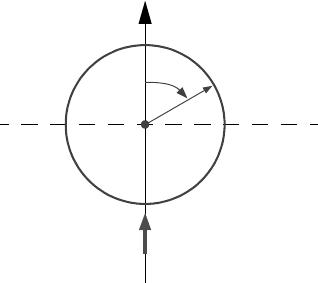
Let us start with a simple problem, whose solution is already known (Sect. 2.12),
namely the problem of a sphere in a uniform electric field (Fig. 3.21). The potential
of the outside applied electric field is
.
(3.305)
The potential due to the bound charges at the sphere’s surface has to be added. For
the inside potential we write
.
(3.306)
This is a result of the Ansatz (3.303) and the rotational symmetry . has
to be zero to avoid the singularity at the center of the sphere. Conversely, for the
outside space we write
.
Comparison with (3.292) reveals that , i.e., one might as well write:
.
(3.307)
F has to be continuous at so that the tangential components of E will be
continuous there. This requires that
Fig. 3.21
z
r
s
ε
i
ε
o
θ
E
o ∞,
E
a ∞,
F
a ∞,
E
a ∞,
z– E
a ∞,
r θcos–==
F
i
A
n
r
n
P
n
θcos()
n 0=
∞
∑
=
m 0= B
n
F
a
B
n
1
r
n 1+
------------
P
n
θcos()
n 0=
∞
∑
F
a ∞,
+=
θcos P
1
=
F
a
B
n
r
n 1+
------------ δ
n1
E
a ∞,
r–
P
n
θcos()
n 0=
∞
∑
=
rr
s
=
3. Separation of Variables of Laplace’s Equation8