
Lehner G. Electromagnetic Field Theory for Engineers and Physicists
Подождите немного. Документ загружается.

194 Formal Methods of Electrostatics
.
(3.308)
Furthermore, the normal component of D has to be continuous, which requires that
.
that is
.
(3.309)
The pair of equations for is
It has only trivial solutions
For , however, the solutions are
which gives
.
(3.310)
This gives the potential inside
and the electric field inside
A
n
r
s
n
B
n
r
s
n 1+
------------ δ
n1
E
a ∞,
r
s
–=
ε
i
∂F
i
∂r
--------
ε
a
∂F
a
∂r
---------
=
ε
i
nA
n
r
s
n 1–
ε
a
n 1+()
B
n
r
s
n 2+
------------
– ε
a
δ
n1
E
a ∞,
–=
n 1≠
A
n
r
s
n
B
n
r
s
n 1+
------------=
ε
i
A
n
r
s
n 1–
ε
a
n 1+()
B
n
r
s
n 2+
------------
.–=
A
n
0 B
n
, 0==
n 1=
A
1
r
s
B
1
r
s
2
------ E
a ∞,
r
s
–=
ε
i
A
1
2ε
a
B
1
r
s
3
------
– ε
a
E
a ∞,
–=
A
1
E
a ∞,
3ε
a
ε
i
2ε
a
+
-------------------
–=
B
1
E
a ∞,
r
s
3
ε
i
ε
a
–
ε
i
2ε
a
+
-------------------
=
F
i
E
a ∞,
3ε
a
ε
i
2ε
a
+
-------------------
r θcos–=
E
a ∞,
3ε
a
ε
i
2ε
a
+
-------------------
z–=

195
(3.311)
in accordance with our previous result (2.136). Thus for we obtain
(3.312)
which is in complete agreement with our previous result (2.139)
3.8.2.2 A Sphere Carrying an arbitrary Surface Charge
Consider a sphere of radius and the surface charge
.
(3.313)
By eq. (3.303) the potentials inside and outside are
.
(3.314)
The coefficients were chosen such that the potential is continuous at the sphere’s
surface at
.
(3.315)
This forces the tangential component of the electric field to be continuous. The
boundary condition
(3.316)
has to be met as well. Therefore
.
(3.317)
Multiplying this equation by and ,
respectively, then integrating over the solid angle and using the
orthogonality relation (3.300) gives the coefficients and , and thereby
solves the problem. We illustrate with a further example
(3.318)
i.e., a point charge Q on the surface of the sphere at location . We thus
obtain from Green’s function for this problem which can be used to solve the
general problem of eq. (3.313). We obtain
E
i
E
a ∞,
3ε
a
ε
i
2ε
a
+
-------------------
=
F
a
F
a
E
a ∞,
θcos
r
s
3
r
2
-----
ε
i
ε
a
–
ε
i
2ε
a
+
-------------------
r–
=
r
0
σσθϕ,()=
F
ia,
r
r
0
----
n
r
0
r
----
n 1+
P
n
m
θcos()A
nm
mϕcos B
nm
mϕsin+[]
m 0=
n
∑
n 0=
∞
∑
=
rr
0
=
F
i
r
0
θϕ,,()F
a
r
0
θϕ,,()=
E
ra
E
ri
–()
rr
0
=
r∂
∂F
i
r∂
∂F
a
–
rr
0
=
σθϕ,()
ε
0
------------------==
P
n
m
θcos()
2n 1+
r
0
---------------
A
nm
mϕcos B
nm
mϕsin+[]
m 0=
n
∑
n 0=
∞
∑
σθϕ,()
ε
0
------------------=
P
n'
m'
θcos()m'ϕcos P
n'
m'
θcos()m'sin ϕ
θsin θd ϕd
∫
A
nm
B
nm
σθϕ,()
Q
r
0
2
θ
0
sin
-------------------
δθ θ
0
–()δϕϕ
0
–()[]=
r
0
θ
0
ϕ
0
,,()
3. Separation of Variables of Laplace’s Equation8
196 Formal Methods of Electrostatics
This gives for
(3.319)
while is insignificant. For we obtain
(3.320)
. (3.321)
Finally we obtain
(3.322)
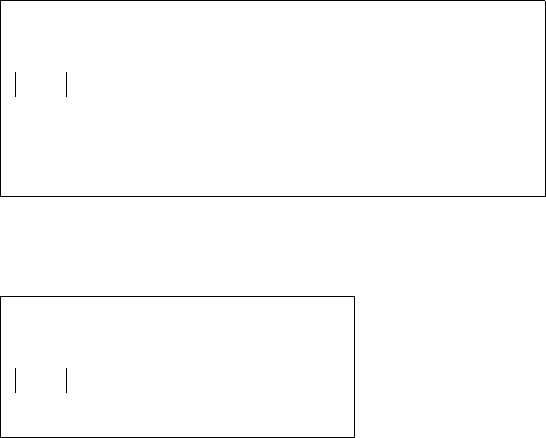
having used the trigonometric identity
.
The factor ensures that the special case of is covered correctly.
Notice the term in braces in eqs. (3.314) and (3.322): The upper term applies to the
case , while the lower one for covers . The potential is of course
(3.323)
2n 1+
r
0
---------------
P
n
m
θcos()P
n'
m'
θcos()
∫
°
m 0=
n
∑
n 0=
∞
∑
A
nm
mϕcos B
nm
mϕsin+[]
m'ϕcos
m'sin ϕ
θsin θd ϕd⋅
Q
ε
0
r
0
2
----------
δθ θ
0
–()δϕϕ
0
–()P
n'
m'
θcos()
∫
°
m'ϕcos
m'sin ϕ
θd ϕd=
Q
ε
0
r
0
2
----------
P
n'
m'
θ
0
cos()
m'ϕ
0
cos
m'sin ϕ
0
=
m 0=
A
n0
Q
4πε
0
r
0
-----------------
P
n
0
θ
0
cos()=
B
n0
m 0≠
A
nm
Q
2πε
0
r
0
-----------------
nm–()!
nm+()!
--------------------
P
n
m
θ
0
cos()mϕ
0
cos=
B
nm
Q
2πε
0
r
0
-----------------
nm–()!
nm+()!
--------------------
P
n
m
θ
0
cos()msin ϕ
0
=
F
ia,
Q
4πε
0
r
0
-----------------
2 δ
0m
–()
r
r
0
----
n
r
0
r
----
n 1+
m 0=
n
∑
n 0=
∞
∑
=
nm–()!
nm+()!
--------------------
P
n
m
θcos()P
n
m
θ
0
cos()m ϕϕ
0
–()[]cos⋅
mϕcos mϕ
0
cos msin ϕ mϕ
0
sin+ m ϕϕ
0
–()cos=
2 δ
0m
–() m 0=
rr
0
≤ rr
0
≥
F
ia,
Q
4πε
0
rr
0
–
-----------------------------=
1
4πε
0
------------
Q
r
2
r
0
2
2rr
0
θsin θ
0
cos ϕϕ
0
–()cos θcos θ
0
cos+[]–+
------------------------------------------------------------------------------------------------------------------------------------
.=
197
As a result of this, we obtain the oftentimes useful series of the inverse distance as
an expansion of spherical harmonics:
(3.324)
For a field point r on the positive z-axis, we have and . Thus
,
(3.325)
which simplifies eq. (3.324)
.
(3.326)
We obtain the Green’s function when dividing (eq. (3.322) by Q.
Then, the potential for an arbitrary distribution of surface charges (3.313) is
.
(3.327)
A specifically simple example is that of a constant surface charge
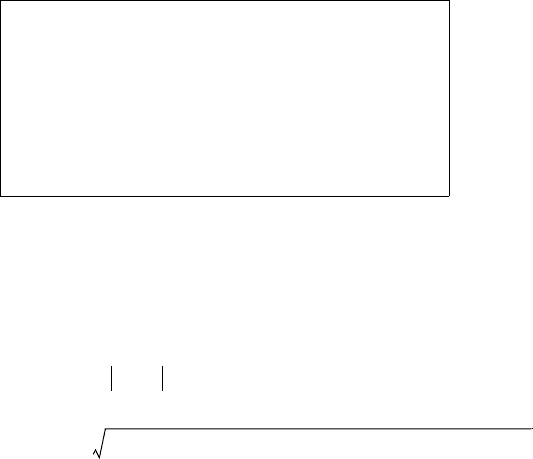
.
(3.328)
The only term left in this case is the one where which yields
,
(3.329)
as required.
The power series of the inverse distance as an expansion by spherical
harmonics is of significant interest for electromagnetic field theory. Consider an
arbitrary distribution of volume charges. We aim to compute the potential at an
arbitrary point outside the region of this volume charge distribution. Without
1
rr
0
–
----------------
1
r
0
----
2 δ
0m
–()
r
r
0
----
n
r
0
r
----
n 1+
m 0=
n
∑
n 0=
∞
∑
=
nm–()!
nm+()!
--------------------
P
n
m
θcos()P
n
m
θ
0
cos()m ϕϕ
0
–()[] . cos⋅
θ 0= θcos 1=
P
n
m
θcos()P
n
m
1() 0= = for m 1≥ P
n
0
1(), 1=
1
rr
0
–
----------------
1
r
0
----
r
r
0
----
n
r
0
r
----
n 1+
P
n
0
θ
0
cos()
n 0=
∞
∑
=
G rr
0
,() F
ia,
F r() G rr
0
,()σr
0
()r
0
2
∫
°
θsin
0
θ
0
d ϕ
0
d=
σσ
0
=
P
0
0
1=
F
ia,
1
4πε
0
r
0
-----------------
σ
0
r
0
2
1
r
0
r
----
θ
0
sin θ
0
d ϕ
0
d
∫
°
σ
0
r
0
ε
0
-----------
1
r
0
r
----
==
F
ia,
σ
0
r
0
ε
0
-----------
Q
4πε
0
r
0
-----------------=for rr
0
≤
σ
0
r
0
2
ε
0
r
-----------
Q
4πε
0
r
--------------= for rr
0
≥
=
3. Separation of Variables of Laplace’s Equation8
198 Formal Methods of Electrostatics
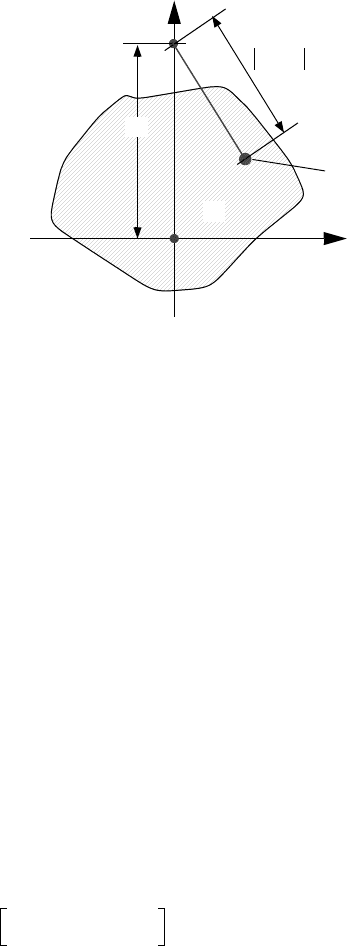
limiting the generality, we simplify by selecting that point to be on the z-axis,
where (see Fig. 3.22).
Then by eq. (3.326)
(3.330)
This is the so-called multipole expansion of the potential for a charge distribution.
It sorts these into contributions which decrease by powers of . These are the
moments of charge distribution and the individual terms (potentials) are called
monopole, dipole, quadrupole, octopole moment, etc. If the total charge is zero,
that is, if
,
(3.331)
then the dipole becomes the leading term of the series in this asymptotic charge
distribution, given that it does not also vanish. Now, consider for instance, a dipole
with charge at , or , then the dipole potential
becomes
(3.332)
as required for a point at the axis for which . If the dipole potential also
vanishes, then the next significant term is the quadrupole potential, etc. Notice that
θ 0=
Fig. 3.22
z
rr
0
–
ρ r
0
()
r
x
V
F r()
1
4πε
0
r
--------------
r
0
r
----
n
ρ r
0
()P
n
0
θ
0
cos()τ
0
d
V
∫
n 0=
∞
∑
=
F r()
1
4πε
0
r
--------------
ρ r
0
()τ
0
d
V
∫
1
4πε
0
r
2
-----------------
r
0
ρ r
0
()P
1
0
θ
0
cos()τ
0
d
V
∫
+=
1
4πε
0
r
3
-----------------
r
0
2
ρ r
0
()P
2
0
θ
0
cos()τ
0
d
V
∫
…++
r
n 1+()–
ρ r
0
()τ
0
d
∫
0=
Q± r
0
d 2⁄= θ
0
0= θ
0
π=
F
1
4πε
0
r
2
-----------------
d
2
---
Q
d
2
---
–
Q–()⋅+
Qd
4πε
0
r
2
-----------------
p
4πε
0
r
2
-----------------===
θcos 1=

199
even a point charge has multipole moments if it is not located at the origin. Using
eq. (3.330) for a point charge yields for the potential
,
(3.333)
which corresponds to the inverse distance eq. (3.326) for .
If the point for which the potential should be determined is not on the z-axis,
then the more general eq. (3.324) for the inverse distance has to be used, which
leads to inconvenient expressions for the individual multipole moments.
3.8.2.3 Dirichlet’s Problem for a Sphere
Consider the point charge at location inside a sphere with radius
. At the sphere’s surface, the potential is specified to be zero. Without any loss
of generality, we may assume that the charge is located on the z-axis ( ).
One obtains the potential by superposition of the specific solution of the
inhomogeneous Poisson equation, and the general solution of the homogeneous
Laplace equation, i.e., we try
.
(3.334)
The first term represents the potential of the point charge in the infinite space for
(top) and (bottom), which is eq. (3.322) and (3.325) applied to the
current case ( ). On the sphere’s surface is if
.
(3.335)
Therefore
.
(3.336)
The second term of (3.334) is the solution of Laplace’s equation for inside the
sphere ( ). It already considers the rotational symmetry of the field, which is
established by the charge on the z-axis. This second term represents the effect of
the charges on the sphere’s surface. This term on its own, using (3.335), gives
F
Q
4πε
0
r
--------------
r
0
r
----
n
P
n
0
θ
0
cos()
n 0=
∞
∑
=
rr
0
>
Qr
0
r
s
<() r
0
r
s
θ
0
0=
F
Q
4πε
0
r
0
-----------------
r
r
0
----
n
r
0
r
----
n 1+
P
n
0
θcos()
n 0=
∞
∑
A
n
r
r
s
----
n
P
n
0
θcos()
n 0=
∞
∑
+=
rr
0
≤ rr
0
≥
θ
0
0= F 0=
A
n
Q
4πε
0
r
0
-----------------
r
0
r
s
----
n 1+
–=
F
Q
4πε
0
------------
1
r
0
----
r
r
0
----
n
r
0
r
----
n 1+
r
0
n
r
n
r
s
2n 1+
---------------
– P
n
0
θcos()
n 0=
∞
∑
=
rr
s
≤
3. Separation of Variables of Laplace’s Equation8

200 Formal Methods of Electrostatics
(3.337)
This is nothing else than the potential of the charge
,
(3.338)
located on the z-axis at the point
.
(3.339)
As it has to be, one sees again that one can solve this problem by means of this
image charge. The radial electric field at the sphere’s surface is
.
(3.340)
This represents a surface charge
.
(3.341)
By (3.327), this surface charge on its own produces the potential inside the sphere
.
(3.342)
This is exactly the potential given by (3.337), which represents the additional
potential due to the image charge.
3.9 Multi-Conductor Systems
The previous sections illustrated the use of the method of separation of variables to
solve electrostatic problems by means of some examples. Although there are a
number of additional coordinate systems for which this separation is possible, it
has become clear that there are many problems where a solution using this
approach is not possible.
Analytical methods may not always be used, such as for systems consisting of
many charged conductors with a complicated geometry. Nevertheless, general
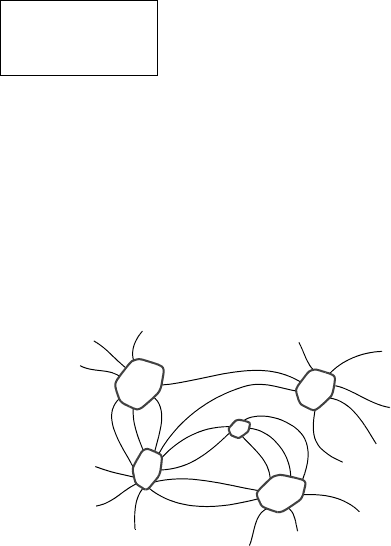
statements on arbitrary multi-conductor systems are possible. Fig. 3.23 shows such
F –
Q
r
s
r
0
----
⋅
4πε
0
--------------
1
r
s
2
r
0
-----
-----
⋅
r
n
r
s
2
r
0
-----
n
-------------
P
n
0
θcos()
n 0=
∞
∑
Q
4πε
0
------------–
r
0
n
r
n
r
s
2n 1+
---------------
P
n
0
θcos() .
n 0=
∞
∑
==
Q' Q
r
s
r
0
----
–=
r
0
'
r
s
2
r
0
-----=
E
r
()
rr
s
=
r∂
∂F
rr
s
=
–
Q
4πε
0
------------–
r
0
n
r
s
n 2+
------------
2n 1+[]P
n
0
θcos()
n 0=
∞
∑
==
σ
Q
4π
------–
r
0
n
r
s
n 2+
------------
2n 1+[]P
n
0
θcos()
n 0=
∞
∑
=
F
σ
Q
4πε
0
------------–
r
0
n
r
n
r
s
2n 1+
---------------
P
n
0
θcos()
n 0=
∞
∑
=
3.9 Multi-Conductor Systems 201
a system with five conductors. We will now analyze a system with n conductors.
They shall carry the charge , and their surface shall have the
potential . Then, the potential becomes
(3.343)
where is the distance from a variable point on conductor i to a fixed point on
conductor k. Furthermore, we use the relation
or
.
If we define
(3.344)
we may as well write
.
(3.345)
The coefficients of this linear relation do not depend on the charges, but solely
on the geometry of the conductors. The definition reveals, that they are symmetric
and nonnegative:
.
(3.346)
The fact that is not immediately obvious from (3.344). However, if we
consider a system of several conductors where only one caries a charge (for
example, the k-th one), then it becomes clear that
Fig. 3.23
Q
i
i, 12… n,, ,=
ϕ
i
i, 12… n,, ,=
ϕ
k
1
4πε
0
------------
σ
i
r
ik
------
A
i
∫
°
dA
i
i 1=
∞
∑
=
r
ik
ϕ
k
σ
k
A
k
∫
°
dA
k
ϕ
k
σ
k
A
k
∫
°
dA
k
ϕ
k
Q
k
1
4πε
0
------------
σ
i
σ
k
r
ik
-----------
dA
i
A
k
∫
°
A
i
∫
°
dA
k
i 1=
n
∑
===
ϕ
k
1
4πε
0
Q
i
Q
k
-------------------------
σ
i
σ
k
r
ik
-----------
dA
i
A
k
∫
°
A
i
∫
°
dA
k
Q
i
i 1=
n
∑
=
p
ki
1
4πε
0
Q
i
Q
k
-------------------------
σ
i
σ
k
r
ik
-----------
dA
i
A
k
∫
°
A
i
∫
°
dA
k
=
ϕ
k
p
ki
Q
i
i 1=
∞
∑
=
p
ki
p
ki
p
ik
=
p
ki
0≥
p
ki
0≥
202 Formal Methods of Electrostatics
.
The are called potential coefficients. We can imagine solving eq. (3.345) for
the charges:
,
(3.347)
where
.
(3.348)
is the determinant of the coefficients and is the minor determinant of
, i.e., the multiple of the determinant that results from by
deleting the k-th row and the i-th column. This symmetry transfers from the to
the , the so-called influence coefficients.
.
(3.349)
Beyond this, they differ from the by the following properties:
.
(3.350)
This can be seen by the following reasoning. All conductors except for one (for
example, i-th conductor) shall have the potential , while the i-th
conductor shall have the potential . Since the potential in the charge-free
space may not have any maxima or minima (Sect. 3.4), the configuration has to be
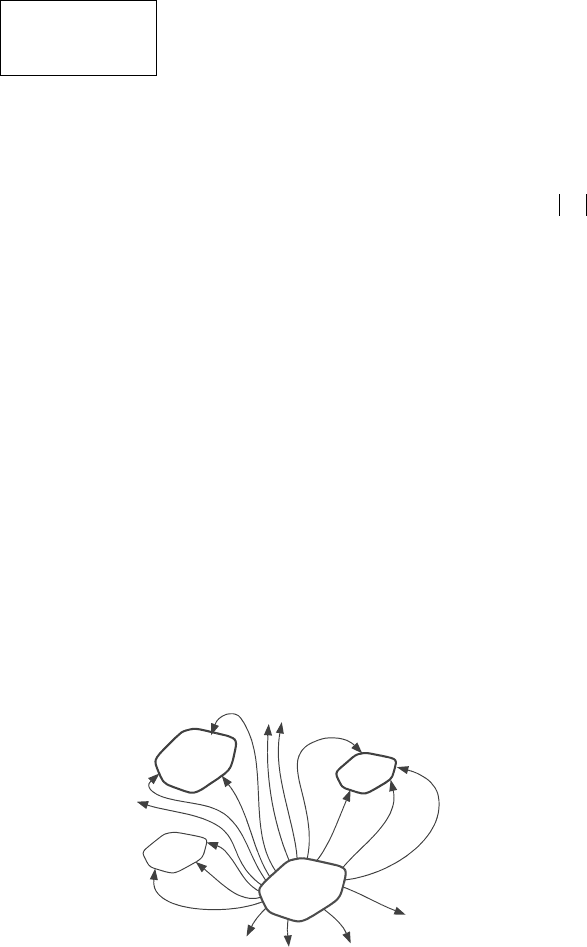
qualitatively as illustrated in Fig. 3.24. All lines of force that originate from
conductor i have to terminate at another conductor or extend toward infinity.
However, there may not be any line originating at a conductor with potential 0 and
ending at another conductor with zero potential.
p
ki
0≥
p
ki
Q
i
c
ik
ϕ
k
i 1=
∞
∑
=
c
ik
P
ik
∆
-------
=
∆
p
ik
P
ik
p
ki
1–()
ik+
∆ p
ki
=
p
ik
c
ik
c
ki
c
ik
=
p
ik
c
ii
0≥
c
ik
0≤ for ik≠
c
ik
i 1=
n
∑
0≥
ϕ
k
0 ki≠(),=
ϕ
i
1V=
Fig. 3.24
ϕ 0=
ϕ 0=
ϕ 0=
ϕ 1V=
3.9 Multi-Conductor Systems 203
The conductor i carries the positive charge . All other charges are negative.
Now, with eq. (3.347) we obtain
i.e.,
as claimed. On the other hand
and therefore as claimed
.
The overall charge is also positive, that is
therefore
,
which proves the last of our claims (3.350), where the coefficients only depend on
the geometry and not on the charge. Written more explicitly:
Expressed differently:
or
Q
i
Q
k
c
ki
ϕ
i
0 ik≠(),≤=
c
ki
0 ik≠(),≤
Q
i
c
ii
ϕ
i
0≥=
0 c
ii
≤
0 Q
k
k 1=
n
∑
≤ c
ki
ϕ
i
k 1=
n
∑
ϕ
i
c
ki
k 1=
n
∑
==
c
ki
k 1=
n
∑
0≥
Q
1
c
11
ϕ
1
c
12
ϕ
2
c
13
ϕ
3
…+++=
Q
2
c
21
ϕ
1
c
22
ϕ
2
c
23
ϕ
3
…+++=
Q
3
c
31
ϕ
1
c
32
ϕ
2
c
33
ϕ
3
…+++=
.
:
…………………………
Q
1
c
11
c
12
c
13
…+++()ϕ
1
c
12
ϕ
2
ϕ
1
–()c
13
ϕ
3
ϕ
1
–()…+++=
Q
2
c
21
ϕ
1
ϕ
2
–()c
22
c
21
c
23
…+++()ϕ
2
c
23
ϕ
3
ϕ
2
–()…+++=
Q
3
c
31
ϕ
1
ϕ
3
–()c
32
ϕ
2
ϕ
3
–()c
33
c
31
c
32
…+++()ϕ
3
…++ +=
.
:
…………………………