
Lehner G. Electromagnetic Field Theory for Engineers and Physicists
Подождите немного. Документ загружается.


204 Formal Methods of Electrostatics
(3.351)
where
.
(3.352)
Equation (3.351) establishes a relation between charges and potential differences
(Voltages). The are therefore called capacitance coefficients. They are a
generalization of the capacitance of a capacitor as defined in Sect. 2.7.
The electrostatic energy of the conductor system can be calculated as follows.
Using eq. (2.173) shows
,
which, when using (3.345) and (3.347) yields
.
(3.353)
Another useful theorem, sometimes called the reciprocity theorem, is the
result of another interesting application of the influence coefficients. Let us
consider two different states of a system consisting of n conductors. The potentials
shall belong to the charges and the potentials shall belong to the charges
. Then we write
then
.
(3.354)
The following example shall serve as a simple application. The charge shall be
distributed on a sphere with arbitrarily small radius. This small sphere shall be
located a distance r away from the center of a larger, grounded sphere of radius
Q
1
C
11
ϕ
1
C
12
ϕ
1
ϕ
2
–()C
13
ϕ
1
ϕ
3
–()…+++=
Q
2
C
21
ϕ
2
ϕ
1
–()C
22
ϕ
2
C
23
ϕ
2
ϕ
3
–()…++ +=
Q
3
C
31
ϕ
3
ϕ
1
–()C
32
ϕ
3
ϕ
2
–()C
33
ϕ
3
…+++=
.
:
…………………………
C
ii
c
ik
k 1=
n
∑
0≥=
C
ik
c
ik
0≥–= ik≠()
C
ii
W
1
2
---
ϕ
i
σ
i
dA
i
A
∫
°
k 1=
n
∑
1
2
---
ϕ
i
Q
i
k 1=
n
∑
==
W
1
2
---
p
ik
Q
i
Q
k
ik, 1=
n
∑
1
2
---
c
ik
ϕ
i
ϕ
k
ik, 1=
n
∑
==
ϕ
i
Q
i
ϕ
˜
i
Q
˜
i
ϕ
˜
i
Q
i
i 1=
n
∑
ϕ
˜
i
c
ik
ϕ
k
k 1=
n
∑
i 1=
n
∑
c
ki
ϕ
k
ϕ
˜
i
ik, 1=
n
∑
c
ik
ϕ
i
ϕ
˜
k
ik, 1=
n
∑
===
ϕ
i
c
ik
ϕ
˜
k
k 1=
n
∑
i 1=
n
∑
ϕ
i
Q
˜
i
,
i 1=
n
∑
==
ϕ
˜
i
Q
i
i 1=
n
∑
ϕ
i
Q
˜
i
i 1=
n
∑
=
Q
1
3.9 Multi-Conductor Systems 205
. What are the influence charges on the large (grounded) sphere? We will
call these influence charges . Let us consider two different states of the two-
conductor system. The first state is just an arbitrary state to be used for comparison
but should be easy to calculate. The second state is the one we would like to solve.
From (3.354), we find
.
(3.355)
This solves the problem. Of course, is just the image charge, which is known
from Sect. 2.6, when substituting . For the case where , the problem
becomes trivial. The influence charge then has to be , because all force
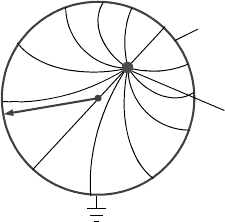
lines have to terminate on the grounded sphere (see Fig. 3.25). This can be
obtained formally because of
.
r
s
rr
s
>()
Q
2
1)
Q
˜
1
0 ,= Q
˜
2
Q
˜
2
=
ϕ
˜
1
Q
˜
2
4πε
0
r
--------------
,= ϕ
˜
2
Q
˜
2
4πε
0
r
s
-----------------=
2)
Q
1
Q
1
,= Q
2
Q
2
=
ϕ
1
ϕ
1
,= ϕ
2
0=
Q
˜
1
ϕ
1
Q
˜
2
ϕ
2
+0Q
1
ϕ
˜
1
Q
2
ϕ
˜
2
+==
Q
2
Q
1
ϕ
˜
1
ϕ
˜
2
------
– Q
1
r
s
r
----
–==
Q
2
z
1
r= rr
s
<
Q
2
Q
1
–=
Fig. 3.25
Q
2
Q
1
r
s
ϕ
1
˜
ϕ
2
˜
Q
˜
2
4πε
0
r
s
-----------------==
206 Formal Methods of Electrostatics
3.10 Plane Electrostatic Problems and the Flux Function
Oftentimes, there are problems that only depend on two Cartesian coordinates, i.e.,
on x and y, but not z. Such planar problems have a number of special properties
which we will discuss in this section.
If the field E is independent of z, then all derivatives of z vanish, i.e., we can
write the strictly formal statement
(3.356)
applied to E gives
In particular
or
.
(3.357)
We conclude that the component is of no particular significance. It may assume
any value, but has to be constant in space. An interesting equation comes from the
third component of , namely
.
(3.358)
This equation can be satisfied by means of an arbitrary function if we define
.
(3.359)
Of course, this should not come as a surprise. It only shows that the electrostatic
field, just as in the general, three-dimensional case, can be obtained from a
potential.
For the charge-free space we also have
.
(3.360)
If we now, by means of an arbitrary scalar function, define
z∂
∂
0=
E∇×
y∂
∂E
z
z∂
∂E
y
–
z∂
∂E
x
x∂
∂E
z
–
x∂
∂E
y
y∂
∂E
x
–,,
=
y∂
∂E
z
x∂
∂E
z
–
x∂
∂E
y
y∂
∂E
x
–,,
0 .==
y∂
∂E
z
x∂
∂E
z
0==
E
z
const=
E
z
E∇×
x∂
∂E
y
y∂
∂E
x
–0=
ϕ
E
x
x∂
∂ϕ
–=
E
y
y∂
∂ϕ
–=
E∇•
x∂
∂E
x
y∂
∂E
y
+0==
3.10 Plane Electrostatic Problems and the Flux Function 207
,
(3.361)
then, eq. (3.360) is obviously satisfied:
.
This function is called flux function. Thus, one may calculate the field from the
potential as well as from the flux function . According to eqs. (3.359) and
(3.361), and belong to the same field if
.
(3.362)
These are the Cauchy-Riemann differential equations. We will discuss their
fundamental significance for function theory (complex analysis) in the next
section. The considerable consequences of and meeting these conditions will
then become obvious. Prior, we want to mention a few properties of flux functions.
1. Eqs. (3.359) and (3.360) yield for the charge-free space
(3.363)
which we already learned in Section 2.1. Furthermore – and this is new – the
consequence of eqs. (3.358) and (3.361) is
.
(3.364)
Both, and satisfy Laplace’s equation and thus, are harmonic functions.
2. is constant along a force line. We also calculate
(3.365)
The vector E is therefore perpendicular to the vector . Since is per-
pendicular to the surface , E has to lie in this plane, which con-
cludes the proof of our claim. On the other hand, E is perpendicular to the
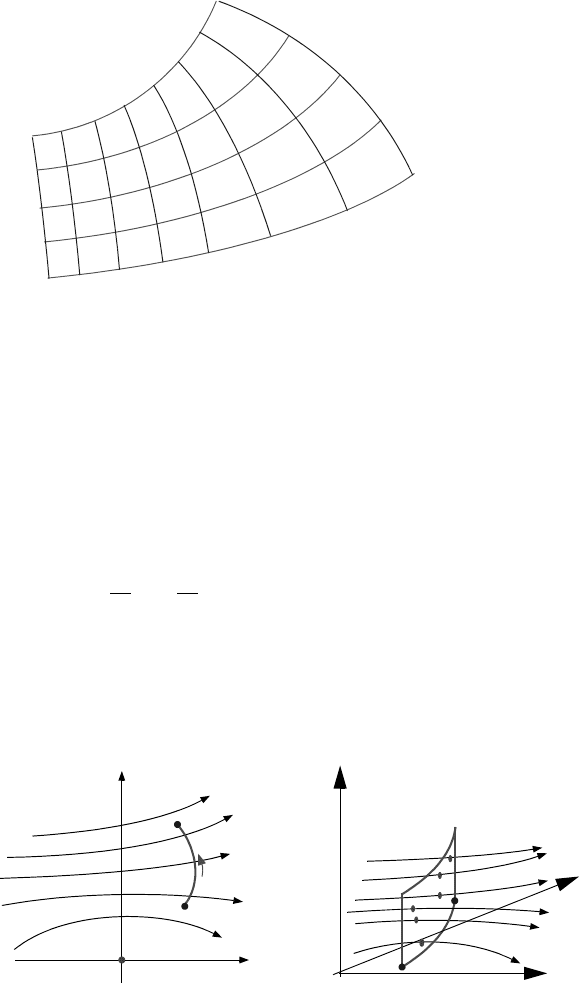
planes , that is, the planes and intersect
everywhere with a right angle (Fig. 3.26). The surfaces and
E
x
y∂
∂ψ
– =
E
y
x∂
∂ψ
=
x∂
∂
y∂
∂ψ
–
y∂
∂
x∂
∂ψ
+0=
ψ
ϕψ
ϕψ
x∂
∂ϕ
y∂
∂ψ
=
y∂
∂ϕ
x∂
∂ψ
–=
ϕψ
x∂
∂
x∂
∂ϕ
–
y∂
∂
y∂
∂ϕ
–
+ ∇
2
ϕ–0==
x∂
∂
x∂
∂ψ
y∂
∂
y∂
∂ψ
–
– ∇
2
ψ 0==
ϕψ
ψ
E ψ∇• E
x
x∂
∂ψ
E
y
y∂
∂ψ
+=
E
x
E
y
E
y
E
x
–()+0 .==
ψ∇ψ∇
ψ const=
ϕ const= ϕ const= ψ const=
ϕ const=
208 Formal Methods of Electrostatics
form, for example, in the plane an orthogonal grid of two
perpendicular arrays of curves (orthogonal trajectories).
3. The flux function gets is name, among other things, from the fact that it is
closely related to the electric flux (current) that “flows” between two points in
the plane (Fig. 3.27). Let the points A and B be connected by some contour.
The flux passing through this contour per unit length is then
.
(3.366)
Fig. 3.26
ϕϕ
1
=
ϕϕ
2
=
ϕϕ
3
=
ϕϕ
4
=
ψψ
1
=
ψψ
2
=
ψψ
3
=
ψψ
4
=
ψ const= z 0=
Fig. 3.27
y
ds
x
A
B
z
x
A
B
y
Ω
L
---- ε
0
E
⊥
sd
A
B
∫
ε
0
Esd×()
z
A
B
∫
ε
0
E
x
ydE
y
xd–()
A
B
∫
== =
ε
0
y∂
∂ψ
– yd
x∂
∂ψ
xd–
A
B
∫
ε
0
ψd
A
B
∫
–==
Ω
L
---- ε
0
ψ B() ψA()–[]–=

3.10 Plane Electrostatic Problems and the Flux Function 209
Notice that, except for the factor , the difference between the flux function
at two different points represents the flux that passes between them (per unit
length in z direction).
Formally speaking, the flux function was introduced by statement (3.361) to
solve eq. (3.360). This approach is not restricted to plane problems, but applicable
more generally to any problem which is two dimensional by any kind of symmetry.
If one, for instance, takes a cylindrical problem that is rotationally symmetric (i.e.,
independent of the azimuthal angle), then
,
(3.367)
with
.
(3.368)
Furthermore, by (3.32) for cylindrical coordinates we have
.
(3.369)
The Ansatz
,
(3.370)
satisfies eq. (3.369) for every . Comparison of (3.368) and (3.370) reveals
.
(3.371)
These equations replace (3.362). Despite a great similarity, there is also a
significant difference: Cauchy-Riemann equations emerge only from the plane
case. The consequence is that the function-theoretical methods which we will
discuss in the next section may only be applied to plane problems – a regrettable
restriction.
ε
0
ϕϕrz,()=
E
r
r∂
∂ϕ
– =
E
z
z∂
∂ϕ
–=
E∇•
1
r
---
r∂
∂
rE
r
z∂
∂
E
z
+=
E
r
1
r
---
z∂
∂ψ
–=
E
z
1
r
---
r∂
∂ψ
=
ψ
E
r
r∂
∂ϕ
–
1
r
---
z∂
∂ψ
–==
E
z
z∂
∂ϕ
– +
1
r
---
r∂
∂ψ
==
210 Formal Methods of Electrostatics
3.11 Analytic Functions and Conformal Mappings
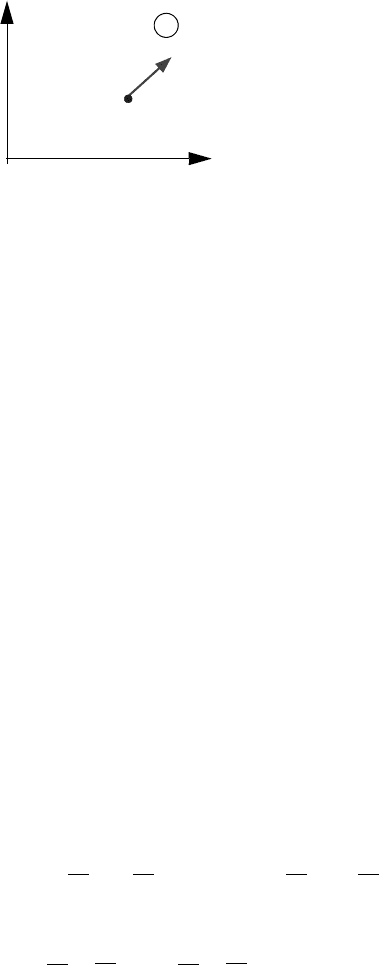
A point in an plane can be addressed “uniquely” (i.e., unique in both
directions) by a complex number
.
Notice that z here has no relation to the third Cartesian coordinate, which is anyway
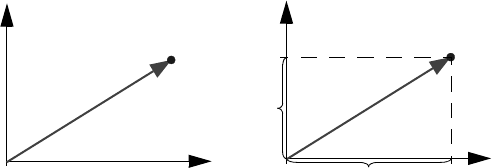
irrelevant for plane problems. The complex number is a two-dimensional quantity,
whose properties are quite similar to those of a two-dimensional vector. This,
therefore, allows to identify z with the vectors (see Fig. 3.29).
.
(3.372)
In any case, the complex number z and the vector r address the same point. It is
also possible to use Vector Calculus on complex numbers, where those operations
simplify in some sense. The scalar product, for instance,
,
(3.373)
and the vector product, or more precisely, its only component that does not vanish
in the plane case is
.
(3.374)
Now, multiplying two complex numbers,
and
,
gives
(3.375)
xy,()
zxiy+=
xy,〈〉
Fig. 3.28
y
x
z = (x + iy)
r
y
x
(x,y)
y
x
r
zxiy+ xy,〈〉⇔ r==
r
1
r
2
• x
1
y
1
,〈〉x
2
y
2
,〈〉• x
1
x
2
y
1
y
2
+==
r
1
r
2
× x
1
y
1
,〈〉x
2
y
2
,〈〉× x
1
y
2
y
1
x
2
–==
z
1
x
1
iy
1
+=
z
2
x
2
iy
2
+=
z
1
*
z
2
x
1
iy
1
–()x
2
iy
2
+()=
x
1
x
2
y
1
y
2
ix
1
y
2
y
1
x
2
–()++=
r
1
r
2
• ir
1
r
2
× .+=
3.11 Analytic Functions and Conformal Mappings 211
z
*
is the complex conjugate, or simply conjugate of the complex number z
.
(3.376)
Eq. (3.375) states that the product can be interpreted in the following way:
The real part is the scalar product and the imaginary part is the vector product of
the two “vectors” and .
We may now study any function of complex numbers, i.e., complex
functions, for example,
,
or
,
etc. Each such function can be split into a real part and an imaginary part, that is,
we can always express it in the following form
.
(3.377)
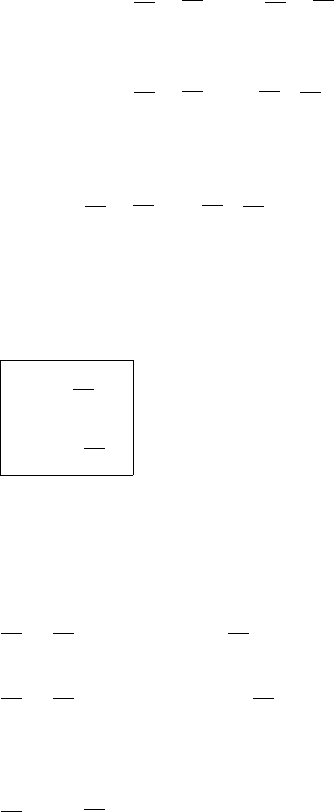
Differentiating such functions does not always provide a unique result. We start by
defining the differential quotient, as we know it from real functions (Fig. 3.29)
.
(3.378)
The general result will depend on the direction of the vector . In any case, the
definition (3.378) yields
.
z
*
xiy–=
z
1
*
z
2
z
1
z
2
f
z() z
2
x
2
y
2
– i2xy+==
f
z() z
*
xiy–==
f
z() uxy,()iv x y,()+=
Fig. 3.29
y
x
P
∆
z
z
f ' z()
df z()
dz
------------
fz ∆z+()fz()–
∆z
-------------------------------------
∆z 0→
lim==
∆z
f ' z()
ux ∆x+ y ∆y+,()iv x ∆x+ y ∆y+,()uxy,()– iv x y,()–+
∆xi∆y+
--------------------------------------------------------------------------------------------------------------------------------------------
∆x ∆y, 0→
lim=
uxy,()
x∂
∂u
∆x
y∂
∂u
∆yivxy,()i
y∂
∂v
∆xi
y∂
∂v
∆yuxy,()– iv x y,()–+++ + +
∆xi∆y+
-----------------------------------------------------------------------------------------------------------------------------------------------------------------------
--
∆x ∆y, 0→
lim=
x∂
∂u
i
x∂
∂v
+
∆x
y∂
∂u
i
y∂
∂v
+
∆y+
∆xi∆y+
------------------------------------------------------------------------
∆x ∆y, 0→
lim=
212 Formal Methods of Electrostatics
If
,
then the parameter c defines the direction which we take from point P when
differentiating. This gives
.
If the two expressions in parenthesis are equal, then
,
(3.379)
which also means that is independent of c, i.e. the direction. It is important
to realize that eq. (3.379) is necessary for the direction-independence of the
derivative. Eq. (3.379) therefore provides a set of necessary and sufficient
conditions for a function to be uniquely differentiable – the previously mentioned
Cauchy-Riemann differential equations:
(3.380)
If these conditions are satisfied, then the function is uniquely differentiable.
The function is then termed to be an analytic function. It is
furthermore necessary that and finite. If, for so-called singular points,
or , then this function is not analytic there.
For instance, the function is analytic because
,
whereby we have to exclude the origin, a singular point. The function , on the
other hand, is not analytic since
.
The square of the absolute value is also not analytic
,
i.e.
∆yc∆x=
f ' z()
x∂
∂u
i
x∂
∂v
+
∆x
y∂
∂u
i
y∂
∂v
+
c∆x+
∆xic∆x+
---------------------------------------------------------------------------
∆x 0→
lim=
f ' z()
x∂
∂u
i
x∂
∂v
+
i–
y∂
∂u
y∂
∂v
+
ic+
1 ic+
------------------------------------------------------------------
∆x 0→
lim=
f ' z()
x∂
∂u
i
x∂
∂v
+ i–
y∂
∂u
y∂
∂v
+==
f ' z()
∂u
∂x
------
y∂
∂v
=
∂u
∂y
------
x∂
∂v
. –=
uiv+
f ' z() uiv+=
f ' z() 0≠
f ' z() 0= f ' z() ∞⇒
z
2
x∂
∂u
x∂
∂
x
2
y
2
–()2x
y∂
∂v
===
y∂
∂u
y∂
∂
x
2
y
2
–()2y–
x∂
∂v
–===
z
*
x∂
∂u
1
y∂
∂v
≠ 1–==
zz
*
zz
*
x
2
y
2
+=
3.11 Analytic Functions and Conformal Mappings 213
and
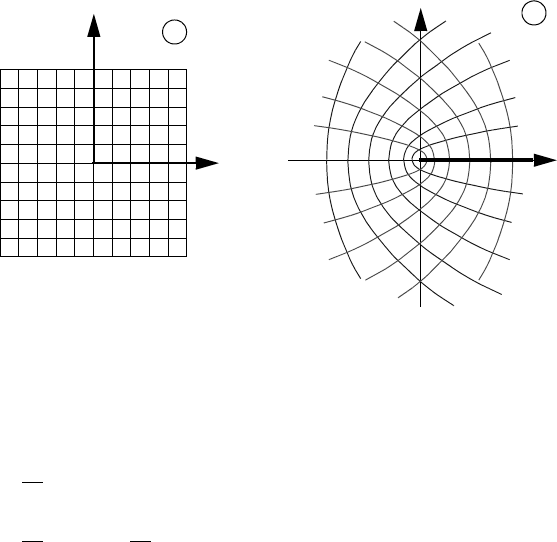
Any complex function , whether analytic or not, can be understood as a
mapping of the complex plane z onto the plane f or vice versa. As illustration, we
choose the example
where
The straight line in the z-plane corresponds to a curve in the f-plane
(Fig. 3.30), whose parameter representation is
Eliminating y, results in the equation for the curve
.
This is the equation of a parabola that opens to the left and whose focal point is at
the origin. Conversely, the straight line corresponds to the curve
uxy,()x
2
y
2
+=
vxy,()0=
x∂
∂u
2x
∂v
∂y
-----
≠ 0 ==
y∂
∂u
2y
x∂
∂v
–≠ 0 .==
fz()
fz() z
2
x
2
y
2
–2ixy+==
uxy,()x
2
y
2
–=
vxy,()2xy .=
xx
i
=
Fig. 3.30
y
x
z
f
v
u
yy
1
=
yy
2
=
yy
4
=
yy
3
=
xx
1
=
xx
2
=
xx
3
=
xx
4
=
ux
i
2
y
2
–=
v 2x
i
y . =
ux
i
2
v
2
4x
i
2
()⁄–=
yy
i
=