
Lehner G. Electromagnetic Field Theory for Engineers and Physicists
Подождите немного. Документ загружается.

214 Formal Methods of Electrostatics
or
,
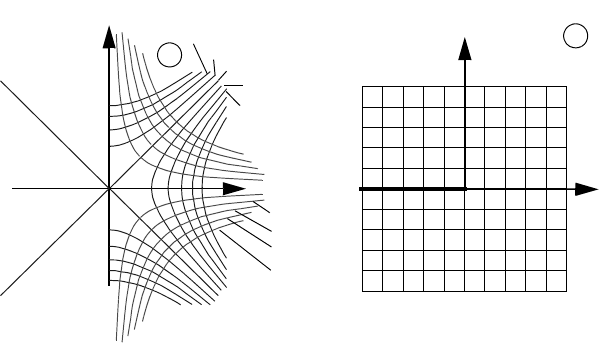
that is now a parabola, which opens to the right and whose focal point is also at the
origin. Collectively, one obtains 2 sets of parabolas. All have their focal points at
the origin, i.e., they are confocal. As a side note, u and v, together with z from a
curvilinear orthogonal coordinate system in which the three-dimensional Laplace
equation can be separated. The “coordinates of this parabolic cylinder” generate
one of the 11 “separable” coordinate systems. The two sets of parabolas intersect
each other at a right angle, which as we shall see, is no accident. This mapping has
a number of peculiar characteristics. Each half of the x-axis transforms into the
positive half of the u-axis; each half of the y-axis transforms into the negative half
of the u-axis. Mapping of only half of the x-y-plane results in a complete coverage
of the u-v-plane. One might imagine the u-v-plane as a result of a distortion of the
x-y-plane in such a way that the negative x-axis is bent over towards the positive
one.
Conversely, the lines transform into hyperbolas
,
as well as the lines (Fig. 3.31), where the whole u-v-plane (f-plane) is
mapped onto one half of the x-y-plane.
A little further on, we will discuss what really happens here (see Sect. 3.12,
Example 5).
The v-axis ( ) transforms into the pair of lines
,
ux
2
y
i
2
–=
v 2xy
i
.=
uv
2
4y
i
2
()⁄ y
i
2
–=
uu
i
=
x
2
y
2
– u
i
=
vv
i
=
y
x
f
v
u
Fig. 3.31
z
vv
1
=
vv
2
=
vv
3
=
uu
1
=
uu
2
=
uu
3
=
uu
4
=
vv
4
=
vv
5
=
uu
5
=
u 0=
x
2
y
2
– xy+()xy–()0==
3.11 Analytic Functions and Conformal Mappings 215
i.e.,
and the u-axis ( ) transforms into the pair of lines
.
i.e.,
or
.
If the mapping function is analytic, as in the just discussed example, then the
mapping is called conformal. This term shall express an important property of the
thereby created mappings, namely their angle preserving property (magnitude and
sense). In our prove, we will use the fact that every complex number can be written
in the form
,
(3.381)
where
.
(3.382)
Given two complex numbers
and
,
then their product is
.
(3.383)
Calling r the magnitude and
ϕ
the argument of a complex number, then the
multiplication of complex numbers is carried out by multiplying their magnitudes
and adding their arguments
.
(3.384)
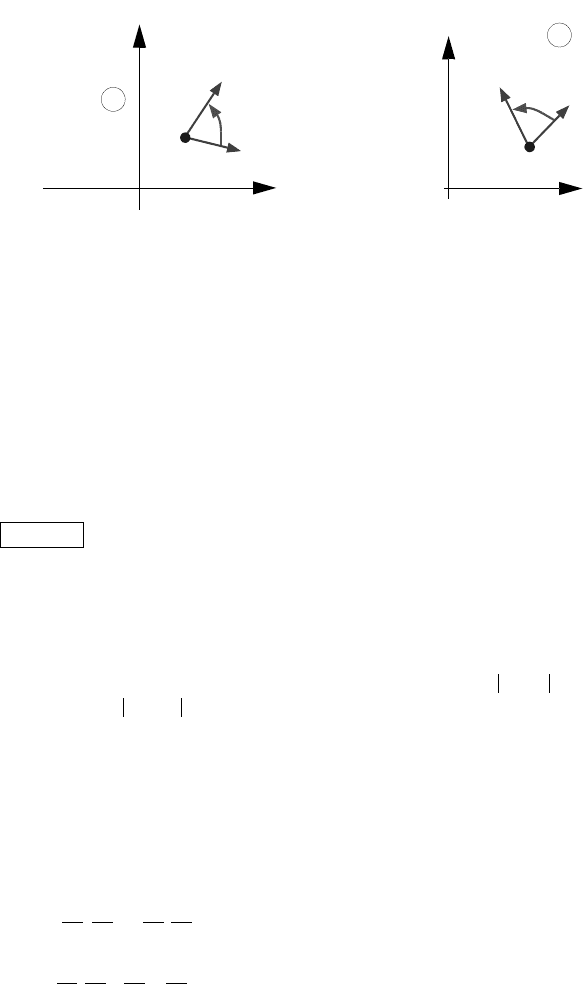
Consider a point and its neighborhood before and after the conformal mapping as
illustrated in Fig. 3.32. Because the mapping is conformal, i.e., f’ has the same
value for all directions, it is
and furthermore
xy
+
−
=
v 0=
xy⋅ 0=
x 0=
y 0=
zxiy+ r ϕcos i ϕsin+()riϕ()exp== =
zr x
2
y
2
+==
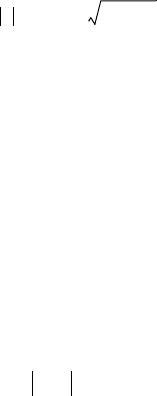
ϕtan
y
x
--=
z
1
r
1
iϕ
1
()exp=
z
2
r
2
iϕ
2
()exp=
z
1
z
2
r
1
r
2
i ϕ
1
ϕ
2
+()[]exp=
z
1
z
2
r
1
r
2
=
z
1
z
2
()arg ϕ
1
ϕ
2
+=
df
1
f 'dz
1
=
df
2
f 'dz
2
.=
216 Formal Methods of Electrostatics
as well as
that is
.
(3.385)
This concludes the proof of the angle preserving property. Furthermore, this
clarifies why the two sets of parabolas of Fig. 3.30 and the two sets of hyperbolas
of Fig. 3.31 intersect with a right angle.
From the angle preserving property it follows that conformal mappings in a
“small scale” are similar, i.e., mapping transforms infinitesimally small figures into
similar ones, whereby the linear dimensions are scaled by a factors and its
surfaces by a factor . The scale factor can magnify or shrink the result.
Overall, we can say that small squares are mapped into small squares, right angles
remain right angles, and therefore, an orthogonal grid transforms into an
orthogonal grid, as shown in Fig. 3.30 and Fig. 3.31. Despite the likeness in the
small scale, there is no likeness in the large scale, as is also obvious from Fig. 3.30
and Fig. 3.31. Finite figures are not mapped as like figures, but are distorted.
Real part and imaginary part of an analytic function are harmonic functions.
This is a consequence of the Cauchy-Riemann equations (3.380). Because of
(3.386)
and
y
x
f
v
u
Fig. 3.32
z
α
dz
1
dz
2
β
fz()
df
2
df
1
z
α z
2
()arg z
1
()arg–=
β df
2
()arg df
1
()arg–=
f 'dz
2
()arg f 'dz
1
()arg–=
f '()arg dz
2
()arg f '()arg– dz
1
()arg–+=
dz
2
()arg dz
1
()arg–=
αβ =
f ' z()
f ' z()
2
∇
2
u
x∂
∂
x∂
∂u
y∂
∂
y∂
∂u
+=
x∂
∂
y∂
∂v
y∂
∂
x∂
∂v
–
+0 .==
3.12 The Complex Potential 217
(3.387)
By the coordinate transformation
(3.388)
in a plane, one can introduce a new coordinate system. These new coordinates are
orthogonal as long as u and v satisfy the Cauchy-Riemann equations. We shall note
without proof, that a consequence of the Cauchy-Riemann equations is, that
Laplace’s equation
(3.389)
transforms into
,
(3.390)
that is, it maintains its form. Obviously, Laplace’s equation is also separable in u
and v as in Cartesian coordinates x and y. This justifies the previous claim that the
plane two-dimensional Laplace equation is separable in any number of coordinate
systems (Sect. 3.5). Every analytic function provides such a system of coordinates.
This is remarkable because the situation in the three-dimensional space is quite
different, where only 11 coordinate systems are “separable”.
3.12 The Complex Potential
When comparing the statements of the last two sections, one realizes that real part
and imaginary part of an analytic function behave exactly like the potential and
flux function of an electrostatic field. The reader is encouraged to compare eqs.
(3.362) and (3.380), as well as (3.363), (3.364) and (3.386), (3.387). One may
conclude that every analytic function can be regarded in an electrostatic way. Its
real part u can be identified with the potential ϕ and its imaginary part v with the
flux function ψ of the related field. In light of this point of view, the analytic
function w(z) is called complex potential.
(3.391)
The accompanying field is
∇
2
v
x∂
∂
x∂
∂v
y∂
∂
y∂
∂v
+=
x∂
∂
y∂
∂u
–
y∂
∂
x∂
∂u
+0 .==
uuxy,()=
vvxy,()=
x
2
2
∂
∂ϕ
y
2
2
∂
∂ϕ
+0=
u
2
2
∂
∂ϕ
v
2
2
∂
∂ϕ
+0=
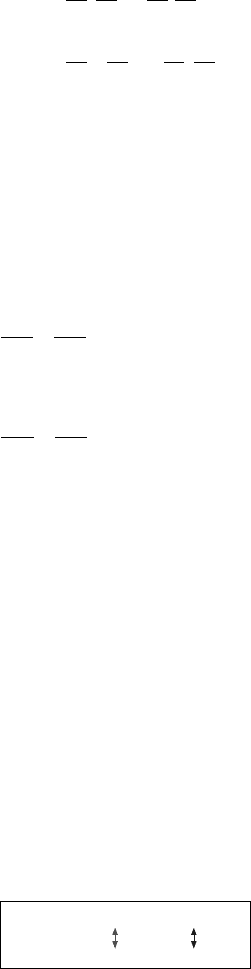
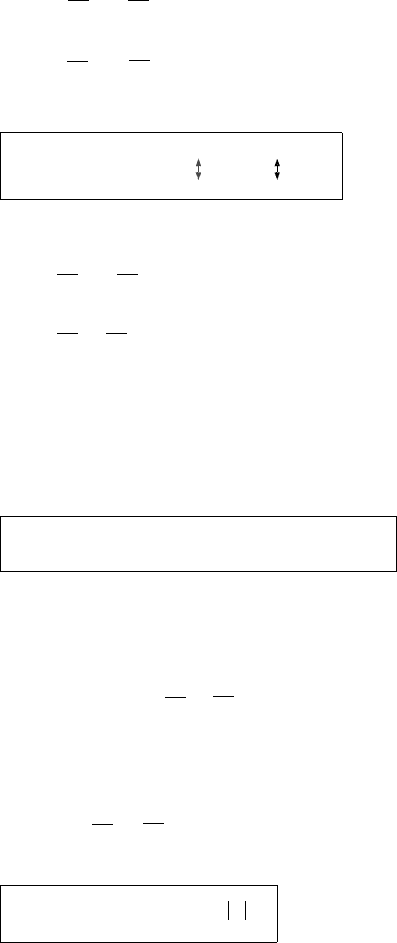
wz() uxy,()iv x y,()+=
potential flux functio
n
218 Formal Methods of Electrostatics
.
(3.392)
Naturally, with w(z) so is iw(z) an analytic function. The potential here is
(3.393)
and the accompanying field is now
.
(3.394)
Thus, multiplication by i results basically in the exchange of potential and flux
function (disregarding the sign). This is also expressed by
,
(3.395)
that is, the fact that is perpendicular to . This allows to interpret every analytic
function in two ways:
.
We might as well define a complex electric field
.
(3.396)
Because of , we find
or
and
.
(3.397)
Therefore, singular points of the potential are also singular points of the electric
field. In particular, the electric field is infinitely large at points where the derivative
is infinite.
E
x
x∂
∂u
–
y∂
∂v
–==
E
y
y∂
∂u
–+
x∂
∂v
==
w
˜
z() iw z() v– xy,()iu x y,()+==
potential flux function
E
˜
x
x∂
∂v
y∂
∂u
–==
E
y
˜
y∂
∂v
x∂
∂u
==
EE
˜
• 0=
EE
˜
1. u potential↔ v flux function↔
2. v– potential↔ u flux function ↔
EE
x
iE
y
+=
∂z ∂x⁄ 1=
dwz()
dz
--------------
∂wz()
∂x
--------------
x∂
∂u
i
x∂
∂v
+==
E–
x
iE
y
+ E
*
–==
dw
*
z()
dz
*
-----------------
x∂
∂u
i
x∂
∂v
– E–
x
iE
y
– E–== =
dwz()
dz
--------------
dw
*
z()
dz
*
-----------------
EE
*
E
2
==
w'dw dz⁄=

3.12 The Complex Potential 219
Every analytic function solves a set of electrostatic problems. The following
shall serve to study a number of such complex potentials. It is easy to establish a
catalog of complex potentials, along with their accompanying fields (which one
may picture as being a result of the conformal mapping of the uniform field), and
then determine from the result which boundary value problems they solve. The
reverse approach, i.e. to start from a boundary value problem and then calculate its
potential, is much more difficult. We will limit ourselves to a small catalog of
interesting mappings.
Example 1:
.
Using
.
gives
.
or
.
.
Therefore
.
.
The result is that of the straight, uniform line-charge q, which we know already. Its
equipotentials are circles around the line-charge and the field lines spread radially
from it:
.
i.e.,
,
.
Conversely, one may also start with
w
q
2πε
0
------------
z
z
B
-----ln–=
zr iϕ()exp= z
B
r
B
iϕ
B
()exp=,
w
q
2πε
0
------------
riϕ()exp[]ln–
q
2πε
0
------------
z
B
ln+=
w
q
2πε
0
------------
rln–
q
2πε
0
------------
iϕ()expln–
q
2πε
0
------------
r
B
ln
q
2πε
0
------------
iϕ
B
()expln++=
w
q
2πε
0
------------
r
r
B
-----ln– i
q
2πε
0
------------
ϕϕ
B
–()–=
u
q
2πε
0
------------
r
r
B
-----ln–=
v
q
2πε
0
------------
ϕϕ
B
–()–=
E u∇–=
E
r
r∂
∂u
–
q
2πε
0
r
--------------==
E
ϕ
1
r
---
ϕ∂
∂u
–0==
220 Formal Methods of Electrostatics
i.e.,
which also results in
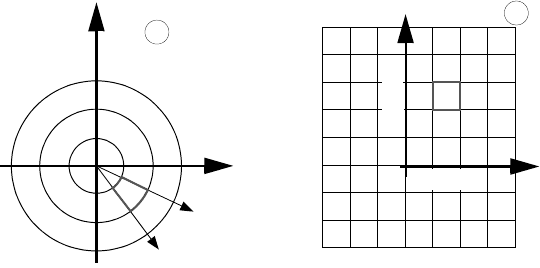
Fig. 3.33 illustrates some properties of the conformal mapping w(z). To
simplify, was chosen to be zero. Then one gets
,
.
The tetragon ABCD in the w-plane is mapped in the z-plane onto the shape
A’B’C’D’. This shape closes to a full annulus when . If the
difference increases further, then the annulus may be covered multiple
times. The situation is simpler with respect to u. r tends to infinity ( ) when
dw
dz
-------
q
2πε
0
z
--------------– E–
x
iE
y
+==
qz
*
2πε
0
zz
*
--------------------–
q
2πε
0
------------–
xiy–
x
2
y
2
+
-----------------
.==
E
x
q
2πε
0
------------
x
x
2
y
2
+
-----------------
q
2πε
0
------------
x
r
2
-----
==
E
y
q
2πε
0
------------
y
x
2
y
2
+
-----------------
q
2πε
0
------------
y
r
2
-----
,==
E
r
E
x
ϕcos E
y
ϕsin+=
E
x
x
r
--
E
y
y
r
--
+
q
2πε
0
------------
x
2
r
3
-----
y
2
r
3
-----+
q
2πε
0
------------
1
r
---
.== =
y
x
x
w
v
u
Fig. 3.33
z
AB
CD
A’
B’
C’
D’
u
1
u
2
v
2
v
1
vv
2
=
vv
1
=
u
=
u
1
u
=
u
3
u
=
u
2
ϕ
B
u
q
2πε
0
------------
r
r
B
-----ln– ,=
r
r
B
-----
2πε
0
u
q
---------------
–
exp=
v
q
2πε
0
------------
ϕ– =
v
2
v
1
– q ε
0
⁄=
v
2
v
1
–
r ∞→
3.12 The Complex Potential 221
, and when . Overall, we find that the u-v-plane covers
the x-y-plane arbitrarily may times.
Every stripe
.
(3.398)
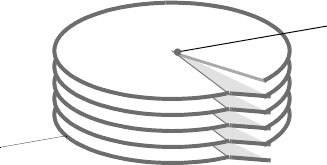
produces the entire x-y-plane. The resulting plane is a connected surface with
infinitely many sheets, and is called a Riemannian surface. These sheets turn, so to
speak, infinitely many times around the origin which is called its branch point
(Fig. 3.34). The mapping is not conformal at this point.
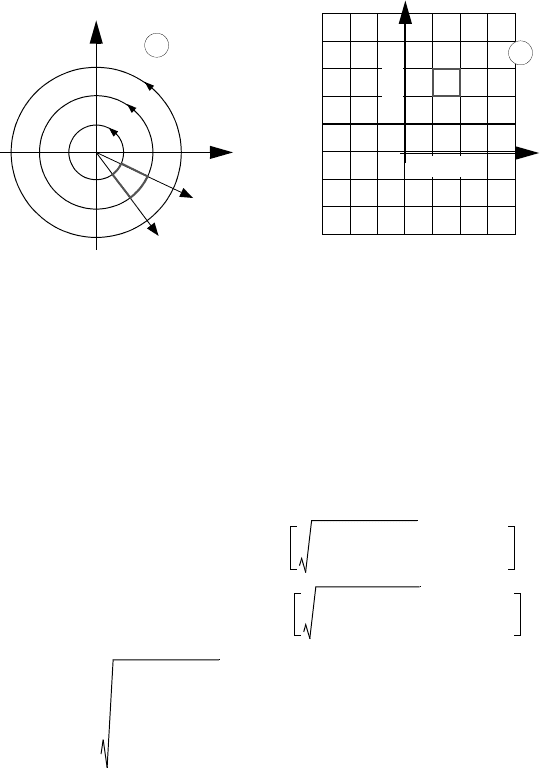
Example 2
.
Now, we have
from which we find (Fig. 3.35)
Comparison with Example 1 shows that this result is very similar, but just has
potential and flux function exchanged. Fields with such properties are actually
possible. The only thing to do is to implement the equipotentials (these are surfaces
where ϕ is constant) as actual conductor surfaces.
Example 3
.
u
1
∞–→ r 0→ u
1
+∞→
∞– u
1
∞<<
v
1
vv
1
q ε
0
⁄+≤≤
Fig. 3.34
branch point
sheet
Riemannian surface
wz() iC z r
B
⁄()ln=
uCϕ–=
vCrr
B
⁄()ln=
E
r
0=
E
ϕ
Cr⁄ .=
wz()
q
2πε
0
------------
z
d
2
---+
z
d
2
---–
-----------ln=
222 Formal Methods of Electrostatics
This is the field of two line charges, one is positive (+q) at location
( , ) and one is negative (-q) at location , for
which we write:
.
We use some algebra in order to separate real and imaginary part
where and are given by Fig. 3.36. Therefore
and
.
Fig. 3.35
y
x
w
v
u
z
AB
CD
D’
A’
B’
C’
u
2
u
1
v
2
v
1
uu
2
=
uu
1
=
v
1
v
3
v
2
xd2⁄= y 0= xd2⁄–= y, 0=()
wz()
q
2πε
0
------------
z
d
2
---–
z
B
-----------ln–
q
2πε
0
------------
z
d
2
---+
z
B
-----------ln+
q
2πε
0
------------
z
d
2
---+
z
d
2
---–
-----------ln==
wz()
q
2πε
0
------------
x
d
2
--- iy++
x
d
2
---– iy+
-----------------------ln
q
2πε
0
------------
x
d
2
---+
2
y
2
+ iϕ
-
()exp⋅ln
x
d
2
---–
2
y
2
+ iϕ
+
()exp⋅ln–
==
q
2πε
0
------------
x
d
2
---+
2
y
2
+
x
d
2
---–
2
y
2
+
--------------------------------ln i
q
2πε
0
------------
ϕ
-
ϕ
+
–() ,+=
ϕ
+
ϕ
-
u
q
4πε
0
------------
x
d
2
---+
2
y
2
+
x
d
2
---–
2
y
2
+
--------------------------------ln=
v
q
2πε
0
------------
ϕ
-
ϕ
+
–()=
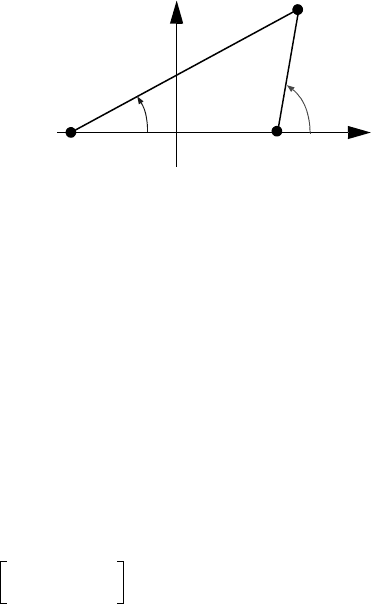
3.12 The Complex Potential 223
The equipotential surfaces are circles (Circles of Apollonius ). From
follows
from which, when using
one derives the equation for a circle whose center is at the x-axis. From
follows
or
,
Fig. 3.36
y
x
ϕ
-
ϕ
+
d
2
---–
+
d
2
---
uu
i
=
u
i
q
4πε
0
------------
x
d
2
---
+
2
y
2
+
x
d
2
---
–
2
y
2
+
----------------------------------ln=
x
d
2
---
+
2
y
2
+
x
d
2
---
–
2
y
2
+
----------------------------------
4πε
0
u
i
q
-----------------
exp C
i
==
x
d 1 C
i
+()
21 C
i
–()
-----------------------+
2
y
2
+
d
2
C
i
1 C
i
–()
2
----------------------=
vv
i
=
1
d
i
----
2πε
0
v
i
q
----------------tan ϕ
-
ϕ
+
–()tan==
ϕ
-
tan ϕ
+
tan–
1 ϕ
-
tan ϕ
+
tan⋅+
------------------------------------------
y
xd2⁄+
-------------------
y
xd2⁄–
------------------–
1
y
2
x
2
d
2
2
-----–
-----------------+
--------------------------------------------
yd–
x
2
y
2
d
2
2
-----–+
-----------------------------== =
x
2
y
d
i
d
2
-------
+
2
+
d
2
4
-----
1 d
i
2
+()=