
Lehner G. Electromagnetic Field Theory for Engineers and Physicists
Подождите немного. Документ загружается.

344 Time Dependent Problems I (Quasi Stationary Approximation)
,
(6.4)
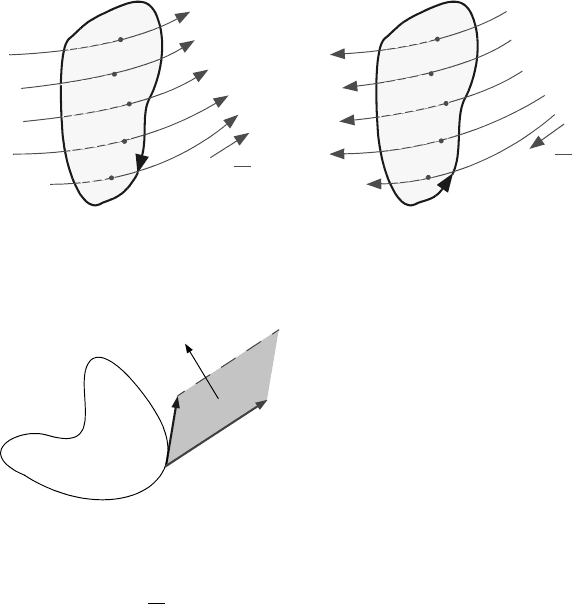
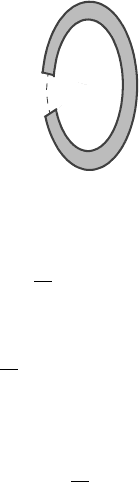
where is the voltage (EMF), induced within the closed loop. Figure 6.1 shows
the direction of the induced field for an increasing and a decreasing B-field,
respectively.
6.1.2 Induction through the Motion of the Conductor
Inside a magnetic field B, the Lorentz force
(6.5)
acts on a particle with charge Q, and velocity v.
One can also explain this force as being the effect of an electric field E on a particle
within a moving reference frame, where
.
(6.6)
If one now moves a closed conductor loop (made of infinitely thin wire) within a
magnetic field that is constant in time, then the line integral along the path S
(Fig. 6.2) is
V
i
Esd•
C
∫
°
t∂
∂φ
–==
V
i
Fig. 6.1
E
E
t∂
∂B
t∂
∂B
a) B increasing b) B decreasing
F Q vB×()=
EvB×=
Fig. 6.2
ds
vdt
S
dA
6.1 Faraday’s Law of Magnetic Induction 345
.
While the conductor loop moves during the time period , the path element
covers an area element (Fig. 6.2):
.
Therefore
,
(6.7)
where we have only considered the flux change based on motion of the loop within
a constant B field. Temporal changes of B itself are currently excluded, as outlined
above. Consequently, as a result of the Lorentz force, the temporal change of the
magnetic flux in a closed loop is given by line integral (compare (6.3)
with (6.7)).
The loop of a conductor does not have to be closed. It is possible for example,
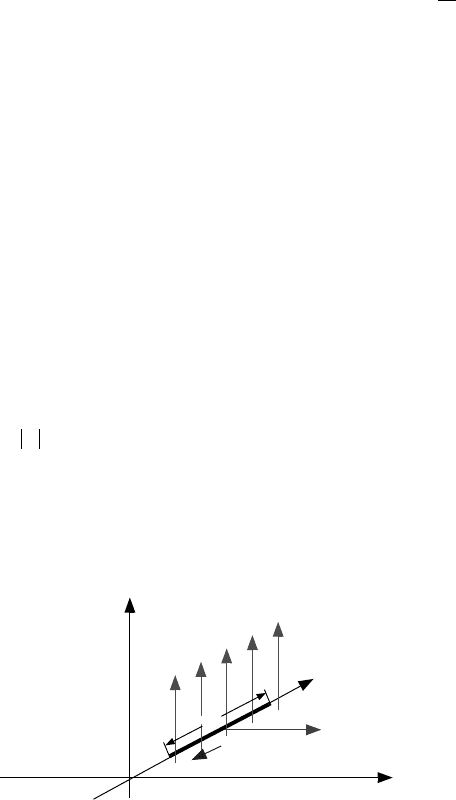
to move a piece of wire perpendicular to a magnetic field (Fig. 6.3) This causes an
induced field inside the wire of magnitude
,
(6.8)
An electric current flows inside the conductor as a result of this field. This
continues until E becomes zero ( ). Charges are moved to the surface of the
conductor and the resulting electrostatic field gradually cancels the induced field
inside the conductor.
The final state is an electric field between the ends of the conductor that creates a
field outside, whose potential difference is exactly the EMF which was initially
induced. Its magnitude is
.
(6.9)
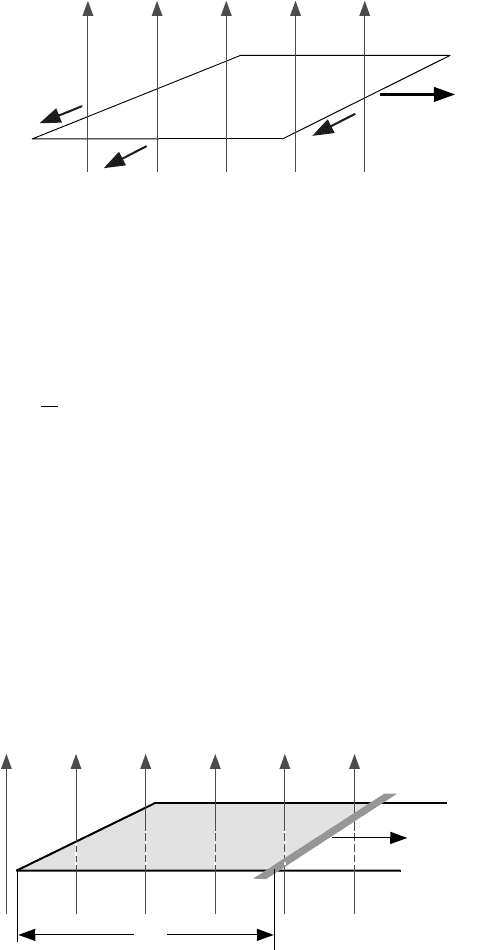
No EMF is induced when moving an entire conductor loop transverse to a uniform
magnetic field (Fig. 6.4). The reason is that the partial EMFs mutually cancel. The
flux through the loop remains unchanged. When moving just one part of the loop,
while maintaining contact with the rest of the loop, then there will be an EMF of
Esd•
S
∫
°
vB×()sd•
S
∫
°
Bvds×()•
S
∫
°
–==
dt ds
dA
v dsdt× dA=
V
i
Esd•
S
∫
°
B
Ad
dt
-------
•
S
∫
°
–
d
dt
-----
BAd•
A
∫
–
td
dφ
–== = =
φ
"
Esd•
Fig. 6.3
E
v
B
x
y
z
l
EvB×=
EvB=
E 0=
VvBl=
346 Time Dependent Problems I (Quasi Stationary Approximation)
magnitude (Fig. 6.5). This results from (6.9) as before, and correlates to the
temporal flux change because of
,
where
.
(6.10)
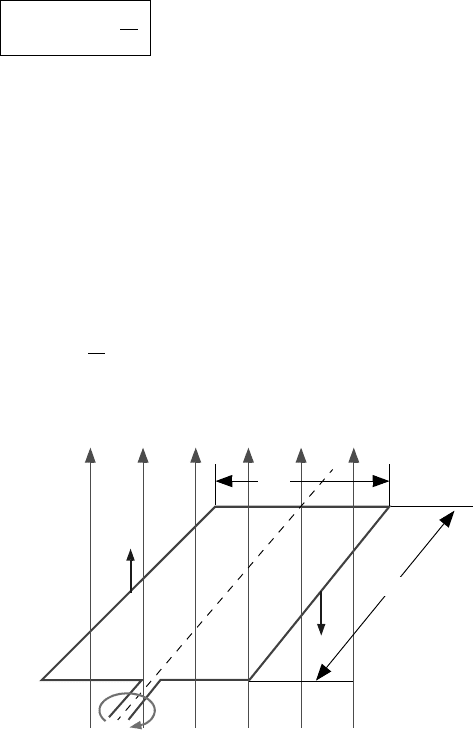
Faraday’s law of electromagnetic induction is of great importance for many
technological applications. Most generators, i.e., current producing machines, rely
on the EMF generated in a conductor loop when rotating within a magnetic field.
During this important process of energy transformation, mechanical energy is
transformed into electrical energy (Fig. 6.6).
If is the angular velocity, then the flux encompassed during the time period t is
,
(6.11)
which lets the induced EMF become
.
(6.12)
Fig. 6.4
E
B
E
E
v⊥B
vBl
Fig. 6.5
B
v⊥B
at()
φ Bla t() Bl a
0
vt+()==
V
i
t∂
∂φ
– vBl–==
ω
φ Bal ωtcos=
V
i
Esd•
∫
°
φ
·
– Balωωtsin===
6.1 Faraday’s Law of Magnetic Induction 347
This is the principle of alternating current generators. Direct current can be
produced by means of commutators, a subject which we will leave untouched.
6.1.3 Induction by simultaneous temporal Change of B and Motion
of the Conductor
The two effects discussed in sects. 6.1.1 and 6.1.2 can also occur simultaneously
and in such case need to be added. The equations read
,
.
(6.13)
Notice the “total time derivative” in the operator , which indicates that the
time derivative of the total flux applies, regardless of the origin of its change by
either the change of the magnetic field or by motion of the conductor. When using
the vector potential A (to avoid ambiguity, we will now change the symbol for the
area element to da and the area to a), to obtain
or
.
Since this is true for any surface, this has to be true for the integrand
Fig. 6.6
B
v
v
l
a
ω
Esd•
∫
°
∂
∂t
----
BAd•
A
∫
– Bvds×()•
∫
°
–=
Esd•
∫
°
td
dφ
–=
ddt⁄
Esd•
∫
°
∂
∂t
----
A∇× ad•
a
∫
– vB×()ds•
∫
°
+=
∂
∂t
----
A∇× ad•
a
∫
– vB×()∇× ad•
a
∫
+=
E
t∂
∂A
vB×–+
∇× ad•
a
∫
0=
348 Time Dependent Problems I (Quasi Stationary Approximation)
.
Introducing a suitable scalar function , we may write
.
(6.14)
The field E here is the one which an observer would “see” when moving with the
conductor. An observer at rest then sees the field
,
(6.15)
a relation which is a generalization of eq. (1.47) for time dependent problems, and
will occupy us some more later on.
Equation (6.13) expresses that the EMF induced in a conducting loop is
always given by the total time derivative of the overall magnetic flux, regardless of
whether or not the loop is moving or flexible. Notice that this peculiar
phenomenon, that two such apparently different effects – temporal change of a
field and motion or change in shape of a closed conductor loop – are related in such
a simple manner. This can be made plausible by imagining the individual force
lines. Then, an increasing field can be thought of as adding lines of force to the
existing field inside the closed loop. Conversely, when field lines move out of the
loop, then the overall field decreases over time. The lines added or the lines
removed are in motion relative to the conductor, which one considers as being at
rest initially. The effect is the same, whether a line of force moves in a certain
direction through the conductor or if the conductor moves in the opposite direction
relative to the force line. This intuitive understanding can also be used for
quantitative analysis and allows to unify understanding of these initially different
effects.
Often times, the task is to analyze not closed, but open loops. For a path that
goes in part through the conductor and in part through vacuum (Fig. 6.7), the
integral becomes
E
t∂
∂A
vB×–+
∇× 0=
ϕ
E
t∂
∂A
vB×–+ ϕ∇–=
E ϕ∇–
t∂
∂A
–=
Fig. 6.7
6.1 Faraday’s Law of Magnetic Induction 349
.
This considers already that volume charges caused by currents (or other preexisting
volume charges) superimpose an electrostatic field over the induced electric
field , where the electrostatic field is derived from the potential . The
latter is, of course, irrotational. The field is
,
where
or
.
Therefore, it is always
.
Eq. (6.13) derived above also holds in the case of superpositioning of electrostatic
fields, regardless of whether these fields are a result of induced currents or not.
The reader is alerted to a possible miss-interpretation of eq. (6.13). This is
best discussed by means of two examples. For this purpose, the unipolar machine is
described and interpreted first, followed by Hering’s experiment.
6.1.4 Unipolar Machine
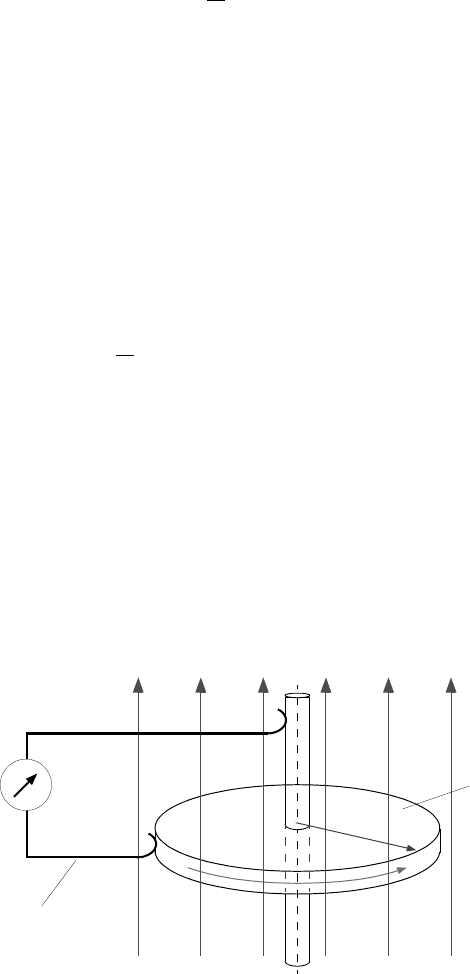
Consider the wheel made of conductive material as shown in Fig. 6.8, rotating with
a constant in a magnetic field. For simplicity reasons, we assume that the
Esd•
∫
°
ϕ∇ sd•
∫
°
–
td
dφ
–=
E
s
E
i
E
s
ϕ
EE
s
E
i
+=
E
s
∇× 0=
E
s
sd•
∫
°
ϕ∇ sd•
∫
°
–0==
Esd•
∫
°
td
dφ
–=
Fig. 6.8
B
ω
r
0
rotating disk
stationary wire
ω
350 Time Dependent Problems I (Quasi Stationary Approximation)
magnetic field is uniform and oriented parallel to the axis of rotation. Two brushes
provide connectivity between the stationary outside part of the circuit that includes
a voltmeter and the rotating part inside. The connection to the rotating part of the
circuit is located at the rotating axis on one hand and the edge of the wheel on the
other. The result of this closed circuit is an induced EMF that can be calculated as
follows: Velocity is a function of the distance to the center
.
(6.16)
Eq. (6.6) allows to calculate the electric field
.
(6.17)
and
.
(6.18)
The problem can be solved in a rather simple manner. However, if we start with the
magnetic flux through the circuit, we encounter difficulties. First, notice how
unclear the quantitative description of this flux actually is. One could state that the
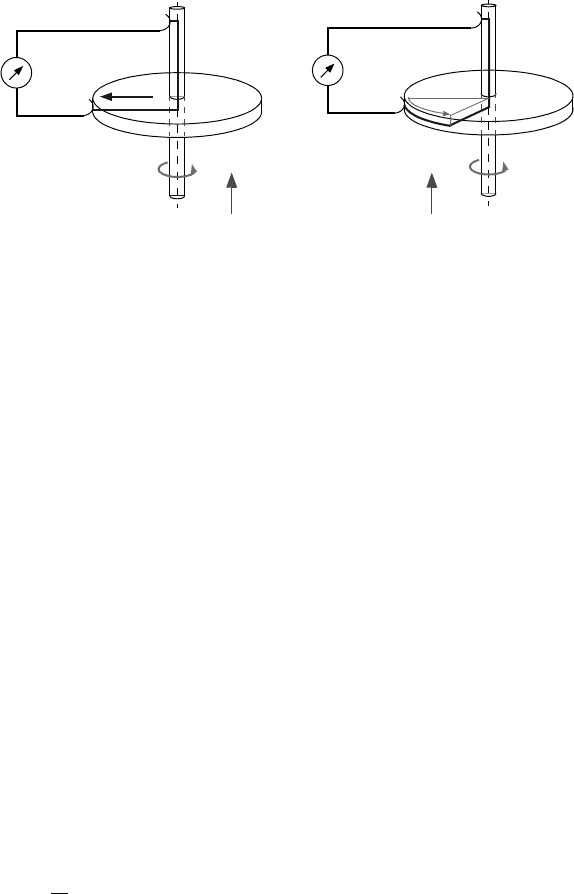
flux is always, identically zero (Fig. 6.9a). Then, the induced EMF would
have to vanish, an obviously incorrect conclusion. However, the circuit as shown in
Fig. 6.9b is also a possibility. This yields
,
which is the correct result for the induced EMF
.
However, this explanation is not very persuasive. While there are a number of
possible ways to define , it is not unique. The definition in Fig. 6.9b was
designed to provide the correct result, but that does not prove anything in and by
itself. What is always true is
v
ϕ
ωr=
E
r
ωBr=
V
i
E r() sd•
∫
°
E
r
r() rd•
r
0
0
∫
°
ωBr
0
2
2
-------------–== =
φ 0=
φ
r
0
2
ϕ
2
---------
B
r
0
2
ωt
2
-----------
B==
Fig. 6.9
ω
E
ϕωt=
ω
a) b)
B B
V
i
td
dφ
–
r
0
2
ω
2
---------
B–==
φ
6.1 Faraday’s Law of Magnetic Induction 351
,
and, is therefore a useful basis to calculate the EMF. Using the flux in this and other
similar situation makes no sense.
6.1.5 Hering’s experiment
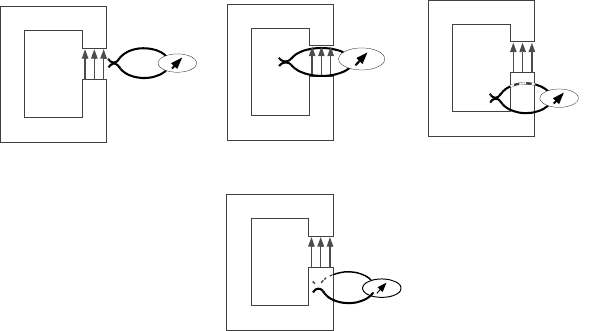
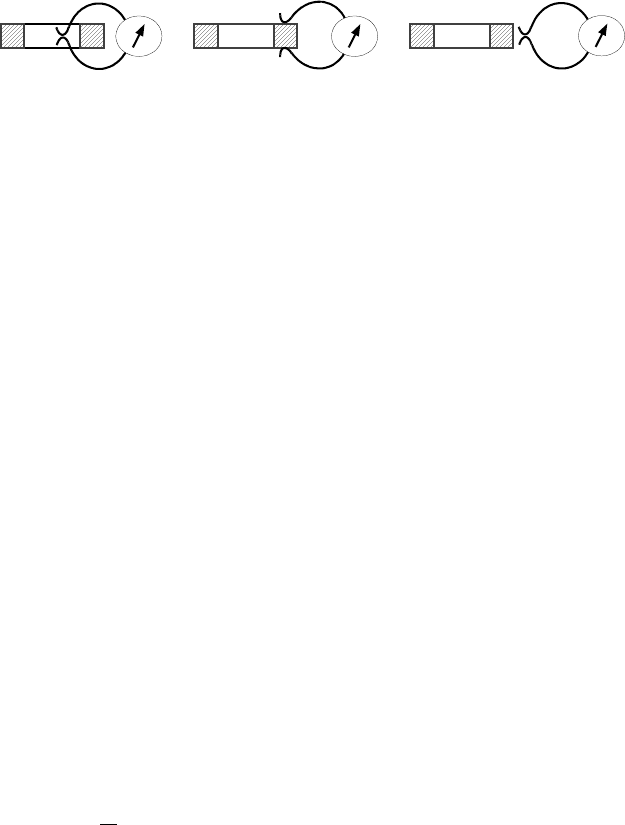
Fig. 6.10 shows a magnet for which one assumes that there is no leakage of its flux.
It has an air gap that is penetrated by a magnetic field. Outside the magnet, there is
a conducting loop with elastic contacts that ensure a closed circuit at all times. The
circuit also includes a voltmeter. Now, we move the conducting loop from its
position Fig. 6.10a to position Fig. 6.10b. This causes a voltage impulse.
,
in the voltmeter. The spring loaded contacts ensure that the circuit remains closed.
The loop is further moved to position Fig. 6.10c, whereby nothing happens, i.e.,
there is no induced EMF. Finally, the loop is pulled from the magnet to the outside,
as illustrated in Fig. 6.10d. The spring contacts open, but stay in contact with the
magnet, so the circuit is still closed at all times.
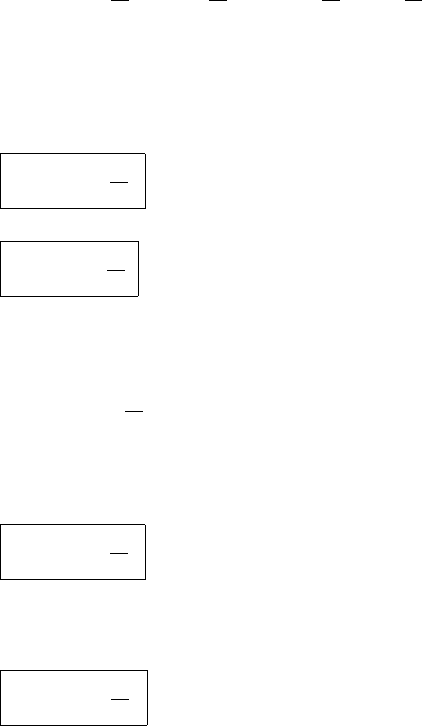
The last phase is shown in more detail in Fig. 6.11. The question is now, what
EMF is induced during the process of going from state Fig. 6.11a to Fig. 6.11c.
Undoubtedly, there is an initial flux , while there is no flux in the final state.
Nevertheless – and as can be verified by experiment – there is no induced EMF.
This may appear like a paradox which represents a contradiction to eq. (6.13).
Essential is, however, that the mentioned flux change is not related to the motion of
the conductor. If we start from the safe grounds of the relation for the locally
induced electrical field
EvB×=
Fig. 6.10
a) b)
B
B
B
c)
d)
Vtd
∫
∆φ–=
φ 0≠
352 Time Dependent Problems I (Quasi Stationary Approximation)
,
then we immediately see that it vanishes everywhere. From Fig. 6.11b, it becomes
clear that during this phase of the process, inside of the magnet but ,
while outside, but (because of the ideal assumption that there is no
leakage of B). Since E vanishes everywhere, so has to vanish the integral .
Thereby, the result of Hering’s experiment which initially appeared to be
paradoxical, now becomes downright self-evident. The seeming paradox is simply
a consequence of using the law of induction in a form (6.13) which is not legitimate
for this particular case.
Eq. (6.13) only applies in situations when the loop during its motion or
deformations maintains its material identity and is penetrated by a uniquely
identifiable flux. This is neither the case for the Unipolar machine nor Hering’s
experiment. Looking back, we could have supposed this because of the spring
contacts, which may have seemed minor. Brushes and sliding contacts require extra
caution. In case of doubt, it is best to go back to the fundamental laws. This is good
advice, not only in the realm of induction, as applying simple recipes and summary
results to complex problems may lead to errors and conflicts in any subject matter.
6.2 Diffusion of Electromagnetic Fields
6.2.1 Equations for E, g, B, A
When neglecting the displacement current but considering induction, then
Maxwells equations are
(6.19)
(6.20)
(6.21)
(6.22)
To solve these equations requires the following relations
(6.23)
(6.24)
Fig. 6.11
a) b)
c)
φ 0≠
φ 0=
EvB×=
B 0≠ v 0=
v 0≠ B 0=
"
Esd•
E∇×
t∂
∂B
–=
H∇× g=
B∇• 0=
D∇• ρ=
D εE=
B µH=
6.2 Diffusion of Electromagnetic Fields 353
(6.25)
shall be location independent factors. Substituting eq. (6.23) in (6.22) while
letting gives
.
(6.26)
Using Eqs. (6.19), (6.24), (6.20), (6.25)one finds
.
Applying (6.26) and the vector identity (5.11) gives
that is
.
(6.27)
Using (6.25) gives
.
(6.28)
In similar manner, for B we obtain from eqs. (6.20), (6.25), (6.19), (6.24), and
(6.21)
that is
.
(6.29)
Since
and with proper gauge choice for A, it follows from (6.29) that
.
(6.30)
Applying the curl on both sides of (6.30) yields again (6.29).
Notice that we obtain the same type of equation for all quantities E, g, B, A.
Of course these quantities are still distinct according to their physical meaning.
Their distinctiveness is, from a formal perspective, not expressed in the equations
themselves, but in their different initial and boundary conditions which are
necessary to solve the equations.
g κE=
εµκ,,
ρ 0=
E∇• 0=
E∇×∇×
t∂
∂
B∇×–
t∂
∂
µ H∇×–
t∂
∂
µg–
t∂
∂
µκE–== ==
E∇×∇× E∇•()∇∇E()∇•– E∇•()∇∇
2
E–==
∇
2
E ,–=
∇
2
E µκ
t∂
∂E
=
∇
2
g µκ
t∂
∂g
=
H∇×∇× g∇× κE∇× κ E∇×== =
κ
t∂
∂B
–+
1
µ
---
B∇×∇×==
1
µ
---
∇B()∇•–
1
µ
---
∇
2
B–==
∇
2
B µκ
t∂
∂B
=
BA∇×=
∇
2
A µκ
t∂
∂A
=