
Lehner G. Electromagnetic Field Theory for Engineers and Physicists
Подождите немного. Документ загружается.

354 Time Dependent Problems I (Quasi Stationary Approximation)
6.2.2 The Physics of these Equations
In eqs. (6.27) through (6.30), we have found a type of equation that has the same
typical structure for E, g, B, A. This equation is the so-called diffusion equation
and is of paramount importance in physics. It received its name from the fact that
(as a scalar equation), it describes the diffusion of particles. From a
thermodynamics perspective, this is a typical behavior of irreversible (entropy
increasing) processes. The formula for heat conduction is of this type. The only
difference between the scalar diffusion equation or the heat equation and
eqs. (6.27) through (6.30) is simply that the current equations are not scalar, but
rather vector diffusion equations. In this context and from a purely formal
perspective, the reader shall be reminded on the discussion about the application of
the -operator (Sect. 5.1). Also note that here, we deal with an irreversible
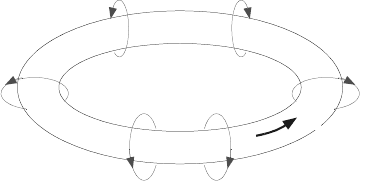
process, too. Consider the path of a conductor forming a closed loop, where at time
, the conductor shall carry a current. Its conductivity shall be . There shall
be no external voltage source. The initial current may be the result of for example,
an induction or an external voltage source that was shorted after creating the
current (Fig. 6.12). When leaving this circuit all by itself, the current decays over
time. Responsible for this is the resistance (R) of the conductor, which produces
irreversible heat ( per unit of time), as long as the current flows. Because of the
law of conservation of energy, this energy has to be taken from another reservoir,
whose energy content is thereby depleted. This energy is that of the magnetic field.
Thus, current and magnetic field have to decrease. This process ceases when all
available energy was transformed into heat.
The energy principle should allow for the reverse process, as well. By only
considering the energy balance, one can imagine that a current emerges in a closed
conductor loop, while using the required energy from the energy stored in the
temperature of the conductor, which would cool down. This has never been
observed. Besides the first law of thermodynamics (the energy principle, or the law
of the impossibility of a perpetuum mobile of the first kind), there is the second law
of thermodynamics (entropy theorem, or the law of the impossibility of a
∇
2
t 0= κ
Fig. 6.12
B
I
RI
2
6.2 Diffusion of Electromagnetic Fields 355
perpetuum mobile of the second kind). It is this second law that does not entirely
prohibit the described process, but declares it as very improbable, so that one can
not expect to actually witness it. The basis of this are probability evaluations of
micro states. In our specific case, it is very improbable that the charges in a
conductor, by pure chance, move in such a way that a macroscopic current results
(by chance shall mean that the motion is not caused by an external field). Much
more likely is that the charges move disorderly with different velocities in all
possible directions, mutually cancelling each other in a spatial and temporal
average. Nevertheless, taking sufficiently accurate measurements (with sufficient
spatial and temporal resolution), will reveal small, fluctuating currents, which are
responsible for the permanent background noise of the macroscopic events. The
problems arising from noise are not only theoretically interesting but also of great
practical importance (for example, because they define the limits of accuracy for
very exact measurements), but this is not the topic of this text. Here, we merely
want to note that the processes described in eqs. (6.27) through (6.30) are
macroscopically irreversible. This irreversibility is formally expressed by the
simple time derivative. Replacing t by -t changes the equation, it is – as it is known
– not invariant against time reversal. In other words, there is a difference whether
time increases or decreases. Therefore, the process can not just run backwards.
The wave equation, which covers electromagnetic waves, will be discussed in
Chapter. 7. Its form for E is
.
(6.31)
The only significant difference to eq. (6.27) is that it contains the second time
derivative. This makes it invariant against time reversal. As we will see, it
describes processes (waves), which may proceed both forward and backward in
time.
To envision the difference, one might imagine taking a movie of such
irreversible processes (for example diffusion) or reversible processes (for example
waves). Then play those movies backwards. In case of a wave (more precisely: not
attenuated wave, i.e., one that does not irreversibly loose energy) the movie played
backwards describes the same natural situation as the one played forward. On the
other hand, the movie of the irreversible process played backwards would seem
unnatural and very puzzling.
Another remark on the formality of the underlaying mathematics shall be
made: One distinguishes three types of partial differential equations of second
order. They are called elliptic, parabolic, and hyperbolic. All three types are very
important in science, and the formal differences also manifest themselves in
practical significance. That is, these three types of equations describe three
significantly different phenomena. When just considering two independent
variables (x, y or x, t), then the equation
(6.32)
∇
2
E µε
∂
2
E
∂t
2
----------
=
∂
2
ϕ
∂x
2
---------
∂
2
ϕ
∂y
2
---------+
ρ
ε
0
-----–=
356 Time Dependent Problems I (Quasi Stationary Approximation)
is an elliptic equation. From an application perspective, this is a potential equation
(Poisson equation). The equation
(6.33)
is a parabolic equation. We have called it a (scalar) diffusion equation. The
equation
(6.34)
is a hyperbolic equation. We recognize in it the just mentioned type of the wave
equation. Summarizing in a table:
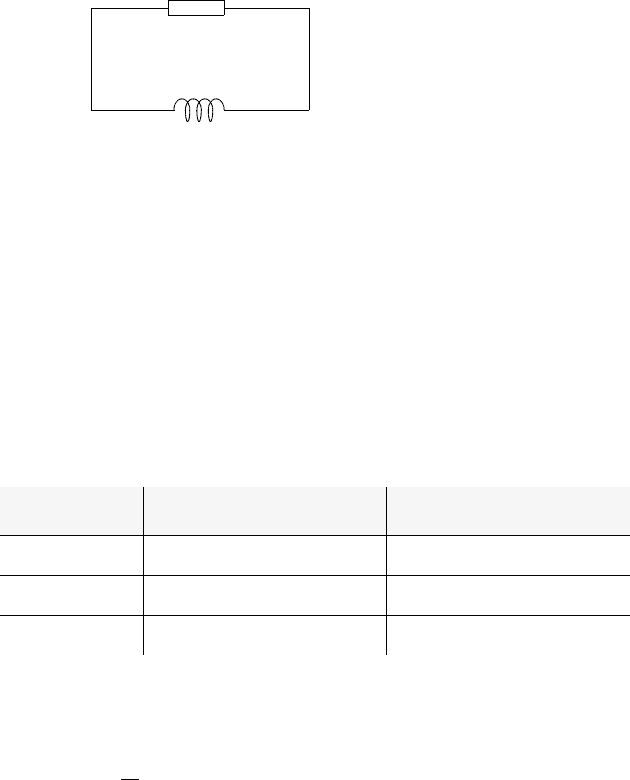
When neglecting field theoretical details, the above discussed example of the
conductor with a decaying current (Fig. 6.12) can be approximated in a summary
description by a simple RL circuit (Fig. 6.13), where
(6.35)
with the general solution
If when , then
and
Equation mathematical term refers to application
(6.32) elliptic equation potential equation
(6.33) parabolic equation. diffusion equation
(6.34) hyperbolic equation. wave equation
∂
2
ϕ
∂x
2
---------
∂ϕ
∂t
------=
∂
2
ϕ
∂x
2
---------
∂
2
ϕ
∂t
2
---------=
Fig. 6.13
R
L
RI t() L
td
d
It()+0=
It() C
R
L
---
t–
exp=
II
0
= t 0=
CI
0
=

6.2 Diffusion of Electromagnetic Fields 357
.
(6.36)
This results in a decaying current, as the 2nd law of thermodynamics mandates.
Multiplying (6.35) by I gives
.
Integrating this equation over time yields
.
(6.37)
This is nothing else than the first law of thermodynamics (energy principle),
applied to this problem. Eq. (6.37) states that the heat produced by the current
during the time period 0 through t is
,
which is drawn from the magnetic energy reservoir. While there was the initial
energy , at time t only the magnetic energy
remains. The magnetic field, which is produced by the current, decays with the
current.
To describe in detail the process of field diffusion, as it is also referred to
because of the formal analogy to the diffusion process, requires one to solve the
equation
with its corresponding boundary conditions and initial values. This is significantly
more difficult than solving eq. (6.35). The following sections will provide
examples of such boundary and initial value problems (skin effect, eddy currents).
A major mathematical tool is the Laplace transform. A few formulas and theorems
shall be compiled in Sect. 6.3.
6.2.3 Approximations and Similarity Theorems
Before delving into that subject, here we show how a rough, still useful
approximation of diffusion problems can be obtained with hardly any calculation at
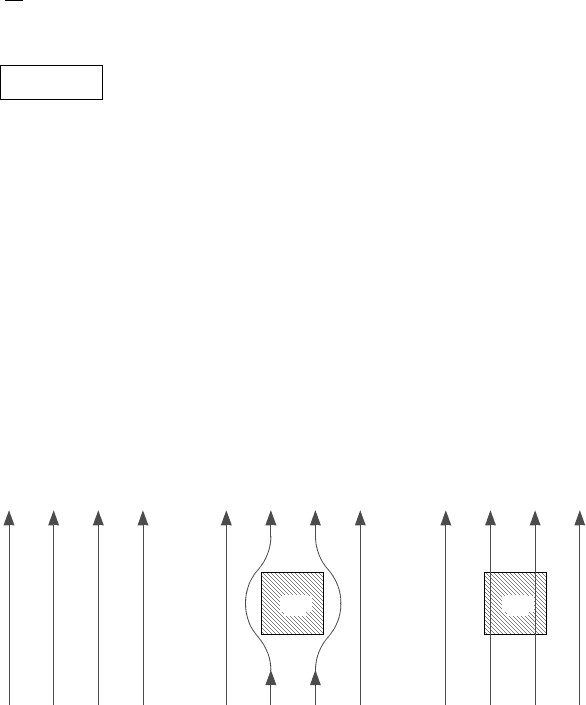
all. For instance, insert a conductor suddenly into a magnetic field. Its inside shall
initially be without a field. Once inside the field, it gradually penetrates, diffuses
into the conductor. One would like to approximate how long it will take for the
field to penetrate the conductor (Fig. 6.14).
It() I
0
R
L
---
t–
exp=
RI
2
t() LI
td
d
It()+0=
RI
2
t() td
0
t
∫
1
2
---
LI
2
t()+
1
2
---
LI
0
2
=
RI
2
t() td
0
t
∫
12⁄()LI
0
2
1
2
---
LI
2
1
2
---
LI
0
2
RI
2
t()td
0
t
∫
–=
∇
2
B µκ
t∂
∂B
=
358 Time Dependent Problems I (Quasi Stationary Approximation)
The typical length of the conductor (which may be cube shaped) shall be of
the order of magnitude l. The diffusion time shall be approximately . This allows
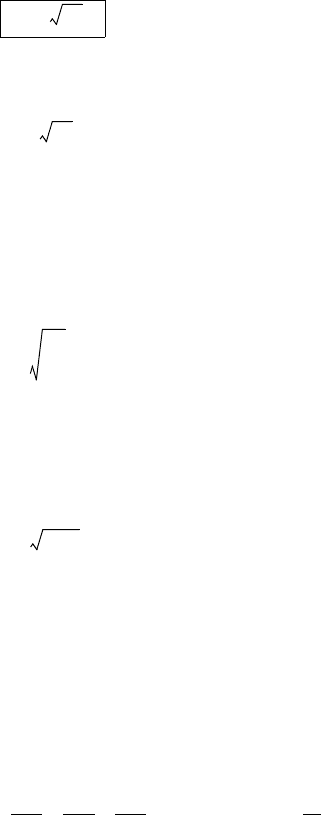
for a rough approximation of eq. (6.29) in the form
.
(6.38)
This is justified because it is approximately
.
and
.
Consequently
.
(6.39)
Rather typical for diffusion processes is, that the time is not proportional to , but
to . This is a consequence of the fact that these processes are a result of random
behavior (stochastic processes). In the case of field diffusion, it is the resistance of
the conductor, which depends on the statistical behavior of charges, i.e., the
collisions which occur statistically.
For comparison, a similar approximation of the wave equation shall be
provided. It will be shown that the wave equation for B is of the form
.
(6.40)
From this follows that
and
Fig. 6.14
B
κµ, κµ,
BB
a) b) c)
t
0
B
l
2
----
µκ
B
t
0
----
≈
∇
2
B
B
l
2
----
≈
t∂
∂BB
t
0
----
≈
t
0
µκl
2
≈
l
l
2
∇
2
B εµ
∂
2
B
∂t
2
----------
=
B
l
2
----
εµ
B
t
0
2
----
≈
6.2 Diffusion of Electromagnetic Fields 359
.
(6.41)
This expresses a linear relation between and , as it is typical for orderly
motion. In this context, the velocity corresponds to
,
(6.42)
which we will later recognize as the propagation velocity (phase velocity) of
electromagnetic waves. The difference between the two relations (6.39) and (6.41),
again, is formally a result of the first and second time derivative.
One may interpret (6.39) also with respect to the skin effect. For instance, if a
magnetic field is applied to the surface of a conductor for a certain time , then
within this time the field can penetrate into the conductor to a depth . This is the
skin depth which is by (6.39)
.
(6.43)
If the applied field is alternating with the frequency f, then we have
i.e., disregarding purely numeric factors, we obtain
.
(6.44)
This formula was obtained in a rather simple manner. The difference with exact
results which are based on detailed calculations and consider boundary conditions
as well as initial values, manifests itself, however, merely in numerical factors,
which are usually unimportant in a first approximation. Nonetheless, the
dependence of the skin depth on , and is described exactly by above
formula.
To make this transparent and to avoid the need to carry along all these many
coefficients when solving, for example, the diffusion equation for the magnetic
field
,
(6.45)
one introduces dimensionless variables, which is also advantageous for many other
problems. We take the liberty to introduce a more or less arbitrary standard length l
in the following manner:
t
0
εµl ≈
lt
0
l
t
0
----
1
εµ
----------
≈
t
0
l
l
t
0
µκ
-------≈
t
0
1
f
---
≈
2π
ω
------=
l
1
µκω
---------------
≈
µκ,ω
x
2
2
∂
∂
y
2
2
∂
∂
z
2
2
∂
∂
++
B xyzt,,,()µκ
t∂
∂
B xyzt,,,()=
360 Time Dependent Problems I (Quasi Stationary Approximation)
.
(6.46)
This simplifies (6.45) to an equation without the parameters and .
.
(6.47)
The advantage of introducing dimensionless variables by eqs. (6.46) is that once a
problem of a certain kind was solved for specific values of and , then by
similarity transformation (changing the scale factor) in conjunction with (6.46),
allows one to solve problems with different values of these parameters. It is said
that the results are scalable, or that it is possible to provide similarity laws. Because
of the freedom to choose the length l, we may reduce the behavior of fields in
similar conductors of different expansion by similarity transformation onto each
other.
6.3 Laplace Transform
The Laplace transform is oftentimes a very helpful tool to solve initial value
problems. In the theory of circuits, this approach is used to reduce ordinary
differential equations, whose independent variable is the time, to algebraic
equations. In field theory, the equations are partial differential equations, for
example in x, y, z, and t. Applying the Laplace transform results in a new partial
differential equation in x, y, and z, where the initial values are automatically
considered. This reduces the problem to a spatial boundary value problem, which
can be solved using the methods introduced in Chapter 3. In the simplest case, the
spatial problem is one dimensional, for example, x-dependent (planar) or r-
dependent (cylindrical). In this case, the Laplace transform reduced the original
partial differential equation to an ordinary differential equation in x or r.
Now, we will compile a list of important relations about the Laplace transform,
whereby no explanation or derivation is provided. More over, no attempt for
completeness will be made.
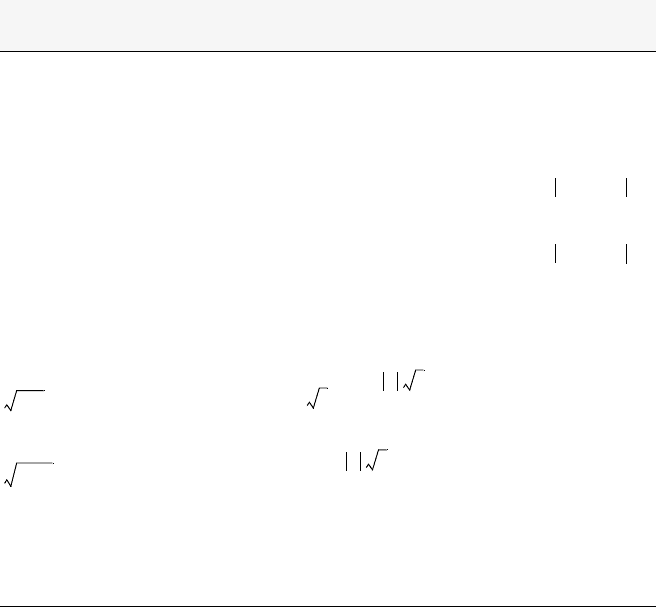
The (one sided) Laplace transform of for a function is defined by
.
(6.48)
ξ
x
l
--=
η
y
l
--=
ζ
z
l
--=
τ
t
t
0
----
t
µκl
2
-----------==
µκ
ξ
2
2
∂
∂
η
2
2
∂
∂
ζ
2
2
∂
∂
++
B
τ∂
∂B
=
µκ
f
˜
p() ft()
f
˜
p() ft() pt–()exp t d
0
∞
∫
=
6.3 Laplace Transform 361
L shall serve as the symbol to represent the Laplace transform of a time dependent
function and L
-1
shall represent the inverse Laplace transformation. Thus, we will
frequently write
,
(6.49)
or
.
(6.50)
p is a complex number. Of course, all this depends on the existence of the integral
on the right side of (6.48), which shall not be our concern here, however.
A few pairs of related functions of and are listed in table 6.1.
Some of these can be found immediately by applying (6.48), some will be
discussed in conjunction with solved problems in subsequent sections. There are
also a number of tables for the Laplace transform. A particularly detailed table for
both the Laplace transform and its inverse can be found in [5] volume 1.
Particularly important in the context of initial value problems is, that for the
n-th time derivative of a function the following relation holds:
L ft(){} f
˜
p()=
L
1–
f
˜
p(){} ft()=
f
˜
p() ft()
Table 6.1
Convergence region
1
time shifting theorem
ft() L
1–
f
˜
p(){}= f
˜
p() L ft(){}=
t
α
α!
p
α 1+
-------------
ℜep{} 0>
δ t()
ωt()sin
ω
p
2
ω
2
+
------------------
ℜep{} ℑm ω{}>
ωt()cos
p
p
2
ω
2
+
------------------
ℜep{} ℑm ω{}>
αt()exp
1
p α–
------------
ℜep{} ℜe α{}>
1
4πt
------------
x
2
4t
-----–
exp
1
2 p
----------
xp–()exp
ℜep{} 0>
x
4πt
3
---------------
x
2
4t
-----–
exp
xp–()exp
ℜep{} 0≥
f
t()
0 for tt'<()
gt t'–() for tt'>()
=
g
˜
p() pt'–()exp ℜep{} 0≥
f
t()
362 Time Dependent Problems I (Quasi Stationary Approximation)
(6.51)
Here, is the first, , the second, , the n-th time derivative of
for . This can be proven by continuously integrating (6.48) by parts.
This still holds for the following relation,
,
(6.52)
which is used to transform multiple time integrals. Apart from the terms ,
, etc., which represent the initial values, every differentiation creates another
factor p and every integration a factor . This highlights in a striking expression
the fact, that integration and differentiation are mutually inverse operations. It also
illustrates that, or how, the Laplace transform under certain conditions reduces
differential and integral equations to algebraic ones.
The convolution or faltungs theorem shall prove itself useful shortly. Consider
two time dependent functions and with their Laplace transform
and . The integral
(6.53)
is the so-called convolution integral of the two functions and . Its
Laplace transform can be shown to be
.
(6.54)
When solving a problem by means of the Laplace transform, we obtain a
result in the p-domain. To get the solution in the time domain, an inverse
transformation is necessary. In simple cases, this can be achieved by finding the
transform in a table. In general, the inverse needs to be calculated. The formula for
inversion is an integral in the complex p-plane, and one can prove by means of
equations known from the Fourier transform that:
.
(6.55)
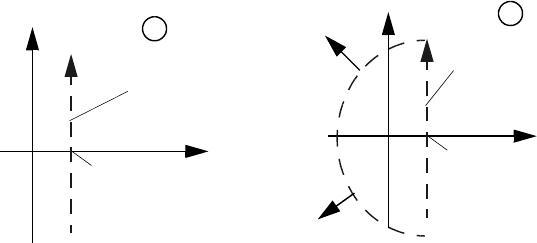
This is called the Fourier-Mellin theorem. Fig. 6.15 shows the complex p-plane
with the integration path from to , which runs at a distance
parallel to the imaginary axis. The path has to be chosen such that it is to the right
of all poles of . This means that there is not a complete freedom in the choice
of . Function theory is frequently used to evaluate the inversion integral (6.55). If
the integrand vanishes at infinity, then the integral (6.55) can be replaced by one
around a closed loop as shown in Fig. 6.16. The path closes at infinity but does not
add to the integral.
L
t
n
n
d
d
ft()
p
n
f
˜
p() p
n 1–
f 0() p
n 2–
f '0()–– p
n 3–
f '' 0()–=
…– p f
n 2–()
0()– f
n 1–()
0() .–
f '0() f '' 0() f
n()
0()
f
t() t 0=
L t
n
d
0
t
∫
t
n 1–
d
0
t
n
∫
t
n 2–
d
0
t
n 1–
∫
… t
2
d
0
t
3
∫
t
1
d
0
t
2
∫
ft
1
()
f
˜
p()
p
n
----------=
f 0()
f '0()
1 p⁄
f
1
t() f
2
t()
f
˜
1
p() f
˜
2
p()
Ft() f
1
t
0
()f
2
tt
0
–()t
0
d
0
t
∫
f
2
t
0
()f
1
tt
0
–()t
0
d
0
t
∫
==
f
1
t() f
2
t()
L Ft(){}F
˜
p() f
˜
1
p()f
˜
2
p()⋅==
f t()
1
2πi
--------
f
˜
p() pt()exp p d
σ i∞–
σ i∞+
∫
=
σ i∞– σ i∞+ σ
f
˜
p()
σ
6.3 Laplace Transform 363
The integral is then:
.
(6.56)
This integral can be evaluated with complex analysis, by accounting for all poles
inside the closed contour C (Fig. 6.16). One way is to add all residues of the
integrand. This requires explanation of a few terms from function theory, complex
analysis in particular. Consider an annular domain in the complex z-plane, centered
around the point . If a function is analytic in that domain, then it has a series
representation of the form
,
(6.57)
which is the so-called Laurent series. If there are terms with negative exponents of
n (i.e., n<0), then diverges for and is said to have a singularity
at . If there are an infinite number of such terms, then the singularity is said
to be an essential singularity. If the series ends with the term (i.e.,
and for all ), then the singularity is called a pole of
order m. The coefficient of this Laurent series is very special. It is called the
residue of the function at the point . The significance of the residue
(its name suggests that it remains) stems from the fact that the integral for any
positively oriented closed contour is
,
(6.58)
as long as the path encloses . If a path includes several poles , then the values
of all residues need to be added:
.
(6.59)
This allows one to reduce the inverse Laplace transform to finding all residues of
all poles and essential singularities. With (6.56) and (6.59) one can write
Fig. 6.16
ℑm
ℜe
σ
C
p
∞
∞
0
Fig. 6.15
ℑm
ℜe
σ
integration path
p
f
t()
1
2πi
--------
f
˜
p() pt()exp pd
C
∫
°
=
z
0
fz() a
n
zz
0
–()
n
n ∞–=
+∞
∑
=
f
z() zz
0
= fz()
zz
0
=
a
m–
zz
0
–()
m–
a
m–
0≠ a
m– v–
0= v 1≥
a
1–
fz() zz
0
=
a
1–
fz()dz
C
∫
°
2πia
1–
⋅=
z
0
z
k
fz()dz
C
∫
°
2πia
1–
k()
k
∑
=