
Lehner G. Electromagnetic Field Theory for Engineers and Physicists
Подождите немного. Документ загружается.

394 Time Dependent Problems I (Quasi Stationary Approximation)
.
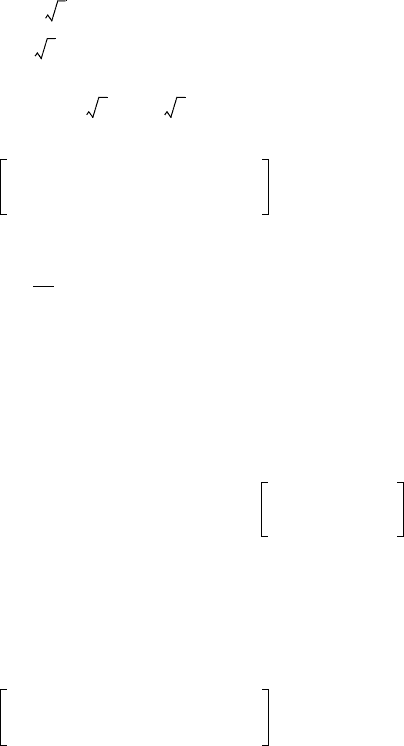
(6.250)
The inverse transform by means of the residue theorem occurs in similar manner as
before for the functions . Recognizing the additional pole at
and the additional factor in the denominator gives
(6.251)
and
(6.252)
Another avenue is to start with the general solution (6.245) to obtain
(6.253)
We have used the fact that
.
(6.254)
This is the Fourier-Bessel series for the function 1 (the number one) in the range
. We shall prove this using the following Ansatz:
.
We multiply it with and integrate over
x from 0 to 1:
B
˜
z
xp,()
B
0
J
0
xi p()
pJ
0
ip()
-----------------------------=
J
0
xi p()J
0
ip()⁄
p
0=
p
λ
0n
2
–=
B
z
x τ,()B
0
1
2J
0
λ
0n
x() λ
0n
2
– τ()exp
λ
0n
J
1
λ
0n
()
-------------------------------------------------------
n 1=
∞
∑
–=
g
ϕ
x τ,()
1
µ
0
r
0
-----------
x∂
∂B
z
–=
2B
0
µ
0
r
0
-----------
J
1
λ
0n
x() λ
0n
2
– τ()exp
J
1
λ
0n
()
----------------------------------------------------
.
n 1=
∞
∑
–=
B
z
x τ,()B
0
2λ
0n
J
0
λ
0n
x() λ
0n
2
– τ()exp
J
1
λ
0n
()
----------------------------------------------------------------
λ
0n
2
τ
0
()exp 1–
λ
0n
2
--------------------------------------
n 1=
∞
∑
=
B
0
2J
0
λ
0n
x()
λ
0n
J
1
λ
0n
()
----------------------------
n 1=
∞
∑
B
0
2J
0
λ
0n
x() λ
0n
2
– τ()exp
λ
0n
J
1
λ
0n
()
-------------------------------------------------------
n 1=
∞
∑
–=
B
z
x τ,()B
0
1
2J
0
λ
0n
x() λ
0n
2
– τ()exp
λ
0n
J
1
λ
0n
()
-------------------------------------------------------
n 1=
∞
∑
– .=
2J
0
λ
0n
x()
λ
0n
J
1
λ
0n
()
----------------------------
n 1=
∞
∑
1=
0 x 1<≤
1 c
n
J
0
λ
0n
x()
n 1=
∞
∑
=
xJ
0
λ
0n'
x()

6.7 The Cylindrical Diffusion Problem 395
The last step is a result of the orthogonality relation (3.214). Furthermore, using
our little set of formulas from Sect. 3.7.2 page 170 we find
.
The coefficients are therefore
.
This proves our claim. The results of (6.251) and () agree. The expansion (6.254)
makes the result (6.251) understandable. According to (6.251) for one has
,
just as the initial condition requires.
The exponential terms may be neglected for very large times, which results in
.
Of course, this is necessary. For very large times, the uniform magnetic field
occupies the entire space, including the inside of the cylinder. The currents which
initially shielded the inside of the cylinder from the magnetic field decay over time.
The time to decay is of the order of magnitude
,
.
(6.255)
Disregarding the factor this agrees with our rough approximation (6.39).
6.7.3 The azimuthal Field B
ϕ
We will now discus the azimuthal field in a similar manner as the longitudinal
field. Now, we create a magnetic field
.
(6.256)
at the surface of a cylinder, while there is no initial field inside of the cylinder.
Then eq. (6.224) applies to . This results for in
xJ
0
λ
0n'
()xd
0
1
∫
c
n
n 1=
∞
∑
xJ
0
λ
0n
x()J
0
λ
0n'
()xd
0
1
∫
=
c
n
2
-----
n 1=
∞
∑
J
1
λ
0n
()[]
2
δ
nn'
c
n'
2
------
J
1
λ
0n'
()[]
2
.==
xJ
0
λ
0n'
x()xd
0
1
∫
J
1
λ
0n'
()
λ
0n'
--------------------=
c
n'
2
λ
0n'
J
1
λ
0n'
()
-----------------------------=
τ 0=
B
z
x 0,()B
0
1
2J
0
λ
0n
x()
λ
0n
J
1
λ
0n
()
----------------------------
n 1=
∞
∑
– B
0
11–[]0===
B
z
x τ,()[]
τ∞→
B
0
=
λ
01
2
τ
λ
01
2
t
µ
0
κr
0
2
---------------
1≈=
t
µκr
0
2
λ
01
2
------------
≈
µκr
0
2
2.40()
2
------------------=
2.40
2
()
B
ϕ
x τ,()[]
x 1=
B
ϕ
1 τ,()f
ϕ
τ()==
B
ϕ
x τ,() B
˜
ϕ
xp,()
396 Time Dependent Problems I (Quasi Stationary Approximation)
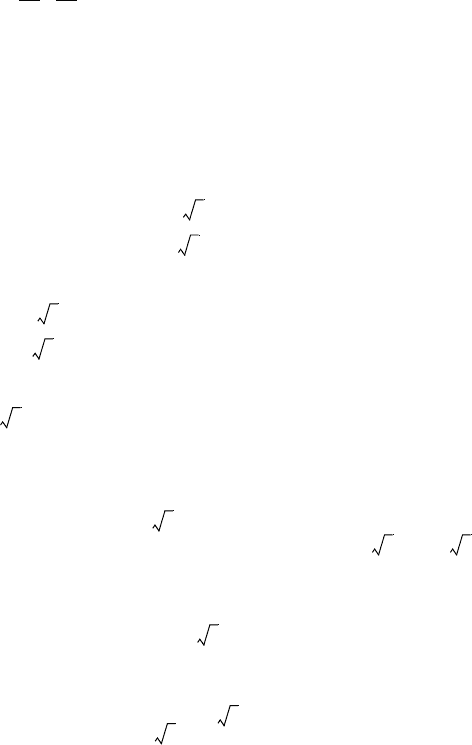
.
(6.257)
The boundary conditions are
(6.258)
. (6.259)
The only difference to the longitudinal case is that now, replaces . The
solution is obtained in analogy to (6.239)
.
(6.260)
For the inverse transform, we need the residues of the function
. (6.261)
Its poles are at
.
(6.262)
or
.
(6.263)
The zero of is no pole but a removable singularity, since the
numerator vanishes there as well. The ratio remains finite
(= x). The residues are then
Using the identity
and
gives
, (6.264)
and similar to (6.244), the transformation is
1
x
---
x∂
∂
x
x∂
∂
1
x
2
-----– p–
B
˜
ϕ
xp,()0=
B
˜
ϕ
1 p,()f
˜
ϕ
p()=
B
˜
ϕ
0 p,()finite=
J
1
J
0
B
˜
ϕ
xp,()f
˜
ϕ
p()
J
1
xi p()
J
1
ip()
----------------------
=
J
1
xi p()
J
1
ip()
----------------------
pτ()exp
ip λ
1n
= n 1≥()
p
λ
1n
2
–= n 1≥()
p
0= J
1
ip()
J
1
xi p()J
1
ip()⁄
R
n
J
1
λ
1n
x() λ
1n
2
– τ[]exp
J
1
ip()
----------------------------------------------------
p λ
1n
2
–→
lim p λ
1n
2
+()=
J
1
λ
1n
x() λ
1n
2
– τ[]exp
i
2 p
----------
J '
1
ip()
----------------------------------------------------
p λ
1n
2
–→
lim .=
J '
1
z() J
0
z()
1
z
---
J
1
z()–=
J '
1
λ
1n
()J
0
λ
1n
()=
R
n
2λ
1n
J
1
λ
1n
x() λ
1n
2
– τ[]exp
J
0
λ
1n
()
----------------------------------------------------------------–=
6.7 The Cylindrical Diffusion Problem 397
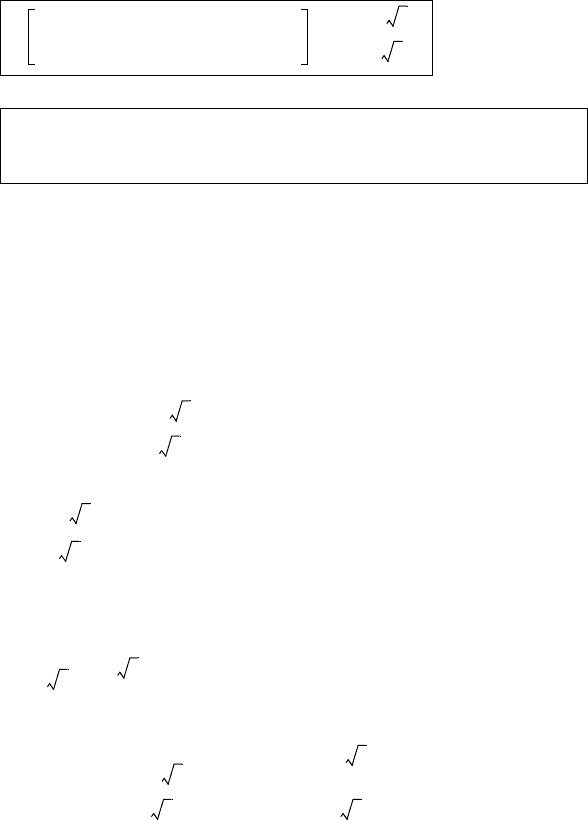
.
(6.265)
Applying the convolution theorem to eq. (6.260) yields
.
(6.266)
As an example, let us consider a similar case as before, now with the
boundary condition
(6.267)
or
.
(6.268)
Then we write the field with (6.260)
.
(6.269)
The function
.
has poles at and also at . The residue there can be found most
conveniently by finding the initial term of the expansion of . According to
(3.174) for small magnitudes of the argument it is approximately
,
and thus, for the residue there
.
(6.270)
The remaining residues are found similarly to (6.264), now with an additional
factor in the denominator.
.
(6.271)
Thus
L
2λ
1n
J
1
λ
1n
x() λ
1n
2
– τ[]exp
J
0
λ
1n
()
----------------------------------------------------------------
n 1=
∞
∑
–
J
1
xi p()
J
1
ip()
----------------------
=
B
ϕ
x τ,()
2λ
1n
J
1
λ
1n
x() λ
1n
2
– τ[]exp
J
0
λ
1n
()
----------------------------------------------------------------
f
ϕ
τ
0
() λ
1n
2
τ
0
()exp τ
0
d
0
τ
∫
n 1=
∞
∑
–=
f
ϕ
τ() B
0
=
f
˜
ϕ
p() B
0
p⁄=
B
˜
ϕ
xp,()
B
0
J
1
xi p()
pJ
1
ip()
-----------------------------=
B
0
J
1
xi p()
pJ
1
ip()
-----------------------------
pτ()exp
p
λ
1n
2
–=
p
0=
J
1
J
1
J
1
xi p()
xi p
2
------------
≈
R
0
B
0
J
1
xi p()
pJ
1
ip()
-----------------------------
pτ()pexp
p 0→
lim B
0
xi p
2
------------
ip
2
---------
------------
B
0
x===
p
λ
1n
2
–=
R
n
B
0
2J
1
λ
1n
x() λ
1n
2
– τ[]exp
λ
1n
J
1
λ
1n
()
-------------------------------------------------------
=
398 Time Dependent Problems I (Quasi Stationary Approximation)
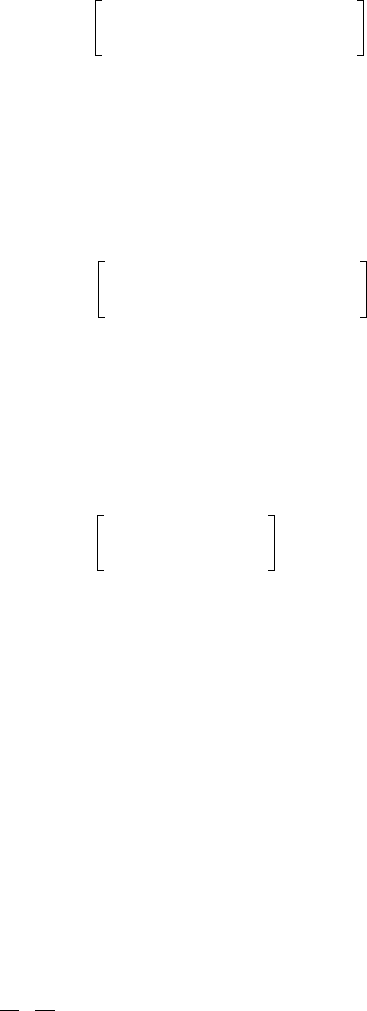
.
(6.272)
The same result can be derived using the general solution (6.266)
.
(6.273)
The Fourier-Bessel series for x in the range has to be used here:
.
(6.274)
The proof is achieved using the formulas from Sect. 3.7.3.3 and is left for the
reader as an exercise. Thus, both methods provide the same result. With (6.272)
and (6.274) follows for the time
,
that is, the initial condition for a vanishing field inside the cylinder is satisfied,
indeed. For very large times the field becomes as required:
.
(6.275)
Prescribing on the boundary of the cylinder means that the total current I inside
the cylinder is determined:
.
(6.276)
The current I remains constant during the entire diffusion process, merely the
current density varies over time. Initially, the current flows entirely in the
cylinder surface, and finally, the current has a uniform density inside the entire
cylinder.
The field that linearly increases with the radius (6.275) corresponds to this final
state. One can also derive the steady state directly from (6.217), from which
follows for the steady state that
,
(6.277)
B
ϕ
x τ,()B
0
x
2J
1
λ
1n
x() λ
1n
2
– τ[]exp
λ
1n
J
0
λ
1n
()
-------------------------------------------------------
n 1=
∞
∑
+=
B
ϕ
x τ,()
2B
0
λ
1n
J
1
λ
1n
x() λ
1n
2
– τ()exp
J
0
λ
1n
()
-----------------------------------------------------------------------
λ
1n
2
τ[]exp 1–
λ
1n
2
-----------------------------------
n 1=
∞
∑
–=
2B
0
J
1
λ
1n
x()
λ
1n
J
0
λ
1n
()
--------------------------------
n 1=
∞
∑
–
2B
0
J
1
λ
1n
x() λ
1n
2
– τ[]exp
λ
1n
J
0
λ
1n
()
--------------------------------------------------------------
n 1=
∞
∑
+=
B
0
x
2J
1
λ
1n
x() λ
1n
2
– τ[]exp
λ
1n
J
0
λ
1n
()
-------------------------------------------------------
n 1=
∞
∑
+=
0 x 1<≤
x
2J
1
λ
1n
x()
λ
1n
J
0
λ
1n
()
----------------------------
n 1=
∞
∑
–=
τ 0=
B
ϕ
x 0,()B
0
x
2J
1
λ
1n
x()
λ
1n
J
0
λ
1n
()
----------------------------
n 1=
∞
∑
+ B
0
xx–[]0===
B
ϕ
x 0,()[]
τ∞→
B
0
xB
0
r
r
0
----
==
B
ϕ
Ig
z
r()2πrrd
0
r
0
∫
1
µ
0
------
2πr
0
B
0
==
g
z
rt,()
1
r
---
r∂
∂
r
r∂
∂
1
r
2
-----–
B
ϕ
r() 0=
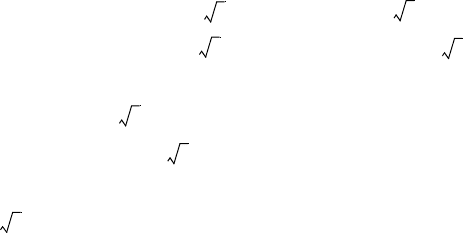
6.7 The Cylindrical Diffusion Problem 399
with the general solution
.
(6.278)
To avoid the divergence at requires that
,
and the boundary condition at is satisfied if
.
Therefore, , as claimed.
6.7.4 Skin Effect in a Cylindrical Wire
As another special case of diffusion, we discuss the skin effect of a cylindrical wire
in an azimuthal field . There shall be no initial field inside the wire. The
current
(6.279)
shall start flowing through the wire at time . At the surface, this
creates the field
(6.280)
. (6.281)
Thus, the boundary conditions in the time and p-domain, respectively are
(6.282)
. (6.283)
With (6.260), we obtain
.
(6.284)
The function
(6.285)
has poles of order 1 at
(6.286)
(6.287)
B
ϕ
r() Ar
B
r
---+=
r 0=
B 0=
rr
0
=
AB
0
r
0
⁄=
B
ϕ
B
0
rr
0
⁄=
B
ϕ
x τ,()
II
0
Ωτ()cos=
t 0 τ 0=()=
B
ϕ
µ
0
I
0
2πr
0
-----------
Ωτ()cos B
0
Ωτ()cos==
B
0
µ
0
I
0
2πr
0
-----------=
f
ϕ
τ() B
0
Ωτ()cos=
f
˜
ϕ
p() B
0
p
p
2
Ω
2
+
-------------------
=
B
˜
ϕ
xp,()
B
0
p
p
2
Ω
2
+
-------------------
J
1
xi p()
J
1
ip()
----------------------
B
0
pJ
1
xi p()
piΩ+()piΩ–()J
1
ip()
-------------------------------------------------------------==
B
0
pJ
1
xi p()
piΩ+()piΩ–()J
1
ip()
-------------------------------------------------------------
pτ()exp
ip λ
1n
=
p
λ
1n
2
–=
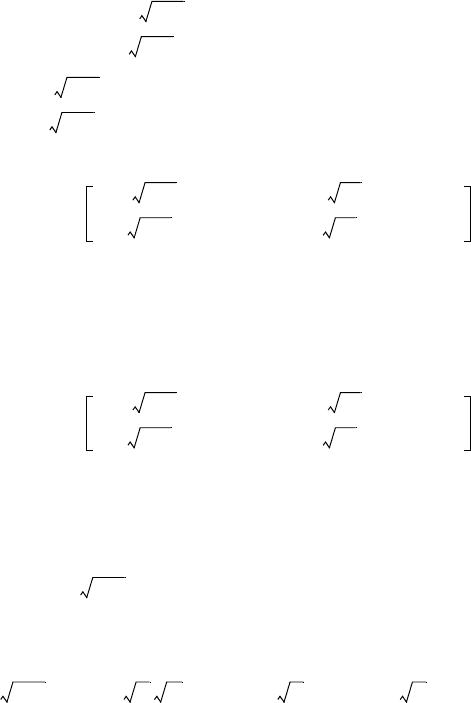
400 Time Dependent Problems I (Quasi Stationary Approximation)
and also at
.
(6.288)
Its residues at the locations are
.
(6.289)
This can be obtained from the residues (6.264) and the factor
.
The residues of the poles at are
.
(6.290)
Therefore
.
(6.291)
Again, the exponentially decaying terms are insignificant for large times. This
gives the “steady state” for which one obtains
.
(6.292)
Particularly for , in harmony with the boundary condition, the field
becomes
.
The functions are complex valued, however, one may split them into
their real and imaginary parts. These functions have such great importance that
new functions and names were introduced to address them, the Kelvin functions
with “ber” (Bessel real part) and “bei” (Bessel imaginary part)
.
(6.293)
p
iΩ±=
p
λ
1n
2
–=
R
n
2B
0
λ
1n
3
J
1
λ
1n
()
λ
1n
4
Ω
2
+()J
0
λ
1n
()
-----------------------------------------------
λ
1n
2
τ–()exp=
B
0
p
p
2
Ω
2
+
-------------------
B
0
λ
1n
2
λ
1n
4
Ω
2
+
----------------------–=
p
iΩ±=
R
±
B
0
iΩ±()J
1
xi iΩ±()
2 iΩ±()J
1
iiΩ±()
---------------------------------------------------
iΩ±τ()exp=
B
0
2
------
J
1
xi iΩ±()
J
1
iiΩ±()
-----------------------------
iΩ±τ()exp=
B
ϕ
x τ,()
B
0
2
------
J
1
xiΩ–()
J
1
iΩ–()
---------------------------
iΩτ()exp
J
1
xiΩ()
J
1
iΩ()
------------------------
iΩ– τ()exp+=
B
0
2λ
1n
3
J
1
λ
1n
x()
λ
1n
4
Ω
2
+()J
0
λ
1n
()
-----------------------------------------------
λ
1n
2
τ–()exp
n 1=
∞
∑
+
B
ϕ
x τ,()
B
0
2
------
J
1
xiΩ–()
J
1
iΩ–()
---------------------------
iΩτ()exp
J
1
xiΩ()
J
1
iΩ()
------------------------
iΩ– τ()exp+=
x 1 rr
0
=(),=
B
ϕ
1 τ,()
B
0
2
------
iΩτ()exp iΩ– τ()exp+[]B
0
Ωτ()cos==
J
1
xi iΩ
+
−
()
J
v
xiΩ
+
−
()J
v
x Ω i
+
−
()ber
v
x Ω()i bei
v
x Ω()±==
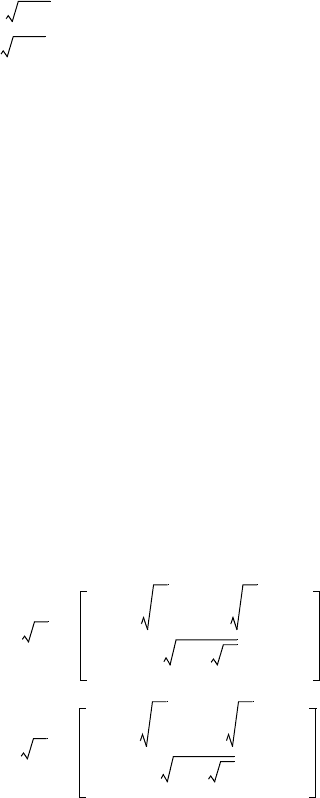
6.7 The Cylindrical Diffusion Problem 401
Kelvin functions allow one to write as of (6.291) or (6.292) in a real
form. We will leave the details for the reader’s further study. Here, we will suffice
with a short discussion of two limits (very low and very high frequencies).
1) The limit of very low Frequencies ( )
If , then the magnitude of all arguments of the Bessel functions in (6.292) are
much smaller than 1 because x is in the interval . Consequently
,
(6.294)
and therefore
.
(6.295)
This should come as no surprise. The field is in phase everywhere because we
assumed that the frequency of the field is small and its corresponding period is
consequently large, that is, it is large against the time it takes to penetrate the
cylinder. From
(6.296)
follows that
.
(6.297)
Note eq. (6.137) with . The amplitude increases linearly with x (i.e., linear
with the radius). Therefore, the current density inside the cylinder is spatially
constant for all times. However, it oscillates over time with the period . In
principle, this is the behavior of a direct current, which changes only slowly
(slowly compared to the typical penetration depths, ).
2) The limit of very high frequencies ( )
A zero order approximation for very large arguments is this:
(6.298)
. (6.299)
Using this in (6.292) and (6.293) gives
B
ϕ
x τ,()
Ω 1«
Ω 1«
0 x 1<≤
J
1
xiΩ±()
J
1
iΩ±()
---------------------------
x≈
B
ϕ
x τ,()
B
0
2
------
xiΩτ()exp xiΩ– τ()exp+[]≈ B
0
x Ωτ()cos=
Ωωµκr
0
2
1«=
1
ω
---- µκr
0
2
»
lr
0
=
Ωτ()cos
µκr
0
2
Ω 1»
ber
1
x Ω()
x
Ω
2
----
x
Ω
2
----
3π
8
------+
cosexp
2πx Ω
-------------------------------------------------------------------
≈
bei
1
x Ω()
x
Ω
2
----
exp x
Ω
2
----
3π
8
------+
sin
2πx Ω
------------------------------------------------------------------
≈
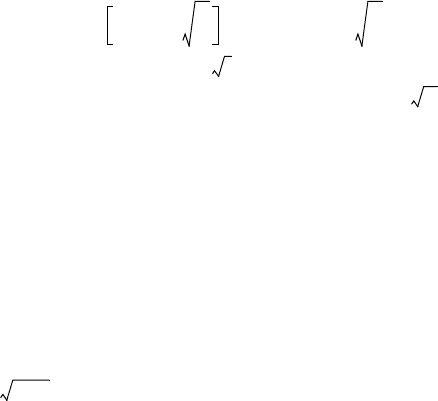
402 Time Dependent Problems I (Quasi Stationary Approximation)
.
(6.300)
The reader is cautioned that this expression is valid only for (that is, even
for large frequencies, its validity is restricted to x being not too small, i.e., not too
close to the axis). Take eq. (6.300), close to the surface where or ,
there one observes that the field behaves just like the planar case. For this purpose,
compare the current result (6.300) with that of the half-space (6.139) and notice
that there, the distance ξ from the surface of the half space corresponds here to the
distance from the cylinder surface , or dimensionless:
. From
(6.301)
follows that
,
(6.302)
that is, the penetration depth is very small versus the cylinder radius. Also plausible
is, that under those circumstances the diffusion occurs as in the plane case. This is
true, not only for cylinders, but for all kinds of shapes, as long as the frequency is
large enough, or the interest is only in sufficiently thin penetration depths. From
this perspective, the result (6.139) is of rather general significance.
Summarizing, we may conclude that the case of very low frequencies can be
reduced to the case of direct currents, while the case of high frequencies can be
reduced to a plane diffusion problem. For intermediate frequencies, there is no easy
approximation. However, the behavior is qualitatively (not quantitatively) similar
to the plane case that we have studied in Sect. 6.5.4: The wave is damped while
penetrating the medium and it exhibits a phase difference.
6.8 Limits of the Quasi Stationary Theory
The quasi stationary theory is an approximation which is based on neglecting the
displacement current in Maxwell’s equations. We have mentioned already that all
phenomena related to electromagnetic waves are neglected. It may sound paradox
that we have encountered wave behavior in processes like the skin effect. Notice
however, that these processes are enforced by the boundary conditions and are
unrelated to electromagnetic waves which we will discuss later.
A typical behavior of propagation of waves is that this occurs with a certain
finite velocity. We will discuss this in detail in the next chapter. Furthermore, the
fundamental postulate of relativity, and thereby for the entire natural science
altogether, is that there is no signal velocity higher than the speed of light in
vacuum, . Consider for example, a field of the kind as discussed in
Sect. 6.4, initially shaped like a δ-function, propagating in the infinite space.
B
ϕ
x τ,()
B
0
1 x–()–
Ω
2
----exp Ωτ 1 x–()–
Ω
2
----
cos
x
------------------------------------------------------------------------------------------------------
≈
x Ω 1»
rr
0
≈ x 1≈
r
0
r–
r
0
r–()r
0
⁄ 1 rr
0
⁄–()1 x–==
ωµκr
0
2
Ω 1»=
r
0
1
ωµκ
---------------»
c
0
310
8
ms
1–
⋅≈

6.8 Limits of the Quasi Stationary Theory 403
Eq. (6.69) describes such a field. This equation indicates something very peculiar.
At the time , the field exists only at one particular place, however, it is there
infinitely large. Then the field already penetrates the entire space after an
arbitrarily small period of time , even though it is very small at large distances.
This seems to suggest that the signal velocity is infinitely large. Indeed, given
sufficiently sensitive instruments, it should be possible to detect a field at very
large distances after an extremely short time period, and use this to transmit
signals, at least in principle, if these fields actually existed. Nonetheless, such is not
the case. The infinite signal speed is typical for “diffusion processes”, i.e., for those
processes described by the diffusion equation. However, physically they are not
real. Formally – as we find – this results from neglecting the displacement current,
which is equivalent to the assumption of infinite signal propagation velocity.
Another example we have dealt with shall be mentioned: The conductive
half-space with no initial field. When a constant field is suddenly applied to the
surface at the time , then according to eq. (6.117) or Fig. 6.20, this field
penetrates the entire half-space after an arbitrarily short time period.
All this should not be interpreted in a manner, rendering all these fields as
useless or totally wrong. Under appropriate preconditions, the quasi stationary
theory provides an excellent approximation of the actual field behavior. The
enormous velocity of the speed of light is thereby fundamental. The fields
propagate with this speed, and the far away areas which have not been reached by
the field are for many problems immaterial. Besides, even though these faraway
fields described by the quasi stationary theory do not vanish, nevertheless, they are
oftentimes so small that they are deemed to be insignificant. The qualitative
conclusion of these remarks is that the quasi stationary theory is a useful
approximation only for sufficiently large times or sufficiently slow or low
frequency processes. To arrive at a quantitative statement, we return to the example
of the field diffusion in the infinite space. In contrast to eq. (6.69), the field has to
vanish if
.
In practice, this is insignificant if
that is, if
.
Therefore, it must be:
τ 0=
τ
B
0
τ 0=
x' x–()
2
l
2
ξ' ξ–()
2
c
2
t
2
>
t
2
µε
------==
ξ' ξ–()
2
4τ
--------------------–exp
x' x–()
2
4t
-------------------
– µκexp 1«= for x' x–()
2
t
2
µε
------=
x' x–()
2
µκ
t
-------
1» for x' x–()
2
t
2
µε
------=
µκ
µε
-------
t 1»