
Lehner G. Electromagnetic Field Theory for Engineers and Physicists
Подождите немного. Документ загружается.

414 Time Dependent Problems II (Electromagnetic Waves)
maintains its shape despite of its propagation, which is also an immediate result of
the wave equation, and which manifests itself in D’Alembert’s solution. The
subject becomes much more complicated when different parts of the wave
propagate with different phase velocities. Then, general statements about the
behavior of a wave packet are no longer possible. What is probable in this case is
that its shape changes significantly over time. As a consequence, it may not even
be possible to describe its motion with a single velocity. However, certain
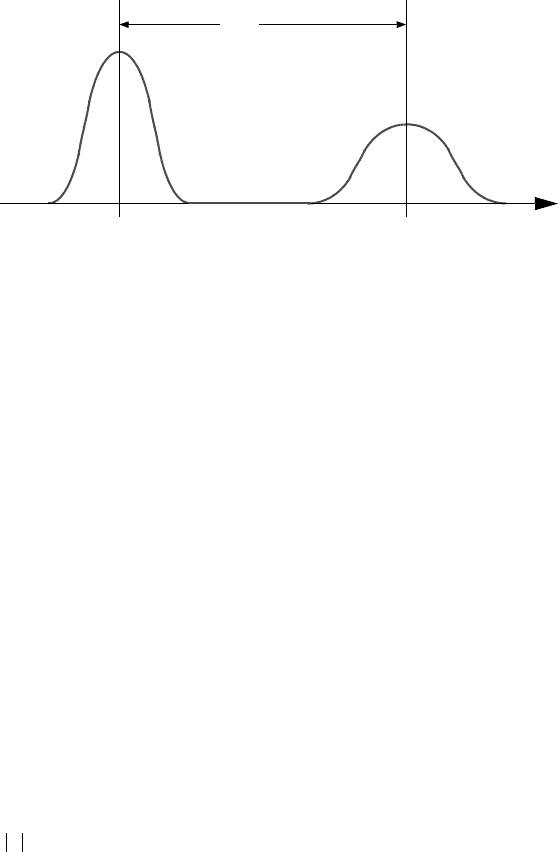
statements for wave packets of a narrow frequency band are possible. Narrow
frequency band shall mean that the frequencies within the wave packet fall into a
small frequency interval ( ) where . Then, the maximum of the
wave packet travels with the velocity (Fig. 7.4). The shape of the packet
changes as it moves. To transmit a signal by means of waves requires a wave
packet, and their signal velocity is, as already mentioned, the group velocity. A
word of caution is here appropriate. may not always be interpreted as the
signal velocity.
The harmonic plane waves are of fundamental theoretical importance because
every possible wave can be composed of them by superposition. We will discuss a
few examples below.
A plane harmonic wave may propagate in an arbitrary direction of the space.
The propagation direction is typically described by the wave vector (propagation
vector, wave number vector) k. Its direction is the propagating direction and its
magnitude is like before
.
(7.45)
This defines a plane wave in the following way:
.
(7.46)
The phase is thereby constant, if for a fixed point in time
.
(7.47)
ωω ∆ω+,∆ωω«
v
G
Fig. 7.4
z
v
G
t
dω dk⁄
k k
2π
λ
------==
EE
0
ωt kr•– ϕ+()cos= where E
0
k• 0=
kr• const=
7.1 Wave Equations and their simplest Solutions 415
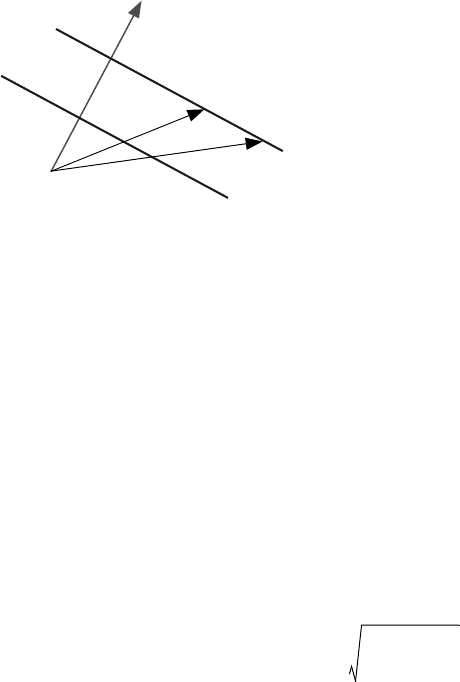
These are the equations of planes to which k is perpendicular (Fig. 7.5). These
waves are, indeed, plane waves which propagate in the direction defined by k.
7.1.4 Elliptic Polarization
Consider superimposing two linearly polarized waves of the same frequency,
propagating in z-direction, but with different amplitude and a phase difference of
.
(7.48)
. (7.49)
After eliminating and by means of these relations:
and ,
we obtain
.
(7.50)
This is the equation for an ellipse, when regarding it as an equation for .
This means that in the planes , the tips of the E vector describe an
elliptic path. These waves are therefore appropriately called elliptically polarized
(or simply elliptic waves). Particularly for
,
(7.51)
or even more general, for
,
(7.52)
Fig. 7.5
r
k
ϕ
E
x
E
x0
ωtkz–()cos=
E
y
E
y0
ωtkz– ϕ+()cos=
E
y0
ωtkz–()cos ϕcos ωtkz–()sin ϕsin–[]=
ωtkz–()cos ωtkz–()sin
ωtkz–()cos
E
x
E
x0
--------= ωtkz–()sin 1
E
x
E
x0
--------
2
–=
E
x
2
E
x0
2
---------
E
y
2
E
y0
2
---------
2E
x
E
y
E
x0
E
y0
-----------------
ϕcos–+ ϕsin
2
=
E
x
E
y
,
z const.=
ϕ
π
2
---=
ϕ
2n 1+
2
---------------
π=
416 Time Dependent Problems II (Electromagnetic Waves)
we obtain
.
(7.53)
This is the equation of an ellipse with its principal axis parallel the x- and y-axis.
Further specializing, so that
(7.54)
yields
.
(7.55)
that is the equation of a circle. This represents a circularly polarized wave. For
one obtains a linearly polarized wave.
7.1.5 Standing Waves
Two waves with the same amplitude, wave length, and polarization travelling in
opposite directions give
.
(7.56)
Because of the trigonometric identities
,
(7.57)
it follows that
.
(7.58)
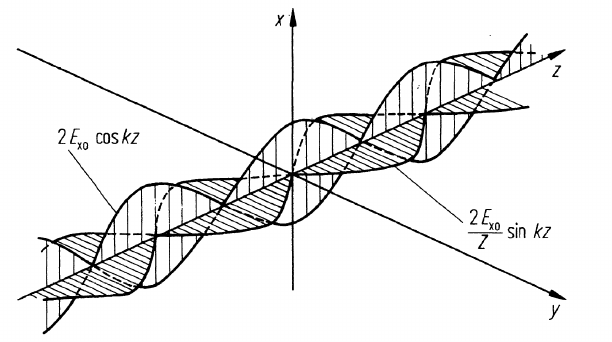
This represents a standing wave, which, so to speak, oscillates in place (Fig. 7.6).
With the appropriate choice of z and t, it is possible to let . Then
.
(7.59)
E
x
2
E
x0
2
---------
E
y
2
E
y0
2
---------+1=
E
x0
E
y0
E
0
==
E
x
2
E
y
2
+ E
0
2
=
ϕ nπ=
E
x
zt,() E
x0
ωtkz– ϕ
1
+()cos E
x0
ωtkzϕ
2
++()cos+=
H
y
zt,()
E
x0
Z
--------
ωtkz– ϕ
1
+()cos
E
x0
Z
--------
ωtkzϕ
2
++()cos–=
αcos βcos+ 2
αβ+
2
-------------
cos
αβ–
2
-------------
cos=
αcos βcos–2
αβ+
2
-------------
sin
αβ–
2
-------------
sin–=
E
x
zt,() 2E
x0
ωt
ϕ
1
ϕ
2
+
2
------------------+
kz–
ϕ
1
ϕ
2
–
2
------------------+
coscos=
H
y
zt,()
2E
x0
Z
------------– ωt
ϕ
1
ϕ
2
+
2
------------------+
sin kz–
ϕ
1
ϕ
2
–
2
------------------+
sin=
ϕ
1
ϕ
2
0==
E
x
zt,() 2E
x0
kzcos ωtcos=
H
y
zt,()
2E
x0
Z
------------
ksin z ωsin t=
7.1 Wave Equations and their simplest Solutions 417
Fig. 7.6 illustrates how the amplitudes of the oscillating field vary.
The zeros of the electric field (which are called its nodes or nodal points) are
located at
and thus
The nodes of the magnetic field are at
and thus
.
At the time , for instance, , while assumes its maximum value.
Conversely for , it is , while assumes its maximum value, etc.
Fig. 7.6
E
x
kz
2n 1+
2
---------------
π=
z
2n 1+
2
---------------
π
k
---
2n 1+
4
---------------
λ==
z
1
4
---
λ±
3
4
---
λ±
5
4
---
λ±…,,,=
kz nπ=
zn
π
k
---
n
2
---
λ==
z 0
1
2
---
λ±λ±
3
2
---
λ±…,,,,=
t 0= H
y
0= E
x
t τ 4⁄= E
x
0= H
y
418 Time Dependent Problems II (Electromagnetic Waves)
7.1.6 TE- and TM Wave
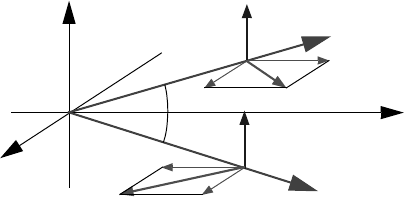
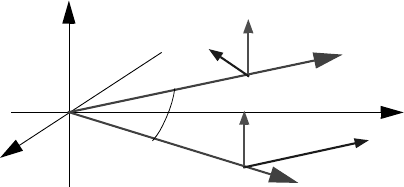
As illustrated in Fig. 7.7, we now superimpose two plane waves with the same
frequency, amplitude, and polarization, but with different propagation direction. It
shall be for the first wave:
1)
where
and for the second wave
2)
where
When superposing these and using (7.57), we find
Fig. 7.7
E
x
y
z
x
α
α
B
y
B
B
z
k
1
0 k
y
– k
z
,,〈〉=
k
2
0 k
y
k
z
,,〈〉=
E
x
B
y
B
B
z
E
1
E
0
ωt k
1
r•–()cos=
B
1
B
01
ωt k
1
r•–()cos=
k
1
0 k
y
– k
z
,,〈〉=
E
0
E
x0
00,,〈〉=
B
01
e
a1
E
0
×
c
---------------------
k
1
E
0
×
k
1
c
------------------
k
1
E
0
×
ω
------------------
E
x0
ω
--------
0 k
z
k
y
,,〈〉====
E
2
E
0
ωt k
2
r•–()cos=
B
2
B
02
ωt k
2
r•–()cos=
k
2
0 k
y
k
z
,,〈〉=
E
0
E
x0
00,,〈〉=
B
02
e
a2
E
0
×
c
---------------------
k
2
E
0
×
ω
------------------
E
x0
ω
--------
0 k
z
k
y
–,,〈〉===
7.1 Wave Equations and their simplest Solutions 419
and
or
(7.60)
and
.
(7.61)
The wave described by (7.60) and (7.61) is not a plane wave. It travels in z-
direction. Its phase velocity is
.
(7.62)
Besides the transverse field components and , the magnetic field has also a
longitudinal component . Thus the field is transverse with respect to the electric
field, but not with respect to the magnetic field. Such a wave is called transverse
electric wave or abbreviated TE wave (also H wave). Its amplitudes are y-
dependent.
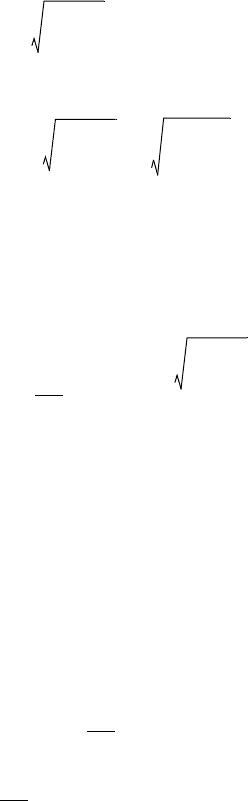
One can treat the case illustrated in Fig. 7.8 in a similar manner. Now one
superimposes the following two waves. First:
EE
0
ωtk
y
yk
z
z–+()cos E
0
ωtk
y
y– k
z
z–()cos+=
2E
0
ωtk
z
z–()cos k
y
y()cos=
BB
01
ωt k
1
r•–()cos B
02
ωt k
2
r•–()cos+=
E
x
2E
x0
ωtk
z
z–()cos k
y
y()cos=
E
y
0=
E
z
0=
B
x
0=
B
y
2E
x0
k
z
ω
----
ωtk
z
z–()cos k
y
y()cos=
B
z
2E
x0
k
y
ω
-----
ωtk
z
z–()sin k
y
y()sin–=
v
ph
ω
k
z
----=
E
x
B
y
B
z
Fig. 7.8
B
x
y
z
x
α
α
k
1
k
2
E
E
B
x

420 Time Dependent Problems II (Electromagnetic Waves)
1)
where
and for the second wave
2)
where
The superposition yields
(7.63)
and
.
(7.64)
Where it was used that
.
The wave described by (7.63) and (7.64) is, again, not a plane wave. It travels in
the z-direction. It is transverse with respect to B but not with respect to E. Such a
wave is called a transverse magnetic wave or abbreviated TM wave (also E wave).
These waves are important in connection with wave guides to which we will
return later. True for both kinds of waves (TE and TM) is that
E
1
E
01
ωt k
1
r•–()cos=
B
1
B
0
ωt k
1
r•–()cos=
k
1
0 k
y
– k
z
,,〈〉=
B
0
B
x0
00,,〈〉=
E
01
cB
0
e
a
× cB
0
k
1
k
1
-----
×
cB
x0
k
1
-----------
0 k
z
k
y
,,〈〉–== =
E
2
E
02
ωt k
2
r•–()cos=
B
2
B
0
ωt k
2
r•–()cos=
k
2
0 k
y
k
z
,,〈〉=
B
0
B
x0
00,,〈〉=
E
02
cB
x0
k
2
-----------
0 k
z
k
y
–,,〈〉 .–=
B
x
2B
x0
ωtk
z
z–()cos k
y
y()cos=
B
y
0=
B
z
0=
E
x
0=
E
y
2cB
x0
k
z
k
----
ωtk
z
z–()cos k
y
y()cos–=
E
z
2cB
x0
k
y
k
-----
ωtk
z
z–()sin k
y
y()sin=
k
1
k
y
2
k
z
2
+ k
2
k===
7.1 Wave Equations and their simplest Solutions 421
and
.
Therefore,
(7.65)
and
.
(7.66)
These waves are not dispersion free. Their phase velocity is higher than the speed
of light for the respective medium, thus its phase velocity for vacuum is higher than
the speed of light in vacuum. This is entirely possible and does not entail any
contradiction to the theory of special relativity, according to which no signal
velocity may exceed the speed of light in vacuum. The group velocity is what
qualifies for the signal velocity, which is
.
(7.67)
Consequently
(7.68)
and
,
(7.69)
as it must be. To obtain (7.68) directly from the dispersion relation by
differentiating for is also possible:
.
v
ph
ω
k
z
----=
k
2
k
y
2
k
z
2
+ µεω
2
ω
2
c
2
------===
k
z
ω
2
c
2
------ k
y
2
–=
v
ph
ω
ω
2
c
2
------ k
y
2
–
----------------------
c
1
k
y
2
c
2
ω
2
-----------–
------------------------
c≥==
v
G
k
z
d
dω 1
dk
z
dω
--------
-------- c
2
ω
2
c
2
------ k
y
2
–
ω
----------------------
c
2
v
ph
--------=== =
v
G
v
ph
c
2
=
v
G
c≤
k
z
k
y
2
k
z
2
+ µεω
2
ω
2
c
2
------==
2k
z
1
c
2
-----
2ω
k
z
d
dω
=
ω
k
z
----
k
z
d
dω
v
G
v
ph
c
2
==
422 Time Dependent Problems II (Electromagnetic Waves)
In the limit , the waves (7.60), (7.61) as well as (7.63), (7.64) become
plane waves. The longitudinal components of and vanish in the process.
The other limit, results in standing waves of the kind discussed in
Sect. 7.1.5.
7.1.7 Energy Density in and Energy Transfer by Waves
First, consider the plane wave
.
(7.70)
. (7.71)
Then, the pointing vector discussed in Sect. 2.14 is according to (2.153)
.
(7.72)
is the energy flux density, i.e., the electromagnetic energy transferred across an
area per unit time and unit area. On the other hand, the energy density stored in the
field of the wave is
.
(7.73)
Multiplying this with c, just yields :
.
(7.74)
We conclude that the energy stored in the field is transferred in z-direction with the
speed of light.
The just discussed TE and TM waves are interesting examples. We limit our
discussion to the TE wave described by the two equations (7.60) and (7.61). in this
case we have
.
(7.75)
Observe that on average over time, there is no energy transfer in y-direction.
However, there is an energy transfer in z-direction, as the time average of
does not vanish. The effective, time averaged energy transfer is
.
(7.76)
Further averaging, now over the location dependency, we obtain
.
(7.77)
Furthermore, the spatial and temporal average of the energy density is
k
y
0=
B
z
E
z
k
z
0=
E
x
E
x0
ωtkz–()cos=
H
y
H
y0
ωtkz–()cos
E
x0
Z
--------
ωtkz–()cos==
SEH× 00E
x
H
y
,,〈〉00
E
x
2
Z
------
,,〈〉== =
S
εE
2
2
---------
µH
2
2
----------+
εE
x
2
2
---------
µE
x
2
2Z
2
----------+
εE
x
2
2
---------
εE
x
2
2
---------+ εE
x
2
===
S
z
εE
x
2
c εE
x
2
1
εµ
----------
E
x
2
Z
------==
SEH× 0 E
x
H
z
– E
x
H
y
,,〈〉==
E
x
H
y
S
z eff
2E
x0
2
k
z
k
y
y()cos
2
µω
------------------------------------------=
S
z eff
E
x0
2
k
z
µω
--------------
εE
x0
2
k
z
εµω
-----------------
εE
x0
2
c
2
k
z
ω
---------------------- εE
x0
2
v
G
== = =
7.2 Plane Waves in a Conductive Medium 423
.
(7.78)
Comparing the last two equations reveals that the available energy, averaged over
time and over space, is transferred in the z-direction with the group velocity
(and not by the phase velocity which is in this case higher than the speed of
light c).
Note: In case the fields are written in complex notation, then it is advisable to
return to the real fields before calculating energy densities or the Poynting vector.
7.2 Plane Waves in a Conductive Medium
7.2.1 Wave Equations and Dispersion Relation
Now, we study a plane wave in a conductive medium which does not have any
volume charges. Then with (7.8) and (7.9), we obtain
(7.79)
. (7.80)
For variation and to simplify, we take advantage of the complex notation which
allows to describe the wave in the following form:
(7.81)
. (7.82)
The physically relevant fields are represented individually by either the real part or
by the imaginary part thereof. Using this approach in either of the two eqs. (7.79)
or (7.80) yields the same dispersion relation:
or
.
(7.83)
The operators of vector analysis can be expressed via multiplications when
applying them to statements of the kind as expressed by (7.81) and (7.82). For
instance, the divergence is
.
(7.84)
Furthermore
εE
x0
2
2
------------
E
x0
2
k
z
2
k
y
2
+()
2µω
2
-------------------------------+
εE
x0
2
2
------------
E
x0
2
2µc
2
------------+ εE
x0
2
==
v
G
v
ph
∇
2
E µκ
t∂
∂E
µε
∂
2
E
∂t
2
----------
+=
∇
2
B µκ
t∂
∂B
µε
∂
2
B
∂t
2
----------
+=
EE
0
i ωt kr•–()[]exp=
BB
0
i ωt kr•–()[]exp=
ik
x
–()
2
ik
y
–()
2
ik
z
–()
2
++ µκiωµεiω()
2
+=
µεω
2
µκiω– k
2
–0 =
E∇• ik
x
E
x
ik
y
E
y
ik
z
E
z
––– ikE•–==