
Lehner G. Electromagnetic Field Theory for Engineers and Physicists
Подождите немного. Документ загружается.

454 Time Dependent Problems II (Electromagnetic Waves)
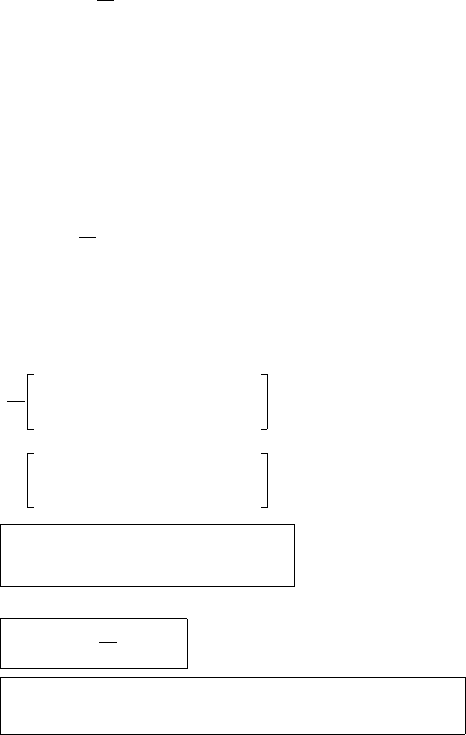
which satisfy the two eqs. (7.227) and (7.229), while the other two eqs. (7.226) and
(7.228), together with the gauge choice
,
(7.242)
yields the homogeneous equations
(7.243)
. (7.244)
Letting
(7.245)
, (7.246)
satisfies the gauge condition (7.242). Now, the wave equations (7.243) and (7.244)
yield
.
(7.247)
And finally, one obtains
.
(7.248)
. (7.249)
7.5 Hertz’s Dipole
7.5.1 Fields of Oscillating Dipoles
Consider a dipole located at the origin, oriented along the z-axis, and oscillating in
time:
.
(7.250)
Its polarization, defined as the spatial density of the dipole moment is
A
*
∇• µε
t∂
∂
ϕ
*
+0=
∇
2
A
*
µκ
∂A
*
∂t
----------
– µε
∂
2
A
*
∂t
2
-------------
–0=
∇
2
ϕ
*
µκ
∂ϕ
*
∂t
---------
– µε
∂
2
ϕ
*
∂t
2
------------
–0=
A
*
µε
t∂
∂
P
m
=
ϕ
*
P
m
∇•–=
t∂
∂
∇
2
P
m
µκ
∂ P
m
∂t
-----------
– µε
∂
2
P
m
∂t
2
--------------
–0=
∇
2
P
m
µκ
∂ P
m
∂t
-----------
– µε
∂
2
P
m
∂t
2
--------------
–∇• 0=
∇
2
P
m
µκ
∂ P
m
∂t
-----------
– µε
∂
2
P
m
∂t
2
--------------
–0 =
D µε
t∂
∂
P
m
∇×–=
H ∇ P
m
∇•()µκ
∂
∂t
----
µε
∂
2
∂t
2
-------
+
P
m
– P
m
∇×() ∇×==
pe
z
p
0
ωtsin=
7.5 Hertz’s Dipole 455
.
(7.251)
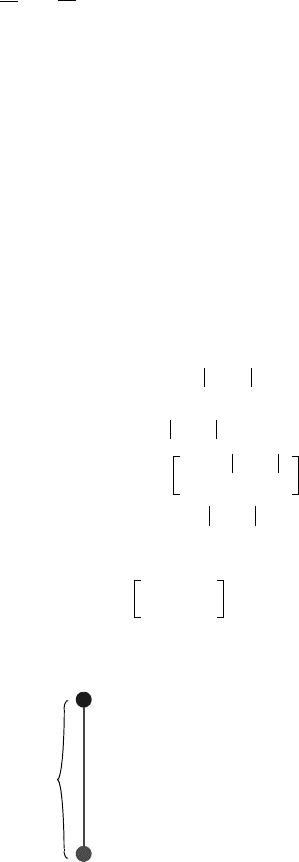
The temporal change of the dipole moment is linked to currents. According to
Fig. 7.16, we get
(7.252)
or
(7.253)
and therefore
,
(7.254)
where
.
(7.255)
To calculate the field of the oscillating dipole, one uses eq. (7.223), which may be
solved similarly to (7.188) and whose solution was (7.195). Since P has only a z-
component, the electric Hertz vector reduces to
.
(7.256)
. (7.257)
. (7.258)
P p
0
ωt()sin δ r()e
z
=
Fig. 7.16 Dipole
Q–
+Q
p
l
p
lQ=
td
dp
l
td
dQ
lI ωp
0
ωtcos===
I
ωp
0
l
----------
ωtcos I
0
ωtcos==
I
0
ωp
0
l
----------=
Π
ex
0=
Π
ey
0=
Π
ez
1
4πε
---------
P
z
r' t
rr'–
c
---------------–,
rr'–
-----------------------------------------
τ'd
∫
=
1
4πε
---------
p
0
ω t
rr'–
c
---------------–
sin δ r'()
rr'–
----------------------------------------------------------------
τ'd
∫
=
Π
ez
p
0
4πεr
------------
ω t
r
c
--
–
sin=
456 Time Dependent Problems II (Electromagnetic Waves)
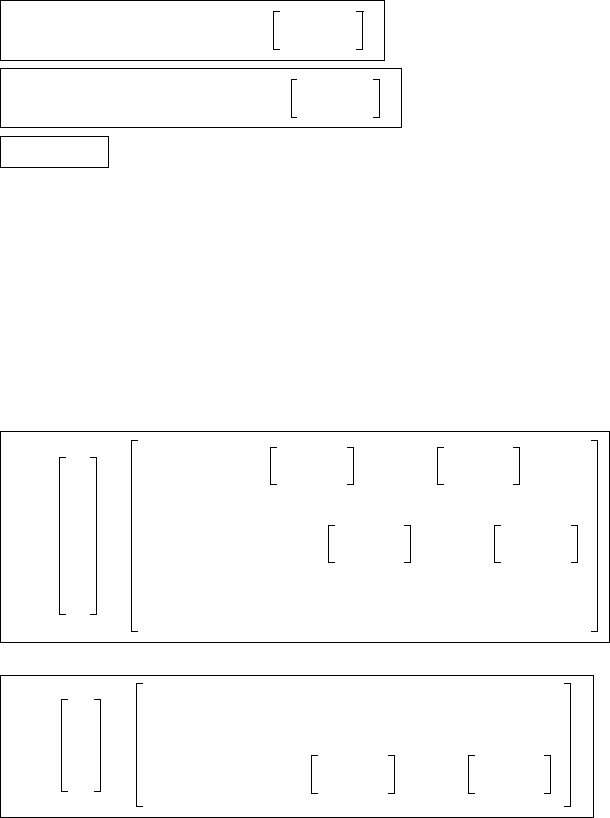
r is the distance from the observation point to the origin and, hence, to the
oscillating dipole. To use spherical coordinates is advisable. The transformed Hertz
vector is
(7.259)
(7.260)
. (7.261)
The fields are calculated according to (7.210), (7.211) and (7.224), (7.225),
respectively, and yield
(7.262)
, (7.263)
where it has to be pointed out that the expression to the far right of (7.263) is only
valid for locations where (i.e., in our case, outside the origin). By means of
the formulas from Sect. 3.3.3 and some algebra, which we skip here, one obtains:
(7.264)
(7.265)
Of course, we might as well use (7.197) and (7.198), to calculate A and ϕ:
Π
er
Π
ez
θcos
p
0
θcos
4πεr
------------------
ω t
r
c
--
–
sin==
Π
eθ
Π
ez
θsin–
p
0
θsin
4πεr
-----------------
ω t
r
c
--
–
sin–==
Π
eϕ
0 =
H ε
∂ P
e
∂t
----------
∇×=
E ∇ P
e
∇•()µε
∂
2
P
e
∂t
2
------------
– P
e
∇×()∇×==
P 0=
E
E
r
E
θ
E
ϕ
2p
0
θcos
4πε
---------------------
1
r
3
-----
ω t
r
c
--–
sin
ω
cr
2
--------
ω t
r
c
--–
cos+
p
0
θsin
4πε
-----------------
1
r
3
-----
ω
2
rc
2
--------
–
ω t
r
c
--–
sin
ω
cr
2
--------
ω t
r
c
--–
cos+
0
==
H
H
r
H
θ
H
ϕ
0
0
ωp
0
θsin
4π
---------------------
ω
rc
-----
–
ω t
r
c
--–
sin
1
r
2
-----
ω t
r
c
--–
cos+
==
7.5 Hertz’s Dipole 457
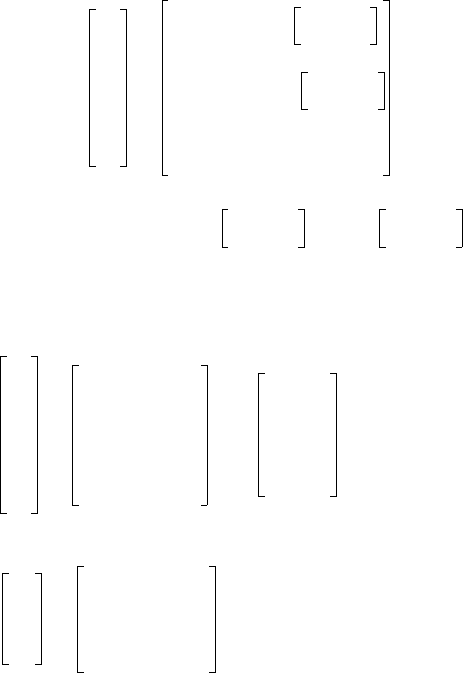
(7.266)
. (7.267)
The effects of retardation occur in the ubiquitous argument . If the speed of
light were infinite, there would be no retardation. An interesting task is to
determine what kind of fields would result in this limit ( ). One finds
(7.268)
and
.
(7.269)
Comparison with eqs. (2.63) reveals that this limit results in the “static” dipole
field. Its time dependency follows exactly all changes of the dipole at the origin,
i.e., all changes are instantaneously apparent everywhere in the entire space, as
expected for an infinite speed of light. For better appreciation of (7.269), we
express in a slightly different form. Applying eqs. (7.254) and (7.255) gives
.
(7.270)
According to (5.20), this can be understood as the field of the current I in the
conductor element , i.e., it represents the field corresponding to Biot-Savart’s
law and is noticeable instantaneously in the entire space. In contrast to
magnetostatics, here it is permissible to regard current carrying line elements (i.e.,
currents with sources), because we also consider the correlated time dependent
charges (here, represented by the time dependent dipole).
A µε
∂ P
e
∂t
----------
A
r
A
θ
A
ϕ
µp
0
ωθcos
4πr
--------------------------
ω t
r
c
--–
cos
µp
0
ωθsin
4πr
-------------------------
ω t
r
c
--–
cos–
0
===
ϕ P
e
∇•–
p
0
θcos
4πε
------------------
1
r
2
-----
ω t
r
c
--–
sin
ω
cr
-----
ω t
r
c
--–
cos+
==
trc⁄–
c ∞→
E
E
r
E
θ
E
ϕ
2p
0
θcos ωtsin
4πεr
3
-----------------------------------
p
0
θsin ωtsin
4πεr
3
-------------------------------
0
2p θcos
4πεr
3
------------------
p θsin
4πεr
3
---------------
0
== =
H
H
r
H
θ
H
ϕ
0
0
ωp
0
θsin ωcos t
4πr
2
-------------------------------------
==
H
ϕ
H
ϕ
I
0
l θsin ωtcos
4πr
2
---------------------------------
Il θsin
4πr
2
---------------==
le
z
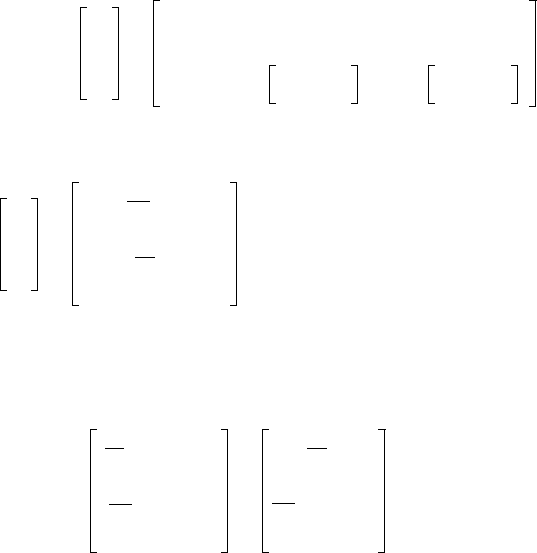
458 Time Dependent Problems II (Electromagnetic Waves)
The magnetic field has according to (7.265) only an azimuthal component.
Thus, the magnetic field lines are concentric circles around the z-axis. The electric
field lines are situated in the meridian plane . Their equations can be
stated, whereby it is beneficial to apply some analogy from the discussion of Sect.
5.11. With (7.263) we may write
.
(7.271)
if
,
(7.272)
C has only an azimuthal component and therefore, the electric field becomes
.
(7.273)
Now, take the function (it corresponds to the function of Sect. 5.11,
but notice that there, we had used cylindrical coordinates, while here we use
spherical coordinates, which is the reason why replaces r). We find its
gradient with (3.41)
.
(7.274)
This shows that
.
Thus E is perpendicular to the gradient of , i.e., E lies within the lines of
the meridian planes, along which is constant. In other words, the function
can be regarded as flux function. With
,
(7.275)
one can rewrite this:
ϕ const.=
EC∇×=
C P
e
∇×
C
r
C
θ
C
ϕ
0
0
p
0
θsin
4πεr
-----------------
1
r
---
ω t
r
c
--
–
sin
ω
c
----
ω t
r
c
--
–
cos+
===
E
E
r
E
θ
E
ϕ
1
r θsin
-------------
θ∂
∂
C
ϕ
θsin()
1
r
---
r∂
∂
rC
ϕ
()–
0
==
r θsin C
ϕ
rA
ϕ
r θsin
∇ r θsin C
ϕ
()
r∂
∂
r θsin C
ϕ
()
1
r
---
θ∂
∂
r θsin C
ϕ
()
0
θsin
r∂
∂
rC
ϕ
()
θ∂
∂
θsin C
ϕ
()
0
==
E ∇ r θsin C
ϕ
()• 0=
r θsin C
ϕ
r θsin C
ϕ
r θsin C
ϕ
ω
c
---- k=
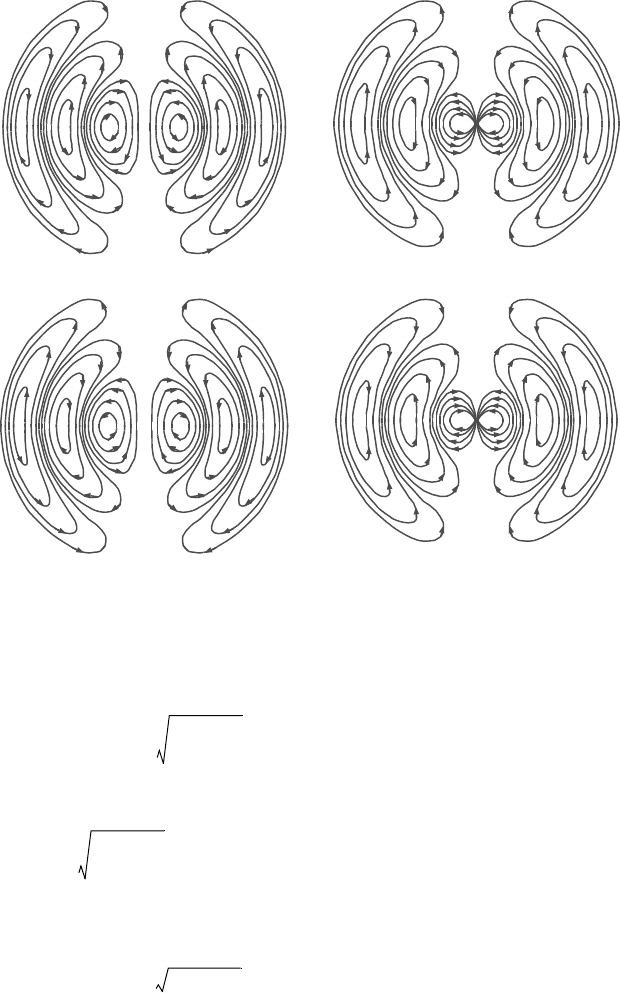
7.5 Hertz’s Dipole 459
Omitting the insignificant factor , one can write the equations for the
field lines in the form
.
(7.276)
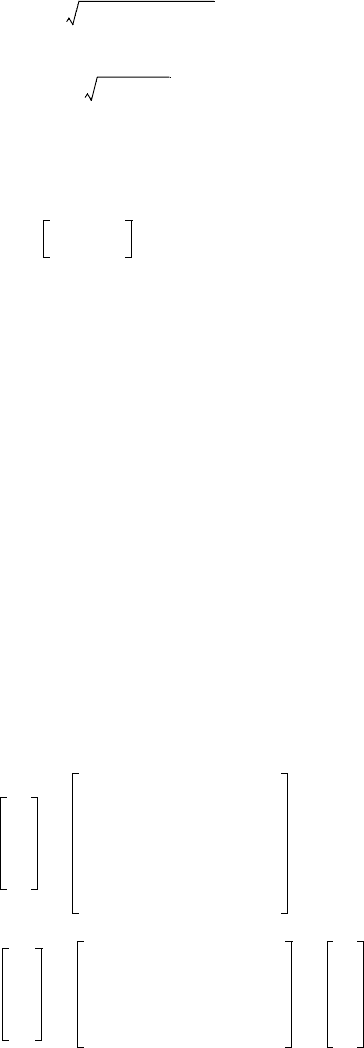
Fig. 7.17. illustrates several field lines for the dipole.
There are many ways to express the dipole fields of eqs. (7.264) and (7.265).
The following one is sometimes particularly useful:
(7.277)
r θsin C
ϕ
p
0
k θsin
2
4πε
----------------------
1
kr
-----
ωtkr–[]sin ωtkr–[]cos+
=
p
0
k θsin
2
4πε
----------------------
1
kr()
2
------------ 1+ ωtkr–arckr()tan+[] .sin=
p
0
k 4πε⁄
θsin
2
1
kr()
2
------------ 1+ ωtkr–arckr()tan+[]sin constant=
Fig. 7.17 Dipole radiation
ωt 0=
ωt π=
ωt
π
2
---=
ωt
3
2
---
π=
E
r
2p
0
θcos 1 kr()
2
+
4πεr
3
------------------------------------------------
ωtkr– χ
r
+[]sin=
460 Time Dependent Problems II (Electromagnetic Waves)
(7.278)
, (7.279)
where
(7.280)
. (7.281)
Notice that the phase angles , and are function of r.
7.5.2 Far Field and Radiation Power
The representation of the dipole fields in eqs. (7.264) and (7.265) is a little difficult
to grasp. However, we will discover that only few of these terms are of sufficient
interest, at least with respect to radiation of electromagnetic waves by the
oscillating dipole. The components of E contain terms that are proportional to ,
, and , while contain terms that are proportional to and . This
result is particularly peculiar but also important and results from retardation, i.e., is
a consequence of the finite nature of c. In the “static” case, i.e. if the speed of light
were infinite, then E would be proportional to and to , i.e., it would
become very small for large distances.
When analyzing the energy flux through the surface of a sphere where a
dipole oscillates in its center reveals, that at large distances only those terms with
make non vanishing contributions to the field of E and H. The reason is that
the corresponding part of the Poynting vector is proportional to , while the
surface of a sphere is proportional to . All other terms of the Poynting vector
decay faster (namely by , , ). Therefore, in the following we will take
interest only in the far field of the oscillating dipole.
,
(7.282)
. (7.283)
E
θ
p
0
θsin 1 kr()
2
– kr()
4
+
4πεr
3
--------------------------------------------------------------
ωtkr– χ
θ
+[]sin=
H
ϕ
ωp
0
θsin 1 kr()
2
+
4πr
2
------------------------------------------------
ωtkr– χ
ϕ
+[]cos=
χ
r
χ
ϕ
arc kr()tan==
χ
θ
kr
1 kr()
2
–
---------------------
atan=
χ
r
χ
θ
,χ
ϕ
r
1–
r
2–
r
3–
H
ϕ
r
1–
r
2–
r
3–
H
ϕ
r
2–
r
1–
r
2–
r
2
r
3–
r
4–
r
5–
E
E
r
E
θ
E
ϕ
0
– p
0
ω
2
θsin
4πεc
2
r
-----------------------------
ωtkr–[]sin
0
==
H
H
r
H
θ
H
ϕ
0
0
– p
0
ω
2
θsin
4πcr
-----------------------------
ωtkr–[]sin
0
0
E
θ
Z
------
== =
7.5 Hertz’s Dipole 461
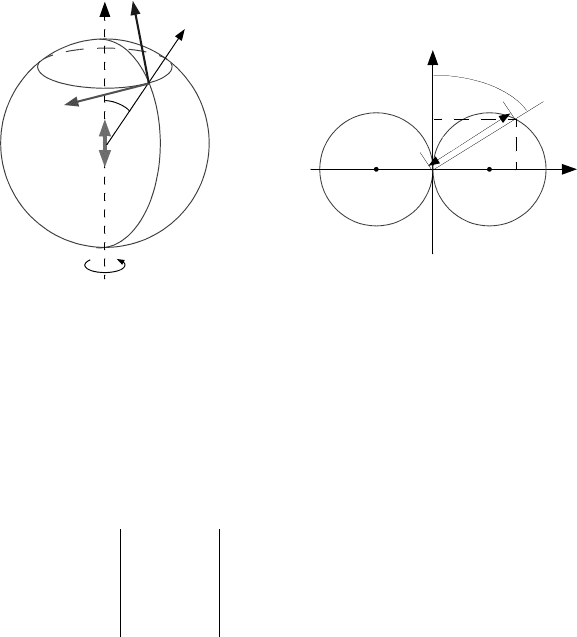
This is now a much simpler representation of the field, which behaves basically
like a plane wave (Fig. 7.18). It is purely transverse, E and H are perpendicular,
etc. However, its r and dependency distinguishes it from a plane wave.
The angular distribution of the dipole radiation, given by is illustrated in
Fig. 7.19 by a polar plot. The amplitude of the field vanishes in z-direction, i.e., the
direction of the dipole orientation. It is an easy task to verify that the endpoints
corresponding to are circles
(7.284)
The Poynting vector of the far field is
.
(7.285)
It only has an r-component, which is
.
(7.286)
is the energy radiated per unit time and unit area, i.e., the radiation power per
unit area. It depends on the direction and is proportional to . To find the total
radiation power requires to integrate over the surface of a sphere.
.
(7.287)
θ
Fig. 7.19
z
ρ
θ
s
i
n
θ
1/2 10
Fig. 7.18
θ
E
H
k
r
z
θsin
θsin
ρ
1
2
---–
2
z
2
+
1
4
---=
SEH×
e
r
e
θ
e
ϕ
0 E
θ
0
00H
ϕ
E
θ
H
ϕ
00,,〈〉== =
S
r
E
θ
H
ϕ
E
θ
2
Z
------
p
0
2
ω
4
θsin
2
ωtkr–()sin
2
Z16π
2
ε
2
c
4
r
2
------------------------------------------------------------===
p
0
2
ω
4
θsin
2
ωtkr–()sin
2
16π
2
εc
3
r
2
------------------------------------------------------------=
S
r
θsin
2
P SAd•
surface of sphere
∫
S
r
Ad
surface of sphere
∫
==

462 Time Dependent Problems II (Electromagnetic Waves)
Substituting
(7.288)
gives initially
.
Obviously
and
.
Therefore
.
(7.289)
P is always positive. Its time average is the effective value or root mean square
(rms):
.
(7.290)
Eq. (7.255) allows one to eliminate and replace it with :
.
(7.291)
Introducing the RMS current
allows to write the RMS power as
. (7.292)
Finally, if one defines the so-called radiation resistance by
,
(7.293)
then because of (7.292) one obtains
.
(7.294)
More specifically, for vacuum is
.
(7.295)
This describes the radiation of an oscillating dipole, the so-called dipole antenna.
Adr
2
θsin
2
dθdϕ=
P
p
0
2
ω
4
ωtkr–()sin
2
16π
2
εc
3
----------------------------------------------
ϕd θsin
3
θd
0
π
∫
0
2π
∫
=
ϕd
0
2
π
∫
2π=
θsin
3
θd
0
π
∫
θsin
2
θcos()d
1–
+1
∫
1 x
2
–()xd
1–
+1
∫
4
3
---===
P
p
0
2
ω
4
ωtkr–()sin
2
6πεc
3
----------------------------------------------
=
P
rms
p
0
2
ω
4
12πεc
3
------------------
=
p
0
I
0
P
rms
I
0
2
l
2
ω
2
12πεc
3
------------------
I
0
2
l
2
k
2
12π
---------------
µ
ε
---
I
0
2
l
2
π
3λ
2
-------------
Z== =
I
0
2
2I
rms
2
=
P
rms
2π
3
------
Z
l
λ
---
2
I
rms
2
=
R
s
P
rms
R
s
I
rms
2
=
R
s
2π
3
------
Z
l
λ
---
2
=
R
s
R
s
2π
3
------
l
λ
---
2
377Ω
l
λ
---
2
790Ω==
7.6 Frame Antenna 463
The antenna gain G is defined as the ratio of the maximum radiation power
(direction of maximum power) over the average radiation power
(averaging all directions). In the current case, with (7.286) and (7.289), this ratio is
.
(7.296)
Now, we proceed from the dipole antenna to the dual frame antenna.
7.6 Frame Antenna
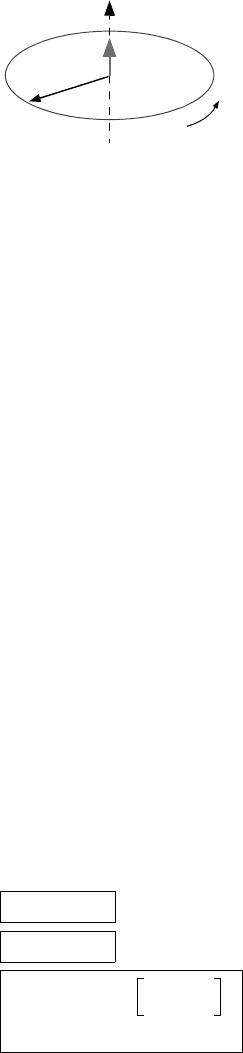
An oscillating magnetic dipole radiates electromagnetic waves. Consider a
magnetic dipole
(7.297)
at the origin (Fig. 7.20). Its magnetization
(7.298)
is caused by a circular current
,
(7.299)
where
.
(7.300)
This arrangement is also called frame antenna. The discussion here parallels
almost completely the discussion of the dipole antenna in the previous section.
Therefore, one may be rather brief. First, one needs to solve the wave equation
(7.222) with the specific magnetization given in (7.298), which in analogy to
eqs (7.256) through (7.258) yields
,
(7.301)
, (7.302)
. (7.303)
S
rmax
S
r
〈〉
G
S
rmax
S
r
〈〉
-------------
p
0
2
ω
4
ωtkr–()sin
2
16π
2
εc
3
r
2
----------------------------------------------
1
4πr
2
------------
p
0
2
ω
4
ωtkr–()sin
2
6πεc
3
----------------------------------------------
-----------------------------------------------------------
3
2
---== =
me
z
m
0
ωtsin=
Fig. 7.20
r
0
I
m
z
Me
z
m
0
ωtsin δ r()=
II
0
ωtsin=
m
0
µI
0
r
0
2
π=
Π
mx
0 =
Π
my
0 =
Π
mz
m
0
ω t
r
c
--–
sin
4πµr
-----------------------------------------
=