
Lehner G. Electromagnetic Field Theory for Engineers and Physicists
Подождите немного. Документ загружается.

484 Time Dependent Problems II (Electromagnetic Waves)
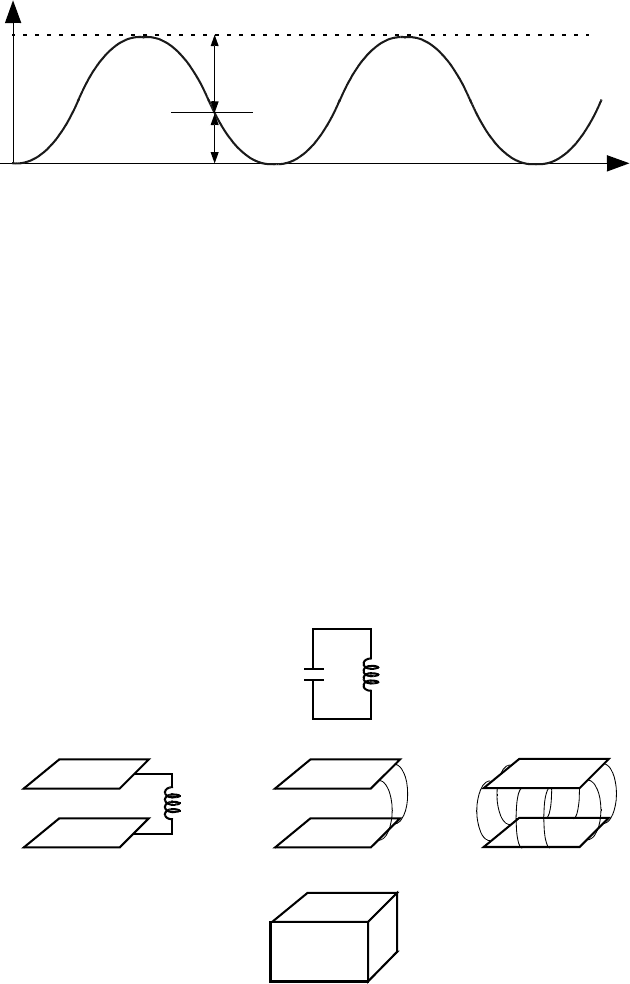
united, while they are spatially separated for the LC oscillator, namely in the two
distinct components. Nevertheless, the transition is gradual. It is possible to start
from an LC oscillator and make a smooth transition into a resonant cavity
(Fig. 7.32).
Notice that for the standing waves of this section as described by eqs. (7.384),
(7.385), (7.387), (7.388) (contrary to the previous sections) it is not permissible to
replace the differential operator by . The reason is that the standing wave is
created by superposition of the two functions and , which,
in the said equation., resulted in the sine and cosine functions, respectively. This
had prevented us to obtain the fields of eq. (7.387) and (7.388) from eqs. (7.347)
and (7.353), rather we had to go back to the more generally applicable eqs. (7.238),
(7.239), (7.248), and (7.249).
It shall also be pointed out that eqs. (7.389) (7.390), (7.391) – just as
analogous equations for mechanical oscillations and waves – have a plausible
Fig. 7.31 Energy in a resonant cavity
t
W
W
mag.
()W
el..
W
el..
()
W
mag.
Fig. 7.32 Transition from LC oscillator to resonant cavity
ik
z
–
ik
z
– z[]exp +ik
z
z[]exp
7.10 Circular Wave Guide 485
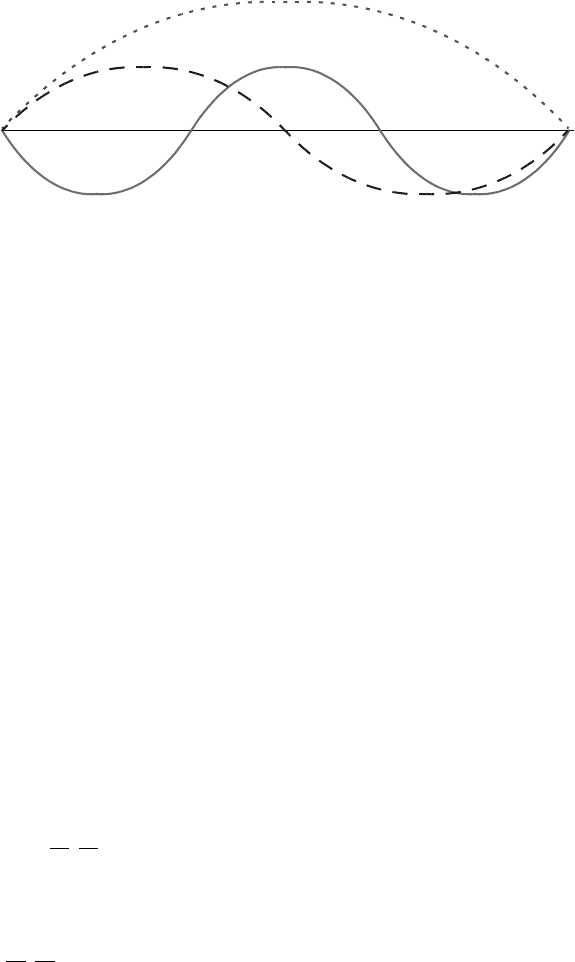
explanation. Consider, for example, a string, mounted at both ends. The relation for
this vibrating string is
,
where a is the length of the string and n is a whole number (Fig. 7.33). For a wave
guide, this applies for waves in x and y direction, while it applies to all three
directions in case of the resonant cavity. The waves in the x and y direction of a
wave guide are standing waves, while the wave in z direction is travelling. In case
of the resonant cavity, all three directions carry standing waves. Intuitively, one
may picture a standing wave by superposition of an incident wave and waves,
reflected at the boundary (the reader shall thereby be reminded of sects. 7.1.5 and
7.1.6).
7.10 Circular Wave Guide
7.10.1 Separation of Variables
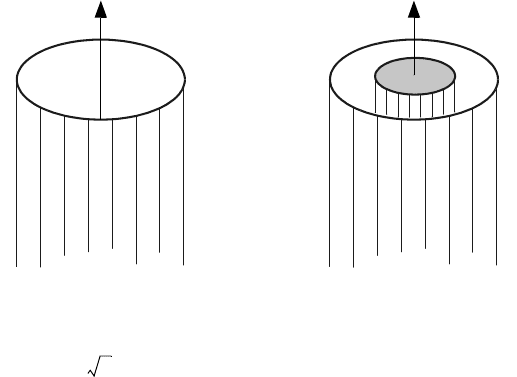
For circular cylindrical wave guides, whether simply or multiply connected
(Fig. 7.34), the best approach is to use cylindrical coordinates. According to
eq. (3.33), the two-dimensional Laplacian in the x-y-plane takes the form
.
(7.395)
The formulas applicable to and are (7.344) and (7.350),
respectively, where N is given by (7.338). Therefore we obtain
.
(7.396)
Separating like in Sect. 3.7 gives
n
λ
2
---
a=
Fig. 7.33 Oscillating string
n=
1
n=
2
n=
3
∆
2
∆
2
1
r
---
r∂
∂
r
r∂
∂ 1
r
2
-----
∂
2
∂ϕ
2
---------
+=
Π
ez
Π
mz
1
r
---
r∂
∂
r
r∂
∂ 1
r
2
-----
∂
2
∂ϕ
2
---------
N++
Π
z
0=
486 Time Dependent Problems II (Electromagnetic Waves)
.
(7.397)
We could have picked a sine instead of the cosine, but this does not constitute a
significant difference. is a general cylinder function:
.
(7.398)
The specific form of given in (7.397) allows to solve an abundance of
problems. Notice, that in general, it has to be , if the area under
consideration includes the z-axis, since diverges for . However, if the
area does not include the z-axis, then the complete solution (7.398) has to be used.
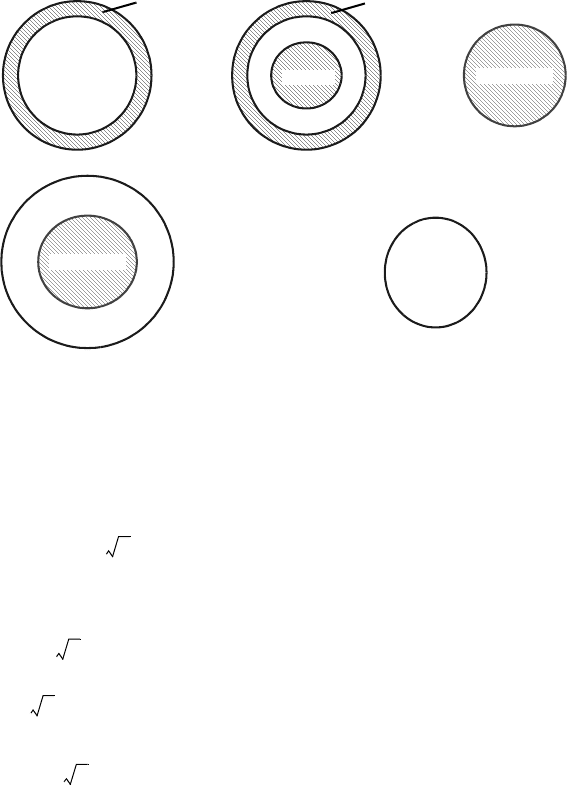
Fig. 7.35 shows a number of arrangements, which can be solved using
(7.397). First, there is the “normal” cylindrical wave guide (Fig. 7.35a),
characterized by an ideal insulator surrounded by an ideal conductor. From this, the
coaxial cable (Fig. 7.35b) emerges when another ideal conductor is inserted inside
the insulator. Fig. 7.35c shows the so-called Sommerfeld conductor, where a
medium of finite conductivity is surrounded by an ideal insulator. The Harms-
Goubau conductor of Fig. 7.35d has a conductor of finite conductivity at its center
and is surrounded by two layers of dielectrics with different permittivity. Another
interesting case is the so-called light conductor or light guide, shown in Fig. 7.35e,
an arrangement important in optics and has gained significance in
telecommunications as well. Subsequently, we will limit our discussion to ordinary
wave guides and the coaxial cable. The limit of ideal insulators and media with
infinite conductivity can – with the exception of super conductors – not be realized
at all or only approximately. Using these limits, however, simplifies the theoretical
analysis significantly, without misrepresenting the material points of the results.
Fig. 7.34 Circular cylindric wave guides
z z
Π
z
Z
m
rN()mϕcos i ωtk
z
z–()[]exp=
Z
m
Z
m
C
1
J
m
C
2
N
m
+=
Π
z
C
2
0=
N
m
r 0→
7.10 Circular Wave Guide 487
7.10.2 TM Waves in a Circular Cylindrical Wave Guide
For the ordinary wave guide, we have to let in eq. (7.398). Here, we are
interested in TM waves and thus with (7.397) find
.
(7.399)
According to (7.349) we also have to ensure that
.
(7.400)
It follows that may not assume every value. If, for instance, is the radius of
the wave guide, then it must be
.
(7.401)
We have already found the zeros of in Sect. 3.7.3.3.:
.
(7.402)
If we only consider ideal insulators ( ), then with (7.338) we obtain
.
(7.403)
The associated wave is called the wave of the wave guide. Its fields are
derived from eqs. (7.238) and (7.239):
Fig. 7.35
a) b) c)
d) e)
κ 0=
κ∞=
κ∞=
κ 0=
κ∞=
κ finite=
κ 0=
κ finite=
κ 0=
κ 0=
ε
1
ε
2
ε
1
≠
κ 0=
εε
0
>
ε
0
C
2
0=
Π
ez
C
e
J
m
rN()mϕcos i ωtk
z
z–()[]exp=
Π
ez
()
boundary
0=
N
r
0
J
m
r
0
N()0=
λ
mn
J
m
λ
mn
r
0
N=
κ 0=
εµω
2
k
z
2
–
λ
mn
2
r
0
2
----------=
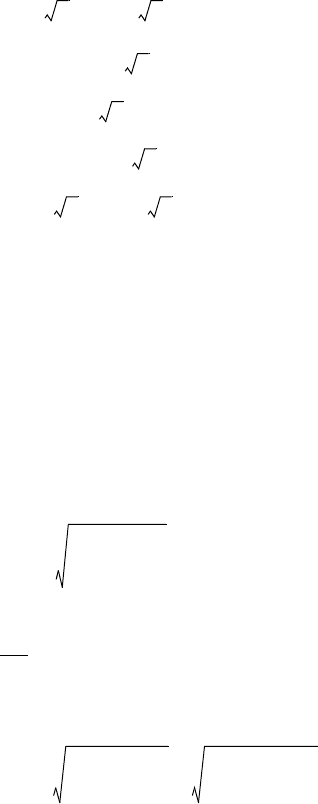
TM
mn
488 Time Dependent Problems II (Electromagnetic Waves)
.
(7.404)
Notice that has to assume one of the values allowed by
eq. (7.402). It becomes clear from inspection that with this restriction, , , and
vanish when , as it must be. is the derivative of the Bessel function,
where the subject of derivative is its entire argument. waves exist for
, (i.e., N>0). n=0, N=0 would result in a TEM wave, which is not
possible in the current case, and even more so, according to our general
conclusions regarding TEM waves.
Similar to the rectangular wave guide, we find the phase velocity from the
dispersion relation, here eq. (7.403)
(7.405)
and the group velocity is
.
(7.406)
The wave length in z-direction, the propagation direction in the wave guide is
.
(7.407)
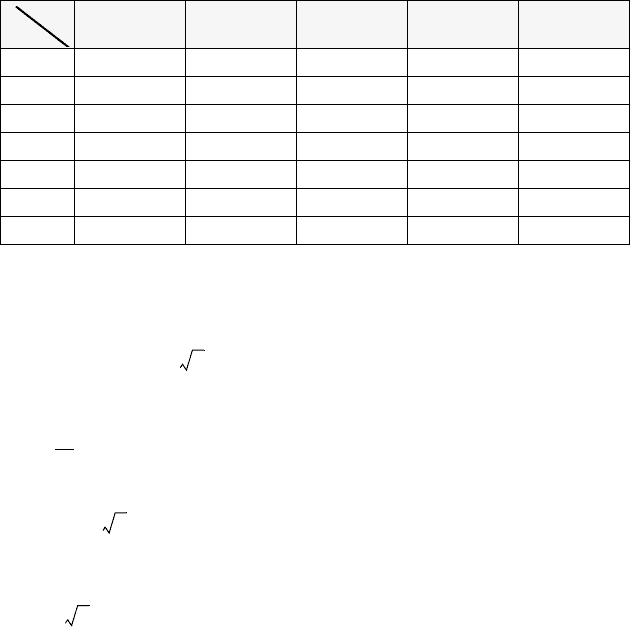
is the related free space wave length. The largest possible free space wave length
of the wave is the critical wave length
.
(7.408)
A few values of are listed in Tab. 7.1. Notice that the quantities with the
double index represent the zeros of the Bessel functions. They are
dimensionless and should not be confused with the wave length , , , etc.
E
r
ik
z
NC
e
J
m
' rN()mϕcos–=
E
ϕ
+
ik
z
m
r
-----------
C
e
J
m
rN()msin ϕ=
E
z
+ NC
e
J
m
rN()mϕcos=
H
r
iωεm
r
-------------
C
e
J
m
rN()msin ϕ–=
H
ϕ
iωε NC
e
J
m
' rN()mϕcos–=
H
z
0=
i ωtk
z
z–()[]exp⋅
N εµω
2
k
z
2
–=
E
ϕ
E
z
H
r
rr
0
= J
m
'
TM
mn
m 0≥ n 0>
v
ph
ω
k
z
----
ω
εµω
2
λ
mn
2
r
0
2
----------–
----------------------------------==
v
G
k
z
d
dω c
2
v
ph
--------==
λ
z
2π
k
z
------
2π
ω
2
c
2
------
λ
mn
r
0
---------
2
–
-----------------------------------
1
1
λ
2
------
λ
mn
2πr
0
-----------
2
–
--------------------------------------–==
λ
TM
mn
λ
c
2πr
0
λ
mn
-----------=
λ
mn
λ
mn
λλ
z
λ
c
7.10 Circular Wave Guide 489
7.10.3 TE Waves in a Circular Cylindrical Wave Guide
For TE waves we have
,
(7.409)
where
, (7.410)
which requires that
.
(7.411)
If one addresses the zeros of in their order by , then one obtains the
dispersion relation
,
(7.412)
and for it becomes
.
(7.413)
In analogy to (7.405) and (7.406), one finds here again
.
(7.414)
The related fields of the wave are determined by (7.248) and (7.249)
Table 7.1 The values of
1 2 3 4 5
0 2.40483 5.52008 8.65373 11.79153 14.93092
1 3.83171 7.01559 10.17347 13.32369 16.47063
2 5.13562 8.41724 11.61984 14.79595 17.95982
3 6.38016 9.76102 13.01520 16.22347 19.40942
4 7.58834 11.06471 14.37254 17.61597 20.82693
5 8.77148 12.33860 15.70017 18.98013 22.21780
6 9.93611 13.58929 17.00382 20.32079 23.58608
λ
mn
J
m
λ
mn
()0=
n
m
Π
mz
C
m
J
m
rN()mϕcos i ωtk
z
z–()[]exp=
r∂
∂Π
mz
rr
0
=
0=
J
m
' r
0
N()0=
J
m
' µ
mn
r
0
N µ
mn
=
κ 0=
εµω
2
k
z
2
–
µ
mn
2
r
0
2
----------=
v
ph
v
G
⋅ c
2
=
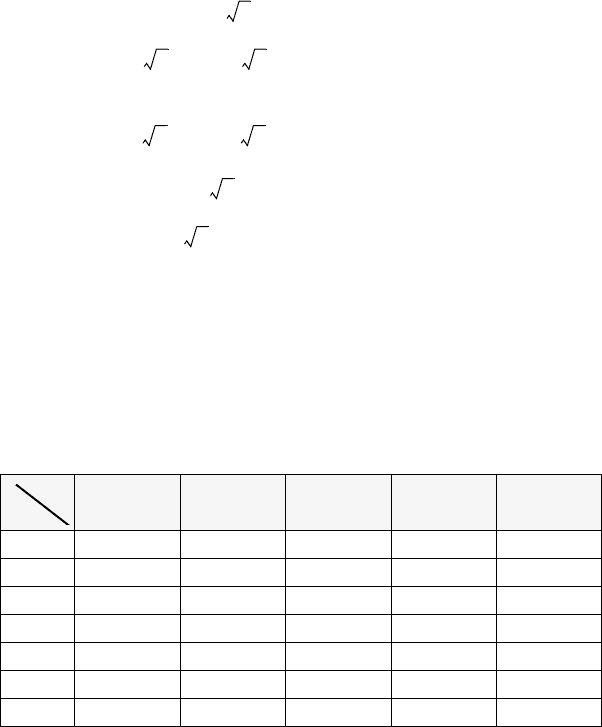
TE
mn
490 Time Dependent Problems II (Electromagnetic Waves)
.
(7.415)
N has to assume a value permitted by eq. (7.412). Eq. (7.407) applies to , if
is replaced by . The critical wave length is found in analogy to (7.408)
.
(7.416)
A number of values for is given in Tab. 7.2. This table and the one for
make it particularly evident that the largest critical wave length of all TM and TE
waves belongs to the wave, with a value of
.
(7.417)
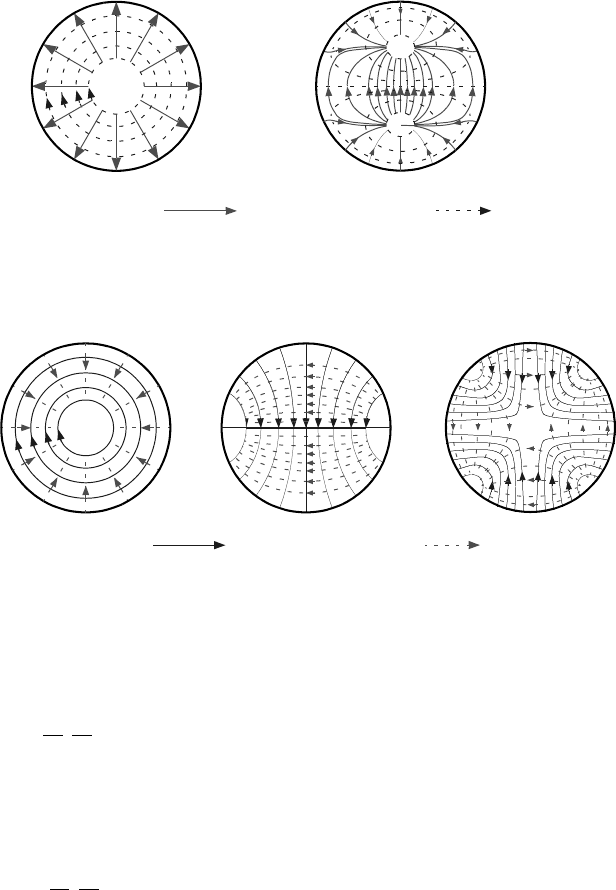
Finally, we will present a few graphs, illustrating the field of some TM and
TE waves, possible in a circular cylindric wave guide (Fig. 7.36, Fig. 7.37).
7.10.4 The Coaxial Cable
An in depth discussion of the coaxial cable requires one to start with the solutions
(7.397), (7.398). However, we will not present the coaxial cable in its full
Table 7.2 The values of
1 2 3 4 5
0 3.8317 7.0156 10.1735 13.3237 16.4706
1 1.8412 5.3314 8.5363 11.7060 14.8636
2 3.0542 6.7061 9.9695 13.1704 16.3475
3 4.2012 8.0152 11.3459 14.5859 17.7888
4 5.3175 9.2824 12.6819 15.9641 19.1960
5 6.4156 10.5199 13.9872 17.3128 20.5755
6 7.5013 11.7349 15.2682 18.6374 21.9318
E
r
iωµm
r
--------------
C
m
J
m
rN()msin ϕ=
E
ϕ
iωµ NC
m
J
m
' rN()mϕcos=
E
z
0=
H
r
ik
z
NC
m
J
m
' rN()mϕcos–=
H
ϕ
ik
z
m
r
-----------
C
m
J
m
rN()msin ϕ=
H
z
NC
m
J
m
rN()mϕcos=
i ωtk
z
z–()[]exp⋅
λ
z
λ
mn
µ
mn
λ
c
2πr
0
µ
mn
-----------=
µ
mn
λ
mn
µ
mn
J
m
' µ
mn
()0=
n
m
TE
11
λ
c
()
TE
11
2πr
0
µ
11
-----------
2πr
0
1.84
----------- 3 . 4 1 r
0
===
7.10 Circular Wave Guide 491
generality, which would provide all of its TE and TM waves. We will limit
ourselves to the case , i.e., its TEM wave, which requires to solve
eq. (7.396) in its form
.
(7.418)
The Ansatz
(7.419)
yields an equation for :
.
(7.420)
Its general solution is
(7.421)
or
Fig. 7.36 TM modes in cylindric wave guide
magnetic fieldelectric field
TM
01
TM
11
Fig. 7.37 TW modes in cylindric wave guide
magnetic fieldelectric field
TE
01
TE
11
TE
21
N 0=
1
r
---
r∂
∂
r
r∂
∂ 1
r
2
-----
∂
2
∂ϕ
2
---------
+
Π
z
0=
Π
z
Rr() mϕcos i ωtk
z
z–()[]exp=
Rr()
1
r
---
r∂
∂
r
r∂
∂ m
2
r
2
-------
–
Rr() 0=
Rr() C
1
C
2
rr
0
⁄ln+= for m 0=
492 Time Dependent Problems II (Electromagnetic Waves)
,
(7.422)
which can also be obtained from the cylindrical functions when taking a limit. We
have met eq. (7.420) and its solutions (7.421) and (7.422) before in Sect. 3.7.3.5,
eqs. (3.262) through (3.264). The result for the Hertz vector is
(7.423)
and
.
(7.424)
Now one has the freedom to take as either the z-component of the electric or
the magnetic Hertz vector and calculate the fields from (7.345), (7.346) or (7.351),
(7.352), respectively. Either way, after considering the boundary conditions (7.363)
and (7.364) at the outer conductor ( ) and at the inner conductor ( ) of
the coaxial cable, it turns out that there is only one case where not all fields are
identically zero (Fig. 7.38). This case requires that and if one regards
as , (7.345), (7.346) yield the fields (for ):
.
(7.425)
Rr() C
1
r
m
C
2
r
m–
+=for m 0>
Π
z
C
1
C
2
r
r
0
----ln+
i ωtk
z
z–()[]exp for m 0==
Π
z
C
1
r
m
C
2
r
m–
+()mϕcos i ωtk
z
z–()[]exp for m 0>=
Π
z
rr
a
= rr
i
=
Fig. 7.38 Coaxial cable
r
a
r
i
z
H
E
m 0= Π
z
Π
ez
κ 0=
E
r
ik
z
r
------
C
2
i ωtk
z
z–()[]exp–=
E
ϕ
0=
E
z
0=
H
r
0=
H
ϕ
iωε
r
---------
C
2
i ωtk
z
z–()[]exp–=
H
z
0=

7.10 Circular Wave Guide 493
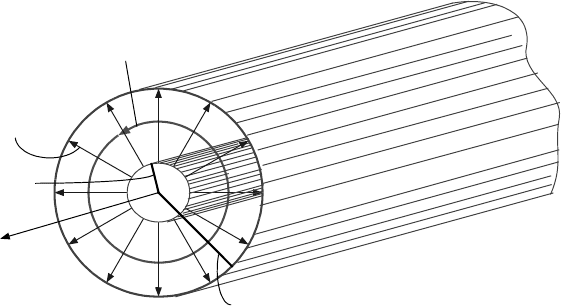
This describes an electric field which is purely radial and a magnetic field that is
purely azimuthal. Fig. 7.38 illustrates this. Since
(7.426)
one finds
,
(7.427)
i.e., the wave behaves in this respect like a plane wave. There is no difficulty in
satisfying the boundary conditions, because there are neither components of E
parallel to the boundary, nor perpendicular components of H. must decrease as
so that E remains source-free, while needs to decrease as so that H
remains irrotational.
For the sake of completeness, it shall be noted that the just derived TEM wave
can also be obtained from
.
For
,
is the most general solution of (7.418). If we take for , then it has to be
because of (7.363), which in conjunction with provides the
fields given in (7.425). If we take for , then it has to be because
of (7.355), which in conjunction with yields as given above. With
the appropriate choice of , this provides the fields (7.425).
Wave types are also called modes. The just found TEM mode of the coaxial
cable is very similar to the TEM wave between two parallel plates. The two
converge for . We could think of Fig. 7.29 as being a piece of an annular
region with a very large radius.
According to (7.426), the TEM wave propagates with the speed of light for
that particular dielectric:
.
(7.428)
The just found wave is also used in transmission theory, where the telegrapher's
equation is used instead of the wave equation. To better illustrate the relation, we
shall now derive the telegrapher's equation and briefly discuss it.
7.10.5 Telegrapher's Equation
To derive the telegrapher's equation, one imagines the transmission line as being a
continuous analog of a network circuit, where a transmission line is nothing more
than a multiply connected wave guide of arbitrary cross section. The coaxial cable
N εµω
2
k
z
2
–0==
H
ϕ
E
r
Z
-----=
E
r
1 r⁄ H
ϕ
1 r⁄
Π
mz
D
1
D
2
ϕ+()i ωtk
z
z–()[]exp=
m 0=
Π
z
C
1
C
2
r
r
0
----ln+
D
1
D
2
ϕ+()i ωtk
z
z–()[]exp=
Π
z
Π
ez
D
2
0= D
1
1=
Π
z
Π
mz
C
2
0=
C
1
1= Π
mz
D
2
r
a
r
i
r
a
«–
v
ph
ω
k
z
----
1
εµ
---------- c== =