
Lehner G. Electromagnetic Field Theory for Engineers and Physicists
Подождите немного. Документ загружается.

474 Time Dependent Problems II (Electromagnetic Waves)
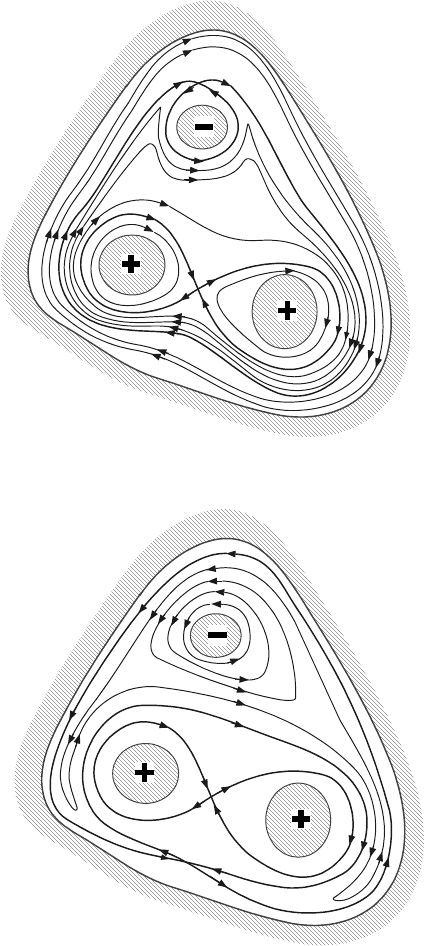
may carry currents, all in the same direction (Fig. 7.24a,b) or different directions
(Fig. 7.24c,d). In the general case, there will be two stagnation lines where the field
Fig. 7.24
d)
c)
S
1
S
2
S
1
S
2
7.8 Rectangular Wave Guide 475
vanishes (Fig. 7.24a,c,d). For special values of currents, the two lines may
degenerate to a single one (Fig. 7.24b). The force lines (separatrices) which pass
through the stagnation lines separate the regions of the cross section into sections
of different field structure, as we have encountered before in electrostatics (Sect.
2.4) and in magnetostatics (Sect. 5.2.1). The difference between Fig. 7.24c and d is
merely that the overall current is positive in Fig. 7.24c and negative in Fig. 7.24d.
7.8 Rectangular Wave Guide
7.8.1 Separation of Variables
Our first example in applying the theory of the previous section shall be for a wave
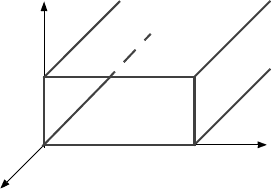
in a wave guide of the shape as shown in Fig. 7.25, with . We will limit the
discussion to the case of an insulator ( ). (or more specifically in
case of TM waves and for TE waves) has to satisfy the Helmholtz equation
(7.344) or (7.350), respectively.
(7.364)
If one now separates according to the model given in Sect. 3.5, then we obtain
in the form:
,
(7.365)
where initially , , , are arbitrary constants. Furthermore, to satisfy
(7.364), the dispersion relation has to be fulfilled
.
(7.366)
Fig. 7.25 Wave guide
x
y
z
κ 0=
εµ,
a
b
0
ab≥
κ 0= Π
z
Π
ez
Π
mz
∂
2
∂x
2
--------
∂
2
∂y
2
-------- εµω
2
k
z
2
–++
Π
z
0=
Π
z
Π
z
Xx() Yy() Zz()⋅⋅=
Π
z
C
1
k
x
xsin C
2
k
x
cos x+()C
3
k
y
ysin C
4
k
y
cos y+()i ωtk
z
z–()[]exp=
C
1
C
2
C
3
C
4
k
x
2
k
y
2
k
z
2
++ εµω
2
=
476 Time Dependent Problems II (Electromagnetic Waves)
7.8.2 TM Waves in a Rectangular Wave Guide
Because of the boundary conditions (7.349), for , , ,
and . This requires that . Furthermore, only certain values for
and are possible, namely, as before in Sect. 3.5.1, eqs. (3.70) and (3.71):
(7.367)
. (7.368)
This leaves
,
(7.369)
from which the fields can be calculated according to (7.347):
.
(7.370)
All possible TM waves are described by this set of equations. Two whole
numbers, n, m correspond to every possible type of wave. This wave is called
wave. Obviously, in order for not all fields to vanish, it has to have
and . Ergo, there are no , , or waves.
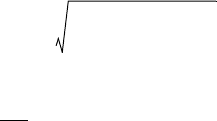
The dispersion relation (7.366), together with (7.367) and (7.368) yields
.
(7.371)
Form this one finds the phase velocity of the wave
,
(7.372)
and for its group velocity
,
(7.373)
so that
.
(7.374)
We have found this result before in a special case, eq. (7.68). If one calculates the
average energy per unit length for the wave guide and multiply this by , then
Π
ez
0= x 0= xa= y 0=
yb= C
2
C
4
0==
k
x
k
y
k
x
nπ
a
------= n whole numbers()
k
y
mπ
b
-------= m whole numbers()
Π
ez
C
e
k
x
xsin k
y
ysin i ωtk
z
z–()[]exp=
E
x
ik
x
k
z
C
e
k
x
cos xk
y
ysin–=
E
y
ik
y
k
z
C
e
k
x
sin xk
y
cos y–=
E
z
k
x
2
k
y
2
+()C
e
k
x
xsin k
y
ysin=
H
x
+iωεk
y
C
e
k
x
sin xk
y
cos y=
H
y
iωεk
x
C
e
k
x
cos xk
y
ysin –=
H
z
0=
i ωtk
z
z–()[]exp⋅
TM
nm
n 1≥
m 1≥ TM
00
TM
01
TM
10
k
z
2
εµω
2
k
x
2
– k
y
2
– εµω
2
π
2
n
2
a
2
------------–
π
2
m
2
b
2
-------------–==
v
ph
ω
k
z
----
ω
ω
2
c
2
------
π
2
n
2
a
2
------------–
π
2
m
2
b
2
-------------–
-------------------------------------------------==
v
G
k
z
d
dω c
2
v
ph
--------==
v
G
v
ph
c
2
=
v
G
7.8 Rectangular Wave Guide 477
one obtains the same energy transfer as it results from the z-component of the
Poynting vector, averaged over time and space (cross section). We conclude, here
as well, the group velocity can be regarded as the velocity of the energy transfer.
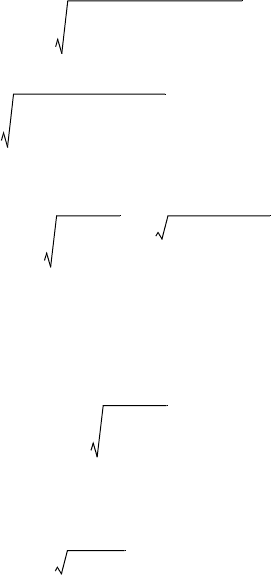
If is the wave length inside the wave guide in the z-direction, and its
corresponding wave length in the free space, then
(7.375)
and
.
(7.376)
This means that is always greater than . even becomes infinite for
,
(7.377)
(or ) becomes imaginary for . The related fields can not propagate
inside the wave guide. The related wave length is called the critical wave length
of the wave. It is also the largest free space wave length for which this type
of wave can exist. The related angular frequency, the cutoff frequency , is the
lowest frequency for which propagation inside the wave guide is possible:
.
(7.378)
The largest among all possible critical wave lengths belongs to the wave,
which is
.
(7.379)
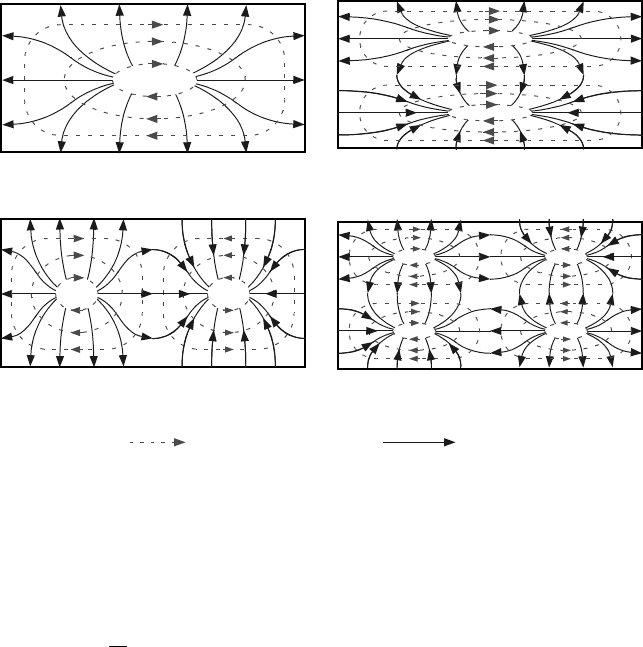
Fig. 7.26 provides a qualitative picture of the fields for a few wave types, namely
their projection onto the cross section. Take into account when interpreting these
pictures, that the electric field has a z-component also. When the electric fields in
those pictures appear to have sources or sinks, then this deception is simply caused
by the projection, while in reality the field is diverted at those points into the z-
direction. These z-fields are the displacement currents, which create the magnetic
fields of the wave.
At the surface, the electric field has perpendicular components and the
magnetic field has tangential components, which cause surface charges and surface
λ
z
λ
εµω
2
ω
2
c
2
------ k
2
2π
λ
------
2
===
λ
z
2π
k
z
------
2π
2π
λ
------
2
π
2
n
2
a
2
------------–
π
2
m
2
b
2
-------------–
---------------------------------------------------------==
λ
z
λ
1
λ
2
---
2
n
2
a
2
-----
m
2
b
2
-------+
–
--------------------------------------------------=
λ
z
λλ
z
λλ
c
2
n
2
a
2
-----
m
2
b
2
-------+
-----------------------
2ab
n
2
b
2
m
2
a
2
+
-----------------------------------== =
λ
z
k
z
λλ
c
>
λ
c
TM
nm
ω
c
ω
c
2πc
λ
c
--------- πc
n
2
a
2
-----
m
2
b
2
-------+==
TM
11
λ
c
()
TM
11
2ab
a
2
b
2
+
----------------------=
478 Time Dependent Problems II (Electromagnetic Waves)
currents there. Their fields can be calculated from the boundary conditions, which
are time dependent. Of course, currents and charges have to meet the continuity
equation, which in the current case takes the form:
,
where shall signify the two dimensional divergence operator in a plane. Of
course, replaces and replaces .
7.8.3 TE Waves in a Rectangular Wave Guide
In this case, the boundary condition (7.355) requires that .
Furthermore, the wave numbers and have to satisfy (7.367) and (7.368).
Therefore:
.
(7.380)
With (7.353) the wave becomes:
Fig. 7.26 Magnetic and electric field for TM modes
TM
11
magnetic field
electric field
TM
12
TM
21
TM
22
∇
2
k
t∂
∂σ
+• 0=
∇
2
•
kgσρ
C
1
C
3
0==
k
x
k
y
Π
mz
C
m
k
x
cos xk
y
cos yiωtk
z
z–()[]exp=
TE
nm
7.8 Rectangular Wave Guide 479
.
(7.381)
Formulas (7.371) through (7.378) apply to TE waves unchanged.
In contrast to the TM wave, the TE wave has non-vanishing fields, if at least
one of the two integers n, m is nonzero. That is to say, there is no wave,
however, and waves exist. The largest critical wave length belongs to
the wave and is determined by (7.377)
,
(7.382)
while the relation for the wave is
.
(7.383)
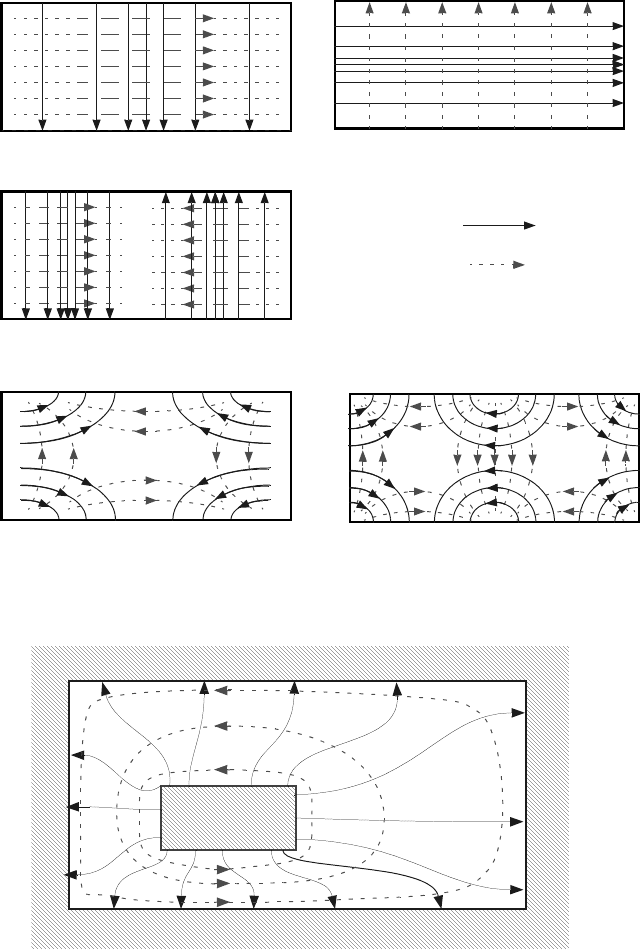
Fig. 7.27 provides a few pictures of various TE wave modes. What was said
in conjunction with Fig. 7.26 applies here in like manner. Of course, the magnetic
field lines do not have sources or sinks. Whenever their projection onto the cross-
sectional area suggests otherwise, then this is because the projection hides the z-
component of the field.
7.8.4 TEM waves
Recall from our general discussion in Sect. 7.7.4 that no TEM wave can exist in
simply connected rectangular wave guides (as is the case in every simply
connected wave guide of any shape). This is also obvious from (7.370) and (7.381).
For the z-components of E and H to vanish requires that
.
This, in turn requires that , whereby all other field components vanish
as well. We know already that neither nor waves exist.
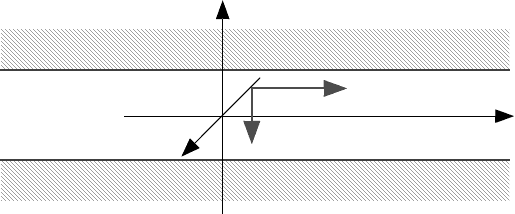
On the other hand, TEM waves do exist in multiply connected rectangular
wave guides, for example, of the kind depicted in Fig. 7.28. The related theory is
rather complicated, however, and shall not be discussed in this text. A remark to
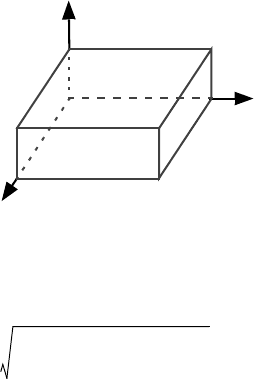
avoid misconception: TEM waves are possible between infinite parallel plates
(Fig. 7.29). The difference between these and an ordinary rectangular wave guide
is that the infinite plates do not impose a limit on . A possible wave is therefore
E
x
+iωµk
y
C
m
k
x
cos xk
y
sin y=
E
y
iωµk
x
C
m
k
x
xsin k
y
cos y –=
E
z
0=
H
x
+ik
x
k
z
C
m
k
x
sin xk
y
cos y=
H
y
+ik
y
k
z
C
m
k
x
cos xk
y
sin y=
H
z
+ k
x
2
k
y
2
+()C
m
k
x
cos xk
y
cos y=
i ωtk
z
z–()[]exp⋅
TE
00
TE
01
TE
10
TE
10
λ
c
()
TE
10
2a=
TE
10
λ
c
()
TE
01
2b 2a≤λ
c
()
TE
10
==
k
x
2
k
y
2
+0=
k
x
k
y
0==
TM
00
TE
00
H
x
480 Time Dependent Problems II (Electromagnetic Waves)
Fig. 7.27 Magnetic and electric field for TE modes
TE
10
TE
11
TE
01
TE
20
magnetic field
electric field
TE
21
Fig. 7.28 Magnetic and electric field for TEM mode
7.9 Rectangular Cavities 481
.
This is nothing other than a plane wave, which however, does not extend to infinity
in the y-direction., i.e., in the direction of the electric field vector. This is possible
because a perpendicular component of E is permissible on the boundary. There, it
causes the necessary surface charges. A different polarization is not possible
because and have to vanish on the boundary. Notice, that the case of infinite
parallel plates is not a result of the limit of a rectangular wave guide with ,
at least not with respect to the TEM waves. The rectangular wave guide does not
allow TEM waves for any value of a, not even for infinitely large a. Of course, all
kinds of TM and TE waves are possible between the parallel plates. Those can
definitely be derived from simply connected rectangular wave guides as the limit
.
7.9 Rectangular Cavities
A cavity bounded by conductors is a resonant cavity. It can hold an electromagnetic
oscillation. The calculation of the various oscillations that are possible in such a
resonant cavity is in general mathematically difficult. However, for a cuboid cavity,
the problem can be reduced to the just discussed rectangular wave guide.
If we let two like waves propagate in opposite directions, then their
superposition gives a standing wave, just as we had discussed for a plane wave in
Sect. 7.1.5.
A standing TM wave can be described by
.
(7.384)
A standing TE wave can be described by
.
(7.385)
and satisfy their corresponding wave equations for if
Fig. 7.29 TEM wave between infinite parallel plates
y
x
z
H
E
H
x
E
0
Z
-----
i ωtk
z
z–()[]exp=
E
y
E
0
i ωtk
z
z–()[]exp–=
H
y
E
x
a ∞→
a ∞→
Π
ez
C
e
k
x
xsin k
y
ysin k
z
zcos iωt[]exp=
Π
mz
C
m
k
x
cos xk
y
cos yk
z
sin ziωt[]exp=
Π
ez
Π
mz
κ 0=
482 Time Dependent Problems II (Electromagnetic Waves)
.
(7.386)
The corresponding fields can be found with (7.238), (7.239) and (7.248),
(7.249). For TM waves
(7.387)
and for TE waves
.
(7.388)
All these fields satisfy the required boundary conditions of the previously
discussed rectangular wave guide, if
(7.389)
and
.
(7.390)
We can create a cuboidal resonant cavity if we cut a piece of length d from this
wave guide and insert a reflecting wall (i.e., an infinitely conducting wall) at
and (Fig. 7.30). The additional walls impose additional boundary
conditions:
Our Ansatz already satisfies the boundary condition for , which was chosen
with this in mind. For , the boundary conditions require
.
(7.391)
k
x
2
k
y
2
k
z
2
++ k
2
εµω
2
ω
2
c
2
------== =
E
x
k
x
k
z
C
e
k
x
cos xk
y
ysin k
z
zsin–=
E
y
k
y
k
z
C
e
k
x
sin xk
y
cos yk
z
zsin–=
E
z
k
x
2
k
y
2
+()C
e
k
x
xsin k
y
ysin k
z
cos z=
H
x
+iωεk
y
C
e
k
x
sin xk
y
cos yk
z
cos z=
H
y
iωεk
x
C
e
k
x
cos xk
y
ysin k
z
cos z –=
H
z
0=
iωt[]exp⋅
E
x
+iωµk
y
C
m
k
x
cos xk
y
sin yk
z
zsin=
E
y
iωµk
x
C
m
k
x
xsin k
y
cos yk
z
zsin –=
E
z
0=
H
x
k
x
k
z
C
m
k
x
sin xk
y
cos yk
z
cos z–=
H
y
k
y
k
z
C
m
k
x
cos xk
y
sin yk
z
cos z–=
H
z
k
x
2
k
y
2
+()C
m
k
x
cos xk
y
cos yk
z
zsin=
iωt[]exp⋅
k
x
nπ
a
------=
k
y
mπ
b
-------=
z 0= zd=
E
x
E
y
0==
H
z
0=
for z 0 =
and zd .=
z 0=
zd=
k
z
pπ
d
------= p whole number
7.9 Rectangular Cavities 483
Overall, using (7.386) and (7.389) through (7.391), yield the following resonant
angular frequencies
(7.392)
as result for the and waves of the resonant cavity.
The totality of all resonant frequencies (eigenfrequencies, i.e. frequencies to the
respective eigenvalues) is obtained by permutation of all permissible combinations
of n, m, p. The requirement for these combinations is that at least two of the
numbers have to be non-zero. Furthermore, there may be no , no ,
and no , while, , , and waves are permissible, as is
obvious from (7.387) and (7.388), respectively.
A resonant cavity has certain common properties with an LC oscillator
(neglecting the fact that the LC oscillator looses energy by radiation, while the
resonant cavity is unable to radiate energy, at least in the approximation of the ideal
conducting walls). Both possess a constant overall energy, which is composed of
electric energy ( , for the LC oscillator) and of magnetic energy
( , for the LC oscillator) whereby the two forms of energy mutually
transform continuously. The energy for the resonant cavity in case of the TM wave
is derived from (7.387)
(7.393)
and for the TE wave, derived from (7.388) (just reversed)
.
(7.394)
In both cases, is the total energy. This behavior is illustrated in Fig. 7.31.
Apart from the fact that a resonant cavity possesses an infinite number of
resonant frequencies, while an LC oscillator has only one, the major other
difference is that the magnetic and electric fields of the resonant cavity are spatially
Fig. 7.30 Resonant cavity
x
y
z
a
d
b
ω
nmp
cπ
n
a
---
2
m
b
----
2
p
d
---
2
++= nmp whole numbers,,
TM
nmp
TE
nmp
TE
nm0
TM
0mp
TM
n0p
TE
0mp
TE
n0p
TM
nm0
12⁄ CV
2
⋅
12⁄ LI
2
⋅
W
mag.
W
t
ωtsin
2
=
W
el.
W
t
ωtcos
2
=
W
mag.
W
t
ωtcos
2
=
W
el.
W
t
ωtsin
2
=
W
t