
Lehner G. Electromagnetic Field Theory for Engineers and Physicists
Подождите немного. Документ загружается.

464 Time Dependent Problems II (Electromagnetic Waves)
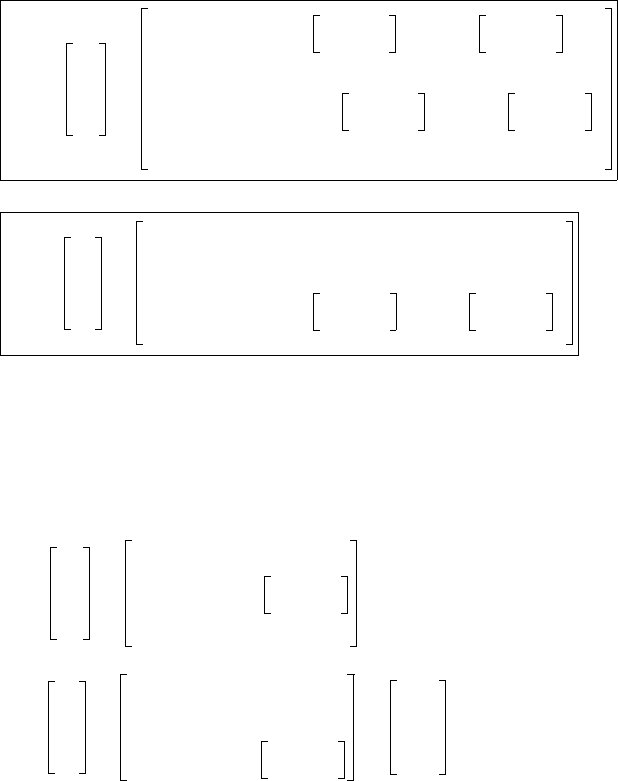
The fields can now be calculated from this and eqs. (7.210) and (7.211), or if
outside of the origin also from (7.224) and (7.225). Thus:
,
(7.304)
. (7.305)
Some more algebra, which we skip, finally yields
(7.306)
.
(7.307)
Here, as in Sect. 7.5, it is most advantageous to carry out the calculations in
spherical coordinates. The result can easily be verified by comparison of
eqs. (7.304) through (7.307) with the similar eqs. (7.262) through (7.265).
Obviously, one only needs to exchange a few quantities: E and H, replace by
, by , and observe the sign change during the transition between E
ϕ
and H
ϕ
Again, one is mostly interested in the far field region:
,
(7.308)
. (7.309)
The Poynting vector of the far field is
H ∇ P
m
∇•()µε
∂
2
P
m
∂t
2
--------------
– P
m
∇×()∇×==
E µ
∂P
m
∂t
-----------
∇×–=
H
H
r
H
θ
H
ϕ
2m
0
θcos
4πµ
----------------------
1
r
3
-----
ω t
r
c
--–
sin
ω
cr
2
--------
ω t
r
c
--–
cos+
m
0
θsin
4πµ
------------------
1
r
3
-----
ω
2
rc
2
--------
–
ω t
r
c
--–
sin
ω
cr
2
--------
ω t
r
c
--–
cos+
0
==
E
E
r
E
θ
E
ϕ
0
0
ωm
0
θsin
4π
----------------------
–
ω
cr
-----
ω t
r
c
--–
sin–
1
r
2
-----
ω t
r
c
--–
cos+
==
p
0
m
0
εµ
H
H
r
H
θ
H
ϕ
0
m
0
θsin ω
2
4µπc
2
r
---------------------------– ω t
r
c
--–
sin
0
==
E
E
r
E
θ
E
ϕ
0
0
+
m
0
ω
2
θsin
4πcr
---------------------------
ω t
r
c
--–
sin
0
0
ZH
θ
–
== =
7.6 Frame Antenna 465
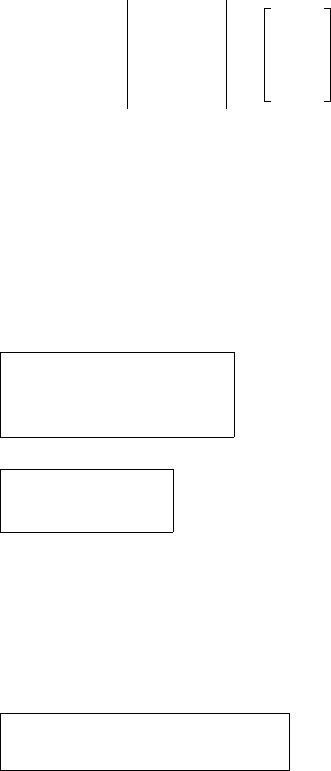
.
(7.310)
It only has a radial component
(7.311)
The radiated power is obtained thereof by integrating over the surface of a sphere.
,
(7.312)
and its time average is
.
(7.313)
Under consideration of (7.300), the RMS power results in
(7.314)
having defined the radiation resistance to
.
(7.315)
The radiation resistance for vacuum is
(7.316)
The antenna gain is again
.
(7.317)
SEH×
e
r
e
θ
e
ϕ
00E
ϕ
0 H
θ
0
E
ϕ
H
θ
–
0
0
== =
S
r
E
ϕ
H
θ
–
E
ϕ
2
Z
-------
m
0
2
ω
4
θsin
2
ω t
r
c
--–
sin
2
Z 16π
2
c
2
r
2
⋅
-----------------------------------------------------------===
m
0
2
ω
4
θsin
2
ω t
r
c
--–
sin
2
16π
2
µc
3
r
2
-----------------------------------------------------------
.=
P
m
0
2
ω
4
ω t
r
c
--–
sin
2
6πµc
3
---------------------------------------------
=
P
rms
m
0
2
ω
4
12πµc
3
-------------------
=
P
rms
µI
0
2
r
0
4
ω
4
π
12c
3
------------------------- Z
I
0
2
r
0
4
k
4
π
12
-------------------
==
π
6
---
r
0
k()
4
ZI⋅
rms
2
R
s
I⋅
rms
2
,==
R
s
π
6
---
r
0
k()
4
Z
π
6
---
2πr
0
λ
-----------
4
Z ==
R
s
2πr
0
λ
-----------
4
π
6
---
377Ω⋅
2πr
0
λ
-----------
4
198Ω⋅==
G
3
2
---=
466 Time Dependent Problems II (Electromagnetic Waves)
7.7 Waves in Cylindrical Wave Guides
7.7.1 Basic Equations
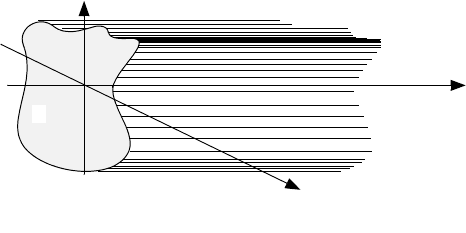
In this section, we will discuss propagation of waves in cylindrical wave guides of
arbitrary cross sections (Fig. 7.21). Its interior consists of a uniform, but not
necessarily ideal dielectric (i.e., it may be ). The outside space shall be of
infinite conductivity. We look for waves of the form
(7.318)
. (7.319)
There shall be no volume charges. Then, Maxwell’s equations apply in the
following form:
(7.320)
(7.321)
(7.322)
. (7.323)
In light of the Ansatz in (7.318) and (7.319), one makes use the following relations
(7.324)
. (7.325)
Applying this to (7.320) through (7.323) yields
(7.326)
Fig. 7.21
x
z
y
κ
κ
κ∞=
κ 0≠
EE
0
xy,() i ωtk
z
z–()[]exp=
HH
0
xy,() i ωtk
z
z–()[]exp=
E∇× µ
∂H
∂t
-------
–=
H∇× κE ε
∂E
∂t
-------
+=
E∇• 0=
H∇• 0=
∂
∂z
----- ik
z
–=
∂
∂t
---- iω=
∂E
z
∂y
---------
ik
z
E
y
+ iωµH
x
–=

7.7 Waves in Cylindrical Wave Guides 467
(7.327)
(7.328)
(7.329)
(7.330)
(7.331)
(7.332)
. (7.333)
These equations require an additional remark. If an Ansatz is proportional to
, then
,
and when taking the divergence, it immediately follows that
.
Consequently, eqs. (7.322) and (7.323) or (7.332) and (7.333) are dependent on the
other equations and thus are really redundant. One might as well omit them.
Eqs. (7.326) and (7.330) allow to calculate and as functions of and .
In similar manner, we may use eqs. (7.327) and (7.329) to calculate and as
functions of and . The result is
(7.334)
(7.335)
(7.336)
. (7.337)
∂E
z
∂x
---------– ik
z
E
x
– iωµH
y
–=
∂E
y
∂x
---------
∂E
x
∂y
---------– iωµH
z
–=
∂H
z
∂y
---------
ik
z
H
y
+ κ iωε+()E
x
=
∂H
z
∂x
---------– ik
z
H
x
– κ iωε+()E
y
=
∂H
y
∂x
----------
∂H
x
∂y
----------– κ iωε+()E
z
=
∂E
x
∂x
---------
∂E
y
∂y
--------- ik
z
E
z
–+0=
∂H
x
∂x
----------
∂H
y
∂y
---------- ik
z
H
z
–+0=
iωt()exp
E∇× iωµH,–= H∇× κ iωε+()E=
H∇• 0=, E∇• 0=
E
y
H
x
H
z
E
z
E
x
H
y
H
z
E
z
E
x
ik
z
∂E
z
∂x
---------
– iωµ
∂H
z
∂y
---------
–
N
-----------------------------------------------
=
E
y
ik
z
∂E
z
∂y
---------
– iωµ
∂H
z
∂x
---------
+
N
-----------------------------------------------
=
H
x
κ iωε+()
∂E
z
∂y
---------
ik
z
∂H
z
∂x
---------
–
N
--------------------------------------------------------
=
H
y
κ iωε+()
∂E
z
∂x
---------
– ik
z
∂H
z
∂y
---------
–
N
-------------------------------------------------------------
=

468 Time Dependent Problems II (Electromagnetic Waves)
Each of these equations share the same denominator for which we introduce N as
an abbreviation. Thus:
.
(7.338)
One obtains the so-called Helmholtz equations when substituting these results into
(7.331)
(7.339)
and (7.328)
.
(7.340)
We could have obtained the result (7.339), (7.340) directly from (7.8) and (7.9) by
means of the Ansatz of (7.318) and (7.319). We introduce the two dimensional
Laplacian in the x-y plane or to write:
(7.341)
. (7.342)
This approach reduces the problem to solving these two, two-dimensional
Helmholtz equations in the x-y-plane. After having found and from these
equations and under consideration of the boundary conditions, all other field
components can be obtained from (7.334) through (7.337).
Some restrictions apply. Initially we have to require that the denominator
does not vanish. Note however, that or does not necessarily cause
the other components to vanish. They will not vanish if the denominator N vanishes
simultaneously. In other words: For pure transverse waves, waves which are
transverse with respect to both E and H, the so-called TEM waves, the following
dispersion relation applies.
.
(7.343)
We have met this relation before when we studied plane waves, which are a special
case of TEM waves (see Section 7.2, in particular eq. 7.83). We will initially
exclude TEM waves from our discussion, but will return to them later.
If , then at least one of the two quantities or has to be non-zero.
It is possible to compose an arbitrary wave from a combination of waves were
but , as well as if but . One set is transverse with
respect to H and called TM waves, while the other set is transverse with respect to
H and called TE waves.
Overall, there are three different types of waves, TM waves, TE waves, and
TEM waves. We shall discuss each one separately in above order.
We have already encountered simple cases of TM and TE waves in Sect.
7.1.6.
N ω
2
εµ k
z
2
– iωκµ– =
∂
2
E
z
∂x
2
-----------
∂
2
E
z
∂y
2
----------- NE
z
++ 0=
∂
2
H
z
∂x
2
------------
∂
2
H
z
∂y
2
------------ NH
z
++ 0=
∇
2
2
∆
2
∆
2
E
z
NE
z
+0 =
∆
2
H
z
NH
z
+0 =
H
z
E
z
H
z
0= E
z
0=
N ω
2
εµ k
z
2
– iωκµ–0 ==
N 0≠ H
z
E
z
H
z
0= E
z
0≠ E
z
0= H
z
0≠

7.7 Waves in Cylindrical Wave Guides 469
7.7.2 TM Waves
For , we have to solve the Helmholtz equation for (7.341) and the
remaining field components result from (7.334) through (7.337). The same result
can be obtained when starting from an electric Hertz vector which only has a z-
component ( ). It has to satisfy the wave equation (7.237), which in turn, leads
to an equation of type (7.341):
.
(7.344)
For the fields, eqs. (7.238) and (7.239) apply. And specifically for the current case
one obtains
(7.345)
. (7.346)
For the individual components of E and H we obtain:
(7.347)
These are exactly those fields, which one would obtain from (7.334) through
(7.337) if we let .
Obviously,
,
(7.348)
revealing that E and H are perpendicular.
The tangential component of E has to vanish on the boundary towards the
infinitely conducting medium. The perpendicular component of H has to vanish
there as well. This is a consequence of the mandate for continuity of the respective
components and thereby, all field components have to vanish in the ideal
conductor. Therefore on the boundary, it has to be , i.e. is must be
.
(7.349)
This condition automatically satisfies all other conditions. A consequence of
(7.347) is that E is perpendicular to the boundary, i.e., does not have a parallel
component. H, on the other hand, is perpendicular to E everywhere, thus H has no
component perpendicular to the boundary. Therefore, we need to solve eq. (7.344)
with the boundary conditions (7.349). Thus, the problem of a TM wave is a two-
dimensional Dirichlet boundary value problem.
Our conclusions are independent from our previous choice of Cartesian
coordinates. It is permissible to transform to any other coordinate system.
Another conclusion of eqs. (7.347) is that is constant on the magnetic
field lines, and thus can be regarded as a flux function.
H
z
0= E
z
Π
ez
∆
2
Π
ez
NΠ
ez
+0 =
E ∇ ik
z
Π
ez
–()εµω
2
iωκµ–()Π
ez
e
z
+=
H iεω κ+[]∇×()Π
ez
e
z
=
E
x
ik
z
∂Π
ez
∂x
------------
–=
E
y
ik
z
∂Π
ez
∂y
------------
–=
E
z
NΠ
ez
=
H
x
κ iεω+()
∂Π
ez
∂y
------------
=
H
y
κ iεω+()
∂Π
ez
∂x
------------
–=
H
z
0 .=
H
z
0=
EH• 0=
E
z
0=
Π
ez
0= boundary()
Π
ez

470 Time Dependent Problems II (Electromagnetic Waves)
7.7.3 TE Waves
TE waves can be dealt with in similar manner, if we start from a magnetic Hertz
vector which has only a z-component ( ). It satisfies the wave equation (7.247),
which for the current case takes the from
.
(7.350)
The field equations are based on (7.248) and (7.249) and yield for our specific
case:
(7.351)
. (7.352)
For the individual components we obtain:
(7.353)
Here again:
.
(7.354)
On the boundary, H may not have a perpendicular component. From (7.353)
follows that on the boundary it has to be:
,
(7.355)
where the subscript n shall describe the normal component. This is now a Neumann
boundary value problem. This also ensures that the parallel components of E
vanish on the boundary, because E and H are perpendicular to each other. is
constant along the electric field lines and thus represents their flux function.
7.7.4 TEM Waves
Now, we shall assume that all z-components vanish:
(7.356)
. (7.357)
With this, eqs. (7.326) through (7.333) yield:
Π
mz
∆
2
Π
mz
NΠ
mz
+0 =
E iωµ Π
mz
e
z
()∇×–=
H ∇ ik
z
Π
mz
–()εµω
2
iωκµ–()Π
mz
e
z
+=
E
x
iωµ
∂Π
mz
∂y
-------------
–=
E
y
+iωµ
∂Π
mz
∂x
-------------
=
E
z
0=
H
x
ik
z
–
∂Π
mz
∂x
-------------
=
H
y
ik
z
–
∂Π
mz
∂y
-------------
=
H
z
NΠ
mz
.=
EH• 0=
∇Π
mz
()
n
∂Π
mz
∂n
------------- 0= = boundary()
Π
mz
H
z
0=
E
z
0=
7.7 Waves in Cylindrical Wave Guides 471
.
(7.358)
When eliminating, for example, and by means of the first two equations,
one realizes that all equations are satisfied if
,
(7.359)
as claimed earlier (7.343) and if it is also
(7.360)
and
.
(7.361)
The last two equations signify that the H field is both, source-free and irrotational.
It is irrotational because there are no currents in z-direction which could create a
curl. Notice that eq. (7.361) is derived from (7.331) which contains , the free
current in the conductor and , the displacement current in z-direction.
Another consequence from (7.358) is that for TEM waves we also have:
.
(7.362)
One can show that the fields given in (7.347) and (7.353) satisfy eqs. (7.358), if we
take while and satisfy the corresponding eqs. (7.344) and
(7.350), respectively. This context also requires one to check the boundary
conditions given in eqs. (7.349) and (7.355). While (7.355) remains unchanged,
now is no longer required to vanish on the boundary. It suffices if is
constant:
.
(7.363)
TEM waves can not exist in every wave guide. To appreciate this, let us look at a
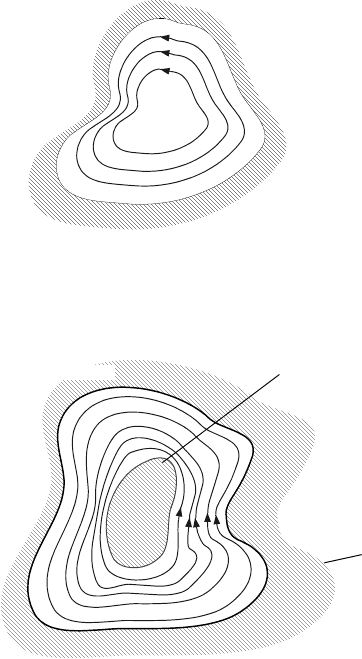
wave guide with a “simply connected” cross section (Fig. 7.22). The H lines on the
k
z
E
y
ωµH
x
–=
k
z
E
x
+ωµH
y
=
∂E
y
∂x
---------
∂E
x
∂y
---------–0=
k
z
H
y
+ ωε iκ–()E
x
=
k
z
H
x
ωε iκ–()E
y
–=
∂H
y
∂x
----------
∂H
x
∂y
----------–0=
∂E
x
∂x
---------
∂E
y
∂y
---------+0=
∂H
x
∂x
----------
∂H
y
∂y
----------+0=
E
x
E
y
N ω
2
εµ k
z
2
– iωκµ–0==
∂H
x
∂x
----------
∂H
y
∂y
----------+0=
∂H
y
∂x
----------
∂H
x
∂y
----------–0=
κE
z
iωεE
z
EH• 0=
N 0= Π
ez
Π
mz
Π
ez
Π
ez
Π
ez
const. (on boundary)=
472 Time Dependent Problems II (Electromagnetic Waves)
boundary have to be parallel to it and their path has to qualitatively look like
sketched in Fig. 7.22. However, this is impossible because the integral
would be nonzero, even though there are no currents inside which could account
for this. The situation changes if we introduce a multiply connected cross section as
shown in Fig. 7.23. In this case, the cause for a non-vanishing integral
could be attributed to one or more internal conductors. In practice, wave guides of
this kind occur frequently, for example, in the form of a coaxial cable. The so-
called transmission theory solves these kind of problems by means of the
telegrapher's equations. However, transmission theory is an approximation and
does not allow to describe all types of waves, possible in such a wave guide. Only
field theory allows for this. We will return later to the relation between field theory
and transmission theory.
κ∞=
Fig. 7.22
"
H ds•
Fig. 7.23
internal conductor
external conductor
κ∞=
κ∞=
"
H ds•
7.7 Waves in Cylindrical Wave Guides 473
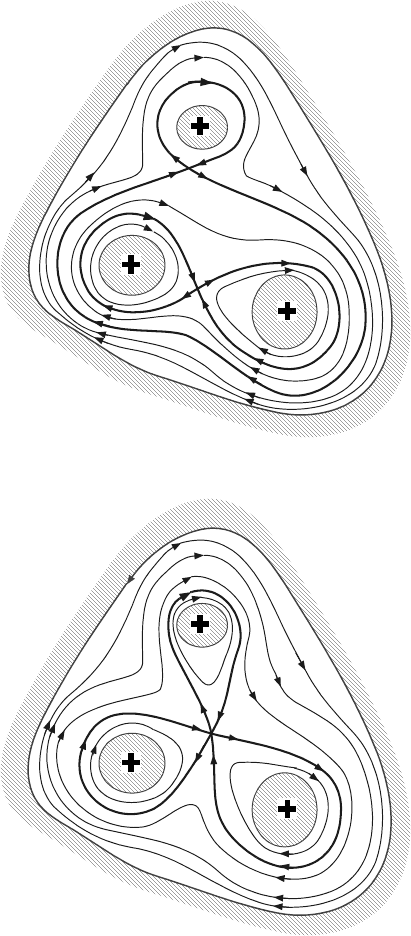
Fig. 7.24 illustrates qualitatively the structure of the magnetic field in wave
guides with several internal conductors – the figure shows three conductors. They
Fig. 7.24
b)
S
S
S
a)