
Lowe D. Networking For Dummies
Подождите немного. Документ загружается.


Chapter 4: Troubleshooting
a Wireless Network
In This Chapter
✓ Isolating the cause of wireless problems
✓ Changing channels
✓ Hardware that can improve wireless connections
✓ Resetting your access point/router password
W
ireless networks are great until something goes haywire. When a
regular network doesn’t work, you usually know about it right away
because the network simply becomes unavailable. You can’t display Web
pages, read e-mail, or access files on shared drives. The troubleshooting
chapters in Book III address the most common problems encountered on
cabled networks.
But wireless networks can cause problems of their own. And to add to the
frustration, wireless networks tend to degrade rather than completely fail.
Performance gets slower. Web pages that usually pop up in a second or two
take 15 to 20 seconds to appear. Or sometimes they don’t appear at all, but
then if you try again a few minutes later, they download fine.
This chapter offers some troubleshooting tips that can help you restore nor-
malcy to a failing wireless network.
Checking for Obvious Problems
Before you roll up your sleeves and take drastic corrective action, you should
check for a few obvious things if you’re having wireless network trouble. The
following list highlights some basic things you should check for:
✦ Is everything turned on? Make sure you have lights on your wireless
access point/router as well as on your cable or DSL modem.
✦ Many access point/routers use a power supply transformer that plugs
into the wall. Make sure that the transformer is plugged into the wall
outlet and that the small cable that comes out of the transformer is
plugged into the power connector on the access point/router.
40_625873-bk05ch04.indd 43740_625873-bk05ch04.indd 437 9/21/10 10:33 PM9/21/10 10:33 PM

438
Pinpointing the Problem
✦ Are the cables connected? Check the network cable that connects your
access point/router to the cable or DSL modem.
✦ Try restarting everything. Turn off the computer, the access point/
router, and your cable or DSL modem. Leave everything off for at least
two minutes. Then turn everything back on. Sometimes simply cycling
the power off and back on clears up a connection problem.
Pinpointing the Problem
If you can’t connect to the Internet, one of the first steps (after you’ve made
sure everything is turned on) is to find out whether the problem is with your
access point/router or with your broadband connection. Here is one way
you can check to find out if your wireless connection is working:
1. Open a command prompt window by choosing Start➪Run, typing
cmd, and pressing Enter.
2. At the command prompt, type ipconfig and press Enter.
You should get a display similar to this:
Ethernet adapter Wireless Network Connection:
Connection-specific DNS Suffix . : hsd1.ca.comcast.net)).
IP Address. . . . . . . . . . . . : 192.168.1.101
Subnet Mask . . . . . . . . . . . : 255.255.255.0
Default Gateway . . . . . . . . . : 192.168.1.1
If the display resembles this but with different numbers, you’re connected to
the wireless network, and the problem most likely lies with your broadband
modem.
But if the IP Address, Subnet Mask, and Default Gateway indicate 0.0.0.0 instead
of valid IP addresses, you have a problem with your wireless network.
Changing Channels
One of the most common problems of wireless network trouble is interfer-
ence from other wireless devices. The culprit might be a cordless phone, or
it could be a neighbor who also has a wireless network.
The simplest solution to this type of interference is to change channels.
802.11b access points let you select 1 of 11 different channels to broadcast
on. If you’re having trouble connecting to your access point, try changing
the channel. To do that, you must log on to the router with the administrator
password. Then, hunt around the router’s administrator pages until you find
the controls that let you change the channel.
You may have to try changing the channel several times before you solve
the problem. Unfortunately, 802.11b channels overlap slightly, which means
40_625873-bk05ch04.indd 43840_625873-bk05ch04.indd 438 9/21/10 10:33 PM9/21/10 10:33 PM
Book V
Chapter 4
Troubleshooting a
Wireless Network
439
Fiddle with the Antennas
that broadcasts on one channel may interfere with broadcasts on adjacent
channels. Thus, if you’re having trouble connecting on channel 1, don’t
bother switching to channel 2. Instead, try switching to channel 5 or 6. If that
doesn’t work, switch to channel 10 or 11.
Fiddle with the Antennas
Sometimes you can fix intermittent connection problems by fiddling with the
antennas on the access point and your computer’s wireless adapter. This is
similar to playing with old-fashioned rabbit-ear antennas on a TV to get the
best reception.
The angle of the antennas can sometimes make a difference, so try adjusting
the antenna angles. In addition, you usually have better results if you place
the access point at a high location, such as on top of a bookshelf.
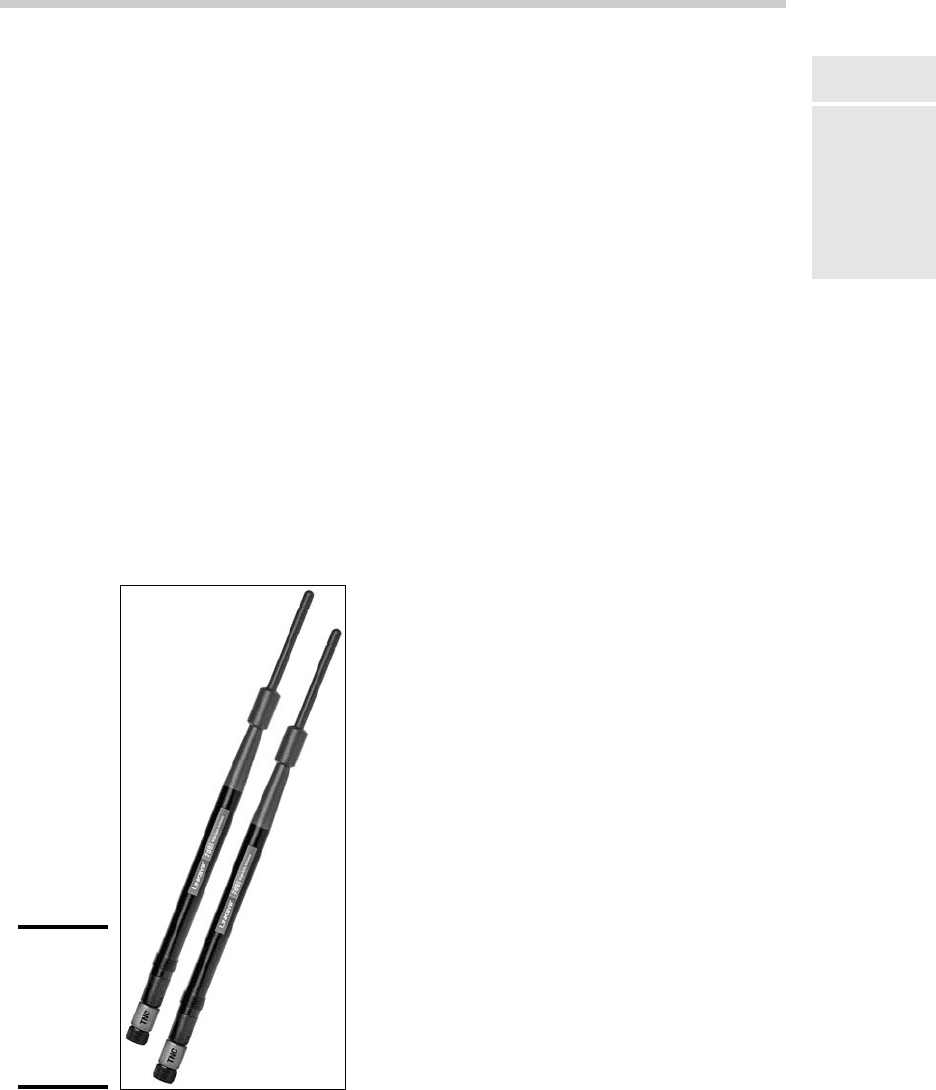
In some cases, you may actually need to add a high-gain antenna to the
access point to increase its range. These high-gain antennas simply snap
or screw on to the access point to provide a bigger antenna. For example,
Figure 4-1 shows high-gain antennas that are designed to work with Linksys
access points. Antennas such as these cost about $70 for the pair.
Figure 4-1:
High-gain
antennas
for a Linksys
wireless
router.
Photo courtesy of Linksys.
40_625873-bk05ch04.indd 43940_625873-bk05ch04.indd 439 9/21/10 10:33 PM9/21/10 10:33 PM
440
Adding Another Access Point
A more drastic fix is to add a signal booster to your access point. A signal
booster is a power amplifier that increases the transmission power of most
wireless devices by a factor of five. A typical signal booster costs about $100.
Adding Another Access Point
If you have a computer that’s out of range of your access point, one solution
is to add a second access point closer to the problematic computer. Most
likely, the only difficulty will be getting an Ethernet cable to the location
where you want to put your second access point.
If possible, you can simply run a length of cable through your walls or attic
to the second access point. If that isn’t feasible, you can use a PowerLine or
Phone (HPNA) network connection for the second access point.
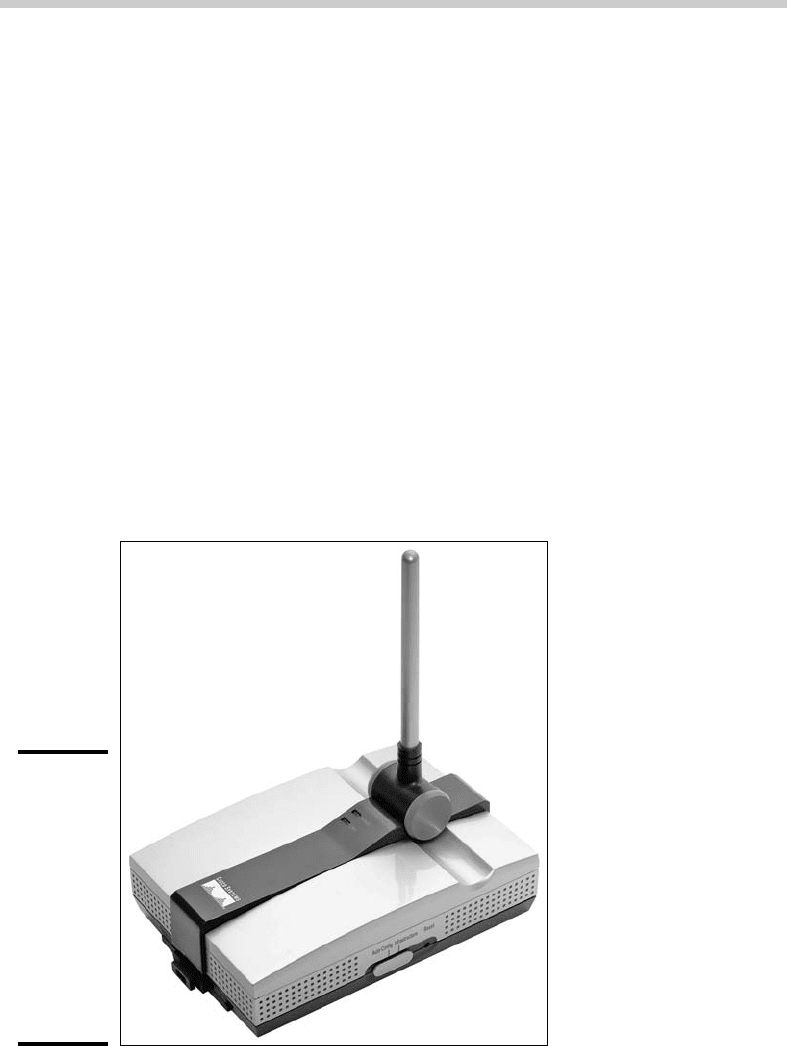
An alternative to a second access point is to simply add a repeater, such as
the Linksys Wireless-G Range Expander shown in Figure 4-2. All you have to
do is place this device midway between your access point and the computer
that’s having trouble connecting.
Figure 4-2:
A wireless
repeater
such as this
one from
Linksys
can help
increase
the range
of your
wireless
network.
Photo courtesy of Linksys.
40_625873-bk05ch04.indd 44040_625873-bk05ch04.indd 440 9/21/10 10:33 PM9/21/10 10:33 PM

Book V
Chapter 4
Troubleshooting a
Wireless Network
441
Help! I Forgot My Router’s Password!
Help! I Forgot My Router’s Password!
I mention many times throughout this book that you should always change
default passwords that come with computer and operating systems to more
secure passwords, usually consisting of a random combination of letters,
digits, and special symbols.
Hopefully, you’ve already taken my sage advice and changed the password
on your combination wireless access point/router. Good for you. But what if
you later forget the password? Is there any way to get back into your access
point/router then?
Fortunately, there is. Most access point/routers have a reset button. It’s
usually located on the back or on the bottom of the router’s case. Press this
button to restore the access point/router to its factory default settings. That
will reset the administrator password to the factory default. It will also reset
any other custom settings you’ve applied, so you may have to reconfigure
your router to get it working again.
40_625873-bk05ch04.indd 44140_625873-bk05ch04.indd 441 9/21/10 10:33 PM9/21/10 10:33 PM

442
Book V: Wireless Networking
40_625873-bk05ch04.indd 44240_625873-bk05ch04.indd 442 9/21/10 10:33 PM9/21/10 10:33 PM

Chapter 5: Wireless Networking
with Bluetooth
In This Chapter
✓ Discovering how Bluetooth works
✓ Digging into some of Bluetooth’s technical issues
✓ Installing a USB Bluetooth adapter
✓ Using Bluetooth in Windows XP and Vista
A
vast! If ’twere up to me, the name Bluetooth surely would be the proud
name of a pirate, not some lilly-livered computer network device. Aye,
and make no mistake. Blame it on those scurvy bilge rats whats call them-
selves Engineers. The next land-lubber Engineer whats wastes a perfectly
good pirate name on some network technology will soon be feeding fish in
Davey Jones’ locker, says I. Alas me hearties, the deed is done, so forever-
more Bluetooth shall be the topic of a chapter in blaggard books about com-
puters instead of proper books about piracy.
Arrrrr!
Understanding Bluetooth
Bluetooth is the name of a short-range wireless network technology that’s
designed to let devices connect to each other without need for cables or a
Wi-Fi network access point. The two main uses for Bluetooth are to connect
peripheral devices such as keyboards or mice to a computer and to connect
hand-held devices such as phones and PDAs (Personal Digital Assistants) to
computers.
Here are just a few of the many uses of Bluetooth:
✦ Wirelessly connecting a keyboard and mouse to a computer so that
you don’t have to fuss with cables. This is marginally useful for desktop
computers because it eliminates the need for cables. But it’s even more
useful for laptop computers because it lets you use a keyboard and
mouse simply by placing them next to the laptop.
✦ Synchronizing the address book in your cell phone with your comput-
er’s address book, with no cables.
41_625873-bk05ch05.indd 44341_625873-bk05ch05.indd 443 9/21/10 10:34 PM9/21/10 10:34 PM

444
Bluetooth Technical Stuff
✦ Exchanging files between your Pocket PC or Palm PDA and your laptop
or desktop computers.
✦ Using a cord-free headset with your cell phone.
✦ Connecting a Global Positioning System (GPS) device to a computer so
that it can track your location. This is especially useful when used in
your car with a laptop, Pocket PC, or Palm PDA.
✦ Swapping electronic business cards between handheld computers.
Bluetooth Technical Stuff
For you technical enthusiasts out there, here’s a whole section that gets the
Technical Stuff icon. The following paragraphs point out some of the impor-
tant and obscure technical highlights of Bluetooth:
✦ Bluetooth was originally developed in 1998 by a consortium of companies,
including IBM, Intel, Ericsson, Nokia, and Toshiba. Not wanting to be left
out of the action, IEEE turned Bluetooth into a standard called 802.15.
✦ Bluetooth operates in the same 2.4-GHz bandwidth as 802.11 Wi-Fi net-
works. Although it’s possible for Bluetooth and Wi-Fi networks to inter-
fere with one another, Bluetooth includes features that usually minimize
or eliminate this interference.
✦ Bluetooth is slow — about 721 Kbps, way slower than Wi-Fi networks.
Bluetooth isn’t designed to transport large amounts of data, such as
huge video files. For that, you should use Wi-Fi.
✦ Bluetooth devices periodically “sniff” the air to see whether other
Bluetooth devices are nearby so that they can automatically hook up.
✦ Bluetooth has very low power requirements. As a result, it’s ideal for
battery-powered devices such as cell phones and PDAs.
✦ Bluetooth comes in three flavors, as described in Table 5-1. Class 1 is the
most powerful form of Bluetooth and the most commonly used. Class 2
is ideal for devices such as wireless mice or keyboards and wireless cell
phone headsets, which need to communicate only at close range. Class 3 is
for devices that operate at even closer range, but few Bluetooth devices
actually implement Class 3.
Table 5-1 Bluetooth Classes
Class Power Range
Class 1 100 mW 300 feet (100 meters)
Class 2 10 mW 30 feet (10 meters)
Class 3 1 mW < 30 feet (10 meters)
41_625873-bk05ch05.indd 44441_625873-bk05ch05.indd 444 9/21/10 10:34 PM9/21/10 10:34 PM

Book V
Chapter 5
Wireless
Networking
with Bluetooth
445
Using Bluetooth in Windows
✦ Bluetooth was originally conceived by cell phone giant Ericsson as a
way to connect a wireless earpiece to a cell phone. As the developers
worked on the idea, they soon realized that the technology had uses far
beyond wireless earpieces for cell phones.
✦ The name Bluetooth is an English translation of Harald Blatand, a Viking
king who united Denmark and Norway in the 10th century.
How to Add Bluetooth to Your Computer
Many computers sold today — especially laptop computers and PDAs —
come equipped with Bluetooth technology. If your computer doesn’t already
support Bluetooth, you can easily add Bluetooth support. Just purchase a
USB Bluetooth adapter, which is a small device that plugs into any available
USB port on your computer. After you plug it in, your computer is Bluetooth
enabled and can connect to any other Bluetooth device that’s in range.
Many companies make Bluetooth USB adapters, and most look and work simi-
larly. Figure 5-1 shows an adapter made by Linksys that sells for about $40.
Figure 5-1:
A typical
USB
Bluetooth
adapter.
Photo courtesy of Linksys.
Using Bluetooth in Windows
Unfortunately, the original version of Windows XP didn’t have any support
for Bluetooth. When Microsoft released Windows XP Service Pack 1 a few
years later, it included limited Bluetooth support. Windows XP Service Pack
41_625873-bk05ch05.indd 44541_625873-bk05ch05.indd 445 9/21/10 10:34 PM9/21/10 10:34 PM

446
Installing a USB Bluetooth Adapter
2 included excellent built-in support for Bluetooth, as does Windows Vista
and Windows 7.
If your computer has Bluetooth, a special Bluetooth icon will appear in the
System Tray (the panel at the right side of the taskbar). You can click this
icon to bring up a menu with the following choices:
✦ Add a Bluetooth Device
✦ Show Bluetooth Devices
✦ Send a File
✦ Receive a File
✦ Join a Personal Area Network
✦ Open Bluetooth Settings
✦ Remove Bluetooth Icon
Installing a USB Bluetooth Adapter
Installing a USB Bluetooth adapter is easy. All you have to do is install the
software provided with the adapter and plug the adapter into a free USB
port. Usually, you can start the installation process by inserting the CD that
comes with the adapter into your CD drive. Then, the installation program
automatically starts up. After the installation program starts, follow its steps
and plug the adapter in when the installation program instructs you to.
Be sure to follow the installation instructions that come with the adapter.
In most cases, you should install the software that comes with the adapter
before you plug in the adapter.
Enabling Discovery
By default, your computer remains hidden from other Bluetooth devices. If
you want other Bluetooth devices to be able to recognize your computer,
you need to enable a feature called discovery. Here are the steps:
1. Right-click the Bluetooth icon in the system tray and choose Open
Bluetooth Settings from the shortcut menu.
2. In the Bluetooth Properties dialog box that appears, click the
Options tab.
3. Select the Turn Discovery On check box.
41_625873-bk05ch05.indd 44641_625873-bk05ch05.indd 446 9/21/10 10:34 PM9/21/10 10:34 PM